Cloduraai vs MergeMail (2026): Which B2B Outreach Tool Wins?
MergeMail sends mail merges from Gmail; Clodura.ai builds and works B2B pipeline. They solve different problems—here's which one your team actually needs in 2026, and where a dedicated data tool beats both.
If you are comparing Cloduraai vs MergeMail (the brand writes it Clodura.ai), you have probably noticed something odd: the two tools barely overlap. One is a full B2B prospecting database with a sales-engagement layer on top. The other is a light Gmail mail-merge add-on. So the choice is less about "which is better" and more about "which job am I trying to do."
This guide breaks down what each tool does, where each one is strong, and where each one quietly falls short. It also shows how to decide fast, without wasting a month of trial credits.
TL;DR: Clodura.ai vs MergeMail at a glance#
- Clodura.ai is a B2B sales-intelligence platform: a contact database, email finder, sequencing, and buyer-intent signals aimed at outbound teams that need net-new leads.
- MergeMail is a Gmail add-on for personalized mass email — mail merge, templates, tracking, and scheduling — aimed at people who already have a list.
- They are not real substitutes. Clodura.ai finds and organizes prospects; MergeMail sends to contacts you already own.
- Both share one weakness: data quality. Stale database records and unverified merge lists produce the same result — bounces and burned domains.
- If your bottleneck is finding and verifying accurate contacts, a focused tool like the Tomba Email Finder plugs the gap either platform leaves.
What is Clodura.ai?#
Clodura.ai is an all-in-one sales prospecting platform. Its pitch is that you start with a blank pipeline and walk out with a working outbound motion. The core pieces:
- B2B contact database — a claimed pool of hundreds of millions of contacts with direct dials and org charts.
- Email finder and verifier — pull business emails for target accounts and check them before sending.
- Sales cadences — multi-step email sequences with follow-ups and basic automation.
- Buyer intent and triggers — technographic data, funding events, and hiring signals to time outreach.
Clodura.ai sits in the same competitive set as Apollo, Lusha, and ZoomInfo. It is built for SDRs and founders doing cold outbound who need the raw inputs — names, companies, emails, phone numbers — before any sending happens. The platform is broad, which is its strength and its weakness: you get a lot of surface area, and the depth of any single feature (deliverability tooling, copywriting, CRM sync) is thinner than a specialist tool.
What is MergeMail?#
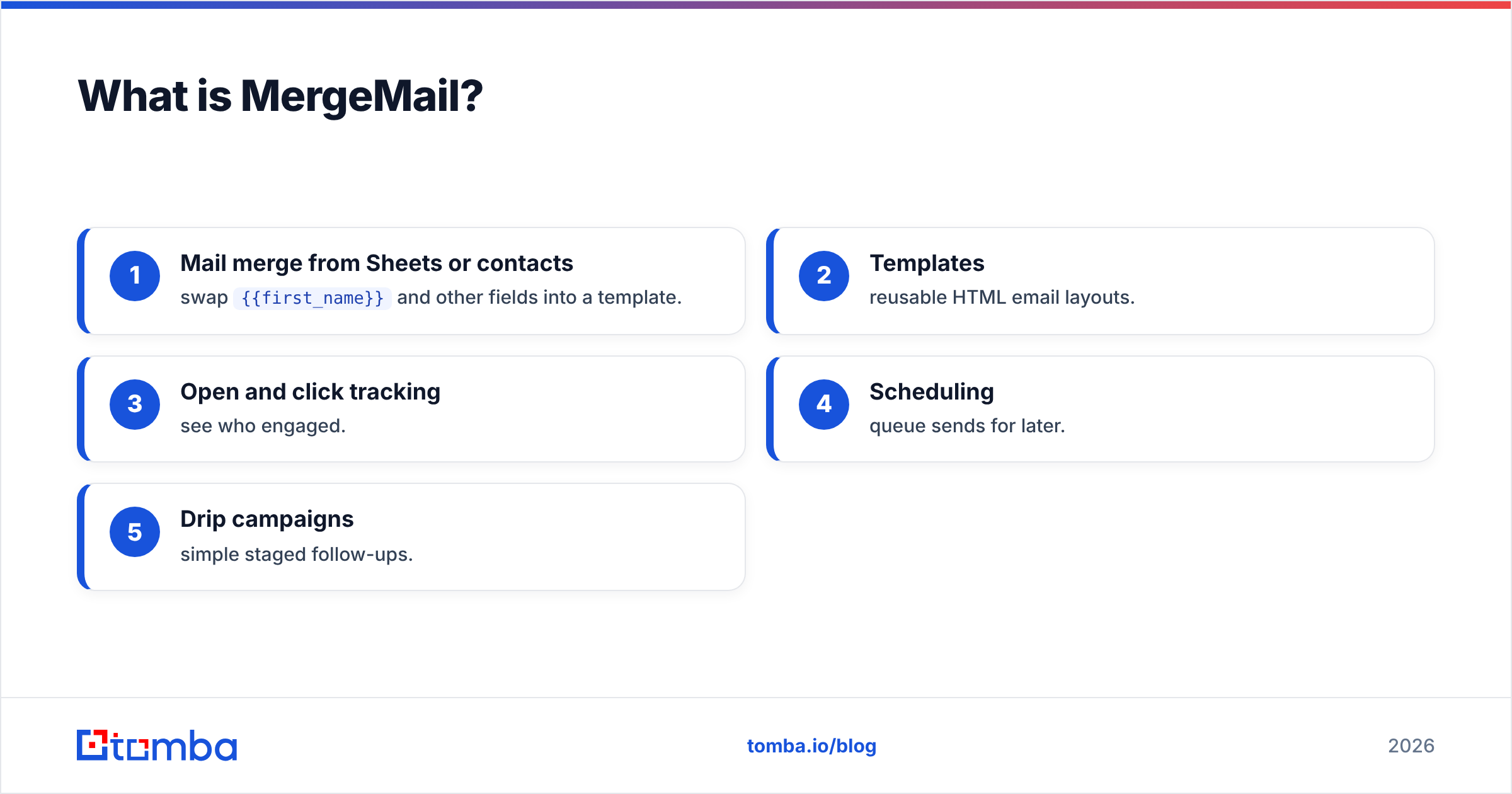
MergeMail is a Gmail-native mail-merge tool. You install it as a Google Workspace add-on, connect a spreadsheet or paste a list, and send personalized bulk email straight from your own Gmail account. Its feature set is deliberately narrow:
- Mail merge from Sheets or contacts — swap
{{first_name}}and other fields into a template. - Templates — reusable HTML email layouts.
- Open and click tracking — see who engaged.
- Scheduling — queue sends for later.
- Drip campaigns — simple staged follow-ups.
MergeMail assumes you already have the list. It does nothing to find contacts, does not enrich records, and does not verify whether an address is deliverable. It is closer to tools like YAMM (Yet Another Mail Merge) or GMass than to a prospecting database. For a solo consultant emailing 200 known contacts, that simplicity is the whole point. For a scaling outbound team, it is a single tile in a much bigger stack.
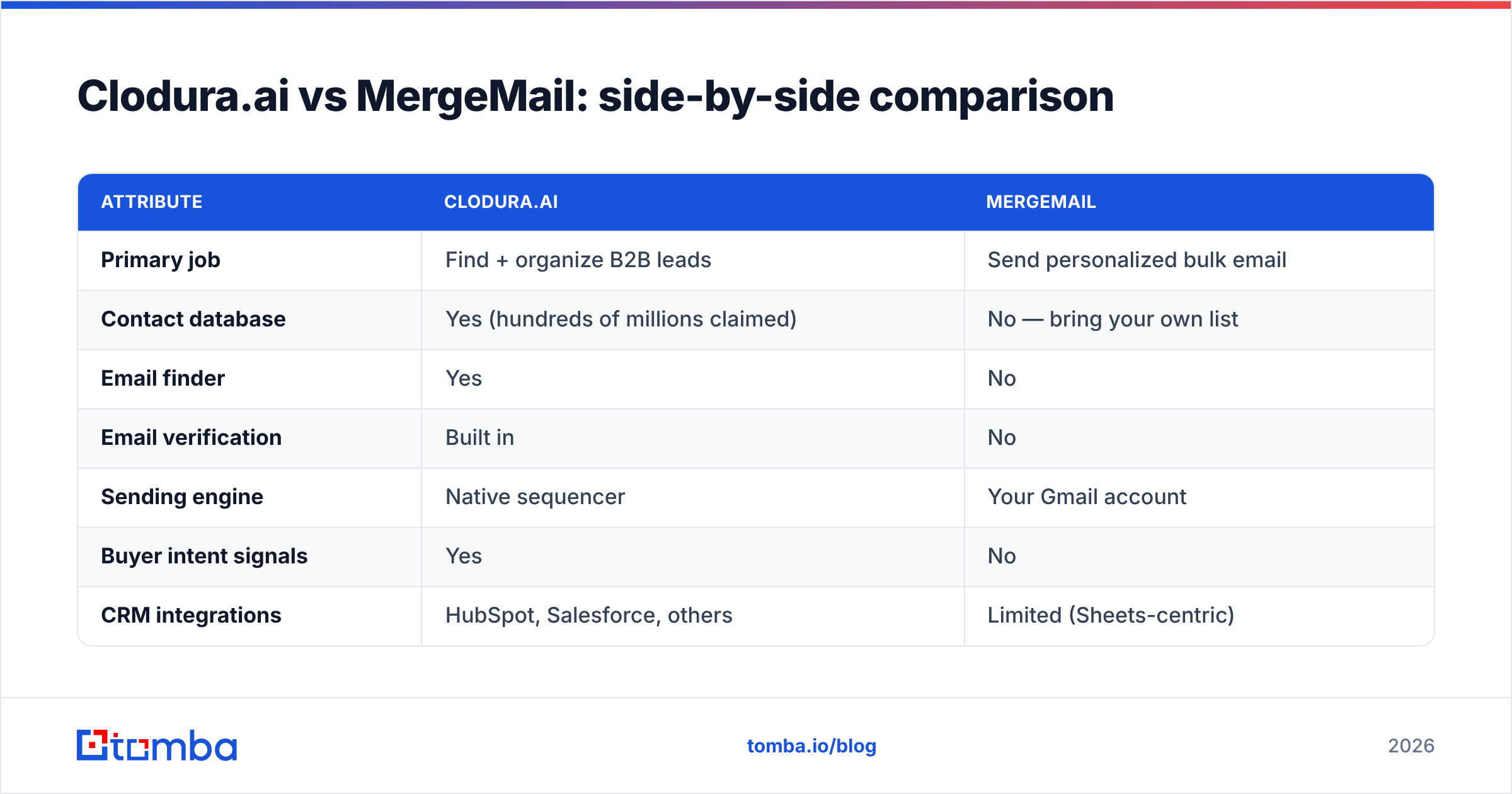
Cloduraai vs MergeMail: side-by-side comparison#
Here is where the two tools genuinely differ. Note how few rows they actually compete on.
| Attribute | Clodura.ai | MergeMail |
|---|---|---|
| Primary job | Find + organize B2B leads | Send personalized bulk email |
| Contact database | Yes (hundreds of millions claimed) | No — bring your own list |
| Email finder | Yes | No |
| Email verification | Built in | No |
| Sending engine | Native sequencer | Your Gmail account |
| Buyer intent signals | Yes | No |
| CRM integrations | HubSpot, Salesforce, others | Limited (Sheets-centric) |
| Best for | SDR / outbound teams | Solo senders, small lists |
| Entry pricing | Free tier + paid plans from ~$39–$99/mo | Free tier + paid from ~$25/mo |
| Learning curve | Moderate (broad platform) | Low (lives inside Gmail) |
The honest read: if your problem is "I have no one to email," MergeMail cannot help you and Clodura.ai is the relevant tool. If your problem is "I have a list and just need to send it nicely," Clodura.ai is overkill and MergeMail wins on speed and price.
Is Clodura.ai better than MergeMail?#
Better at what? For net-new lead generation, Clodura.ai is not just better — it is the only one of the two that does the job. It gives you a database, a way to find email addresses for target accounts, and intent data to prioritize them. MergeMail has none of that.
For pure sending experience, the answer flips. MergeMail lives inside Gmail, so there is no new inbox to manage, no separate deliverability domain to warm, and no onboarding. Reply handling happens in the thread you already use. Many teams that adopt broad platforms like Clodura.ai still find the sequencer clunky and end up sending from a dedicated tool anyway.
So "better" depends entirely on your bottleneck:
- Bottleneck = prospects → Clodura.ai (or a dedicated data tool).
- Bottleneck = sending a known list → MergeMail.
- Bottleneck = both → you likely need two tools, not one.
Where both tools quietly fail: data quality#
Here is the part neither product page emphasizes. Clodura.ai and MergeMail can both wreck your sender reputation for the same underlying reason — bad data.
Clodura.ai's risk is staleness. Large B2B databases decay fast; people change jobs, companies fold, and domains lapse. If you export a segment and blast it without re-checking, a meaningful slice will bounce. Independent reviews on G2 repeatedly flag database accuracy as the top complaint for broad prospecting platforms in this class.
MergeMail's risk is unverified input. It sends whatever is in your spreadsheet. Paste a scraped list, and MergeMail will faithfully deliver every message to every dead address — from your primary Gmail account, the one your real business runs on.
Both paths end in the same place: high bounce rates, spam-folder placement, and a damaged domain. The fix is not a different sender or a different database. It is a verification step between getting the list and sending it.

This is exactly the gap a focused tool fills. Running your list through an email verifier before it ever hits a sequencer or a mail merge keeps bounces low regardless of which sending tool you chose. If you build lists in bulk, a bulk email finder plus verification does the same job at scale, so you are not feeding either platform garbage.
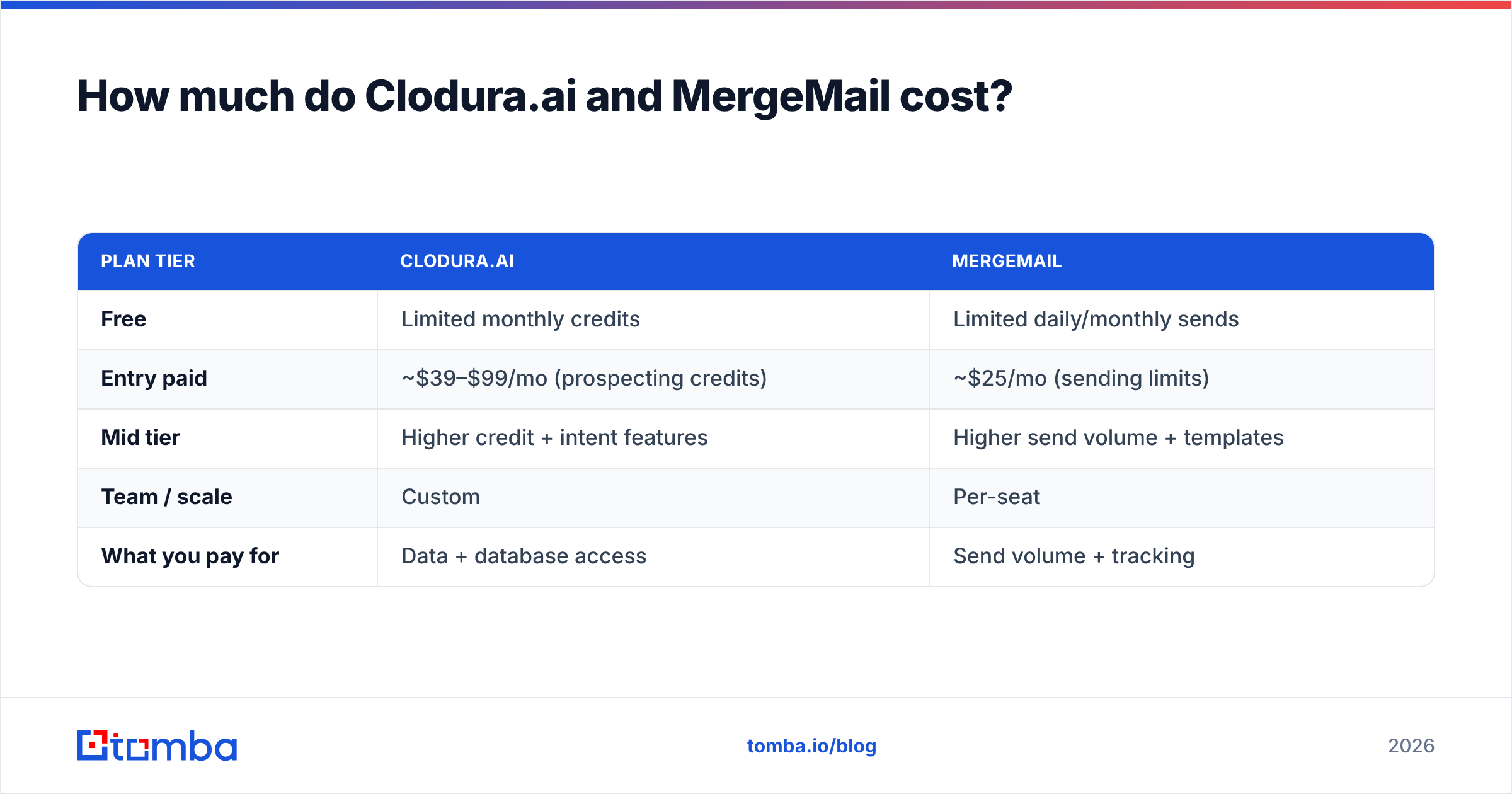
How much do Clodura.ai and MergeMail cost?#
Both use freemium pricing, but they are priced for different buyers.
| Plan tier | Clodura.ai | MergeMail |
|---|---|---|
| Free | Limited monthly credits | Limited daily/monthly sends |
| Entry paid | ~$39–$99/mo (prospecting credits) | ~$25/mo (sending limits) |
| Mid tier | Higher credit + intent features | Higher send volume + templates |
| Team / scale | Custom | Per-seat |
| What you pay for | Data + database access | Send volume + tracking |
MergeMail is cheaper because it does less — you are paying for a sending convenience, not a data asset. Clodura.ai costs more because the database is the product. Neither price includes a serious standalone verification guarantee, which is why teams often add a specialist data layer. If you want a transparent, credit-based alternative for the data side, compare against Tomba pricing: a Free tier with 25 searches/month, Starter at $49/mo, Growth at $99/mo, and Pro at $249/mo.
Which should you choose in 2026?#
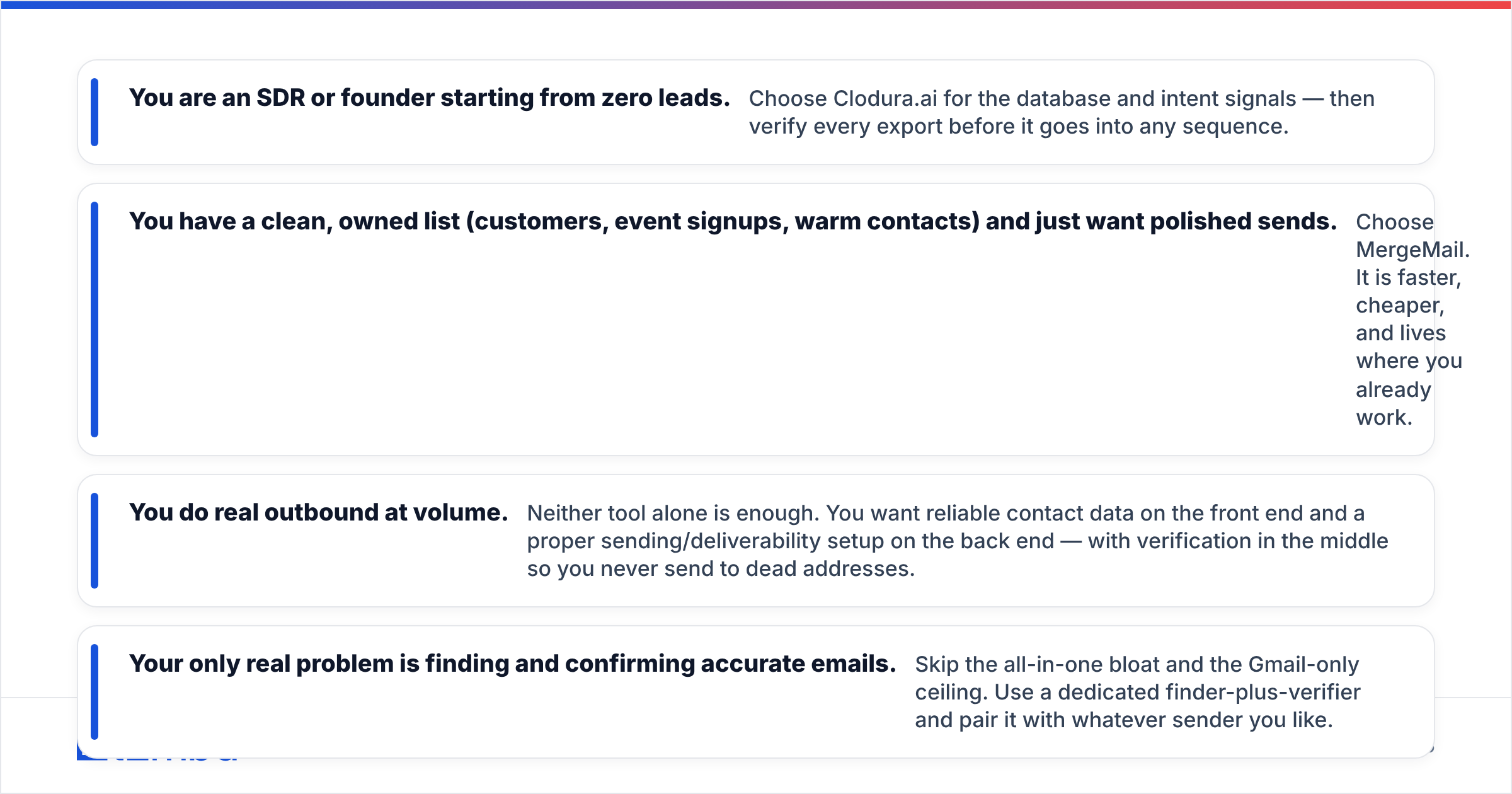
Decide by matching the tool to your actual constraint:
- You are an SDR or founder starting from zero leads. Choose Clodura.ai for the database and intent signals — then verify every export before it goes into any sequence.
- You have a clean, owned list (customers, event signups, warm contacts) and just want polished sends. Choose MergeMail. It is faster, cheaper, and lives where you already work.
- You do real outbound at volume. Neither tool alone is enough. You want reliable contact data on the front end and a proper sending/deliverability setup on the back end — with verification in the middle so you never send to dead addresses.
- Your only real problem is finding and confirming accurate emails. Skip the all-in-one bloat and the Gmail-only ceiling. Use a dedicated finder-plus-verifier and pair it with whatever sender you like.
The trap to avoid is treating this as a binary. "Cloduraai vs MergeMail" implies they are interchangeable. They are not. One fills the top of your funnel with data; the other pushes messages out the bottom. The step both leave underserved — making sure the data is accurate before you send — is where deliverability is won or lost.
The bottom line#
Clodura.ai and MergeMail are not really rivals. Clodura.ai answers "who do I email?" and MergeMail answers "how do I send to people I already have?" Pick based on which question is actually blocking you, and do not expect either to fully own the other's job.
Whichever you land on, protect your domain by verifying contacts before they enter a sequence or a mail merge. The Tomba Email Finder gives you accurate, source-backed business emails and built-in verification, so the leads you hand to Clodura.ai's sequencer or MergeMail's merge are ones that actually land. Start free with 25 searches a month, scale when you are ready, and stop paying for bounces either platform would happily send on your behalf.
Related guides#
Ready to find emails that actually work?
Join 150,000+ professionals who stopped guessing and started sending. Free credits on signup — no credit card required.
Get the Tomba newsletter
Practical outbound tactics and product updates — once every two weeks.
About the author