Cloduraai vs Ninjapear (2026): Full Comparison & Verdict
Clodura.ai and Ninjapear both promise B2B contact data and prospecting on autopilot — but they win on very different things. Here's the honest, side-by-side breakdown.
Choosing between Clodura.ai and Ninjapear comes down to one question. Whose data lands in the inbox, and whose quietly bounces? A pricing page won't tell you. This Cloduraai vs Ninjapear guide answers it head on. Both tools sell the same dream — a fuller pipeline with less manual work. But they get there in different ways, at different prices, with very different tradeoffs.
This is a neutral, hands-on comparison. No vendor spin. By the end you'll know which one fits your motion, where each one falls short, and when a dedicated data provider beats both.
TL;DR: Cloduraai vs Ninjapear at a glance#
- Clodura.ai is a full sales-intelligence platform — database, sequences, buyer intent, and email verification in one place. Best if you'll actually use the extra modules.
- Ninjapear is a leaner, prospecting-first tool. It finds and exports contacts fast. Best if you already own a CRM and sequencer and just need contacts.
- Data accuracy is the real battleground. Both claim high accuracy. Real bounce rates depend on verification depth and how fresh the database is.
- Pricing: Clodura.ai leans to higher-commitment plans with more seats and modules. Ninjapear is the cheaper, simpler entry point.
- The honest verdict: neither beats a specialist finder-plus-verifier stack on raw email accuracy. If deliverability is your bottleneck, pair either with a dedicated email finder.
What is Clodura.ai?#
Clodura.ai is a B2B sales-intelligence and prospecting platform. Think of it as a Swiss Army knife, not a single tool. You get a contact database of tens of millions of companies, buyer-intent signals, an email sequencer, technographic filters, and built-in email verification — all under one login.
The pitch is consolidation. You stop stitching together a database, a verifier, and a cold-email sequencer. Instead you get one subscription. For teams tired of juggling five tabs, that's appealing. The catch is the all-in-one tax. You pay for modules you may barely touch, and no single module is usually best-in-class.
Where Clodura.ai earns its keep is the intent layer and the org-chart data. Say your motion depends on catching accounts that are researching your category. That signal is hard to copy with a pure contact-finder. You can read more about how these platforms fit the wider stack in guides on sales automation.
What is Ninjapear?#
Ninjapear is a newer, prospecting-first tool built for speed and simplicity. Its job is finding business contacts — names, emails, sometimes phone numbers. Then it gets them out of the tool and into your workflow with little friction.
The philosophy is the opposite of Clodura.ai's. Ninjapear doesn't want to own your whole pipeline. It wants to be the fast, affordable front door. You search, you enrich, you export to your CRM or sequencer. For solo founders, agencies, and small SDR teams who already have an outreach engine, that focus is a feature, not a limitation.
The tradeoff is coverage and depth. A leaner tool leans on fewer data sources. That can mean thinner records in niche regions or industries. It also means fewer safety nets, like deep catch-all handling. Think of a specialist scalpel versus a full workshop.

Cloduraai vs Ninjapear: side-by-side comparison#
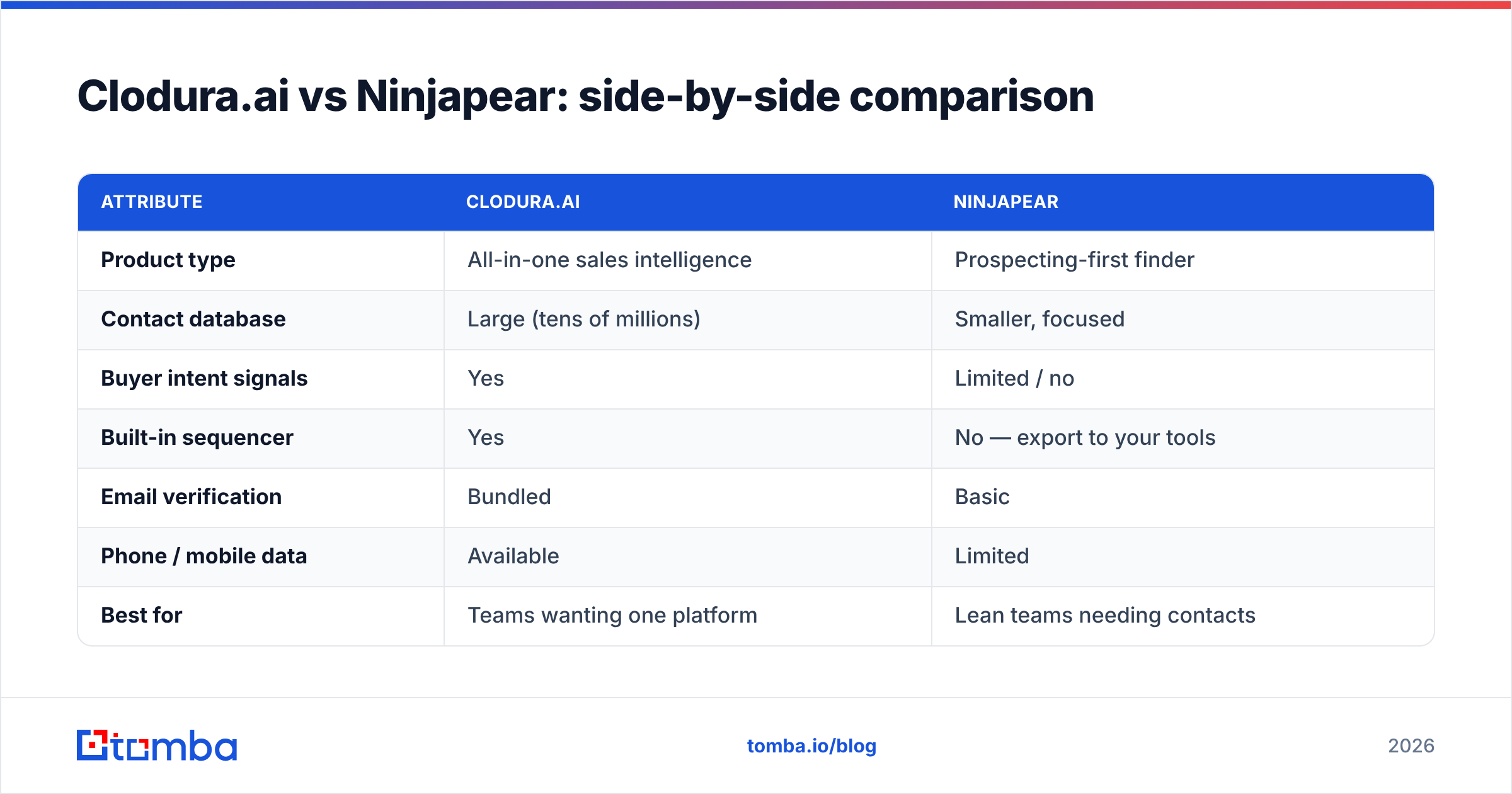
Here's how the two stack up on the attributes that change your results. Treat vendor accuracy numbers as marketing claims until you run your own test list.
| Attribute | Clodura.ai | Ninjapear |
|---|---|---|
| Product type | All-in-one sales intelligence | Prospecting-first finder |
| Contact database | Large (tens of millions) | Smaller, focused |
| Buyer intent signals | Yes | Limited / no |
| Built-in sequencer | Yes | No — export to your tools |
| Email verification | Bundled | Basic |
| Phone / mobile data | Available | Limited |
| Best for | Teams wanting one platform | Lean teams needing contacts |
| Learning curve | Steeper (many modules) | Shallow, fast to adopt |
| Pricing posture | Higher, seat-based tiers | Lower entry point |
The pattern is clear. Clodura.ai wins on breadth. Ninjapear wins on focus and price. Neither number tells you which one keeps your sender reputation clean. That comes down to verification, which we'll cover next.
Which has better data accuracy?#
Accuracy is where marketing pages and inbox reality drift apart. Both tools quote a headline figure in the 90s. That number hides a key difference: matched records versus verified deliverable records.
Three things decide whether an email lands:
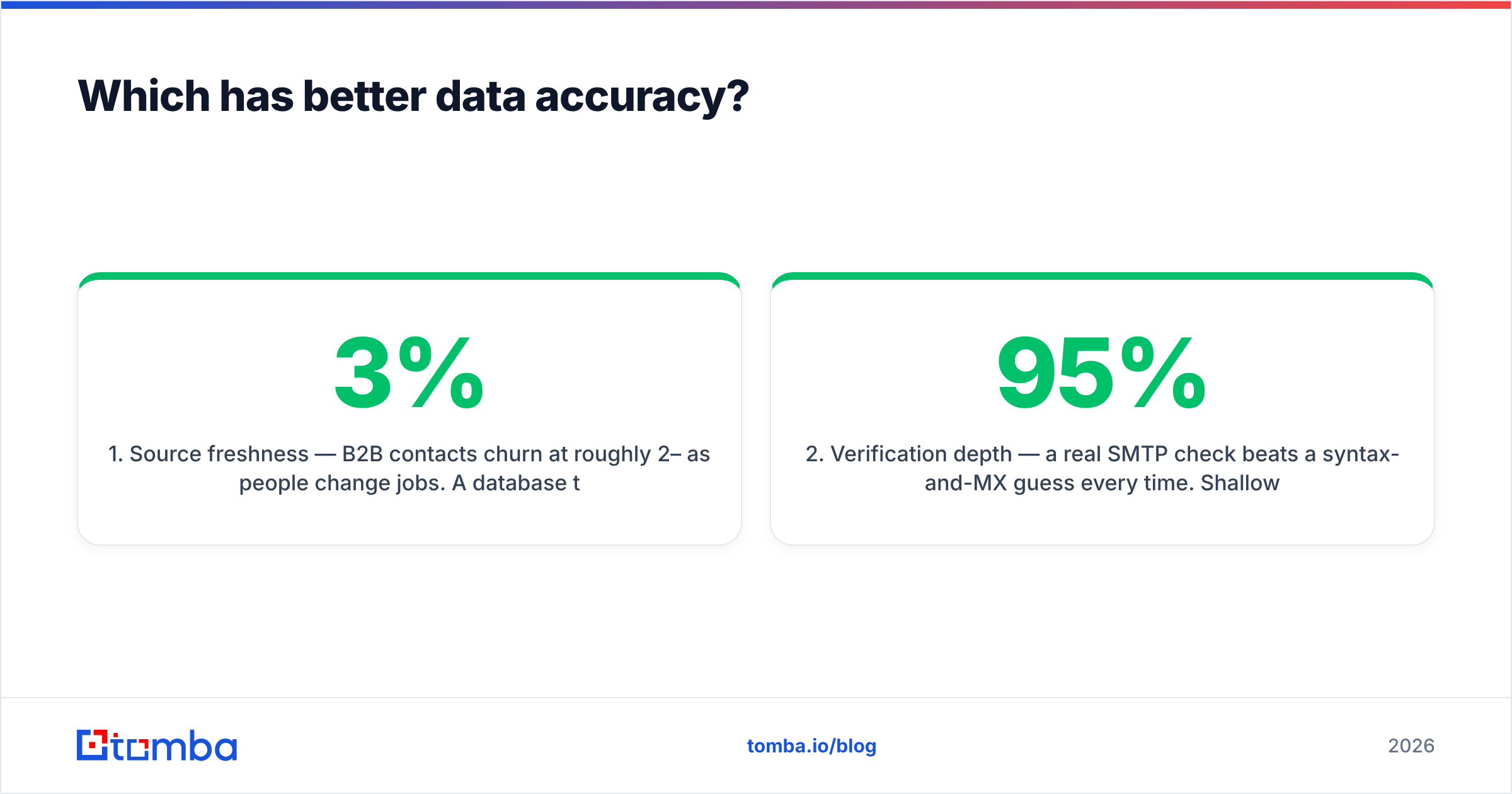
- Source freshness — B2B contacts churn at roughly 2–3% a month as people change jobs. A database that isn't re-crawled goes stale fast, no matter how big it started.
- Verification depth — a real SMTP check beats a syntax-and-MX guess every time. Shallow checks are why "95% accurate" lists still bounce at 8–10%.
- Catch-all handling — many corporate domains are catch-all. A naive verifier marks everything "valid." Telling a real mailbox from a catch-all wildcard is the hard part. It's where cheaper tools cut corners.
Clodura.ai's bundled verification beats a finder with only basic checks. But bundled rarely means best. If you send at volume, run every list through a dedicated email verifier first. For wildcard domains, a purpose-built catch-all verifier is the difference between a clean send and a reputation hit.

The practical takeaway: don't buy either tool on its accuracy claim. Buy a small credit pack. Export 200 contacts you can check yourself. Then measure the real bounce rate.
How do Clodura.ai and Ninjapear compare on pricing?#
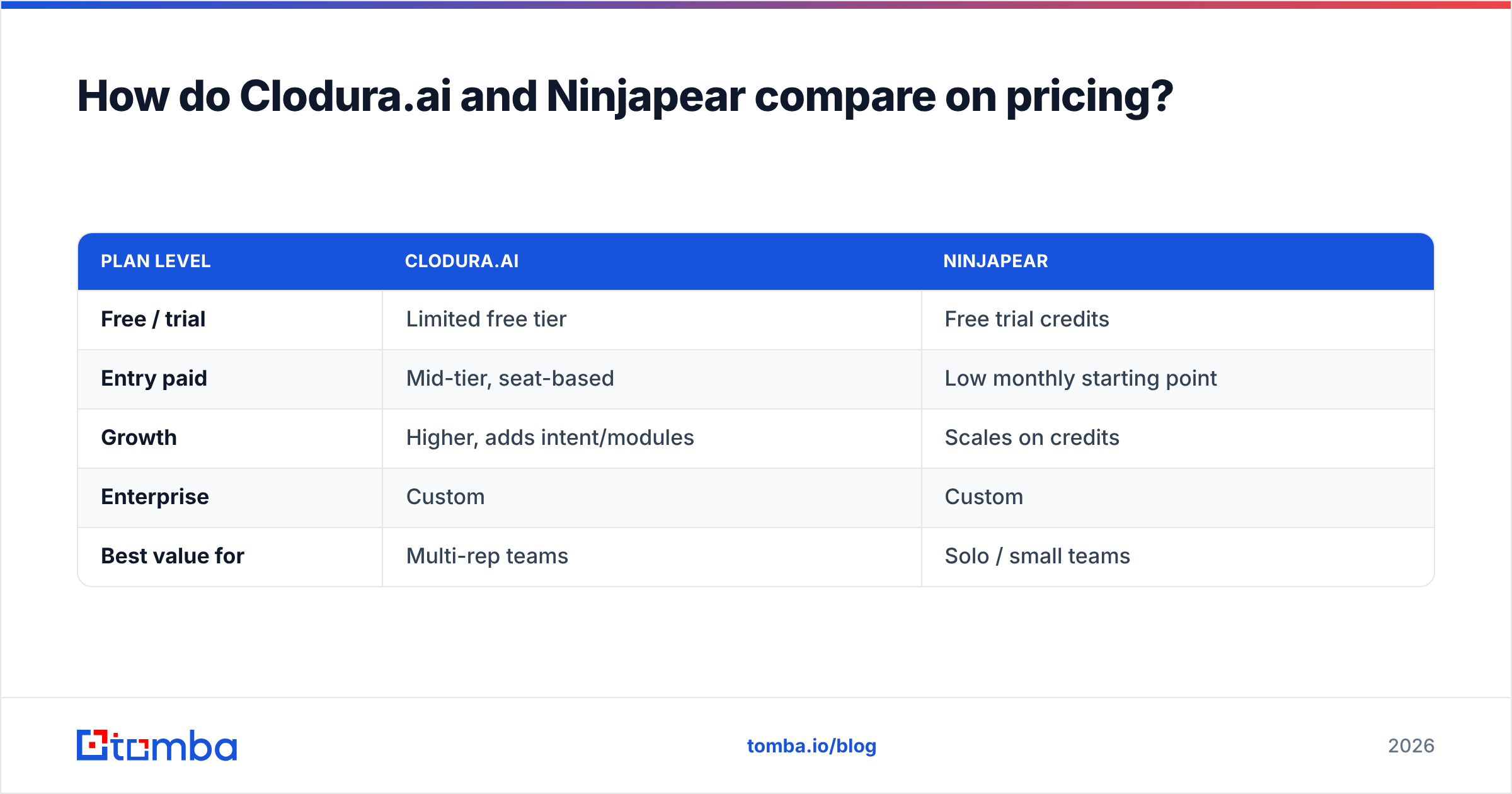
Pricing is where the two philosophies show up most clearly. Clodura.ai's tiers are built for teams: more seats, more credits, more modules, higher commitment. Ninjapear is the affordable on-ramp. It trades breadth for a lower monthly number.
Both vendors change plans often. Treat the shape below as directional, not a live quote. Always confirm on the source pages.
| Plan level | Clodura.ai | Ninjapear |
|---|---|---|
| Free / trial | Limited free tier | Free trial credits |
| Entry paid | Mid-tier, seat-based | Low monthly starting point |
| Growth | Higher, adds intent/modules | Scales on credits |
| Enterprise | Custom | Custom |
| Best value for | Multi-rep teams | Solo / small teams |
If you only need contacts and already pay for a sequencer, Clodura.ai's all-in-one price is poor value. You'd pay for modules you won't use. Ninjapear or a specialist finder makes more sense. But if you'd otherwise buy a database, a verifier, and a sequencer separately, Clodura.ai's bundle can pencil out.
For reference, a focused tool like Tomba runs a free tier at 25 searches a month, with paid plans from $49/mo. It's worth comparing if data is the only thing you need. See the full breakdown on the Tomba pricing page.
Which tool is right for your team?#
Match the tool to your motion, not to the feature count.
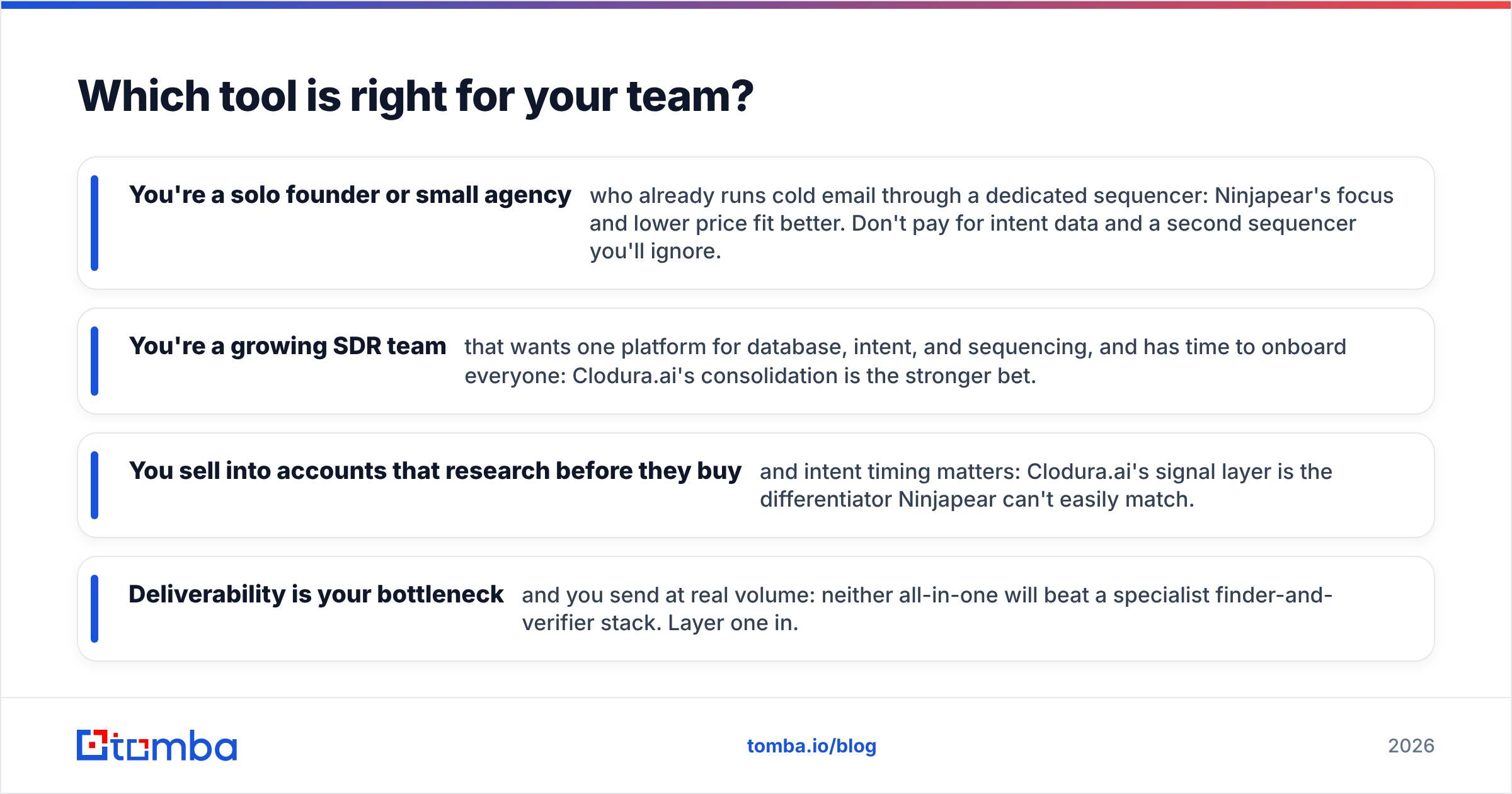
- You're a solo founder or small agency already running cold email through a dedicated sequencer: Ninjapear's focus and lower price fit better. Don't pay for intent data and a second sequencer you'll ignore.
- You're a growing SDR team that wants one platform for database, intent, and sequencing: Clodura.ai's consolidation is the stronger bet, if you have time to onboard everyone.
- You sell into accounts that research before they buy and timing matters: Clodura.ai's signal layer is the edge Ninjapear can't easily match.
- Deliverability is your bottleneck and you send at real volume: neither all-in-one beats a specialist finder-and-verifier stack. Layer one in.
That last point deserves emphasis. The most common mistake is assuming an all-in-one's bundled data is "good enough." Then open rates crater because bounces tank your sender reputation. Protecting sender reputation is cheaper than rebuilding it.
What are the pros and cons?#
Clodura.ai — pros:
- One platform for database, intent, sequencing, and verification.
- Buyer-intent signals that pure finders don't offer.
- Org-chart and technographic filters for precise targeting.
Clodura.ai — cons:
- You pay for modules you may not use.
- Steeper learning curve across many features.
- No single module is best-in-class, especially verification at volume.
Ninjapear — pros:
- Lower entry price and fast adoption.
- Prospecting focus — does one job without bloat.
- Clean export into whatever CRM or sequencer you already run.
Ninjapear — cons:
- Thinner data in niche industries and geographies.
- Basic verification — validate externally before sending.
- No intent or native sequencing, so you'll need other tools.
Is there a better alternative for data accuracy?#
Say your only real problem is finding and verifying business emails — not sequencing, not intent scoring. A dedicated tool almost always beats a bundled module. That's not a knock on either platform. It's the nature of specialization.
A finder-plus-verifier approach lets you keep the sequencer and CRM you like. You just swap in a more accurate data layer. Tomba, for example, focuses on that one job: find email addresses by name or company, run a domain search to pull every contact at an account, verify in bulk, and handle catch-all domains directly. The whole product is built around accuracy, so verification isn't an afterthought.
You can also check where the data comes from on Tomba's data sources page. Transparency about sourcing is a useful tiebreaker when two vendors quote identical accuracy numbers. Independent reviews on G2 and Capterra are another sanity check before you commit to any of the three.

For many teams, the smart play isn't Clodura.ai or Ninjapear. It's using one of them for the workflow you like and feeding it a cleaner contact source. Deliverability is a stack decision, not a single-vendor one.
How should you decide?#
Skip the feature-count comparison. Run a three-step test instead:
- Define your one bottleneck. Is it finding contacts, timing outreach, or landing in the inbox? Buy for that, not for the longest feature list.
- Test on your own data. Pull 200 real target contacts from each tool. Verify them independently. Measure the actual bounce rate. Vendor claims are a hypothesis, not evidence.
- Price the whole stack. Add up what you'd pay across finder, verifier, and sequencer. Sometimes the bundle wins. Often a focused finder plus your existing tools wins on cost and quality.
Do that and the Cloduraai vs Ninjapear question usually answers itself. The real upgrade is often a better data layer under whichever workflow tool you keep.
The bottom line#
Clodura.ai wins on breadth and intent. Ninjapear wins on focus and price. But if the metric that moves your pipeline is deliverable, verified contact data, neither all-in-one will beat a specialist. Pair the workflow tool you prefer with a dedicated finder built for accuracy.
Want to see the difference on your own list first? Start free with the Tomba Email Finder — 25 searches a month at no cost, verified emails, and explicit catch-all handling. Then measure the bounce rate against whatever Clodura.ai or Ninjapear hands you. Let the inbox settle the debate.
Related guides#
Ready to find emails that actually work?
Join 150,000+ professionals who stopped guessing and started sending. Free credits on signup — no credit card required.
Get the Tomba newsletter
Practical outbound tactics and product updates — once every two weeks.
About the author