Clodura.ai vs Postaga (2026): Which B2B Sales Tool Wins?
Clodura.ai bundles a B2B database with sequences; Postaga leans on AI-driven campaigns and link building. Here's which one fits your outbound motion in 2026 — and where a dedicated data layer beats both.
Choosing between Clodura.ai and Postaga usually comes down to one question: do you need a B2B data engine that also runs sequences, or an AI campaign builder that turns research into personalized outreach? They look similar on a feature grid, but they solve different halves of the outbound problem.
TL;DR — Clodura.ai vs Postaga at a glance#
- Clodura.ai is a database-first prospecting platform: a built-in B2B contact database, intent signals, org charts, and an email sequencer bundled together.
- Postaga is an AI outreach platform: it finds relevant contacts around a campaign (link building, podcasts, partnerships, cold email) and auto-drafts personalized messages.
- Pick Clodura.ai if you want prospecting data and sending under one roof and sell into mid-market/enterprise accounts.
- Pick Postaga if you run content-led, relationship, or link-building campaigns and want AI to write the first draft.
- Watch the data layer. Both bundle their own contact data, and bundled data ages fast. Pairing either tool with a dedicated email finder and email verifier usually beats relying on the built-in database alone.
What is Clodura.ai?#
Clodura.ai is an all-in-one sales prospecting platform built around its own B2B database. The pitch is that you never leave the tool: you search a database of company and contact records, layer on buyer-intent and technographic filters, map org charts, then push prospects into an email cadence with tracking.
That "one platform" model appeals to teams tired of stitching a database, a sequencer, and a verifier together. Clodura leans into mid-market and enterprise motions — org charts and intent data matter most when you're selling into large, multi-stakeholder accounts.
The trade-off is depth versus breadth. When a vendor owns data and sequencing and verification, each piece is usually "good enough" rather than best-in-class. The database is broad, but coverage and freshness vary by region and seniority, which is the same limitation you'll find in most bundled-data tools.

What is Postaga?#
Postaga is an AI-powered outreach platform designed around campaigns, not lists. You tell it what you're promoting — a blog post, a product, a podcast, a partnership — and its "Campaign Assistant" finds relevant opportunities, discovers contact details, and drafts personalized emails using AI.
Where Clodura starts with "who fits my ICP," Postaga starts with "what am I reaching out about." That makes it a natural fit for link building, PR, guest posting, influencer outreach, and other relationship-driven plays where the reason for the email carries the personalization.
Postaga includes contact discovery and email sending, so it can run a full campaign end to end. But its data footprint is narrower than a dedicated database platform's — it's tuned to find the right person for a specific outreach angle rather than to slice a market by firmographics and intent.
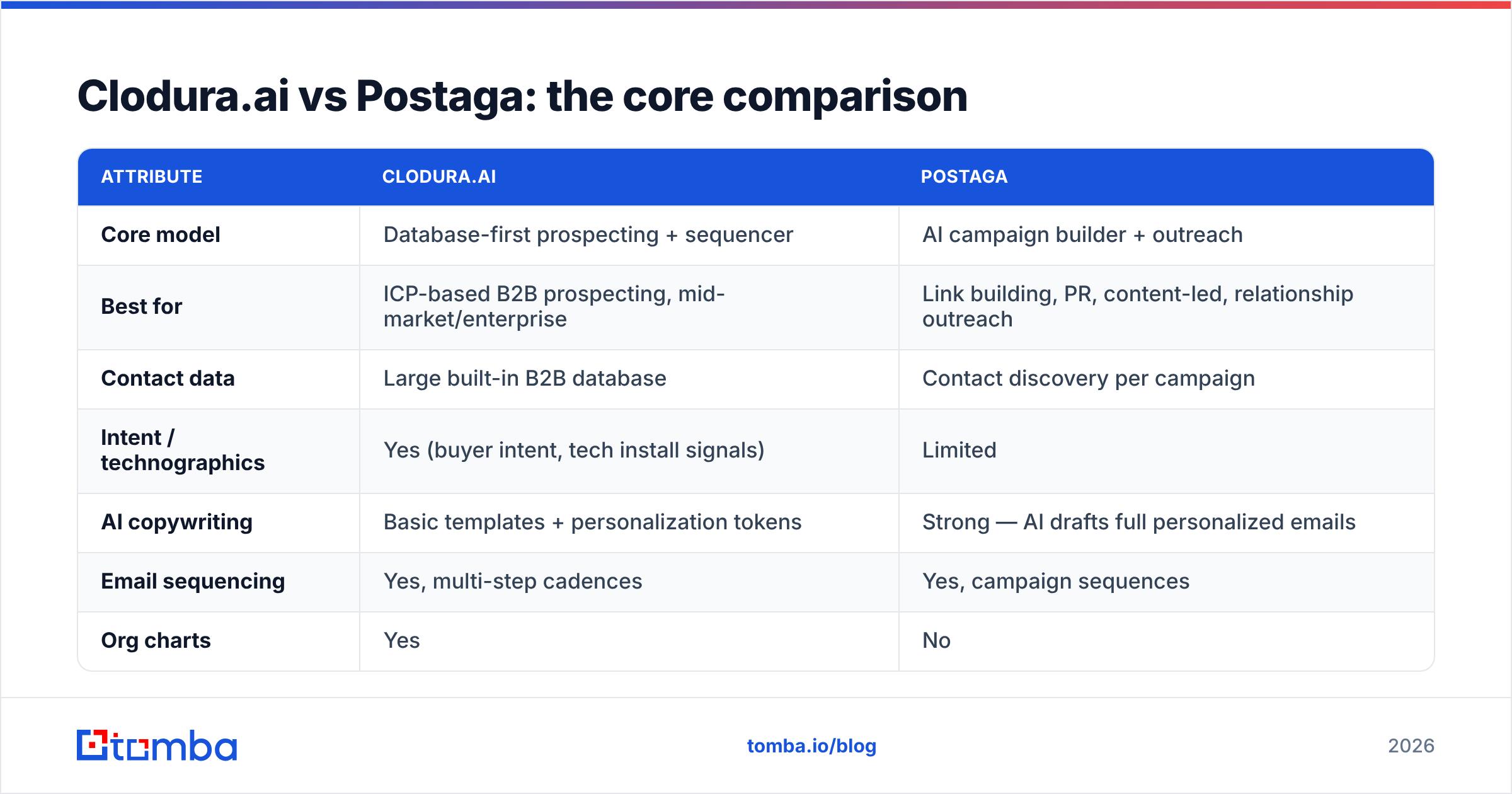
Clodura.ai vs Postaga: the core comparison#
Here's how the two stack up on the attributes that actually change your results.
| Attribute | Clodura.ai | Postaga |
|---|---|---|
| Core model | Database-first prospecting + sequencer | AI campaign builder + outreach |
| Best for | ICP-based B2B prospecting, mid-market/enterprise | Link building, PR, content-led, relationship outreach |
| Contact data | Large built-in B2B database | Contact discovery per campaign |
| Intent / technographics | Yes (buyer intent, tech install signals) | Limited |
| AI copywriting | Basic templates + personalization tokens | Strong — AI drafts full personalized emails |
| Email sequencing | Yes, multi-step cadences | Yes, campaign sequences |
| Org charts | Yes | No |
| Verification | Built-in | Basic |
| Free option | Free plan (limited credits) | Free trial |
| Typical entry price | ~$33–$50/user/mo (annual) | ~$99/mo (project tiers) |
Read that table as two different jobs. Clodura wins on data breadth and account intelligence. Postaga wins on campaign personalization and outreach angles. Neither is strictly "better" — they're optimized for different first questions.
Is Clodura.ai better than Postaga for prospecting?#
Yes — if your motion is ICP-driven and account-based. Clodura's database, intent signals, and org charts are built for the "build a target list, then work the accounts" workflow. You can filter by industry, headcount, tech stack, and hiring signals, then map the buying committee before you send a single email.
Postaga can find contacts too, but it's not designed to hand you a 5,000-row segmented list of every VP of Marketing at Series B SaaS companies. It's designed to find the right blogger for your outreach campaign and write a message they'll actually open.
So the honest answer: for volume prospecting and territory planning, Clodura is the stronger tool. For targeted, angle-based outreach, Postaga is.
One caution that applies to both — bundled databases decay. Contacts change jobs, domains get retired, and catch-all servers hide bad addresses. That's why many teams run their list through a dedicated catch-all verifier before a big send, regardless of which platform sourced the data.
Is Postaga better than Clodura.ai for cold email?#
For creative, personalized cold email, Postaga usually wins on the writing. Its AI reads the context of your campaign and drafts openers that reference the recipient's content, company, or role. If your bottleneck is "I can't write 200 unique first lines," Postaga removes it.
Clodura's sequencing is competent but more template-driven. You get multi-step cadences, tracking, and A/B testing, but the personalization is closer to mail-merge with tokens than genuine AI drafting.
If you care about email deliverability — and you should — remember that neither tool replaces the fundamentals. AI copy and big databases don't matter if your domain lands in spam. Warm up your sending domain, authenticate with SPF/DKIM/DMARC, and keep your bounce rate low by verifying before you send. You can pressure-test a list quickly with a free email checker before committing your main sequence to it.
How much do Clodura.ai and Postaga cost?#
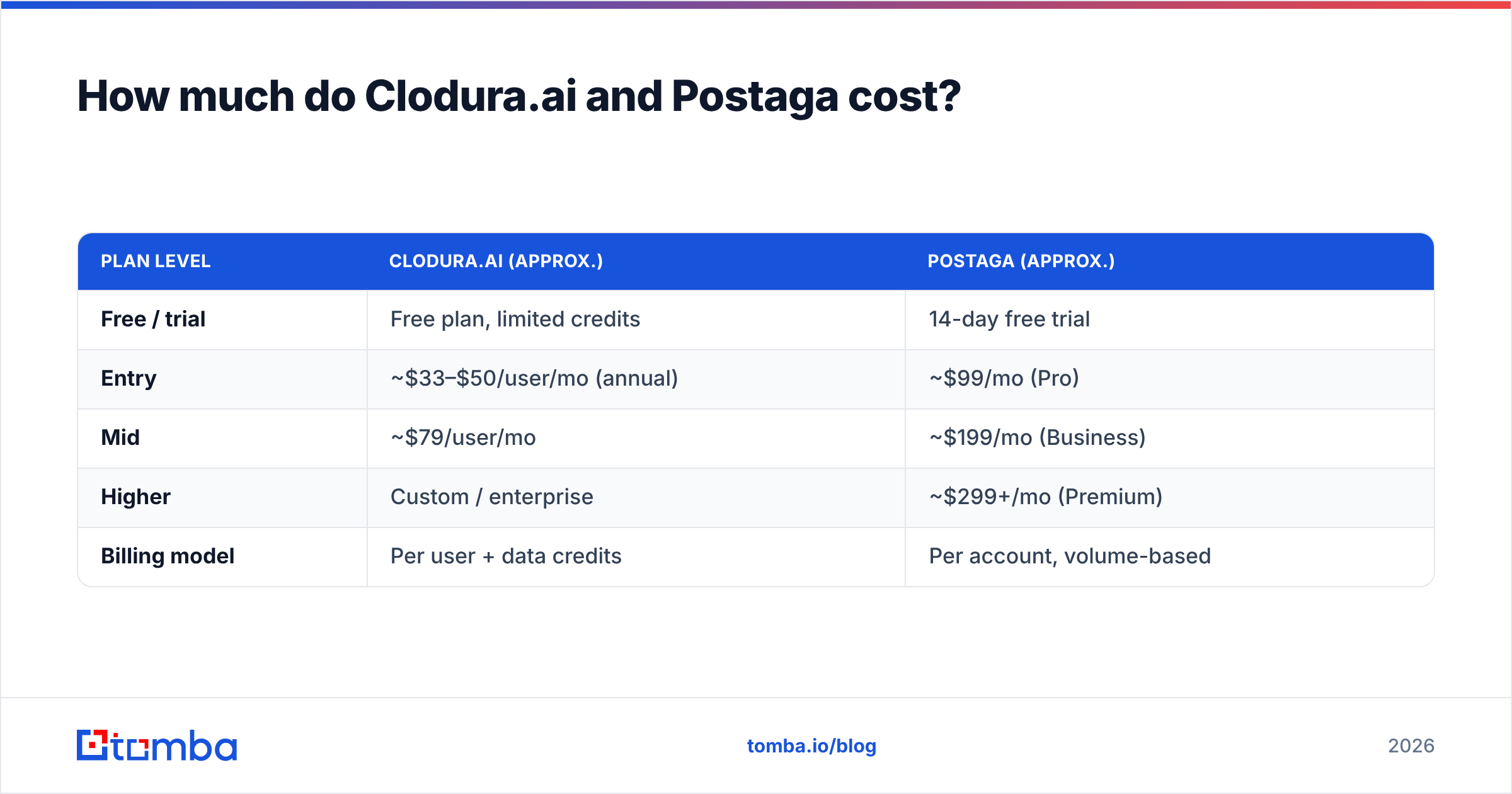
Pricing structures differ enough that a flat "which is cheaper" comparison misleads. Clodura prices mostly per user with credit-based data access; Postaga prices in project/volume tiers.
| Plan level | Clodura.ai (approx.) | Postaga (approx.) |
|---|---|---|
| Free / trial | Free plan, limited credits | 14-day free trial |
| Entry | ~$33–$50/user/mo (annual) | ~$99/mo (Pro) |
| Mid | ~$79/user/mo | ~$199/mo (Business) |
| Higher | Custom / enterprise | ~$299+/mo (Premium) |
| Billing model | Per user + data credits | Per account, volume-based |
Two things to keep in mind. First, Clodura's per-user model scales with headcount, so a 10-rep team pays very differently than a solo founder. Second, both meter data — extra lookups, credits, or contacts cost more once you exceed your tier, and that overage is where "cheap" plans get expensive.
That metering is the real reason to think about your data layer separately, which brings us to the gap both tools share.
What both tools miss: a dedicated, verified data layer#
Here's the pattern we see repeatedly: teams buy an all-in-one tool for the sequencing and AI, then discover the bundled data is the weakest link. Bounces climb, deliverability drops, and reps waste hours chasing wrong contacts.
The fix is to treat data as its own layer instead of an afterthought bundled into your outreach tool. A specialist data stack gives you three things bundled tools rarely match:
- Coverage — a focused email finder that finds professional addresses by name, domain, or company, with sources you can inspect.
- Accuracy — real-time email verification so you catch dead and catch-all addresses before they burn your sender reputation.
- Scale — bulk lead generation and a domain search to pull every relevant contact at a company in one pass.
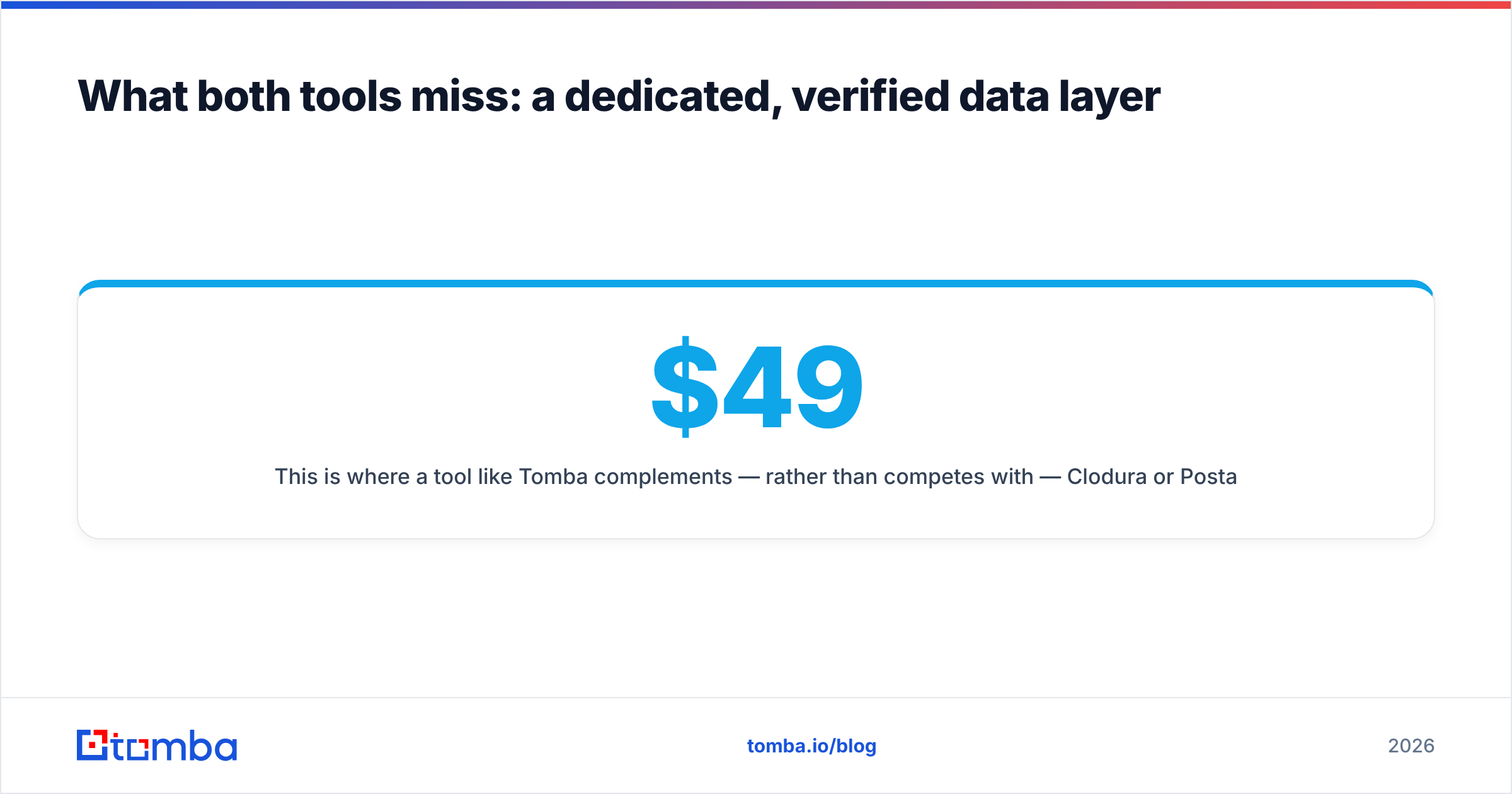
This is where a tool like Tomba complements — rather than competes with — Clodura or Postaga. You keep Clodura for account intelligence or Postaga for AI campaigns, and you plug a clean, verified data feed into whichever one you run. Tomba pricing starts with a free tier (25 searches/mo), then Starter at $49/mo, Growth at $99/mo, and Pro at $249/mo — so you can bolt on accurate data without doubling your per-seat spend. You can review the full Tomba pricing tiers to match volume to plan.
The wider industry backs this up: analyst and review sites like G2 and Gartner consistently show that data accuracy — not feature count — is the top driver of sales-tool satisfaction. A platform is only as good as the contacts you feed it.
Which should you choose in 2026?#
Match the tool to your motion:
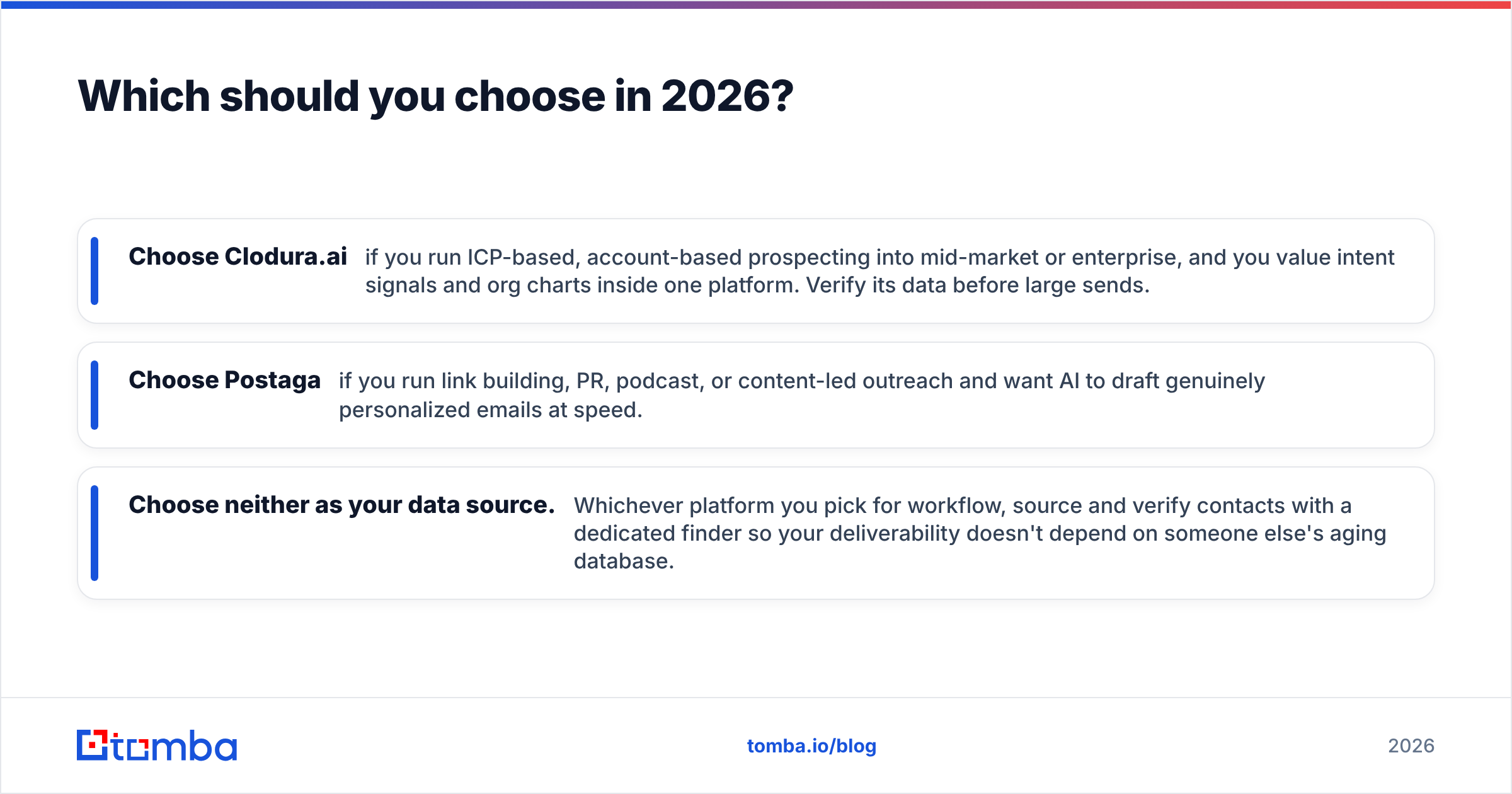
- Choose Clodura.ai if you run ICP-based, account-based prospecting into mid-market or enterprise, and you value intent signals and org charts inside one platform. Verify its data before large sends.
- Choose Postaga if you run link building, PR, podcast, or content-led outreach and want AI to draft genuinely personalized emails at speed.
- Choose neither as your data source. Whichever platform you pick for workflow, source and verify contacts with a dedicated finder so your deliverability doesn't depend on someone else's aging database.
If you're comparing more broadly, it's worth looking at how each stacks up against pure-play options too — see how a focused finder compares as an Apollo alternative or RocketReach alternative before you commit budget to a bundle.
The bottom line#
Clodura.ai and Postaga aren't really competitors — they're two answers to different questions. Clodura is a data-and-sequencing engine for structured B2B prospecting. Postaga is an AI outreach builder for angle-driven campaigns. Pick based on whether your first question is "who fits my ICP" or "what am I reaching out about."
But whichever you choose, don't let the bundled database decide your results. The teams that win at outbound in 2026 treat contact data as a specialized layer: found accurately, verified in real time, and refreshed constantly.
Want the data half done right? Start with the Tomba Email Finder — find and verify professional emails by name, domain, or company, then feed clean contacts straight into Clodura, Postaga, or whatever you're already running. Try it free with 25 searches a month and see how much your bounce rate drops before you commit to any all-in-one bundle.
Related guides#
// get started
Find, verify and enrich your first contacts today
Start on the free plan with 25 searches a month, then scale when your team is ready.
Free plan · No credit card required · GDPR & CCPA
// about the author