CloduraAI vs QuickenRich: Full 2026 Comparison Guide
Clodura.AI and QuickenRich both promise clean B2B contact data, but they win at different jobs. Here's an honest breakdown of pricing, accuracy, and the best fit for your outbound.
CloduraAI vs QuickenRich comes down to one question: do you want an all-in-one sales-intelligence suite, or a focused data-enrichment engine you bolt onto tools you already trust? Both platforms sell "accurate B2B contact data." But they solve different problems, and paying for the wrong one wastes budget you could spend on real pipeline.
This guide breaks down where each tool wins and where each falls short. You'll know how to decide without a 14-day trial rabbit hole.
TL;DR — CloduraAI vs QuickenRich at a glance#
- Clodura.AI is a broad sales-intelligence platform. It bundles a prospect database, buyer-intent signals, email sequencing, and org charts. Best if you want one login for the whole outbound motion.
- QuickenRich is narrower and enrichment-first. Feed it names, domains, or partial records, and it returns cleaned, appended contact data. Best if your workflow already lives in a CRM or sequencer.
- Accuracy is the real battleground. Neither vendor's headline "95%+" number survives a catch-all-heavy list unless you re-verify.
- Pricing favors QuickenRich for pure enrichment volume. Clodura.AI charges more because you pay for the whole suite, not just the data.
- The smart play for most teams: pick the platform that fits your motion, then run every export through a dedicated email verifier before you send. Data decays no matter who you buy it from.

What is Clodura.AI?#
Clodura.AI is an all-in-one B2B sales-intelligence platform. Instead of doing one job well, it tries to cover the full top of funnel. You get a searchable database of companies and contacts, technographic and intent filters, direct-dial phone numbers, org charts, and a built-in email cadence tool. So you can prospect and send from the same place.
The pitch is consolidation. Say you're a small team that doesn't want to stitch together a database tool, a verifier, and a sequencer. Clodura.AI hands you a single dashboard. You can read more on the Clodura.AI site or scan verified user reviews on G2.
The trade-off with any suite is depth. Bundled email sequencing rarely matches a dedicated sender. And a general database rarely beats a specialist verifier on accuracy. You're buying convenience, and convenience has a price.
What is QuickenRich?#
QuickenRich is a data-enrichment service. Its core job is simple. You give it incomplete records — a name and company, a LinkedIn URL, a bare domain. It returns enriched rows with business emails, job titles, company size, and other firmographics appended.
Enrichment-first tools shine in a specific spot. You already have a list — inbound signups, event scans, a scraped account list — and you need to fill the gaps before your reps touch it. QuickenRich is built to sit in that pipeline. It won't replace your CRM or your outreach tool.
Because the scope is tighter, pricing tends to be more transparent and volume-friendly. You're not subsidizing an intent-data engine or a sequencer you may never open.
CloduraAI vs QuickenRich: the core comparison#
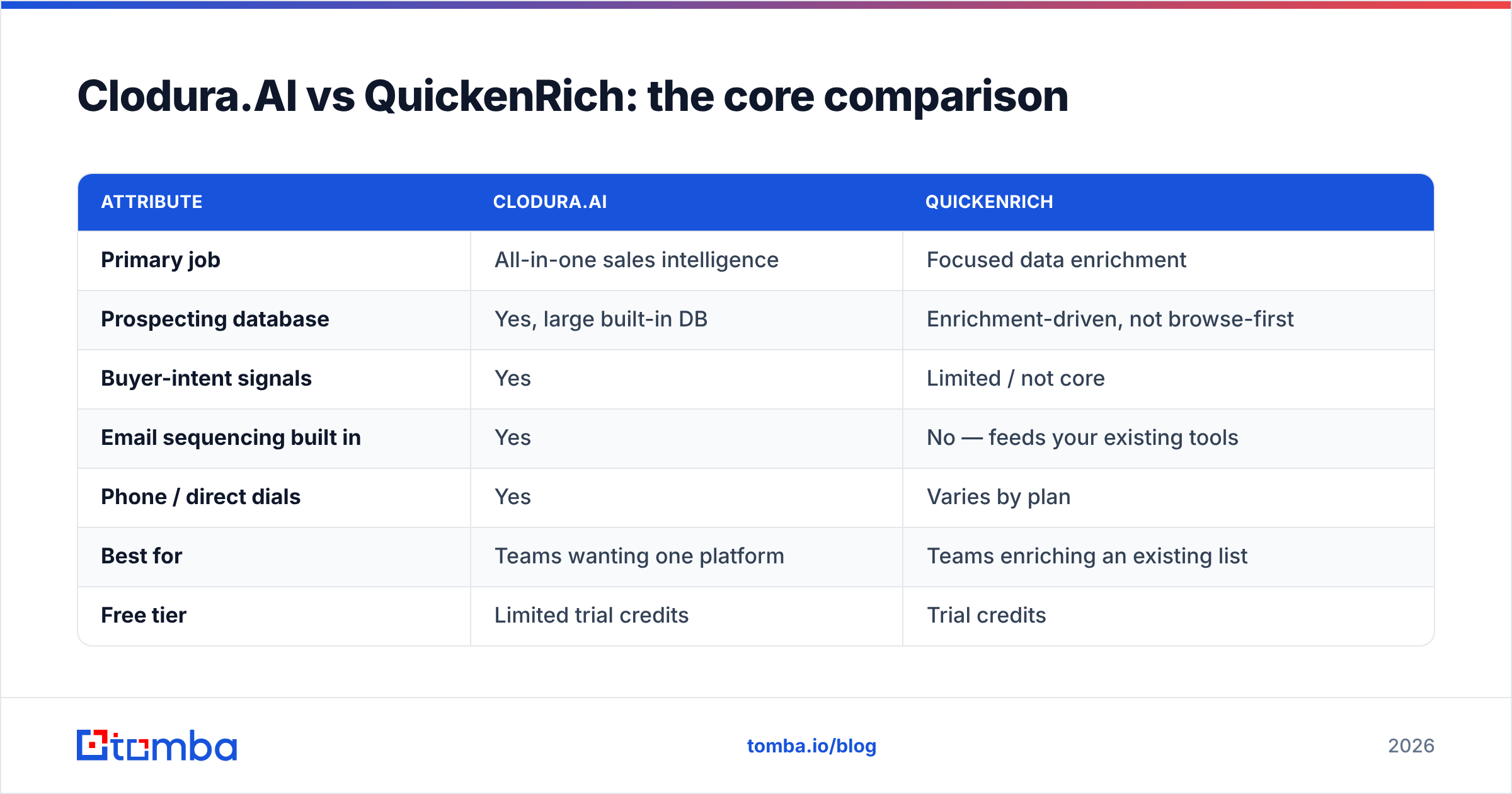
Here's the head-to-head on the attributes that actually change your buying decision. Treat vendor-published accuracy numbers as marketing until you test them on your own list.
| Attribute | Clodura.AI | QuickenRich |
|---|---|---|
| Primary job | All-in-one sales intelligence | Focused data enrichment |
| Prospecting database | Yes, large built-in DB | Enrichment-driven, not browse-first |
| Buyer-intent signals | Yes | Limited / not core |
| Email sequencing built in | Yes | No — feeds your existing tools |
| Phone / direct dials | Yes | Varies by plan |
| Best for | Teams wanting one platform | Teams enriching an existing list |
| Free tier | Limited trial credits | Trial credits |
| Re-verification needed | Yes, before send | Yes, before send |
The pattern is clear. Clodura.AI is wider. QuickenRich is deeper on the one thing it does. Wider isn't automatically better. A suite you use 30% of costs more than a specialist you use fully.
Is Clodura.AI or QuickenRich more accurate?#
Neither wins accuracy by default. And here's the uncomfortable truth: B2B contact data decays at roughly 22–30% per year as people change jobs. Whatever a vendor claims at the point of scrape, a chunk of it is stale by the time it reaches your sequencer.
Where the two differ is what happens with unclear addresses. Catch-all domains are the silent killer of "verified" lists. (The mail server accepts everything, so a standard SMTP check can't confirm a mailbox.) If a platform marks catch-alls as "valid," your bounce rate tells the real story a week later.
That's why the workflow matters more than the vendor badge:
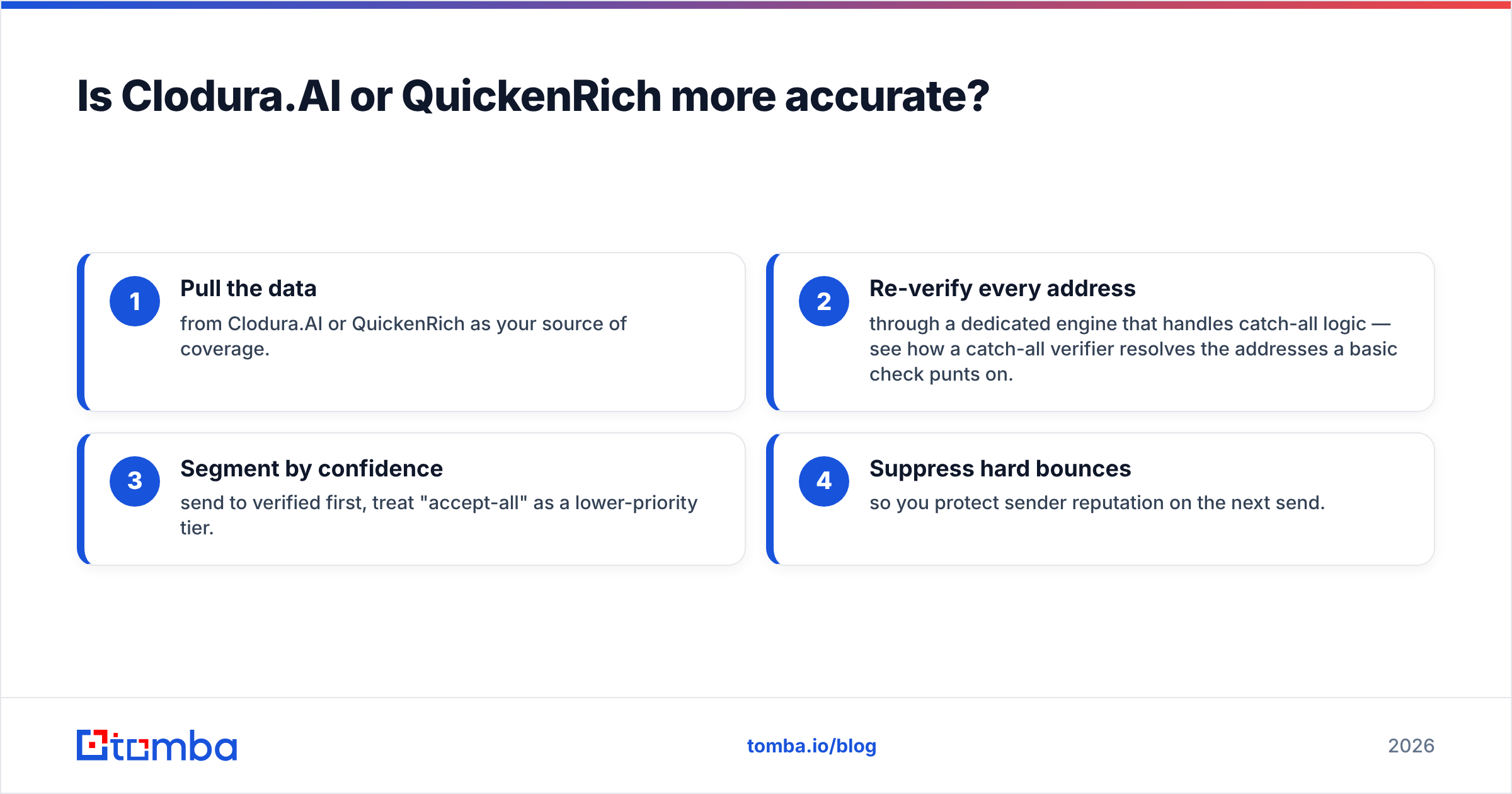
- Pull the data from Clodura.AI or QuickenRich as your source of coverage.
- Re-verify every address through a dedicated engine that handles catch-all logic — see how a catch-all verifier resolves the addresses a basic check punts on.
- Segment by confidence — send to verified first, and treat "accept-all" as a lower-priority tier.
- Suppress hard bounces so you protect sender reputation on the next send.

Accuracy is a process, not a purchase. A cheaper database plus rigorous verification beats an expensive one you trust blindly.
How do Clodura.AI and QuickenRich price?#
Pricing is where the "suite vs specialist" split shows up most. Clodura.AI charges for the whole platform — database access, intent, sequencing — so seat and credit costs run higher. QuickenRich charges closer to a per-record or per-credit model. That usually reads cheaper for pure list-filling at volume.
A few honest cautions apply to both:
- Credit definitions differ. One "credit" might mean one revealed email on one tool and one full enriched record on another. Compare cost-per-usable-contact, not the headline credit price.
- Catch-alls can burn credits for a result you still can't safely send to.
- Annual lock-in discounts look great until your ICP shifts in Q3 and you're stuck.
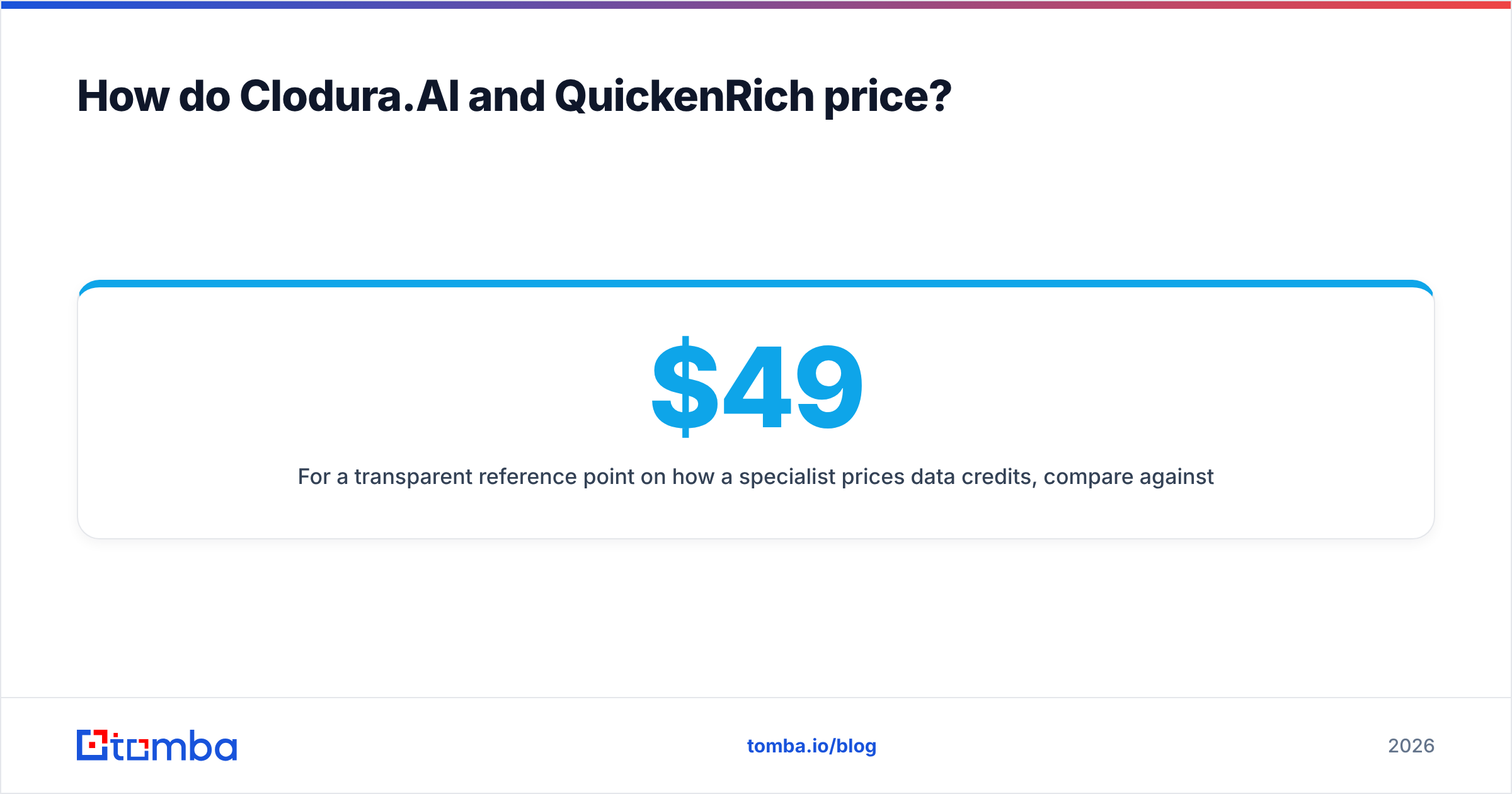
Want a transparent reference point on how a specialist prices data credits? Compare against published Tomba pricing: a free tier at 25 searches/month, Starter at $49/mo, Growth at $99/mo, and Pro at $249/mo. Use a known scale like that to sanity-check whatever quote you're handed. You can also cross-check both vendors on Capterra for real buyer pricing notes.
Which should you choose — and where does Tomba fit?#
Match the tool to your motion, not the loudest feature list:
- Choose Clodura.AI if you're a lean team that wants prospecting, intent, and sending under one roof. You accept "good enough" depth in each module for the convenience of one login.
- Choose QuickenRich if you already have a CRM and sequencer you like. You mainly need to enrich and clean an existing list at predictable cost.
- Choose a focused data layer like Tomba if your bottleneck is specifically finding and verifying the right business emails. You then plug that into whatever stack you run via the Tomba API, Sheets, or a CRM integration.

There's no rule that says you must pick exactly one vendor. The most durable outbound stacks separate concerns: a source of coverage, a verification gate, and a sender. When those are decoupled, swapping one out doesn't blow up the other two.
CloduraAI vs QuickenRich vs a dedicated finder#
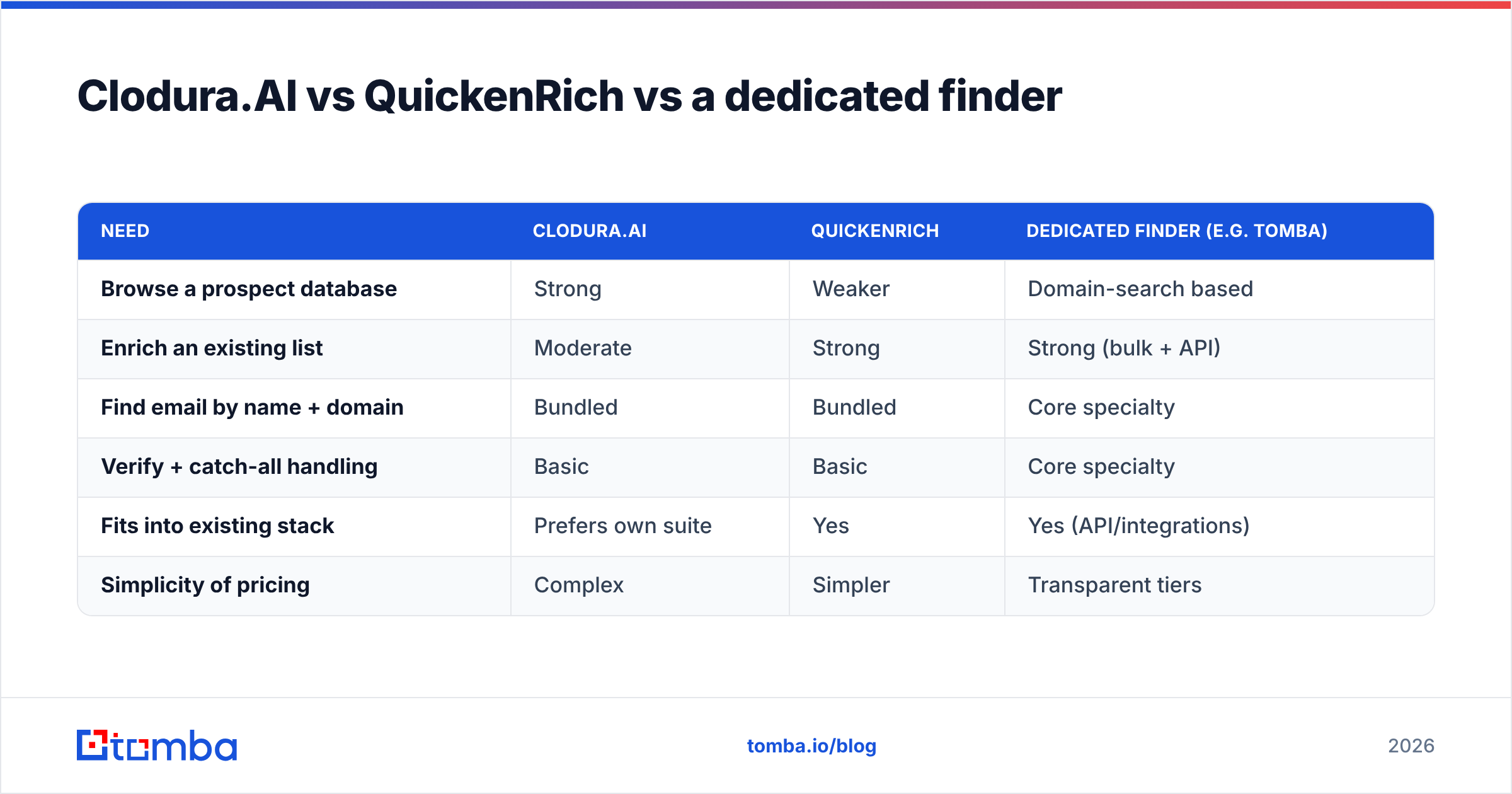
To make the three-way trade-off concrete:
| Need | Clodura.AI | QuickenRich | Dedicated finder (e.g. Tomba) |
|---|---|---|---|
| Browse a prospect database | Strong | Weaker | Domain-search based |
| Enrich an existing list | Moderate | Strong | Strong (bulk + API) |
| Find email by name + domain | Bundled | Bundled | Core specialty |
| Verify + catch-all handling | Basic | Basic | Core specialty |
| Fits into existing stack | Prefers own suite | Yes | Yes (API/integrations) |
| Simplicity of pricing | Complex | Simpler | Transparent tiers |
Is your single biggest pain "I get bounces and I don't know which addresses are real"? A purpose-built finder-plus-verifier will move the needle faster than either broad platform. If your pain is "I have no list at all," a database-first tool earns its keep.
Common mistakes when comparing these tools#
- Trusting the trial's cherry-picked list. Vendors seed demo searches with clean, well-known domains. Test on your messy target accounts.
- Ignoring catch-all rates. Ask each vendor what percentage of your test list came back "accept-all." That's the number that predicts bounces.
- Buying seats you won't use. A five-module suite billed per seat is expensive if your team only touches two modules.
- Skipping re-verification. No matter who you buy from, run the export through a bulk email verifier before the first send. This one habit protects deliverability more than any vendor choice.
- Forgetting the exit. Annual contracts are fine when the fit is proven — not before.
The bottom line#
Clodura.AI and QuickenRich aren't really competing for the same job. Clodura.AI wants to be your whole outbound platform. QuickenRich wants to be the clean-data layer under the stack you already have. Pick based on whether you're buying a suite or a specialist. Then hold both to the same standard: prove accuracy on your own list, not their demo.
And whichever you land on, don't skip the verification gate. Stale data sinks campaigns regardless of the logo on the invoice.
Is your real goal finding accurate, verified business emails without paying for modules you'll never open? Start with a focused tool built for exactly that. Try the Tomba Email Finder — search by name, domain, or company, verify in the same flow, and push clean contacts into your existing CRM or sequencer. Free tier included, and you only scale up when the results earn it.
Related guides#
// get started
Find, verify and enrich your first contacts today
Start on the free plan with 25 searches a month, then scale when your team is ready.
Free plan · No credit card required · GDPR & CCPA
// about the author