Clodura.ai vs SalesGenie (2026): Data, Pricing & Verdict
Clodura.ai vs SalesGenie compared on database size, data freshness, pricing, and real outbound use cases — plus where a dedicated email finder beats both.
The Clodura.ai vs SalesGenie choice comes down to one question. Do you want a modern outbound engine for SDR teams? Or a legacy business directory for local and SMB prospecting? On a feature grid they look alike. But they solve different problems. Pick the wrong one and you pay too much for data you can't use — or buy too little to keep the pipeline full.
This is a neutral, hands-on comparison. No vendor spin. By the end you'll know which platform fits your team. You'll see what each one costs. And you'll learn where a focused email finder like Tomba does the core job for far less.
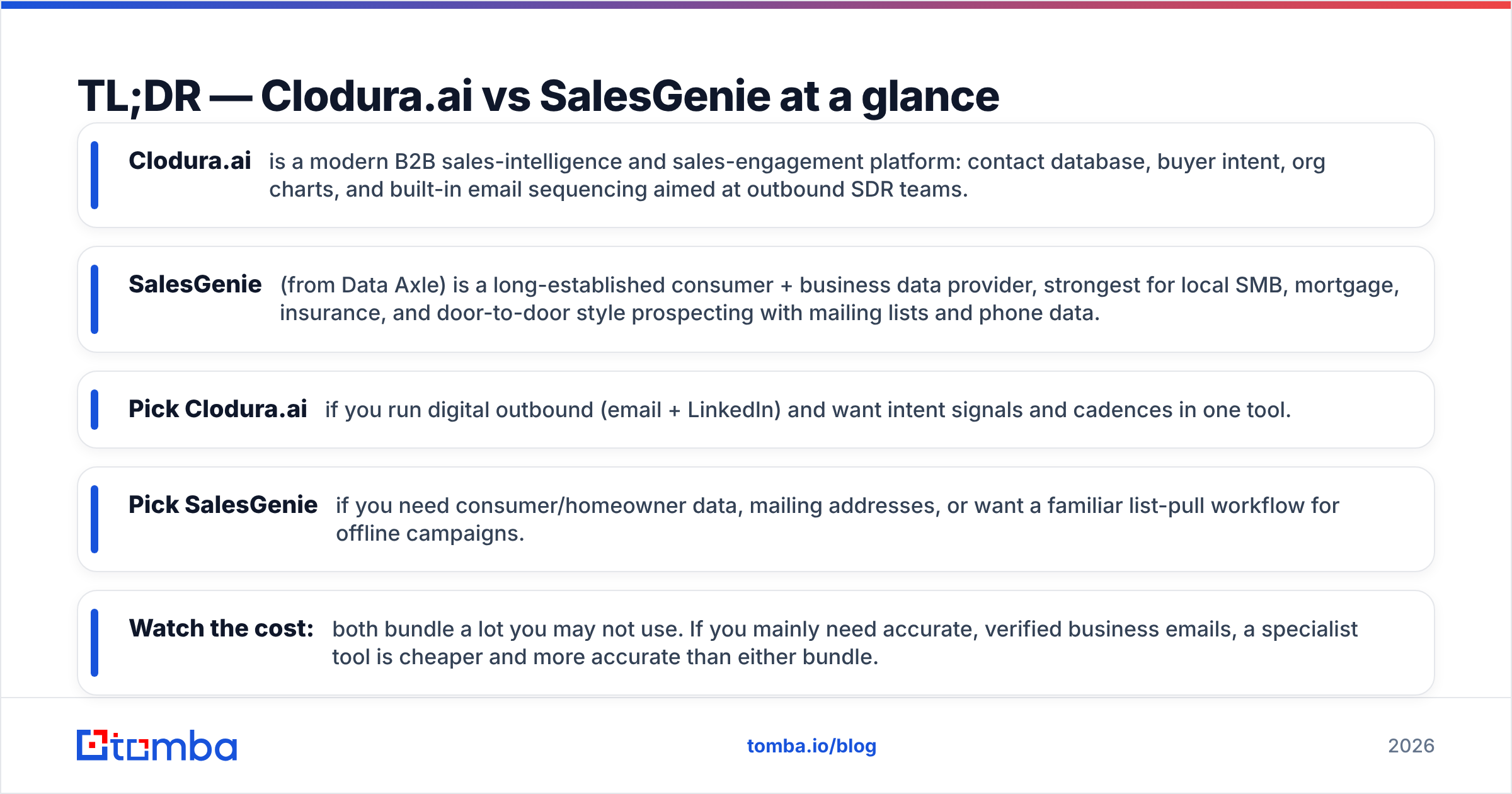
TL;DR — Clodura.ai vs SalesGenie at a glance#
- Clodura.ai is a modern B2B sales-intelligence and sales-engagement platform: contact database, buyer intent, org charts, and built-in email sequencing aimed at outbound SDR teams.
- SalesGenie (from Data Axle) is a long-established consumer + business data provider, strongest for local SMB, mortgage, insurance, and door-to-door style prospecting with mailing lists and phone data.
- Pick Clodura.ai if you run digital outbound (email + LinkedIn) and want intent signals and cadences in one tool.
- Pick SalesGenie if you need consumer/homeowner data, mailing addresses, or want a familiar list-pull workflow for offline campaigns.
- Watch the cost: both bundle a lot you may not use. If you mainly need accurate, verified business emails, a specialist tool is cheaper and more accurate than either bundle.
What is Clodura.ai?#
Clodura.ai is a sales-intelligence platform. It pairs a B2B contact database with sales-engagement features. The database advertises hundreds of millions of contacts and direct dials. On top sit email sequences, cadence tracking, and buyer-intent data. The pitch is "prospect to close in one place." You find the account, get the contact, see intent, and launch a sequence — all without a second tool.
Its sweet spot is the digital SDR. That rep builds targeted lists by job title and tech stack, then runs multi-step email campaigns. Org charts and direct-dial numbers push it toward mid-market SaaS and tech sales.
The trade-offs are typical of all-in-one platforms. You pay for the engagement layer even if you already run Instantly or Salesloft. And accuracy varies by region — strong in North America, thinner elsewhere.
What is SalesGenie?#
SalesGenie is a data product from Data Axle. Data Axle is one of the oldest names in US business and consumer data. SalesGenie is less a modern SaaS and more a subscription list-building service. You filter a giant database by geography, SIC code, revenue, homeowner status, income, and other fields. Then you pull lists for calls, direct mail, or email.
That heritage is both a strength and a limit. Do you sell insurance, mortgages, or home services? Or run a local B2C campaign? Then SalesGenie's consumer and small-business coverage is hard to beat. It also carries mailing addresses and landline phone data that digital-first tools ignore.
But for a software SDR chasing VPs of Engineering at Series-B startups, SalesGenie feels dated. There is no native buyer intent and no email-sequencing engine. The UI reflects its list-broker roots. You are buying a database, not an outbound workflow.
Clodura.ai vs SalesGenie: how do they compare?#
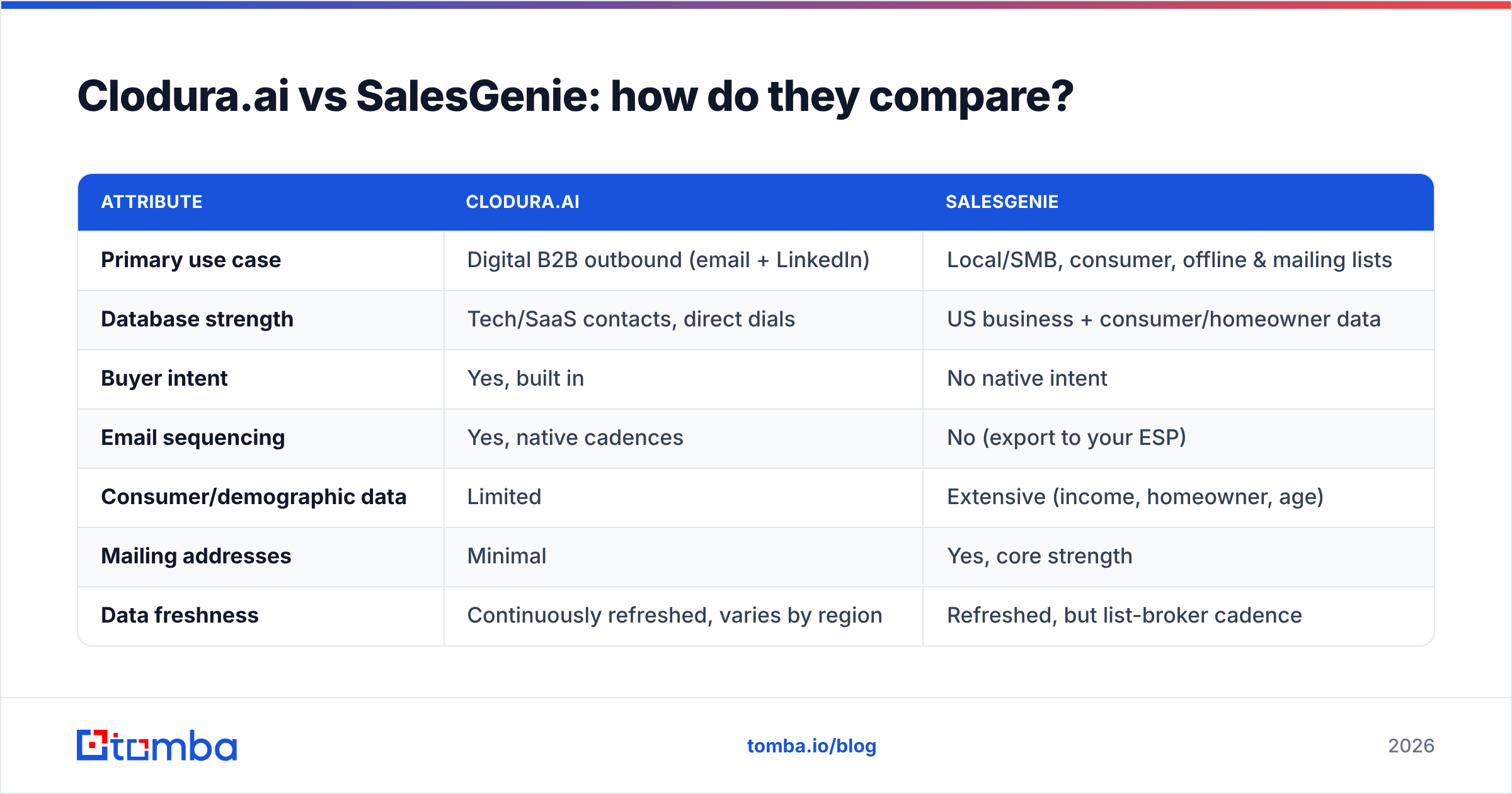
Here's the side-by-side on the attributes that actually change a buying decision.
| Attribute | Clodura.ai | SalesGenie |
|---|---|---|
| Primary use case | Digital B2B outbound (email + LinkedIn) | Local/SMB, consumer, offline & mailing lists |
| Database strength | Tech/SaaS contacts, direct dials | US business + consumer/homeowner data |
| Buyer intent | Yes, built in | No native intent |
| Email sequencing | Yes, native cadences | No (export to your ESP) |
| Consumer/demographic data | Limited | Extensive (income, homeowner, age) |
| Mailing addresses | Minimal | Yes, core strength |
| Data freshness | Continuously refreshed, varies by region | Refreshed, but list-broker cadence |
| Best for | SDR teams, SaaS/tech | Insurance, mortgage, home services, local |
| Entry pricing | Free tier + paid plans (quote-based) | Monthly/annual subscription, quote-based |
The pattern is clear. These aren't really competitors. They're tools for two different worlds. Clodura.ai suits a rep who lives in email and LinkedIn. SalesGenie suits a rep who lives on the phone and in the mailbox.
Which has better data accuracy?#
Neither wins outright. It depends on who you target. SalesGenie's edge is breadth of US consumer and small-business records. Data Axle verifies them through a long-running compilation process. Clodura.ai's edge is business email and direct-dial coverage for tech and mid-market accounts, refreshed often.
One caveat applies to both. Any large compiled database decays. B2B data goes stale at about 2–3% per month as people change jobs. So a record that was accurate at list-pull can bounce a week later. Smart teams treat "database accuracy" and "deliverable email" as two separate problems. You source the contact from one place. Then you run it through an email verifier before you hit send.
Skip that step and you inherit whatever bounce rate the database ships with. High bounce rates quietly wreck your sender reputation and inbox placement. A verify pass is cheap insurance against an expensive deliverability problem.
How much do Clodura.ai and SalesGenie cost?#
Both use quote-based pricing. That is the first friction point for smaller teams. Clodura.ai offers a free tier, then paid plans that scale by credits, users, and features. Sequencing and intent add up fast. SalesGenie sells monthly or annual subscriptions. Its tiers usually cap the number of lists or records you can download.
The practical takeaways:
- Neither posts transparent public per-seat pricing the way self-serve tools do, so budget for a sales call and a demo.
- Clodura.ai's cost climbs when you turn on the engagement and intent layers you may already own elsewhere.
- SalesGenie's value concentrates in consumer/demographic data — if you only need business emails, you're paying for a lot of unused coverage.
- Annual lock-in is common. Ask about download caps, overage fees, and what happens to exported records if you cancel.
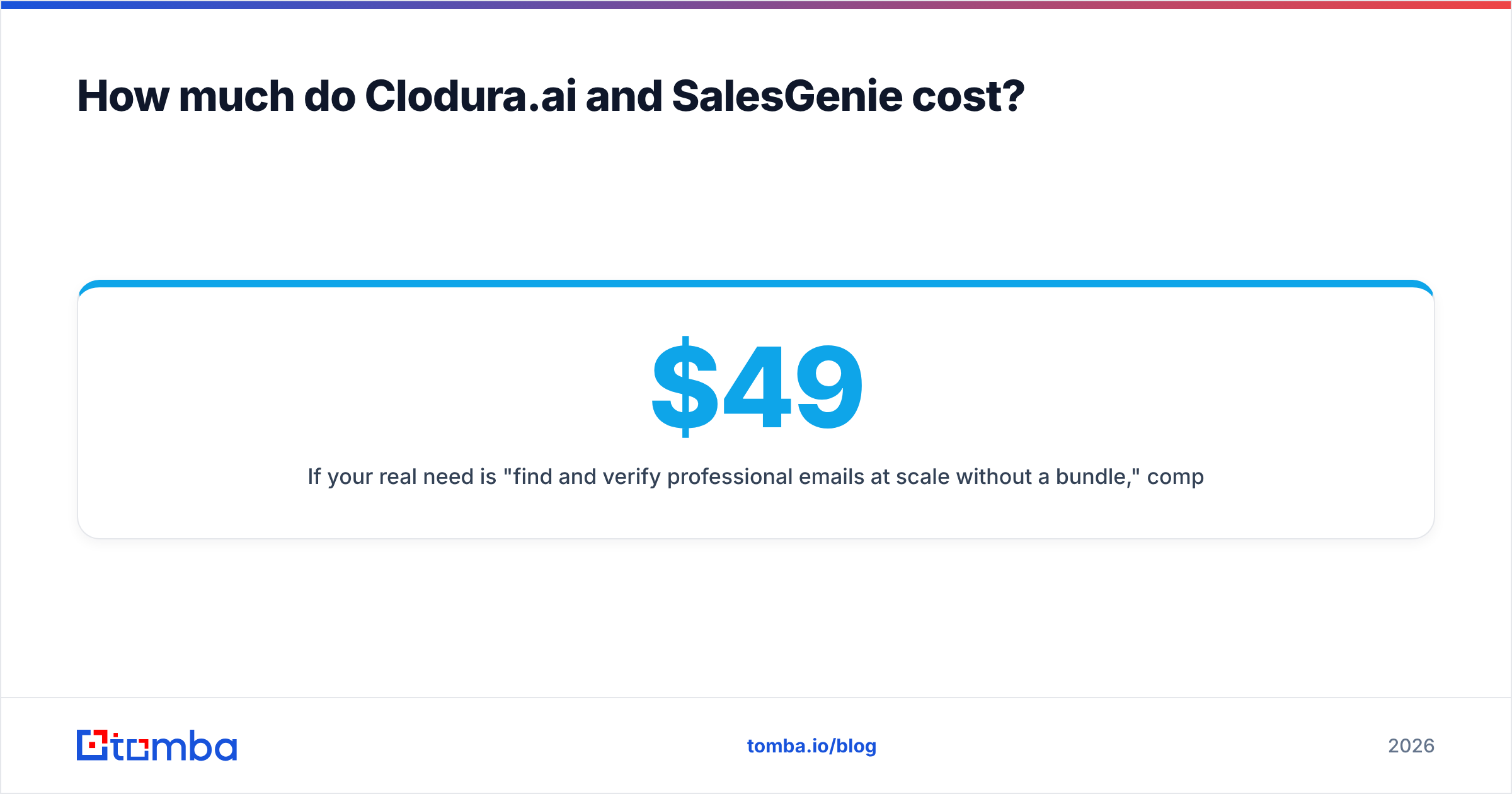
If your real need is "find and verify professional emails at scale without a bundle," compare both against transparent, credit-based Tomba pricing — Free (25 searches/mo), Starter $49/mo, Growth $99/mo, and Pro $249/mo — before you commit to an annual contract.

Which one is right for your team?#
Match the tool to your workflow, not the feature list.
Choose Clodura.ai if:
- You run digital outbound — cold email and LinkedIn — and want find, intent, and sequence in one login.
- You sell SaaS, tech, or mid-market and need direct dials plus org charts.
- You value buyer-intent signals to prioritize accounts.
Choose SalesGenie if:
- You need consumer or homeowner data (insurance, mortgage, solar, home services).
- Direct mail and phone are core channels, not afterthoughts.
- You want a familiar list-pull workflow and don't need a sequencing engine.
Choose a focused stack (email finder + verifier + your own sequencer) if:
- Your core need is accurate, verified B2B emails — nothing more.
- You already own a sending tool and don't want to pay twice for cadences.
- You want transparent, usage-based pricing and a fast API instead of a sales call.
That third path is where many modern teams land. You don't always need a monolith. You need reliable contact data that plugs into the tools you already run.
Is there a leaner alternative to both?#
Yes — and it's worth a look before you sign anything. Clodura.ai and SalesGenie both bundle a database with workflow features. Is your bottleneck simply getting the right verified email for a known person or company? Then a specialist tool does that job more accurately and far more cheaply.
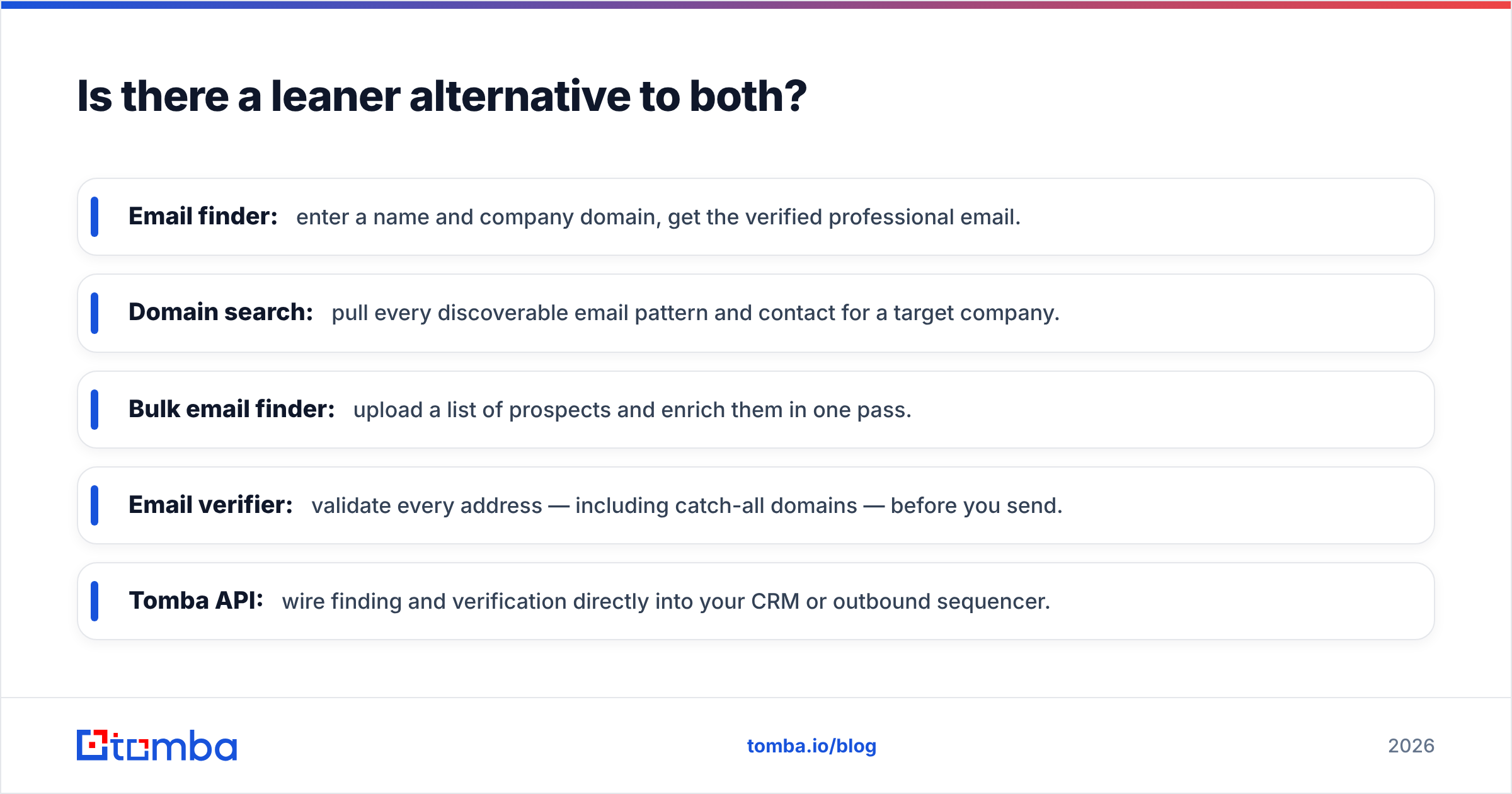
That's Tomba's lane. Instead of buying a giant list and hoping the records are fresh, you look up contacts on demand:
- Email finder: enter a name and company domain, get the verified professional email.
- Domain search: pull every discoverable email pattern and contact for a target company.
- Bulk email finder: upload a list of prospects and enrich them in one pass.
- Email verifier: validate every address — including catch-all domains — before you send.
- Tomba API: wire finding and verification directly into your CRM or outbound sequencer.
You keep your existing sequencer — Instantly, Salesloft, whatever. You plug in verified data through the Tomba API or a native HubSpot integration. And you pay only for what you use. For a team that already has an outbound engine and just needs clean contacts, the total cost is far lower than either all-in-one.
This isn't a knock on Clodura.ai or SalesGenie — it's about scope. If you need intent and cadences, buy the platform. If you need mailing lists and consumer data, buy the directory. If you need verified emails, buy the finder. The mistake is paying platform prices for finder work.
How to evaluate any of them before you buy#
Run the same three-step test on Clodura.ai, SalesGenie, and any alternative:
- Sample your ICP, not their demo list. Pull 50 real target accounts and see how many contacts come back verified, not just "found."
- Bounce-test the emails. Run the sample through an independent verifier. If more than 3–5% bounce, the database is decaying faster than the vendor admits.
- Price the job you actually have. Strip out features you won't use. Compare the per-verified-contact cost, not the headline plan price.
Do this and the right answer usually shows up in an afternoon. No year-long contract required. You can read how B2B contact sources are compiled and refreshed on Tomba's data sources page. And you can cross-check vendor claims against real user reviews on G2 before you decide.
The verdict#
So how does Clodura.ai vs SalesGenie end? Clodura.ai wins for digital SDR teams that want intent and sequencing in one place. SalesGenie wins for consumer-data, mailing-list, and local-prospecting work, where its Data Axle heritage is unmatched. Neither is "better" in the abstract. They serve different buyers.
But strip the question down to one line: "I need accurate, verified business emails that flow into the outbound tools I already run." Then you don't need either bundle. Start free with the Tomba Email Finder. Enrich and verify your first lists in minutes. Add a heavier platform only when you truly need intent data or built-in cadences. Buy the tool that fits the job — not the biggest logo on the grid.
Related guides#
Ready to find emails that actually work?
Join 150,000+ professionals who stopped guessing and started sending. Free credits on signup — no credit card required.
Get the Tomba newsletter
Practical outbound tactics and product updates — once every two weeks.
About the author