Clodura.ai vs SignalHire (2026): Which B2B Prospecting Tool Wins?
Clodura.ai bundles a sales-intelligence database with cadences; SignalHire is a lean contact finder for email and phone. Here's which one fits your team in 2026 — and where a dedicated finder beats both.
Picking between Clodura.ai and SignalHire usually comes down to one question: do you want a full prospecting suite with a built-in database and cadences, or a lightweight tool that just spits out a verified email and phone number when you need one? They solve overlapping problems from opposite ends.
This comparison breaks down data, features, pricing, and fit — with no pretense that either one is perfect. If your only real need is accurate contact data, you'll also see why a focused email finder can quietly outperform both.
TL;DR: Clodura.ai vs SignalHire at a glance#
- Clodura.ai is a sales-intelligence platform: a 600M+ contact database, org charts, buying-intent signals, and email cadences bundled into one workspace. Best for teams that want prospecting and outreach under one login.
- SignalHire is a contact finder built around a browser extension. It reveals emails and phone numbers from LinkedIn and other profiles, with real-time verification. Best for recruiters and reps who live in LinkedIn.
- Pricing: SignalHire is credit-based and cheap to start (around $49/mo). Clodura.ai has a free tier but its useful plans cost more per seat because you're paying for the whole suite.
- Accuracy: Both do real-time verification, but coverage and match rates vary by region and seniority. Always test on your own list before committing.
- The third option: If you mainly need clean emails at scale via API or bulk upload, a dedicated email finder like Tomba is faster and cheaper per verified contact than either suite.
What is Clodura.ai?#
Clodura.ai is an all-in-one sales prospecting and intelligence platform. Instead of just finding a contact, it tries to run the top of your funnel end to end: search a database of hundreds of millions of B2B contacts, see company org charts and technographics, catch buying-intent and hiring signals, then launch multi-step email sequences without leaving the tool.
Think of it like a Swiss Army knife for outbound. The upside is that everything lives in one place — you find the account, map the buying committee, and start a cadence in the same session. The downside is the same as any Swiss Army knife: each individual blade is decent, not best-in-class, and you pay for tools you may never open.
Clodura leans toward teams that don't already own a separate database, sequencer, and enrichment stack. If you're starting from a blank page, the bundle is appealing. You can read more about their positioning on the Clodura.ai site.

What is SignalHire?#
SignalHire is a contact-finding tool built for speed and simplicity. Its core is a browser extension: open a LinkedIn profile, click SignalHire, and it returns emails and phone numbers, checking them against live sources in real time. It also offers a web app for list building and a bulk mode for processing many profiles at once.
SignalHire is especially popular with recruiters because it surfaces personal emails and mobile numbers, not just work addresses — useful when you're sourcing candidates who won't answer a corporate line. For sales, it works the same way: find the person on LinkedIn, pull their details, drop them into your CRM or sequencer.
Where Clodura wants to be your whole prospecting workspace, SignalHire wants to be the fastest way to turn a profile into a reachable contact. You can compare its plans directly on the SignalHire website.
Clodura.ai vs SignalHire: feature-by-feature comparison#
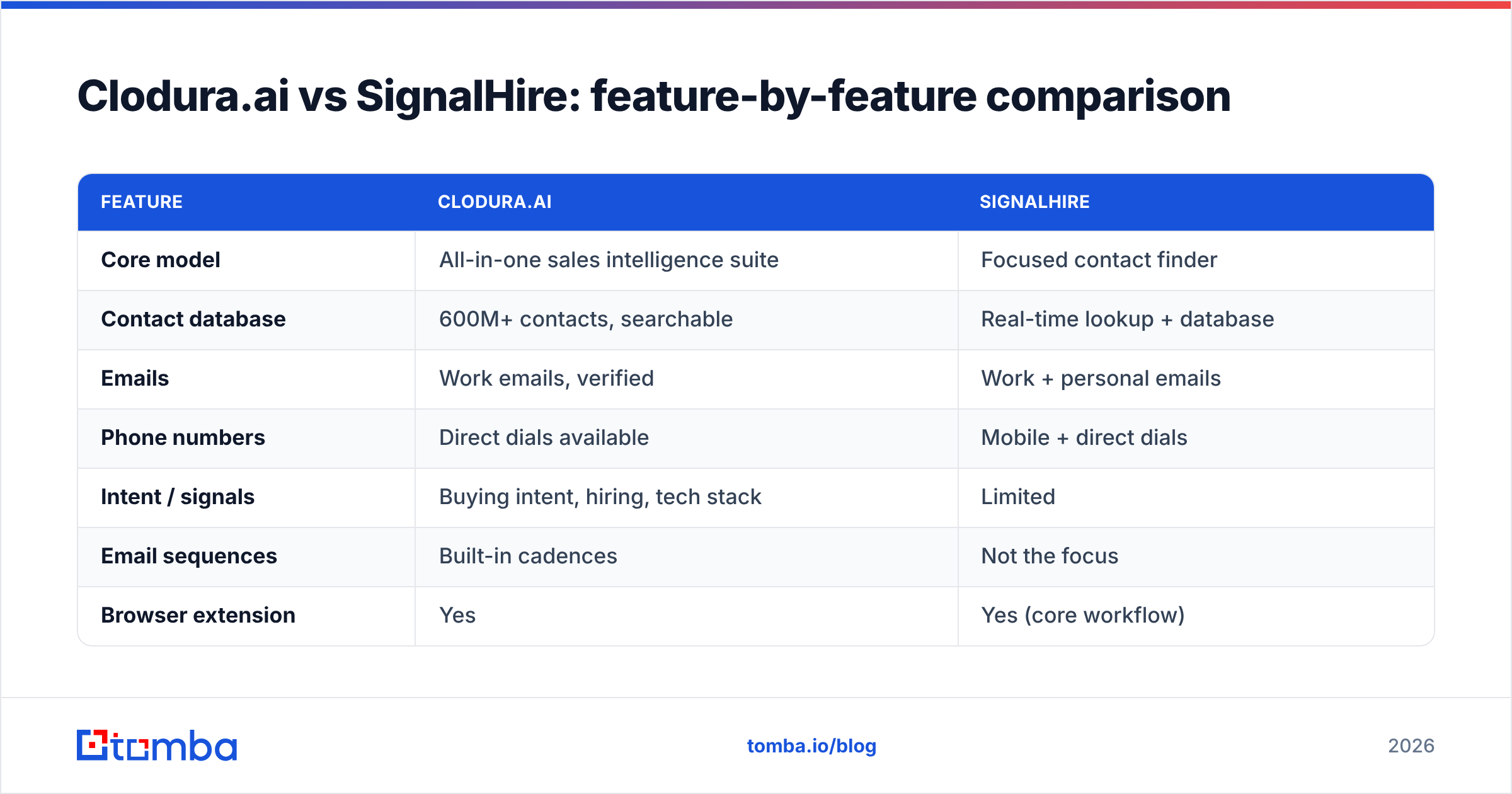
Here's how the two stack up on the attributes that actually change your day-to-day workflow.
| Feature | Clodura.ai | SignalHire |
|---|---|---|
| Core model | All-in-one sales intelligence suite | Focused contact finder |
| Contact database | 600M+ contacts, searchable | Real-time lookup + database |
| Emails | Work emails, verified | Work + personal emails |
| Phone numbers | Direct dials available | Mobile + direct dials |
| Intent / signals | Buying intent, hiring, tech stack | Limited |
| Email sequences | Built-in cadences | Not the focus |
| Browser extension | Yes | Yes (core workflow) |
| Bulk processing | Yes | Yes (credit-based) |
| Best for | Teams wanting one workspace | Recruiters, LinkedIn-first reps |
| Starting price | Free tier, paid per seat | ~$49/mo credit plans |
The pattern is clear: Clodura is broader, SignalHire is sharper. If your team needs intent data and cadences, Clodura's bundle saves you from stitching three tools together. If you just need contact details fast, SignalHire's narrower scope means less to learn and less to pay for.

Is Clodura.ai or SignalHire more accurate?#
Accuracy is the whole ballgame — a cheaper tool that returns dead emails costs you more in bounced sends and burned sender reputation than a pricier one that gets it right.
Both platforms verify contacts in real time rather than serving stale database records, which is the right approach. But real-world match rates depend heavily on three things:
- Region. North American and Western European data is dense and accurate across most providers. Coverage thins out fast in LATAM, MENA, and parts of APAC.
- Seniority. VP-and-above contacts are well-covered; individual contributors and frontline staff are spottier.
- Recency. Job-changers are the silent killer. A contact verified six months ago may have moved companies, and not every tool re-checks aggressively.
SignalHire's live-lookup model tends to do well on personal emails and mobile numbers, which is why recruiters favor it. Clodura's strength is breadth — you get the contact plus the surrounding context (org chart, tech stack) so you can prioritize who's worth reaching.
The honest answer: don't trust anyone's marketing accuracy percentage, including this post. Export 50 contacts from each on your actual target segment, run them through an independent email verifier, and compare the valid-rate. That 20-minute test tells you more than any G2 badge. Speaking of which, cross-check current user sentiment on G2 before you buy.

How do Clodura.ai and SignalHire pricing compare?#
Pricing is where the two diverge most, because you're buying fundamentally different things.
SignalHire uses a credit model. Plans start low — around $49/month for a few hundred credits — and each credit reveals a contact's details. This is pay-for-what-you-use in spirit: predictable if your volume is steady, and cheap to pilot. Heavy users scale into larger credit bundles.
Clodura.ai offers a free tier to get you in the door, but its meaningful plans are priced per seat because you're renting the entire suite: database access, intent data, and cadences. For a small team, that per-seat cost adds up quickly — and you pay it whether or not you use the sequencing and intent features.
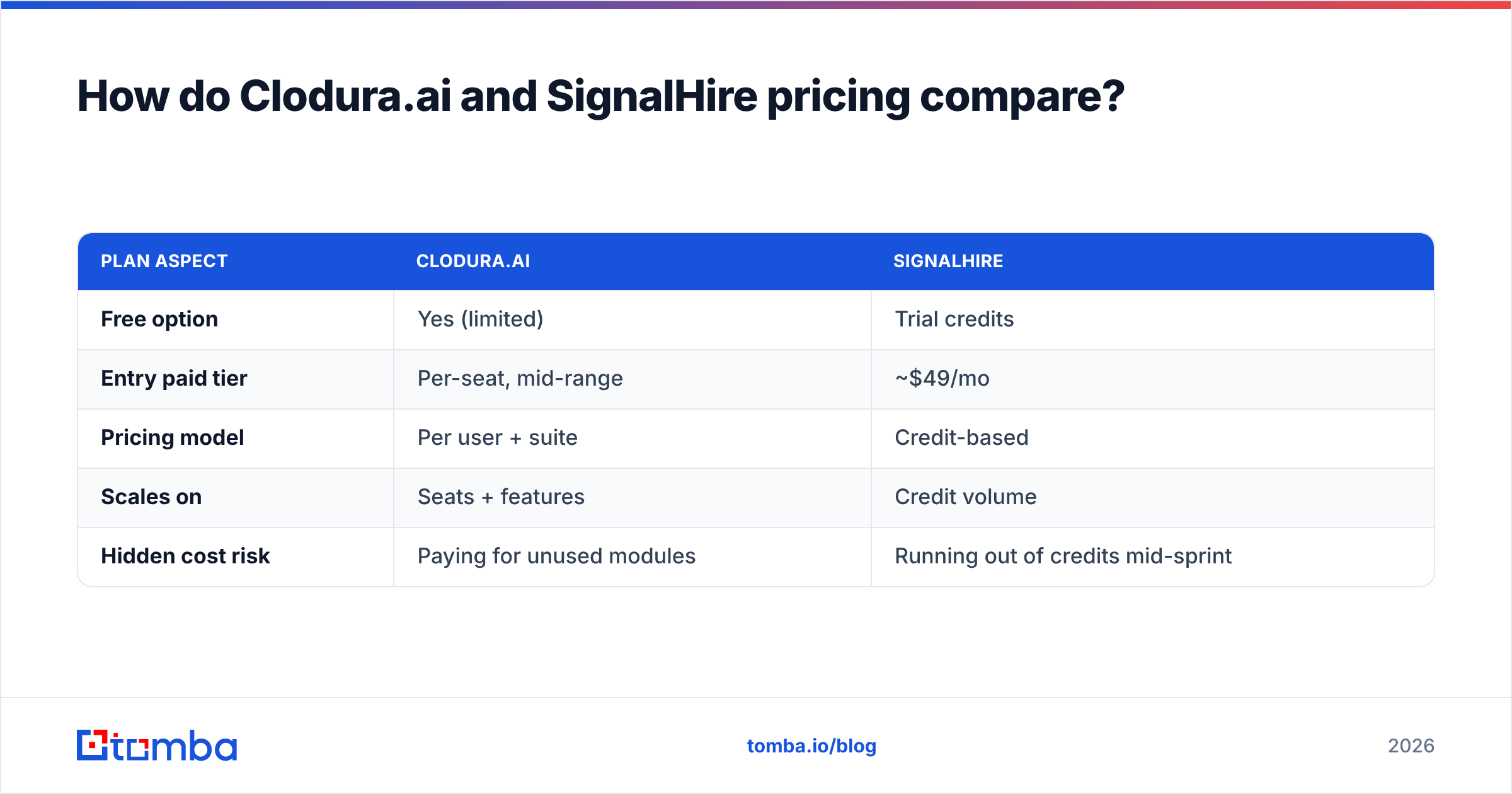
| Plan aspect | Clodura.ai | SignalHire |
|---|---|---|
| Free option | Yes (limited) | Trial credits |
| Entry paid tier | Per-seat, mid-range | ~$49/mo |
| Pricing model | Per user + suite | Credit-based |
| Scales on | Seats + features | Credit volume |
| Hidden cost risk | Paying for unused modules | Running out of credits mid-sprint |
The takeaway: SignalHire is the safer bet if you want to control spend and only need contacts. Clodura makes financial sense only if your team will genuinely use the intent data and built-in cadences — otherwise you're subsidizing features you don't touch. Confirm the latest numbers on each vendor's page, since credit bundles and per-seat rates change often.
Which tool should you choose?#
Match the tool to the job rather than chasing a single "winner."
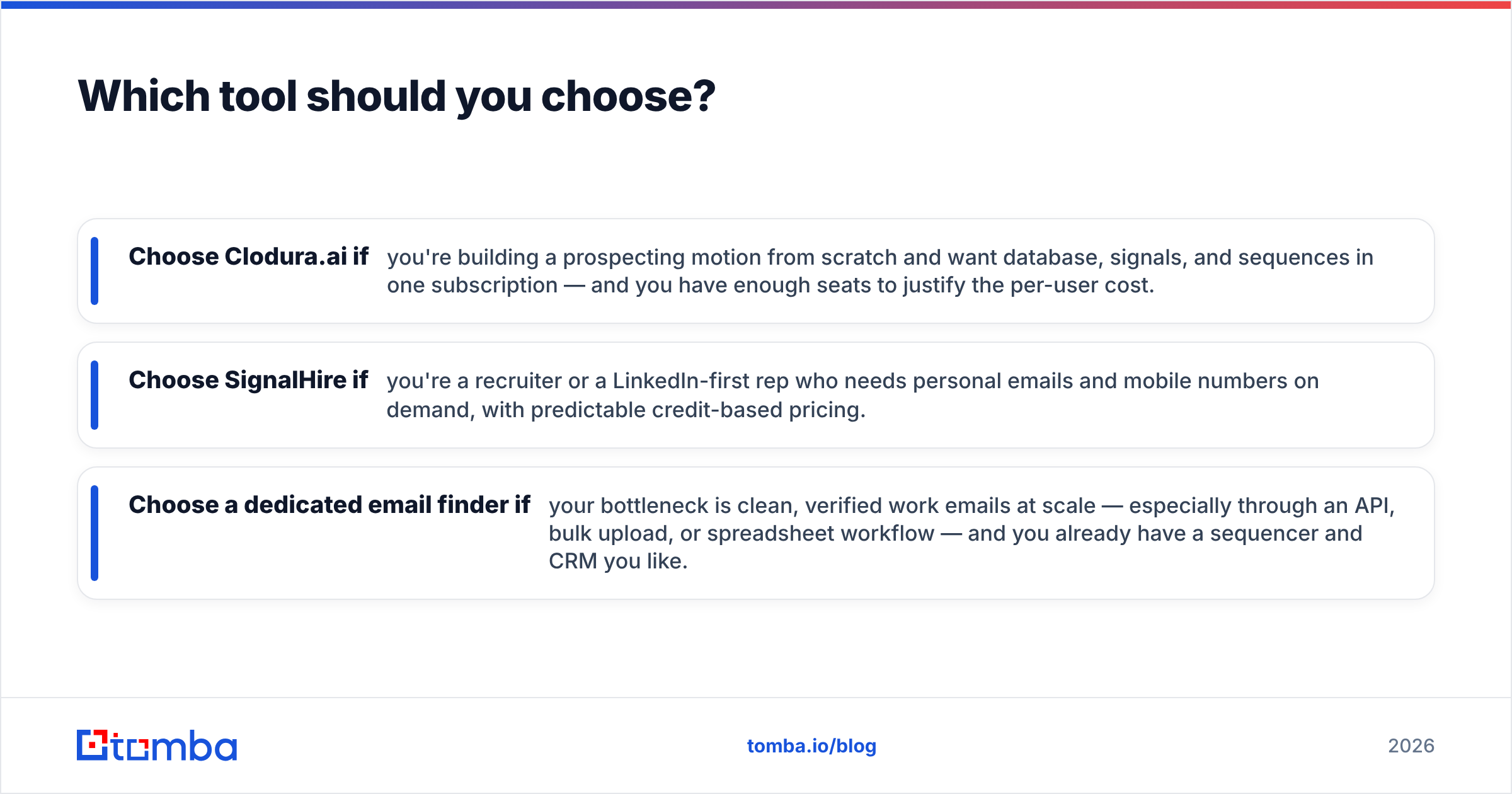
- Choose Clodura.ai if you're building a prospecting motion from scratch and want database, signals, and sequences in one subscription — and you have enough seats to justify the per-user cost.
- Choose SignalHire if you're a recruiter or a LinkedIn-first rep who needs personal emails and mobile numbers on demand, with predictable credit-based pricing.
- Choose a dedicated email finder if your bottleneck is clean, verified work emails at scale — especially through an API, bulk upload, or spreadsheet workflow — and you already have a sequencer and CRM you like.
That third path is the one most teams underrate. If you strip prospecting down to its core, the job is usually "turn a name and domain into a valid email." Bolting that onto a heavy suite means paying suite prices for a finder-shaped need.
Where does Tomba fit against Clodura.ai and SignalHire?#
Tomba isn't trying to be a full sales-intelligence suite or a LinkedIn recruiting tool — and that focus is the point. It does one category of work extremely well: finding and verifying professional email addresses, then getting them into your workflow with minimal friction.
Here's how the trade-off actually plays out:
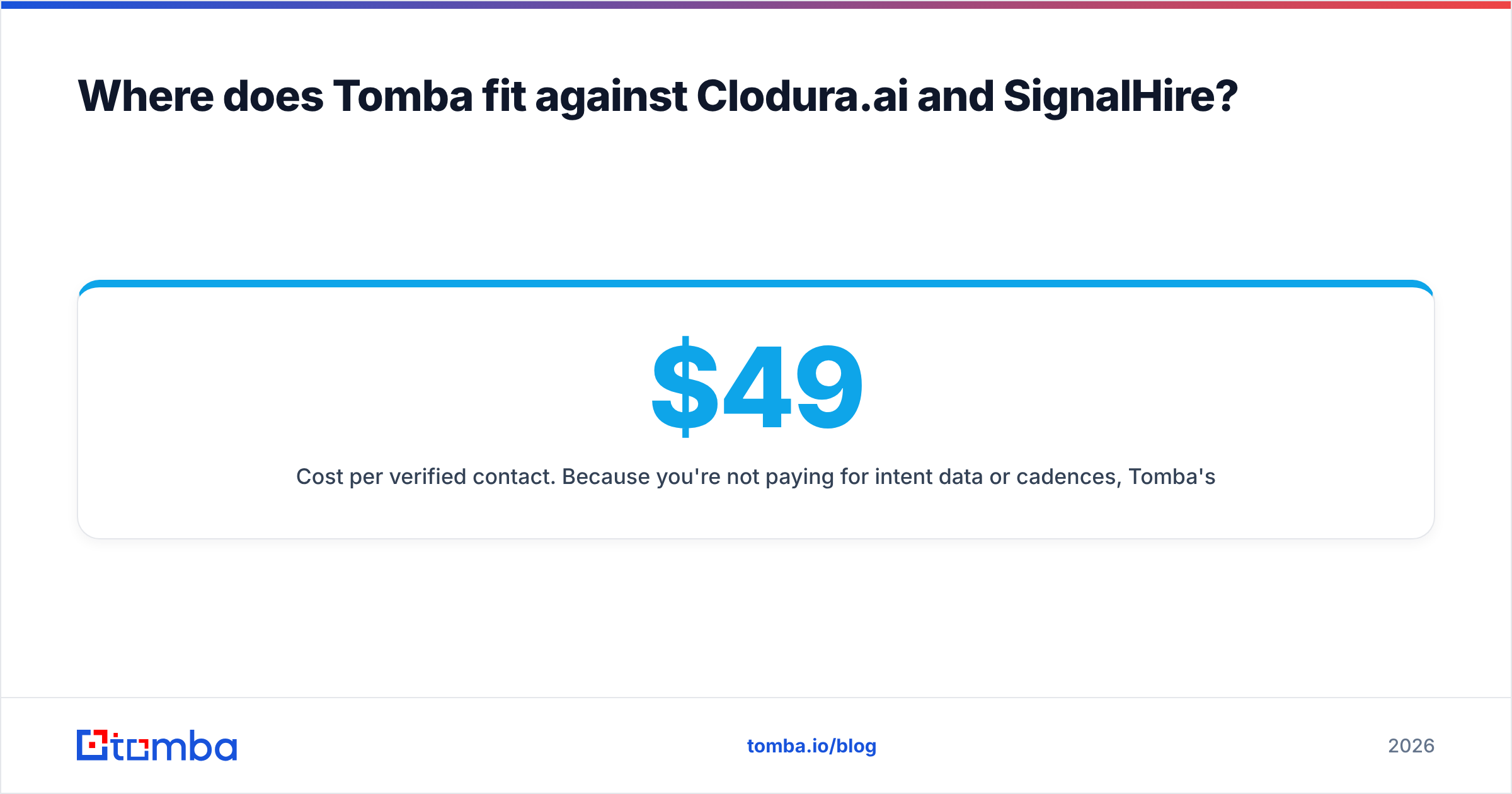
- Cost per verified contact. Because you're not paying for intent data or cadences, Tomba's pricing is built around the finding-and-verifying job. The Free tier gives you 25 searches/month, Starter is $49/mo, Growth $99/mo, and Pro $249/mo — so you scale on the work you actually do.
- Scale via automation. The Tomba API, bulk tools, and spreadsheet add-ons mean you can enrich thousands of rows without clicking through profiles one at a time. If you run outbound programmatically, this is a different league from a browser-extension workflow.
- Verification built in. Every find can be checked, catch-all domains flagged, and lists cleaned before they ever hit your sequencer — protecting the deliverability the whole campaign depends on.
- Complementary, not either/or. Plenty of teams keep SignalHire for mobile numbers or Clodura for intent, and route their high-volume email finding and verification through a focused tool to keep cost and accuracy in check.
If your real problem is "I need reliable work emails, fast, and I don't want to overpay for modules I'll never open," a dedicated finder plus verifier is the leaner answer. For phone-heavy workflows, Tomba also offers a phone finder so you're not locked out of that channel.
Frequently asked questions#
Is SignalHire better than Clodura.ai for recruiting? Generally yes. SignalHire's strength in personal emails and mobile numbers, plus its LinkedIn-first extension, fits sourcing candidates better than Clodura's sales-suite design. Clodura shines for outbound sales teams that want intent data and cadences too.
Does Clodura.ai include email sequences? Yes. Built-in cadences are one of Clodura's differentiators — you can prospect and run multi-step email outreach in the same platform, which SignalHire doesn't focus on.
Can I use these tools together with a dedicated email finder? Absolutely. A common stack keeps one tool for phones or intent and routes bulk email finding and verification through a focused finder to control cost per contact and protect deliverability.
Which is cheaper, Clodura.ai or SignalHire? For low-to-moderate contact volume, SignalHire's credit plans are usually cheaper to start. Clodura's per-seat pricing only pays off if your team uses the full suite.
The bottom line#
Clodura.ai and SignalHire both do real work: Clodura as an all-in-one intelligence-and-cadence suite, SignalHire as a fast, credit-friendly contact finder. Choose Clodura if you want everything in one workspace and will use the extras; choose SignalHire if you need emails and phones on demand without the overhead.
But if you zoom out, most teams' core need is simpler than either suite assumes — accurate, verified emails delivered at scale. That's exactly the job the Tomba Email Finder is built for. Start on the free tier, run your own accuracy test against whatever else you're using, and let the valid-rate decide. The best prospecting stack is the one that gets the right person's inbox for the lowest cost — not the one with the most tabs.
Related guides#
Ready to find emails that actually work?
Join 150,000+ professionals who stopped guessing and started sending. Free credits on signup — no credit card required.
Get the Tomba newsletter
Practical outbound tactics and product updates — once every two weeks.
About the author