Clodura.ai vs Success.ai (2026): Which Sales Tool Wins?
Clodura.ai and Success.ai both promise pipeline on autopilot, but they solve different problems. Here's an honest, feature-by-feature breakdown to help you pick the right one in 2026.
If you're comparing cloduraai vs successai, you're not alone. On the surface, Clodura.ai and Success.ai look like the same product: AI finds leads, AI sends emails, you close deals. Dig one layer down, though, and they solve two different jobs. This breakdown gives you the honest version. You'll see where each tool is strong, where each one quietly falls short, and how to choose without burning a month of trial credits.
TL;DR — Clodura.ai vs Success.ai at a glance#
Here's the quick cloduraai vs successai summary:
- Clodura.ai is a sales-intelligence platform first: a B2B contact database, org charts, buying-intent signals, and sequencing bolted on top. Best if your bottleneck is finding and researching the right accounts.
- Success.ai is a cold-email engine first: a large contact pool feeding unlimited sender accounts, warmup, and automated sequences. Best if your bottleneck is sending volume at low cost.
- Data accuracy is the real deciding factor for both, and neither is bulletproof. Verify every list before you send, no matter which you pick.
- Pricing: Success.ai wins on raw affordability and "unlimited" positioning; Clodura wins on depth of research per contact.
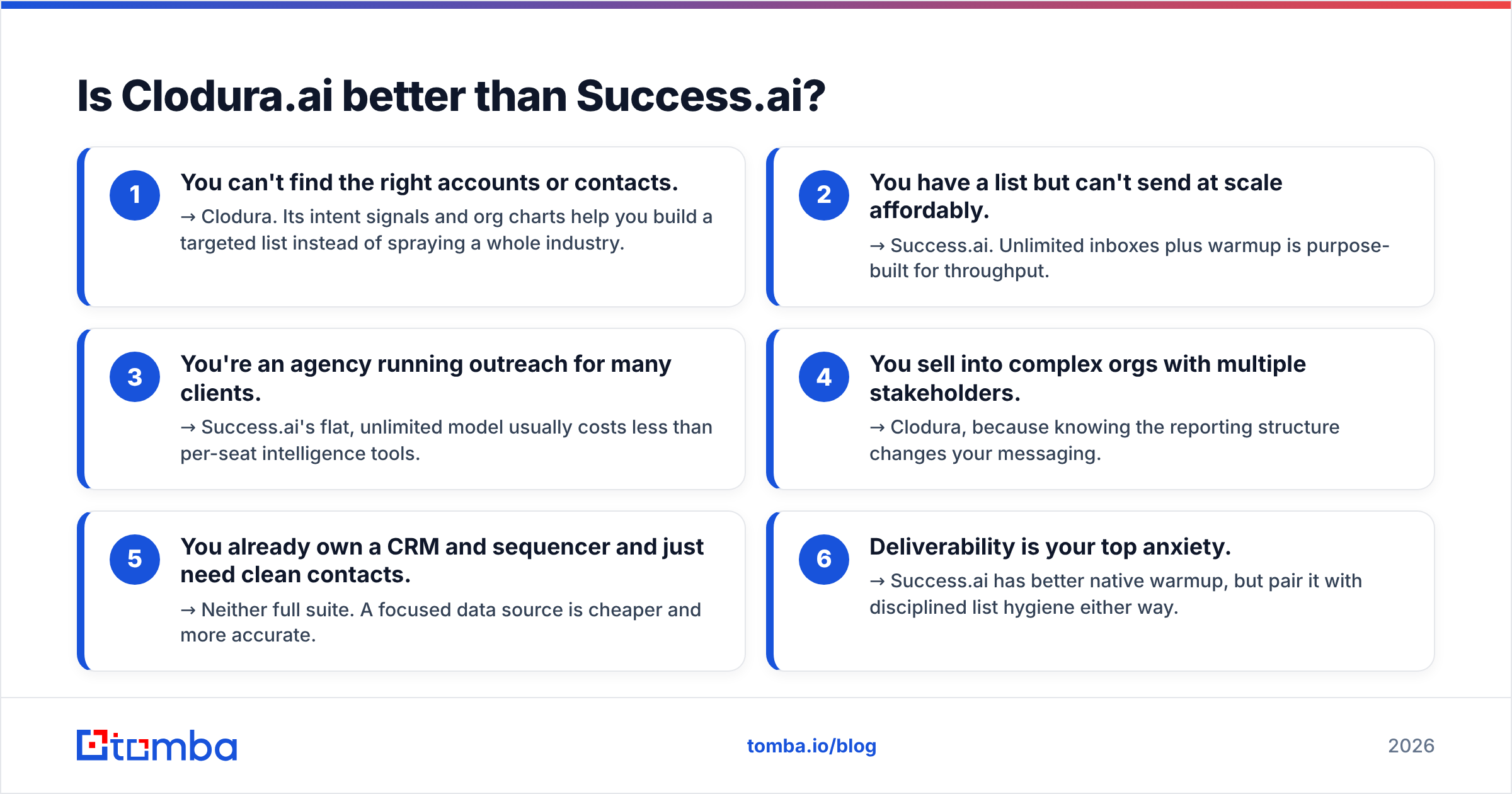
- If you mainly need clean, verified emails to plug into a workflow you already run, a dedicated finder like the Tomba Email Finder is often cheaper and more accurate than paying for a full suite you'll half-use.
What is Clodura.ai?#
Clodura.ai is an all-in-one sales prospecting platform that leads with data. Its pitch is a database of hundreds of millions of B2B contacts. Each one is enriched with direct dials, org charts, technographics, and "buying intent" triggers (funding rounds, hiring signals, tech installs). On top of that data layer it adds email sequencing, a meeting scheduler, and email verification.
The mental model: Clodura wants to be the place your reps research a territory. You filter an industry and see who the decision-makers are. You map the reporting structure, catch a trigger event, then launch a sequence. You do all of it without leaving the tool. That research depth is its genuine differentiator. You can read more on their own positioning at clodura.ai.
The trade-off is that a wide platform spreads itself thin. The database is large but variable in freshness. The sequencing is competent rather than best-in-class. And you pay for breadth whether or not you use every module.
What is Success.ai?#
Success.ai is a cold-outreach platform built around volume and price. Its headline features are a large B2B lead pool (marketed in the 700M+ contact range), unlimited email sending accounts, automated inbox warmup, and AI-assisted sequence writing. The promise is simple: load leads, spin up dozens of sending inboxes, warm them, and send at scale for a flat, low monthly fee.
The mental model here is different from Clodura. Success.ai assumes you already know who you want to reach. Your constraint is throughput — getting thousands of personalized emails delivered without torching your domain reputation. Its unlimited-inbox angle is aimed squarely at agencies and high-volume outbound teams. You can see their feature list at success.ai.
The trade-off: when a platform optimizes for cheap volume, data hygiene and deliverability discipline become your job. Big pools contain stale and catch-all addresses. Sending hard into an unverified list is the fastest way to land in spam.
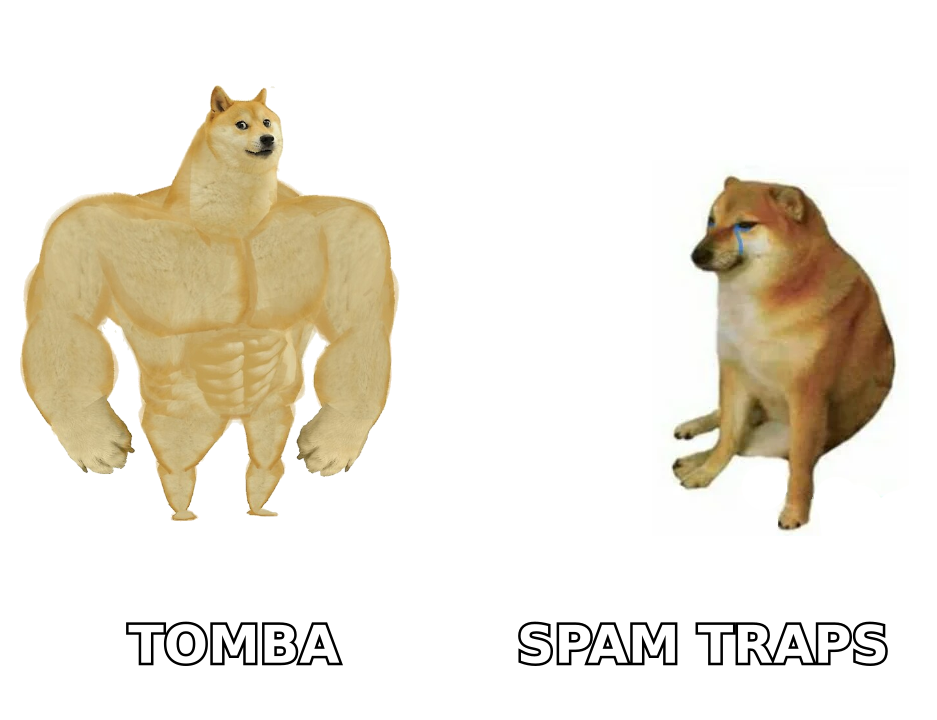
Clodura.ai vs Success.ai: full comparison table#
| Attribute | Clodura.ai | Success.ai |
|---|---|---|
| Primary strength | Sales intelligence + research | High-volume cold email |
| Database size (claimed) | ~600M+ contacts | ~700M+ contacts |
| Intent / trigger signals | Yes (funding, hiring, tech) | Limited |
| Org charts & direct dials | Yes | No / minimal |
| Sending inboxes | Standard sequencing | Unlimited inboxes |
| Built-in warmup | Basic | Yes (a core feature) |
| Email verification | Included | Included, but verify again |
| Best-fit team | AE/SDR research-led teams | Agencies, volume outbound |
| Entry pricing | Mid-tier per seat | Low flat monthly |
| Learning curve | Moderate–steep | Light |
Use this cloduraai vs successai table as a starting filter, not a verdict. The row that matters most is the "best-fit" one. Pick the platform whose primary strength matches your actual bottleneck.
Is Clodura.ai better than Success.ai?#
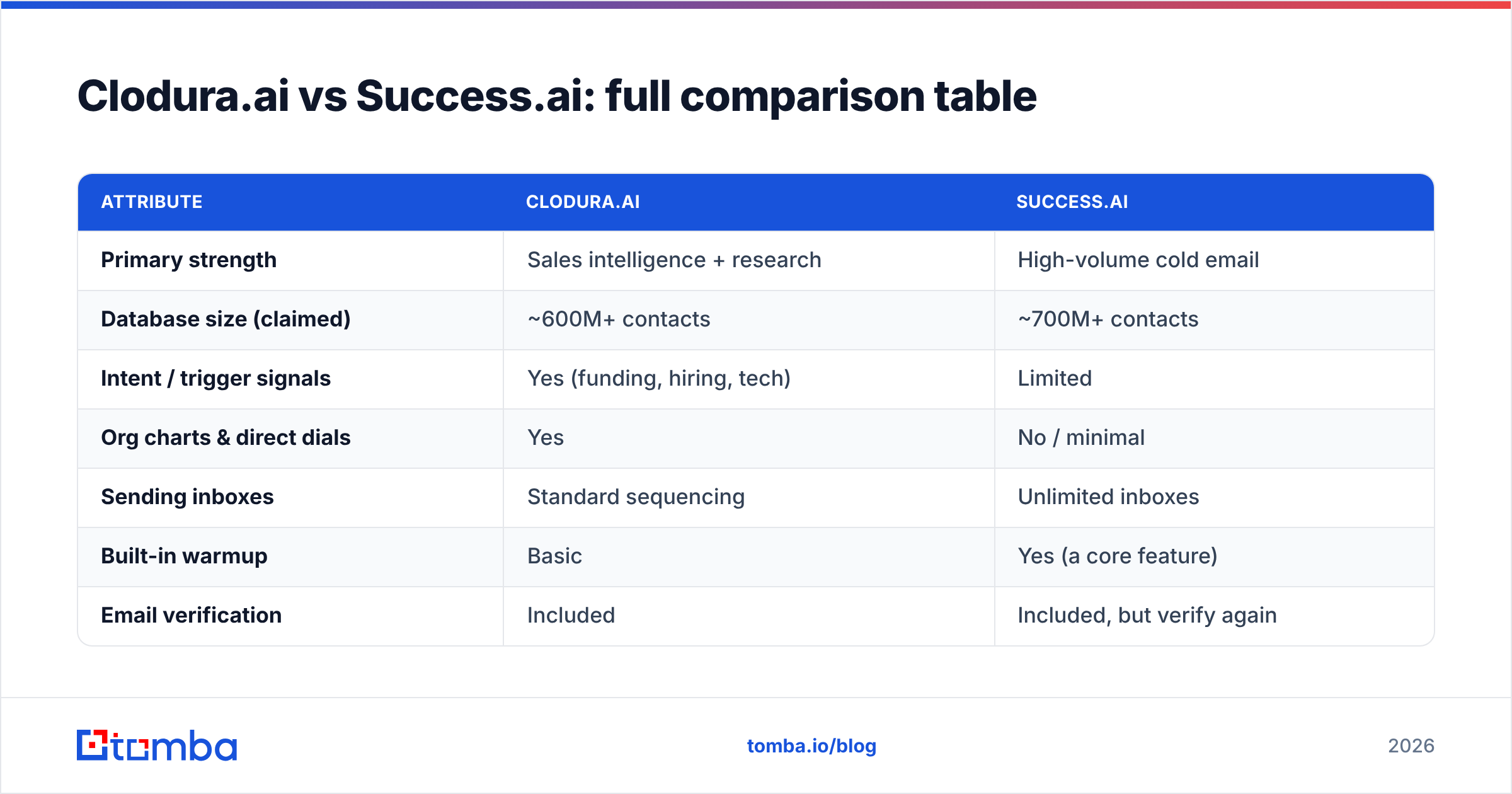
It depends entirely on which half of the funnel is broken. Here's the honest decision framework, as a short checklist:
- You can't find the right accounts or contacts. → Clodura. Its intent signals and org charts help you build a targeted list instead of spraying a whole industry.
- You have a list but can't send at scale affordably. → Success.ai. Unlimited inboxes plus warmup is purpose-built for throughput.
- You're an agency running outreach for many clients. → Success.ai's flat, unlimited model usually costs less than per-seat intelligence tools.
- You sell into complex orgs with multiple stakeholders. → Clodura, because knowing the reporting structure changes your messaging.
- You already own a CRM and sequencer and just need clean contacts. → Neither full suite. A focused data source is cheaper and more accurate.
- Deliverability is your top anxiety. → Success.ai has better native warmup, but pair it with disciplined list hygiene either way.
Notice that half of those answers point away from buying a full suite. That's the uncomfortable truth of the category. A lot of teams pay for an all-in-one platform to solve one narrow problem — usually "give me a valid email for this person."
How accurate is the data in each tool?#
This is where both tools should be judged hardest. Everything downstream — deliverability, reply rate, sender reputation — depends on it.
Large B2B databases are compiled from scraping, third-party licensing, and user contributions. They then decay at roughly 2–3% per month as people change jobs. A "700M contacts" headline tells you nothing about how many are current, role-accurate, and safe to email today. Independent reviews on G2 show accuracy complaints against nearly every provider in this space, Clodura and Success.ai included. That isn't a knock on either brand. It's the physics of static databases.
The practical implication: treat every exported list as unverified until proven otherwise. Run it through real-time verification before your first send. Catch-all domains, role addresses (info@, sales@), and long-dormant contacts are the three biggest silent killers of a campaign. A dedicated email verifier or a catch-all verifier will strip those out and protect the domain reputation you spent months building.
If your list came from a static database, add fresh data enrichment at send-time. Pull the current email and title rather than the one cached six months ago. It's the single highest-leverage habit in outbound. It's also why many teams keep a real-time finder in the stack even when they own a big-suite subscription.
Clodura.ai vs Success.ai: pricing reality check#
Neither vendor makes true apples-to-apples pricing easy. So compare on cost per usable contact, not sticker price.
- Success.ai leads with a low flat monthly fee and "unlimited" sending, which is genuinely attractive for agencies. The catch: unlimited sending is not unlimited good data. If a third of your pulled contacts bounce or sit in catch-all limbo, your effective cost per delivered, verified email climbs fast.
- Clodura.ai charges more per seat and gates advanced intent data behind higher tiers. You're paying for research depth. If your reps actually use the org charts and triggers, the price is defensible. If they don't, you're subsidizing features you ignore.
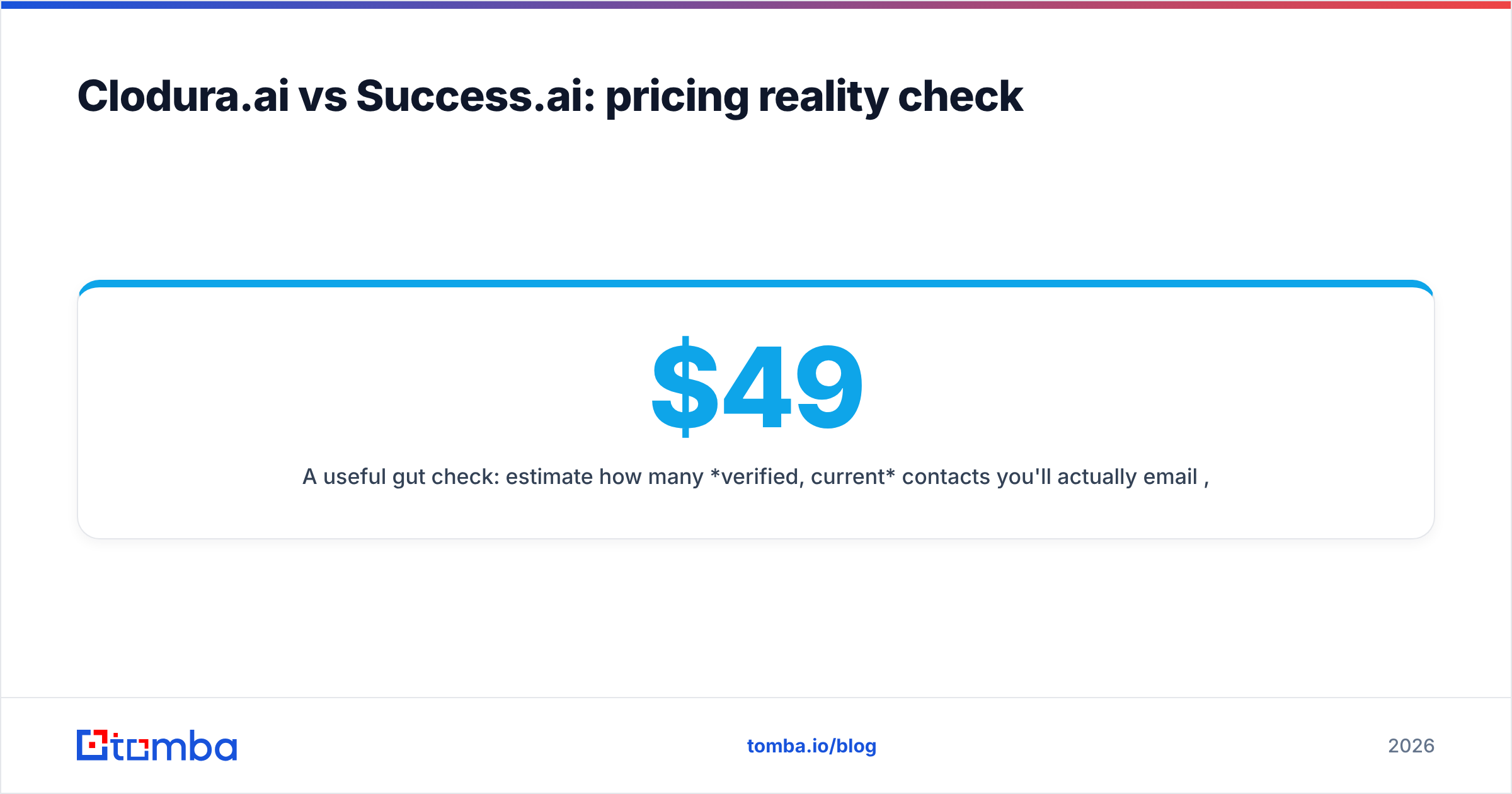
A useful gut check: estimate how many verified, current contacts you'll actually email per month. Divide the subscription by that number, then compare. Suites often look cheap per record until you subtract the dead data. For comparison, a usage-based finder such as Tomba's plans starts free (25 searches/month) and moves to $49/month Starter, $99/month Growth, and $249/month Pro. You pay for records you keep, not seats you half-use.
Where does a dedicated email finder fit in?#
A focused finder is the layer that keeps either suite honest. Whichever platform you choose, sooner or later you'll need a specific person's verified email — a referral, an inbound lead, a name from a LinkedIn thread. You don't want to buy another seat or wait on a stale database row.
That's the gap tools like Tomba fill. Instead of renting a giant static list, you look up exactly the contact you need, on demand. You get a verified result with a confidence score. Common patterns:
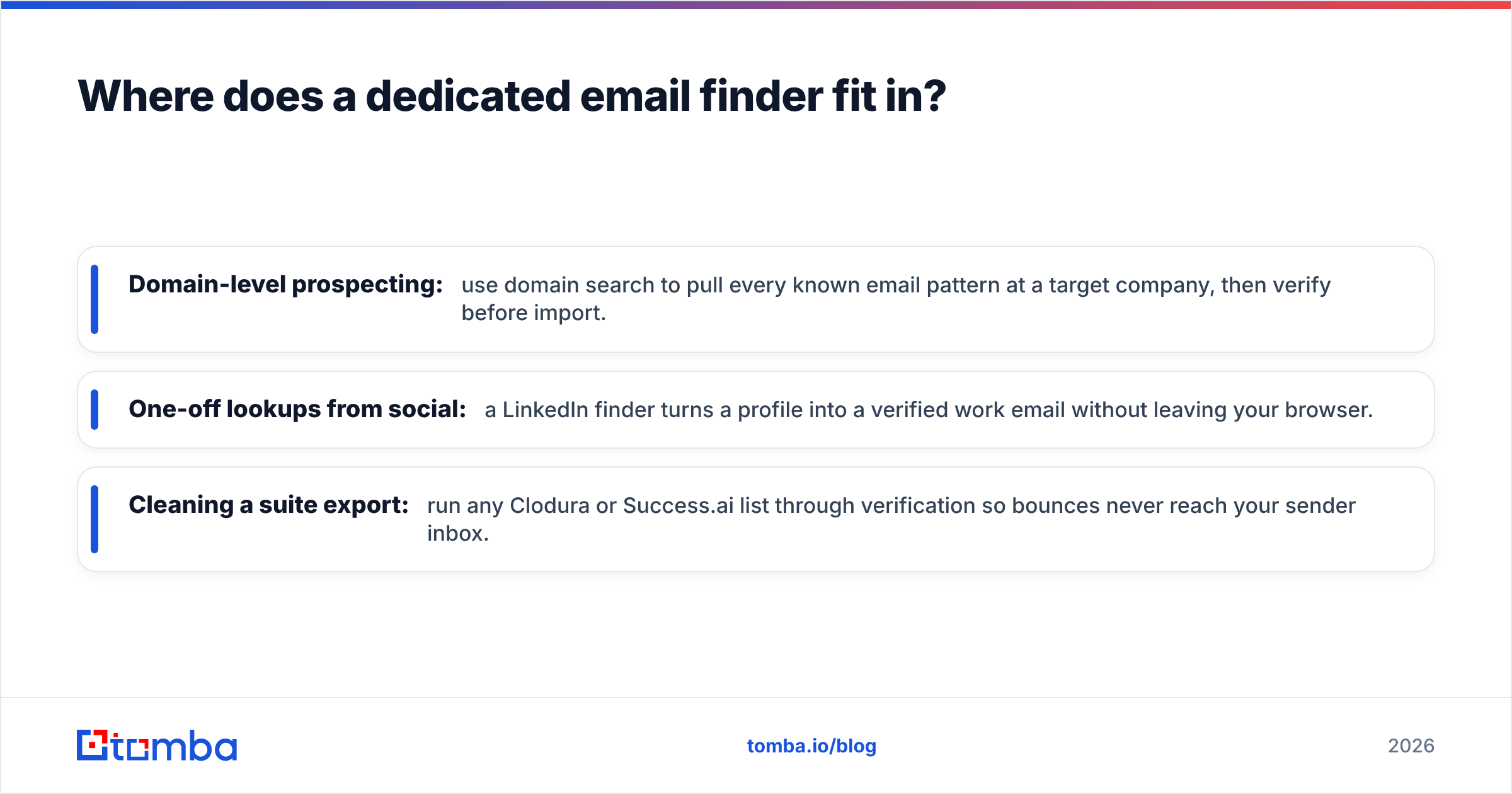
- Domain-level prospecting: use domain search to pull every known email pattern at a target company, then verify before import.
- One-off lookups from social: a LinkedIn finder turns a profile into a verified work email without leaving your browser.
- Cleaning a suite export: run any Clodura or Success.ai list through verification so bounces never reach your sender inbox.
This is also why buyers researching an Apollo alternative or a RocketReach alternative often land on a finder-plus-verifier combo rather than a fourth all-in-one platform. The stack gets simpler, not heavier.
Cloduraai vs successai: which should you choose in 2026?#
Here's the plain recommendation:
- Pick Clodura.ai if your team is research-led, sells into complex organizations, and will genuinely use intent signals and org charts to shape messaging. Its depth is real, and it justifies the higher per-seat cost when reps lean on it daily.
- Pick Success.ai if you're an agency or high-volume team whose constraint is sending throughput at a predictable low price, and you have the discipline to verify lists and manage warmup yourself.
- Pick neither as your core if what you actually need is clean, current contact data feeding a CRM and sequencer you already trust. In that case, pair a precise finder with a strong verifier and skip the suite tax.
The mistake to avoid is buying a broad platform to solve a narrow problem. Both Clodura and Success.ai are capable in their lane. Just be honest about which lane you're in before the annual invoice lands.
The bottom line#
The cloduraai vs successai question isn't really "which is better." It's "which bottleneck are you solving." Clodura buys you research depth. Success.ai buys you sending scale. Data accuracy is the shared weak point, and it's the one you control with good verification habits — no matter the logo on the dashboard.
If your real need is verified emails on demand, without a per-seat suite you'll only partly use, start with the Tomba Email Finder. Find the exact contacts you need, get a confidence score on every result, and verify before you send. Then your reply rate reflects your message instead of your data hygiene. The free tier gives you 25 searches a month to test it against your current list before you commit to anything bigger.
Related guides#
// get started
Find, verify and enrich your first contacts today
Start on the free plan with 25 searches a month, then scale when your team is ready.
Free plan · No credit card required · GDPR & CCPA
// about the author