Cloduraai vs Tomba: Email Finder Accuracy & Pricing Test
Clodura.ai bundles a sales-intelligence suite; Tomba focuses on finding and verifying B2B emails. Here's an honest breakdown of accuracy, pricing, and which one fits your workflow in 2026.
Choosing between Clodura.ai and Tomba comes down to one question. Do you want an all-in-one sales-intelligence platform, or a focused email finder you can plug into the stack you already have? This cloduraai vs tomba comparison answers that simply. Both tools find B2B contact data, but they solve the problem from opposite ends. Below we break down accuracy, pricing, data coverage, and real-world fit. By the end, you can pick without buyer's remorse.
TL;DR — Clodura.ai vs Tomba at a glance#
- Clodura.ai is a broad sales-intelligence suite: a prospecting database, buyer-intent signals, email sequences, and a built-in dialer. Great if you want prospecting, outreach, and cadence in one login.
- Tomba is a specialist email finder and verifier with a strong API, browser extension, and spreadsheet add-ons. Great if you want the cleanest possible emails feeding tools you already use.
- Accuracy: Tomba pairs domain-pattern discovery with SMTP verification. That tends to lower bounce rates on niche and non-US domains. Clodura leans more on its static database, which is deep for North American accounts.
- Pricing: Tomba starts at $49/mo with a genuine free tier (25 searches). Clodura offers a free plan too, but it pushes you toward higher tiers for verified data and sequencing.
- Verdict: Pick Clodura if you want an end-to-end outbound platform. Pick Tomba if accuracy, verification, and integration flexibility matter most.
What is Clodura.ai?#
Clodura.ai is a B2B sales-intelligence and sales-engagement platform. Instead of doing one job well, it aims to cover the full top-of-funnel. That includes a contact and company database (the company advertises hundreds of millions of contacts), buyer-intent and technographic data, org charts, an email-sequencing engine, and a click-to-call dialer.
The pitch is consolidation. A sales development rep can build a list, verify a handful of emails, drop prospects into a cadence, and dial them — all without leaving the app. For teams that hate stitching five tools together, that's appealing.
The trade-off is the usual one for suites. Each module is competent rather than best-in-class, and pricing climbs quickly once you need verified data volume and multiple seats. You can see the full feature set on the official Clodura.ai site.
What is Tomba?#
Tomba is a focused email finder and verification platform. Its core job is simple. It turns a name plus a company domain into a deliverable email address, then proves that address is real before you send.
Where Clodura sells breadth, Tomba sells depth on one problem. The toolset around the finder reflects that: an email verifier, domain search for pulling every address on a company domain, a catch-all verifier, phone finder, and enrichment — plus a robust Tomba API, a Chrome extension, and Google Sheets and Excel add-ons.
That makes Tomba less of a destination and more of an engine. You point it at your CRM, your prospecting list, or your outreach tool, and it feeds clean data in. If you already run Apollo, Instantly, HubSpot, or a homegrown workflow, Tomba slots in rather than replacing it.
How accurate is each tool at finding emails?#
Accuracy is where these two philosophies diverge most, so it deserves the most scrutiny.

Clodura.ai works mainly from its stored database. When a contact exists in that database and was recently refreshed, you get an instant result with firmographic context attached. The weakness is staleness and coverage. Database records decay because people change jobs constantly, and coverage is strongest for North American mid-market and enterprise accounts. Outside that sweet spot — smaller companies, EMEA, APAC, non-English domains — hit rates fall and you face more outdated records.
Tomba combines pattern discovery with live verification. It infers a company's email format from known public addresses, generates the candidate, and then runs SMTP-level checks to confirm the mailbox exists. Verification happens at request time rather than from a cached snapshot. So bounce rates tend to stay lower on the long tail of smaller and international domains. Tomba is transparent about where its data comes from on its data sources page, and it exposes a confidence score so you can filter aggressively before a campaign.
The practical takeaway is short. If your ICP is squarely North American enterprise, Clodura's database will feel fast and full. If you prospect broadly — niche verticals, international markets, or fast-moving startups — Tomba's verify-at-send-time model protects your sender reputation better.
Neither tool is magic. Any vendor claiming 99% accuracy across all domains is rounding up. What matters is whether the tool tells you its confidence and lets you drop the risky ones. Both do, and Tomba does it more granularly.
Cloduraai vs Tomba: feature and pricing comparison#
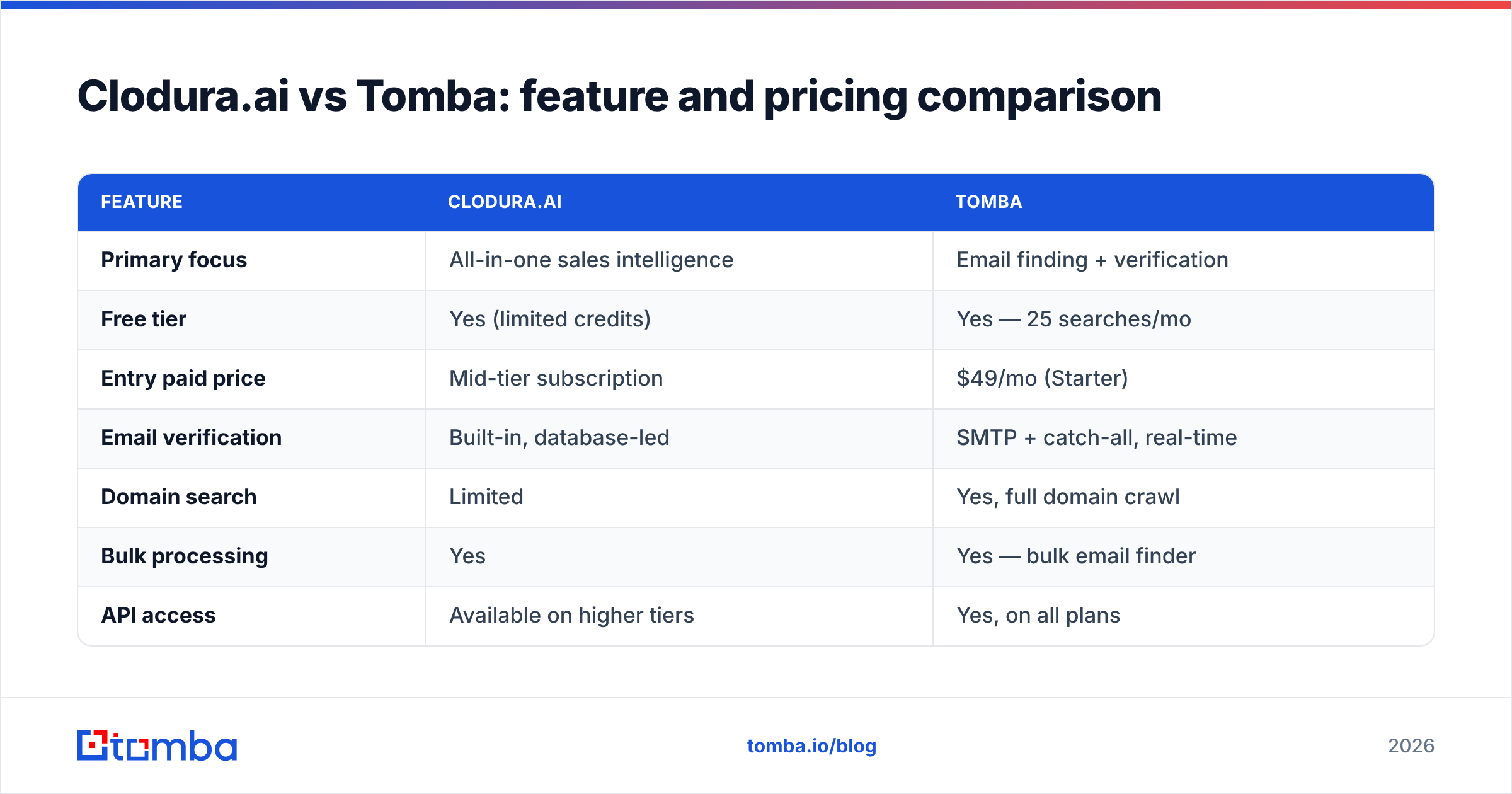
Here's the head-to-head on the attributes that actually change your monthly bill and your bounce rate.
| Feature | Clodura.ai | Tomba |
|---|---|---|
| Primary focus | All-in-one sales intelligence | Email finding + verification |
| Free tier | Yes (limited credits) | Yes — 25 searches/mo |
| Entry paid price | Mid-tier subscription | $49/mo (Starter) |
| Email verification | Built-in, database-led | SMTP + catch-all, real-time |
| Domain search | Limited | Yes, full domain crawl |
| Bulk processing | Yes | Yes — bulk email finder |
| API access | Available on higher tiers | Yes, on all plans |
| Email sequences / cadence | Yes (native) | No (integrates instead) |
| Built-in dialer | Yes | No (phone finder only) |
| Buyer-intent data | Yes | No |
| Chrome extension | Yes | Yes |
| Best for | End-to-end outbound teams | Accuracy-first data workflows |
For exact numbers on the Tomba side, the current Tomba pricing tiers are Free (25 searches), Starter $49/mo, Growth $99/mo, Pro $249/mo, and custom Enterprise. Clodura's public pricing is more tier-gated. Several of the features that make it attractive — verified data volume, sequencing seats, intent — live on its higher plans. So the sticker price and the price you actually pay can differ.
Which one has better data coverage and enrichment?#
Coverage is a wash until you define your market.
Clodura's database advantage is real for account-based, North America-heavy motions. You get org charts, technographics, and intent signals bundled with the contact. That shortens research time for SDRs working named accounts. The context is genuinely useful when you personalize at the account level.
Tomba's advantage is freshness and reach on the long tail. Because it discovers and verifies on demand, it isn't limited to whoever sits in a pre-built database. Pair the finder with data enrichment and you can append job titles, company details, and social profiles to a raw list. For teams that already have a list of target domains and just need reliable contacts, that's often all they need.
If you're weighing coverage claims, don't take either vendor's headline contact count at face value. Check independent reviews on G2 for how each performs in your segment. Contact counts measure the size of the haystack, not how many needles are still sharp.
When should you choose Clodura.ai?#
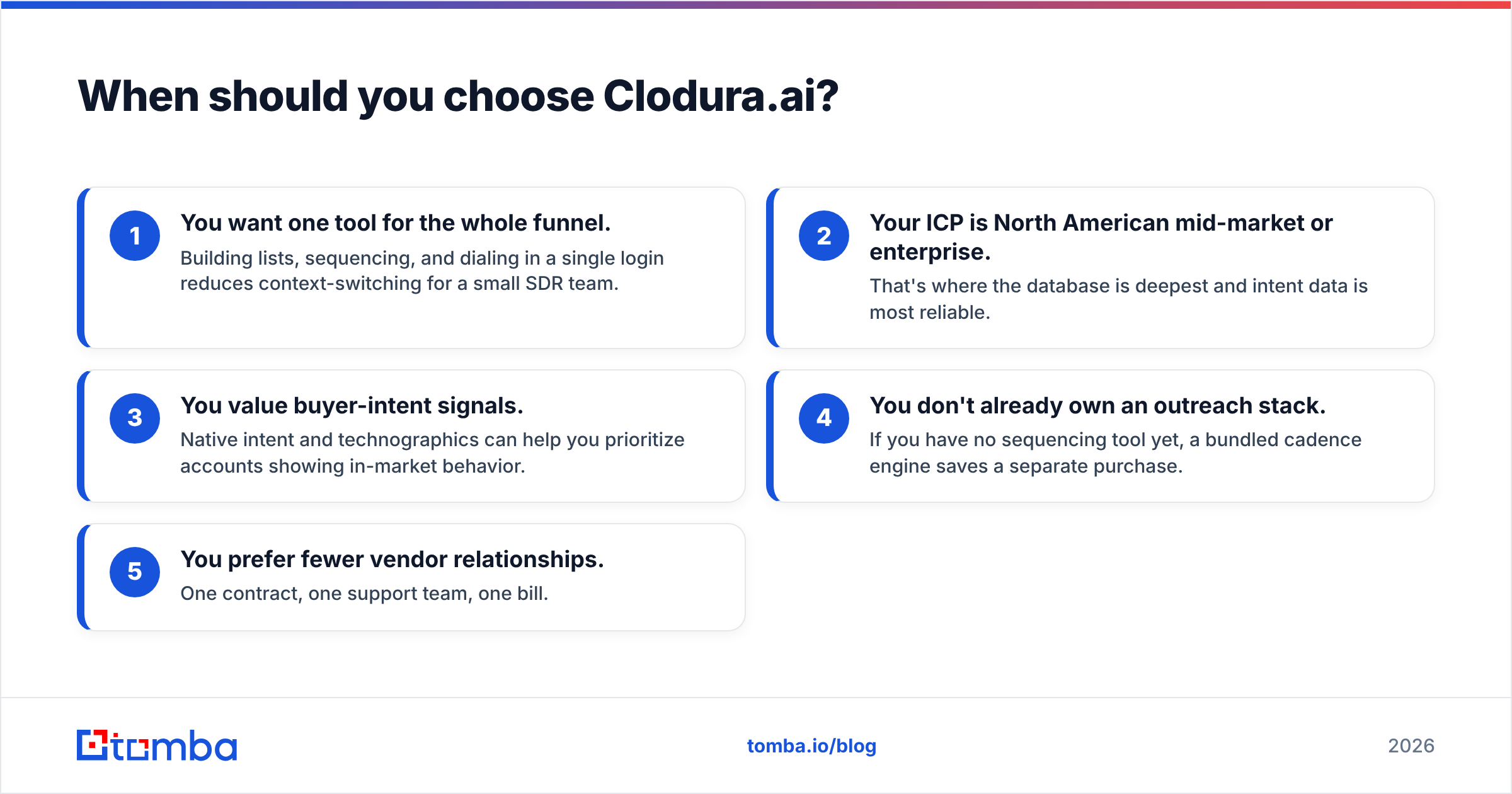
Clodura.ai is the better pick when the platform value outweighs raw email accuracy. Choose it if:
- You want one tool for the whole funnel. Building lists, sequencing, and dialing in a single login reduces context-switching for a small SDR team.
- Your ICP is North American mid-market or enterprise. That's where the database is deepest and intent data is most reliable.
- You value buyer-intent signals. Native intent and technographics can help you prioritize accounts showing in-market behavior.
- You don't already own an outreach stack. If you have no sequencing tool yet, a bundled cadence engine saves a separate purchase.
- You prefer fewer vendor relationships. One contract, one support team, one bill.
The risk to weigh is suite lock-in and paying for modules you underuse. If you only need clean emails, you'll be subsidizing the dialer and sequencer you never touch.
When should you choose Tomba?#
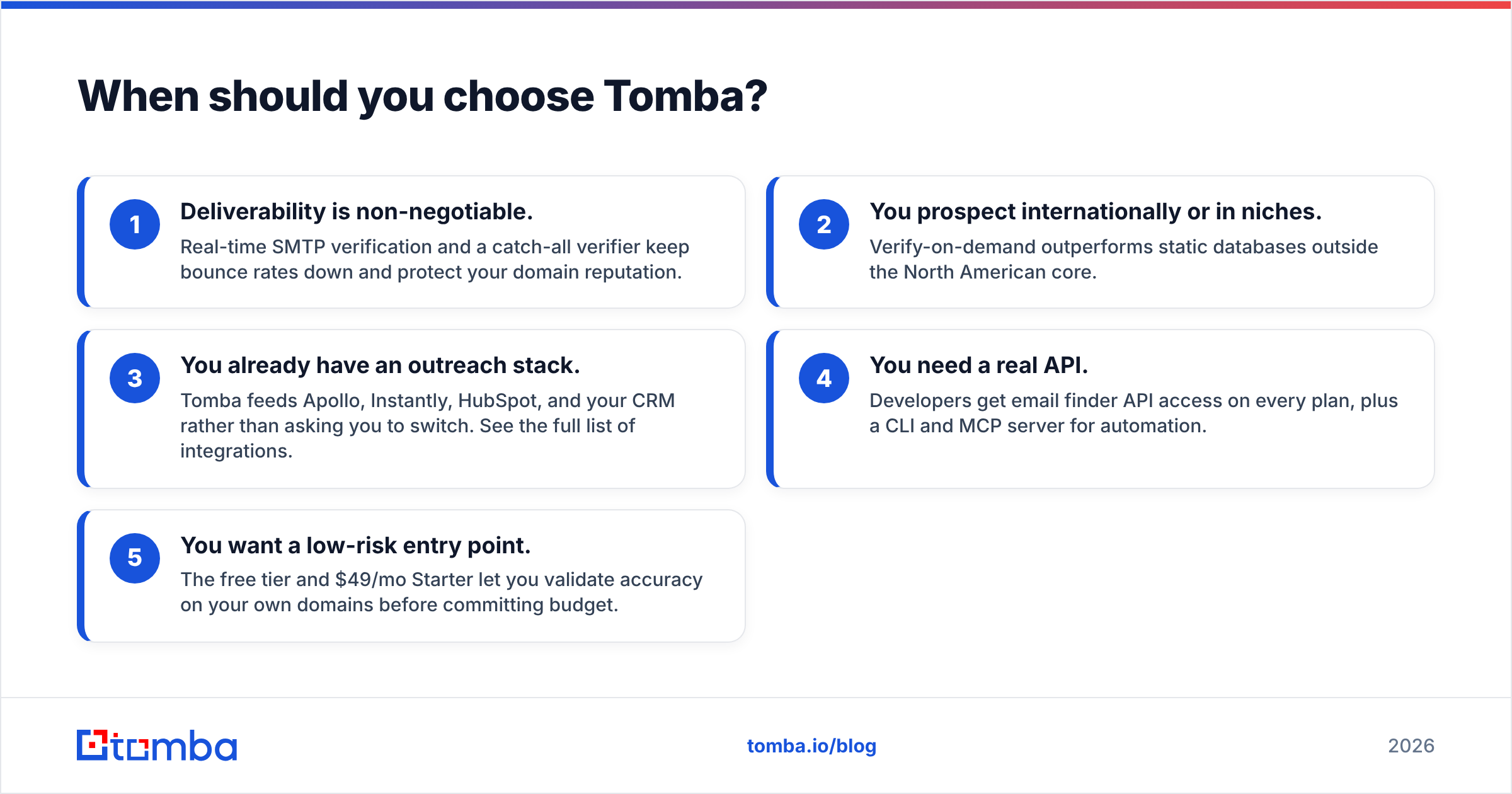
Tomba is the better pick when accuracy and flexibility beat all-in-one convenience. Choose it if:
- Deliverability is non-negotiable. Real-time SMTP verification and a catch-all verifier keep bounce rates down and protect your domain reputation.
- You prospect internationally or in niches. Verify-on-demand outperforms static databases outside the North American core.
- You already have an outreach stack. Tomba feeds Apollo, Instantly, HubSpot, and your CRM rather than asking you to switch. See the full list of integrations.
- You need a real API. Developers get email finder API access on every plan, plus a CLI and MCP server for automation.
- You want a low-risk entry point. The free tier and $49/mo Starter let you validate accuracy on your own domains before committing budget.
The trade-off is clear. Tomba won't sequence or dial for you. It's an engine, not a cockpit — which is exactly the point for teams that already have a cockpit.
Clodura.ai vs Tomba: pros and cons#
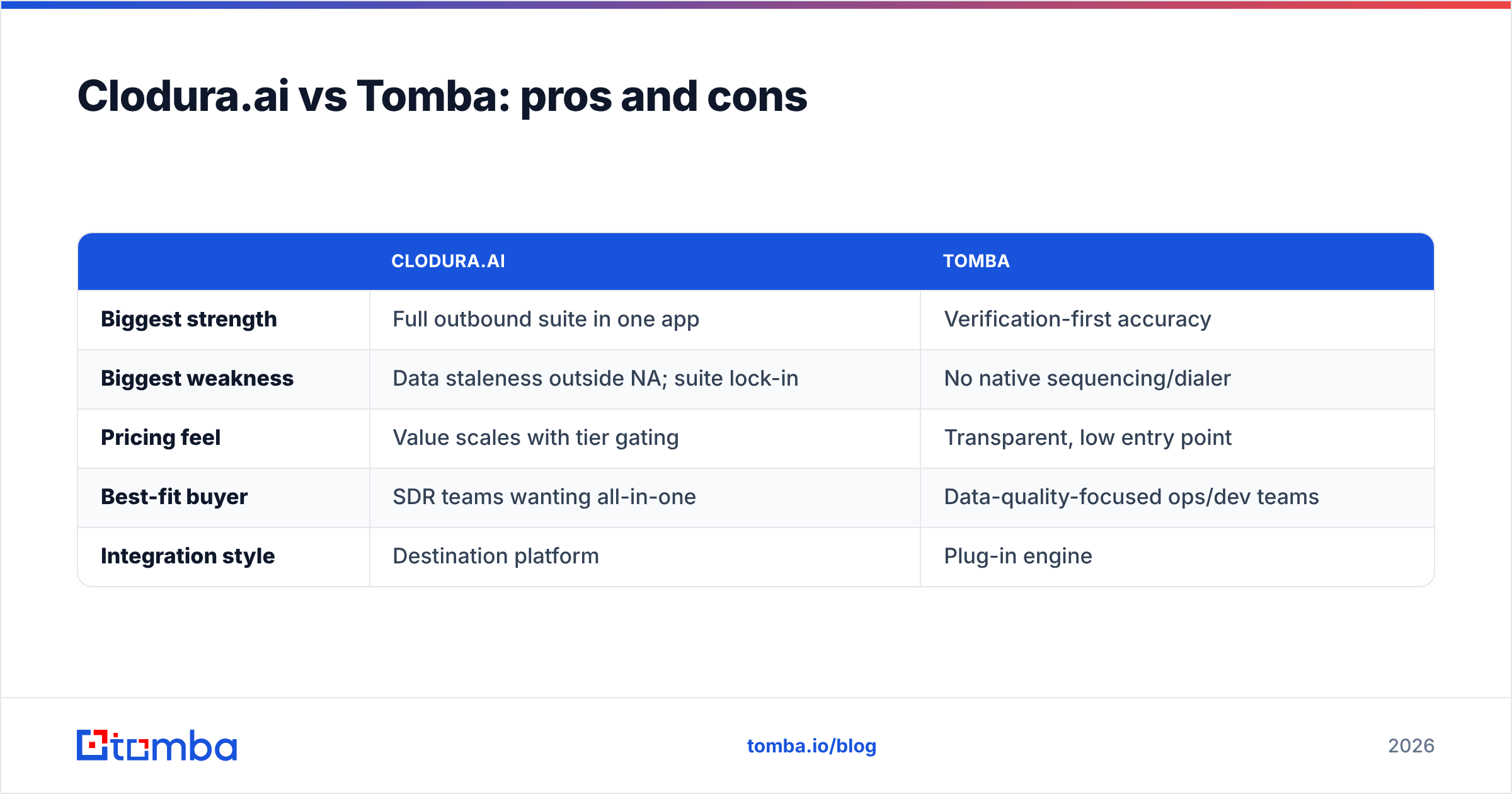
| Clodura.ai | Tomba | |
|---|---|---|
| Biggest strength | Full outbound suite in one app | Verification-first accuracy |
| Biggest weakness | Data staleness outside NA; suite lock-in | No native sequencing/dialer |
| Pricing feel | Value scales with tier gating | Transparent, low entry point |
| Best-fit buyer | SDR teams wanting all-in-one | Data-quality-focused ops/dev teams |
| Integration style | Destination platform | Plug-in engine |
Can you use both together?#
Yes, and plenty of teams do. A common pattern works well. Use Clodura (or any database tool) for account discovery and intent. Then run every email through a dedicated verifier before it enters a campaign. Feeding Clodura-sourced contacts through Tomba's email verification or bulk verification catches decayed records the database missed. That directly lowers your bounce rate.
This "database for discovery, specialist for verification" split is how many revenue teams get the best of both. You get the breadth of a suite and the deliverability of a focused verifier. It's not either/or if your budget allows both.
The bottom line#
In this cloduraai vs tomba matchup, both tools are credible, but they win different buyers. Clodura is the stronger choice for teams that want an end-to-end outbound platform and prospect mostly in North America. Tomba is the stronger choice for teams that treat data quality as the foundation. That means international coverage, real-time verification, a real API, and a price that starts at $49/mo instead of an enterprise commitment.
If your top priority is clean, deliverable emails that feed the tools you already run, start with the Tomba Email Finder. The free tier gives you 25 searches to test accuracy on your own target domains before you spend a dollar. If it holds up, scaling to Starter or Growth is a smaller, safer bet than committing to a full suite you haven't validated. Verify the data first, then decide.
Related guides#
Ready to find emails that actually work?
Join 150,000+ professionals who stopped guessing and started sending. Free credits on signup — no credit card required.
Get the Tomba newsletter
Practical outbound tactics and product updates — once every two weeks.
About the author