Cloduraai vs Truelist (2026): Which Tool Actually Wins?
Clodura.ai is a full sales-intelligence database; Truelist is a lean email verifier. They solve different problems — here's which one fits your pipeline, and where a third option beats both.
Comparing Clodura.ai and Truelist is like comparing a warehouse to a quality-control scanner. One hands you a giant B2B contact database, with sequences and intent data bolted on. The other does one job: it tells you whether an email address will bounce. And it does that fast. So if you searched "cloduraai vs truelist" hoping for a straight feature-for-feature fight, here is the honest answer. The two tools overlap on maybe 20% of what they do.
This guide sorts out where they actually compete, where they don't, and how to pick based on the job you're hiring the tool for.
TL;DR — Cloduraai vs Truelist in five bullets#
- Clodura.ai is an all-in-one sales-intelligence platform: a 600M+ contact database, email finder, verifier, sequences, and buyer-intent signals. It's built to source prospects.
- Truelist is a focused email-verification service. It cleans lists you already have and integrates cleanly via API. It does not source contacts.
- If your problem is "I have no leads," Clodura wins. If your problem is "my list is bouncing," Truelist wins.
- Pricing models are opposite: Clodura sells seats and credits on monthly plans; Truelist sells pay-as-you-go verification credits.
- Many teams end up needing both a finder and a verifier — which is why a consolidated tool like Tomba that does finding and verification under one bill is worth a look before you buy two subscriptions.
What is Clodura.ai?#
Clodura.ai is a B2B sales-intelligence and prospecting platform. Think of it as a prospecting workbench. You search a large contact and company database. You pull verified emails and direct-dial numbers. You load them into built-in email sequences. Then you layer on intent signals that hint which accounts are ready to buy. Its own marketing leans on a database of 600M+ verified B2B contacts and about 120M+ companies.
The pitch is consolidation. Instead of one tool for data, one for outreach, and one for enrichment, Clodura tries to be the whole top-of-funnel stack. That breadth is its strength. Depending on your budget, it is also its weakness. You pay for a lot of surface area whether or not you use it all. You can see the full product scope on the official Clodura.ai site.
Where Clodura fits:
- SDR teams that need net-new contacts every week and want sequences in the same tab.
- Account-based outbound where intent data helps prioritize which companies to hit first.
- Data + outreach in one seat, avoiding the finder-plus-sender tool sprawl.
What is Truelist?#
Truelist is an email-verification tool, full stop. You feed it a list: a CSV, a form submission, or an API call. It then tells you which addresses are deliverable, risky, or invalid. It catches typos, spam traps, and dead mailboxes before you hit send. It sells bulk verification, real-time API checks, and no monthly commitment through pay-as-you-go credits. The official Truelist site frames it around speed and simplicity.
Truelist does not find or source contacts. It assumes you already have addresses — from a form, a scrape, a finder tool, or a purchased list. Its whole reason to exist is protecting your sender reputation by scrubbing that list first.
Where Truelist fits:
- Signup forms that need real-time validation to block junk at the door.
- Cleaning an aging CRM or a list you inherited before a big send.
- Developers who want a clean verification API without a platform wrapped around it.

Cloduraai vs Truelist: the core difference#
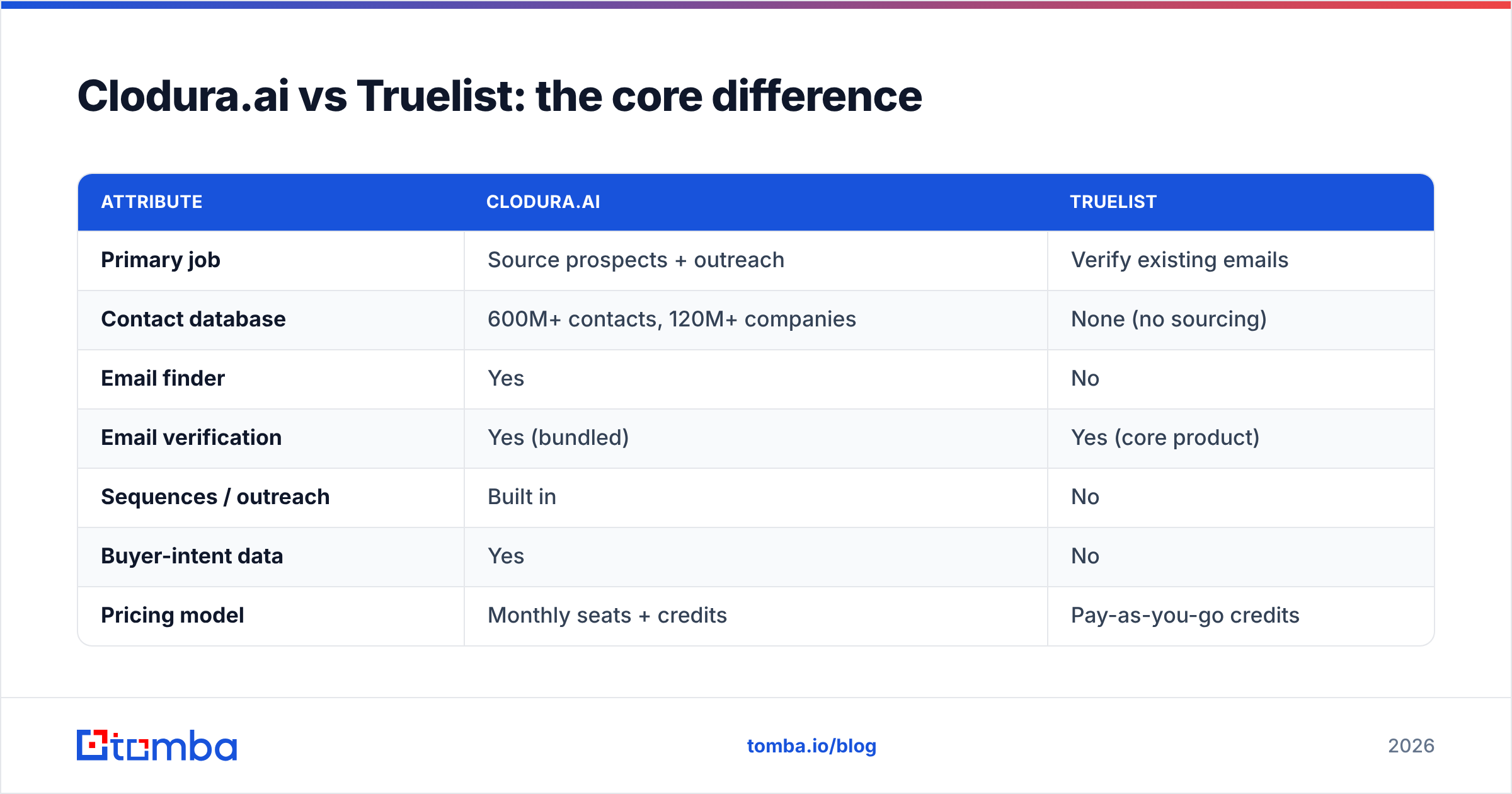
Here's the one sentence that resolves 90% of the "cloduraai vs truelist" confusion: Clodura creates a list; Truelist cleans one. A finder answers "who should I email and what's their address?" A verifier answers "will this address bounce?" You often need both answers. But they are different questions. Buy the wrong tool for your question and you waste money.
The table below lines them up on the attributes that actually change a buying decision.
| Attribute | Clodura.ai | Truelist |
|---|---|---|
| Primary job | Source prospects + outreach | Verify existing emails |
| Contact database | 600M+ contacts, 120M+ companies | None (no sourcing) |
| Email finder | Yes | No |
| Email verification | Yes (bundled) | Yes (core product) |
| Sequences / outreach | Built in | No |
| Buyer-intent data | Yes | No |
| Pricing model | Monthly seats + credits | Pay-as-you-go credits |
| Best for | SDRs building pipeline | Teams cleaning lists |
| API access | Yes | Yes (verification-focused) |
Read that table as two mostly separate tools that share one column: verification. Clodura bundles verification because it has to. Data decays, and unverified data is a liability. Truelist makes verification the whole product. It usually goes deeper on edge cases like catch-all domains and real-time API latency.
Is Clodura.ai better than Truelist?#
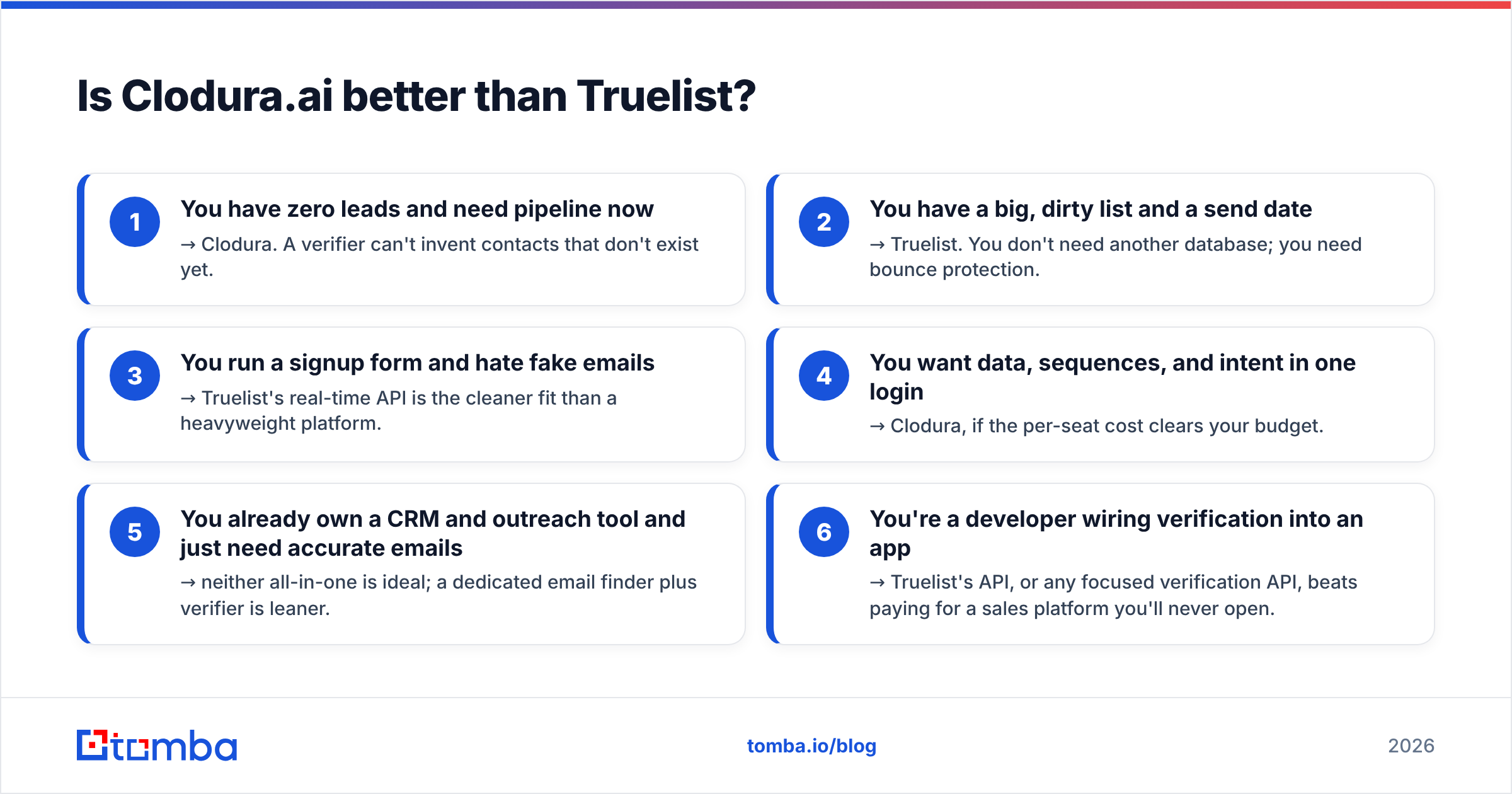
Neither is "better" in the abstract — it depends entirely on the gap in your stack. Use this decision list instead of a scorecard:
- You have zero leads and need pipeline now → Clodura. A verifier can't invent contacts that don't exist yet.
- You have a big, dirty list and a send date → Truelist. You don't need another database; you need bounce protection.
- You run a signup form and hate fake emails → Truelist's real-time API is the cleaner fit than a heavyweight platform.
- You want data, sequences, and intent in one login → Clodura, if the per-seat cost clears your budget.
- You already own a CRM and outreach tool and just need accurate emails → neither all-in-one is ideal; a dedicated email finder plus verifier is leaner.
- You're a developer wiring verification into an app → Truelist's API, or any focused verification API, beats paying for a sales platform you'll never open.
Points 5 and 6 are where a lot of buyers quietly land. They don't want Clodura's full outreach suite. They also don't want only a verifier. They want to turn a name and a company domain into a validated, ready-to-send address. That's a third category, and it's worth naming.
Where a dedicated finder-plus-verifier fits#
Say your real need is simple: find the right email and confirm it's deliverable. A tool built for that one loop is usually cheaper and simpler than a broad platform or a standalone verifier. This is Tomba's lane. You run a domain search to pull every public address at a company. You use the finder to resolve a person's email from their name and domain. Then you verify the result. It all happens in one pass, one API, one bill.
The practical wins of consolidating find + verify:
- One credit system instead of reconciling a database subscription against a separate verification top-up.
- Verification happens at find-time, so you're not exporting to a second tool and re-importing.
- Bulk workflows — upload a list of names and domains, get back verified emails — via the bulk email finder rather than stitching two products together.
- A real free tier to test accuracy on your own domains before paying anything.
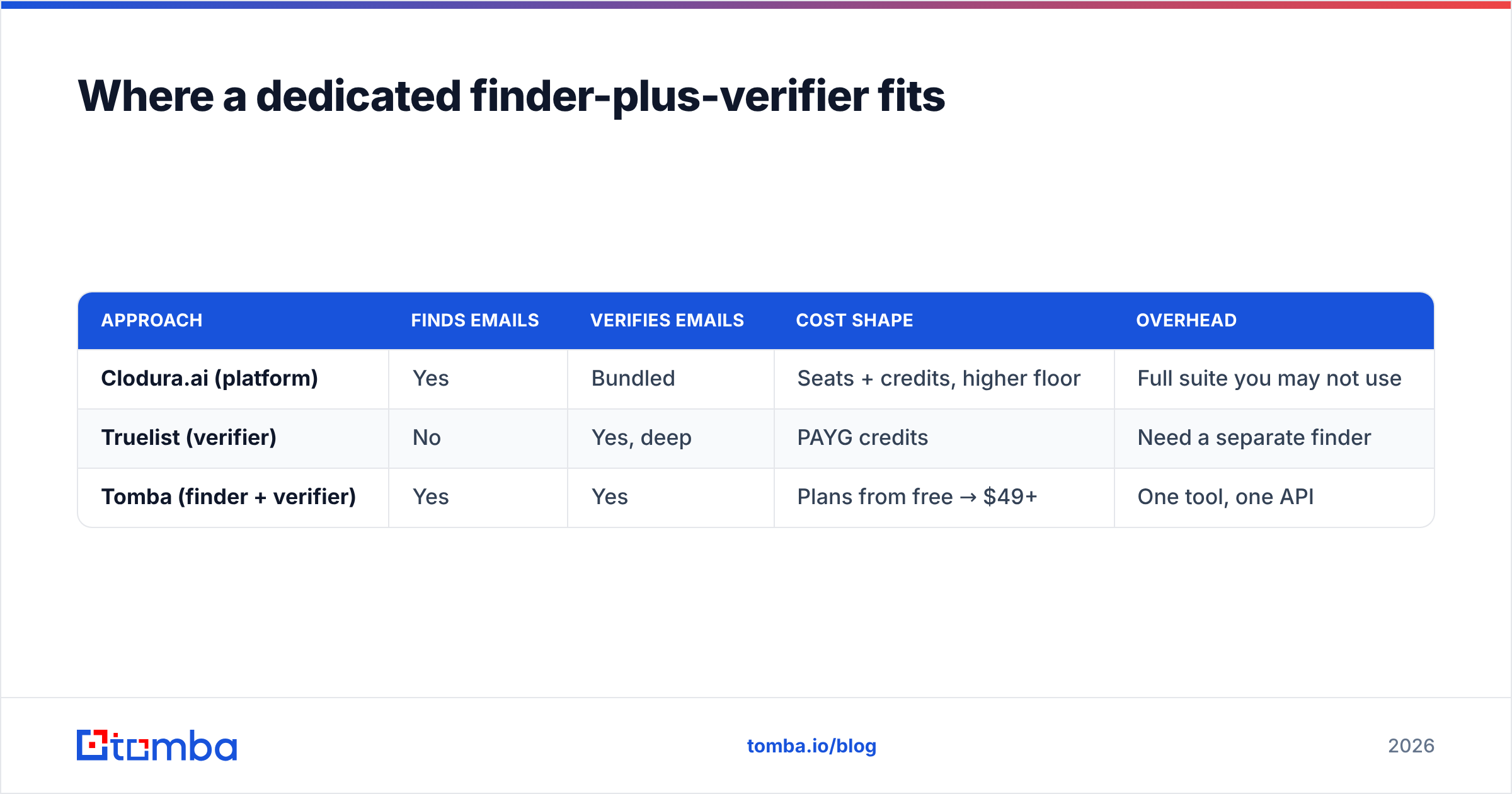
Here's how the three approaches stack up on the "find and verify" job specifically:
| Approach | Finds emails | Verifies emails | Cost shape | Overhead |
|---|---|---|---|---|
| Clodura.ai (platform) | Yes | Bundled | Seats + credits, higher floor | Full suite you may not use |
| Truelist (verifier) | No | Yes, deep | PAYG credits | Need a separate finder |
| Tomba (finder + verifier) | Yes | Yes | Plans from free → $49+ | One tool, one API |
How much do Clodura.ai and Truelist cost?#
Pricing is where the two philosophies diverge hardest, so compare models before you compare numbers.
- Clodura.ai uses tiered monthly plans priced per user. Each plan includes credit allowances for contact reveals and outreach volume. There's a free entry point with limited credits. But real outbound volume pushes you into paid seats fast. You're buying a database plus sequences plus intent, so the effective floor is higher than a single-purpose tool.
- Truelist is pay-as-you-go: you buy verification credits and burn them as you validate. No seat cost, no monthly lock-in. That's ideal for spiky, occasional list cleaning. It's a poor fit if you'd rather predict a flat monthly bill.
Always confirm current numbers on each vendor's own pricing page. SaaS pricing drifts, and both companies revise tiers. Cross-check independent reviews on G2 too. Real users there flag hidden credit limits and data-accuracy issues that vendor pages won't volunteer.
For context on a consolidated alternative, Tomba publishes flat, transparent tiers: a Free plan (25 searches/month), Starter at $49/mo, Growth at $99/mo, and Pro at $249/mo. You can see the full breakdown on the Tomba pricing page. The point isn't that cheaper is automatically better. It's that a single find-and-verify bill is easier to forecast than a database subscription plus a separate pay-as-you-go verifier.
How accurate is each tool?#
Accuracy means different things for each product, so judge them on their own turf.
For Clodura, accuracy is about the database. How fresh are the 600M+ contacts? How many reveals bounce? Large databases decay all the time. People change jobs and companies restructure. So even a well-kept set will surface stale rows. The fix is to verify every address at export, which Clodura does. Still, no static database beats real-time lookups on freshness.
For Truelist, accuracy is about verdict quality. Does it correctly flag catch-all domains, spam traps, and role accounts? And does it do that without rejecting good addresses? A verifier that's too aggressive quietly deletes reachable prospects. One that's too lenient lets bounces through. The signal to watch is how it handles catch-all servers. That is the hardest case in verification.
Want to pressure-test any of these before you commit? Run a sample of your own known-good addresses through each tool. Then measure the false-positive and false-negative rate. Accuracy varies by industry and geography, so your own list beats any vendor's headline number. A standalone email verifier helps here too, even just as a control to benchmark the others against.
Which should you actually choose?#
The whole "cloduraai vs truelist" decision comes down to one thing: match the tool to the gap, not the hype.
- Choose Clodura.ai if you have no pipeline and want sourcing, sequences, and intent data in one platform — and your budget supports per-seat SaaS.
- Choose Truelist if your contacts already exist and you need fast, no-commitment verification, especially real-time on forms or via API.
- Choose a dedicated finder + verifier like Tomba if your job is specifically turning names and domains into validated, send-ready emails without paying for an outreach suite or juggling two subscriptions.
Most teams over-buy. They grab a full platform for a job a focused tool does better. Or they buy a verifier and then realize they still can't find anyone. Name your real bottleneck first — sourcing, cleaning, or both. Then the choice makes itself.
If your bottleneck is finding accurate emails and confirming they'll land, start with Tomba's Email Finder. Search by domain, name, or company. Every result comes back verified. And the free tier lets you benchmark accuracy against Clodura and Truelist on your own data before you spend a dollar. Find the address, confirm it's deliverable in one step, then send.
Related guides#
Ready to find emails that actually work?
Join 150,000+ professionals who stopped guessing and started sending. Free credits on signup — no credit card required.
Get the Tomba newsletter
Practical outbound tactics and product updates — once every two weeks.
About the author