Clodura.ai vs VC-Backed Sales Tools: Which Wins in 2026?
Clodura.ai is bootstrapped; ZoomInfo, Apollo and Lusha burn venture money. We compare pricing, data accuracy and real ROI so you can pick the right B2B prospecting stack in 2026.
Choosing a B2B prospecting platform in 2026 often comes down to a quieter question than "which has the most features": who is paying for the roadmap, and who ends up footing the bill? That is the real story behind Clodura.ai vs VC-backed sales tools. Clodura.ai is a bootstrapped, profitability-first platform. Its loudest competitors — ZoomInfo, Apollo.io, Lusha, and Seamless.AI — are venture-funded machines built to grow at almost any cost. Those two business models produce very different pricing, data strategies, and support experiences.
This is a neutral breakdown for buyers who care about outcomes, not logos. We will compare data accuracy, pricing structure, contract terms, and the hidden costs that only show up on renewal day.
TL;DR#
- Clodura.ai is bootstrapped and pushes an all-in-one prospecting + engagement suite at a flat, predictable price — good for lean SMB and mid-market teams that hate surprise upsells.
- VC-backed tools (ZoomInfo, Apollo, Lusha, Seamless.AI) usually win on raw database size and enterprise integrations, but list prices climb fast and contracts get sticky.
- Data accuracy is the deciding factor, and no single vendor owns it — the smart play is to pair any database with a dedicated verification layer.
- Best-fit rule of thumb: bootstrapped platforms reward cost discipline; VC-backed platforms reward teams with budget and complex enterprise workflows.
- If you only need clean, verified contact data on demand, a focused tool like the Tomba Email Finder often beats paying platform pricing for features you never touch.
What is Clodura.ai, and how is it different from VC-backed tools?#
Clodura.ai is a sales prospecting and engagement platform that bundles a B2B contact database, email sequencing, buyer-intent signals, and org-chart data into one subscription. Because it is bootstrapped, its incentives are shaped by profitability rather than by the next funding round. That tends to show up as flat pricing, fewer aggressive upsell walls, and a product roadmap driven by paying customers instead of growth-at-all-costs metrics.
VC-backed tools operate on a different clock. When a company raises tens or hundreds of millions of dollars, investors expect rapid revenue growth. That pressure is not evil — it funds massive data acquisition, slick UIs, and deep CRM integrations — but it also shapes pricing psychology. Annual contracts, credit-metered features, and seat minimums are common because they maximize contract value. You are not just buying a tool; you are buying into a growth model.
The practical difference for you: with a bootstrapped vendor, the price you see is closer to the price you pay over three years. With a VC-backed vendor, the sticker price is frequently the start of a negotiation, and renewals can jump once you are embedded.
How do Clodura.ai and VC-backed tools compare on features and price?#
Here is a side-by-side look at the categories buyers actually evaluate. Treat published pricing as directional — VC-backed vendors in particular quote custom deals — but the structure of each model is stable.
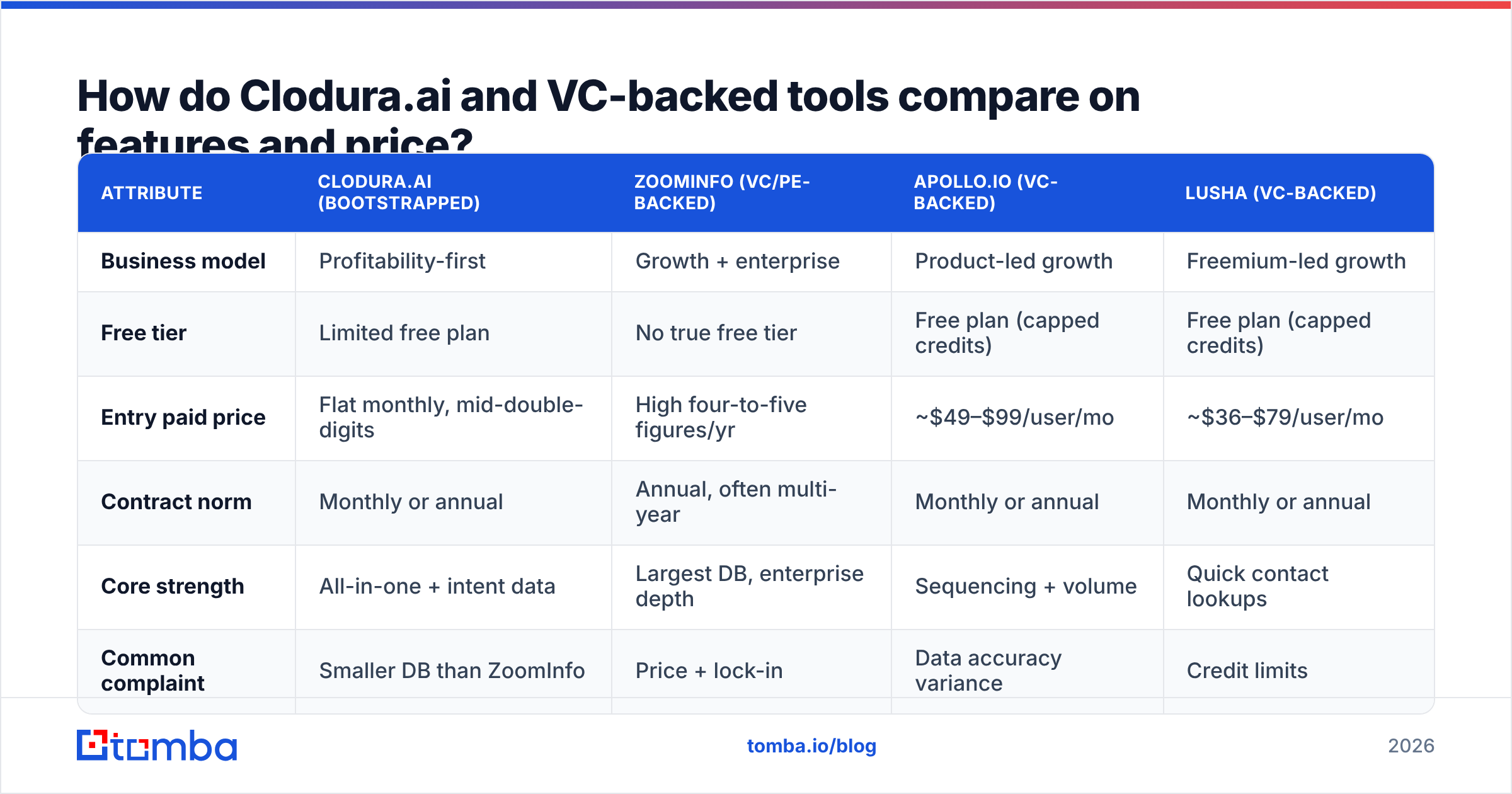
| Attribute | Clodura.ai (bootstrapped) | ZoomInfo (VC/PE-backed) | Apollo.io (VC-backed) | Lusha (VC-backed) |
|---|---|---|---|---|
| Business model | Profitability-first | Growth + enterprise | Product-led growth | Freemium-led growth |
| Free tier | Limited free plan | No true free tier | Free plan (capped credits) | Free plan (capped credits) |
| Entry paid price | Flat monthly, mid-double-digits | High four-to-five figures/yr | ~$49–$99/user/mo | ~$36–$79/user/mo |
| Contract norm | Monthly or annual | Annual, often multi-year | Monthly or annual | Monthly or annual |
| Core strength | All-in-one + intent data | Largest DB, enterprise depth | Sequencing + volume | Quick contact lookups |
| Common complaint | Smaller DB than ZoomInfo | Price + lock-in | Data accuracy variance | Credit limits |
A few honest takeaways from this table. ZoomInfo remains the reference point for enterprise database depth and firmographic coverage — if you are running a large, complex ABM motion, it earns its place on the shortlist. Apollo and Lusha win on speed-to-value and self-serve onboarding. Clodura.ai's edge is bundling: intent, org charts, and sequencing without stacking three separate invoices.
But notice what none of these platforms guarantee: perfect deliverability. That is the gap most teams underestimate.
Is Clodura.ai's data more accurate than VC-backed databases?#
Accuracy is a moving target, not a fixed spec. B2B data decays fast — a widely cited industry estimate is that roughly 30% of contact data goes stale every year as people change jobs, companies rebrand, and domains shift. Neither a bootstrapped vendor nor a nine-figure VC-backed one is immune to that decay.
What actually varies between vendors:
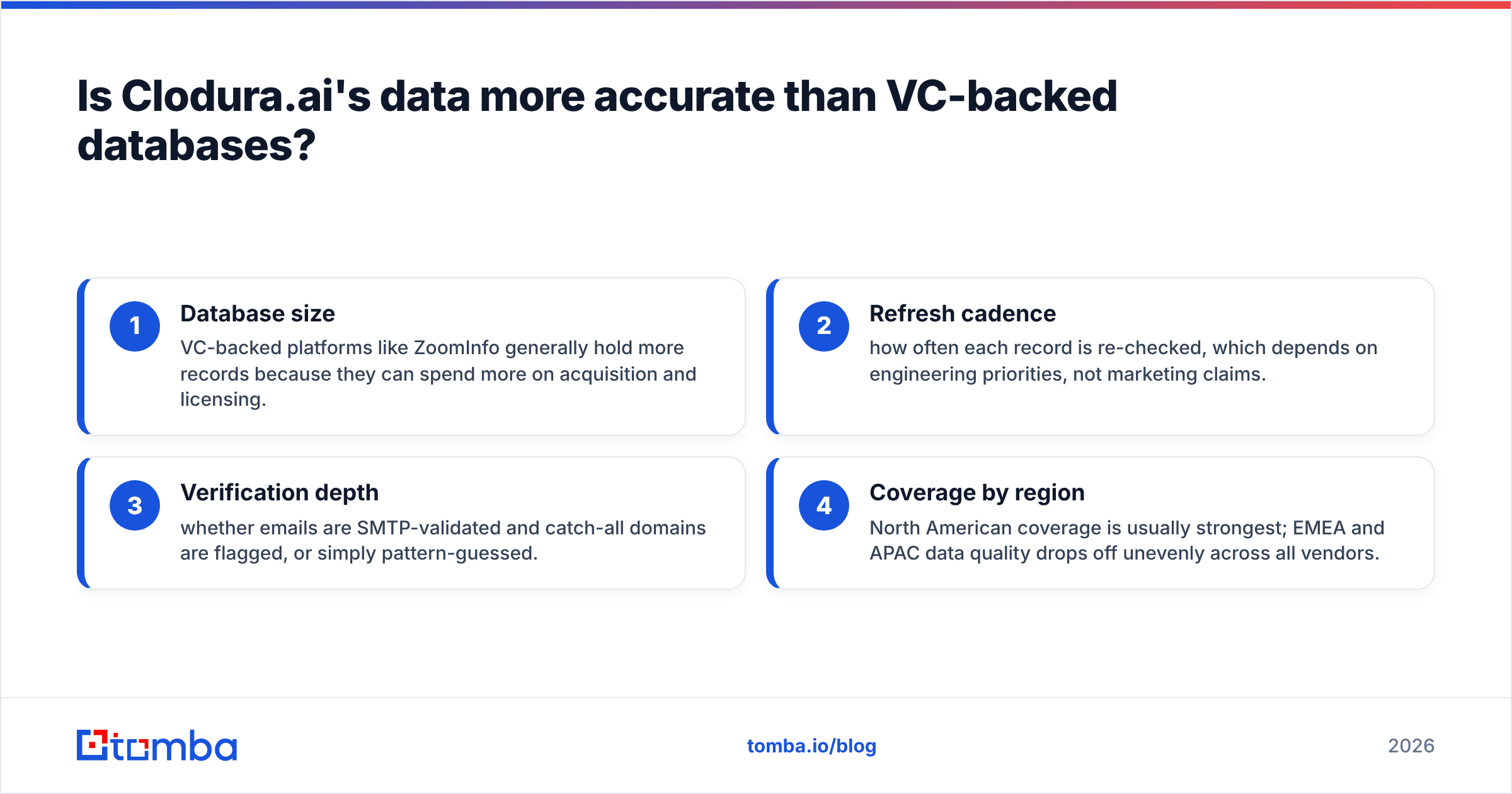
- Database size — VC-backed platforms like ZoomInfo generally hold more records because they can spend more on acquisition and licensing.
- Refresh cadence — how often each record is re-checked, which depends on engineering priorities, not marketing claims.
- Verification depth — whether emails are SMTP-validated and catch-all domains are flagged, or simply pattern-guessed.
- Coverage by region — North American coverage is usually strongest; EMEA and APAC data quality drops off unevenly across all vendors.
The mistake is treating any single provider's database as ground truth. The teams with the best deliverability treat their prospecting platform as a source and run every list through an independent email verifier before sending. That way, whether your records came from Clodura.ai or a VC-backed giant, you are not torching your sender reputation on bounces. If you rely heavily on catch-all domains, a dedicated catch-all verifier closes the biggest blind spot in every database on this list.
You can sanity-check any vendor's accuracy claims against third-party reviews on G2 rather than taking a sales deck at face value.
What are the hidden costs of VC-backed sales tools?#
The sticker price is rarely the real price. When a platform is optimized for revenue growth, the cost structure is engineered to expand your spend over time. Watch for these patterns:
- Credit metering. Many VC-backed tools cap exports or "reveals" per month. Run a busy quarter and you hit the ceiling, then buy more credits at a premium.
- Seat minimums and annual lock-in. Enterprise contracts often require a minimum seat count and a 12-month commitment, so you pay for capacity you may not use.
- Renewal jumps. First-year discounts are common; the uncomfortable increase arrives at renewal once your workflows depend on the tool.
- Feature gating. Intent data, org charts, or API access frequently sit behind the top tier, turning an advertised entry price into a much larger effective cost.

None of this makes VC-backed tools a bad choice — for a well-funded enterprise team, the ROI can be excellent. The point is to model total cost over the contract term, not the headline number. Bootstrapped platforms like Clodura.ai tend to have fewer of these mechanics precisely because they do not need to satisfy an investor growth curve, though you should still confirm what is metered versus flat.
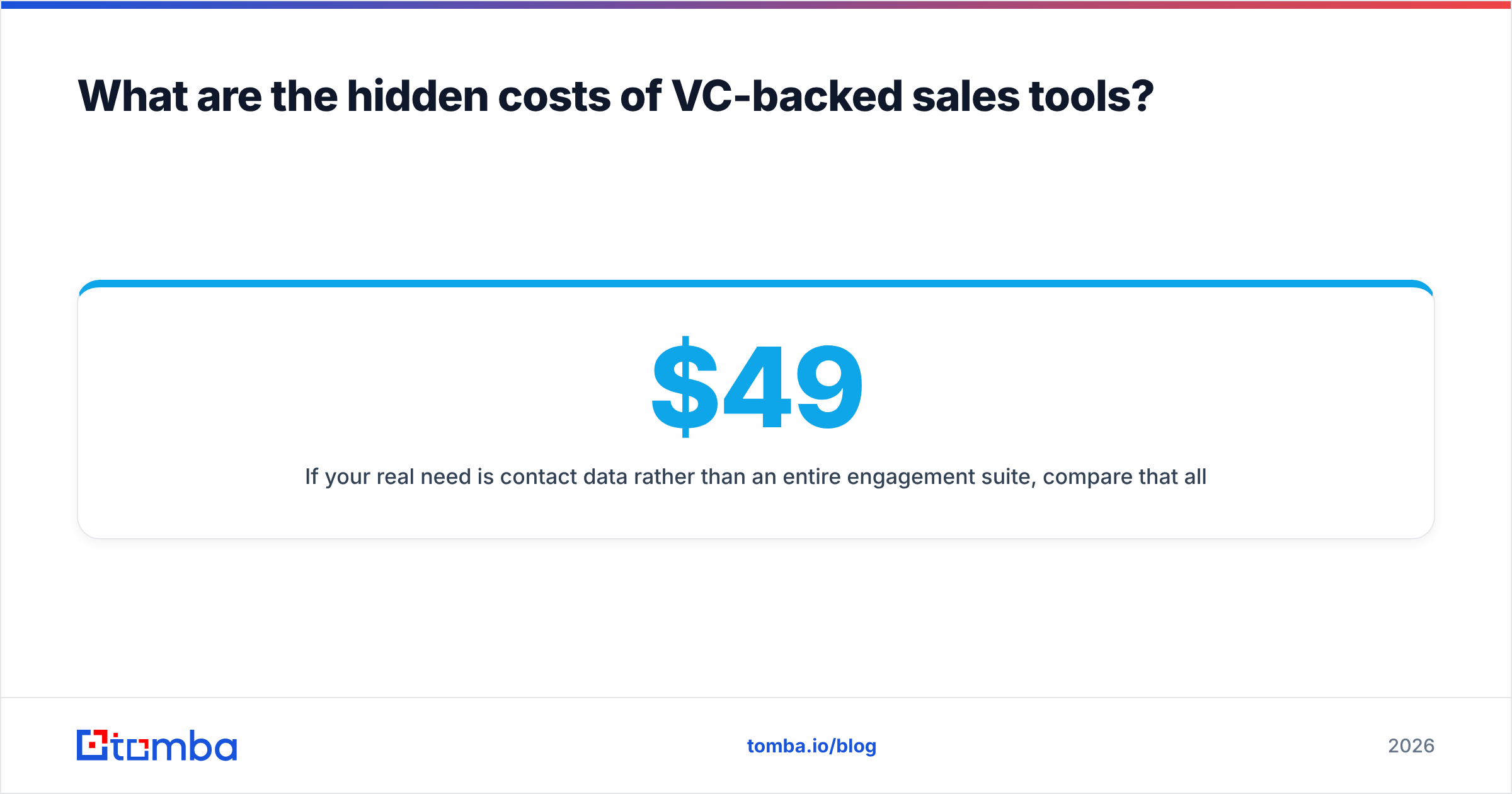
If your real need is contact data rather than an entire engagement suite, compare that all-in platform cost against transparent, usage-based Tomba pricing: a Free tier with 25 searches/mo, Starter at $49/mo, Growth at $99/mo, and Pro at $249/mo. Paying platform rates for features you never open is the most common form of B2B tool waste.
When should you pick Clodura.ai over a VC-backed tool?#
Choose based on the shape of your team, not the size of the vendor's funding round.
Pick a bootstrapped platform like Clodura.ai when:
- You are an SMB or mid-market team that needs predictable, flat pricing.
- You want prospecting, intent, and sequencing in one place without three invoices.
- You dislike aggressive upsells and annual lock-in.
- Your ICP sits in regions the platform covers well (validate before you commit).
Pick a VC-backed tool when:
- You run enterprise ABM and need the largest possible database.
- You require deep, native integrations with a complex RevOps stack.
- You have budget headroom and value breadth over cost discipline.
- Your team is large enough to absorb seat minimums efficiently.
Pick a focused data tool when:
- You mainly need verified emails and phone numbers on demand.
- You want to enrich records already in your CRM rather than replace it.
- You are cost-sensitive and want to pay only for what you use.
That third path is where many lean teams land. Instead of committing to a full platform, they wire a domain search and enrichment API into their existing workflow, then verify before every send. It is not glamorous, but it protects deliverability and keeps spend proportional to activity.
How do you build a data stack that beats both models?#
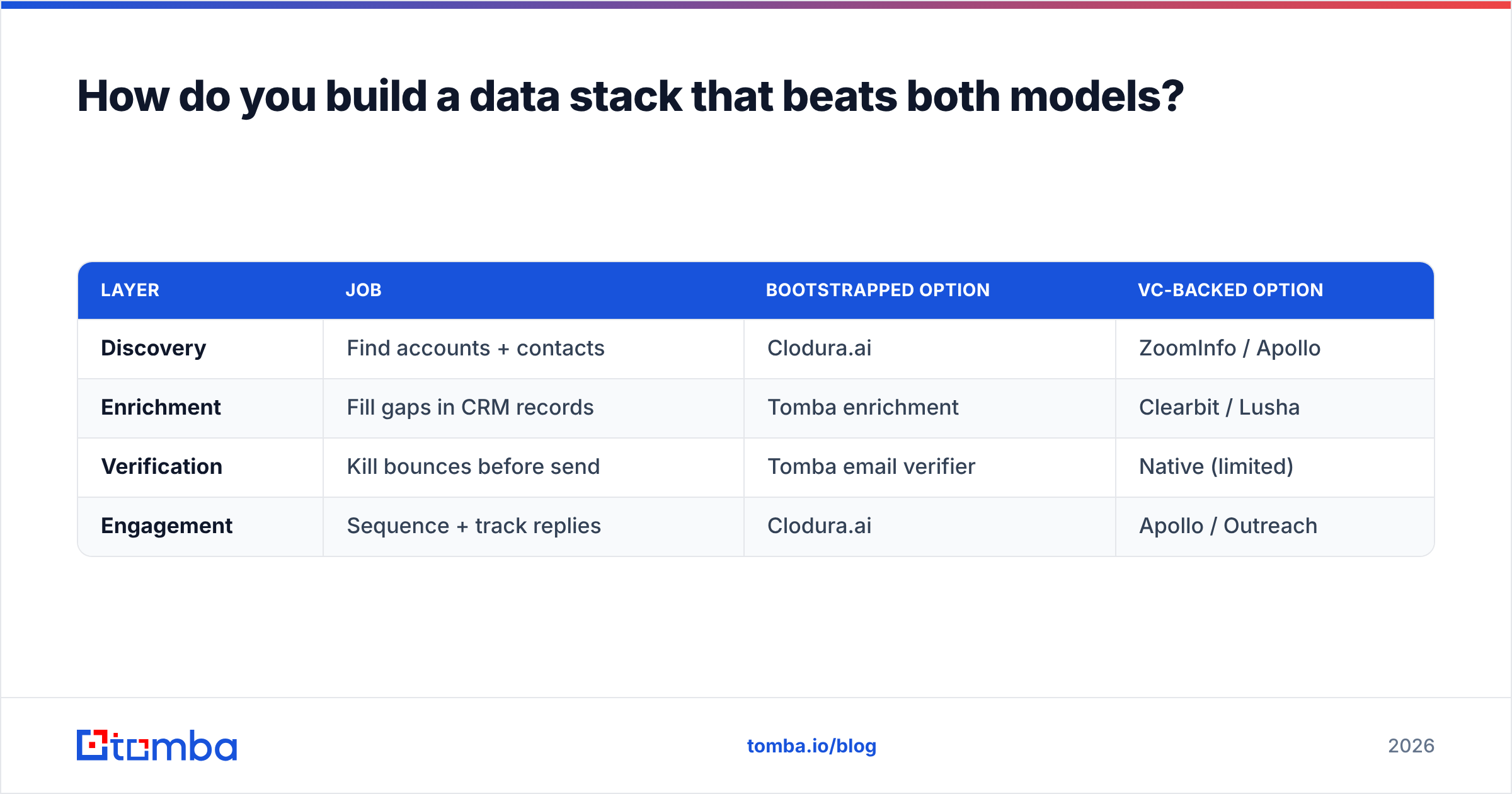
The best-performing outbound teams in 2026 rarely bet everything on one vendor. They assemble a stack where each layer does one job well:
| Layer | Job | Bootstrapped option | VC-backed option |
|---|---|---|---|
| Discovery | Find accounts + contacts | Clodura.ai | ZoomInfo / Apollo |
| Enrichment | Fill gaps in CRM records | Tomba enrichment | Clearbit / Lusha |
| Verification | Kill bounces before send | Tomba email verifier | Native (limited) |
| Engagement | Sequence + track replies | Clodura.ai | Apollo / Outreach |
The verification layer is the one teams skip and later regret. Even a large, well-funded database will hand you stale addresses, and a spike in bounces can quietly cripple your email deliverability for weeks. A thin, dedicated verification step in front of every campaign is the cheapest insurance in the entire stack.
For a deeper look at how any vendor sources and refreshes records, vendor transparency pages — like Tomba's data sources — are worth reading before you sign anything. Compare that against the funding-and-acquisition history of VC-backed vendors on a neutral directory such as Crunchbase to understand the incentives behind each roadmap.
The verdict: which one actually wins?#
There is no universal winner in Clodura.ai vs VC-backed — there is only the winner for your budget, region, and workflow complexity. If you value flat pricing, an all-in-one bundle, and freedom from investor-driven upsells, a bootstrapped platform like Clodura.ai is the more rational default. If you need the largest database on earth and have the budget to match, a VC-backed giant still has a role.
But for a huge segment of teams, the honest answer is "neither, entirely." You do not need a nine-figure database or a bundled suite to run great outbound. You need accurate, verified contacts flowing into a system you already own. That is exactly the gap Tomba fills without a platform-sized invoice.
Start with the Tomba Email Finder to pull professional emails by name, domain, or company, then verify every address before it hits your sequence. You get the data quality that matters, on transparent usage-based pricing, with no seat minimums and no renewal surprise — the parts of the VC-backed model nobody actually enjoys. Try it on your next campaign and measure the bounce rate for yourself.
Related guides#
Ready to find emails that actually work?
Join 150,000+ professionals who stopped guessing and started sending. Free credits on signup — no credit card required.
Get the Tomba newsletter
Practical outbound tactics and product updates — once every two weeks.
About the author