Clodura.ai vs Vocus.io (2026): Which Sales Tool Wins?
Clodura.ai bundles a B2B database with sequences; Vocus.io lives inside Gmail for tracking and follow-ups. Here's which one fits your outbound in 2026—and where each falls short.
Two tools, two very different jobs. Clodura.ai wants to be the place you find prospects. Vocus.io wants to be the place you email them. People pit them against each other because both wear the "sales productivity" label, but choosing between them without understanding that split is how you end up paying for software you barely touch.
This is a straight, no-spin comparison of Clodura.ai vs Vocus.io for 2026: what each actually does, where the pricing bites, and which one belongs in your stack. Spoiler: for a lot of teams, the honest answer is "neither, on its own."
TL;DR — Clodura.ai vs Vocus.io at a glance#
- Clodura.ai is a B2B sales-intelligence platform: a contact database, email finder, buying-signal alerts, and built-in sequences. Best if you have no lead source yet.
- Vocus.io is a lightweight Gmail/Google Workspace add-on for email tracking, templates, mail merge, and follow-ups. Best if you already have your list and live in Gmail.
- They barely overlap. Clodura is "where do I get contacts + reach out," Vocus is "reach out better from the inbox I already use."
- Pricing gap is real: Vocus.io starts near $5–$10/user/mo; Clodura.ai's paid intelligence tiers run far higher once you need real credit volume.
- Data accuracy is the weak point for both. Pairing either with a dedicated verification layer beats trusting a single bundled database.
What is Clodura.ai?#
Clodura.ai is an all-in-one prospecting platform. The pitch is that you start with an empty CRM and walk out with a targeted list: search a database of company and contact records, pull direct-dial phone numbers and emails, watch for buying signals (job changes, funding, tech installs), and then fire sequences without leaving the tool.
Think of it as a grocery store with a kitchen attached. You come for the ingredients (contact data), and they'll also let you cook the meal (email cadences) on the premises. The convenience is the selling point.
Where it earns its keep:
- Net-new lead discovery when you have no existing list to work from.
- Org-chart and direct-dial data for teams that cold call as well as email.
- Signal-based prospecting — reaching accounts when something just changed.
Where it frustrates users: database coverage and accuracy vary by region and seniority, credits get consumed fast, and the sequencing engine is functional rather than best-in-class. You can read the vendor's own feature framing on the Clodura.ai homepage, then sanity-check it against verified buyer reviews on G2.
What is Vocus.io?#
Vocus.io is a Gmail-native outreach tool. It bolts onto Google Workspace and gives you email tracking (opens, clicks), templates, personalized mail merge, scheduled sends, and automated follow-up sequences — all inside the inbox you already use. It also offers light CRM integrations and team-sharing of templates.
If Clodura is a grocery store with a kitchen, Vocus.io is a really good set of knives for the kitchen you already own. It assumes you have the contacts. It just makes emailing them faster and more measurable.
Where it shines:
- Zero context-switching — it runs where reps already work.
- Cheap and fast to adopt — minimal onboarding, per-seat pricing that starts low.
- Solid tracking and follow-up automation for one-to-one and small-batch outreach.
Where it stops: Vocus.io does not find you anyone. There's no B2B database, no email finder, no enrichment. Feed it a bad list and it will faithfully track your bounces. You can confirm the current feature set on vocus.io directly.
Clodura.ai vs Vocus.io: full comparison table#
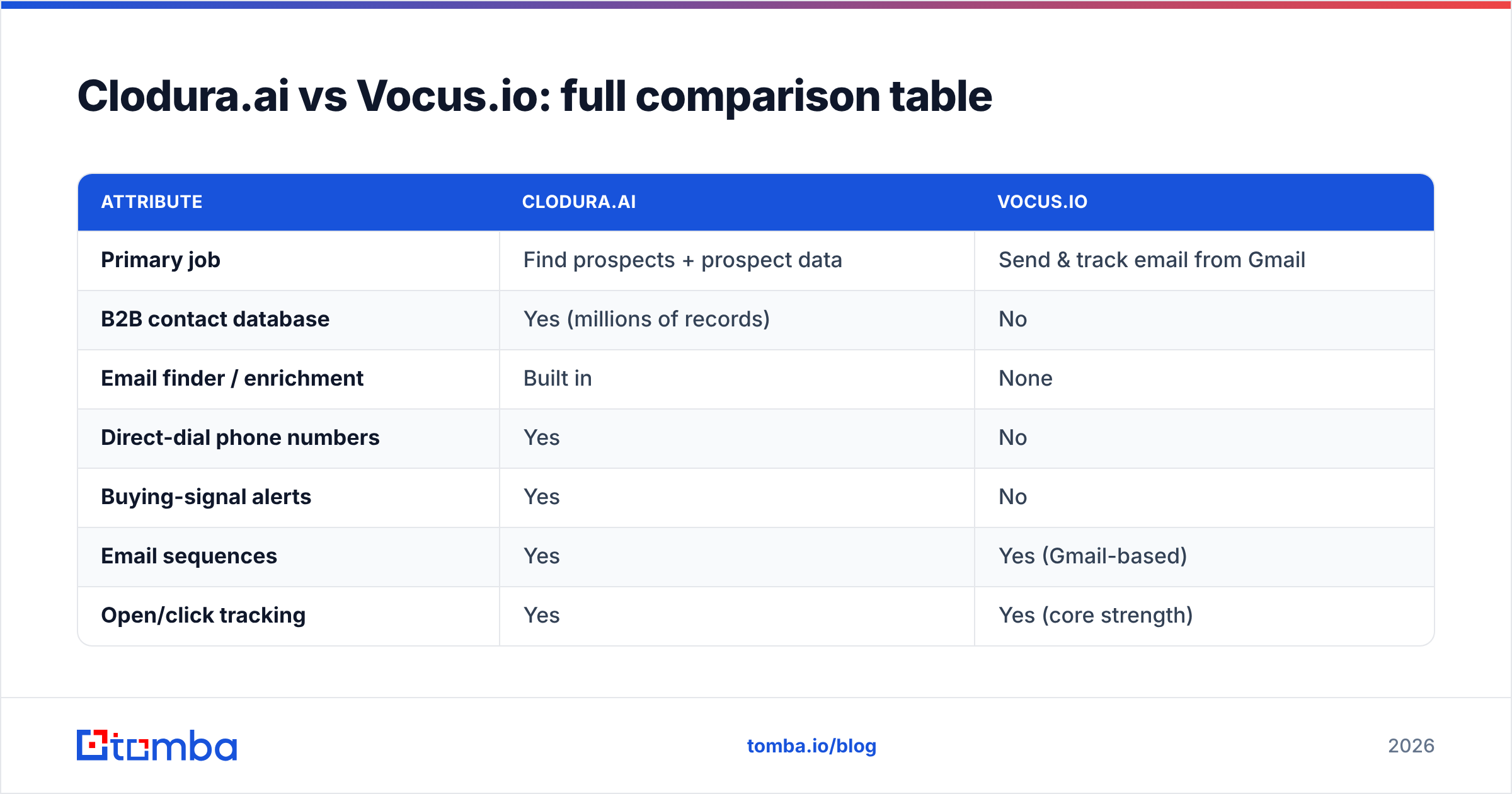
| Attribute | Clodura.ai | Vocus.io |
|---|---|---|
| Primary job | Find prospects + prospect data | Send & track email from Gmail |
| B2B contact database | Yes (millions of records) | No |
| Email finder / enrichment | Built in | None |
| Direct-dial phone numbers | Yes | No |
| Buying-signal alerts | Yes | No |
| Email sequences | Yes | Yes (Gmail-based) |
| Open/click tracking | Yes | Yes (core strength) |
| Lives inside Gmail | Partial | Native |
| Entry price | Higher, credit-based tiers | ~$5–$10/user/mo |
| Best for | Teams with no lead source | Teams who own their list |
The table makes the real story obvious: these aren't competitors so much as two halves of one workflow. One sources contacts; the other works them.
Is Clodura.ai better than Vocus.io?#
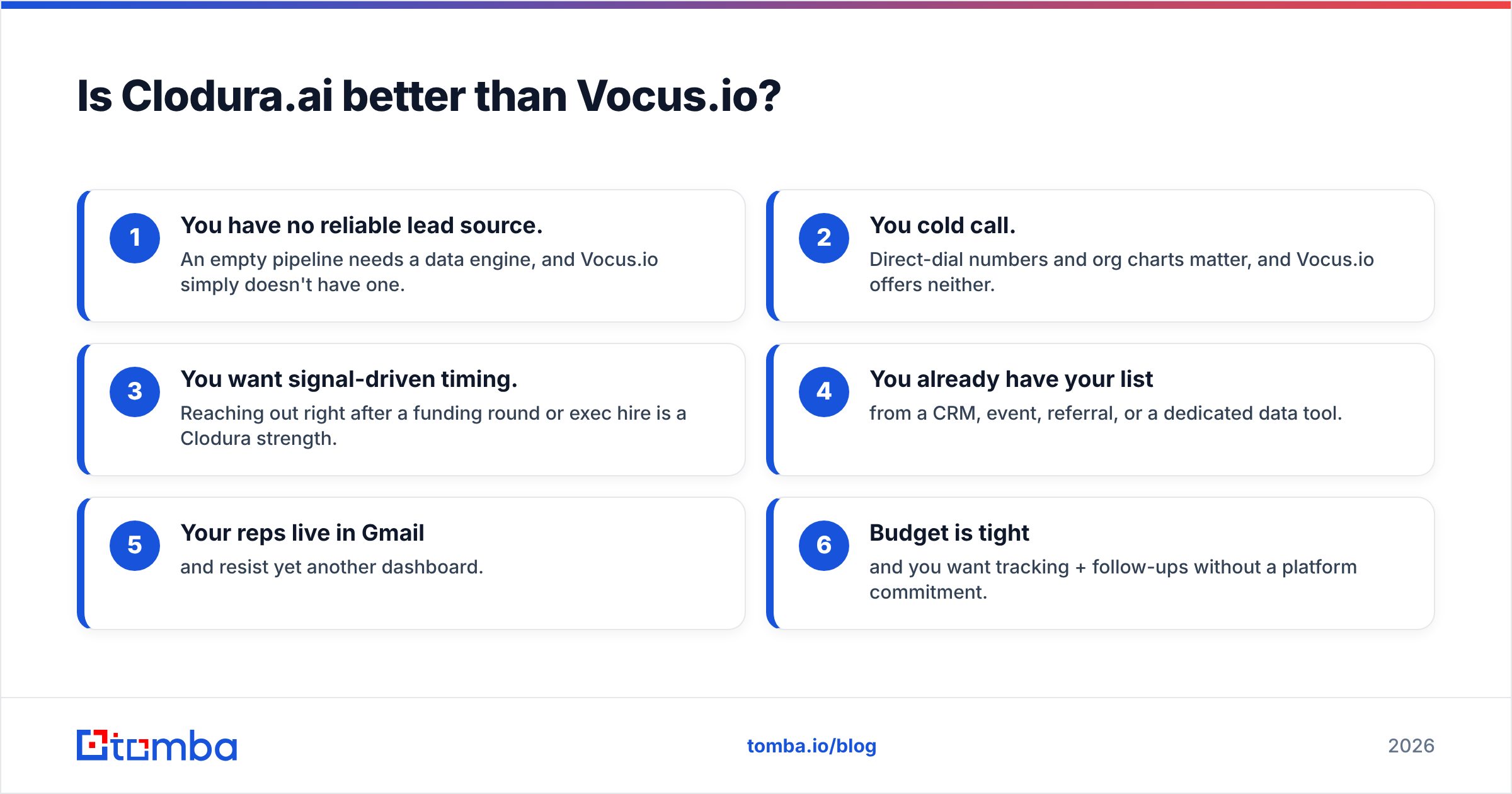
It depends on the hole in your stack — and the honest framing is need-based, not "which is better software."
Choose Clodura.ai if:
- You have no reliable lead source. An empty pipeline needs a data engine, and Vocus.io simply doesn't have one.
- You cold call. Direct-dial numbers and org charts matter, and Vocus.io offers neither.
- You want signal-driven timing. Reaching out right after a funding round or exec hire is a Clodura strength.
Choose Vocus.io if:
- You already have your list from a CRM, event, referral, or a dedicated data tool.
- Your reps live in Gmail and resist yet another dashboard.
- Budget is tight and you want tracking + follow-ups without a platform commitment.
A useful gut check: if your problem sentence is "I don't know who to email," lean Clodura. If it's "I know who to email but my follow-up is a mess," lean Vocus.io.
What both tools get wrong: data accuracy#
Here's the part neither vendor leads with. An all-in-one database (Clodura) tends to trade freshness for breadth — records age, people change jobs, and catch-all domains slip verified-looking emails past you. Vocus.io, meanwhile, has no verification at all; it trusts whatever list you paste in.
The result is the same failure mode from two directions: you send to addresses that were never going to land. Bounces above 2–3% start dragging your sender reputation, and a damaged domain quietly taxes every future campaign — including the ones sent from a pricey platform.
The fix isn't loyalty to one vendor's database. It's inserting a verification step you control. Run any list — Clodura exports, Vocus imports, CRM dumps — through a dedicated email verifier before it hits the send queue. For domains that accept everything, a proper catch-all verifier tells you what a generic SMTP ping can't.
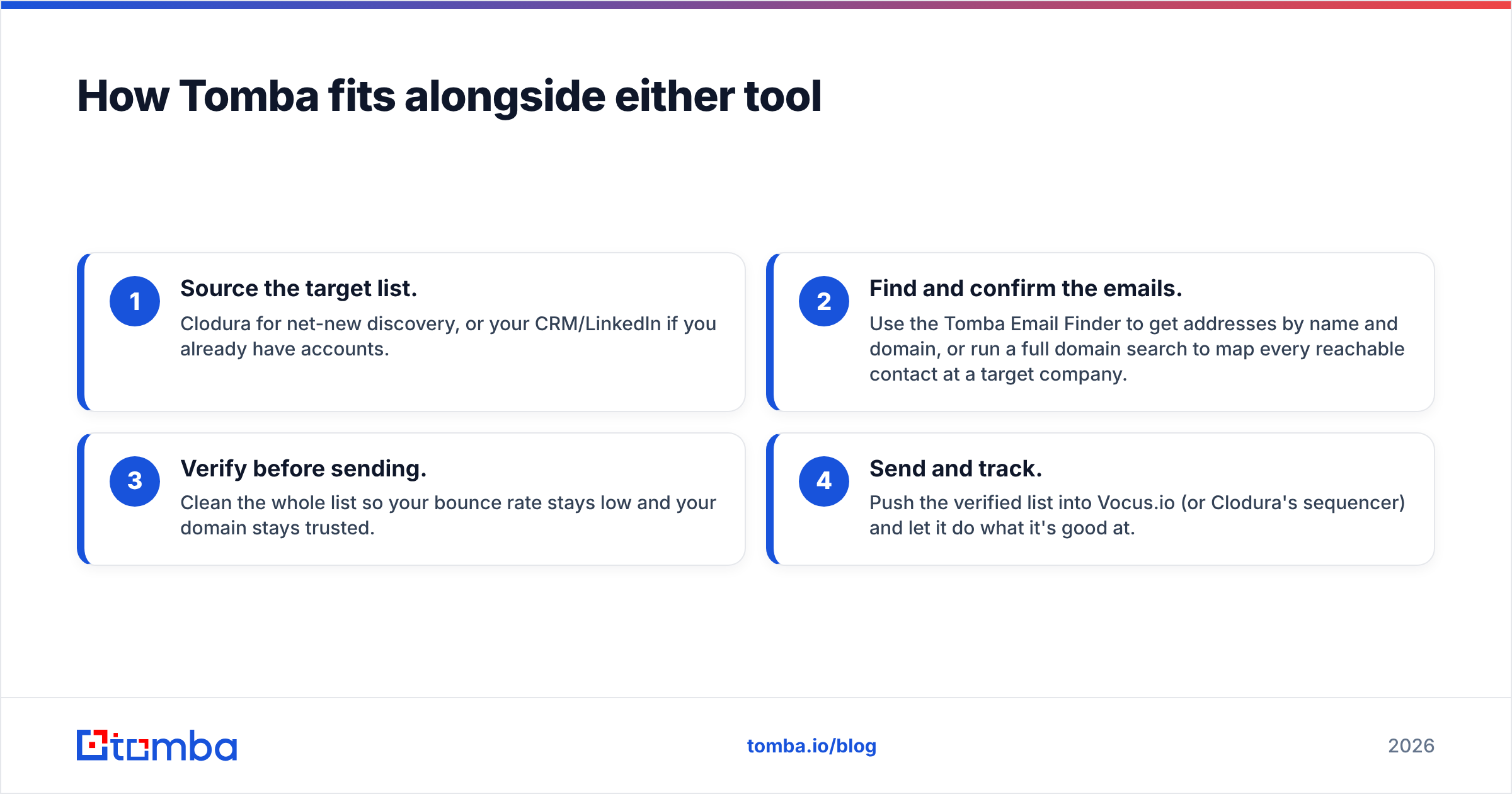
How Tomba fits alongside either tool#
Tomba isn't a sequencer and it won't track your opens — so it doesn't replace Vocus.io. And it isn't trying to be a full signal platform, so it doesn't replace everything Clodura does either. What it does is the one job both tools do unevenly: turn a name and a company into a verified, deliverable email address.
The practical stack looks like this:
- Source the target list. Clodura for net-new discovery, or your CRM/LinkedIn if you already have accounts.
- Find and confirm the emails. Use the Tomba Email Finder to get addresses by name and domain, or run a full domain search to map every reachable contact at a target company.
- Verify before sending. Clean the whole list so your bounce rate stays low and your domain stays trusted.
- Send and track. Push the verified list into Vocus.io (or Clodura's sequencer) and let it do what it's good at.
That division of labor is why "Clodura vs Vocus" is often the wrong question. A finder-plus-verifier layer makes both downstream tools perform better, because clean data is the input neither one reliably produces.
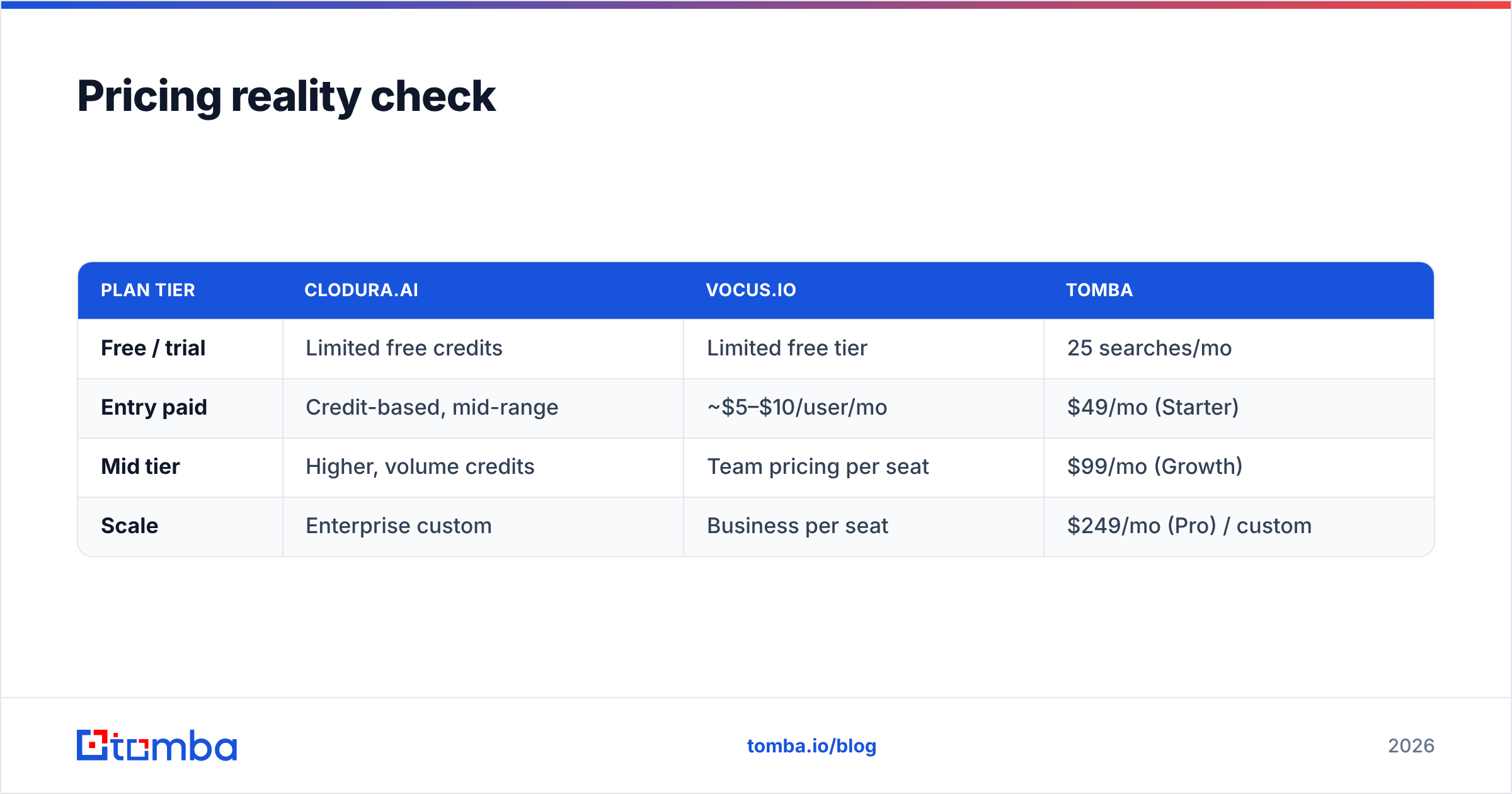
Pricing reality check#
| Plan tier | Clodura.ai | Vocus.io | Tomba |
|---|---|---|---|
| Free / trial | Limited free credits | Limited free tier | 25 searches/mo |
| Entry paid | Credit-based, mid-range | ~$5–$10/user/mo | $49/mo (Starter) |
| Mid tier | Higher, volume credits | Team pricing per seat | $99/mo (Growth) |
| Scale | Enterprise custom | Business per seat | $249/mo (Pro) / custom |
Two takeaways. First, Vocus.io is genuinely cheap because it does one narrow thing — that's a feature, not a knock. Second, the "all-in-one" convenience of Clodura shows up on the invoice; credit-heavy prospecting adds up fast. If you're comparing total cost, price the outcome (verified contacts reached), not the sticker. You can line up Tomba pricing against your current per-lead cost to see whether a dedicated finder-verifier is cheaper than burning platform credits on data you then have to re-verify anyway.
Frequently asked questions#
Is Clodura.ai the same as Vocus.io? No. Clodura.ai is a B2B data and prospecting platform with a built-in database and sequencer. Vocus.io is a Gmail add-on for email tracking, templates, and follow-ups. They solve different problems.
Can I use Vocus.io without a data tool? Only if you already have a contact list. Vocus.io has no email finder or database, so it can't generate prospects on its own — you'll need a source like Clodura, your CRM, or a dedicated finder.
Does Clodura.ai include email verification? It offers verification as part of its data platform, but accuracy varies and catch-all domains are a common blind spot. Running exports through an independent verifier before sending is the safer play.
Which is better for cold email deliverability? Neither guarantees it. Deliverability comes from list hygiene and domain reputation, not the sending tool. Verify every address first — that single step protects your email deliverability more than any feature toggle.
The verdict#
Clodura.ai and Vocus.io aren't really rivals — they're two stages of the same pipeline. Clodura answers who and where; Vocus.io answers how the follow-up runs. Pick Clodura when you need a lead engine, pick Vocus.io when you own your list and want cheap, Gmail-native outreach, and be honest that many teams eventually want a bit of both.
But the piece that determines whether either tool actually earns its subscription is data quality — and that's the layer to own yourself. Before your next campaign leaves the outbox, put your list through the Tomba Email Finder and its verification tools so every send lands on a real, deliverable inbox. Clean data in, better results out — no matter which platform you're paying for.
Related guides#
Ready to find emails that actually work?
Join 150,000+ professionals who stopped guessing and started sending. Free credits on signup — no credit card required.
Get the Tomba newsletter
Practical outbound tactics and product updates — once every two weeks.
About the author