Clodura vs YAMM: B2B Database vs Gmail Mail Merge 2026
Clodura.ai is a B2B sales-intelligence database; YAMM is a Gmail mail-merge add-on. They solve different problems. Here's which one fits your outbound stack in 2026, and where a dedicated email finder quietly beats both.
People type "Clodura vs YAMM" into Google as if they're picking between two versions of one tool. They aren't. One is a B2B sales-intelligence database. It hands you contacts and intent signals. The other is a Gmail mail-merge add-on. It emails those contacts. Confuse the two and you pay for the wrong half of your stack.
This guide breaks down what each tool does, where they overlap, what they cost in 2026, and how to combine them (or replace part of the workflow) so you're not stuck with stale data or a capped send limit.
TL;DR#
- Clodura.ai is a prospecting and sales-intelligence platform: a B2B contact database, email finder, intent data, and basic sequencing. It fills your pipeline with who to contact.
- YAMM (Yet Another Mail Merge) is a Gmail-native mail-merge add-on: it sends personalized bulk emails from your own inbox and tracks opens. It handles how you reach them.
- They're complementary, not competitive — Clodura finds and enriches, YAMM sends. A real Clodura vs YAMM comparison only makes sense when you're deciding which problem to solve first.
- Data quality is the real bottleneck. A dedicated email finder like Tomba Email Finder plus a verifier gives you cleaner lists than either tool's built-in data, so your YAMM sends don't bounce.
- Budget reality: YAMM is cheap (starts around $25/user/year). Clodura.ai runs into hundreds per month. Match the spend to whether your gap is finding people or emailing them.
What is Clodura.ai?#
Clodura.ai is an all-in-one sales-prospecting platform for outbound B2B teams. Think of it as a phone book that also tells you which companies just raised money, changed leadership, or started hiring. Those signals make a cold email feel timely instead of random.
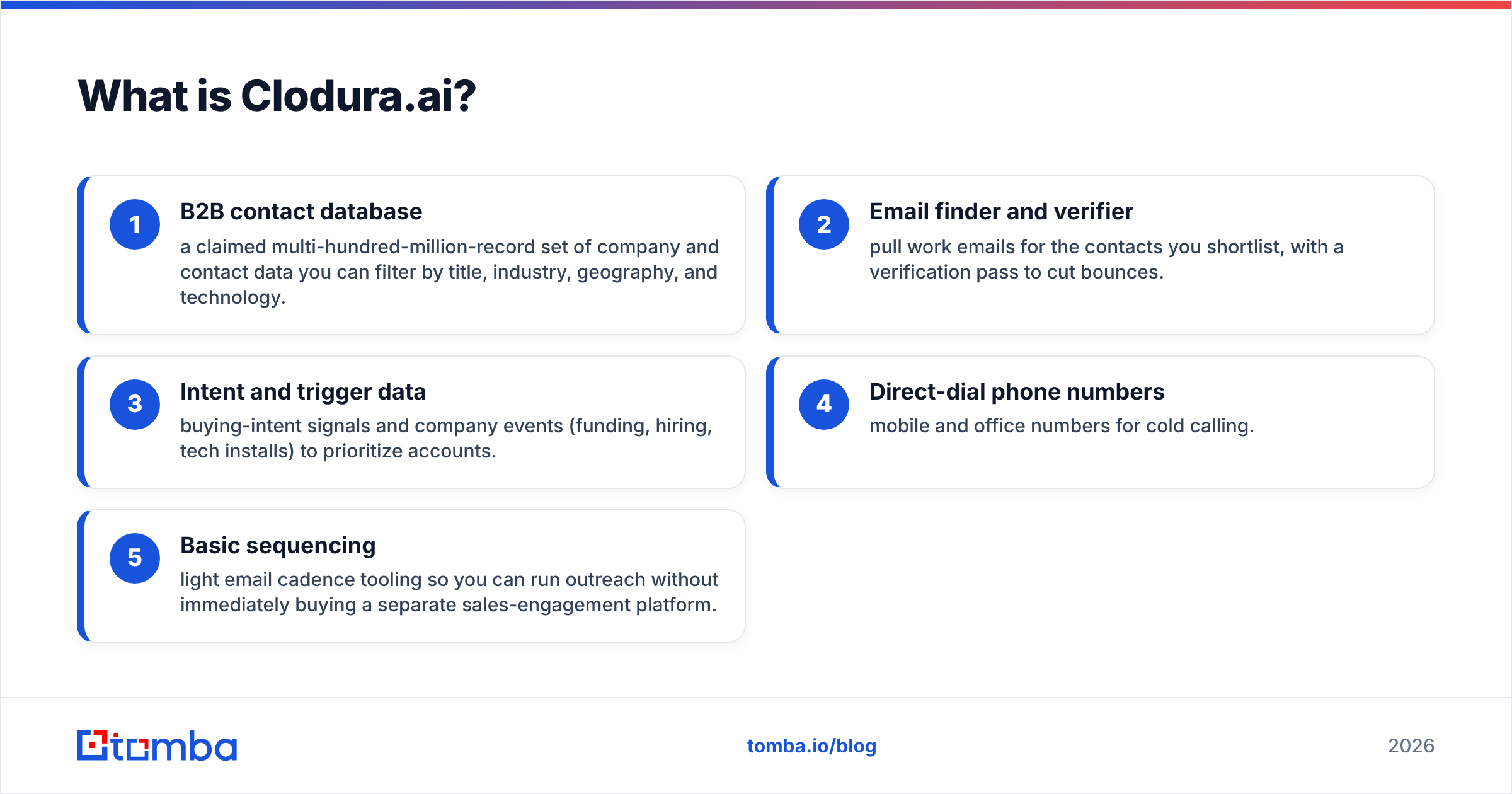
Its core modules:
- B2B contact database — a claimed multi-hundred-million-record set of company and contact data you can filter by title, industry, geography, and technology.
- Email finder and verifier — pull work emails for the contacts you shortlist, with a verification pass to cut bounces.
- Intent and trigger data — buying-intent signals and company events (funding, hiring, tech installs) to prioritize accounts.
- Direct-dial phone numbers — mobile and office numbers for cold calling.
- Basic sequencing — light email cadence tooling so you can run outreach without immediately buying a separate sales-engagement platform.
Clodura sits in the same competitive space as Apollo, ZoomInfo, and Lusha. If your problem is "I don't have enough of the right contacts," it's built for you. You can read more about the platform on Clodura's own site.

What is YAMM (Yet Another Mail Merge)?#
YAMM is a Google Workspace add-on that turns Gmail plus Google Sheets into a mail-merge machine. You put recipients and personalization fields in a spreadsheet, write a Gmail draft with {{merge tags}}, and YAMM sends each person an individual, personalized message from your real inbox.
Because it sends through Gmail rather than a third-party server, YAMM's emails land in the primary tab more often than blast-style marketing tools. You inherit your own domain reputation instead of a shared marketing IP. It's popular with small teams, founders, and anyone already living in Google Workspace.
What YAMM does well:
- Personalized bulk sends from Gmail with spreadsheet merge fields.
- Open and click tracking with basic reporting.
- Automatic follow-ups to non-openers.
- Deliverability by inheritance — you use your own inbox, so there's no separate warmup vendor for light volume.
What YAMM does not do: it doesn't find email addresses, build lists, verify contacts, or supply company data. It assumes you already have a clean recipient list. That assumption is exactly where most YAMM campaigns quietly fail. You can see the official feature set on yamm.com.
Clodura vs YAMM: how do they actually compare?#
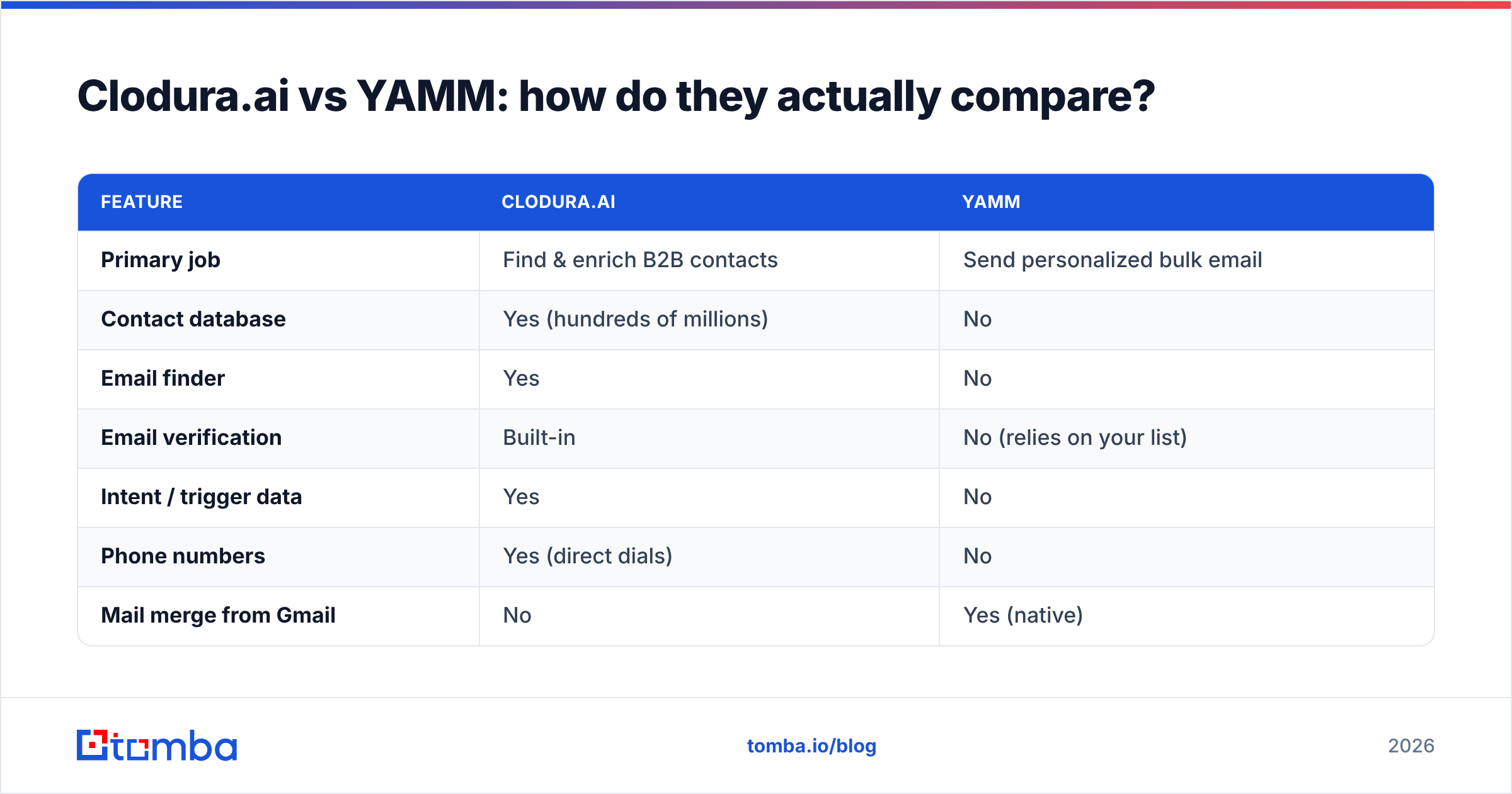
Here's the honest side-by-side. Notice how few rows they genuinely share — that's the whole point.
| Feature | Clodura.ai | YAMM |
|---|---|---|
| Primary job | Find & enrich B2B contacts | Send personalized bulk email |
| Contact database | Yes (hundreds of millions) | No |
| Email finder | Yes | No |
| Email verification | Built-in | No (relies on your list) |
| Intent / trigger data | Yes | No |
| Phone numbers | Yes (direct dials) | No |
| Mail merge from Gmail | No | Yes (native) |
| Open/click tracking | Basic (in sequences) | Yes |
| Automatic follow-ups | Yes (sequencing) | Yes |
| Sends from your inbox | No (external sending) | Yes (Gmail) |
| Best for | Filling the pipeline | Emailing an existing list |
| Starting price (2026) | ~$100+/user/mo | ~$25/user/year |
Read that table again and the Clodura vs YAMM verdict writes itself: Clodura is a data-and-discovery tool; YAMM is a send tool. If you only buy one and you already have a list, YAMM covers you for the price of a lunch. If your lists are thin or stale, no amount of clever mail merge saves you. You need Clodura's discovery layer first.
Clodura vs YAMM: is one better than the other?#
Neither is "better." They answer different questions. Pick based on which of these sounds like your Monday morning:
- "I have a great list but no efficient way to email it personally." → YAMM. It's the cheapest, fastest path to personalized bulk sends from Gmail, and you keep your own sender reputation.
- "I have Gmail and templates but no idea who to email." → Clodura.ai (or a comparable prospecting tool). You need the database, the filters, and the enrichment before sending is even relevant.
- "I have both problems." → You'll end up using something like Clodura to build the list and something like YAMM to send it. That's a normal, healthy stack.
The trap is buying Clodura's heavier price tag when your real gap is sending, or buying YAMM and then blasting a garbage list into a wall of bounces. Diagnose the bottleneck before you diagnose the tool.
Where does data quality break the YAMM workflow?#
This is the part the "Clodura vs YAMM" framing hides. YAMM's deliverability advantage — sending from your own Gmail — is also its biggest risk. When you send from your real inbox, every bounce hits your personal domain reputation directly. Blast 800 unverified addresses and you can torch your inbox's standing for weeks, dragging down even your legitimate one-to-one email.
Clodura verifies the emails it finds, which helps. But no single database is complete or perfectly fresh, and multi-source verification consistently beats any one provider's internal check. That's the gap where a dedicated finder-and-verifier stack earns its keep:
- Find the addresses database tools miss with a specialized email finder that cross-references multiple sources.
- Verify before you send using an email verifier to strip invalids, catch-alls, and role accounts that would bounce or spam-trap you.
- Work a whole company at once with domain search to pull every reachable contact at a target account.
- Clean lists at scale with a bulk email finder before they ever touch your Sheet.
Run your recipient list through verification first, then hand the clean file to YAMM. Your bounce rate drops, your open rate looks honest, and your Gmail reputation stays intact. Skipping this step is the single most common reason mail-merge campaigns underperform.
Clodura vs YAMM pricing: what does each tool cost in 2026?#
Pricing is where the two tools stop looking comparable at all.
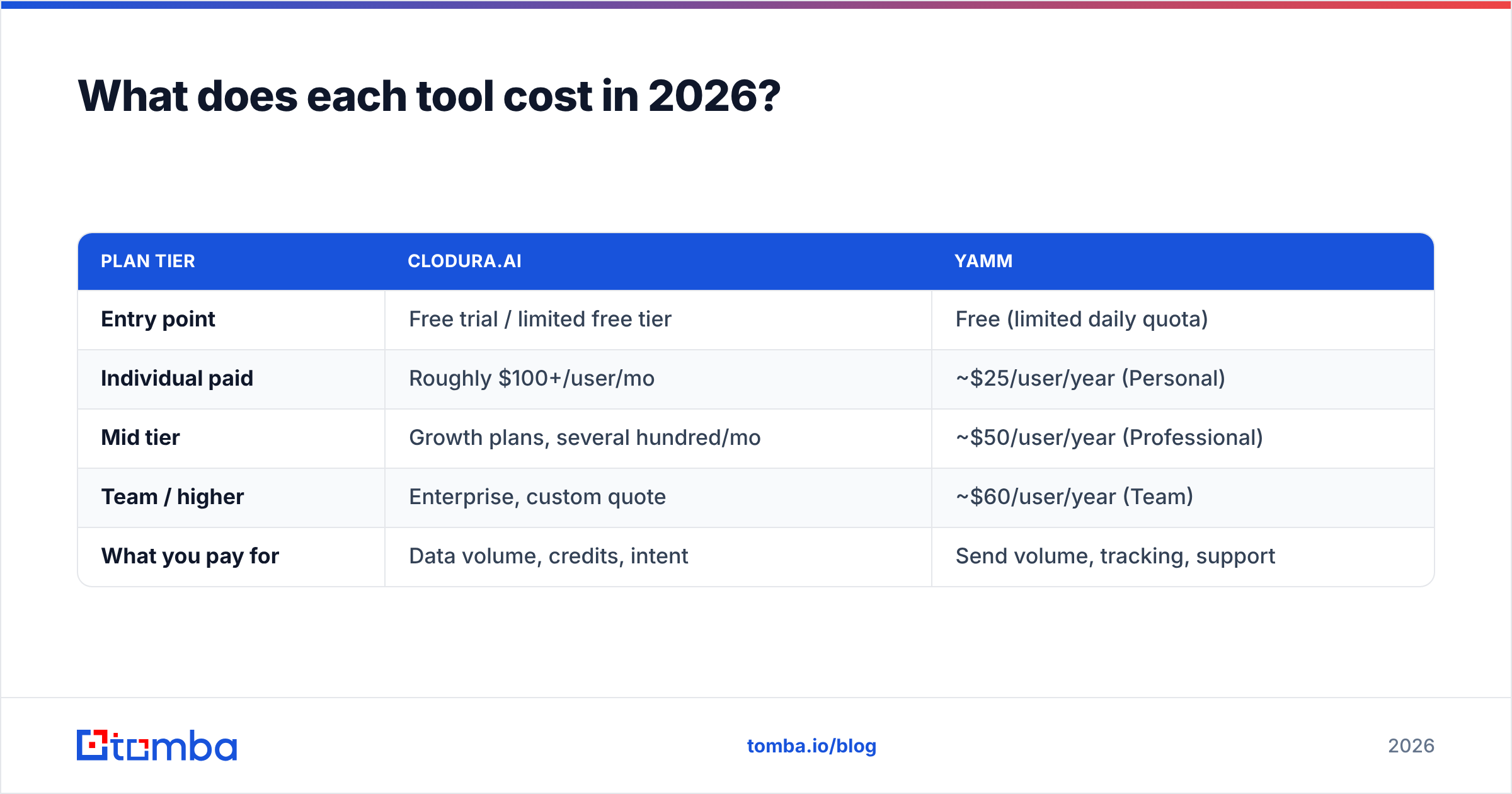
| Plan tier | Clodura.ai | YAMM |
|---|---|---|
| Entry point | Free trial / limited free tier | Free (limited daily quota) |
| Individual paid | Roughly $100+/user/mo | ~$25/user/year (Personal) |
| Mid tier | Growth plans, several hundred/mo | ~$50/user/year (Professional) |
| Team / higher | Enterprise, custom quote | ~$60/user/year (Team) |
| What you pay for | Data volume, credits, intent | Send volume, tracking, support |
YAMM is priced like a productivity add-on because that's what it is. Clodura is priced like a data platform because data — sourced, verified, and enriched — is expensive to maintain. Comparing the two on price alone is like comparing a stamp to a mailing list. You need both, and they don't cost the same because they aren't the same.
If your spend is mostly going toward finding and verifying contacts, it's worth benchmarking that line item on its own. Transparent, usage-based pricing on a dedicated finder can be dramatically cheaper than paying a full platform seat just for its data module, especially if you already own a sending tool like YAMM.
How should you build the stack?#
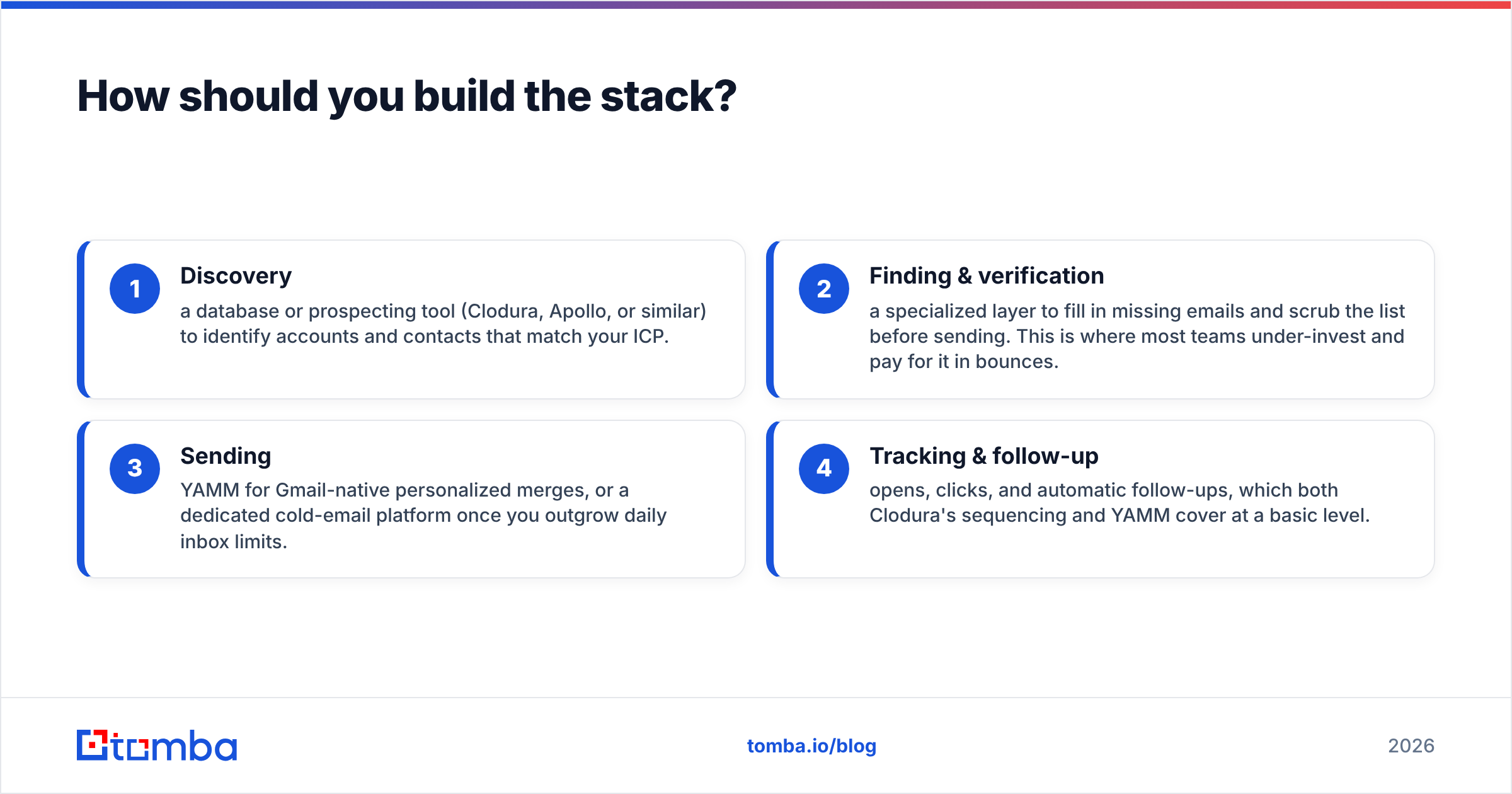
A clean, modular 2026 outbound stack usually looks like this:
- Discovery — a database or prospecting tool (Clodura, Apollo, or similar) to identify accounts and contacts that match your ICP.
- Finding & verification — a specialized layer to fill in missing emails and scrub the list before sending. This is where most teams under-invest and pay for it in bounces.
- Sending — YAMM for Gmail-native personalized merges, or a dedicated cold-email platform once you outgrow daily inbox limits.
- Tracking & follow-up — opens, clicks, and automatic follow-ups, which both Clodura's sequencing and YAMM cover at a basic level.
The mistake is assuming one tool does all four well. Clodura is strong on step 1 and decent on step 2. YAMM owns step 3 for small volume and part of step 4. Nobody nails everything, which is exactly why a focused finder-and-verifier in the middle makes both tools work better.
For very high send volume, note that YAMM inherits Gmail's daily sending caps (a few hundred to ~1,500 recipients/day depending on your Workspace plan). Past that, you graduate to a purpose-built cold-email platform. But for the sub-1,000/day founder-and-SMB motion, YAMM plus a clean list is hard to beat on cost.
Frequently asked questions#
Is YAMM a competitor to Clodura.ai? No. YAMM sends email; Clodura finds contacts and supplies data. Many teams use both together — Clodura (or another finder) to build the list, YAMM to send it. That's the honest answer to the Clodura vs YAMM question.
Can Clodura.ai replace YAMM? Partially. Clodura has light sequencing, but it sends through its own infrastructure rather than your Gmail inbox, so you lose YAMM's "send from my own inbox" deliverability model. For simple, personal Gmail merges, YAMM is purpose-built and cheaper.
Can YAMM replace Clodura.ai? No. YAMM has zero data-finding capability. You still need a source for contacts and verified emails before YAMM is useful at all.
Do I still need a separate email verifier if I use Clodura? Usually yes. Built-in verification helps, but running lists through an independent email verifier before a Gmail-based send is the cheapest insurance you'll buy. A single bad batch can hurt your inbox reputation for weeks. See how independent reviews rank these tools on G2 if you want third-party validation.
The bottom line#
The Clodura vs YAMM debate misses the point: they aren't rivals, they're two links in the same chain. Clodura fills the top: who to contact, with which signal, at which company. YAMM handles the bottom: sending each of those people a personalized email from your own Gmail. The weak link is almost always in the middle, where unverified or missing emails quietly wreck otherwise good campaigns.
That's the gap worth fixing first. Before you send a single YAMM merge, run your list through Tomba Email Finder to fill in the missing addresses and verify every one so it doesn't bounce. Start free with 25 searches a month, scale up as your outbound grows, and let YAMM do what it does best: deliver clean, personalized email from an inbox whose reputation you've protected. Find the right people, verify them, then send. In that order, both tools finally earn their keep.
Related guides#
// get started
Find, verify and enrich your first contacts today
Start on the free plan with 25 searches a month, then scale when your team is ready.
Free plan · No credit card required · GDPR & CCPA
// about the author