9 Best Closefactor Alternatives for 2026 (Free & Paid)
Closefactor was folded into HubSpot in late 2024, leaving teams hunting for a replacement. Here are 9 Closefactor alternatives for AI account research, GTM signals, and contact data — compared on price, data, and fit.

Closefactor built a name on AI-driven account research — pulling signals, org charts, and buying intent so reps could walk into accounts already knowing the story. Then HubSpot acquired the company in late 2024, and standalone Closefactor as most teams knew it stopped being something you could just sign up for. If you landed here, you probably need a replacement that does the same job: turn raw company data into a prioritized, contactable list.
This guide ranks nine Closefactor alternatives for 2026 across three buckets — AI account intelligence, intent/signal platforms, and contact data plus email discovery — and tells you which fits which team and budget.
TL;DR — the short version#
- Closefactor was absorbed by HubSpot in October 2024; if you're not all-in on the HubSpot ecosystem, you need another tool.
- Best for pure account research + AI GTM plays: Clay and 6sense cover signal-rich workflows, but they're expensive and have a learning curve.
- Best for contact data at scale: Apollo.io and ZoomInfo dominate, with Cognism strong in EU/GDPR coverage.
- Best value for finding and verifying the actual email addresses your research surfaces: Tomba, starting at $49/mo with a free tier.
- Most teams end up pairing a signal/research layer with a data-accuracy layer — no single tool wins both cleanly.
Why are people looking for Closefactor alternatives?#
The main trigger is simple: the product changed hands. HubSpot's acquisition of Closefactor rolled the technology into Breeze Intelligence and the broader HubSpot data layer. That's great if HubSpot is your CRM and system of record. It's a problem if you run Salesforce, Pipedrive, or a lighter stack and just want the standalone research engine you were paying for.
The secondary triggers are the same ones that push people off any account-intelligence tool:
- Price creep — enterprise research platforms rarely publish pricing, and quotes climb fast once seats and credits enter the conversation.
- Data you can't action — great account insights are useless if you can't reach a verified decision-maker. Research tools often hand you a company and a role, not a deliverable inbox.
- Ecosystem lock-in — being told your data now lives inside one vendor's CRM is exactly the dependency many teams want to avoid.

What should a Closefactor alternative actually do?#
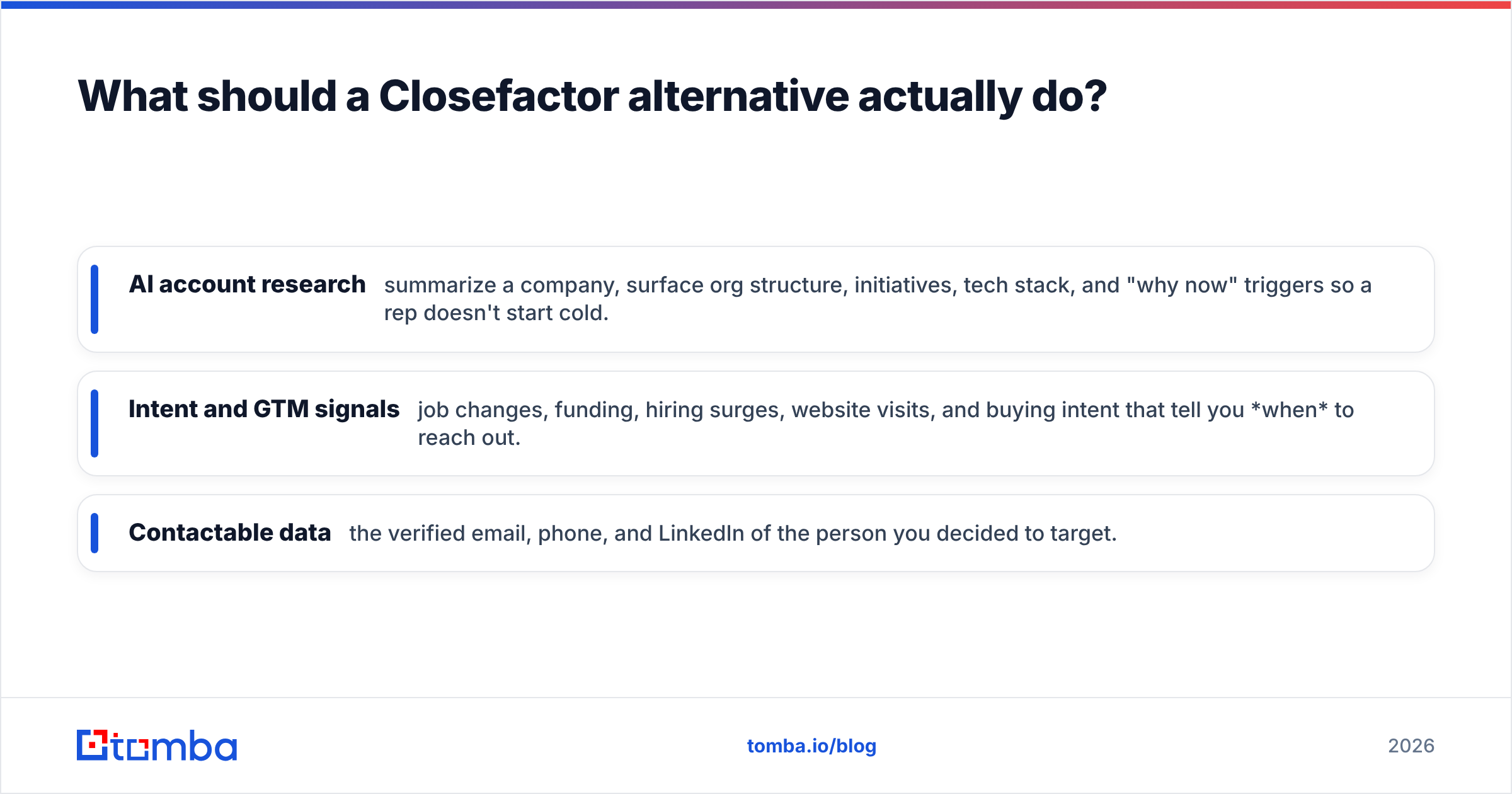
Before comparing logos, get clear on the three jobs Closefactor did, because most "alternatives" only cover one or two well:
- AI account research — summarize a company, surface org structure, initiatives, tech stack, and "why now" triggers so a rep doesn't start cold.
- Intent and GTM signals — job changes, funding, hiring surges, website visits, and buying intent that tell you when to reach out.
- Contactable data — the verified email, phone, and LinkedIn of the person you decided to target.
A tool that nails research but leaves you guessing at email formats forces you to bolt on an email finder and an email verifier anyway. Keep that in mind as you read — the "complete" platforms are pricey, and the affordable stacks are usually two focused tools working together.
The 9 best Closefactor alternatives in 2026#
1. Clay — best for custom AI research workflows#
Clay is the closest spiritual successor for teams that liked Closefactor's "programmable research" feel. It chains data providers, scraping, and AI enrichment into automated tables. You can replicate account-research plays, waterfall-enrich contacts, and trigger outreach — all without engineering. The trade-off is complexity and cost: Clay rewards power users and punishes casual ones, and credits burn quickly at scale.
2. 6sense — best for enterprise intent data#
6sense is a full account-based marketing and intent platform. If your reason for using Closefactor was the timing signal — knowing which accounts are in-market — 6sense is the heavyweight. Expect enterprise pricing and a real implementation. Smaller teams should look at a 6sense alternative before committing.
3. Apollo.io — best all-in-one for SMB and mid-market#
Apollo bundles a large B2B database, sequences, and basic intent into one affordable platform. It's the default "do everything" pick for growing teams. Data accuracy is decent but variable, especially outside North America, and heavy users hit credit ceilings. If Apollo's limits pinch, an Apollo alternative that specializes in verified emails pairs well with it.
4. ZoomInfo — best for depth of enterprise data#

ZoomInfo remains the deepest B2B dataset, with strong org charts, intent (via its Chorus and WebSights products), and firmographics. It's also the most expensive and locks you into annual contracts. It's overkill for a five-person startup and right-sized for a large sales org that needs coverage and won't blink at the invoice.
5. Cognism — best for EU and GDPR-first coverage#
Cognism's differentiator is phone-verified mobile data and strong European coverage with a compliance-first posture. If your ICP is in EMEA and deliverability plus GDPR matter, Cognism often beats the US-centric datasets. Pricing is enterprise and gated behind a demo.
6. Common Room — best for signal aggregation#
Common Room pulls signals from your product, community, social, and CRM into one place to reveal warm accounts and people. It's less about cold research and more about surfacing intent hiding in data you already own — a modern complement to, or replacement for, part of what Closefactor did.
7. HubSpot Breeze Intelligence — the "official" successor#
Since HubSpot absorbed Closefactor, Breeze Intelligence is technically where the technology went. If you already run HubSpot, this is the path of least resistance — enrichment and intent native to your CRM. If you don't, adopting HubSpot just to get it is a large commitment for one feature.
8. Clearbit (now Breeze) — best for enrichment APIs#
Clearbit, also part of HubSpot now, is still a strong enrichment and reveal layer, especially via API. Teams that want programmatic firmographic and contact enrichment can use it, though standalone availability has narrowed. Compare a Clearbit alternative if you want enrichment without the HubSpot gravity.
9. Tomba — best value for finding and verifying contact data#
Here's the piece the research platforms above under-deliver: turning a target account and a name into a verified, deliverable email address. Tomba's domain search returns the email pattern and known contacts for any company, the email finder resolves a specific person, and the built-in verifier plus catch-all verifier keep bounce rates low. Paired with data enrichment, it's the affordable "make the research actionable" layer — and it starts at $49/mo with a free tier, which none of the enterprise platforms offer.

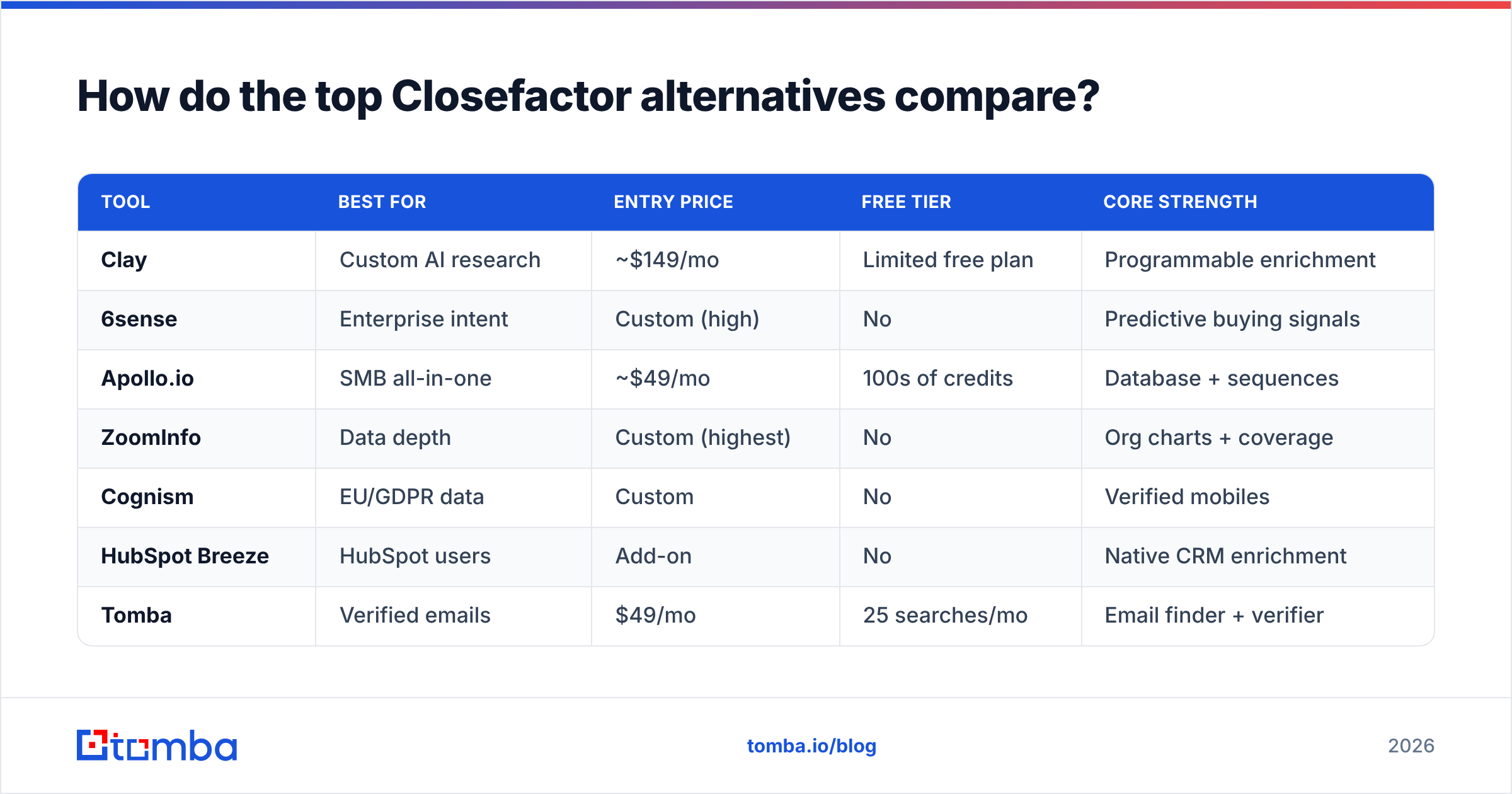
How do the top Closefactor alternatives compare?#
Pricing and free tiers matter as much as features when you're replacing a tool mid-cycle. Here's the head-to-head on the attributes that decide fit.
| Tool | Best for | Entry price | Free tier | Core strength |
|---|---|---|---|---|
| Clay | Custom AI research | ~$149/mo | Limited free plan | Programmable enrichment |
| 6sense | Enterprise intent | Custom (high) | No | Predictive buying signals |
| Apollo.io | SMB all-in-one | ~$49/mo | 100s of credits | Database + sequences |
| ZoomInfo | Data depth | Custom (highest) | No | Org charts + coverage |
| Cognism | EU/GDPR data | Custom | No | Verified mobiles |
| HubSpot Breeze | HubSpot users | Add-on | No | Native CRM enrichment |
| Tomba | Verified emails | $49/mo | 25 searches/mo | Email finder + verifier |
A few takeaways from the table:
- Only Apollo and Tomba publish an accessible entry price and a real free tier. Everything else is a demo-and-quote motion.
- The enterprise research tools don't guarantee deliverable emails — they surface people, but verification is on you.
- A stacked approach is cheaper than one mega-platform for most teams under 50 reps: use a signal tool for who and when, and a data tool like Tomba for the actual contact.
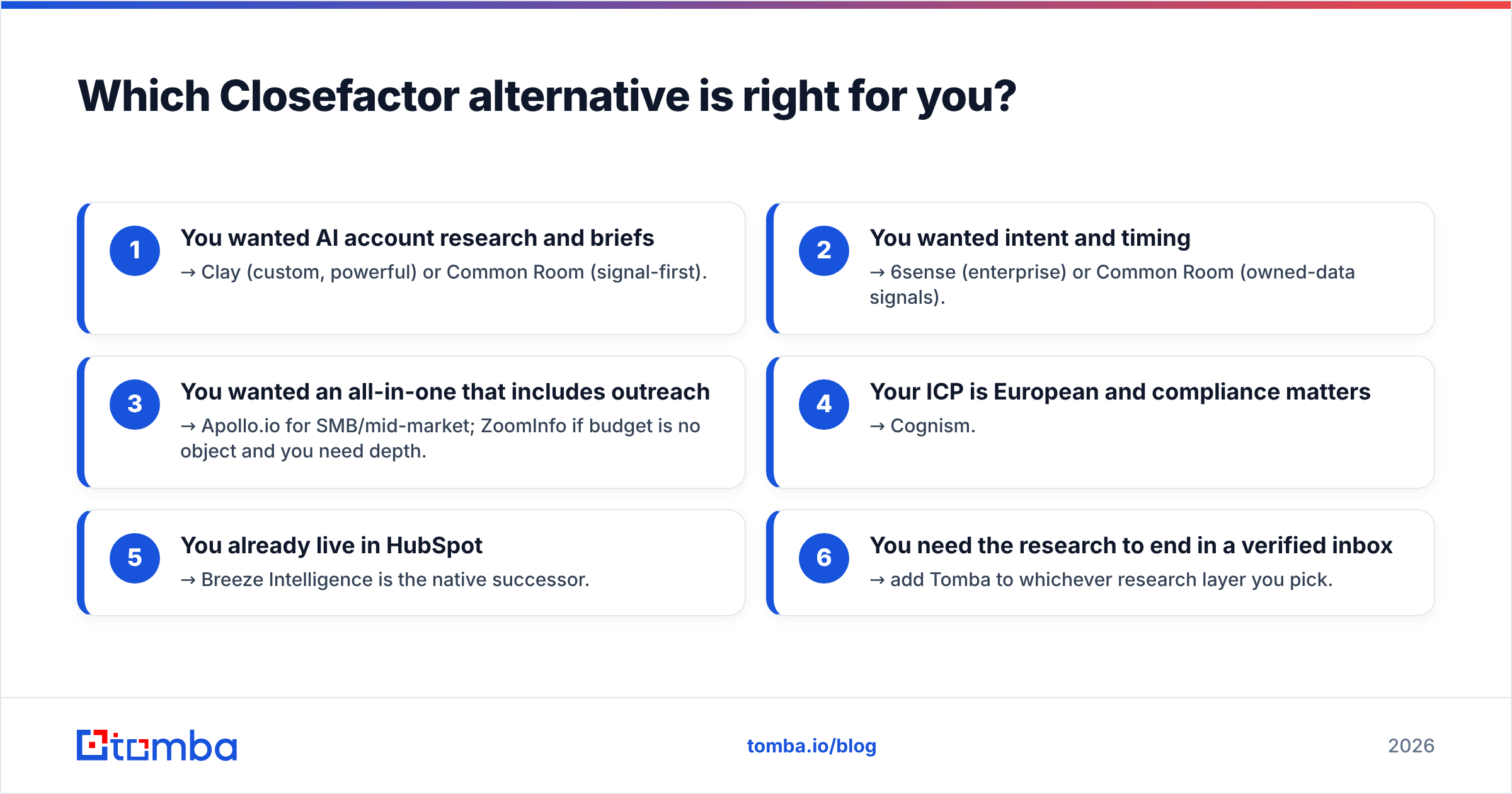
Which Closefactor alternative is right for you?#
Match the tool to the job you actually needed Closefactor for:
- You wanted AI account research and briefs → Clay (custom, powerful) or Common Room (signal-first).
- You wanted intent and timing → 6sense (enterprise) or Common Room (owned-data signals).
- You wanted an all-in-one that includes outreach → Apollo.io for SMB/mid-market; ZoomInfo if budget is no object and you need depth.
- Your ICP is European and compliance matters → Cognism.
- You already live in HubSpot → Breeze Intelligence is the native successor.
- You need the research to end in a verified inbox → add Tomba to whichever research layer you pick.
The most common winning combo in 2026 is a lightweight signal source plus a focused, accurate contact-data tool. It costs a fraction of a single enterprise seat and keeps your data out of any one CRM's walled garden. You can see how the numbers work on the Tomba pricing page and stack it against your current spend.
Is a single all-in-one platform better than a stack?#
Not usually, and here's the honest trade-off. All-in-one platforms like ZoomInfo and Apollo reduce tool sprawl and give you one login, one contract, one support team. That's real value for larger orgs that prize simplicity and have the budget.
But all-in-ones optimize for breadth, not accuracy in any one lane. Their email data is a byproduct of the database, not a verified, real-time SMTP check. When you send at volume, that difference shows up as bounce rate — which drags sender reputation and hurts email deliverability across your whole domain. A dedicated finder-plus-verifier catches bad addresses before they ever reach your sequence.
The stack approach wins on three fronts: lower total cost, no ecosystem lock-in, and best-in-class accuracy on the one thing that determines whether your outreach lands. The all-in-one wins on convenience. Choose based on which pain is louder for your team right now.
What about data accuracy and deliverability?#
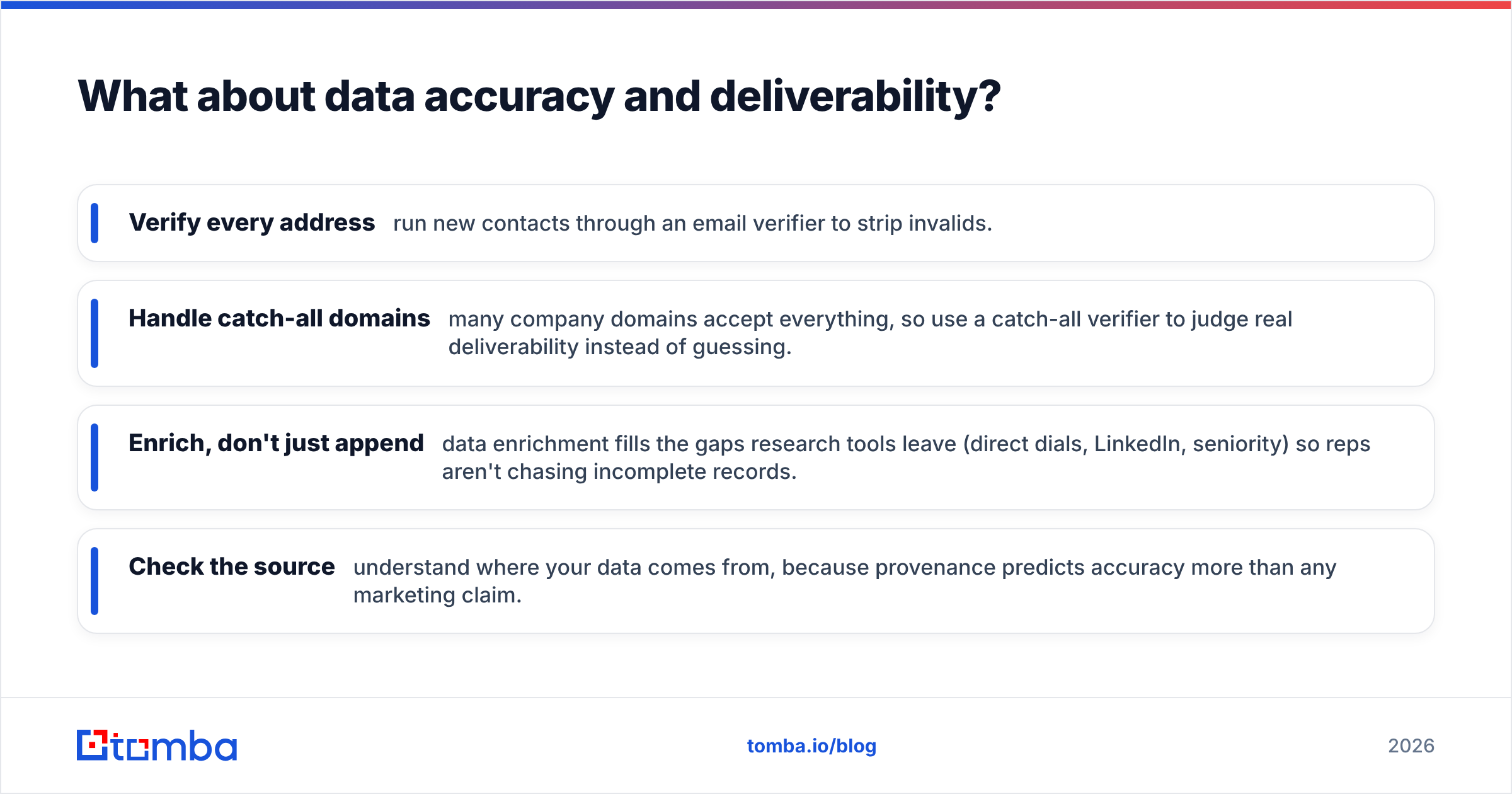
Whatever you pick, put accuracy first. Research tools rank accounts; they don't guarantee the email won't bounce. Before you push a list into outreach:
- Verify every address — run new contacts through an email verifier to strip invalids.
- Handle catch-all domains — many company domains accept everything, so use a catch-all verifier to judge real deliverability instead of guessing.
- Enrich, don't just append — data enrichment fills the gaps research tools leave (direct dials, LinkedIn, seniority) so reps aren't chasing incomplete records.
- Check the source — understand where your data comes from, because provenance predicts accuracy more than any marketing claim.
You can validate any vendor's real accuracy yourself: pull 100 contacts from a target account, verify them independently, and measure the bounce rate. Marketing decks quote 95%+ accuracy; your own test tells the truth.
The bottom line#
Closefactor's move into HubSpot doesn't leave a single obvious heir — it splits into two decisions. Pick a research and signal layer (Clay, 6sense, or Common Room) based on how much intent and automation you need, and pick a contact-data layer that makes those signals actionable with verified, deliverable emails.
For that second layer — the one that decides whether your carefully researched outreach actually reaches a human — start with the Tomba Email Finder. Use domain search to map any account's contacts, verify them on the spot, and keep your bounce rate low without an enterprise contract. The free tier gives you 25 searches a month to test it against your current stack before you pay a cent.
Related guides#
Ready to find emails that actually work?
Join 150,000+ professionals who stopped guessing and started sending. Free credits on signup — no credit card required.
Get the Tomba newsletter
Practical outbound tactics and product updates — once every two weeks.
About the author