Coefficy Reviews 2026: Features, Pricing, Pros and Cons
An independent look at Coefficy: what it does well, where it falls short, real pricing, and whether it belongs in your 2026 prospecting stack.

Coefficy has been popping up in more "best prospecting tool" lists lately, and the search volume for coefficy reviews tells you buyers are doing their homework before they pay. Good instinct. This is an independent breakdown — not a vendor pitch — of what Coefficy actually does, what it costs, where it earns its price, and where you should be skeptical.
TL;DR — Is Coefficy worth it?#
- What it is: Coefficy is a B2B lead-generation and contact-data tool built around finding and enriching business contacts for outbound sales.
- Best for: Small-to-mid outbound teams that want a single dashboard for list building and basic enrichment without a heavyweight platform contract.
- Weak spots: Data-accuracy consistency on niche domains, thin native integrations, and pricing that climbs quickly once you leave the entry tier.
- The catch nobody mentions: Like most all-in-one tools, Coefficy is a jack-of-all-trades — if email accuracy is your top priority, a dedicated email finder will usually beat it on hit rate and cost-per-valid-email.
- Verdict: Solid for generalists; not the sharpest tool if verified deliverable emails are the whole point of your workflow.
What is Coefficy and who is it for?#
Coefficy positions itself as an all-in-one prospecting layer: you search for companies or people, pull back contact details, enrich the records, and export to your CRM or cold-email tool. The pitch is convenience — one login instead of five.
That framing appeals most to:
- Founders and solo SDRs who need lists fast and don't have a data ops team.
- Small agencies running outbound for multiple clients who want a shared workspace.
- Generalist marketers who occasionally build a list and don't want a per-seat enterprise contract.
If you're a high-volume outbound team that lives and dies by deliverability, keep reading — the convenience story has trade-offs.

How does Coefficy actually work?#
The core loop is familiar to anyone who's used a contact-data tool:
- Search by company domain, job title, industry, or location.
- Reveal contact details (business email, sometimes phone) for matching people.
- Enrich the record with firmographic fields like company size, tech stack, or role seniority.
- Export to CSV or push into a connected tool.
Under the hood, tools in this category typically blend three data sources: licensed third-party databases, public web crawling, and pattern-based email guessing validated against SMTP responses. The quality of that blend — and how honestly a vendor reports confidence — is what separates a good tool from a list of bounces. Understanding where the data comes from matters more than any feature checklist, because a pretty dashboard on top of stale data still burns your sender reputation.
Coefficy features: what you actually get#
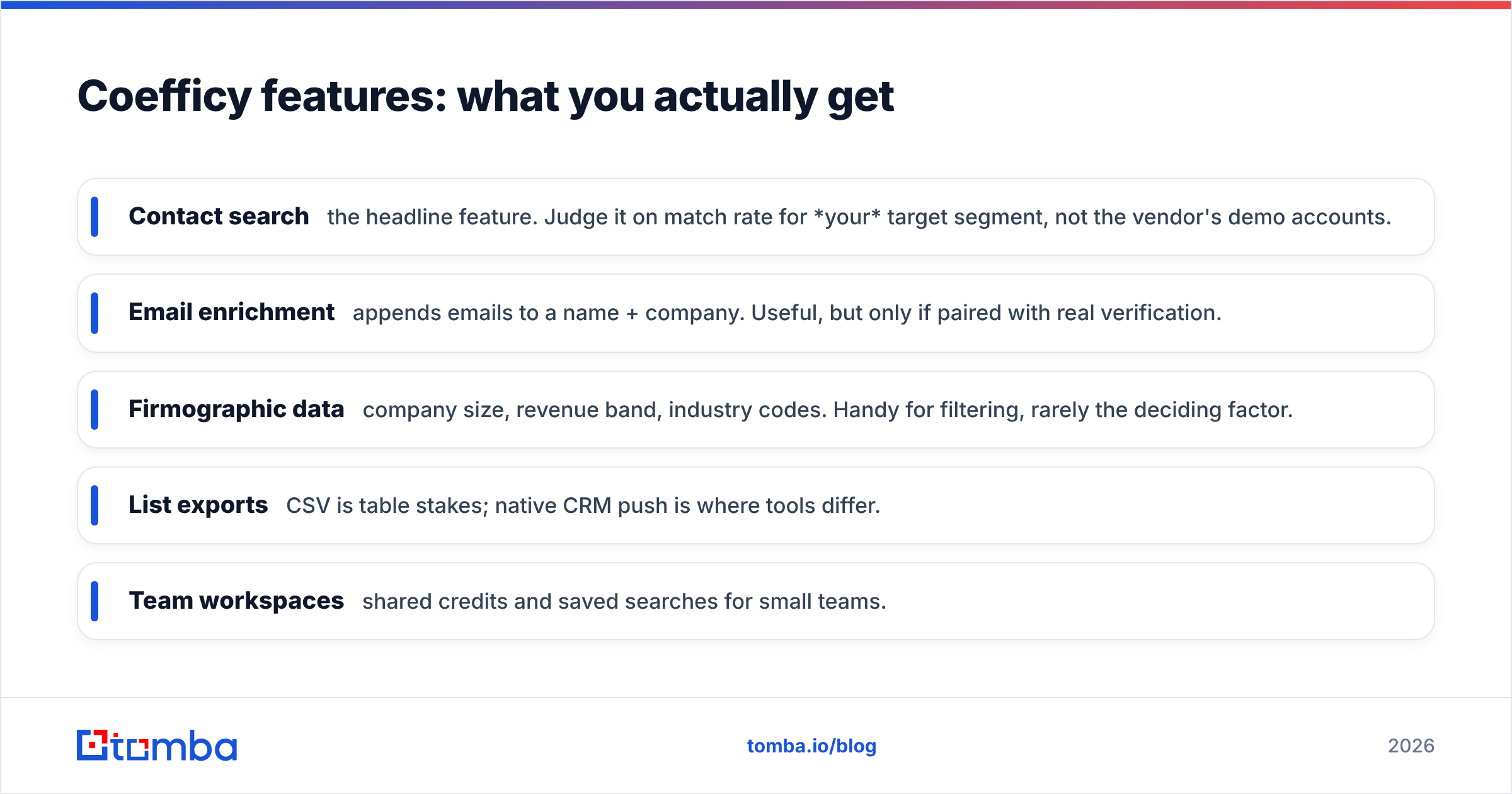
Here's a neutral rundown of the capabilities Coefficy-class tools advertise, and how to read each one:
- Contact search — the headline feature. Judge it on match rate for your target segment, not the vendor's demo accounts.
- Email enrichment — appends emails to a name + company. Useful, but only if paired with real verification.
- Firmographic data — company size, revenue band, industry codes. Handy for filtering, rarely the deciding factor.
- List exports — CSV is table stakes; native CRM push is where tools differ.
- Team workspaces — shared credits and saved searches for small teams.
What you should test before committing: catch-all handling. Many tools mark a catch-all domain as "valid" when it's really "unknown," which inflates their accuracy claims and inflates your bounce rate. A proper catch-all verifier treats those addresses honestly instead of hiding the uncertainty.
How much does Coefficy cost?#
Public pricing for newer tools shifts often, so treat any number you read (including here) as a starting point and confirm on the vendor's own page before you buy. The pattern across this category is a cheap entry tier that gets you hooked, then steep jumps as your credit needs grow.
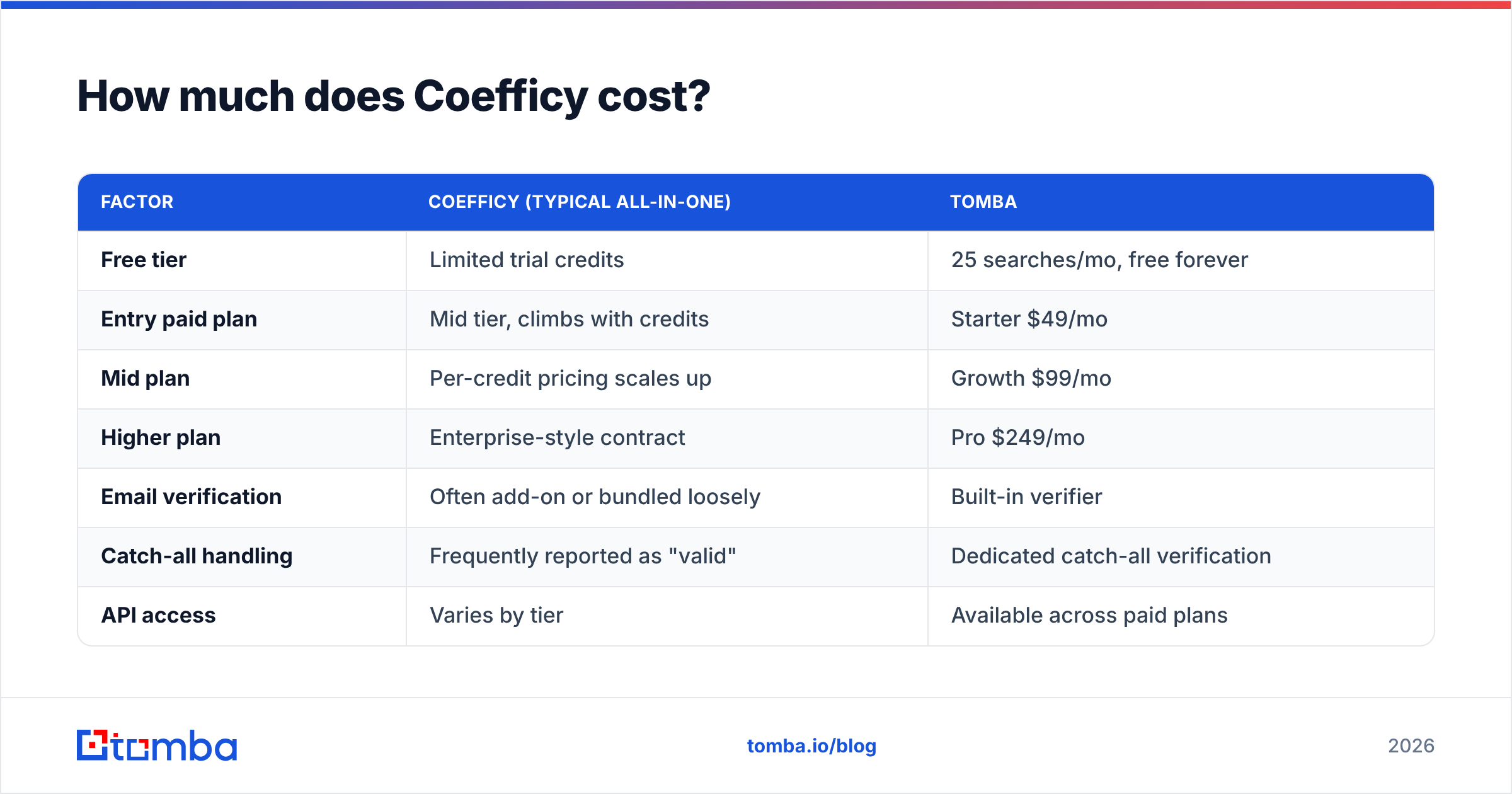
The table below compares a typical Coefficy-style plan structure against Tomba, so you can see how an all-in-one generalist stacks up against a specialist email-data tool on the things that actually drive cost-per-valid-lead.
| Factor | Coefficy (typical all-in-one) | Tomba |
|---|---|---|
| Free tier | Limited trial credits | 25 searches/mo, free forever |
| Entry paid plan | Mid tier, climbs with credits | Starter $49/mo |
| Mid plan | Per-credit pricing scales up | Growth $99/mo |
| Higher plan | Enterprise-style contract | Pro $249/mo |
| Email verification | Often add-on or bundled loosely | Built-in verifier |
| Catch-all handling | Frequently reported as "valid" | Dedicated catch-all verification |
| API access | Varies by tier | Available across paid plans |
The takeaway isn't "Tomba is cheaper on every line" — it's that you should price the tool by cost per verified, deliverable email, not by sticker price or raw credit count. A plan that returns 60% deliverable addresses at $49 can be more expensive per usable lead than one at $99 that returns 90%. Run that math against your own segment. You can sanity-check the numbers on the Tomba pricing page and against whatever Coefficy quotes you.
Is Coefficy accurate enough for cold outreach?#
This is the question that actually matters, and the honest answer is: it depends on your target list. Accuracy for contact-data tools is not one number — it swings hard by geography, company size, and industry.
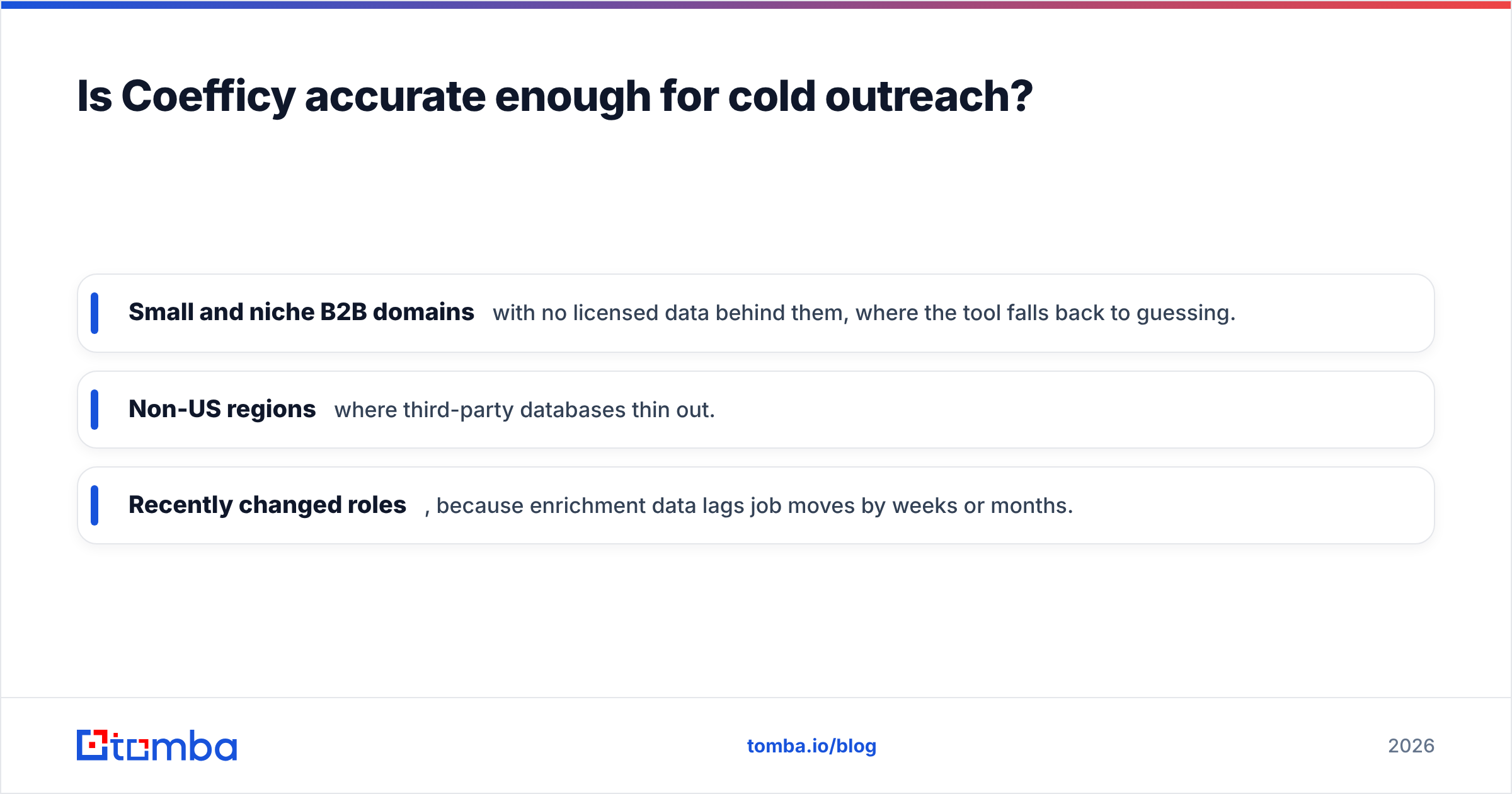
Where all-in-one tools tend to struggle:
- Small and niche B2B domains with no licensed data behind them, where the tool falls back to guessing.
- Non-US regions where third-party databases thin out.
- Recently changed roles, because enrichment data lags job moves by weeks or months.
The deliverability risk is real. Every percentage point of bounce rate chips away at your sender reputation, and once that's damaged even your verified emails land in spam. That's why the smart workflow is: find, then independently verify before you send. Never trust a single tool's "valid" flag as gospel — run the list through a dedicated email verifier as a second gate. It costs a fraction of one lost deal and protects the domain you spent months warming up.
For a broader sense of how buyers rate these tools, cross-reference user reviews on G2 and Capterra rather than relying on any single testimonial — patterns across dozens of reviews are far more reliable than a handful of five-star quotes on a vendor's landing page.
Coefficy pros and cons#
Pros
- One dashboard for search, enrichment, and export — genuinely convenient for generalists.
- Low barrier to entry — you can build a first list without a sales call.
- Team workspaces make it reasonable for small agencies.
- Firmographic filters help you narrow to an ICP quickly.
Cons
- Accuracy varies by segment; niche and non-US domains are weak spots.
- Verification is often an afterthought, pushing bounce risk onto you.
- Integrations are thinner than incumbent platforms — expect CSV middlemen.
- Pricing scales steeply once you outgrow the entry tier.
- No specialist edge — it's rarely the best at any one job, including email finding.
How does Coefficy compare to specialist tools?#
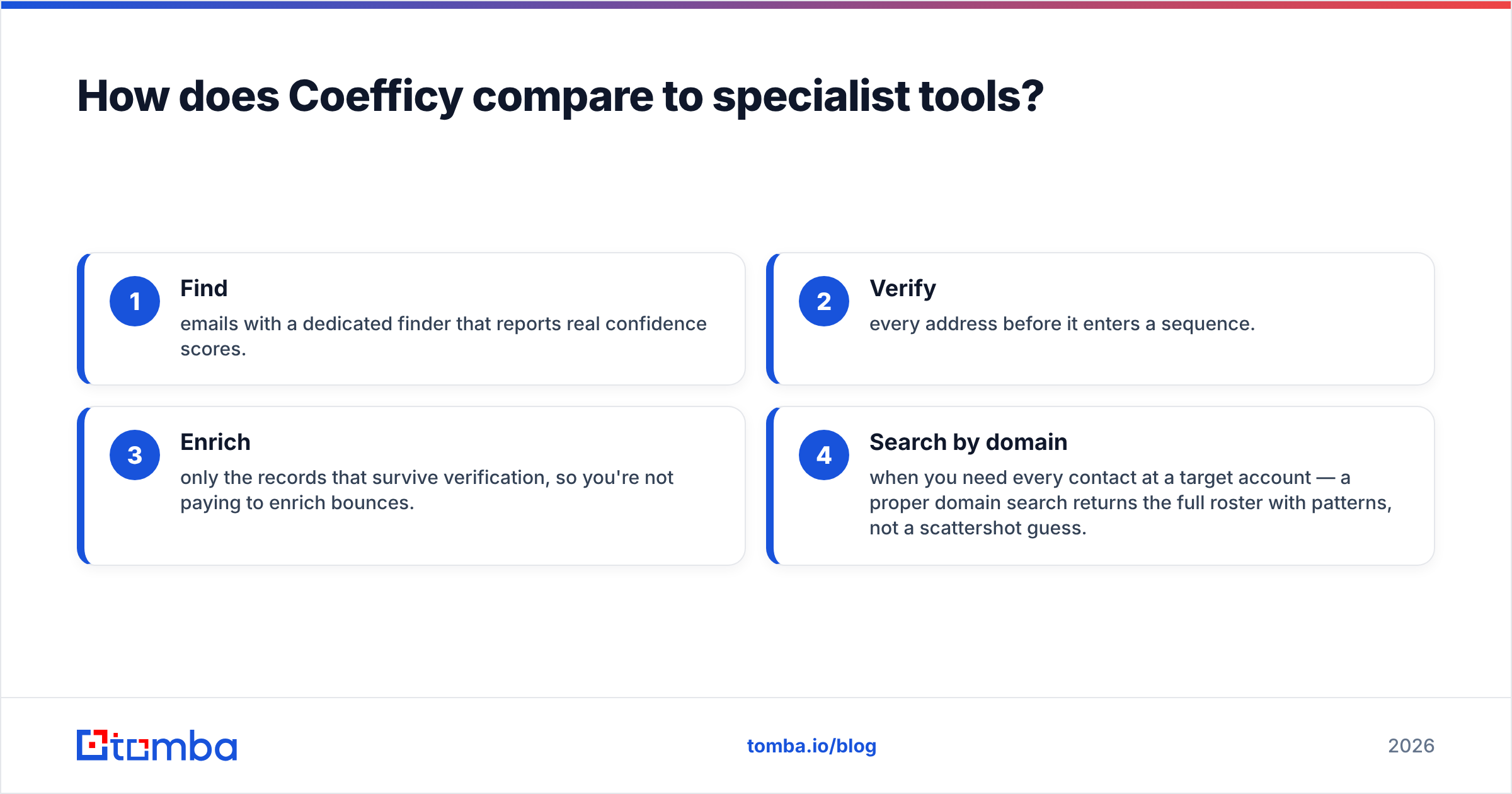
The core strategic question is whether you want one tool that does many things adequately, or a specialist for the job that drives your revenue. For most outbound motions, the job that drives revenue is getting a verified, deliverable email in front of the right person — everything else is supporting cast.
If that's your priority, a focused stack usually wins:
- Find emails with a dedicated finder that reports real confidence scores.
- Verify every address before it enters a sequence.
- Enrich only the records that survive verification, so you're not paying to enrich bounces.
- Search by domain when you need every contact at a target account — a proper domain search returns the full roster with patterns, not a scattershot guess.
This is where Tomba's specialization shows. It's not trying to be your CRM or your sequencer — it's built to return accurate, verified B2B contact data, with the email finder, verifier, domain search, and catch-all tooling working as one pipeline. If Coefficy is the Swiss Army knife, a specialist finder is the chef's knife: narrower, sharper, better at the one cut you make a hundred times a day.
That said, Coefficy isn't a bad choice for someone who genuinely values breadth over depth. If you build one list a month and verification volume is low, the convenience may outweigh the accuracy trade-off. Match the tool to how often you actually use it.
What do real Coefficy reviews focus on?#
When you read through user feedback across review sites, the recurring themes are predictable — and they're the same themes you should personally test during a trial:
- Match rate on their specific ICP (the single biggest satisfaction driver).
- Bounce rate after sending (the number that reveals verification quality).
- How fast credits burn relative to usable results.
- Support responsiveness when data looks wrong.
- Export friction into whatever CRM or cold-email tool they run.
Notice what's missing from happy reviews: nobody raves about firmographic breadth or the number of data fields. They rave about deliverable emails and low bounce rates. Weight your evaluation the same way. For a deeper background on why deliverability sits at the center of all this, the concept of email deliverability is worth understanding before you spend a dollar on any prospecting tool.
Should you buy Coefficy in 2026?#
Buy it if: you're a generalist or small team that values a single dashboard, your list-building is occasional, and you're willing to run an independent verification pass before you send. In that context, Coefficy is a reasonable, low-friction choice.
Skip it if: email accuracy and deliverability are the whole game for you, you send at volume, or you're already burned by bounces eating your sender reputation. In that case, a specialist finder-plus-verifier stack will return more usable leads per dollar and protect the domain you've invested in.
The honest framing: Coefficy competes on convenience, not on being the sharpest data tool in any single category. Whether that trade is worth it comes down to how central verified email is to your revenue.
The bottom line#
Coefficy is a competent all-in-one for teams that want breadth. But if your outbound success is measured in replies and booked meetings — and it should be — then the accuracy and deliverability of your emails outrank every other feature. Convenience is nice; a low bounce rate pays the bills.
If verified, deliverable B2B emails are what you're really after, start with a tool built for exactly that. Try the Tomba Email Finder — find professional email addresses by domain, name, or company, verify them in the same pipeline, and start on the free tier with 25 searches a month before you commit a cent. Test it against your own list, measure the bounce rate, and let the numbers decide.
Related guides#
Ready to find emails that actually work?
Join 150,000+ professionals who stopped guessing and started sending. Free credits on signup — no credit card required.
Get the Tomba newsletter
Practical outbound tactics and product updates — once every two weeks.
About the author