Cognism vs Data Axle: B2B Data Accuracy Compared (2026)
Cognism and Data Axle both sell B2B contact data, but they solve different problems. Here's an honest breakdown of coverage, accuracy, pricing, and the leaner alternative worth testing first.
Choosing a B2B data provider usually comes down to a boring question with expensive consequences: whose records are actually accurate, and what does it cost to find out? Cognism and Data Axle both promise clean, compliant contact data at scale, but they were built for different buyers. This comparison breaks down where each one wins, where it frustrates users, and when a lighter, pay-as-you-go tool covers the same job for a fraction of the spend.
TL;DR: Cognism vs Data Axle#
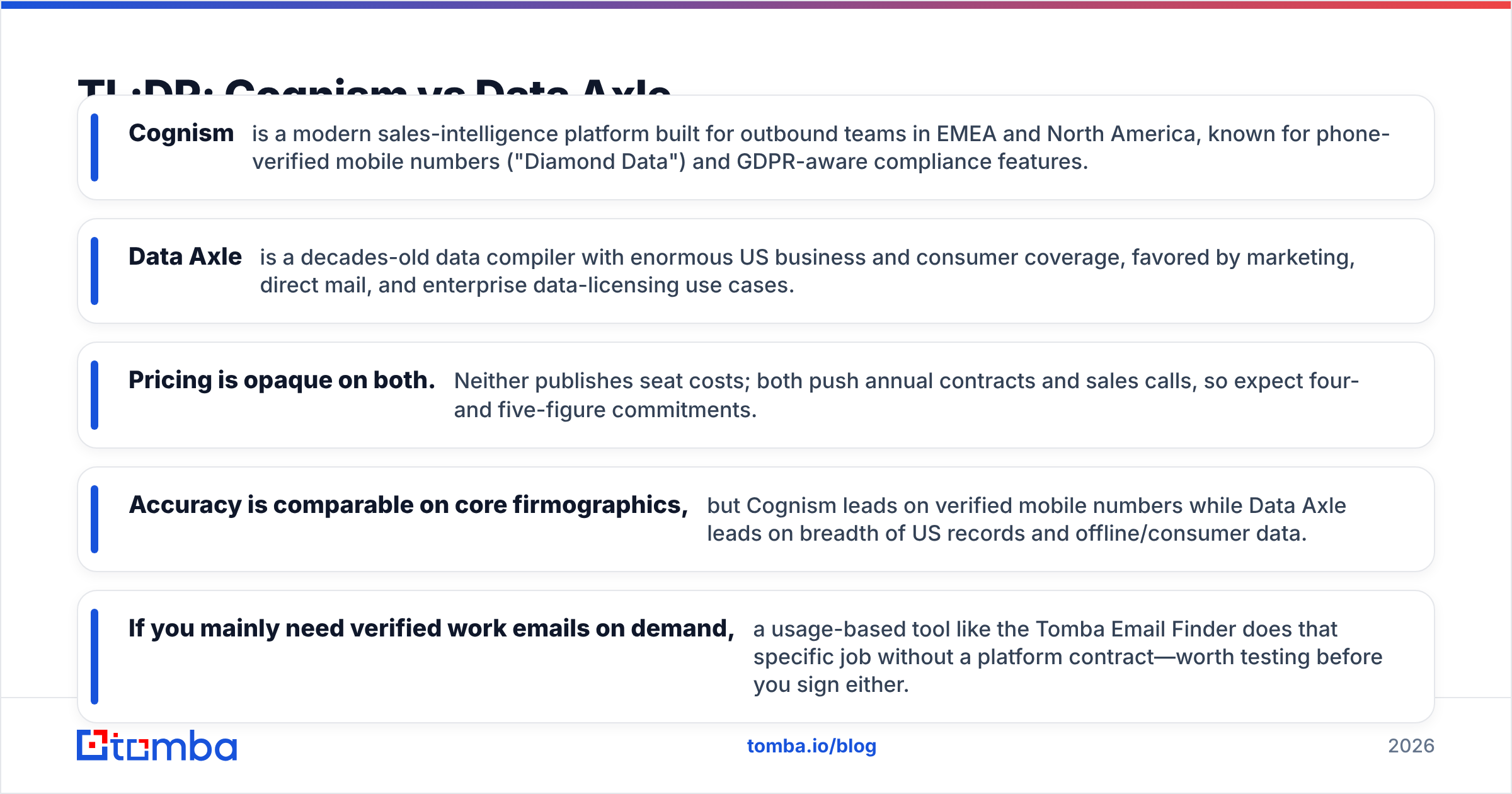
- Cognism is a modern sales-intelligence platform built for outbound teams in EMEA and North America, known for phone-verified mobile numbers ("Diamond Data") and GDPR-aware compliance features.
- Data Axle is a decades-old data compiler with enormous US business and consumer coverage, favored by marketing, direct mail, and enterprise data-licensing use cases.
- Pricing is opaque on both. Neither publishes seat costs; both push annual contracts and sales calls, so expect four- and five-figure commitments.
- Accuracy is comparable on core firmographics, but Cognism leads on verified mobile numbers while Data Axle leads on breadth of US records and offline/consumer data.
- If you mainly need verified work emails on demand, a usage-based tool like the Tomba Email Finder does that specific job without a platform contract—worth testing before you sign either.
What is Cognism?#
Cognism is a sales-intelligence and prospecting platform aimed at revenue teams running outbound. Its core pitch is high-quality contact data—especially mobile phone numbers verified by a human calling team, marketed as Diamond Verified. It layers on intent data, sales-trigger signals, a Chrome extension for LinkedIn, and CRM integrations with Salesforce and HubSpot.
The company leans hard into compliance. It maintains a notified list checked against the major European Do-Not-Call registries, which matters if your reps dial prospects across the UK, DACH, and the Nordics. For teams whose pipeline depends on connecting by phone in Europe, that phone-verification layer is Cognism's headline differentiator.
Cognism sells to sales development, account executives, and RevOps leaders who want one enrichment source feeding their sequencing tools. You can read its own positioning on cognism.com, and cross-check real buyer sentiment on G2.
What is Data Axle?#
Data Axle (formerly Infogroup) is a data compiler with roots going back decades. Where Cognism feels like a modern SaaS product, Data Axle is a data-licensing business: it maintains massive US databases of businesses and consumers, and sells access to them for marketing, analytics, direct mail, and enrichment.
Its scale is the story. Data Axle claims coverage of tens of millions of US business records and hundreds of millions of consumer records, refreshed through phone verification and a large compilation operation. That breadth makes it a common choice for enterprise marketing teams, agencies running multichannel campaigns, and organizations that need both firmographic and consumer/household data in one licensing deal.
The tradeoff is that Data Axle is less of a self-serve prospecting tool and more of a data supplier. You can review its offering on data-axle.com. If your workflow is a rep finding one contact at a time inside LinkedIn, Data Axle is not designed around that motion the way Cognism is.

Cognism vs Data Axle: how do they compare?#
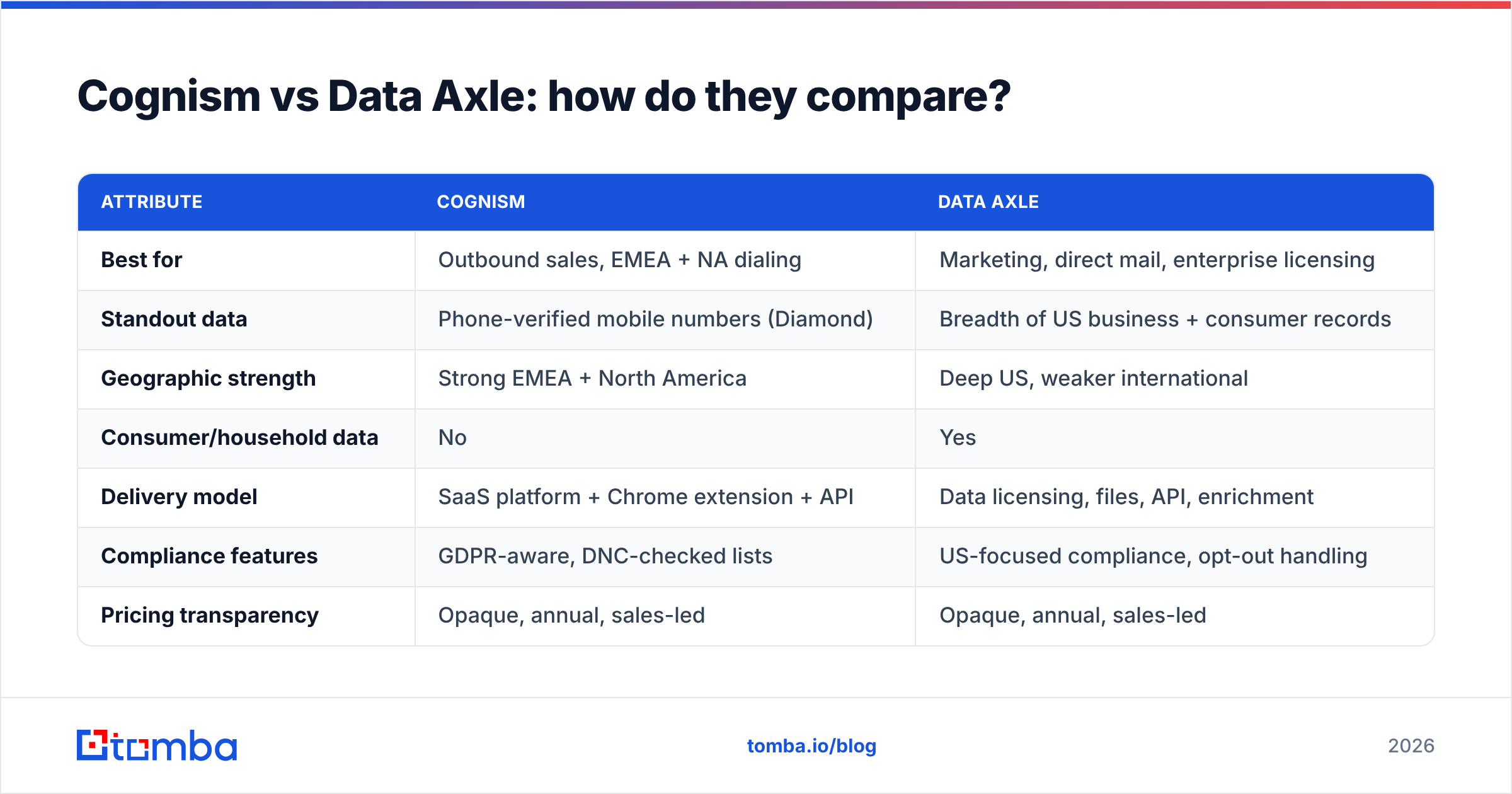
Here's the head-to-head on the attributes buyers actually weigh. Treat the pricing figures as directional—both vendors quote per deal and rarely publish numbers.
| Attribute | Cognism | Data Axle |
|---|---|---|
| Best for | Outbound sales, EMEA + NA dialing | Marketing, direct mail, enterprise licensing |
| Standout data | Phone-verified mobile numbers (Diamond) | Breadth of US business + consumer records |
| Geographic strength | Strong EMEA + North America | Deep US, weaker international |
| Consumer/household data | No | Yes |
| Delivery model | SaaS platform + Chrome extension + API | Data licensing, files, API, enrichment |
| Compliance features | GDPR-aware, DNC-checked lists | US-focused compliance, opt-out handling |
| Pricing transparency | Opaque, annual, sales-led | Opaque, annual, sales-led |
| Typical commitment | Annual contract, per-seat | Annual license/volume deal |
| Free trial | Limited, sales-gated | Sales-gated |
The pattern is clear: Cognism optimizes for the outbound rep, Data Axle optimizes for the data buyer. Neither is "better" in the abstract; the winner depends on whether your bottleneck is connecting with prospects by phone or licensing a large addressable universe for campaigns.
Which one is more accurate?#
Accuracy depends on what you're measuring, and neither vendor has a monopoly on "clean data."
Cognism wins on verified mobile numbers. The human-verification layer means fewer dead dials, which is the whole reason phone-heavy teams pay a premium. If your reps live on the phone in Europe, that verification is worth real money because a connected call is worth far more than a bounced email.
Data Axle wins on breadth and offline data. Its compilation engine covers small US businesses, local firms, and consumer/household records that a sales-first tool like Cognism simply doesn't carry. For direct mail or multichannel marketing across the long tail of US businesses, that coverage is hard to replicate.
But breadth and freshness pull in opposite directions. Large compiled databases inevitably carry stale rows—people change jobs, companies fold, and a record verified 18 months ago may be wrong today. That's why serious teams re-verify before they send, regardless of the source. Running any list through an email verifier before a campaign protects your sender reputation more than trusting a vendor's "verified" label at face value. The most accurate provider is the one whose data you re-check closest to send time.

How does pricing compare?#
Neither Cognism nor Data Axle publishes prices, and that opacity is the single most common complaint in buyer reviews. Both run a sales-led motion: you book a call, describe your use case, and get a custom quote tied to an annual contract.
Expect the following realities:
- Annual commitment by default. Month-to-month is rare. You're signing up for a year before you've measured ROI on your specific territory.
- Seat- or volume-based tiers. Cognism typically prices per user with credit limits; Data Axle prices by record volume or license scope.
- Four- to five-figure entry points. Both are enterprise-priced. Small teams often find the minimum spend hard to justify.
- Add-ons cost extra. Intent data, extra credits, and premium verification frequently sit outside the base price.
- Negotiation matters. Quotes are flexible, so the price you're first offered is rarely the floor.
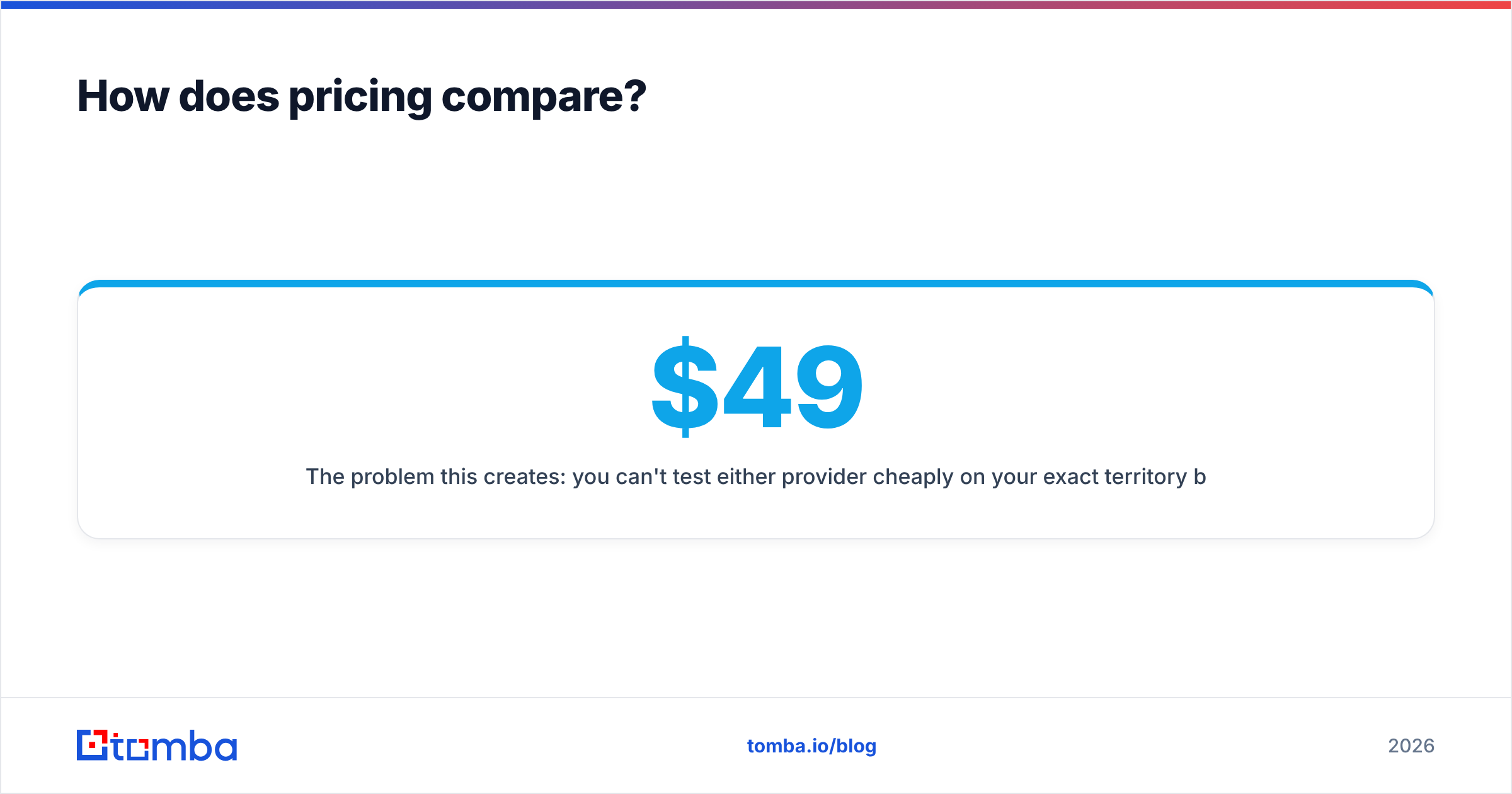
The problem this creates: you can't test either provider cheaply on your exact territory before committing. For a lot of teams, that's the deal-breaker. If your need is narrower than "full sales-intelligence platform," a transparent, usage-based tool is easier to justify. Tomba, for example, publishes plans openly—a free tier with 25 searches a month, then $49/mo Starter, $99/mo Growth, and $249/mo Pro. You can see the full Tomba pricing without a sales call, which makes it trivial to run a pilot before scaling up.
When should you pick Cognism?#
Choose Cognism if most of these describe you:
- Your pipeline depends on outbound phone connects, especially in the UK, DACH, and broader EMEA.
- You need DNC-checked, GDPR-aware contact data and want that compliance handled upstream.
- Your reps work primarily in LinkedIn and your CRM, and you want a Chrome extension plus native Salesforce/HubSpot sync.
- You can absorb an annual, per-seat contract and want intent signals bundled in.
Cognism is a strong fit for funded SDR teams running high-volume, phone-forward outbound across Europe. That's its home turf, and few compilers match its mobile-number verification there.
When should you pick Data Axle?#
Choose Data Axle if these fit:
- You run marketing, direct mail, or multichannel campaigns and need reach across the long tail of US businesses.
- You need consumer or household data alongside B2B firmographics.
- You're an enterprise or agency licensing data for analytics, modeling, or list rental.
- Your use case is breadth of US coverage rather than one-rep-at-a-time prospecting inside LinkedIn.
Data Axle shines when the job is "give me a large, compliant addressable universe to campaign against," not "help my rep find one CFO's mobile number right now."
Is there a leaner alternative to both?#
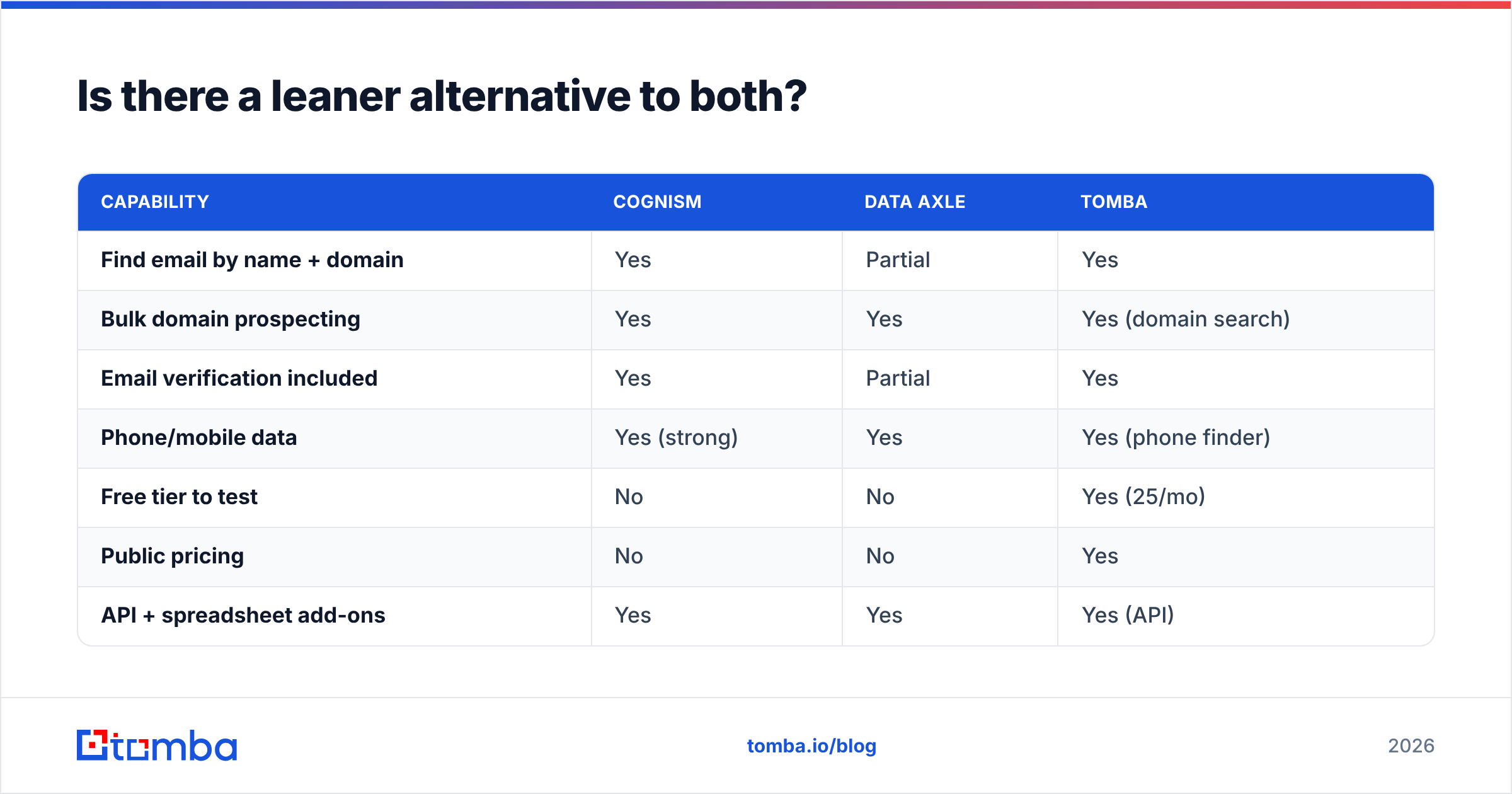
Yes—and for a large share of teams, it's the smarter first move. The uncomfortable truth is that many buyers evaluate Cognism and Data Axle when what they actually need is a reliable way to find and verify work emails on demand, without a platform contract.
That's a much smaller, cheaper problem. A focused email-finding tool covers it with pay-as-you-go pricing and no annual lock-in:
| Capability | Cognism | Data Axle | Tomba |
|---|---|---|---|
| Find email by name + domain | Yes | Partial | Yes |
| Bulk domain prospecting | Yes | Yes | Yes (domain search) |
| Email verification included | Yes | Partial | Yes |
| Phone/mobile data | Yes (strong) | Yes | Yes (phone finder) |
| Free tier to test | No | No | Yes (25/mo) |
| Public pricing | No | No | Yes |
| API + spreadsheet add-ons | Yes | Yes | Yes (API) |
Tomba isn't trying to replace a full sales-intelligence suite with intent scoring and household data. What it does replace is the reflex to buy a heavyweight platform for a job that's really "get me verified emails and phone numbers, priced by usage." You can enrich records through data enrichment, pull contacts from its B2B database, and check how the data is sourced on its data sources page—all without booking a demo. For teams that want to prove ROI before committing, starting lean and scaling up beats signing an annual contract on faith.
How to decide#
Work backward from your bottleneck:
- Phone-first outbound in Europe → Cognism is likely worth the contract.
- Large-scale US marketing, direct mail, or consumer data → Data Axle's breadth is hard to beat.
- You mainly need verified emails and phones, priced by usage → start with a lean tool and only graduate to a platform when volume demands it.
- You're not sure yet → pilot the cheap option first. It costs almost nothing to learn what your territory actually needs.
Both Cognism and Data Axle are legitimate, capable providers—this isn't a case of one being a scam and the other a savior. It's a case of matching the tool to the job and refusing to overpay for capabilities you won't use.
The bottom line#
Cognism vs Data Axle is really a question of motion: sales-led phone outbound versus marketing-led data breadth. Cognism gives outbound teams verified mobile numbers and European compliance; Data Axle gives marketers unmatched US reach and consumer data. Both hide their pricing behind sales calls and annual contracts, which makes cheap experimentation impossible.
If your core need is finding and verifying business emails—and confirming phone numbers—without committing to a platform, test a usage-based tool first. Try the Tomba Email Finder on your real target accounts with the free tier, measure the hit rate on your own territory, and let the results—not a sales quote—decide how much data infrastructure you actually need.
Related guides#
Ready to find emails that actually work?
Join 150,000+ professionals who stopped guessing and started sending. Free credits on signup — no credit card required.
Get the Tomba newsletter
Practical outbound tactics and product updates — once every two weeks.
About the author