Cognism vs DiscoverOrg: B2B Sales Data Compared for 2026
DiscoverOrg became part of ZoomInfo, and Cognism grew into its biggest rival. Here's how these two B2B data platforms actually compare on accuracy, coverage, compliance, and cost in 2026.
Choosing between Cognism and DiscoverOrg feels harder than it should, partly because DiscoverOrg no longer exists under that name. It merged with ZoomInfo in 2019, and the combined company now sells under the ZoomInfo brand. So when buyers search "Cognism vs DiscoverOrg," they're usually comparing Cognism against the ZoomInfo data engine that DiscoverOrg became famous for: deep org charts, verified direct dials, and intent signals.
This guide treats the comparison honestly. Both are premium B2B data platforms sold on annual contracts, both are expensive, and neither publishes public pricing. If you need enterprise-grade coverage, one of them may be right. If you mostly need accurate email addresses and phone numbers without a five-figure commitment, there's a leaner path worth knowing about too.
TL;DR#
- DiscoverOrg is now ZoomInfo. Comparing "Cognism vs DiscoverOrg" in 2026 means comparing Cognism against ZoomInfo's DiscoverOrg-derived data engine.
- Cognism wins on international coverage (strong EMEA data), GDPR-first compliance, and phone-verified "Diamond Data" mobile numbers.
- DiscoverOrg/ZoomInfo wins on North American depth, org charts, intent data, and platform breadth.
- Both are pricey and annual-only. Expect four to five figures per year, with per-seat and credit gates.
- If your core need is verified emails and direct contacts, a pay-as-you-go tool like Tomba Email Finder covers the essential job for a fraction of the cost.
Wait, isn't DiscoverOrg the same as ZoomInfo now?#
Yes. DiscoverOrg acquired ZoomInfo in 2019 and adopted the ZoomInfo name for the combined product. The DiscoverOrg heritage lives on as the human-verified org-chart and technographic layer inside ZoomInfo's database. You can confirm the history on ZoomInfo's own site and background on Wikipedia.
That matters for your decision in two ways. First, any "DiscoverOrg" reviews older than 2019 describe a standalone product that no longer ships. Second, when a sales rep pitches you "the DiscoverOrg data," they mean ZoomInfo's premium tier. Keep that straight and the comparison gets much clearer.
What does Cognism actually do?#
Cognism is a UK-founded sales intelligence platform built around compliance and international coverage. Its pitch is that you can prospect across Europe without tripping over GDPR, because the company runs a notification and do-not-call process baked into its workflow.
Its headline feature is Diamond Data: mobile phone numbers that Cognism claims are phone-verified by a human team, with accuracy rates it markets in the high 90s for that verified subset. For teams that live on cold calls into EMEA, that verified-mobile angle is the main reason to look at Cognism at all.
Cognism sells access to contact data, company data, and intent signals (via a Bombora partnership), delivered through a web app, Chrome extension, and CRM integrations.
What does DiscoverOrg (ZoomInfo) actually do?#
DiscoverOrg's legacy, now inside ZoomInfo, is depth. It built its reputation on human-researched org charts, reporting structures, and technographics for North American companies. ZoomInfo layered on scale, intent data (from its Bombora relationship and first-party signals), websites-visitor tracking, conversation intelligence, and a workflow/automation suite.
If Cognism is "compliant reach into Europe," DiscoverOrg/ZoomInfo is "the deepest picture of a North American account you can buy." That depth is why large enterprise sales teams keep renewing despite the price.
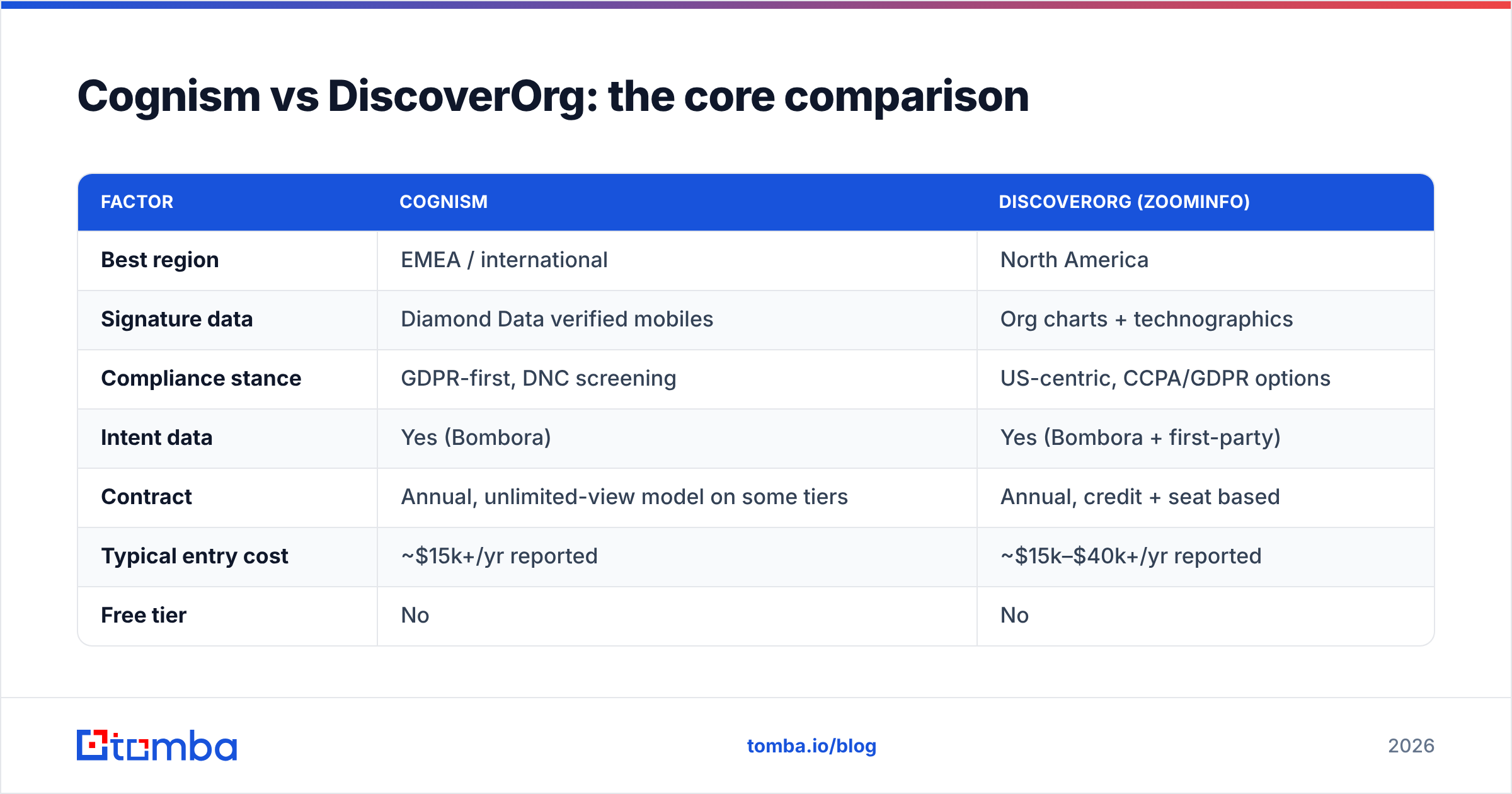
Cognism vs DiscoverOrg: the core comparison#
Here's the honest side-by-side. Because pricing is gated behind sales calls for both, the price rows reflect widely reported ranges rather than published rate cards.
| Factor | Cognism | DiscoverOrg (ZoomInfo) |
|---|---|---|
| Best region | EMEA / international | North America |
| Signature data | Diamond Data verified mobiles | Org charts + technographics |
| Compliance stance | GDPR-first, DNC screening | US-centric, CCPA/GDPR options |
| Intent data | Yes (Bombora) | Yes (Bombora + first-party) |
| Contract | Annual, unlimited-view model on some tiers | Annual, credit + seat based |
| Typical entry cost | ~$15k+/yr reported | ~$15k–$40k+/yr reported |
| Free tier | No | No |
| Pay-as-you-go | No | No |
Two takeaways. If your reps sell into the UK, DACH, or the Nordics, Cognism's compliance workflow and EMEA mobile coverage are genuinely differentiated. If your motion is North American enterprise and you value org hierarchy plus intent, DiscoverOrg's data inside ZoomInfo is hard to beat.
Which one is more accurate?#
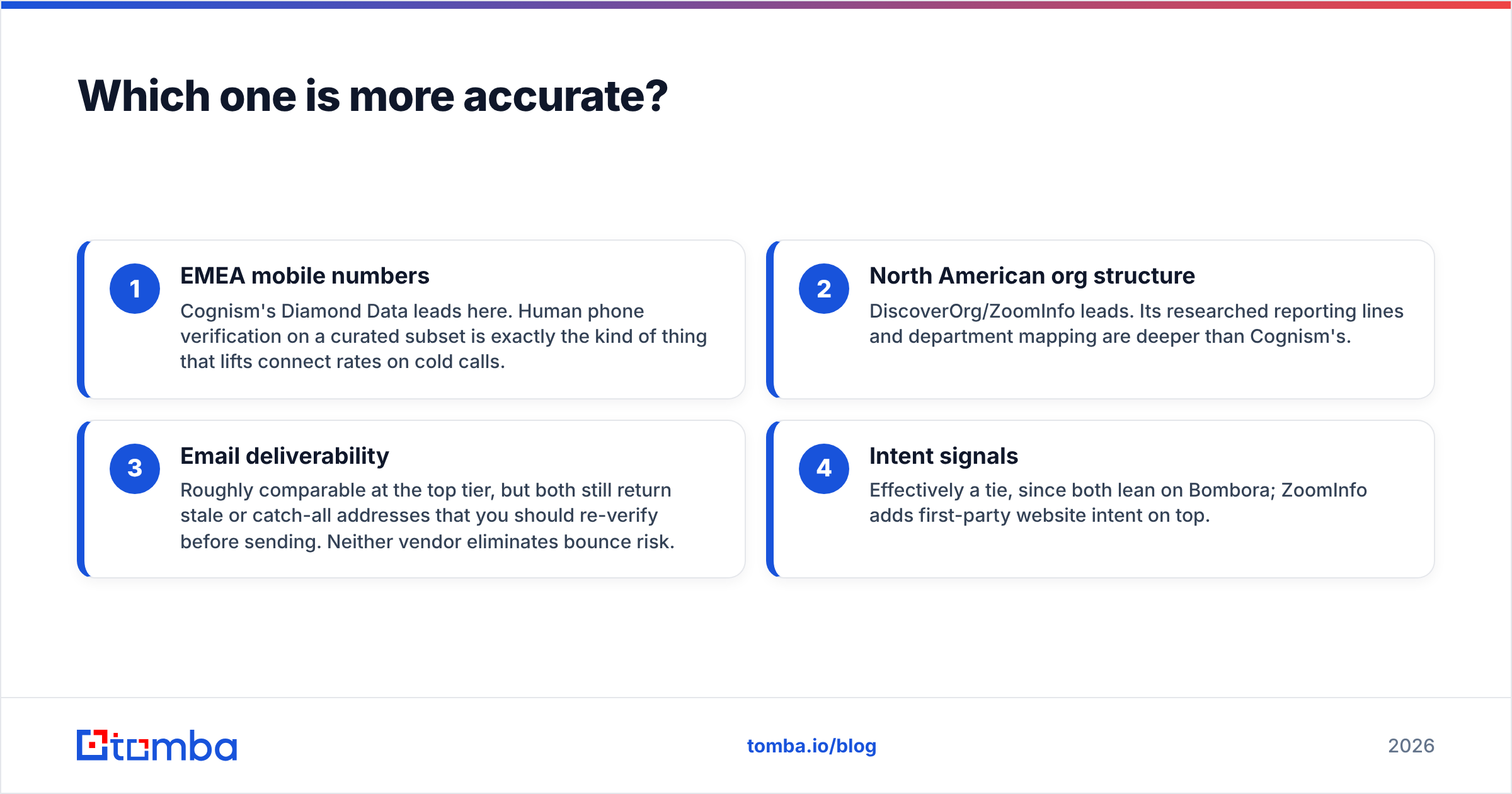
Accuracy depends entirely on region and data type, so a single "winner" is misleading. Use this breakdown instead:
- EMEA mobile numbers — Cognism's Diamond Data leads here. Human phone verification on a curated subset is exactly the kind of thing that lifts connect rates on cold calls.
- North American org structure — DiscoverOrg/ZoomInfo leads. Its researched reporting lines and department mapping are deeper than Cognism's.
- Email deliverability — Roughly comparable at the top tier, but both still return stale or catch-all addresses that you should re-verify before sending. Neither vendor eliminates bounce risk.
- Intent signals — Effectively a tie, since both lean on Bombora; ZoomInfo adds first-party website intent on top.
The practical lesson: no premium database is a substitute for verifying an address right before you hit send. Even the best providers decay a few percent every month as people change jobs. Running contacts through a dedicated email verifier is cheap insurance against protecting your sender reputation and your email deliverability.
How much do Cognism and DiscoverOrg cost?#
Both are enterprise purchases. Neither lists prices, both require a demo, and both push annual contracts. Reported figures put Cognism entry packages in the low-to-mid five figures per year, and ZoomInfo (the DiscoverOrg engine) commonly lands anywhere from the mid five figures upward once you add seats, credits, and premium data modules.
That model works if you're staffing a full outbound team that will use every feature. It works poorly if you mainly need accurate contact details for a focused list, because you're paying for a platform when you need a lookup.

Where does a tool like Tomba fit in?#
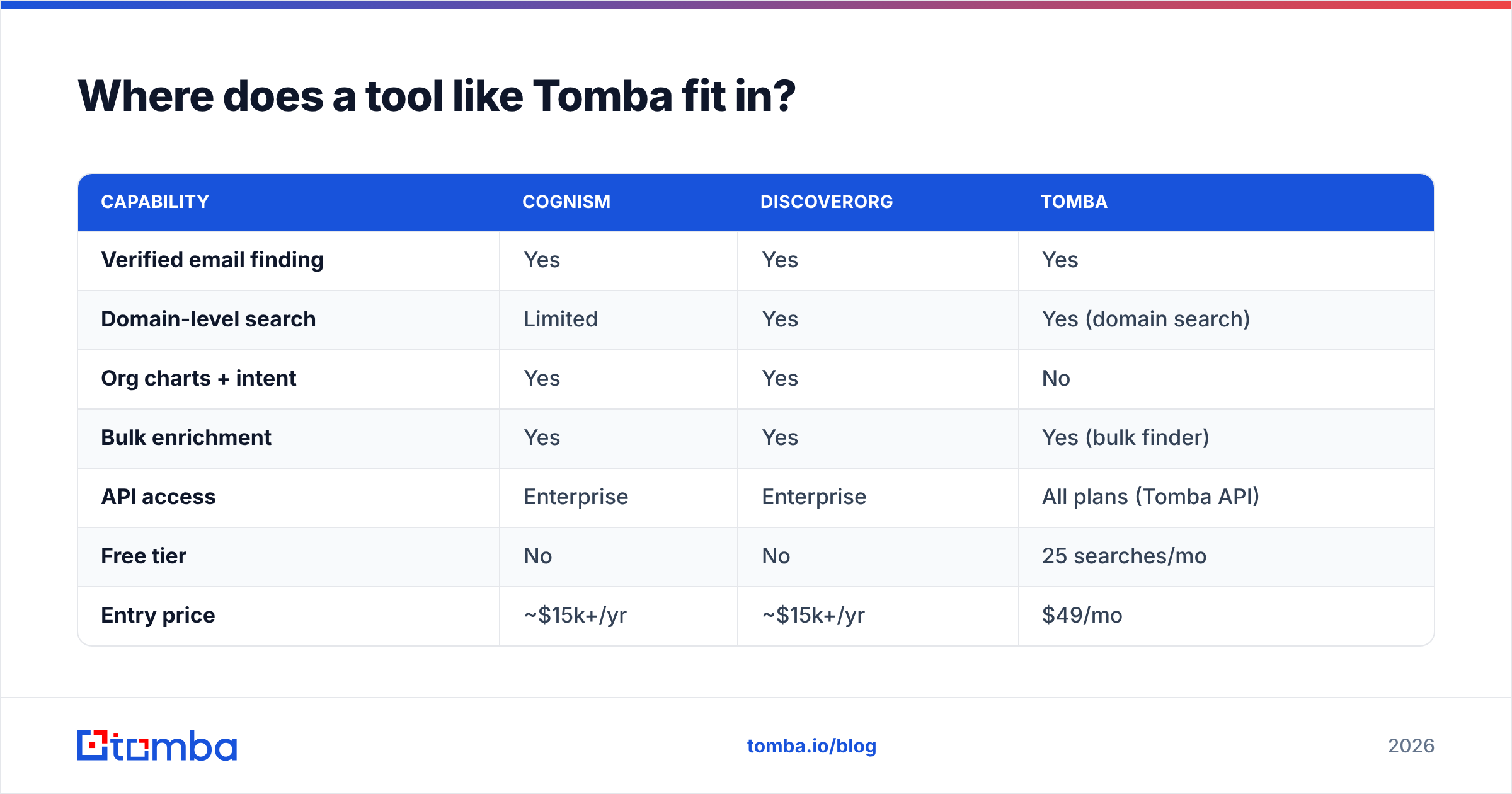
Different job, different price. Cognism and DiscoverOrg are broad sales-intelligence suites. Tomba is a focused email-finding and enrichment tool: you give it a name and domain (or just a domain), and it returns verified professional email addresses, with confidence scoring and source citations.
If the actual task on your plate is "build a clean, verified list of decision-maker emails and direct contacts," you don't necessarily need a $20k annual platform to do it. Here's the honest positioning:
| Capability | Cognism | DiscoverOrg | Tomba |
|---|---|---|---|
| Verified email finding | Yes | Yes | Yes |
| Domain-level search | Limited | Yes | Yes (domain search) |
| Org charts + intent | Yes | Yes | No |
| Bulk enrichment | Yes | Yes | Yes (bulk finder) |
| API access | Enterprise | Enterprise | All plans (Tomba API) |
| Free tier | No | No | 25 searches/mo |
| Entry price | ~$15k+/yr | ~$15k+/yr | $49/mo |
Tomba won't map a 5,000-person org's reporting structure or serve intent signals. If that's your requirement, buy the suite. But for verified emails, phone lookups, and enrichment at volume, you can start on the free tier, scale to a Starter plan at $49/mo, and skip the annual commitment entirely. Full Tomba pricing is public, which is more than either incumbent offers.
Which should you choose?#
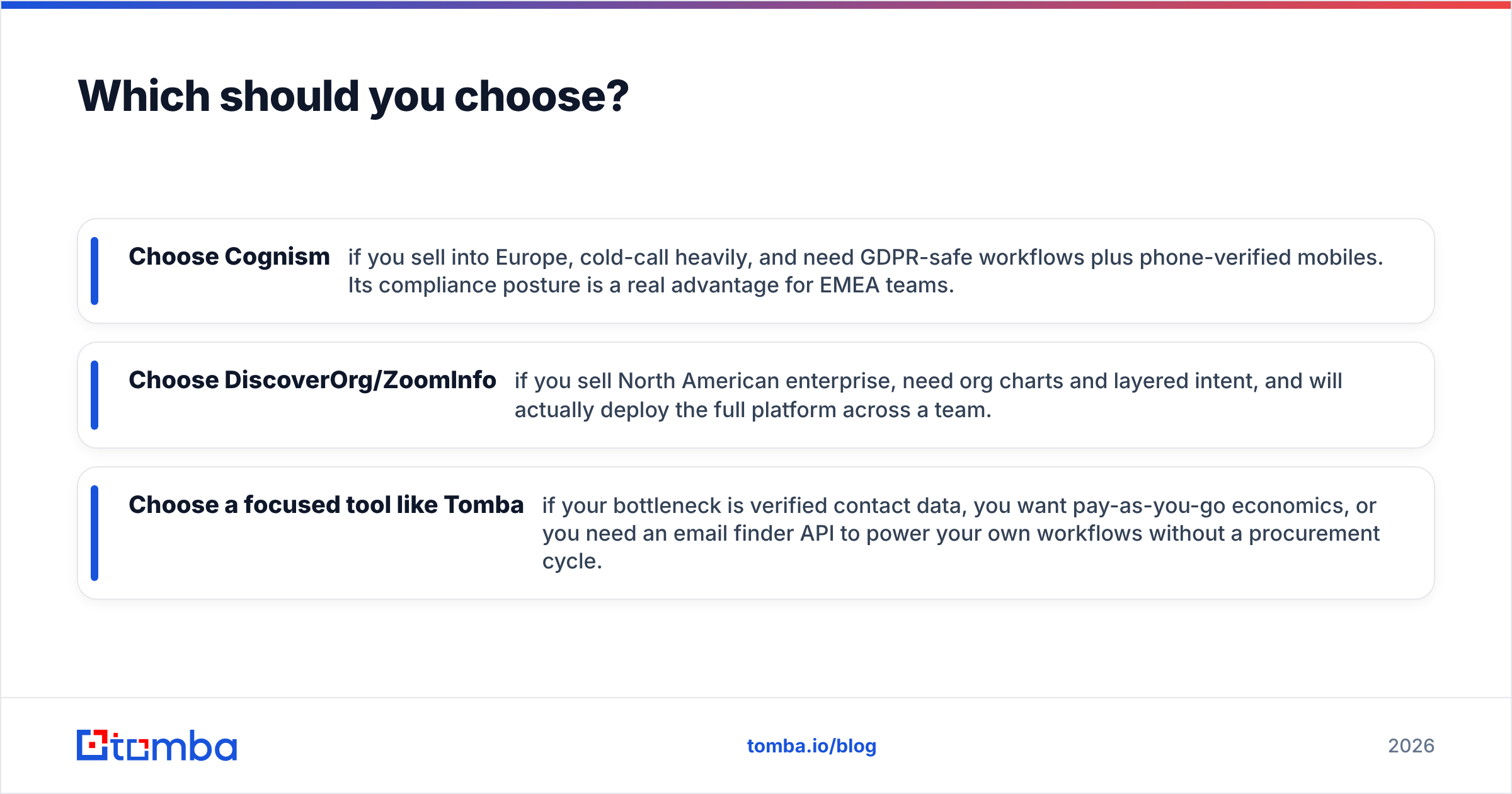
Pick based on your motion, not the marketing:
- Choose Cognism if you sell into Europe, cold-call heavily, and need GDPR-safe workflows plus phone-verified mobiles. Its compliance posture is a real advantage for EMEA teams.
- Choose DiscoverOrg/ZoomInfo if you sell North American enterprise, need org charts and layered intent, and will actually deploy the full platform across a team.
- Choose a focused tool like Tomba if your bottleneck is verified contact data, you want pay-as-you-go economics, or you need an email finder API to power your own workflows without a procurement cycle.
Many teams end up running a hybrid: a premium suite for a small group of strategic account reps, and a lightweight finder for the rest of the org that just needs accurate emails on demand. That combination often costs less than putting everyone on enterprise seats.
A quick note on independent reviews#
Before you sign anything, read current, dated reviews on G2 and Capterra. Filter to your region and company size, because a five-star North American review tells you little about EMEA mobile accuracy, and vice versa. Pay special attention to comments about contract flexibility and data refresh rates, which are where buyers most often feel burned.
The bottom line#
The "Cognism vs DiscoverOrg" question is really "compliant EMEA reach vs deep North American intelligence," since DiscoverOrg now lives inside ZoomInfo. Both are strong, both are expensive, and both lock you into an annual contract with gated pricing.
If your real need is verified emails and direct contacts rather than a full intelligence suite, start smaller and cheaper. Try the Tomba Email Finder free tier, run a real list through it, and see how far accurate contact data gets you before you commit five figures to a platform. You can always add a premium suite later, once you know exactly which of its features you'll actually use.
Related guides#
Ready to find emails that actually work?
Join 150,000+ professionals who stopped guessing and started sending. Free credits on signup — no credit card required.
Get the Tomba newsletter
Practical outbound tactics and product updates — once every two weeks.
About the author