Cognism vs Lakeb2b (2026): Data Quality, Pricing & Which Wins
Cognism and Lakeb2b both sell B2B contact data, but they win on very different things. Here's an honest breakdown of accuracy, compliance, coverage, and price—plus a cheaper way to get verified emails.
Choosing a B2B data vendor is really a bet on two things: how many of the contacts are real, and how much you pay to find that out. Cognism and Lakeb2b sit on opposite ends of that spectrum. Cognism is a premium, compliance-first sales intelligence platform. Lakeb2b is a high-volume, list-and-database provider built around custom data builds. Picking the wrong one wastes budget on either records you can't use or a platform you can't afford.
This is a neutral, side-by-side breakdown—no vendor wrote it. Below you'll get the differences that actually move your reply rate: data accuracy, phone coverage, compliance posture, pricing model, and the buyer each one really fits. At the end, we'll show where a leaner verified-email workflow beats both for pure prospecting.
TL;DR#
- Cognism wins on data freshness, phone-verified mobile numbers (Diamond Data), and GDPR/CCPA compliance—but pricing is opaque, annual-contract, and premium.
- Lakeb2b wins on breadth and custom list builds across niche industries and healthcare, at a lower per-record cost—but data is bought-list quality and needs heavy verification.
- Cognism vs Lakeb2b is really "verified sales intelligence platform" vs "custom B2B database vendor." They solve different problems.
- If your core need is finding and verifying professional email addresses for outbound, a dedicated tool like Tomba costs a fraction of either and lets you verify before you send.
- Always verify any purchased list. Even premium databases decay ~2.5% per month as people change jobs.
What is Cognism?#
Cognism is a sales intelligence platform aimed at mid-market and enterprise revenue teams in Europe and North America. Its pitch is quality and compliance: phone-verified mobile numbers (branded "Diamond Data"), intent signals via Bombora, and a database screened against global do-not-call lists. Cognism markets itself heavily on GDPR and CCPA compliance, which is why regulated industries and EU-focused outbound teams gravitate to it.
You use Cognism through a web app, a Chrome extension that works over LinkedIn and company sites, and a CRM sync into Salesforce or HubSpot. The value isn't just raw records—it's that the mobile numbers are human-verified, so your SDRs waste less time dialing dead lines.
The trade-off is cost and commitment. Cognism sells annual contracts, rarely publishes prices, and gates features (like unrestricted individual exports or Diamond Data) behind higher tiers. It's a platform purchase, not a pay-as-you-go list.
What is Lakeb2b?#
Lakeb2b is a B2B data provider and list-building service. Instead of a self-serve intelligence platform, its model centers on delivering targeted contact and account lists—often custom-built to a spec you provide (industry, title, geography, technographics). It's especially known for healthcare data (physicians, practitioners, NPI-linked records) and for covering niche verticals many platforms skip.
You typically engage Lakeb2b by describing your ideal customer profile; their team assembles a list, often with an accuracy guarantee and replacement policy for bounced records. Pricing is per-record or per-project, which makes it attractive when you need volume in a specific niche without committing to an annual seat-based subscription.
The catch is that list-based data—no matter how it's sourced—carries more risk than continuously verified platform data. You should treat every delivered file as unverified until you run it through an email verifier. Coverage is broad; per-record freshness is the variable you manage.

Cognism vs Lakeb2b: How do they compare?#
Here's the core comparison across the attributes that decide ROI. Prices for both are directional—neither publishes a rigid public rate card, and both negotiate.
| Attribute | Cognism | Lakeb2b |
|---|---|---|
| Primary model | Sales intelligence platform (subscription) | Custom B2B lists / database (per-record) |
| Best-known strength | Phone-verified mobiles (Diamond Data) | Niche + healthcare data breadth |
| Data freshness | Continuously refreshed | Varies by list; verify on receipt |
| Compliance focus | Strong (GDPR, CCPA, DNC-screened) | Standard; buyer due diligence advised |
| Pricing model | Annual contract, seat-based | Per-record / per-project |
| Transparency | Opaque, sales-led quotes | Quote-based, negotiable |
| Self-serve trial | Limited | No true self-serve |
| Ideal buyer | EU/enterprise outbound teams | Volume + niche-vertical marketers |
| Intent data | Yes (Bombora) | Add-on / limited |
How to read this table:
- If compliance is a board-level concern, Cognism's DNC screening and GDPR posture are hard to match with a bought list.
- If you need 50,000 physician contacts in a specific region, Lakeb2b will build that faster and cheaper than Cognism can serve it.
- If you want to try before you commit, neither is ideal—both are sales-led. That friction alone pushes many small teams toward self-serve tools.
- If email is your main channel, you're overpaying with either; a focused email finder plus verifier covers 80% of the job.
Which has better data accuracy?#
Cognism generally wins on verified accuracy, especially for mobile phone numbers, because Diamond Data records are human-checked. Lakeb2b wins on breadth—it will find contacts in verticals Cognism doesn't prioritize—but breadth and freshness are different things.
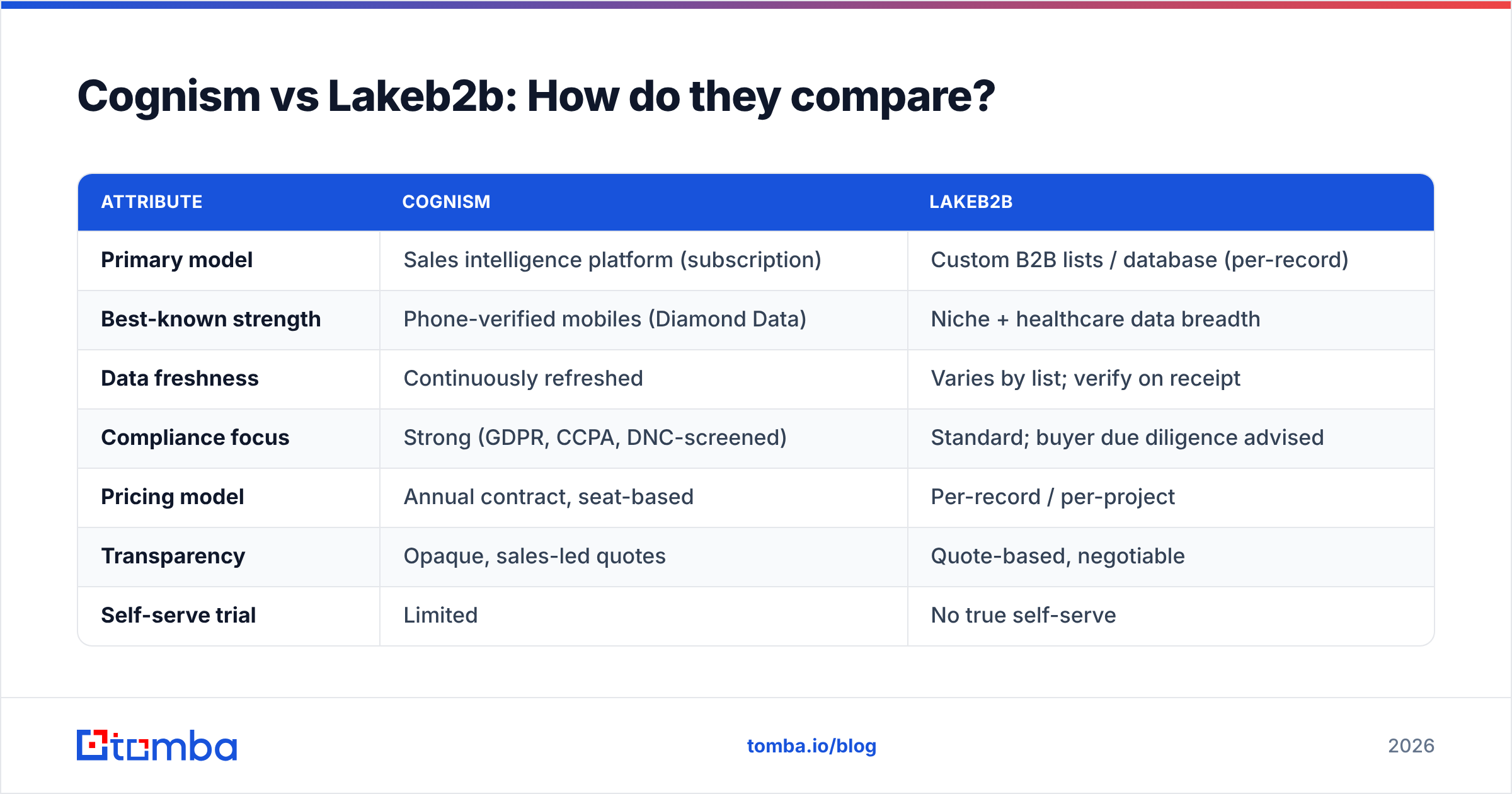
The uncomfortable truth for both: B2B data decays fast. Industry research consistently puts contact data decay around 2.5–3% per month as people change roles, companies restructure, and domains change. That means even a "95% accurate" list is materially worse 90 days later. This is why the smartest teams decouple sourcing from verification—source anywhere, then validate every address independently before it enters a sequence.
You can pressure-test any vendor's claim cheaply. Pull a sample of 200 records, run them through a catch-all verifier and a standard email verification pass, and measure the real deliverable rate. If a "premium" file lands below 90% deliverable, you're paying premium prices for mid-tier data. If a "budget" list lands at 88% after verification, it may be the better deal.
Independent reviews on G2 are also worth scanning before you sign—look specifically at recent reviews mentioning bounce rates and mobile-number accuracy, not the aggregate star score.
Which is better for compliance and risk?#
Cognism, clearly, if your outbound touches the EU or regulated sectors. Its screening against do-not-call registries and its documented GDPR handling reduce legal exposure in a way a generic purchased list can't guarantee. For enterprise legal and RevOps teams, that de-risking is often the entire reason to pay the premium. If you want a primer on the underlying concepts, Tomba's B2B glossary covers terms like sender reputation and data provenance in plain language.
Lakeb2b operates within standard B2B data norms, but per-record custom lists put more due-diligence burden on you—the buyer. That's not a knock; it's the nature of list purchasing. If you go this route, keep records of consent basis and honor opt-outs rigorously.
Which is more affordable?#
Lakeb2b usually has a lower entry cost and no annual lock-in, which matters if your needs are project-based or seasonal. Cognism's annual, seat-based pricing means a real floor—often five figures for a small team—before you've sent a single email.
But "cheapest vendor" is the wrong question. The right one is cost per deliverable, verified contact you actually use. A cheap list with a 40% bounce rate costs more per usable contact than a pricier, cleaner source. Run this math on a sample before committing to either.
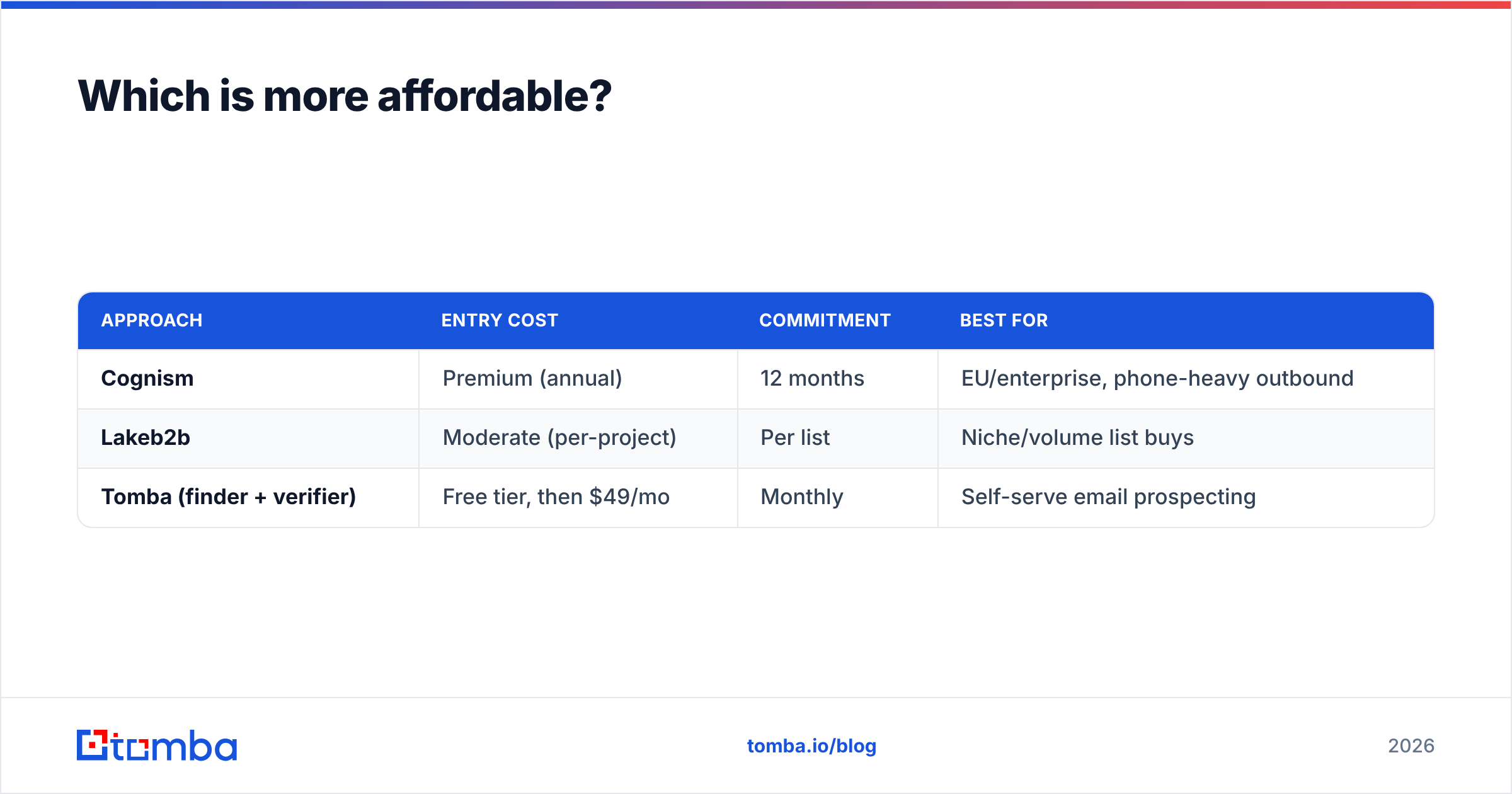
Here's how the three approaches stack up for a team whose primary goal is email outbound:
| Approach | Entry cost | Commitment | Best for |
|---|---|---|---|
| Cognism | Premium (annual) | 12 months | EU/enterprise, phone-heavy outbound |
| Lakeb2b | Moderate (per-project) | Per list | Niche/volume list buys |
| Tomba (finder + verifier) | Free tier, then $49/mo | Monthly | Self-serve email prospecting |
For teams whose bottleneck is simply "I have a company and a name, I need the right email," the platform overhead of Cognism or the list-buying cycle of Lakeb2b is more machinery than the job requires.
Where does a dedicated email finder fit in?#
When your workflow is account → contact → verified email → sequence, a focused tool beats a broad platform on speed and price. This is the gap Tomba fills. Instead of buying a database or a static list, you find and verify addresses on demand:
- Find by domain or name with the email finder—give it a company and a person, get the professional address.
- Search a whole company with domain search to pull every discoverable email pattern for a target account.
- Validate before you send so your bounce rate stays low and your sender reputation stays intact.
- Scale with the API via the Tomba API when you want to enrich records inside your own stack.
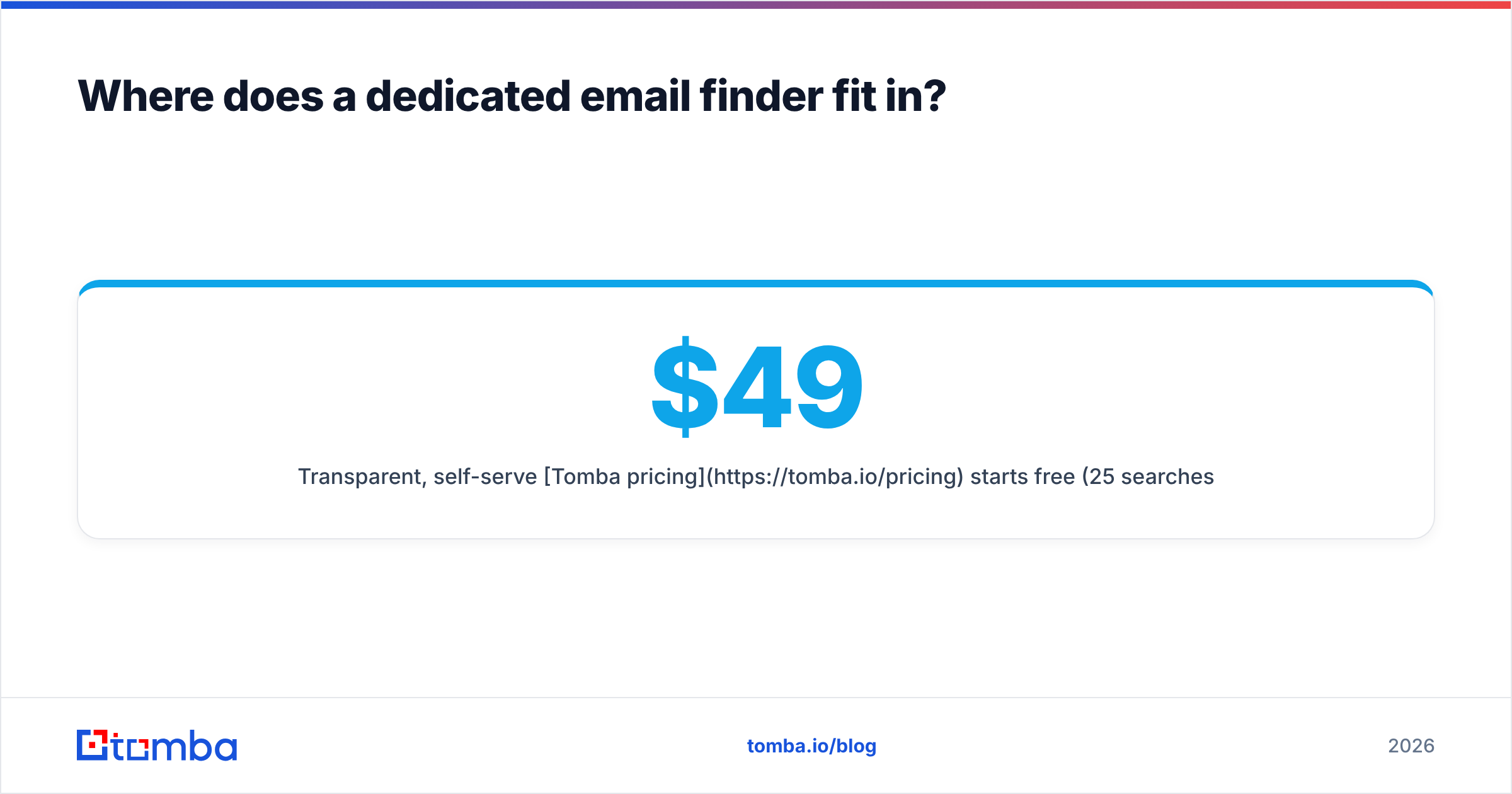
Transparent, self-serve Tomba pricing starts free (25 searches/month), then Starter at $49/mo, Growth at $99/mo, and Pro at $249/mo—no annual handcuffs, no sales call to see a number. That transparency is the opposite of the quote-gated model both Cognism and Lakeb2b use.
This isn't an either/or in every case. Plenty of teams keep Cognism for compliant mobile dialing and use a finder-plus-verifier for the email side, because paying platform rates to guess an email address makes no sense.
Which should you choose?#
Choose Cognism if you sell into Europe or regulated industries, live on the phone, and need verified mobile numbers with airtight compliance—and you can absorb premium annual pricing.
Choose Lakeb2b if you need volume in a niche vertical (healthcare especially), prefer per-project buys over subscriptions, and have a verification step ready to clean what you receive.
Choose a dedicated finder like Tomba if your primary channel is email, you want to verify before you send, and you'd rather pay a transparent monthly rate than negotiate an enterprise contract for data you'll need to re-verify anyway.
The honest verdict: Cognism and Lakeb2b aren't really rivals—they serve different buyers. The real question is whether you need a platform at all, or just clean, verified emails on demand.
Ready to skip the sales call?#
If your bottleneck is finding and verifying professional email addresses—not buying a whole database—start with the Tomba Email Finder. Find emails by domain, name, or company, verify them before they enter a sequence, and keep your bounce rate low without an annual contract. The free tier gives you 25 searches a month to test accuracy on your own target accounts before you spend a dollar. Run a sample, check the deliverable rate, and let the numbers decide.
Related guides#
// get started
Find, verify and enrich your first contacts today
Start on the free plan with 25 searches a month, then scale when your team is ready.
Free plan · No credit card required · GDPR & CCPA
// about the author