Cognism vs Leadsforge: Full 2026 B2B Data Comparison
Cognism and Leadsforge both promise clean B2B contact data, but they win at very different jobs. Here is an honest, side-by-side breakdown of accuracy, pricing, compliance, and the cheaper way to get verified emails.
Choosing between Cognism and Leadsforge usually comes down to one question you already suspect the answer to: are you paying for a full sales-intelligence platform, or just for verified contact records you can actually email? Both tools sit in the B2B data space, both claim high accuracy, and both will happily quote you an annual contract. But they solve different problems, and the price gap between them is large enough to matter.
This is a neutral, side-by-side look at how the two stack up in 2026 — where each wins, where each overpromises, and where a focused tool like Tomba quietly does the one job most teams actually need.
TL;DR: Cognism vs Leadsforge at a glance#
- Cognism is a mature, enterprise-grade sales intelligence platform with strong phone-verified mobile data (its "Diamond Data") and solid GDPR/CCPA compliance positioning. It is powerful and expensive, usually annual-contract only.
- Leadsforge is a lighter, AI-assisted lead-list builder aimed at SMBs and founders who want targeted contact lists fast without a big platform commitment. Cheaper, simpler, less depth.
- Data accuracy is comparable on core firmographics; Cognism leads on verified mobile numbers, Leadsforge is fine for email-first outbound but thinner on coverage.
- Pricing is the real divider: Cognism runs into five figures a year; Leadsforge targets monthly SMB budgets.
- If your actual need is "find and verify professional emails at scale without a platform tax," a dedicated email finder like Tomba costs a fraction of either and plugs into the same workflow.
What is Cognism?#
Cognism is a B2B sales intelligence platform built for outbound teams that live and die by phone and email outreach. Its reputation rests on Diamond Data — mobile numbers that are human-verified rather than scraped — plus intent signals, firmographics, and technographics layered on top of a large contact database.
Think of Cognism as a fully staffed data department you rent. You get coverage across regions (it is notably strong in EMEA), compliance workflows that legal teams like, and integrations into Salesforce, HubSpot, and Outreach. That breadth is the selling point, and it is genuine.
The trade-off is cost and commitment. Cognism sells annual contracts, gates most features behind sales calls, and rarely publishes transparent per-seat pricing. For a well-funded SDR team hammering the phones, that can pay back quickly. For a three-person startup, it is a lot of platform to buy for a contact list.
What is Leadsforge?#
Leadsforge is an AI-driven lead-list generator that positions itself as the fast, founder-friendly alternative to heavyweight platforms. You describe your ideal customer in plain language, and it assembles a targeted list of contacts with emails and basic firmographic detail.
The appeal is speed and simplicity. There is no six-week onboarding, no enterprise procurement dance, and the pricing is built for monthly SMB budgets rather than annual enterprise ones. For a solo founder or a small agency that needs a few hundred good-fit contacts this month, that is a reasonable value proposition.
Where Leadsforge shows its limits is depth: coverage is thinner than Cognism's, mobile-number verification is not its strength, and intent data and advanced compliance tooling are not really the point of the product. It is a list builder, not a data platform — and that is fine, as long as you buy it for what it is.

Cognism vs Leadsforge: the core comparison#
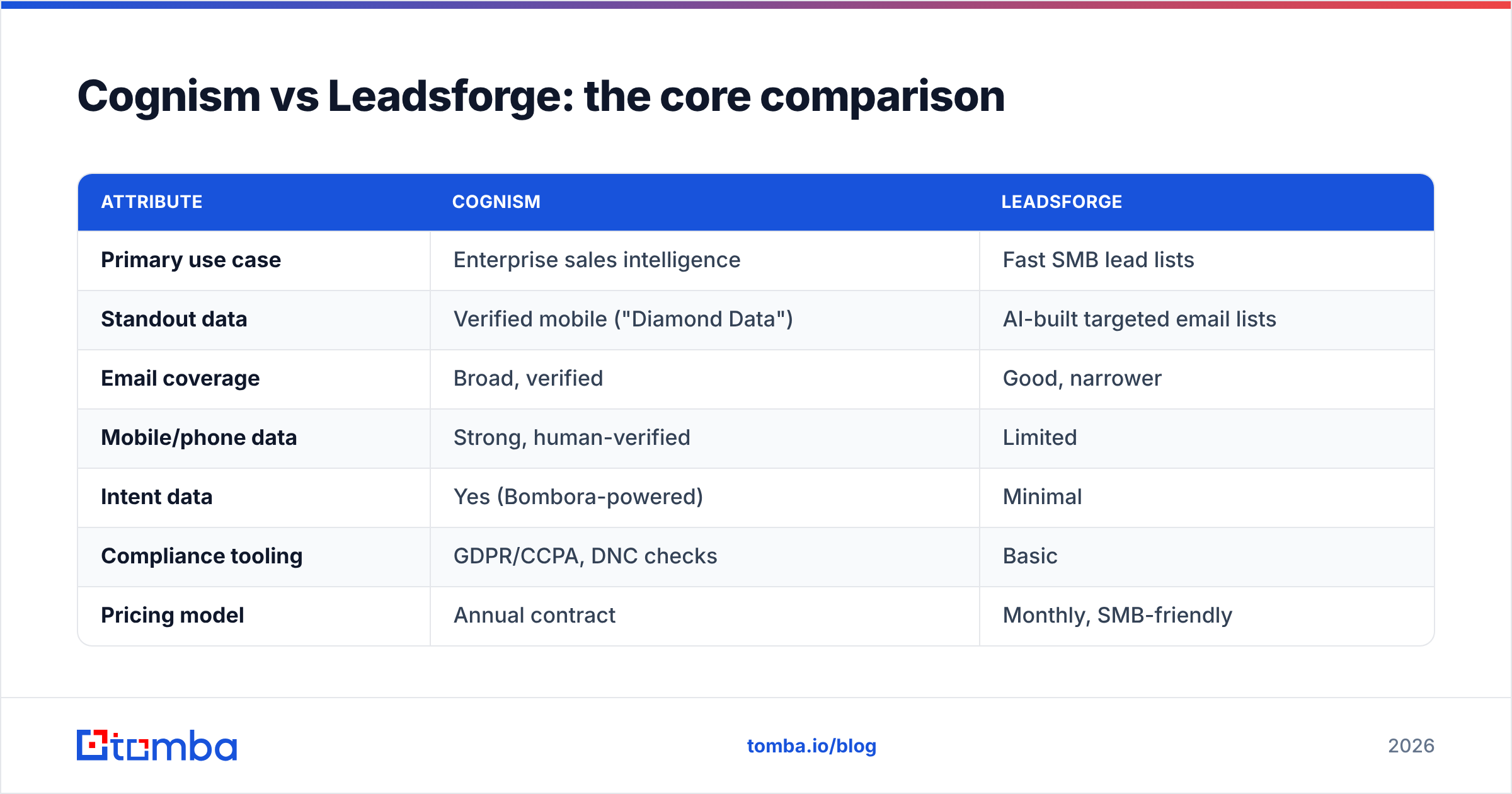
Here is the honest side-by-side. Numbers for Cognism reflect its typical enterprise positioning; Leadsforge reflects its published SMB tiers. Always confirm current pricing directly, since both vendors change terms.
| Attribute | Cognism | Leadsforge |
|---|---|---|
| Primary use case | Enterprise sales intelligence | Fast SMB lead lists |
| Standout data | Verified mobile ("Diamond Data") | AI-built targeted email lists |
| Email coverage | Broad, verified | Good, narrower |
| Mobile/phone data | Strong, human-verified | Limited |
| Intent data | Yes (Bombora-powered) | Minimal |
| Compliance tooling | GDPR/CCPA, DNC checks | Basic |
| Pricing model | Annual contract | Monthly, SMB-friendly |
| Typical entry cost | Five figures/year | Tens–low hundreds/month |
| Free trial/tier | Limited, sales-gated | Self-serve options |
| Best for | Funded outbound teams | Founders, small agencies |
The pattern is clear: Cognism is the deeper, pricier platform; Leadsforge is the lighter, cheaper builder. Neither is "better" in the abstract — they are aimed at different buyers with different budgets.
Is Cognism more accurate than Leadsforge?#
On verified mobile numbers, yes — Cognism's phone-verified data is a real, defensible edge, and if cold calling is central to your motion, that alone can justify the platform. On core B2B emails and firmographics, the two are closer than the price gap suggests. Both do the fundamental job of returning a real contact at a real company.
The nuance most comparison pages skip: accuracy decays the moment data leaves the vendor's dashboard. A record that was verified last quarter can bounce today. That is why serious outbound teams re-verify contacts at send time regardless of source, using an email verifier as a final gate. No database — Cognism, Leadsforge, or anyone else — replaces that step. It reduces how often you need it; it does not eliminate it.
If your data quality is inconsistent, the problem is often not the provider but the missing verification layer between the list and the inbox.
How do Cognism and Leadsforge handle compliance?#
Cognism leans hard into compliance as a differentiator: GDPR and CCPA alignment, notification-based processing in Europe, and phone-list scrubbing against Do-Not-Call registries. For regulated industries and EMEA-heavy outbound, that is a meaningful reason to pay the premium.
Leadsforge covers the basics but does not market itself as a compliance-first platform. For US-centric SMB outreach at modest volume, that is usually acceptable. For heavily regulated sectors or large European campaigns, it is a gap you should weigh seriously.
If you want to understand the mechanics behind why compliant sourcing matters for inbox placement, Tomba's glossary entry on email deliverability is a useful primer — clean, permissioned data is the first domino in landing in the inbox.
Cognism vs Leadsforge pricing: which is cheaper?#
Leadsforge is dramatically cheaper up front, and for most small teams that difference is decisive.
Consider the realistic cost picture:
- Cognism — Expect annual commitments that land in the five-figure range, with pricing gated behind a sales process. Excellent value at scale, painful for small teams.
- Leadsforge — Monthly, self-serve, SMB-oriented. You can start small and cancel without a procurement fight.
- The hidden cost — Neither price includes the re-verification and enrichment work you will still do downstream. Budget for that, not just the license.
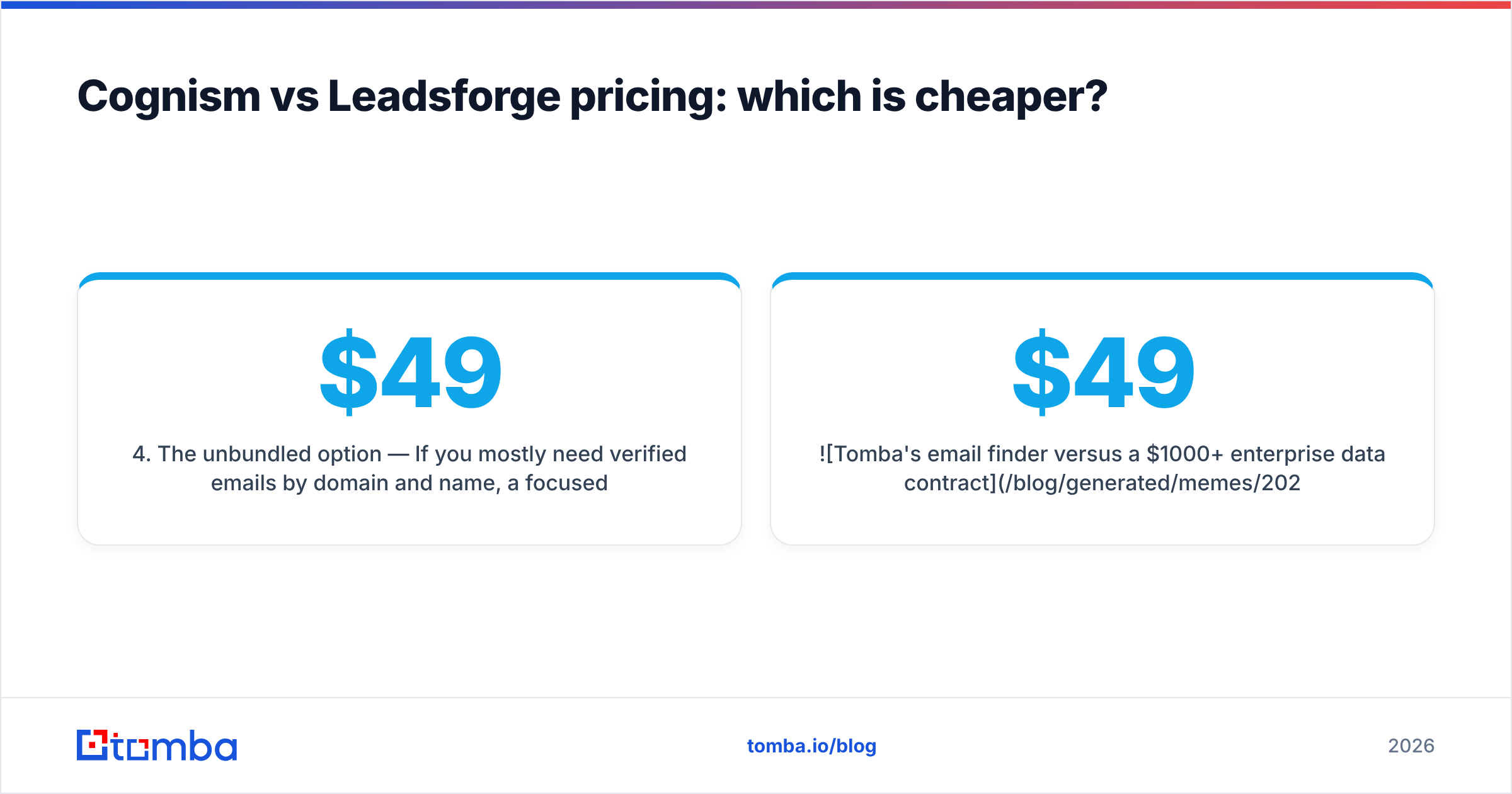
- The unbundled option — If you mostly need verified emails by domain and name, a focused finder priced from $49/mo does that specific job for a fraction of a full platform.
That last point is where a lot of teams over-buy. You do not always need a data department. Sometimes you need reliable emails, on demand, without a contract.

Where does Tomba fit against Cognism and Leadsforge?#
Tomba is not a full sales-intelligence suite, and it does not pretend to be. It is a specialist: find professional emails by domain, name, or company, verify them, and push them into your workflow. That focus is the point.
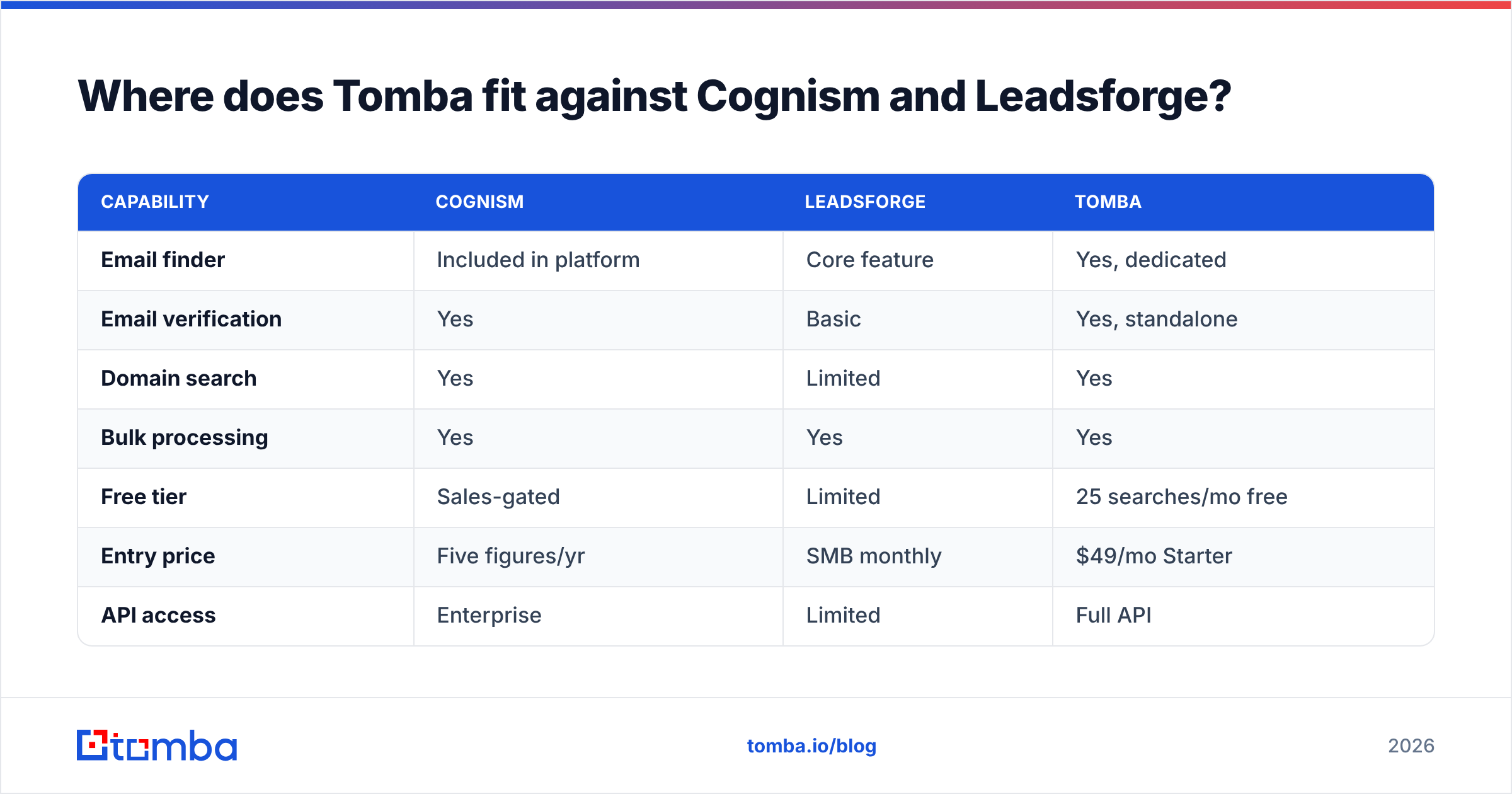
Here is how the three compare on the job most outbound teams actually run every day — getting verified contact emails into a sequence:
| Capability | Cognism | Leadsforge | Tomba |
|---|---|---|---|
| Email finder | Included in platform | Core feature | Yes, dedicated |
| Email verification | Yes | Basic | Yes, standalone |
| Domain search | Yes | Limited | Yes |
| Bulk processing | Yes | Yes | Yes |
| Free tier | Sales-gated | Limited | 25 searches/mo free |
| Entry price | Five figures/yr | SMB monthly | $49/mo Starter |
| API access | Enterprise | Limited | Full API |
| Contract required | Yes | No | No |
Tomba's model is transparent and low-commitment: a Free tier with 25 searches a month, Starter at $49/mo, Growth at $99/mo, and Pro at $249/mo, with Enterprise custom. You can check the full Tomba pricing without a sales call. For teams that already have a CRM and just need clean emails feeding it, that is often the whole solution.
The realistic play for many buyers is a stack, not a single tool: use Tomba to find and verify contacts affordably, and add a heavier platform like Cognism only when phone-verified mobile data and intent signals become worth the enterprise price.
Which should you choose in 2026?#
Match the tool to your motion, not the marketing.
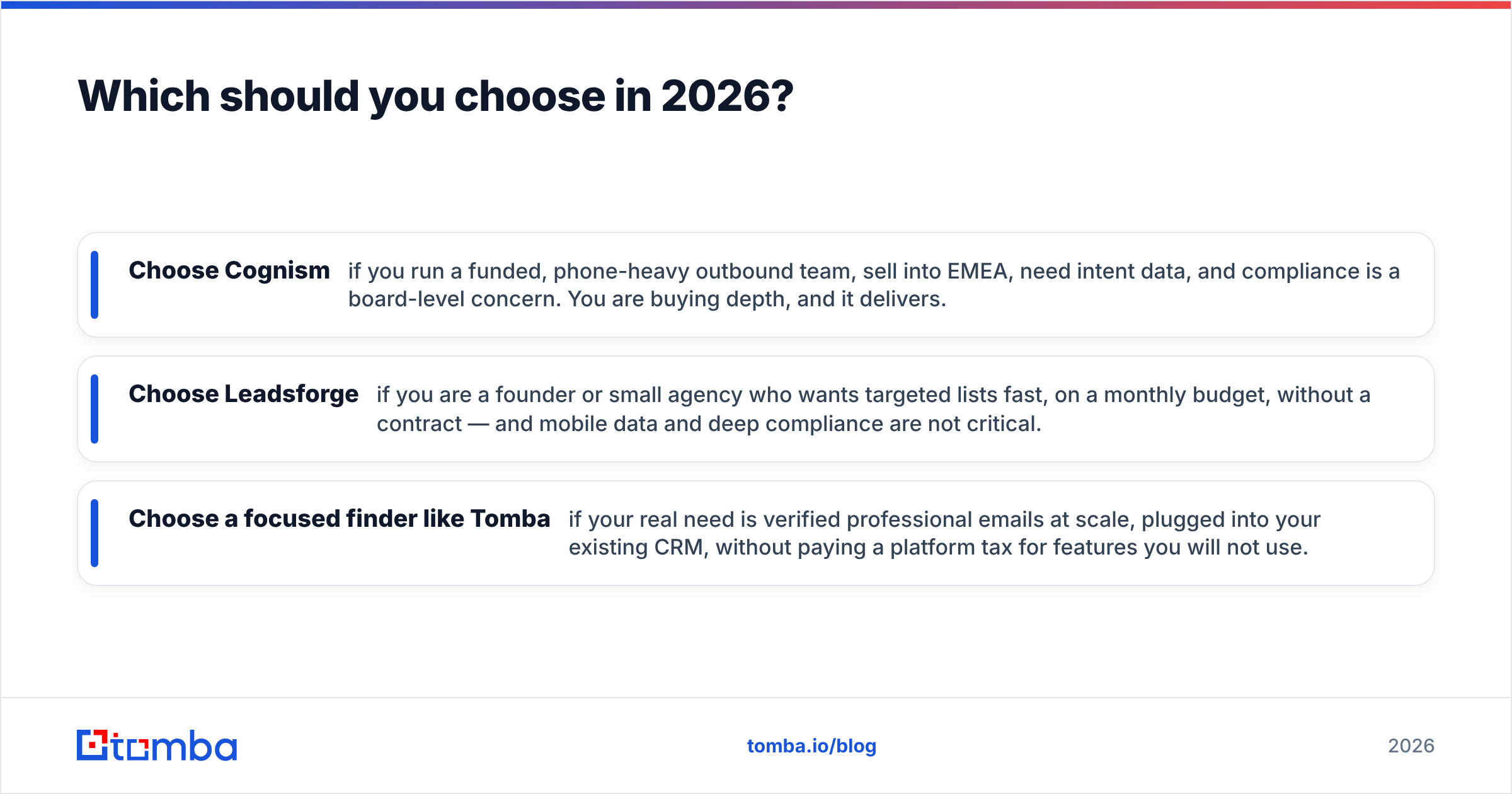
- Choose Cognism if you run a funded, phone-heavy outbound team, sell into EMEA, need intent data, and compliance is a board-level concern. You are buying depth, and it delivers.
- Choose Leadsforge if you are a founder or small agency who wants targeted lists fast, on a monthly budget, without a contract — and mobile data and deep compliance are not critical.
- Choose a focused finder like Tomba if your real need is verified professional emails at scale, plugged into your existing CRM, without paying a platform tax for features you will not use.
Most teams overestimate how much platform they need and underestimate how much verification they skip. Be honest about which job you are actually solving.
For deeper context, both vendors' own sites (Cognism and industry review profiles on G2) are worth reading alongside independent reviews before you commit to any annual contract.
The bottom line#
Cognism and Leadsforge are not really competitors so much as neighbors — one is an enterprise data platform, the other an SMB list builder, and your budget usually decides for you. But before you sign either contract, ask whether you need the whole platform or just verified emails flowing into your outreach.
If it is the latter, start with the Tomba Email Finder. Find emails by domain, name, or company, verify them before you send, and skip the annual commitment entirely — with a free tier to test it on your real target list today. When your motion grows into needing verified mobile numbers and intent data, you can layer a platform on top. Until then, do not pay enterprise prices for a job a $49/mo tool does cleanly.
Related guides#
// get started
Find, verify and enrich your first contacts today
Start on the free plan with 25 searches a month, then scale when your team is ready.
Free plan · No credit card required · GDPR & CCPA
// about the author