Cognism vs Limeleads: B2B Data Accuracy and Pricing Compared
Cognism sells premium mobile-verified data at enterprise prices; Limeleads sells cheap self-serve lists. Here's how they really compare on accuracy, coverage, and cost—and where a pay-as-you-go finder beats both.
Choosing between Cognism and Limeleads usually comes down to one uncomfortable question: how much are you willing to pay for data you still have to verify yourself? These two tools sit at opposite ends of the B2B data market. Cognism is an enterprise sales-intelligence suite with phone-verified mobile numbers and a five-figure entry point. Limeleads is a lightweight, self-serve list builder priced for solo founders and small teams. This comparison breaks down where each one wins, where each one quietly costs you more than the sticker price, and when a pay-as-you-go finder is the smarter buy.
TL;DR#
- Cognism is built for mid-market and enterprise revenue teams that need verified mobile numbers, intent data, and compliance coverage across the EU and US—but pricing starts in the thousands per year and requires a sales call.
- Limeleads is a budget, self-serve B2B list-building tool with transparent per-credit pricing. It's fast and cheap, but coverage and data freshness are thinner, and mobile/intent data is not its strength.
- Data accuracy is the real battleground: Cognism verifies phones manually; Limeleads relies on aggregated web data you should re-verify before sending.
- Cost per usable contact matters more than the plan price. A cheap list full of stale emails is not cheaper than a smaller verified one.
- If you mostly need accurate work emails on demand, a per-search tool like Tomba's email finder can beat both on cost while keeping bounce rates low.
What is Cognism?#
Cognism is a sales-intelligence platform aimed at outbound teams that live and die by phone connect rates. Its headline feature is "Diamond Data"—mobile numbers that are human-verified rather than scraped—plus firmographic filters, technographics, and buyer-intent signals sourced through a Bombora partnership. It leans hard into compliance, offering GDPR- and CCPA-aligned data and phone-DNC screening across major regions.
In practice, Cognism is the tool a VP of Sales buys when the team's biggest complaint is "the mobile numbers are always wrong." It integrates with Salesforce, HubSpot, Outreach, and Salesloft, and its browser extension pulls contacts straight from LinkedIn. The trade-off is cost and commitment: pricing is quote-based, annual, and typically lands in the four-to-five-figure range depending on seats and data volume. You can read independent user impressions on G2 before you ever reach a sales rep.
What is Limeleads?#
Limeleads is a self-serve B2B contact database that sells business emails and company data by the credit. You build a list with filters—industry, title, location, company size—preview matching records, and export the ones you want. There's no mandatory sales call, no annual lock-in, and the pricing is published on the site.
That transparency is the whole appeal. A founder who needs 2,000 targeted contacts this week, without signing an enterprise contract, can get them from Limeleads in an afternoon. The catch is what you'd expect at that price: the database skews US-heavy, mobile-phone coverage is limited, intent data is essentially absent, and record freshness varies. Limeleads is a list source, not a full revenue-intelligence platform—and it doesn't pretend otherwise.

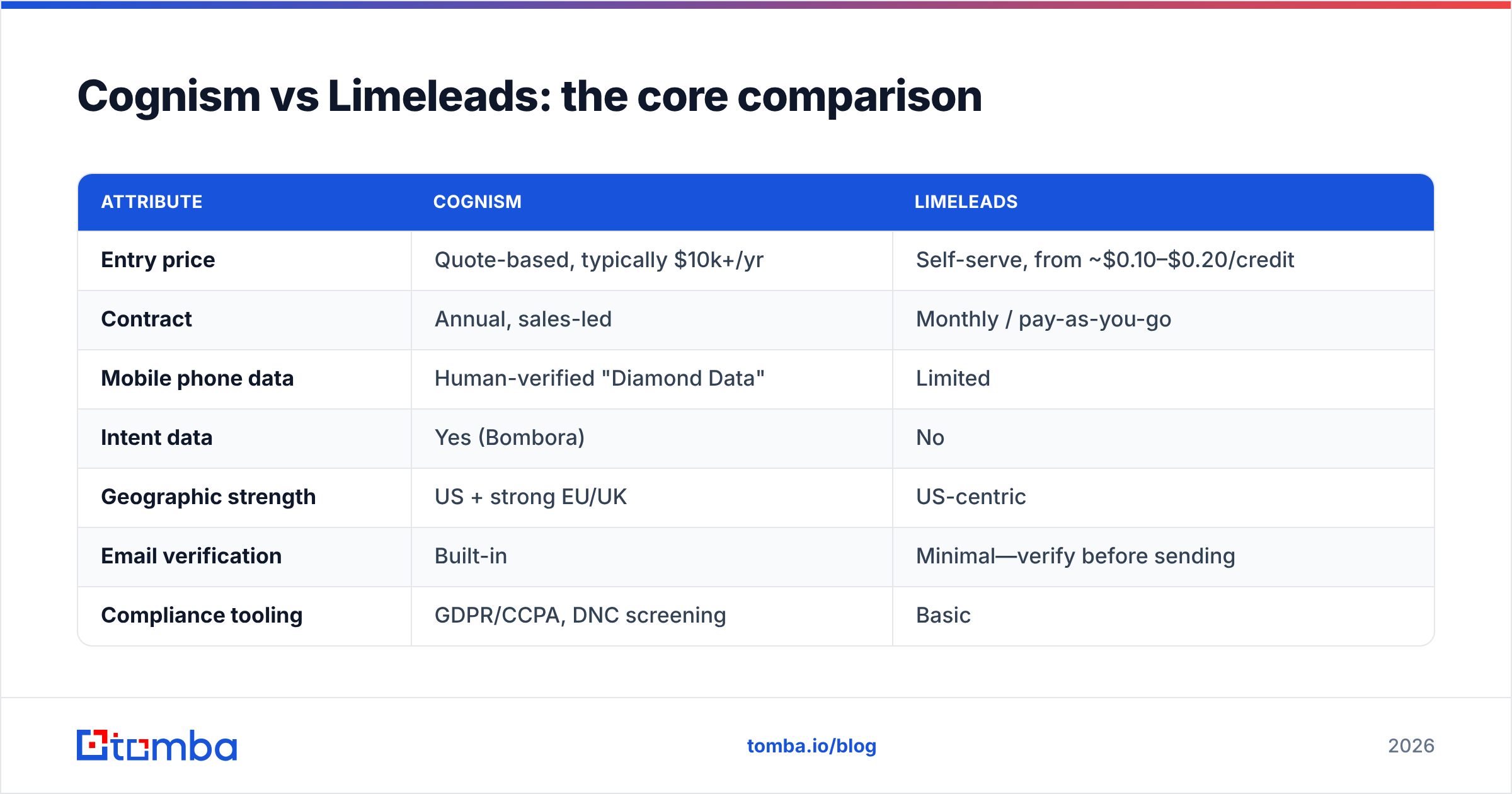
Cognism vs Limeleads: the core comparison#
Here's the head-to-head on the attributes that actually change your pipeline math.
| Attribute | Cognism | Limeleads |
|---|---|---|
| Entry price | Quote-based, typically $10k+/yr | Self-serve, from ~$0.10–$0.20/credit |
| Contract | Annual, sales-led | Monthly / pay-as-you-go |
| Mobile phone data | Human-verified "Diamond Data" | Limited |
| Intent data | Yes (Bombora) | No |
| Geographic strength | US + strong EU/UK | US-centric |
| Email verification | Built-in | Minimal—verify before sending |
| Compliance tooling | GDPR/CCPA, DNC screening | Basic |
| Best for | Mid-market & enterprise outbound | Solo founders, SMB list building |
| Free trial | Demo only | Free preview credits |
The pattern is clear: Cognism is the premium, full-stack option, and Limeleads is the budget, single-purpose one. Neither is "better" in a vacuum—they're built for different buyers with different bounce-rate tolerances and different budgets.
Is Cognism worth the price over Limeleads?#
Cognism is worth it only if phone connect rate is your bottleneck and you have the budget to match. If your reps burn hours dialing dead mobile numbers, verified phone data pays for itself in booked meetings. The intent signals and compliance tooling also matter if you sell into regulated industries or run outbound in the EU, where getting consent and DNC wrong carries real legal risk.
But most small teams don't have that bottleneck. They have an email problem, not a phone problem. Paying five figures a year for verified mobiles you rarely dial is like buying a delivery van to carry your groceries home. If your outbound is 90% email, the case for Cognism over a cheaper source gets weak fast—and that's exactly the gap Limeleads (and per-search finders) fill.
Which tool has more accurate data?#
Accuracy is where the two philosophies diverge hardest.
- Cognism invests in verification. Diamond Data phone numbers are manually checked, and emails run through validation before they reach you. You pay for that labor, but the promise is lower waste at send time.
- Limeleads aggregates from public and third-party web sources. That keeps prices low, but freshness and validity vary by record. Job changes, rebrands, and dead inboxes accumulate in any aggregated database, and Limeleads does less to scrub them than an enterprise vendor does.
The takeaway isn't "Limeleads data is bad"—it's that any budget list should be re-verified before you send. Emailing an unverified list is the fastest way to spike your bounce rate and damage sender reputation, which quietly tanks deliverability for every future campaign. Running exports through an email verifier before the first send is non-negotiable regardless of which vendor you pick.
What does each tool actually cost per usable contact?#
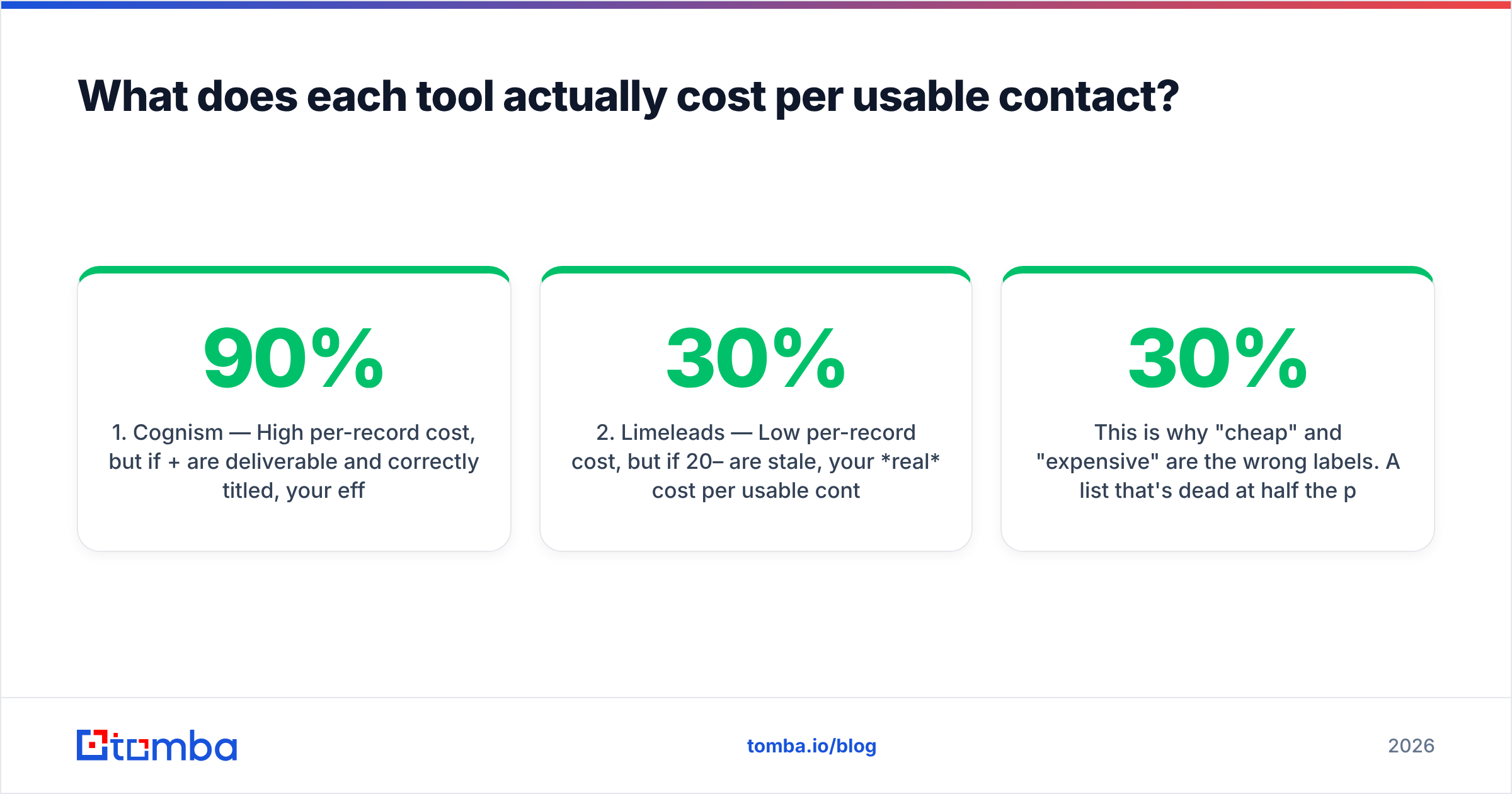
Sticker price lies. The number that matters is cost per usable contact—a record with a valid, deliverable email and correct title. Consider a simplified scenario for 1,000 contacts:
- Cognism — High per-record cost, but if 90%+ are deliverable and correctly titled, your effective waste is low. The premium buys you fewer bounces and fewer wrong-person sends.
- Limeleads — Low per-record cost, but if 20–30% are stale, your real cost per usable contact climbs once you subtract the dead ones—and climbs again once you add a verification step.
- Pay-as-you-go finder — You pull and verify only the specific contacts you need, so you rarely pay for records you'll never use. For targeted outbound, this is often the lowest true cost of the three.
This is why "cheap" and "expensive" are the wrong labels. A list that's 30% dead at half the price isn't half the cost—it's roughly the same cost with extra cleanup work bolted on. Always model the deliverable-contact number, not the raw record count.
Where does a pay-as-you-go finder fit in?#
Neither Cognism nor Limeleads is ideal if your real need is specific, verified work emails on demand rather than giant pre-built lists. That's the lane a tool like Tomba occupies, and it's worth understanding as a third option rather than a footnote.
Instead of buying a database subscription or a bulk credit pack, you search by person, company, or domain and pull verified emails as you go. Tomba's domain search returns every discoverable address at a company with a confidence score, its finder locates a specific person's email from a name and domain, and verification is built into the same workflow so you're not exporting to a second tool. For teams doing focused, account-based outbound—50 hand-picked targets, not 5,000 scraped ones—this avoids paying for coverage you'll never touch.
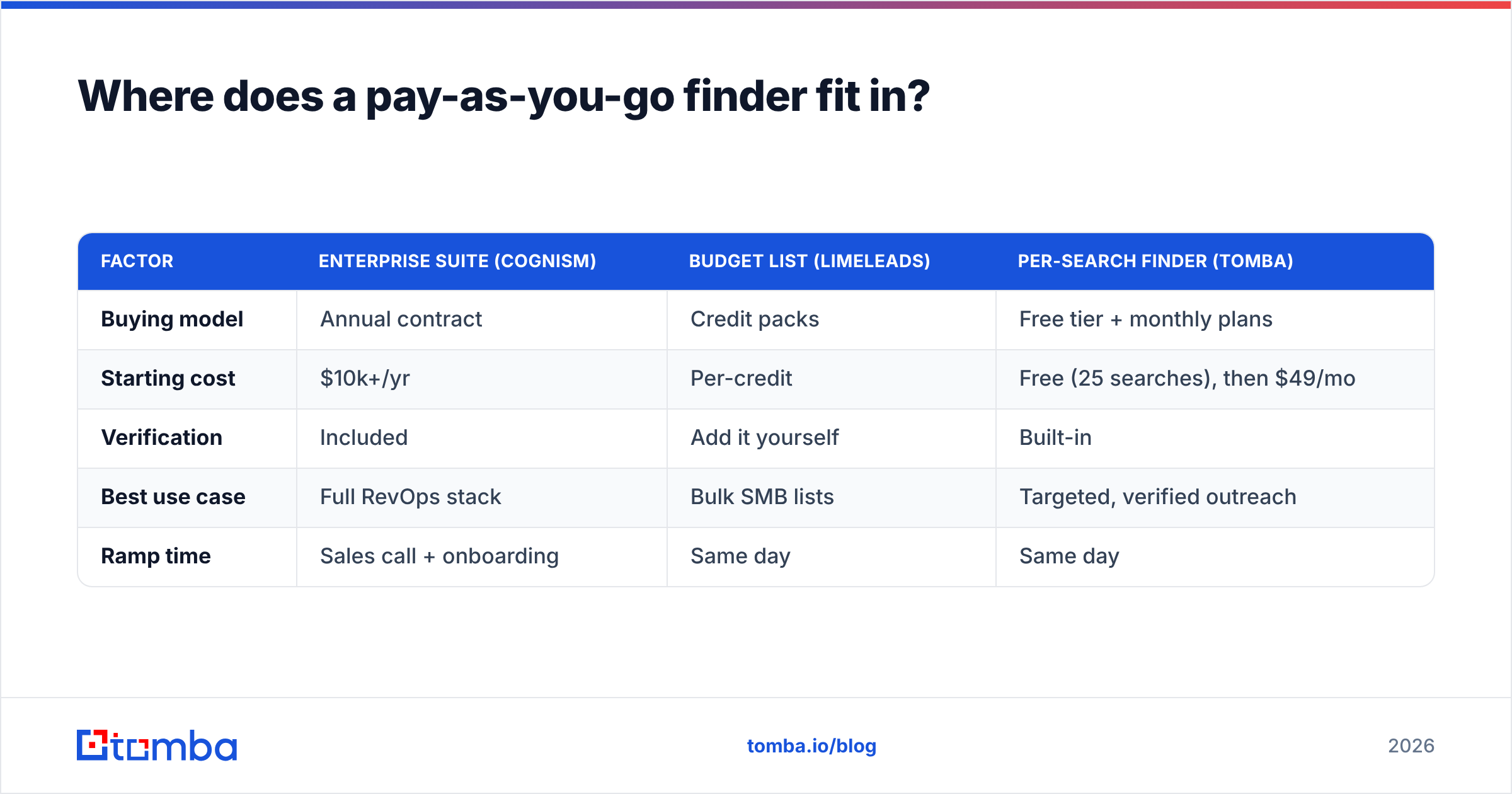
Here's how the models compare at a glance:
| Factor | Enterprise suite (Cognism) | Budget list (Limeleads) | Per-search finder (Tomba) |
|---|---|---|---|
| Buying model | Annual contract | Credit packs | Free tier + monthly plans |
| Starting cost | $10k+/yr | Per-credit | Free (25 searches), then $49/mo |
| Verification | Included | Add it yourself | Built-in |
| Best use case | Full RevOps stack | Bulk SMB lists | Targeted, verified outreach |
| Ramp time | Sales call + onboarding | Same day | Same day |
Tomba's pricing starts with a free tier of 25 searches a month, then Starter at $49/mo and Growth at $99/mo—no annual lock-in and no quote required. You can also layer in data enrichment when you need to fill in missing firmographics on contacts you already have. It won't replace Cognism's verified mobile numbers or intent data, but for the email side of outbound it removes the "pay a lot up front and hope" problem both incumbents share.
If you're specifically weighing enterprise data providers, it's also worth previewing peers like Clearbit and RocketReach through their own alternatives pages before you commit, since the right fit depends heavily on region and data type.
How do you choose between Cognism and Limeleads?#
Match the tool to your actual constraint, not the flashiest feature.
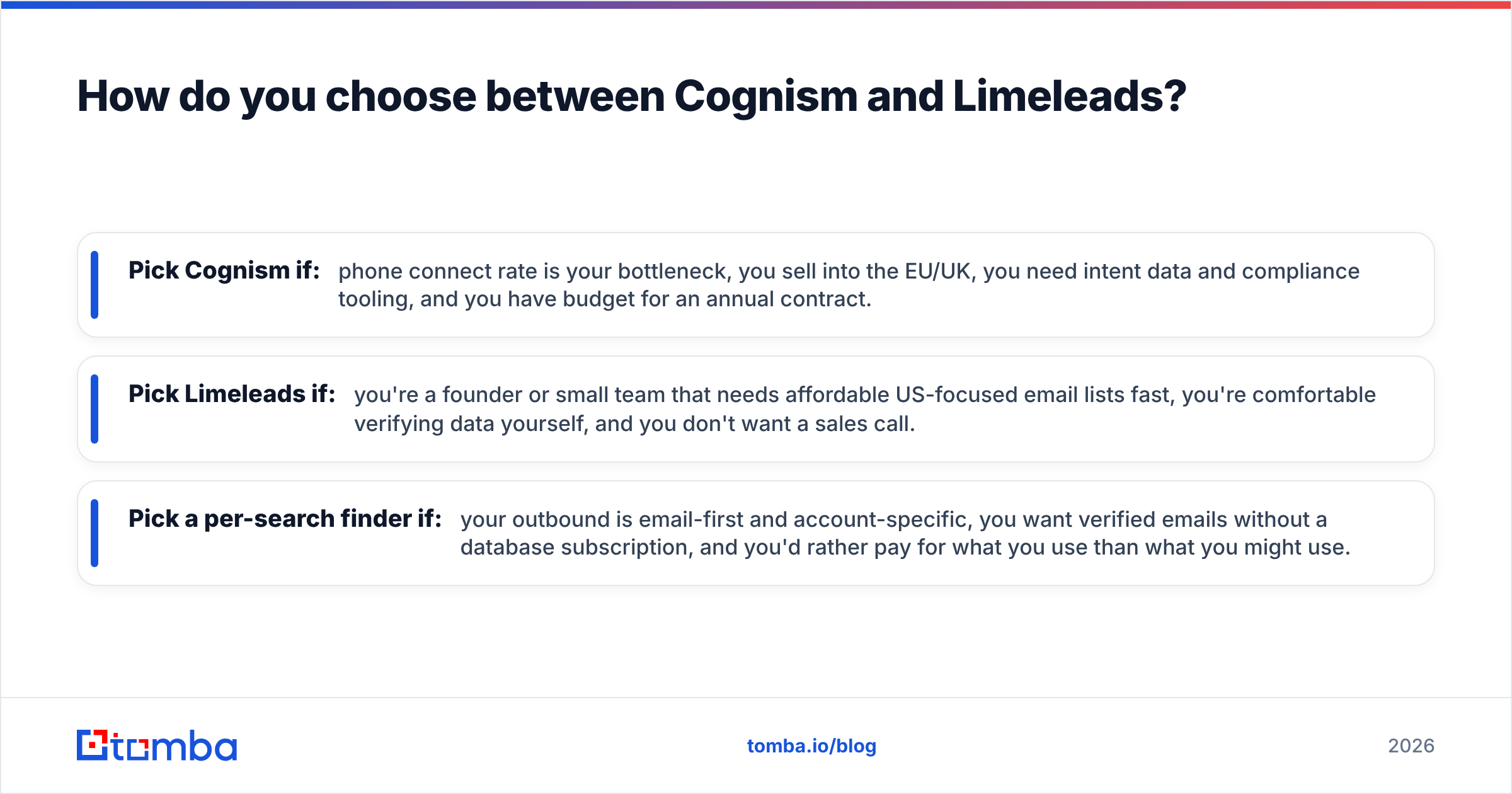
- Pick Cognism if: phone connect rate is your bottleneck, you sell into the EU/UK, you need intent data and compliance tooling, and you have budget for an annual contract.
- Pick Limeleads if: you're a founder or small team that needs affordable US-focused email lists fast, you're comfortable verifying data yourself, and you don't want a sales call.
- Pick a per-search finder if: your outbound is email-first and account-specific, you want verified emails without a database subscription, and you'd rather pay for what you use than what you might use.
A lot of teams end up combining the last two: a lean finder for targeted, verified emails plus an occasional budget list when they need volume—reserving an enterprise contract for when phone-heavy outbound genuinely justifies it. There's no rule that says you must standardize on one vendor for every play.
The bottom line#
Cognism vs Limeleads is really a question about what you're optimizing for. Cognism buys you verified mobile data, intent signals, and compliance coverage—at enterprise prices and with an annual commitment. Limeleads buys you cheap, fast, self-serve US email lists—at the cost of thinner coverage and data you should verify yourself. Both can be the right call; both can be overkill or underkill depending on your motion.
Before you sign anything, model your cost per deliverable contact and be honest about whether your bottleneck is phones or emails. If it's emails, you may not need either platform's full weight.
Ready to stop paying for data you can't send to? Start free with Tomba's Email Finder—find and verify professional emails by name, company, or domain, keep bounce rates low, and skip the annual contract entirely. The free tier gives you 25 searches to test accuracy against whatever list you're using today.
Related guides#
Ready to find emails that actually work?
Join 150,000+ professionals who stopped guessing and started sending. Free credits on signup — no credit card required.
Get the Tomba newsletter
Practical outbound tactics and product updates — once every two weeks.
About the author