Cognism vs Lusha (2026): Which B2B Data Platform Wins?
Cognism vs Lusha compared on data accuracy, coverage, compliance, and price. See which B2B contact-data platform fits your team in 2026 — and the cheaper way to get verified emails.
Cognism vs Lusha (2026): Which B2B Data Platform Wins?
Both promise clean, dialable B2B contact data. Both charge real money for it. And both get pitched to you by reps who insist their database is "the most accurate on the market." So which one actually earns a seat in your stack?
This is a neutral, side-by-side look at Cognism vs Lusha — how they compare on data accuracy, coverage, compliance, workflow, and price — plus where a leaner tool beats both for teams that mostly need verified emails.
TL;DR#
- Cognism wins on compliance-heavy, phone-first outbound — strong EU/DACH coverage, phone-verified mobile data ("Diamond Data"), and GDPR/CCPA guardrails. It's the pricier, enterprise-leaning option.
- Lusha wins on speed and simplicity — a slick Chrome extension, self-serve pricing, and a genuinely usable free tier. Better for SMBs and individual reps.
- Accuracy is close and use-case dependent: Cognism edges ahead on mobile numbers, Lusha is competitive on direct emails.
- Pricing is the real fork: Cognism is quote-based and seat-heavy; Lusha publishes per-user plans that scale down cleanly.
- If your bottleneck is finding and verifying work emails (not buying a full intelligence suite), a focused email finder like Tomba covers that job for a fraction of either price.
What is Cognism?#
Cognism is a B2B sales-intelligence platform built around a globally compliant contact database. Its calling card is phone-verified mobile numbers — a premium data set (marketed as Diamond Data) where numbers are human-checked before they reach you. It leans into regulatory coverage: consented data, GDPR/CCPA alignment, and notification against do-not-call lists across regions.
Cognism sells to mid-market and enterprise revenue teams that run heavy outbound and need EU coverage. You get intent data (via Bombora), technographics, sales triggers, and CRM/sequencer integrations. The trade-off is that it's a bigger, quote-based commitment — you talk to sales, not a pricing page. You can read Cognism's own positioning on cognism.com.
What is Lusha?#
Lusha is a B2B contact-data tool built for speed. Its Chrome extension surfaces emails and phone numbers straight from LinkedIn, company sites, and Salesforce — one click, contact captured. It's the tool a rep installs on a Monday and uses on the same afternoon.
Lusha targets SMBs, startups, and individual sellers who want data without a procurement cycle. It offers a free tier, transparent per-user plans, prospecting filters, list-building, and CRM enrichment. It won't match Cognism's compliance apparatus or phone-verification depth, but it's dramatically faster to adopt. See Lusha's product pages on lusha.com.

Cognism vs Lusha: the head-to-head table#
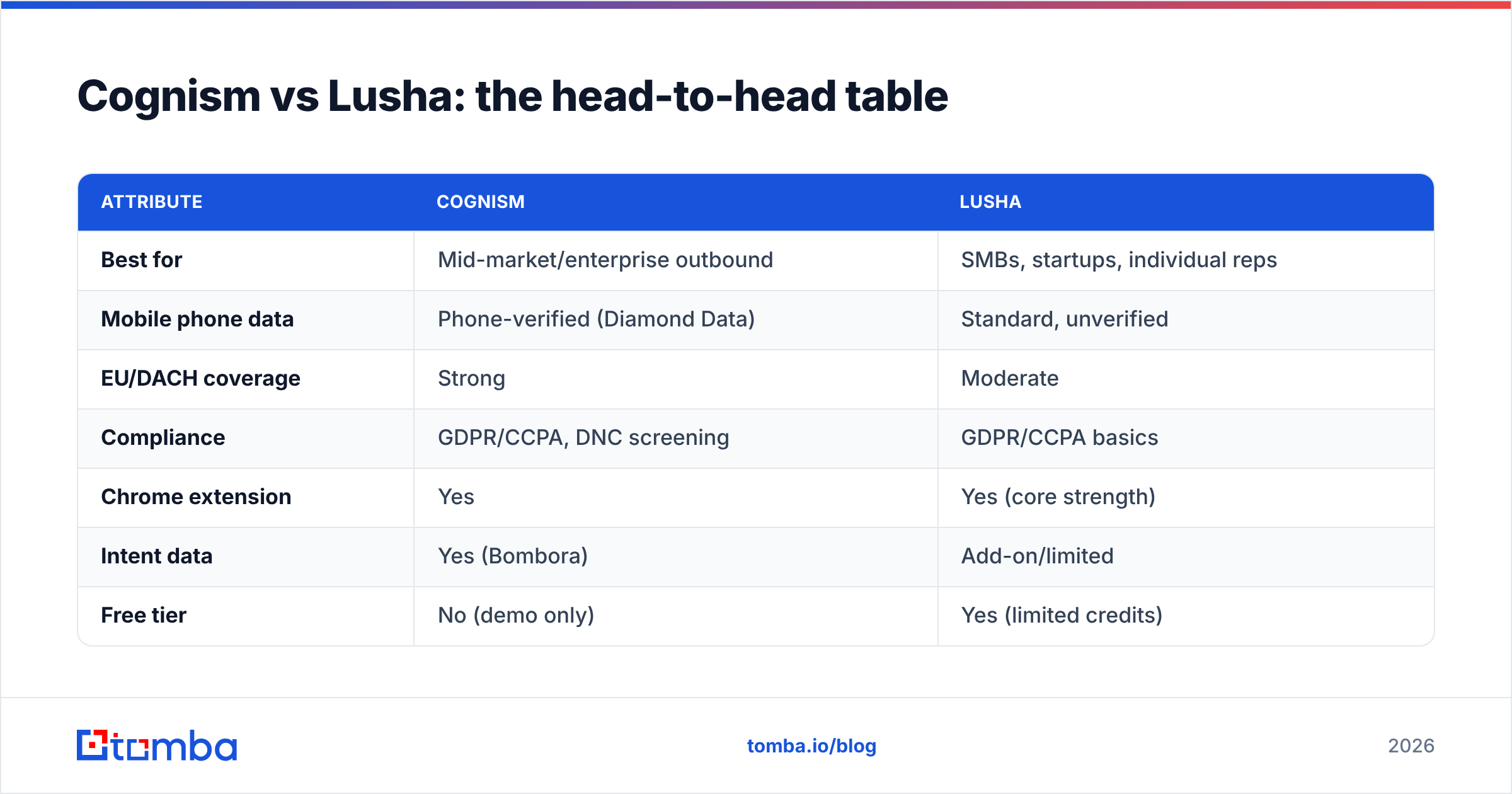
| Attribute | Cognism | Lusha |
|---|---|---|
| Best for | Mid-market/enterprise outbound | SMBs, startups, individual reps |
| Mobile phone data | Phone-verified (Diamond Data) | Standard, unverified |
| EU/DACH coverage | Strong | Moderate |
| Compliance | GDPR/CCPA, DNC screening | GDPR/CCPA basics |
| Chrome extension | Yes | Yes (core strength) |
| Intent data | Yes (Bombora) | Add-on/limited |
| Free tier | No (demo only) | Yes (limited credits) |
| Pricing model | Quote-based, per seat | Published per-user plans |
| Setup speed | Slower (onboarding) | Same-day |
The pattern is clear: Cognism is the heavier, compliance-first platform; Lusha is the light, fast, self-serve one. Neither is "better" in the abstract — it depends on whether your constraint is regulatory risk and phone accuracy, or speed and budget.
Is Cognism's data more accurate than Lusha's?#
On mobile numbers, usually yes. On emails, it's close. Cognism's phone-verification step is the difference-maker for dialing teams — a human-checked mobile number connects more often than a scraped one, and that lifts real conversations per hour. If cold calling is your primary motion, that verification is worth paying for.
For email accuracy, the gap narrows. Both platforms pull from overlapping sources and both suffer the same industry-wide decay problem: B2B data goes stale at roughly 2–3% per month as people change jobs. No provider escapes it. That's why the smart move — regardless of vendor — is to run any purchased list through a dedicated email verifier before you send, so you're not torching your sender reputation on bounces.
One honest caveat: accuracy claims from either vendor are self-reported. Treat "98% accurate" marketing numbers as directional, not gospel, and validate against your own sample before committing budget.
How do Cognism and Lusha compare on coverage?#
Coverage splits along geography and contact type:
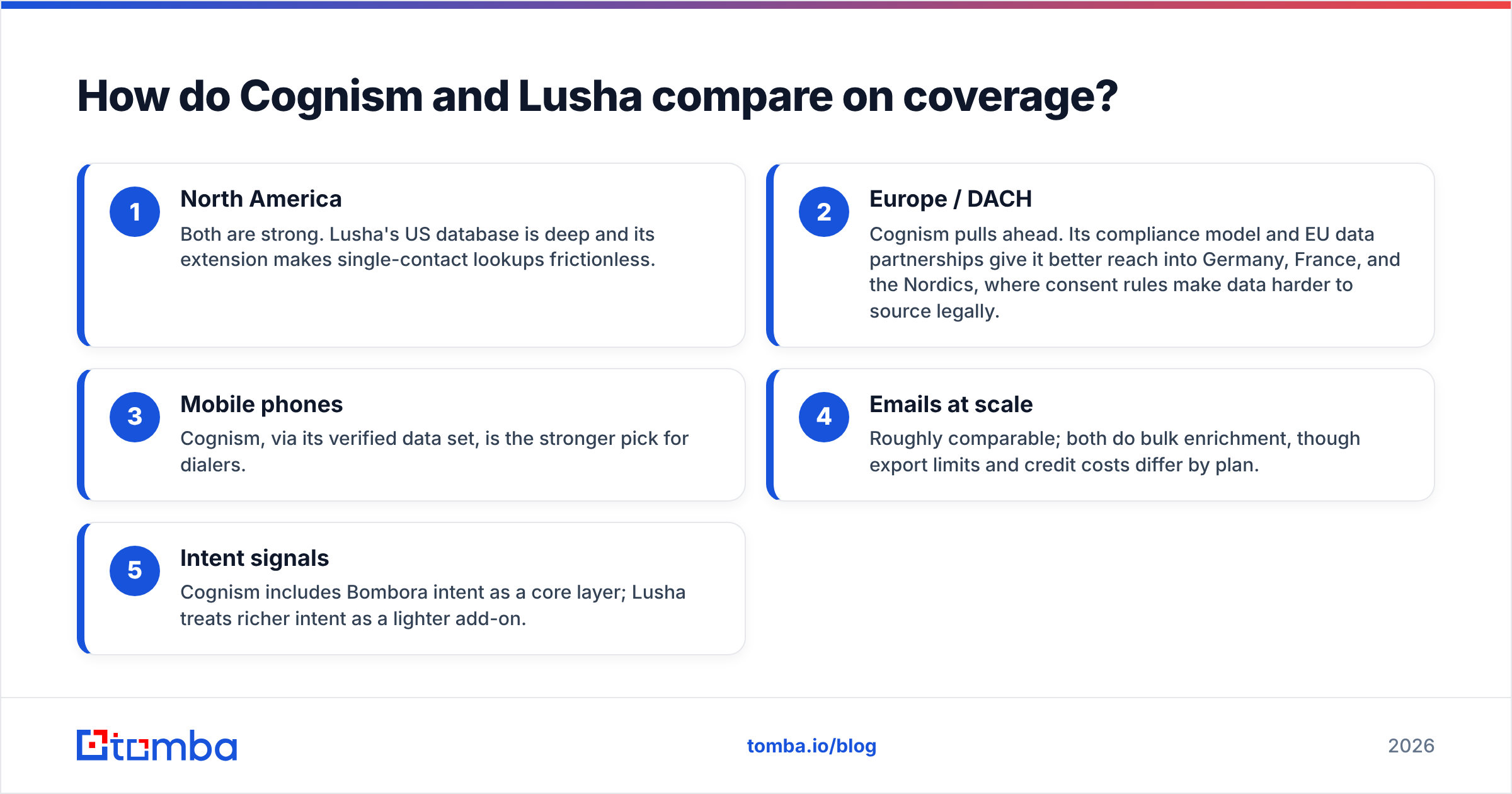
- North America — Both are strong. Lusha's US database is deep and its extension makes single-contact lookups frictionless.
- Europe / DACH — Cognism pulls ahead. Its compliance model and EU data partnerships give it better reach into Germany, France, and the Nordics, where consent rules make data harder to source legally.
- Mobile phones — Cognism, via its verified data set, is the stronger pick for dialers.
- Emails at scale — Roughly comparable; both do bulk enrichment, though export limits and credit costs differ by plan.
- Intent signals — Cognism includes Bombora intent as a core layer; Lusha treats richer intent as a lighter add-on.
If your ICP sits in regulated European markets, Cognism's coverage advantage is concrete. If you're selling into North American SMBs, Lusha covers you at a lower entry cost.
Which is easier to use day to day?#
Lusha, clearly — at least for individual reps. Its extension is the whole point: land on a LinkedIn profile, click, get the contact. There's almost no learning curve, and the free tier lets a rep prove value before anyone signs a contract.
Cognism is more of a platform. There's onboarding, admin setup, and a richer (busier) interface built for teams running structured plays across intent data, sequences, and CRM sync. Powerful, but it asks more of you before it pays off. For a solo seller or a five-person team, that overhead can outweigh the upside.
If you already live in a CRM, check how each connects — Cognism and Lusha both offer native syncs, and you can compare that to how a data layer like Tomba plugs into HubSpot or Salesforce so enriched contacts flow without CSV gymnastics.

Cognism vs Lusha pricing: what will you actually pay?#
This is where the two diverge hardest.
- Cognism is quote-based. You won't find a public price; deals are built around seats, data volume, and modules (intent, integrations). Expect an enterprise-tier annual commitment. That's fine if you're a larger team, frustrating if you just want to try it.
- Lusha publishes per-user plans with a free tier and a self-serve upgrade path. Costs scale with credits and seats, and you can start small. Predictable, but per-seat pricing adds up fast as headcount grows.
The uncomfortable truth for smaller teams: both models penalize you for scale in different ways. Cognism's floor is high; Lusha's per-seat math balloons once you add reps. If your actual need is "verified work emails for outbound," you may be buying a Ferrari to drive to the corner store.
That's the case for a focused tool. Tomba's pricing starts free (25 searches/mo), with Starter at $49/mo, Growth at $99/mo, and Pro at $249/mo — flat, published, no sales call. You trade a full intelligence suite for a sharp email-finding-and-verification engine, and for a lot of teams that's the 80% of the value at 20% of the cost.
When should you pick Cognism?#
Choose Cognism if:
- You run phone-heavy outbound and connect rate is your north-star metric.
- You sell into Europe or other consent-strict regions and need documented compliance.
- You're mid-market or enterprise with budget for a platform and a team to operate it.
- You want intent + technographics baked into the same workflow, not bolted on.
Cognism is the safer institutional choice when regulatory risk and phone accuracy justify the spend.
When should you pick Lusha?#
Choose Lusha if:
- You're an SMB, startup, or solo rep who needs data today, not after procurement.
- Speed and simplicity matter more than depth of compliance tooling.
- You want to start free and expand only as you prove ROI.
- Your motion is North-America-centric and email-first with occasional dialing.
Lusha is the pragmatic pick when you value getting moving over getting everything.
Is there a cheaper alternative to both?#
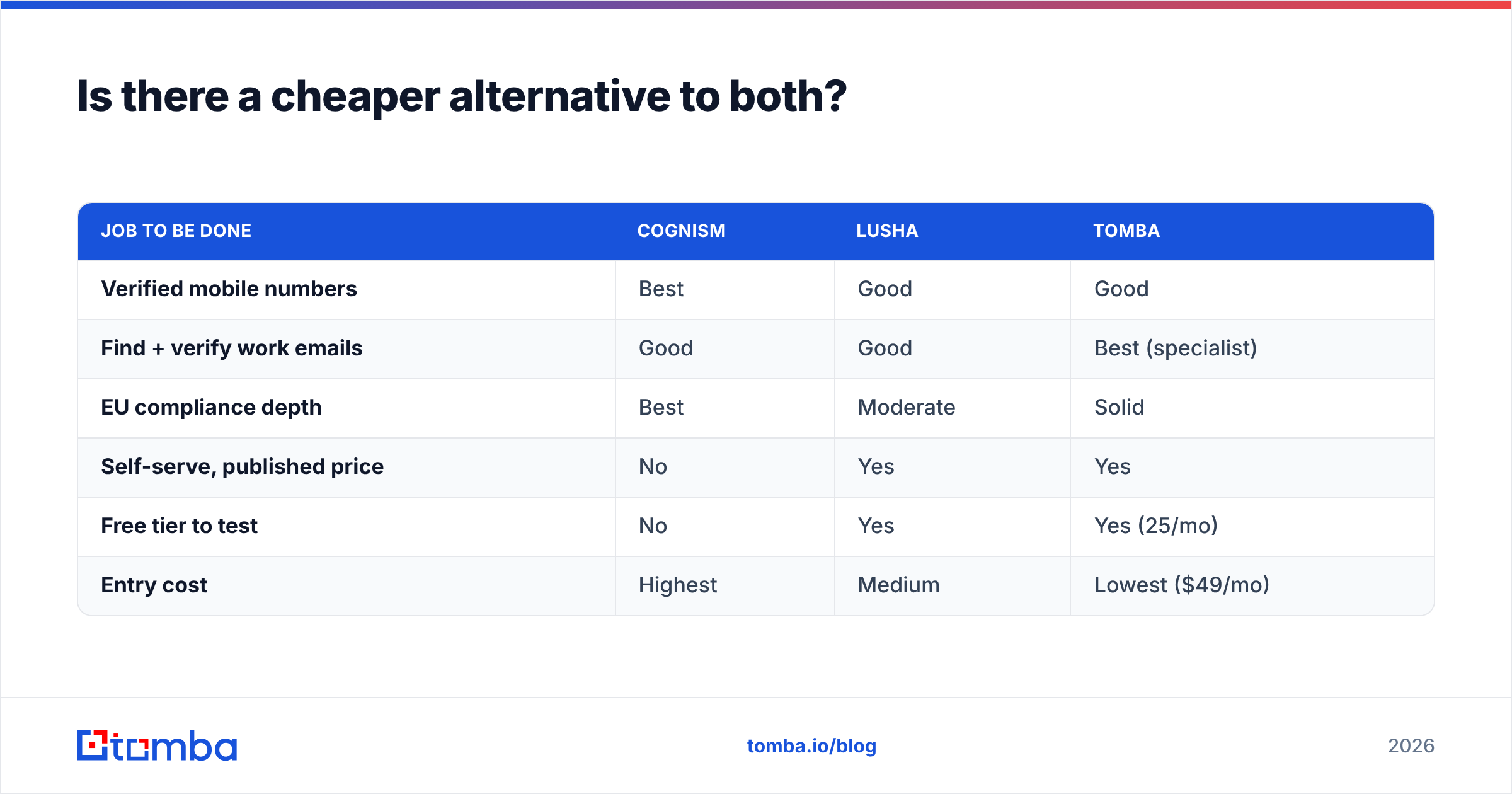
Yes — if your core need is emails, not a full platform. Cognism and Lusha are intelligence suites; you pay for a lot of surface area. But many teams only really use the "find and verify a contact" slice. For that job, a specialist wins on price and precision.
Tomba focuses on exactly that: find professional emails by name, company, or domain search, verify them, and enrich the record — with a phone finder and data enrichment alongside when you need more than an address. There's no per-seat trap and no quote gate.
| Job to be done | Cognism | Lusha | Tomba |
|---|---|---|---|
| Verified mobile numbers | Best | Good | Good |
| Find + verify work emails | Good | Good | Best (specialist) |
| EU compliance depth | Best | Moderate | Solid |
| Self-serve, published price | No | Yes | Yes |
| Free tier to test | No | Yes | Yes (25/mo) |
| Entry cost | Highest | Medium | Lowest ($49/mo) |
Other names worth a look depending on your angle: BookYourData offers pay-as-you-go B2B lists, and larger suites like Apollo bundle sequencing. The right answer is the one that matches your actual bottleneck — don't buy suite features you'll never open.
For a broader market view, cross-check user reviews on G2 before you commit; vendor accuracy claims rarely survive contact with real reviewer data.
Cognism vs Lusha: the verdict#
There's no single winner — there's a winner for your situation:
- Pick Cognism for compliance-critical, phone-first, EU-heavy enterprise outbound.
- Pick Lusha for fast, self-serve, North-America-focused SMB prospecting.
- Pick a specialist like Tomba when the job is really just verified emails (and some phones) and you'd rather not fund a full platform to get them.
Match the tool to your constraint, validate the data on a small sample first, and always verify before you send — whichever vendor's logo ends up in your stack.
Get verified B2B emails without the enterprise price tag#
If reading this made you realize you mostly need clean, dialable, verified contacts — not another platform to administer — start with the Tomba Email Finder. Find professional emails by domain, name, or company, verify them in the same flow, and enrich what you keep. It's free to try (25 searches a month), $49/mo when you're ready to scale, and there's no seat tax or sales call standing between you and your first list. Point it at your ICP and see how many good addresses you get before your next outbound push.
Related guides#
// get started
Find, verify and enrich your first contacts today
Start on the free plan with 25 searches a month, then scale when your team is ready.
Free plan · No credit card required · GDPR & CCPA
// about the author