Cognism vs ZoomInfo (2026): Which B2B Data Tool Wins?
A neutral, hands-on breakdown of Cognism vs ZoomInfo — coverage, compliance, phone accuracy, and real pricing — so you can pick the right B2B data platform without overpaying.
Choosing between Cognism and ZoomInfo usually comes down to one uncomfortable question: how much are you willing to pay for B2B contact data, and how much of that data will actually be accurate when your reps dial it? Both platforms sell the same promise — verified emails, direct-dial phone numbers, company intelligence, and intent signals — but they get there differently, price differently, and win in different regions.
This is a neutral, practitioner-level comparison. No vendor is paying for a verdict here. We'll look at data coverage, phone accuracy, compliance posture, integrations, and the pricing both companies try hard not to publish — then help you match the right tool to your motion.
TL;DR: Cognism vs ZoomInfo at a glance#
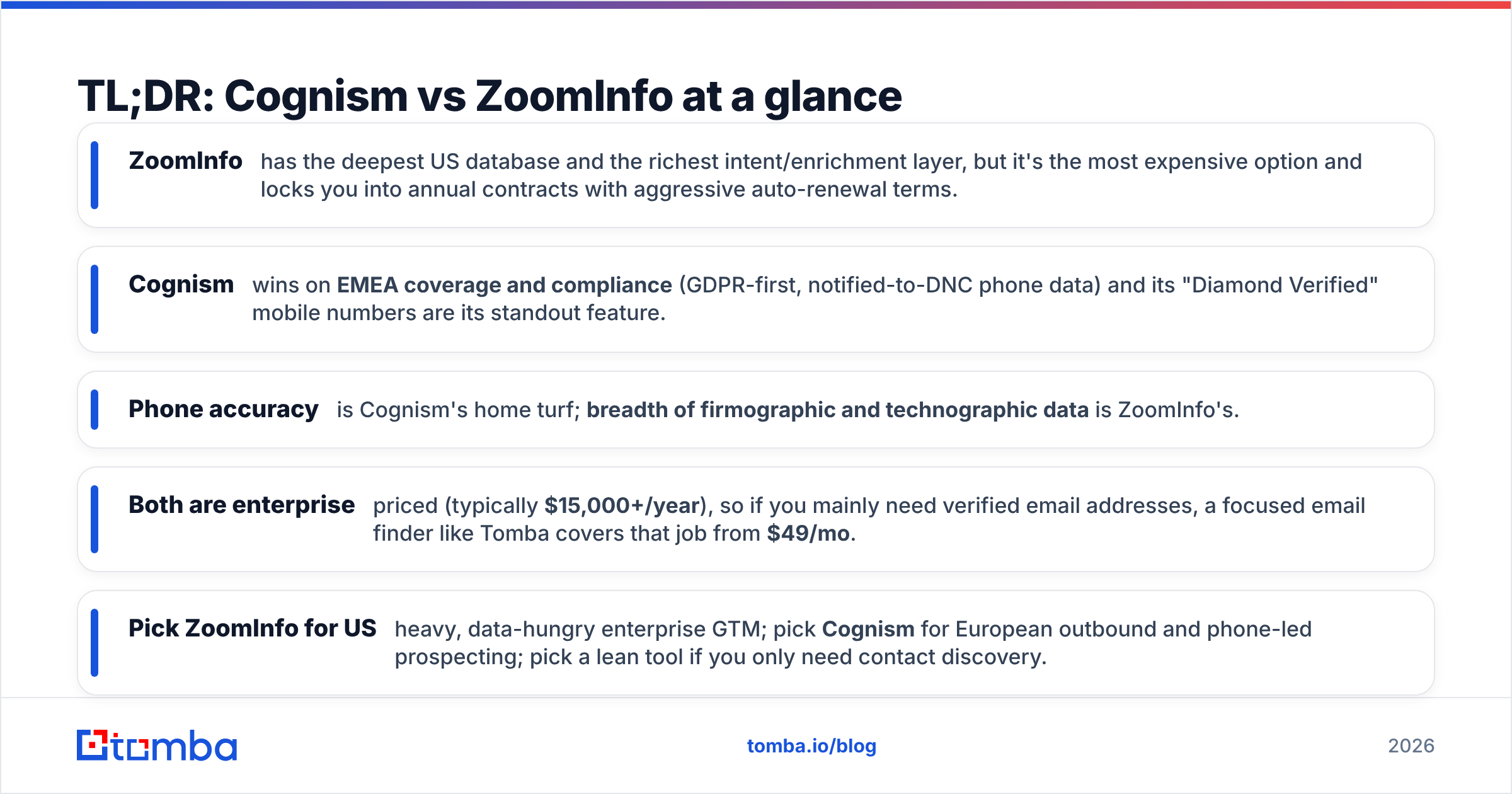
- ZoomInfo has the deepest US database and the richest intent/enrichment layer, but it's the most expensive option and locks you into annual contracts with aggressive auto-renewal terms.
- Cognism wins on EMEA coverage and compliance (GDPR-first, notified-to-DNC phone data) and its "Diamond Verified" mobile numbers are its standout feature.
- Phone accuracy is Cognism's home turf; breadth of firmographic and technographic data is ZoomInfo's.
- Both are enterprise-priced (typically $15,000+/year), so if you mainly need verified email addresses, a focused email finder like Tomba covers that job from $49/mo.
- Pick ZoomInfo for US-heavy, data-hungry enterprise GTM; pick Cognism for European outbound and phone-led prospecting; pick a lean tool if you only need contact discovery.
What is Cognism?#
Cognism is a UK-founded sales intelligence platform built around compliant B2B data for outbound teams. Its reputation rests on two things: strong coverage across the UK, Europe, and increasingly the US, and a compliance model designed for GDPR from the start. Cognism checks contact data against Do-Not-Call lists in multiple countries and markets its phone-verified mobile numbers as Diamond Verified — numbers a human or rigorous process has confirmed.
If your team lives on the phone and sells into Europe, that DNC-cleaned, phone-verified angle is the reason Cognism shows up on the shortlist. You can read more about how compliant data affects email deliverability and outreach risk in Tomba's glossary.
What is ZoomInfo?#
ZoomInfo is the market's 800-pound gorilla — a publicly traded company with the largest commercial contact and company database, especially in North America. Beyond contacts, it bundles intent data (via its Streaming Intent and former Clearbit-style signals), website visitor tracking, conversation intelligence (Chorus), and sales engagement (ZoomInfo Copilot and workflows). It's less a "data vendor" and more a full go-to-market operating system.
That breadth is the appeal and the catch: you're buying a platform, and platforms are priced — and contracted — like platforms. G2 and Gartner reviews consistently praise ZoomInfo's data depth while flagging cost and renewal friction. You can sanity-check current sentiment on G2 before committing.

How do Cognism and ZoomInfo compare on data and pricing?#
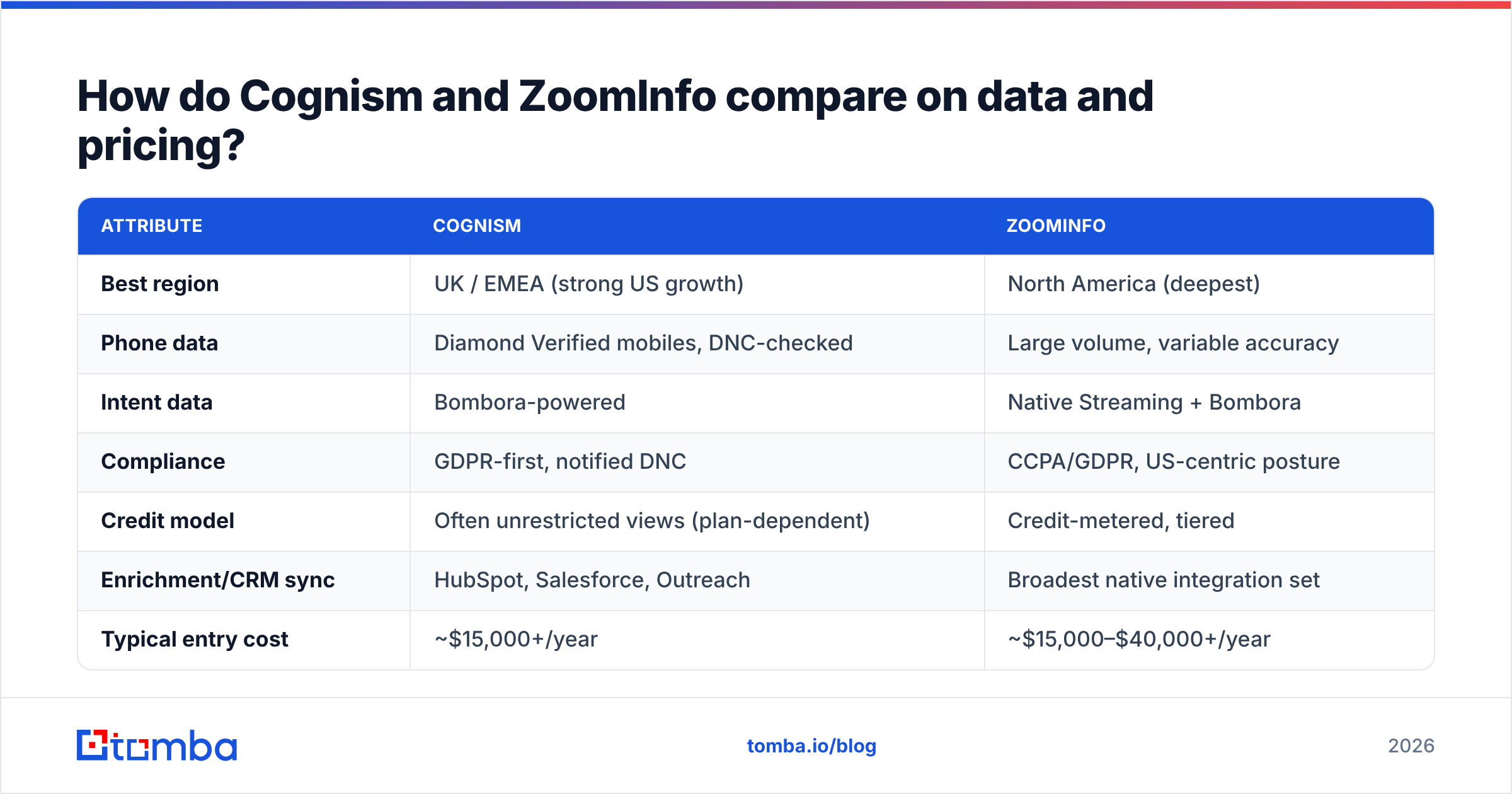
Here's the honest side-by-side. Pricing figures are directional — both vendors quote per-seat with credit tiers and rarely publish rates — so treat these as the ranges teams commonly report, not fixed list prices.
| Attribute | Cognism | ZoomInfo |
|---|---|---|
| Best region | UK / EMEA (strong US growth) | North America (deepest) |
| Phone data | Diamond Verified mobiles, DNC-checked | Large volume, variable accuracy |
| Intent data | Bombora-powered | Native Streaming + Bombora |
| Compliance | GDPR-first, notified DNC | CCPA/GDPR, US-centric posture |
| Credit model | Often unrestricted views (plan-dependent) | Credit-metered, tiered |
| Enrichment/CRM sync | HubSpot, Salesforce, Outreach | Broadest native integration set |
| Typical entry cost | ~$15,000+/year | ~$15,000–$40,000+/year |
| Contract | Annual | Annual, strict auto-renewal |
| Free trial | Limited/demo-gated | Limited/demo-gated |
Two takeaways. First, neither is a "swipe a card and start" product — both run through sales-led demos and annual commitments. Second, the price gap between them narrows or widens entirely based on how many seats and credits you negotiate, so list-price comparisons are almost meaningless without your specific volume.
Which has better phone number accuracy?#
Cognism generally wins on mobile phone accuracy; ZoomInfo wins on sheer volume of numbers. This is the cleanest real difference between them.
Cognism's Diamond Verified program exists precisely because unverified mobile data is where most providers quietly fail. A phone-led SDR team calling into Europe will usually connect at a higher rate with Cognism's cleaned, DNC-suppressed numbers. ZoomInfo returns more numbers overall, but a larger share are office lines or stale directs, which matters more now that most buyers work hybrid.
If dialing is your primary motion, weigh connect-rate quality over raw record count. If you need to layer verified B2B phone numbers onto an existing list rather than replatform, a dedicated phone finder can fill that gap without a five-figure contract.
Which has better data coverage and enrichment?#
ZoomInfo has the broader and deeper database, especially in the US, plus the richest enrichment graph. Its firmographic, technographic, and org-chart data is the industry benchmark, and its enrichment can hydrate a thin CRM record into a full profile in one pass.
Cognism has closed much of the gap in Europe and is competitive on email coverage, but for someone selling across every US vertical, ZoomInfo simply returns more rows. Where ZoomInfo also pulls ahead is the surrounding intelligence: scoops (sales trigger events), funding data, and intent all live natively in one interface.
The trade-off is that all this depth is what you're paying for — and a lot of teams use maybe 20% of it. If your real need is finding and enriching contacts rather than running an intent-driven GTM engine, that platform tax is hard to justify. Tomba's data enrichment and domain search cover the contact-discovery slice at a fraction of the cost.
Is Cognism or ZoomInfo better for compliance?#
Cognism is the safer default for GDPR-sensitive, Europe-facing outbound. It was architected around European privacy law: it notifies contacts, suppresses against Do-Not-Call registries in several countries, and documents its lawful basis clearly. For a UK or EU sales team, that reduces legal exposure in a way that matters to security and legal reviewers.
ZoomInfo is compliant with CCPA and GDPR frameworks, but its center of gravity is the US, and its data-collection model has drawn more scrutiny in European contexts. Neither is "non-compliant," but if a German or French legal team is signing off on your data vendor, Cognism tends to clear the bar with less friction. Review each vendor's current DPA and data-processing documentation directly — compliance posture changes, and vendor docs are the source of truth. Gartner's market research is a useful neutral reference point for how buyers rate each.

Do you actually need Cognism or ZoomInfo?#
This is the question most comparison posts skip. Both tools are excellent — and both are overkill for a large share of the teams evaluating them.
Ask yourself what you're really buying:
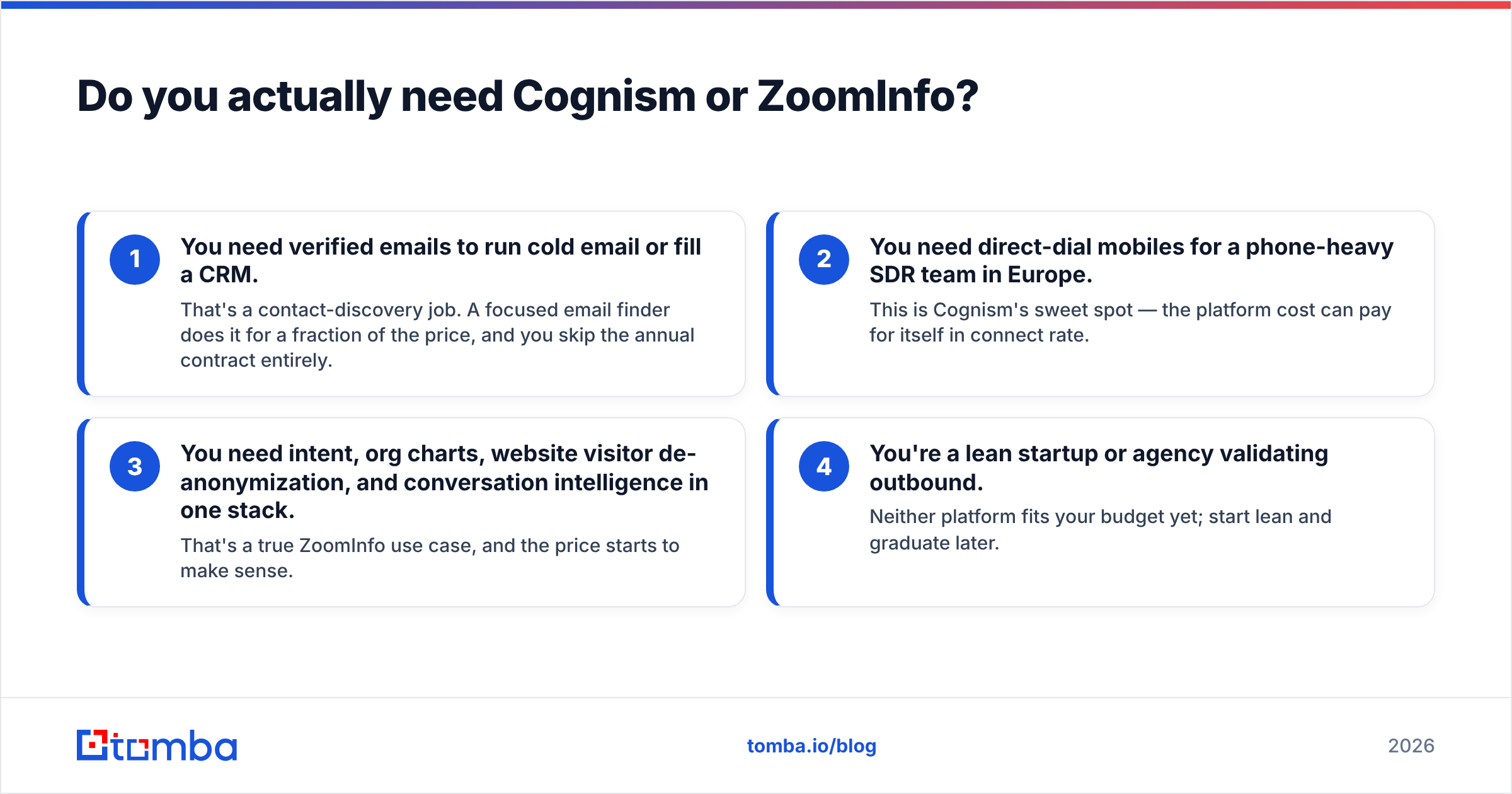
- You need verified emails to run cold email or fill a CRM. That's a contact-discovery job. A focused email finder does it for a fraction of the price, and you skip the annual contract entirely.
- You need direct-dial mobiles for a phone-heavy SDR team in Europe. This is Cognism's sweet spot — the platform cost can pay for itself in connect rate.
- You need intent, org charts, website visitor de-anonymization, and conversation intelligence in one stack. That's a true ZoomInfo use case, and the price starts to make sense.
- You're a lean startup or agency validating outbound. Neither platform fits your budget yet; start lean and graduate later.
Be honest about which bucket you're in. Paying $15k+/year for capabilities you won't touch is the most common mistake in this category.
Cognism vs ZoomInfo vs a focused email finder#
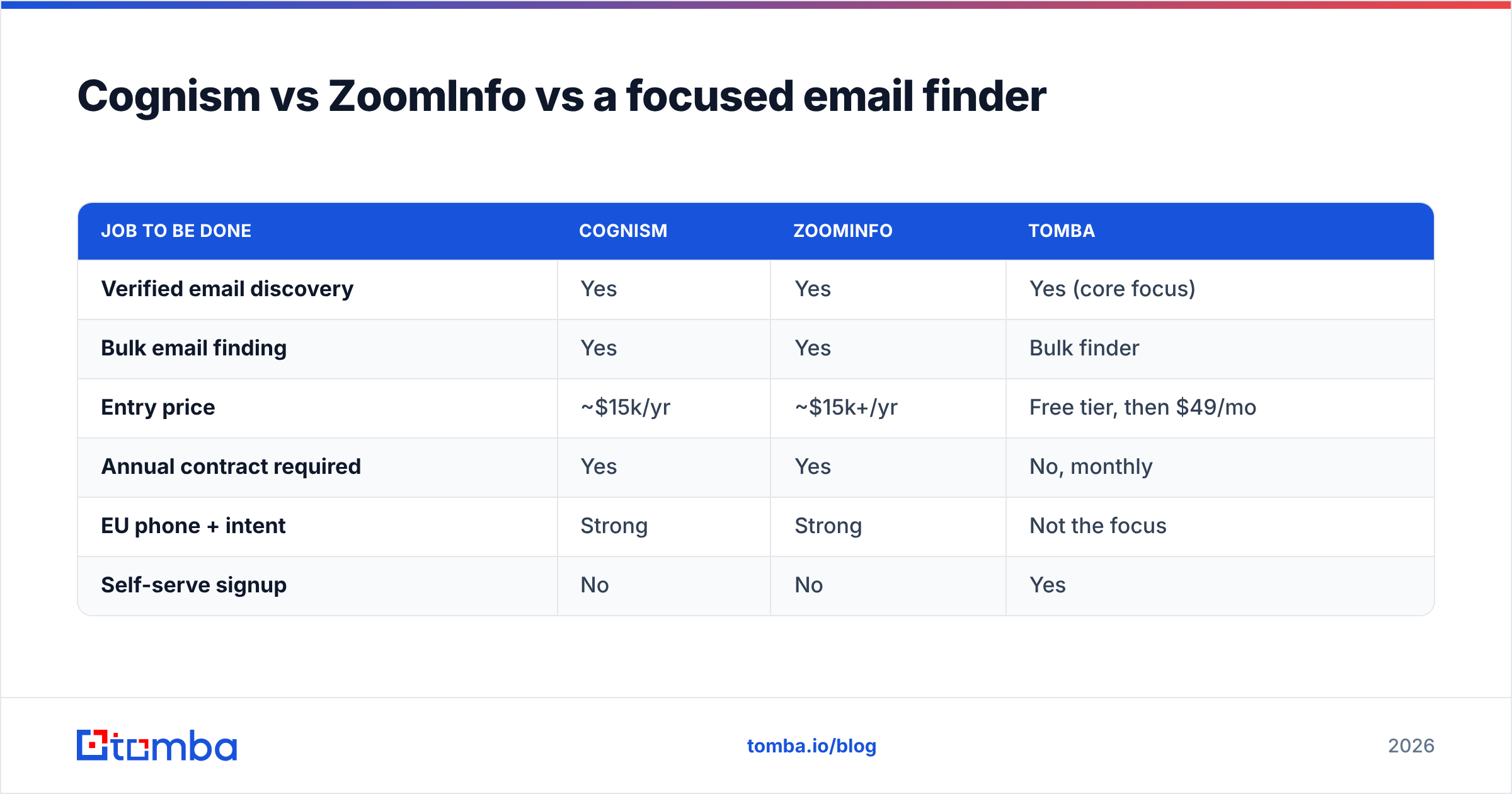
If your core need is "find the right person's verified email at a company and enrich it," you're comparing a Ferrari and a truck when you might just need a reliable car. Here's how the platforms stack against a purpose-built finder for that specific job.
| Job to be done | Cognism | ZoomInfo | Tomba |
|---|---|---|---|
| Verified email discovery | Yes | Yes | Yes (core focus) |
| Bulk email finding | Yes | Yes | Bulk finder |
| Entry price | ~$15k/yr | ~$15k+/yr | Free tier, then $49/mo |
| Annual contract required | Yes | Yes | No, monthly |
| EU phone + intent | Strong | Strong | Not the focus |
| Self-serve signup | No | No | Yes |
The point isn't that Tomba replaces ZoomInfo's intent engine or Cognism's Diamond phones — it doesn't. The point is that a big fraction of "we need a data provider" requests are really "we need verified emails," and that job doesn't require an enterprise contract. You can compare full Tomba pricing — Free (25 searches/mo), Starter $49/mo, Growth $99/mo, Pro $249/mo — against a five-figure annual commitment and decide for yourself.
How to choose: a simple decision framework#
Use this quick logic to land the decision without a two-month bake-off:
- Sell mostly into the US, want depth + intent + engagement in one platform, have budget → ZoomInfo.
- Sell into the UK/EU, phone-led motion, compliance matters → Cognism.
- Mixed regions, mid-market budget, want data without the platform tax → Cognism (often the more flexible commercial terms of the two).
- You mainly need verified emails and enrichment, or you're still proving outbound → a focused finder/verifier stack, then upgrade once volume justifies it.
Whatever you pick, negotiate hard. Both vendors have real flexibility on price, credits, and contract length that never appears in the first quote — and both have auto-renewal clauses worth reading closely before you sign.
The verdict#
There's no universal winner in Cognism vs ZoomInfo — there's only the winner for your motion. ZoomInfo is the most complete B2B data platform on the market and the right call for US-centric, data-driven enterprise GTM. Cognism is the sharper tool for compliant, phone-led European outbound, and often the friendlier partner on terms. Both are premium, both are annual, and both assume you'll use far more than raw contact lookup.
If, after all that, your honest need is just accurate emails to reach the right people, don't overbuy. Start with the Tomba Email Finder — find verified professional emails by name, domain, or company, enrich them, and export to your CRM, with a free tier to test accuracy before you spend a cent. Prove the motion first, then let real volume tell you whether a full platform like Cognism or ZoomInfo is worth the five-figure jump.
Related guides#
Ready to find emails that actually work?
Join 150,000+ professionals who stopped guessing and started sending. Free credits on signup — no credit card required.
Get the Tomba newsletter
Practical outbound tactics and product updates — once every two weeks.
About the author