Cold Call Connect Rate: Benchmarks and How to Fix It
Your cold call connect rate decides whether your dialing hours turn into conversations or dead tone. Here are the 2026 benchmarks and the fixes that actually move the number.
TL;DR
- Cold call connect rate is the percentage of dials that reach a live human. In 2026, most B2B teams sit between 5% and 12% — anything above 15% is elite.
- Connect rate is not a talent problem first. It's a data, timing, and caller-ID problem. Fix those before you touch the script.
- Bad phone numbers are the silent killer: up to 30% of purchased mobile lists are wrong, disconnected, or gatekeeper lines.
- Dialing at the right local hour, using a local presence number, and warming your caller ID can double the number of live pickups from the same list.
- Clean, verified mobile-direct data is the highest-leverage fix. Tools like Tomba's phone finder and phone validator exist to keep your list dialing live numbers.
What is cold call connect rate?#
Cold call connect rate is the share of your outbound dials that reach a real, live person on the other end. If you dial 100 numbers and 8 people actually pick up and talk, your connect rate is 8%.
Think of it like fishing. Your dial volume is how many times you cast; your connect rate is how often something actually bites. You can cast all day, but if you're casting into an empty pond — dead numbers, wrong contacts, bad timing — you go home with nothing. Most reps blame their casting technique when the real problem is the pond.
The formula is simple:
Connect rate = (live conversations ÷ total dials) × 100
A few definitions to keep clean, because teams measure this inconsistently and then argue about benchmarks that aren't comparable:
- Dial — every attempt, including voicemails and no-answers.
- Connect — you reached a live human, decision-maker or not.
- Right-party connect (RPC) — you reached the specific person you were targeting. This is the number that actually predicts pipeline.
- Conversation — a connect that lasted long enough to exchange more than "wrong number."
When you read "20% connect rates" in a vendor case study, ask whether they mean connects or right-party connects. The gap between the two is often 2-3x.
What is a good cold call connect rate in 2026?#
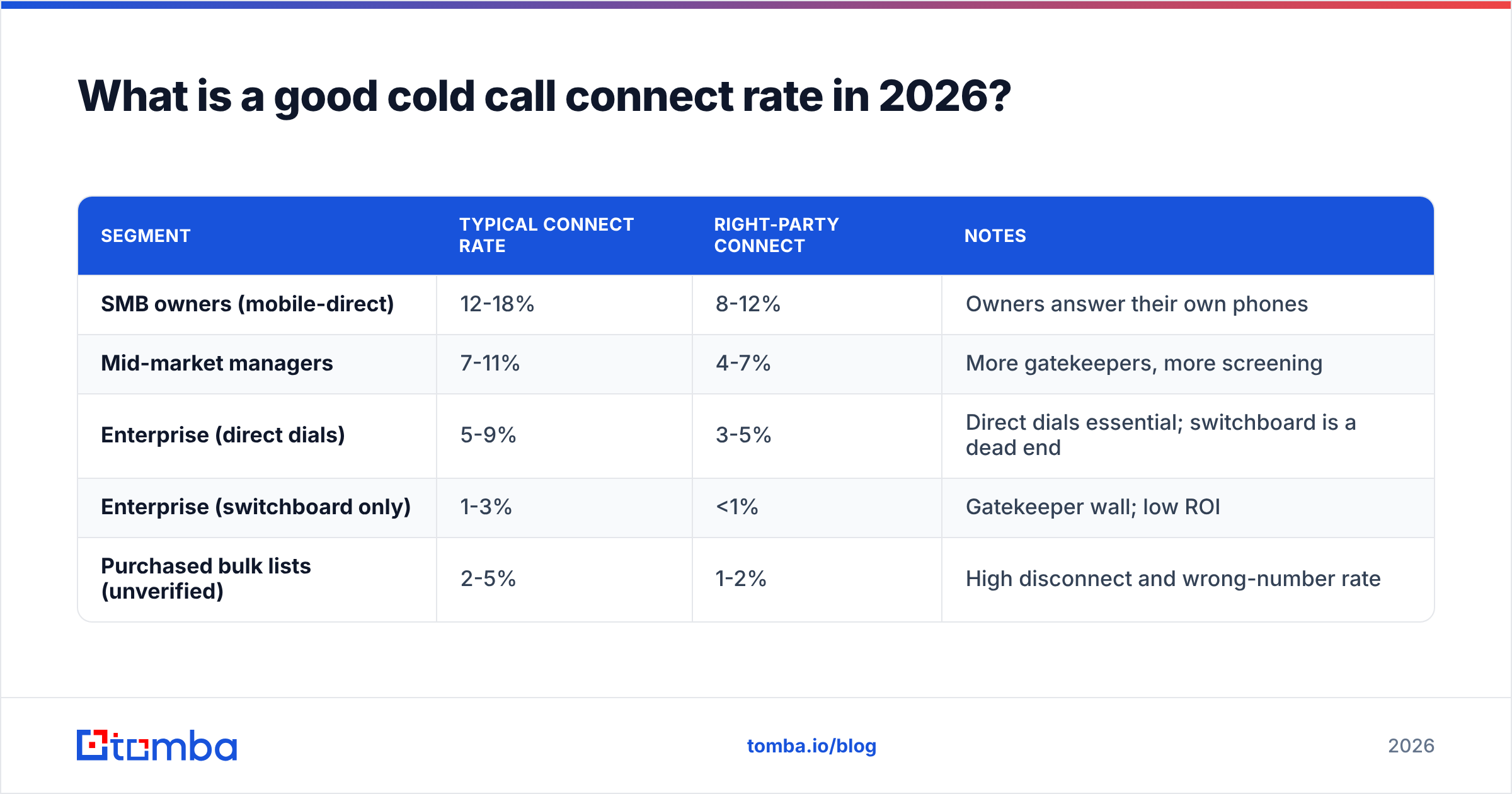
Short answer: 5-12% is normal, 15%+ is excellent, and anything under 4% means your data or timing is broken — not your reps.
Connect rates have drifted down over the past decade as mobile spam filtering, call-screening apps, and "likely spam" caller-ID labels became default on carriers. The counterweight is better data and smarter dialing. Here's where realistic B2B teams land today.
| Segment | Typical connect rate | Right-party connect | Notes |
|---|---|---|---|
| SMB owners (mobile-direct) | 12-18% | 8-12% | Owners answer their own phones |
| Mid-market managers | 7-11% | 4-7% | More gatekeepers, more screening |
| Enterprise (direct dials) | 5-9% | 3-5% | Direct dials essential; switchboard is a dead end |
| Enterprise (switchboard only) | 1-3% | <1% | Gatekeeper wall; low ROI |
| Purchased bulk lists (unverified) | 2-5% | 1-2% | High disconnect and wrong-number rate |
Two things jump out of that table. First, mobile-direct and direct-dial data outperforms switchboard numbers by a wide margin. Second, unverified bulk lists cluster at the bottom regardless of segment, because a third of the numbers never had a chance to connect.
For a broader view of how connect rate ties into downstream metrics, industry benchmarks from HubSpot's sales research and analyst data from Gartner consistently show the same pattern: data quality explains more of the variance in outbound results than script or cadence.
Why is my cold call connect rate so low?#
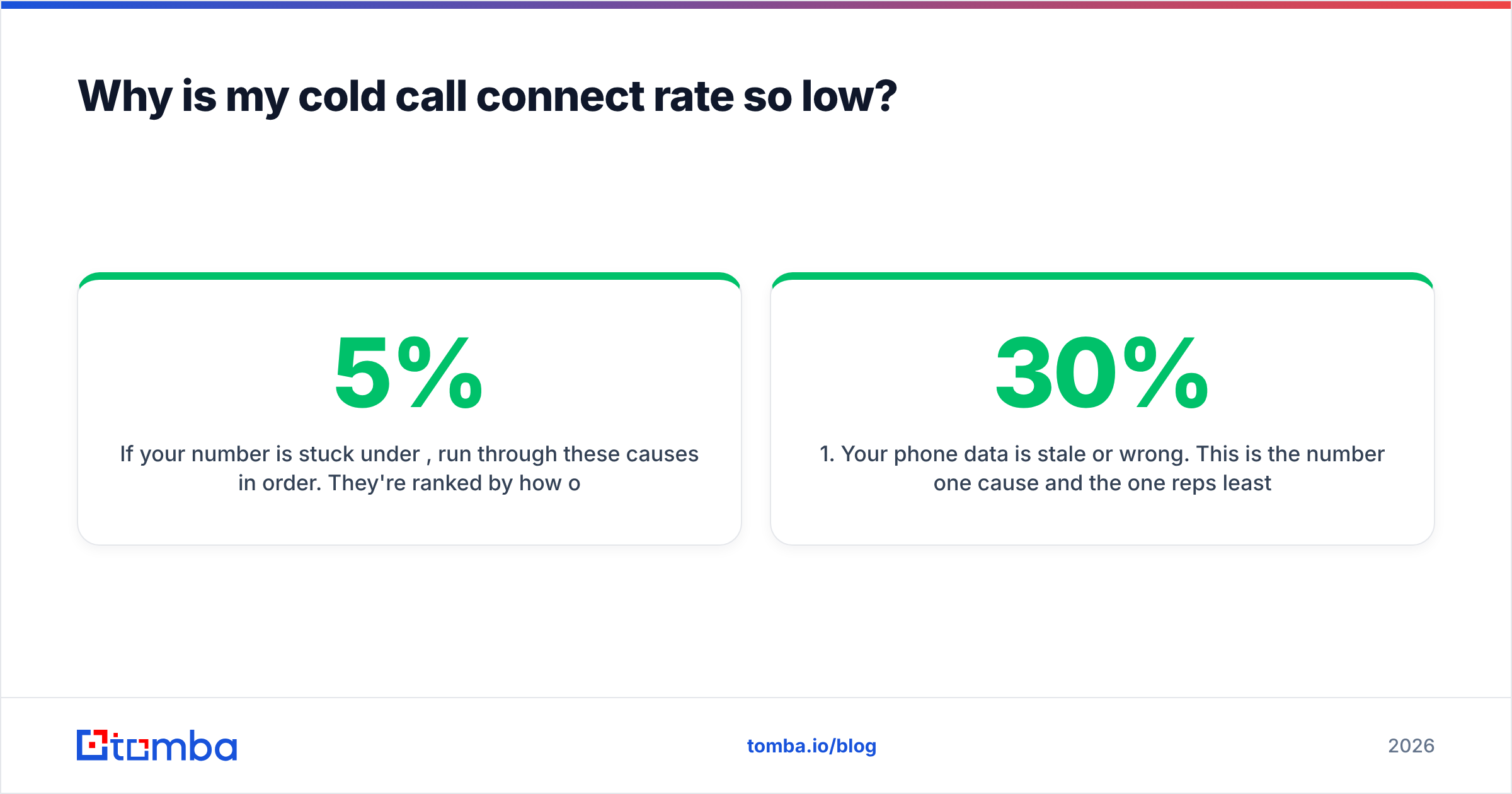
If your number is stuck under 5%, run through these causes in order. They're ranked by how often they're the actual culprit, not by how fun they are to fix.
1. Your phone data is stale or wrong. This is the number one cause and the one reps least suspect. A list you bought six months ago has already decayed — people change jobs, switch numbers, and drop landlines. Direct dials rot faster than emails. If you've never run your list through a phone validator, assume 20-30% of it is dead weight.
2. You're calling switchboards, not direct lines. A main company number routes you to a receptionist whose job is to keep you out. Direct dials and mobile numbers skip that wall entirely. Sourcing mobile-direct data is the single biggest lever most teams ignore.
3. Your caller ID is flagged. Carriers and apps like Hiya and Truecaller label high-volume numbers "Spam Likely," and nobody answers those. If you've been hammering one DID with hundreds of daily dials, it's probably burned.
4. You're dialing at the wrong hour. Connect rates swing by 2-3x depending on the local time of the prospect. Calling a West Coast prospect at 8am your Eastern time means 5am for them — pure waste.
5. Your list has the wrong people. Even a live pickup is useless if it's not the buyer. This is where data enrichment matters: matching the right title, seniority, and department before the dial.
Does dialing time and caller ID really change connect rate?#
Yes, and by more than most managers believe. These are the two highest-ROI changes you can make without buying a single new lead.
Local dialing windows. Across large B2B datasets, the best connect windows cluster around 8-9am and 4-5pm in the prospect's local time zone — before the calendar fills and after it clears. Mid-morning and just-after-lunch are dead zones. If your dialer isn't segmenting by the prospect's time zone, you're throwing away a third of your good hours.
Local presence. A number with the prospect's area code gets answered more often than an out-of-state or toll-free number. It's not a trick; people are simply more likely to pick up a call that looks local. Most modern dialers offer this, but it only works if the underlying phone data is accurate enough to match region correctly.
Caller-ID health. Rotate your outbound numbers, keep daily volume per DID reasonable, and register your numbers with the major caller-ID databases. A burned number can drag an otherwise strong list down to a 2% connect rate no matter how good your reps are.
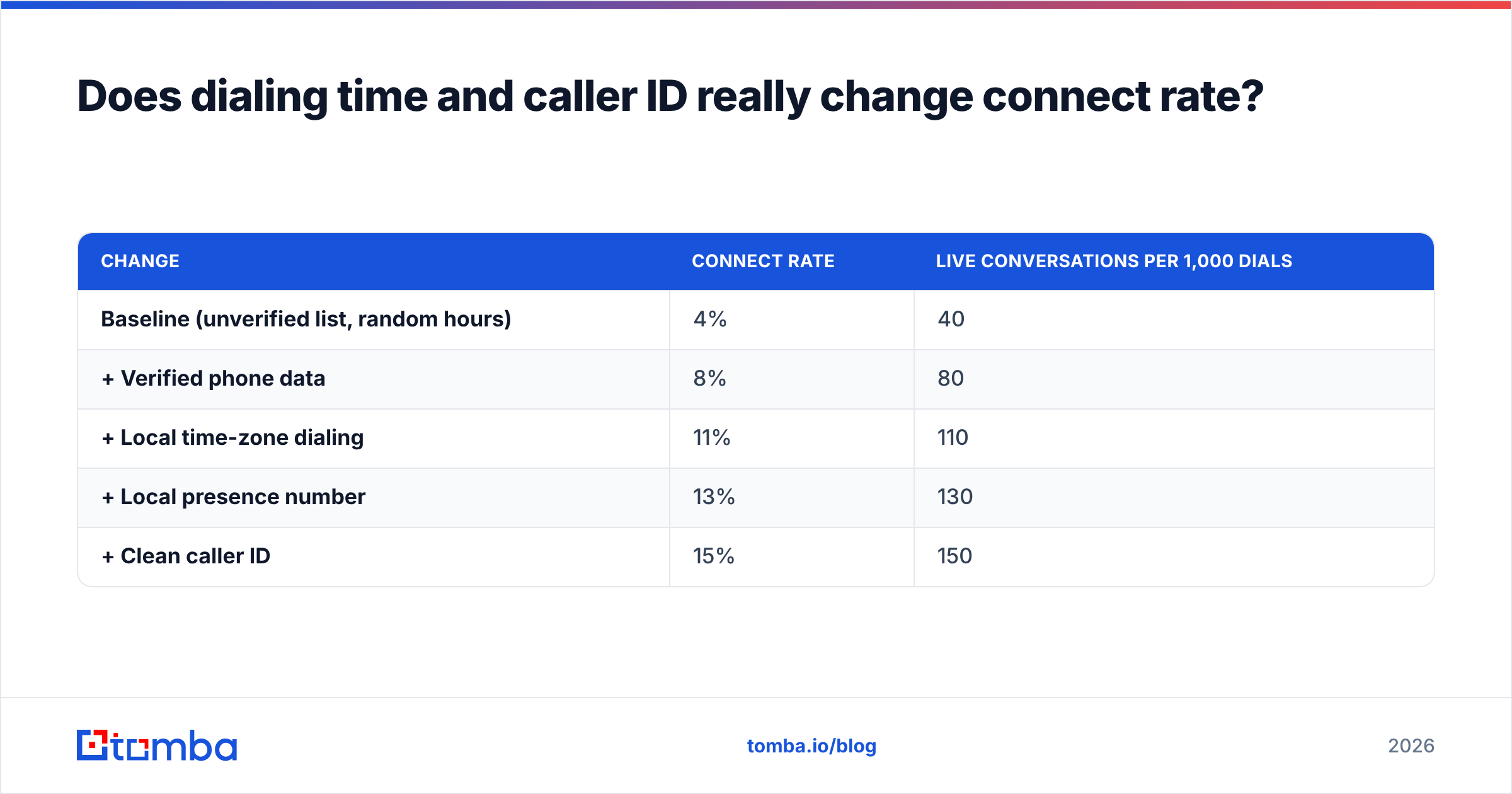
Here's how those levers stack, using the same 1,000-dial list:
| Change | Connect rate | Live conversations per 1,000 dials |
|---|---|---|
| Baseline (unverified list, random hours) | 4% | 40 |
| + Verified phone data | 8% | 80 |
| + Local time-zone dialing | 11% | 110 |
| + Local presence number | 13% | 130 |
| + Clean caller ID | 15% | 150 |
Same reps, same script, same effort — nearly 4x the conversations from stacking data and timing fixes. The script never entered the equation.
How do I actually fix my cold call connect rate?#
Work top-down: data first, timing second, technique last. Fixing the script before the data is like tuning the radio in a car with no engine.
Step 1 — Verify every number before you dial. Run your list through validation to strip disconnected, invalid, and reassigned numbers. This alone recovers hours of wasted dial time. Tomba's phone validator checks line status so your reps stop burning attempts on dead numbers.
Step 2 — Source mobile-direct data, not switchboards. Prioritize direct dials and cell numbers. You can build these with a phone finder that returns direct contact numbers by name and company, then enrich for title accuracy so you're dialing the actual buyer. Pair it with find phone numbers workflows tied to your existing account list.
Step 3 — Segment by time zone and dial in the local golden hours. Group your list by region and schedule calls for the prospect's 8-9am and 4-5pm. Don't let a national list dial in a single wave.
Step 4 — Manage caller-ID hygiene. Rotate DIDs, cap per-number volume, use local presence, and monitor for spam flags weekly.
Step 5 — Only now, refine the opener. Once you're consistently reaching live buyers, a tighter first 10 seconds compounds. But an opener with nobody on the line is worthless.
For teams running phone alongside multichannel outreach, connect rate improvements also lift your other channels: the same verified, enriched records feed your email and LinkedIn sequences. If you're building that combined motion, our notes on LinkedIn outreach and response rate benchmarks pair naturally with cold calling.
How is cold call connect rate different from answer rate and pickup rate?#
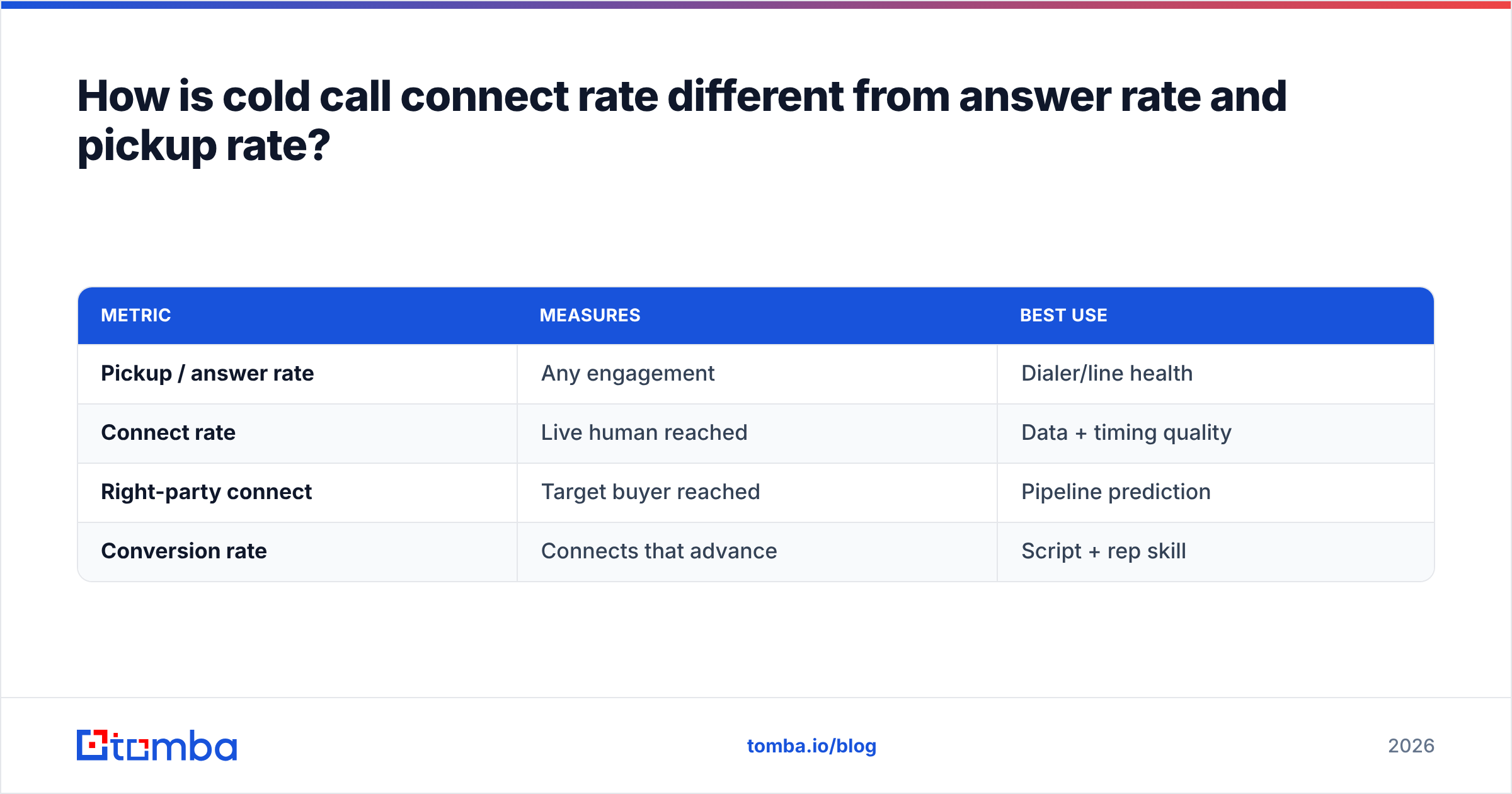
These terms get used interchangeably and it causes real confusion in reporting. Here's the clean distinction so your team measures the same thing.
- Pickup rate / answer rate — someone (anyone, including voicemail-adjacent auto-answers or a gatekeeper) engaged the line. Loosest definition.
- Connect rate — a live human spoke with you. Tighter.
- Right-party connect rate (RPC) — the specific target buyer spoke with you. Tightest and most predictive of pipeline.
- Conversion rate — of the connects, how many advanced to a next step (meeting booked, demo set).
A rep can post a flashy "20% pickup rate" that's mostly gatekeepers and voicemails, while their RPC — the number that actually creates pipeline — sits at 3%. Always report RPC to leadership. Pickup rate flatters; RPC tells the truth.
Comparing them side by side:
| Metric | Measures | Best use |
|---|---|---|
| Pickup / answer rate | Any engagement | Dialer/line health |
| Connect rate | Live human reached | Data + timing quality |
| Right-party connect | Target buyer reached | Pipeline prediction |
| Conversion rate | Connects that advance | Script + rep skill |
The bottom line: better data beats a better script#
Your cold call connect rate is mostly a reflection of the list you're dialing and the hour you're dialing it. Reps get blamed for a number that data and timing decide before they ever say hello. Fix the pond before you critique the cast: verify every number, source mobile-direct data, dial in local golden hours, and keep your caller ID clean. Do that and the same team, working the same hours, connects with two to four times as many buyers.
That starts with a list worth dialing. Tomba's phone finder surfaces direct-dial and mobile numbers by name and company, and pairs with the phone validator so every record you hand your reps is a live line, not a dead tone. Start on the free tier (25 searches/month), then scale on Starter at $49/mo when your connect rate proves the point. Stop paying for dials that never had a chance to connect.
Related guides#
// get started
Find, verify and enrich your first contacts today
Start on the free plan with 25 searches a month, then scale when your team is ready.
Free plan · No credit card required · GDPR & CCPA
// about the author