Cold Call Email Subject Lines: 40+ Examples That Get Opens
Your cold call email subject decides whether the message gets read or buried. Here are 40+ tested subject lines, open-rate benchmarks, and a repeatable formula to lift replies.
Your cold call email subject line is the whole ballgame. A prospect sees the sender name and the subject, and in about two seconds decides whether to open, ignore, or hit delete. Everything you wrote inside — the sharp value prop, the tight CTA, the social proof — is worthless if the subject fails. This guide gives you the formula, the benchmarks, and 40+ subject lines you can adapt today.
TL;DR#
- Short wins. Subject lines under 40 characters (roughly 4–7 words) consistently out-open long ones, especially on mobile where 46% of opens happen.
- Relevance beats cleverness. A specific reference to the prospect's company, role, or a recent trigger event outperforms generic curiosity gambits.
- Never bait-and-switch. "RE:" tricks and fake reply threads spike opens once, then torch reply rates and your sender reputation.
- Use a repeatable formula: Relevance + Specificity + Curiosity, minus anything that smells like a mass blast.
- Test everything. A/B two subjects per campaign, measure open rate, and kill the loser. Small lifts compound across thousands of sends.
What is a cold call email subject line?#
A cold call email subject line is the one-line preview a prospect reads before opening an unsolicited outreach email — the follow-up to a cold call, or the cold email itself when a call didn't connect. Think of it like the headline on a newspaper stand: nobody buys the paper because the article inside is good; they buy it because the headline made them stop. The subject line's only job is to earn the open. The body's job is to earn the reply.
That distinction matters because most reps over-engineer the body and phone in the subject. The subject is where the leverage is. If your open rate is 20% and you push it to 30%, you just gave every downstream metric — replies, meetings, pipeline — a 50% raise without changing a word of your pitch.
Cold outreach subjects differ from marketing newsletter subjects in one key way: the recipient has no prior relationship with you. There's no brand trust to lean on, so you can't rely on "You'll love our July update." You have to manufacture relevance from scratch, usually by referencing something true about them.

What makes a cold email subject line actually work?#
Three ingredients, in order of importance:
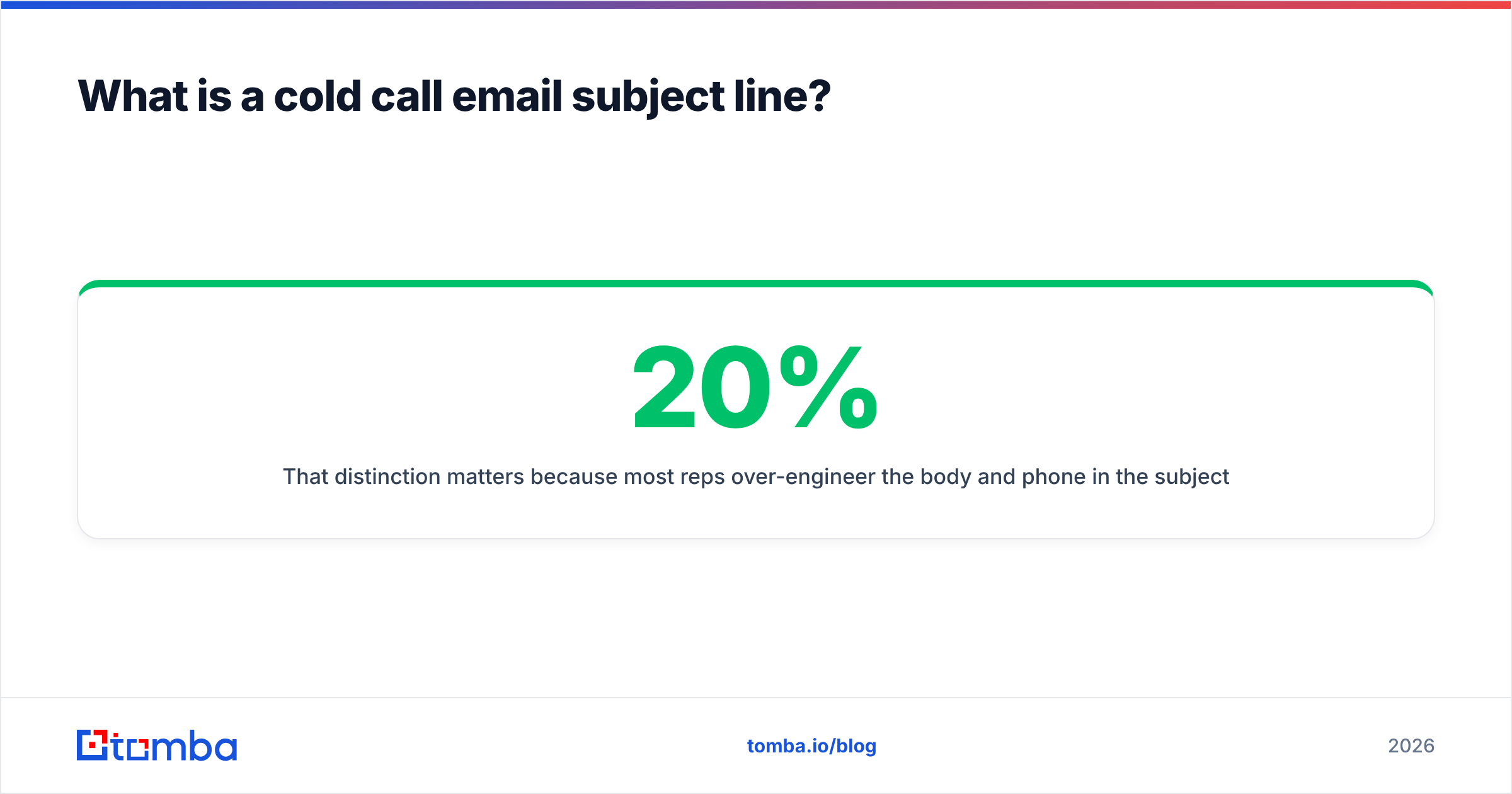
- Relevance — The prospect should feel the email was written for them, not blasted to 5,000 inboxes. Reference their company, role, industry, or a trigger event (funding round, new hire, product launch).
- Specificity — Vague promises ("grow your revenue") read as spam. Concrete details ("cut SDR ramp time to 3 weeks") read as credible.
- Curiosity — A small open loop the prospect wants to close. Not clickbait — a genuine question or partial statement that's only resolved by opening.
- Brevity — Under 40 characters so the full line shows on mobile. Long subjects truncate mid-thought and look like automation.
- Honesty — The subject must match the body. Deception gets one open and permanent distrust.
- Zero spam triggers — No ALL CAPS, no "FREE!!!", no excessive punctuation, no "guaranteed." These tank deliverability before a human ever sees them.
Get relevance and specificity right and you're already ahead of 90% of the cold email hitting your prospect's inbox. Run your draft through a spam checker before you send to catch the filter triggers you'd otherwise miss.
What are the best cold call email subject line examples?#
Here are 40+ subject lines grouped by angle. Swap the bracketed variables for real data — never send them raw.
Post-call follow-up (you called, they didn't answer):
- Tried calling, [First Name]
- Missed you — quick question re: [Company]
- Following up on my call
- [First Name], you free for 10 min this week?
- Sorry I missed you today
Personalized / trigger-based:
- Congrats on the [funding round]
- Saw [Company] is hiring 5 SDRs
- Noticed you're expanding into [market]
- [Competitor] switched last quarter — worth a look?
- Question about [Company]'s [specific initiative]
Curiosity / open loop:
- A weird idea for [Company]
- Probably not for you, but…
- Bad timing?
- Should I stop reaching out?
- Two options for [First Name]
Direct / value-first:
- Cut [pain point] by [X]%
- 3 ways to [achieve outcome]
- [Outcome] without [common obstacle]
- Idea for [team] at [Company]
- 15 minutes = [specific benefit]
Referral / social proof:
- [Mutual connection] suggested I reach out
- [Similar company] uses this — thought of you
- How [peer company] fixed [problem]
- [First Name] + [your company]?
Question-based (drives replies):
- Who owns [function] at [Company]?
- Worth a conversation?
- Are you the right person for this?
- Open to a quick idea?
Ultra-short (mobile-optimized):
- [First Name]?
- quick q
- [Company] + [outcome]
- idea
- re: [initiative]
The "quick q" and lowercase styles work because they mimic how a busy colleague actually emails — no marketing polish. Just don't overuse them across a whole sequence, or they lose their edge. For more ready-to-send frameworks, browse Tomba's cold email templates and pair a subject with a matching body.
Which subject line styles get the highest open rates?#
Not all angles perform equally. Here's how the common styles stack up on the metrics that matter for cold outreach.
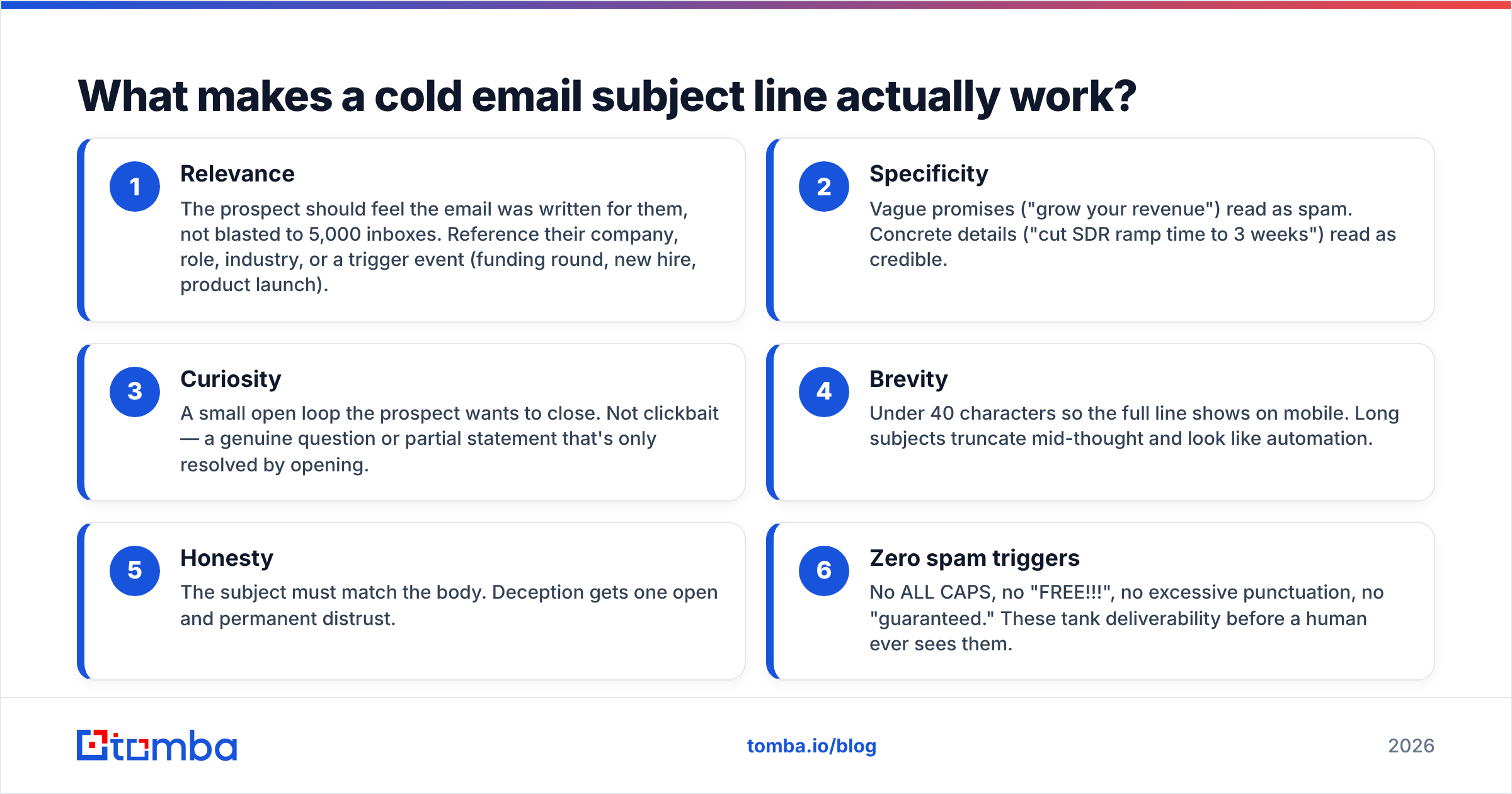
| Subject line style | Typical open rate | Reply quality | Spam risk | Best for |
|---|---|---|---|---|
| Personalized / trigger-based | 45–60% | High | Low | Named accounts, ABM |
| Post-call follow-up | 40–55% | High | Low | Warm-ish, post-dial |
| Question-based | 35–50% | Medium-High | Low | Driving direct replies |
| Ultra-short (1–3 words) | 40–55% | Medium | Low | Founders, execs, mobile readers |
| Curiosity / open loop | 30–45% | Medium | Medium | Top-of-funnel volume |
| Direct value-first | 25–40% | Medium | Low | Clear, urgent pain points |
| Clickbait / fake "RE:" | 55–70% (first send) | Very Low | High | Never — reputation killer |
Two things jump out. First, personalization and post-call follow-ups win on both open rate and reply quality — the combination that actually books meetings. Second, fake "RE:" threads look tempting because the raw open rate is highest, but the reply quality collapses and the spam risk is severe. Prospects feel tricked, mark you as spam, and your sender reputation erodes for every future send. A one-time open bump is never worth a burned domain.
Benchmarks vary by industry and list quality, so treat these as directional. According to HubSpot's sales research, personalization and relevance are the most consistent levers across verticals — which lines up with what the table shows.
How long should a cold email subject line be?#
Keep it under 40 characters, or about 4–7 words. Here's the mechanical reason: roughly 46% of email opens happen on mobile, and mobile clients truncate subject lines around 30–40 characters. A subject like "A few ideas on how your team at Acme could reduce SDR onboarding time this quarter" gets chopped to "A few ideas on how your team at…" — the interesting part never shows.
Shorter subjects also feel more human. Long, comma-laden subject lines read as marketing automation; a two- or three-word line reads like a note from a colleague. That perception gap is worth real open-rate points.
A practical rule: write your subject, then delete every word that isn't doing work. "Quick question about your hiring plans at Acme" becomes "Question re: Acme hiring." Same meaning, half the length, twice the punch. When you want a second opinion fast, run drafts through a subject line tester to score length, spam signals, and clarity before you commit.
What mistakes kill your cold email subject lines?#
The fastest ways to guarantee a delete:
- ALL CAPS or excessive punctuation. "URGENT!!! OPEN NOW!!!" is a spam-filter magnet and an instant trust killer.
- Spammy trigger words. "Free," "guarantee," "act now," "risk-free," "$$$." Filters are trained on these; many emails never reach the inbox.
- Fake reply/forward tricks. "RE:" or "FWD:" on a first-ever email is deception. It works once, then destroys reply rates.
- Being vague. "Touching base" and "Checking in" say nothing and get ignored. Give the prospect a reason to care.
- Writing about yourself. "Introducing [Your Company]" centers you, not them. Prospects open emails about their own problems.
- Over-personalizing awkwardly. "Hey [First Name], loved your tweet about [thing]" reads as stalkerish when it's obviously templated. Personalize the relevance, not just the greeting.
- Sending to bad data. The best subject line in the world can't open in a bounced inbox. If 15% of your list is invalid, you're wasting sends and hurting deliverability.
That last point is where a lot of otherwise-good campaigns quietly fail. You can obsess over word choice, but if the address is wrong, the domain is a catch-all, or the contact left the company, your open rate craters through no fault of the copy. Clean data is the foundation the subject line sits on.
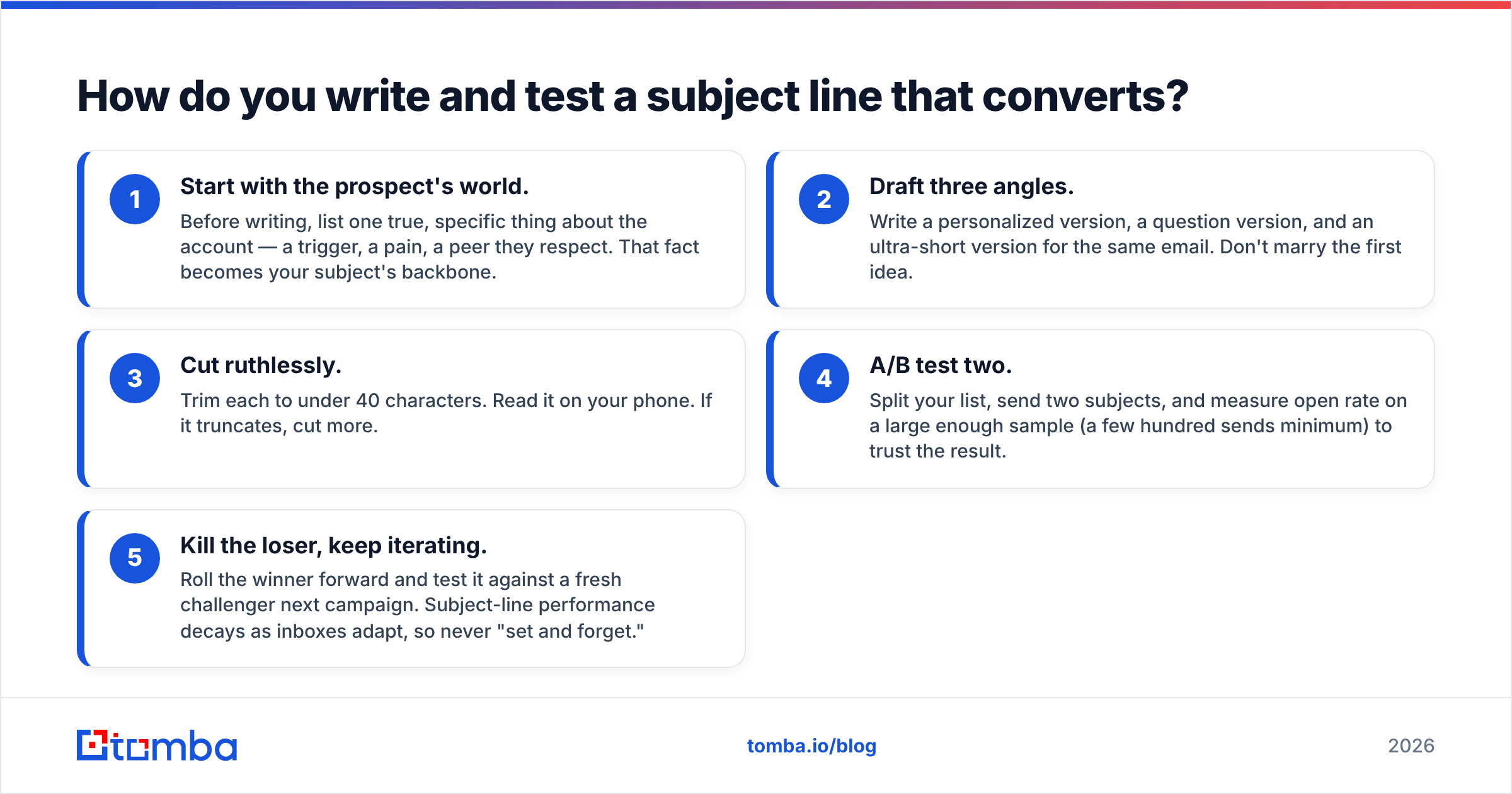
How do you write and test a subject line that converts?#
Use this five-step loop for every campaign:
- Start with the prospect's world. Before writing, list one true, specific thing about the account — a trigger, a pain, a peer they respect. That fact becomes your subject's backbone.
- Draft three angles. Write a personalized version, a question version, and an ultra-short version for the same email. Don't marry the first idea.
- Cut ruthlessly. Trim each to under 40 characters. Read it on your phone. If it truncates, cut more.
- A/B test two. Split your list, send two subjects, and measure open rate on a large enough sample (a few hundred sends minimum) to trust the result.
- Kill the loser, keep iterating. Roll the winner forward and test it against a fresh challenger next campaign. Subject-line performance decays as inboxes adapt, so never "set and forget."
If writing three fresh angles per campaign feels slow, a subject line generator can produce first drafts you then sharpen with real prospect detail. The tool gives you the raw clay; you add the specificity that makes it convert.
One more multiplier: warm your sending domain and keep your list clean so those hard-won opens actually land in the primary inbox rather than Promotions or spam. Great copy and healthy email deliverability are two halves of the same result.
Do subject lines matter more than the person you're emailing?#
No — and this is the point most guides miss. The best subject line sent to the wrong person still fails. Reach the right person with a decent subject and you'll beat a genius subject sent to a stale list every time.
Cold outreach is a chain: correct contact → deliverable address → compelling subject → relevant body → clear CTA. The subject is one critical link, but it can't compensate for a broken link upstream. If you're emailing a generic info@ address, a contact who changed jobs, or an address that bounces, no amount of copywriting saves you.
That's why serious outbound teams start with accurate contact data, then layer copy on top. Verify that the address is real and reachable before you invest effort in the perfect subject. It's the difference between optimizing a funnel and pouring water into a leaky bucket. When you tighten both — data quality and subject-line craft — the compounding effect on reply rate is dramatic.
Get the right inbox before you write the perfect subject#
A brilliant cold call email subject only pays off when it lands in a real, active inbox belonging to the person who can actually say yes. Before you A/B test another subject line, make sure your list is built on verified, accurate contacts.
Use the Tomba Email Finder to source professional email addresses by name, company, or domain — with verification baked in so your carefully crafted subjects reach humans instead of bouncing. Start free with 25 searches a month, and scale up on the Starter plan at $49/mo when your outbound engine is humming. Get the contact right, then let your subject line do what it does best: earn the open.
Frequently asked questions#
What is the ideal length for a cold email subject line? Under 40 characters, or roughly 4–7 words. This keeps the full line visible on mobile, where nearly half of opens happen, and makes the message read as personal rather than automated.
Should I use the prospect's first name in the subject? Sometimes, but relevance beats name-dropping. A specific reference to their company or a trigger event ("Saw Acme is hiring 5 SDRs") outperforms a generic "Hey [First Name]" that any mail merge could produce.
Are fake "RE:" subject lines effective? They spike opens once, then destroy reply rates and sender reputation because prospects feel deceived. Avoid them entirely — the short-term open bump isn't worth the long-term damage to deliverability.
How many subject lines should I test? A/B test two per campaign on at least a few hundred sends, keep the winner, and challenge it with a fresh option next time. Performance decays as inboxes adapt, so testing should be continuous.
Why are my open rates low even with good subject lines? Usually the problem is upstream: invalid addresses, poor deliverability, or the wrong contact. Verify your list and warm your domain first — clean data is the foundation every subject line depends on.
Related guides#
// get started
Find, verify and enrich your first contacts today
Start on the free plan with 25 searches a month, then scale when your team is ready.
Free plan · No credit card required · GDPR & CCPA
// about the author