Cold Calling in France in 2026: Rules, Timing, and Tactics
Cold calling in France is legal for B2B, but Bloctel, RGPD, and cultural norms change the playbook. Here's how to stay compliant and still book meetings in 2026.
Cold Calling in France in 2026: Rules, Timing, and Tactics
Cold calling in France is not the same game it is in the United States. The phone still works — French buyers pick up, and a well-placed call can open a door faster than any email — but the legal rails, the etiquette, and the timing are all different. Get one wrong and you either burn the prospect or invite a fine.
This guide walks through what is legal, what is expected, and what actually books meetings in 2026.
TL;DR#
- B2B cold calling is legal in France, but consumer (B2C) calling is tightly restricted by the Bloctel opt-out list and new 2026 consent rules.
- Bloctel matters even for business when you dial mobile numbers or sole traders — always screen your list first.
- RGPD (GDPR) applies to the data, not just the call: you need a lawful basis, a source you can cite, and an easy opt-out.
- Timing and tone are cultural: mid-morning calls, formal address (vous), and a clear reason for calling beat American-style pitching.
- Clean, well-sourced contact data is the real unlock — a right-party phone number with a verified role beats a bigger, dirtier list every time.
Is cold calling legal in France in 2026?#
Yes for B2B, with conditions — and much more restricted for consumers. The distinction between calling a business and calling an individual is the single most important thing to understand.
For business-to-business outreach, you may call a professional at their workplace to discuss a product or service relevant to their role. This is treated as legitimate commercial activity. You still have obligations under the RGPD (the French implementation of GDPR) around how you obtained and store the number, but the call itself is permitted.
For business-to-consumer calls, France runs one of the strictest regimes in Europe. The Bloctel opt-out registry blocks unsolicited sales calls to registered consumers, and legislation tightening in 2026 moves the country toward an opt-in model for many consumer scenarios — meaning you need prior consent rather than relying on the prospect not having opted out. Calling registered consumers without a valid exemption exposes you to penalties from the DGCCRF, France's consumer-protection authority.
The practical takeaway: if your list contains mobile numbers, freelancers, auto-entrepreneurs, or personal lines, treat them as consumer contacts and screen against Bloctel before dialing.
What is Bloctel and how does it affect B2B?#
Bloctel is France's national do-not-call list, and it can catch business calls when the line belongs to an individual. Consumers register their numbers, and companies running telephone canvassing must scrub their calling lists against the registry — typically before each campaign.
Where teams get caught out is the grey zone:
- Sole traders and freelancers often use a personal mobile as their business line. If that number is on Bloctel, calling it as "B2B" is risky.
- Mobile-heavy lists blur the B2C/B2B boundary because there is no reliable way to know from the number alone whether it is a work desk phone or a personal handset.
- Purchased lists frequently mix consumer and business records without labeling them, so a single un-screened campaign can include hundreds of protected numbers.
The safest workflow is to (a) confirm you are calling a genuine corporate role, (b) screen ambiguous or mobile numbers against Bloctel, and (c) keep evidence of where each number came from. That last point is where data hygiene and compliance overlap — a phone number you can trace to a verified professional profile is defensible in a way a scraped, un-sourced number is not.
Does RGPD (GDPR) apply to cold calling?#
Yes — RGPD governs the personal data behind the call, and enforcement is real. A phone number tied to a named person is personal data. To process it for outreach you need a lawful basis, and for most B2B calling that basis is legitimate interest.
Legitimate interest is not a free pass. To rely on it you should be able to show:
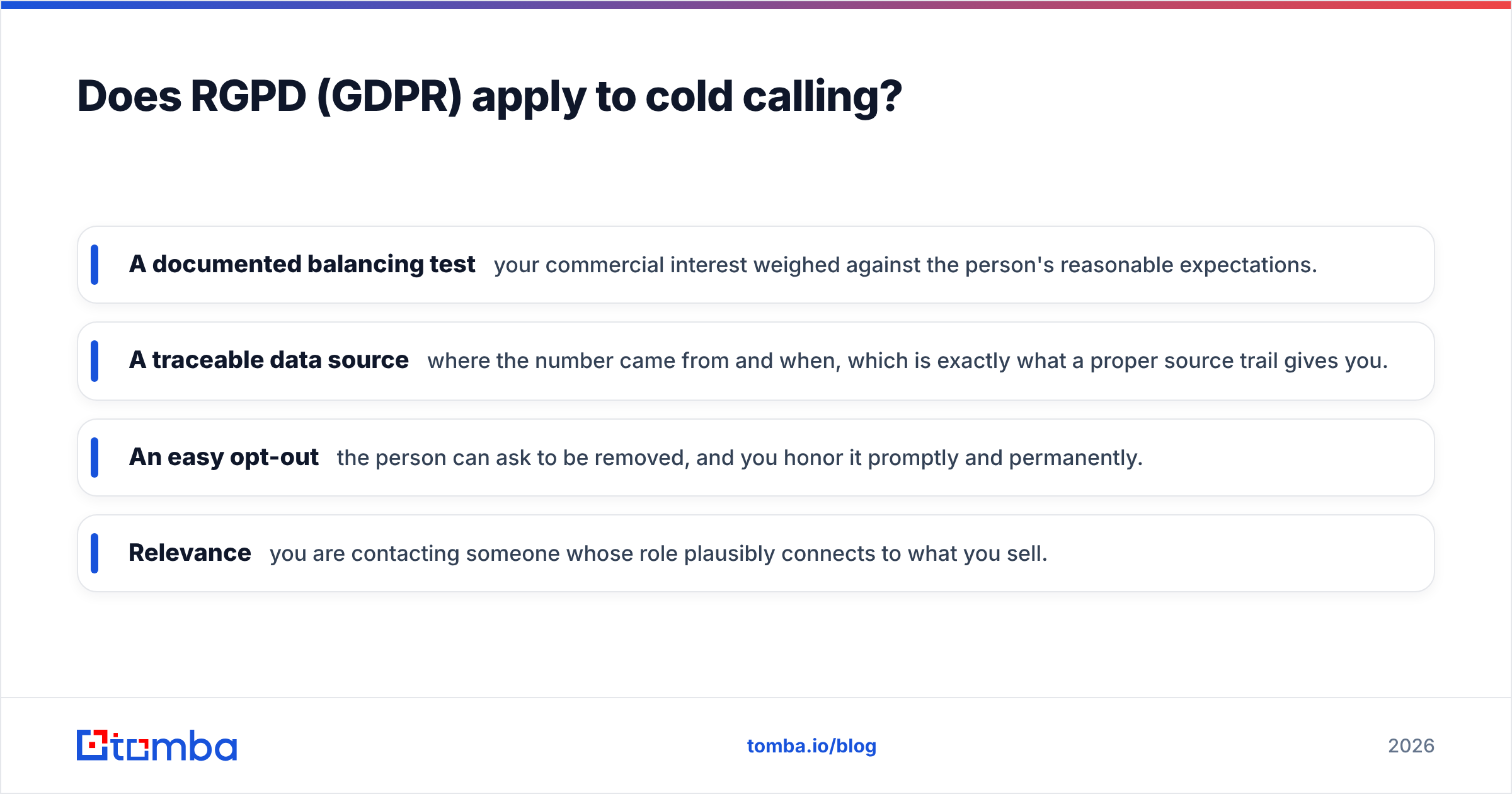
- A documented balancing test — your commercial interest weighed against the person's reasonable expectations.
- A traceable data source — where the number came from and when, which is exactly what a proper source trail gives you.
- An easy opt-out — the person can ask to be removed, and you honor it promptly and permanently.
- Relevance — you are contacting someone whose role plausibly connects to what you sell.
France's data authority, the CNIL, publishes guidance on commercial prospecting and has been active in enforcement. Fines under GDPR can reach the higher of €20 million or 4% of global annual turnover, so this is not a box-ticking exercise.
This is one reason serious outbound teams lean on tools that document provenance. When you build lists from a source that records where each record came from — like Tomba's data sources and B2B database — you are not just getting contacts, you are getting the audit trail that a legitimate-interest defense depends on.
How is cold calling in France different from the US or UK?#
The culture rewards formality, preparation, and a clear reason for calling — and punishes the hard-sell open. French professionals are generally more reserved on a cold call than their American counterparts and expect a level of respect in tone and language.
A few concrete differences:
- Use vous, not tu. Formal address is the default with a stranger. Slipping into casual French reads as presumptuous.
- Lead with a reason, not a pitch. "I'm calling because I saw your team is hiring three SDRs" lands better than "I wanted to tell you about our platform."
- Expect a gatekeeper. Reaching a decision-maker often means getting past an assistant or a standard (switchboard). Being polite and specific gets you transferred; being evasive gets you blocked.
- Respect the calendar. France largely shuts down for August and around major public holidays. Campaigns run in those windows waste dials.
- Slower to the close. Trust-building is expected. Pushing for a same-call commitment can stall an otherwise warm conversation.
None of this means the phone is dead in France — quite the opposite. It means the bar for a good call is higher, and preparation is your edge.
What are the best times to cold call in France?#
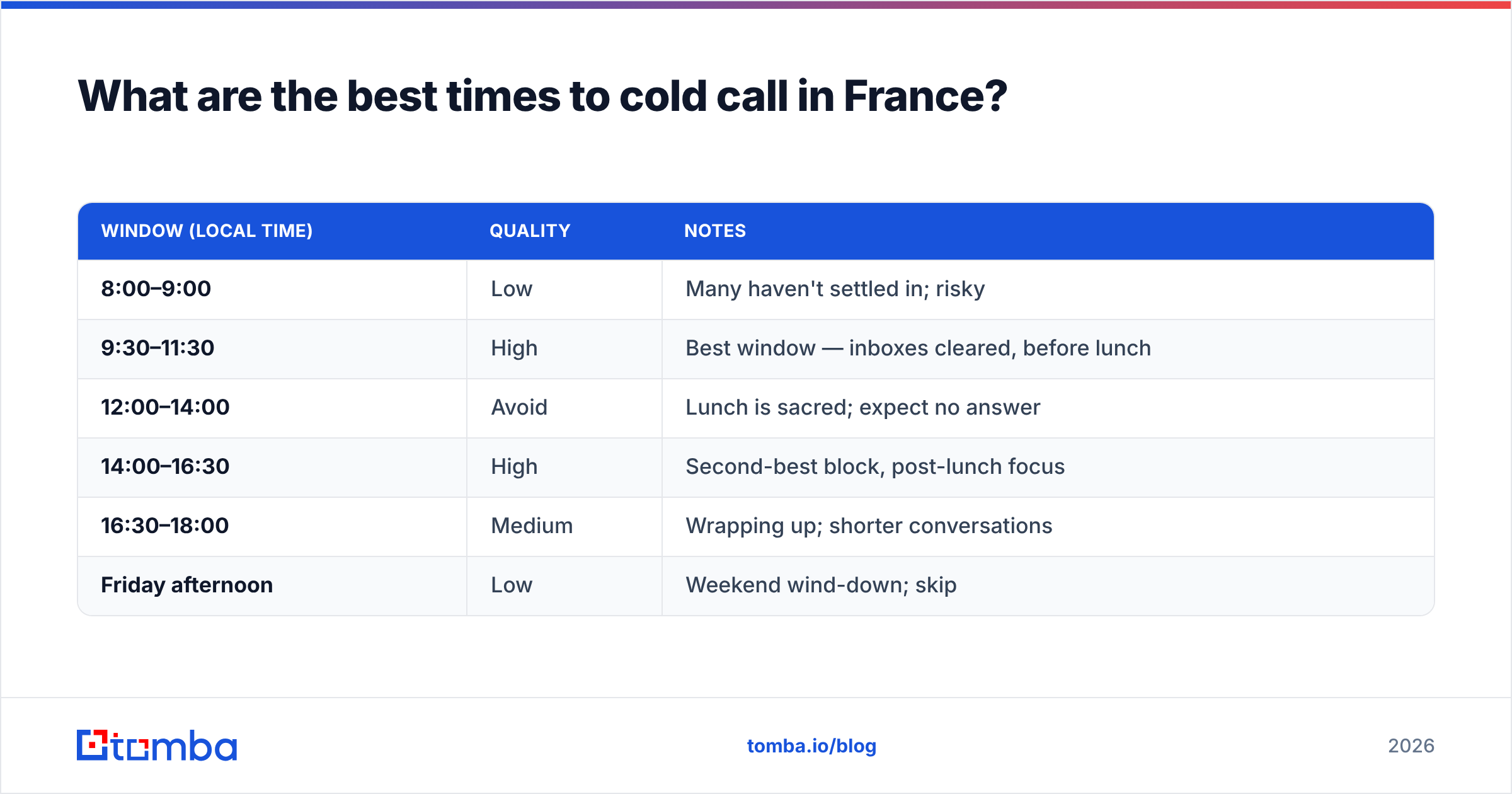
Mid-morning and early afternoon on Tuesday through Thursday are the sweet spots. French office rhythms differ from the Anglo default, and lunch is genuinely protected time.
| Window (local time) | Quality | Notes |
|---|---|---|
| 8:00–9:00 | Low | Many haven't settled in; risky |
| 9:30–11:30 | High | Best window — inboxes cleared, before lunch |
| 12:00–14:00 | Avoid | Lunch is sacred; expect no answer |
| 14:00–16:30 | High | Second-best block, post-lunch focus |
| 16:30–18:00 | Medium | Wrapping up; shorter conversations |
| Friday afternoon | Low | Weekend wind-down; skip |
Avoid Monday mornings (week planning) and Friday afternoons. And build your dialing calendar around French public holidays and the August slowdown — a list that ignores them just inflates your no-answer rate.
How do you build a compliant call list for France?#
Start from verified, well-sourced B2B contacts and layer compliance screening on top. The order matters: get accurate right-party data first, then filter for legal fitness, then dial.
Here is a workflow that keeps you both effective and defensible:
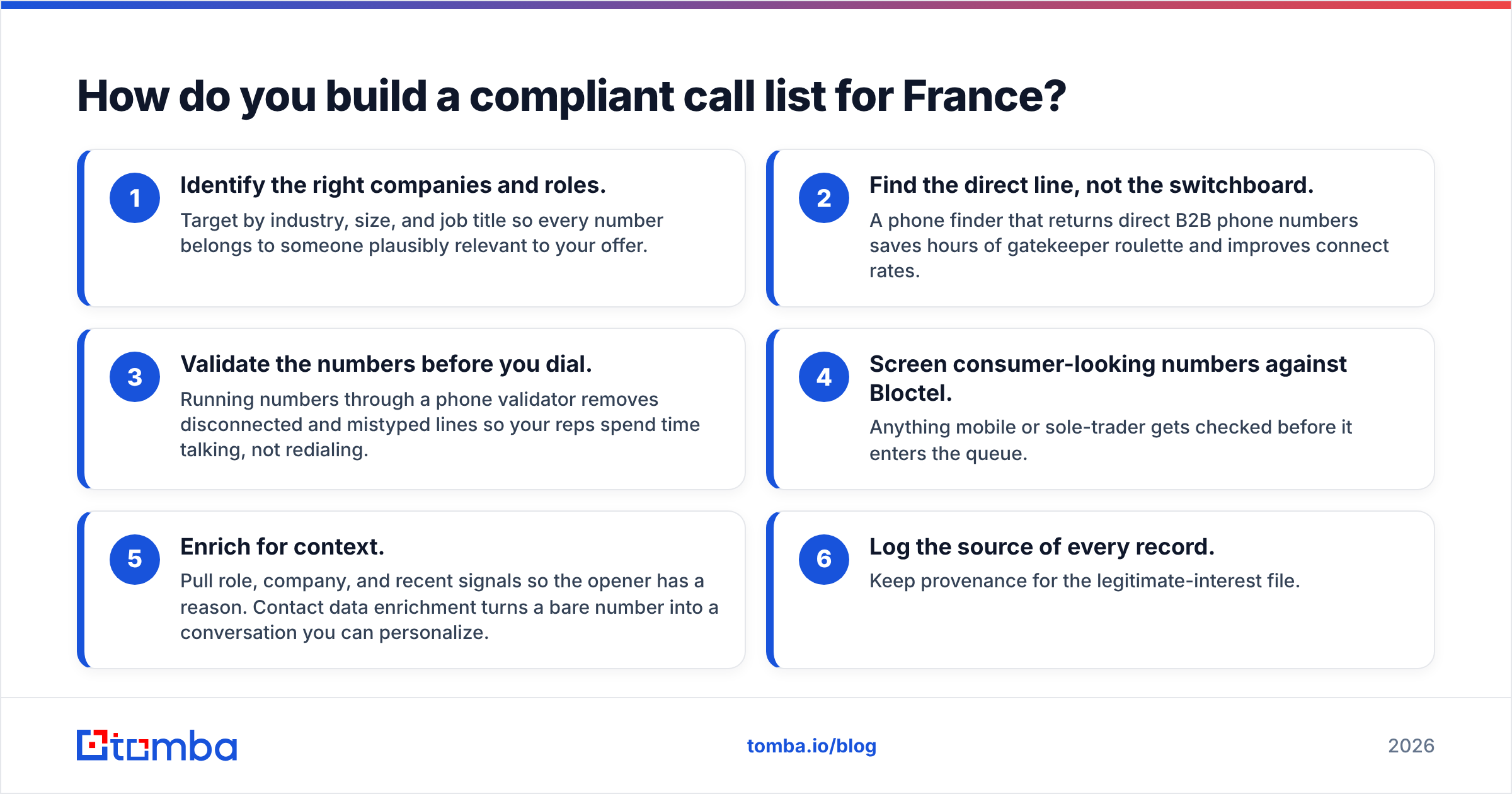
- Identify the right companies and roles. Target by industry, size, and job title so every number belongs to someone plausibly relevant to your offer.
- Find the direct line, not the switchboard. A phone finder that returns direct B2B phone numbers saves hours of gatekeeper roulette and improves connect rates.
- Validate the numbers before you dial. Running numbers through a phone validator removes disconnected and mistyped lines so your reps spend time talking, not redialing.
- Screen consumer-looking numbers against Bloctel. Anything mobile or sole-trader gets checked before it enters the queue.
- Enrich for context. Pull role, company, and recent signals so the opener has a reason. Contact data enrichment turns a bare number into a conversation you can personalize.
- Log the source of every record. Keep provenance for the legitimate-interest file.
Notice that steps 1–3 are pure data quality and steps 4–6 are compliance and context. Teams that skip the quality layer end up "compliant" but calling dead numbers; teams that skip compliance move fast and inherit legal risk. You want both.
Cold calling vs. other channels in France: what mixes best?#
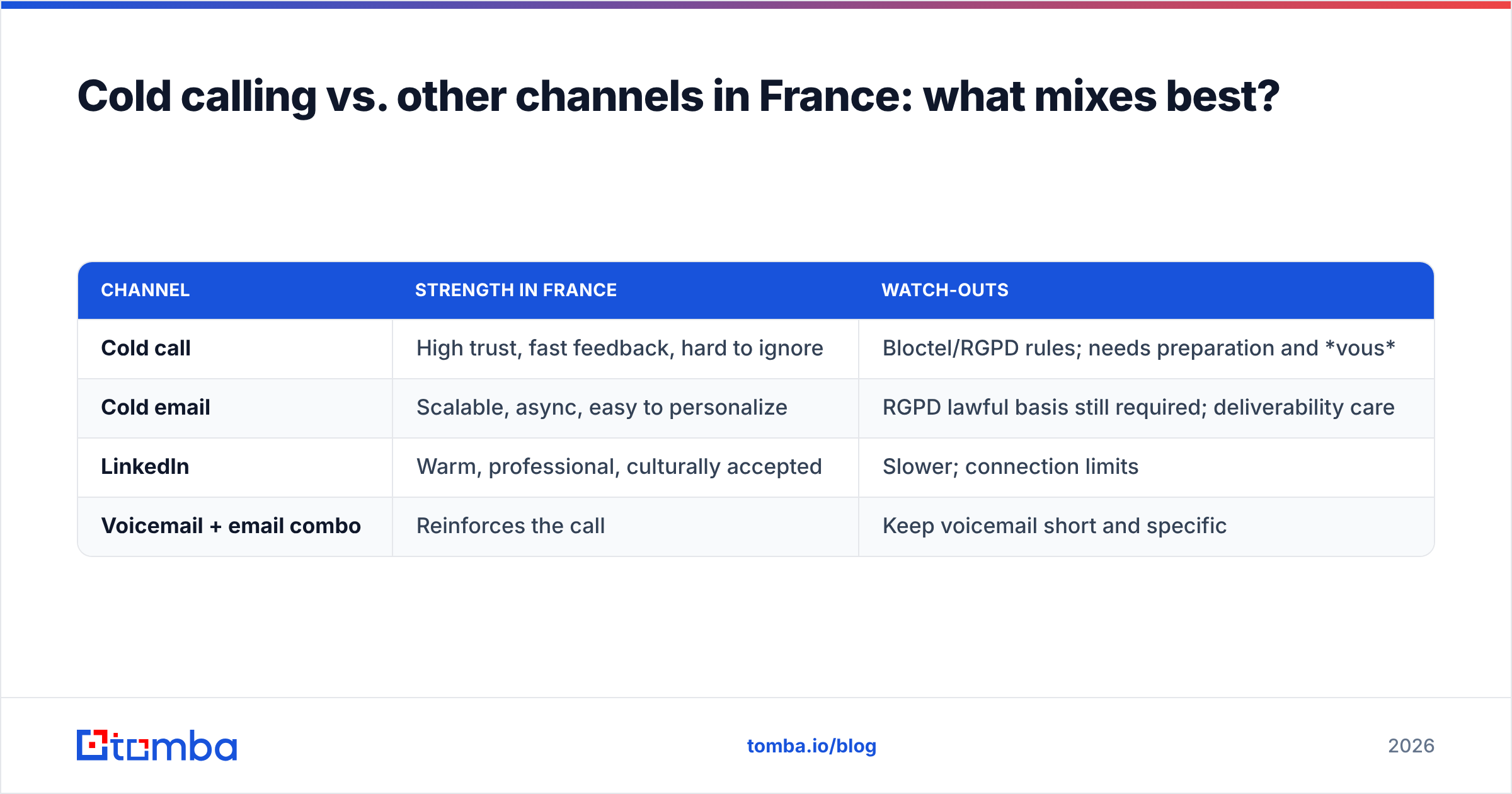
Phone still opens doors, but it works far better paired with email and LinkedIn than run alone. French buyers respond to being contacted like humans across a couple of channels, not blasted on one.
| Channel | Strength in France | Watch-outs |
|---|---|---|
| Cold call | High trust, fast feedback, hard to ignore | Bloctel/RGPD rules; needs preparation and vous |
| Cold email | Scalable, async, easy to personalize | RGPD lawful basis still required; deliverability care |
| Warm, professional, culturally accepted | Slower; connection limits | |
| Voicemail + email combo | Reinforces the call | Keep voicemail short and specific |
A common high-performing sequence: a personalized email that references something specific, a call two days later that opens with "I sent you a note about X," and a LinkedIn touch to stay visible. The call is stronger because it is no longer truly cold. Building that sequence starts with accurate contacts — the same email finder and phone data feed all three channels, so you are not maintaining three separate, drifting lists.
If you are also running the email leg, verifying addresses with an email verifier protects your sender reputation and keeps the whole sequence landing.
What does a good French cold-call opener sound like?#
Short, formal, specific, and permission-based. You are earning the next thirty seconds, not delivering a pitch.
A workable structure:
- Greeting + name: "Bonjour, Madame Laurent, c'est Marc de [company]."
- Reason for calling: tie it to something real about their business.
- Permission: "Vous avez un instant ?" — asking respects their time and lowers the shield.
- One-sentence value hook: what changes for them, not what your product does.
- A single, easy next step: a short discovery call, not a signature.
Keep it under twenty seconds before you pause and let them respond. French buyers dislike being talked at, and the pause signals you see this as a conversation.
Common mistakes to avoid#
- Dialing an un-screened purchased list. This is how you hit Bloctel numbers and dead lines at the same time.
- Using casual language or English by default. Open in French and formally; switch only if invited.
- Calling over lunch or in August. Respect the rhythm or waste the dials.
- No documented data source. If you can't say where a number came from, your RGPD basis is shaky.
- Pitching before earning attention. Lead with relevance, ask permission, then talk.
- Ignoring the opt-out. One honored removal request costs nothing; one ignored request is a complaint waiting to happen.
The bottom line#
Cold calling in France in 2026 rewards discipline. The law draws a bright line between businesses and consumers, Bloctel and RGPD raise the cost of sloppy lists, and the culture expects preparation and respect. None of that makes the phone less effective — it makes good callers with clean data far more effective than everyone else.
Start where the leverage is: accurate, well-sourced, right-party contact data with a provenance trail you can stand behind. Tomba's phone finder and B2B database give you direct numbers tied to verified professional profiles, and enrichment fills in the context that turns a dial into a conversation. Check the Tomba pricing plans — from the free tier up through Growth at $99/mo — build a list you can defend, and let your reps spend their time talking to the right people instead of screening the wrong ones.
Related guides#
Ready to find emails that actually work?
Join 150,000+ professionals who stopped guessing and started sending. Free credits on signup — no credit card required.
Get the Tomba newsletter
Practical outbound tactics and product updates — once every two weeks.
About the author