Cold Calling in the UK: Laws, Scripts, and What Works in 2026
Cold calling in the UK is legal but tightly regulated. Here is what the TPS, PECR, and GDPR actually require in 2026 — plus scripts, data tips, and a compliance checklist.
Cold calling in the UK is not dead, and it is not banned — but it is fenced in by rules that trip up most sales teams. If you dial the wrong number, skip a register check, or lean on a shaky data source, you are not just annoying a prospect. You are exposed to fines from the Information Commissioner's Office and a reputation hit that outlasts any single deal.
This guide covers what is actually legal in 2026, how the TPS, PECR, and UK GDPR interact, and the tactics that still make outbound phone work — without putting your business at risk.
TL;DR#
- Cold calling in the UK is legal, but you must screen numbers against the Telephone Preference Service (TPS/CTPS) and respect PECR and UK GDPR.
- B2B calling has more latitude than B2C — but corporate subscribers on the CTPS, sole traders, and partnerships still have protections.
- The ICO can fine up to £500,000 under PECR for unsolicited call breaches, and separately under UK GDPR for data misuse.
- Data quality is the real lever. Verified, correctly-sourced numbers beat spray-and-pray dialing every time.
- A tight script plus a clean list still books meetings — the channel works when the compliance and data foundations are solid.
Is cold calling legal in the UK in 2026?#
Yes — cold calling is legal in the UK, provided you follow three overlapping rulebooks. Nothing has outlawed picking up the phone to a business you have never spoken to. What the law regulates is who you call, how you got their number, and whether they have opted out.
The three frameworks you need to know:
- PECR (Privacy and Electronic Communications Regulations) — governs unsolicited marketing calls, including the requirement to screen against preference registers and to identify yourself.
- UK GDPR — governs the personal data behind the call: your lawful basis for holding a mobile number or a named contact, and the individual's right to object.
- TPS / CTPS — the opt-out registers. The Telephone Preference Service covers individuals; the Corporate TPS covers organisations.
You can read PECR straight from the source on the ICO's guidance pages, which is the single most useful bookmark for any UK outbound team.
What is the difference between B2B and B2C cold calling rules?#
The short version: B2B gives you more room, but not a free pass.
For live marketing calls to individuals (B2C), you must not call anyone registered with the TPS, or anyone who has told you directly they do not want your calls. Full stop.
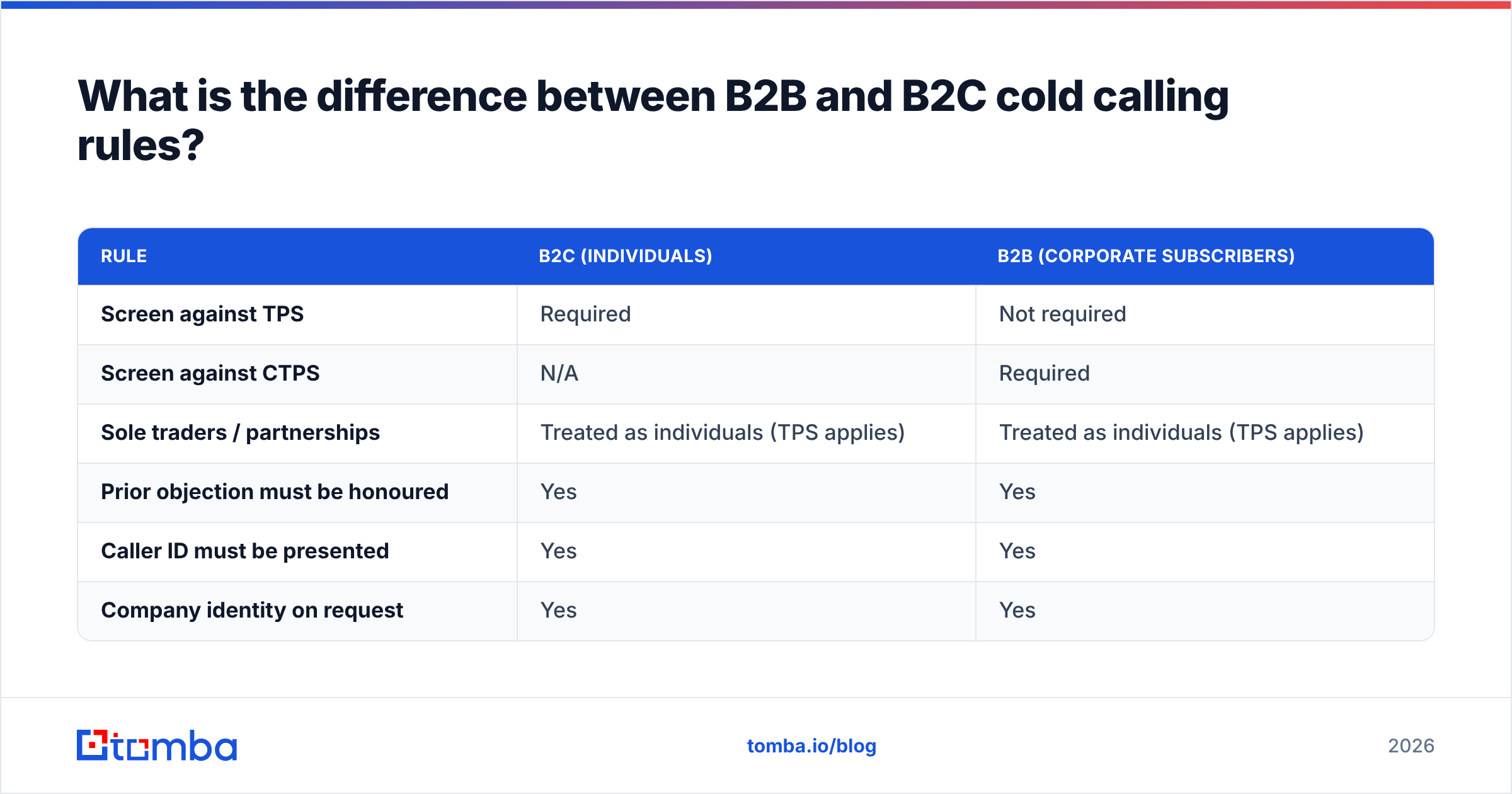
For B2B calls, you may call corporate subscribers unless they are registered with the Corporate TPS (CTPS) or have objected to you directly. The catch: sole traders and most partnerships are treated as individuals under PECR, so they get TPS-level protection even though they feel like businesses to your reps.
| Rule | B2C (individuals) | B2B (corporate subscribers) |
|---|---|---|
| Screen against TPS | Required | Not required |
| Screen against CTPS | N/A | Required |
| Sole traders / partnerships | Treated as individuals (TPS applies) | Treated as individuals (TPS applies) |
| Prior objection must be honoured | Yes | Yes |
| Caller ID must be presented | Yes | Yes |
| Company identity on request | Yes | Yes |
Because sole traders and partnerships blur the line, the safe operating rule is to screen your list against both registers before a campaign, not just the one you think applies.
What are the penalties for getting it wrong?#
The ICO can issue monetary penalties of up to £500,000 under PECR for unlawful marketing calls — and that is before any separate UK GDPR enforcement over how you stored or sourced the underlying data.
Enforcement is not theoretical. The ICO publishes a running list of companies fined for nuisance calls, and the pattern is consistent: firms that ignored TPS screening, hid their caller ID, or bought unverified lists from a broker with no consent trail. The government's own overview of nuisance-call rules on GOV.UK mirrors the same expectations.
The reputational cost compounds the financial one. Registered-number complaints feed spam-flagging databases, and once your outbound numbers get labelled "Scam Likely" by carriers, your connect rate collapses regardless of how good your pitch is.
How do you build a compliant UK calling list?#
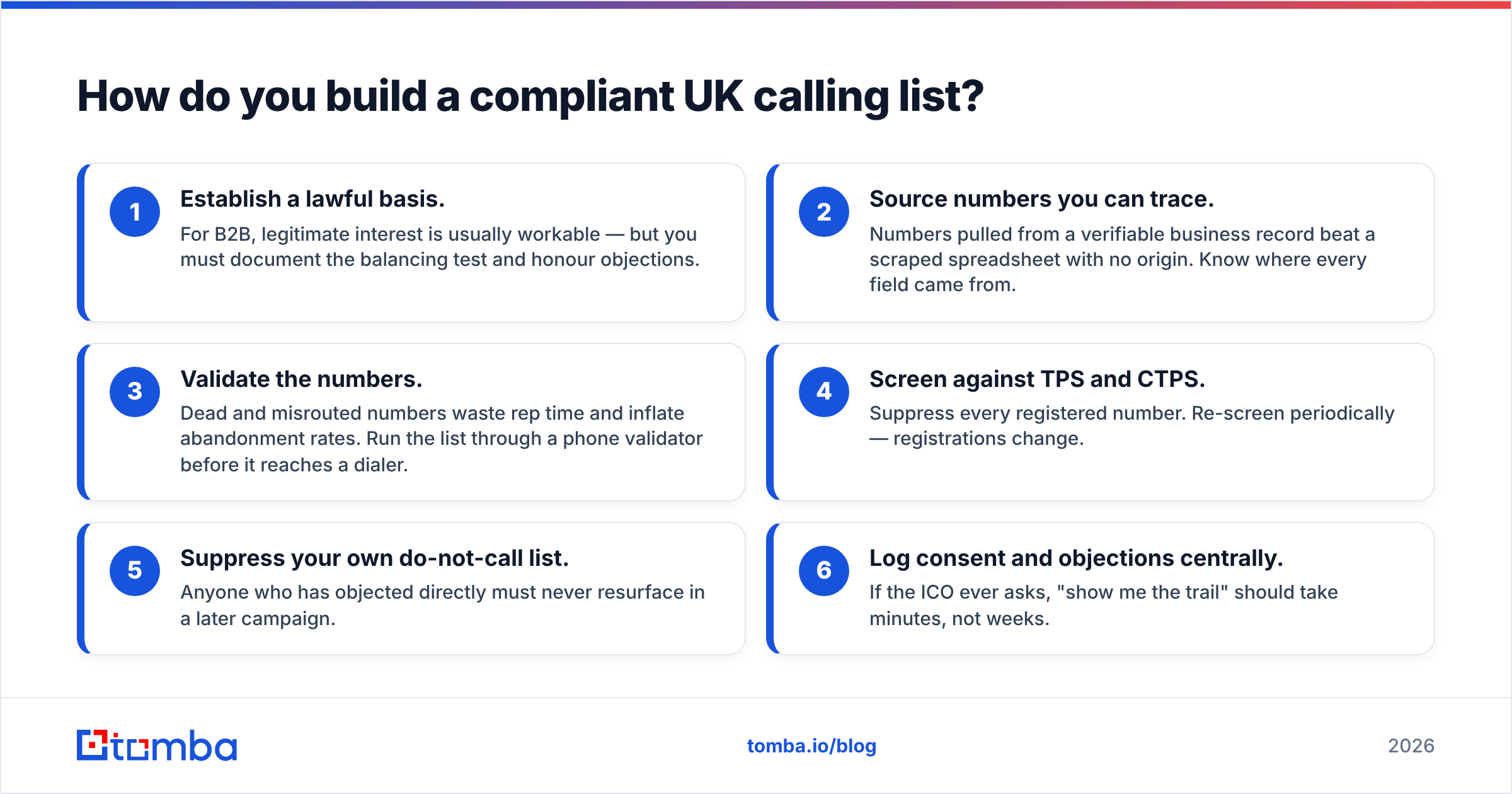
Compliance starts with data provenance, not the dial. Work through these six steps in order:
- Establish a lawful basis. For B2B, legitimate interest is usually workable — but you must document the balancing test and honour objections.
- Source numbers you can trace. Numbers pulled from a verifiable business record beat a scraped spreadsheet with no origin. Know where every field came from.
- Validate the numbers. Dead and misrouted numbers waste rep time and inflate abandonment rates. Run the list through a phone validator before it reaches a dialer.
- Screen against TPS and CTPS. Suppress every registered number. Re-screen periodically — registrations change.
- Suppress your own do-not-call list. Anyone who has objected directly must never resurface in a later campaign.
- Log consent and objections centrally. If the ICO ever asks, "show me the trail" should take minutes, not weeks.
The difference between a modern outbound motion and a 2015 boiler-room isn't effort — it's data discipline.

Where does good calling data actually come from?#
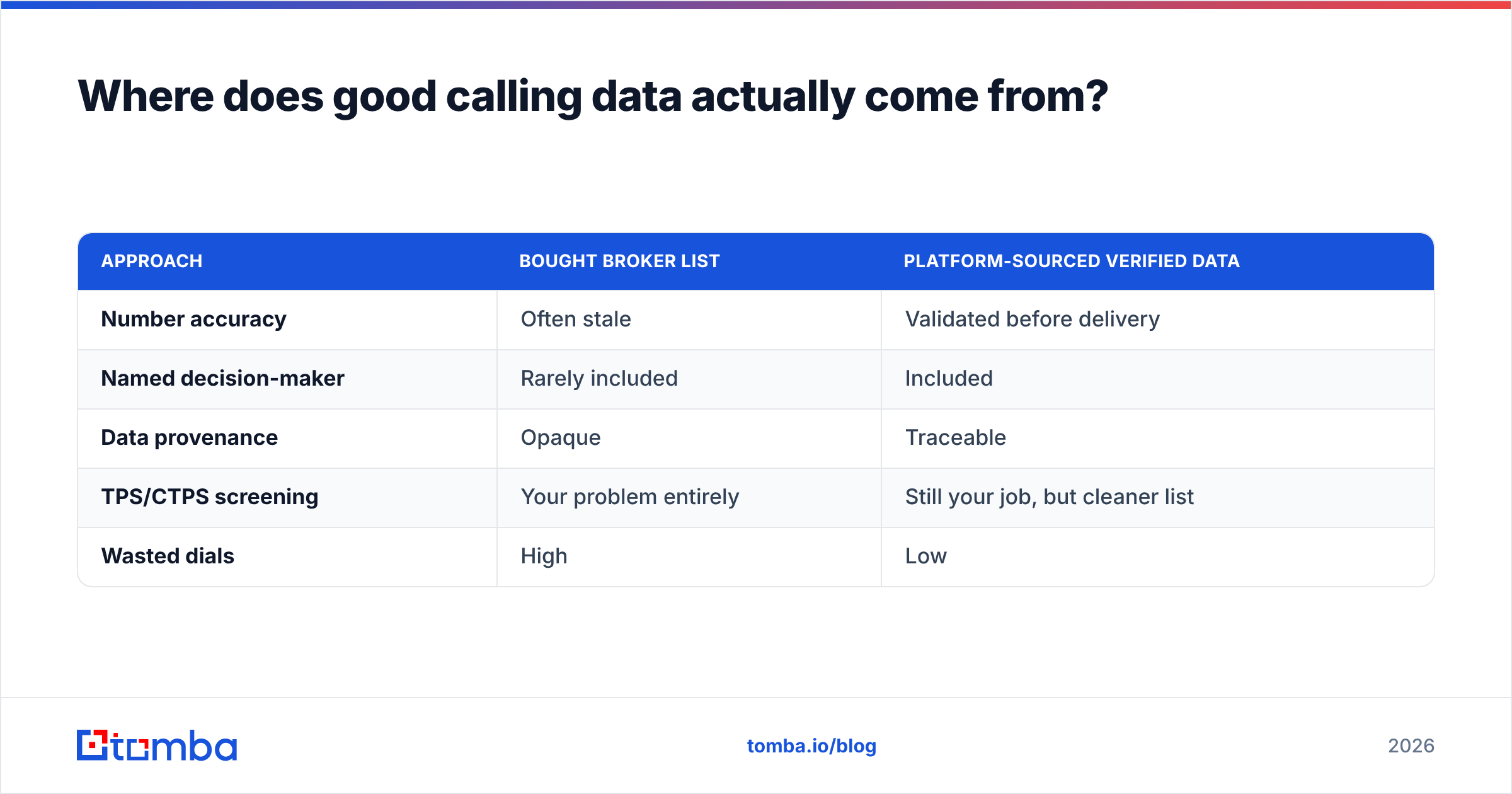
The best UK calling data pairs an accurate business phone number with a real, named decision-maker — sourced and verified, not guessed. Random dialing burns hours; targeted dialing books meetings.
This is where a lead-intelligence platform earns its keep. Instead of buying a stale broker list, you can build a list from current business records: identify the company, find the right contact, and pull a verified direct line. Tomba's phone finder locates B2B phone numbers tied to named contacts, and the underlying B2B database gives you the firmographic context to prioritise who is actually worth calling.
For teams that run phone and email in parallel — which is most high-performing outbound teams — pairing the phone workflow with an email finder lets you follow a voicemail with a same-day email that references the call. Multi-touch, single source of truth.
| Approach | Bought broker list | Platform-sourced verified data |
|---|---|---|
| Number accuracy | Often stale | Validated before delivery |
| Named decision-maker | Rarely included | Included |
| Data provenance | Opaque | Traceable |
| TPS/CTPS screening | Your problem entirely | Still your job, but cleaner list |
| Wasted dials | High | Low |
You are always responsible for register screening — no vendor removes that duty — but starting from clean, traceable data makes the whole compliance chain shorter.
What does a good UK cold call script look like in 2026?#
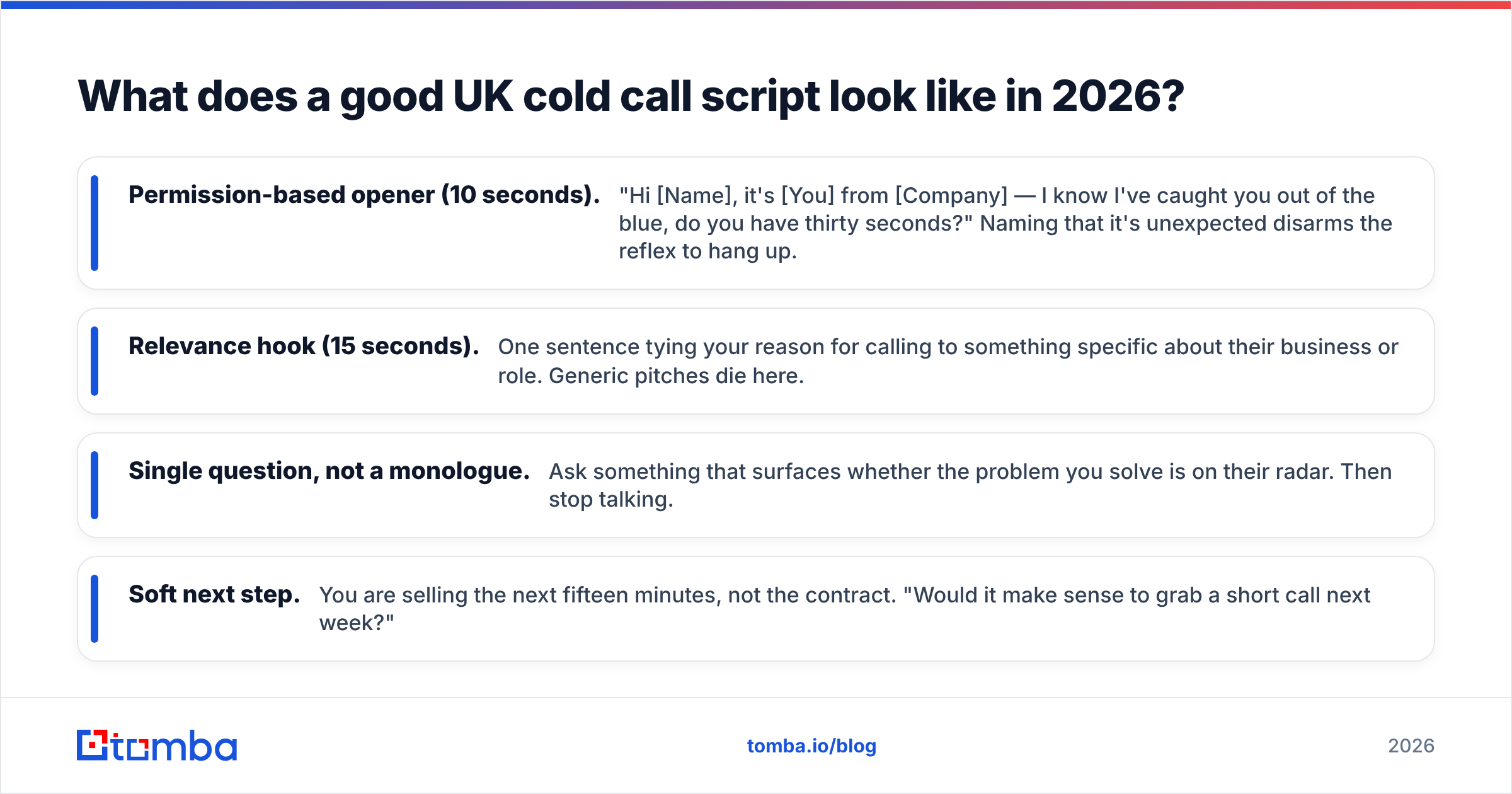
A script's job is not to sound scripted. It is to give reps a reliable structure so they can listen instead of scramble. The proven shape:
- Permission-based opener (10 seconds). "Hi [Name], it's [You] from [Company] — I know I've caught you out of the blue, do you have thirty seconds?" Naming that it's unexpected disarms the reflex to hang up.
- Relevance hook (15 seconds). One sentence tying your reason for calling to something specific about their business or role. Generic pitches die here.
- Single question, not a monologue. Ask something that surfaces whether the problem you solve is on their radar. Then stop talking.
- Soft next step. You are selling the next fifteen minutes, not the contract. "Would it make sense to grab a short call next week?"
Two hard rules layered on top: present your caller ID (PECR requires it, and withheld numbers tank pickup rates), and identify your company the moment they ask. Both are legal obligations and trust signals at once.
HubSpot's research on sales call best practices consistently shows the same thing UK reps see on the ground: shorter openers, more questions, and personalised relevance outperform feature-dumping every time.
How does cold calling fit with the rest of outbound?#
Phone should rarely be your only channel. The strongest UK outbound sequences treat the call as one touch inside a coordinated set: a connect-attempt, a voicemail, a follow-up email, and a LinkedIn touch, spaced over a couple of weeks.
The mechanics matter. When a rep leaves a voicemail and follows it within the hour with an email that says "just tried your line about X," reply rates jump — the prospect now has a name, a face, and a reason. That only works when your phone data and email data describe the same verified contact, which is exactly why a single enrichment source beats stitching together three tools that disagree with each other.
If you are budgeting for this, the Tomba pricing tiers scale from a free tier at 25 searches per month up to Starter at $49/mo and Growth at $99/mo, so you can start small and validate the motion before committing.
Is cold calling still worth it in the UK?#
Yes — for the right offers, to the right segments, with clean data and a compliant process. It is not a volume game anymore. A rep making 40 well-researched, register-screened calls to named decision-makers will out-book a rep smashing through 200 random numbers, and won't put the company one complaint away from an ICO letter.
The channel rewards discipline. Get your lawful basis documented, screen against TPS and CTPS every campaign, validate your numbers, and lead with relevance instead of a pitch. Do that, and the phone remains one of the highest-intent, fastest-feedback channels in B2B.
Start with data you can trust#
The fastest way to make UK cold calling pay is to stop wasting dials on dead numbers and wrong contacts. Build your list from verified, traceable records instead of a stale broker file.
Use the Tomba Email Finder to identify the right decision-maker and pull verified contact details, then pair it with the phone finder and validator to arm your reps with numbers that actually connect. Screen the result against TPS and CTPS, load it into your dialer, and let your team spend their time talking to real prospects — not chasing ghosts. Start on the free tier and scale up when the pipeline shows you it's working.
Related guides#
Ready to find emails that actually work?
Join 150,000+ professionals who stopped guessing and started sending. Free credits on signup — no credit card required.
Get the Tomba newsletter
Practical outbound tactics and product updates — once every two weeks.
About the author