Cold Calling Response Rate: 2026 Benchmarks and How to Improve
What counts as a good cold calling response rate in 2026? See real benchmarks by industry, the math that actually matters, and seven levers that move connect and conversion rates.
Cold calling still works in 2026 — but only if you measure it honestly. Most teams quote a single "response rate" number that hides three very different problems: bad data, wrong timing, and weak talk tracks. This guide breaks the metric apart, shows you real benchmarks, and gives you the levers that actually move the needle.
TL;DR#
- A realistic cold calling response rate in 2026 is a 4.8%–8% connect-to-conversation rate, with 1%–3% of dials turning into a booked meeting.
- "Response rate" is not one number. Split it into dial-to-connect, connect-to-conversation, and conversation-to-meeting — each has a different fix.
- The single biggest lever is data accuracy: bad phone numbers cap your connect rate before you say a word. Clean numbers with a phone validator before you dial.
- Timing (Tuesday–Thursday, 8–10am and 4–6pm local), local presence, and a tight opener beat volume every time.
- Track the funnel weekly, not the vanity total. Teams that isolate the weak stage improve 2–3x faster.
What is a cold calling response rate?#
Your cold calling response rate is the percentage of dials that produce a meaningful two-way conversation — not a voicemail, not a hang-up, not a wrong number. Think of it like fishing: the number of times you cast (dials) matters far less than how many fish actually bite (conversations).
The problem is that "response rate" gets used loosely. One rep means "someone picked up." Another means "someone agreed to a next step." Those are wildly different denominators, so comparing them is meaningless. Before you benchmark anything, define the funnel:
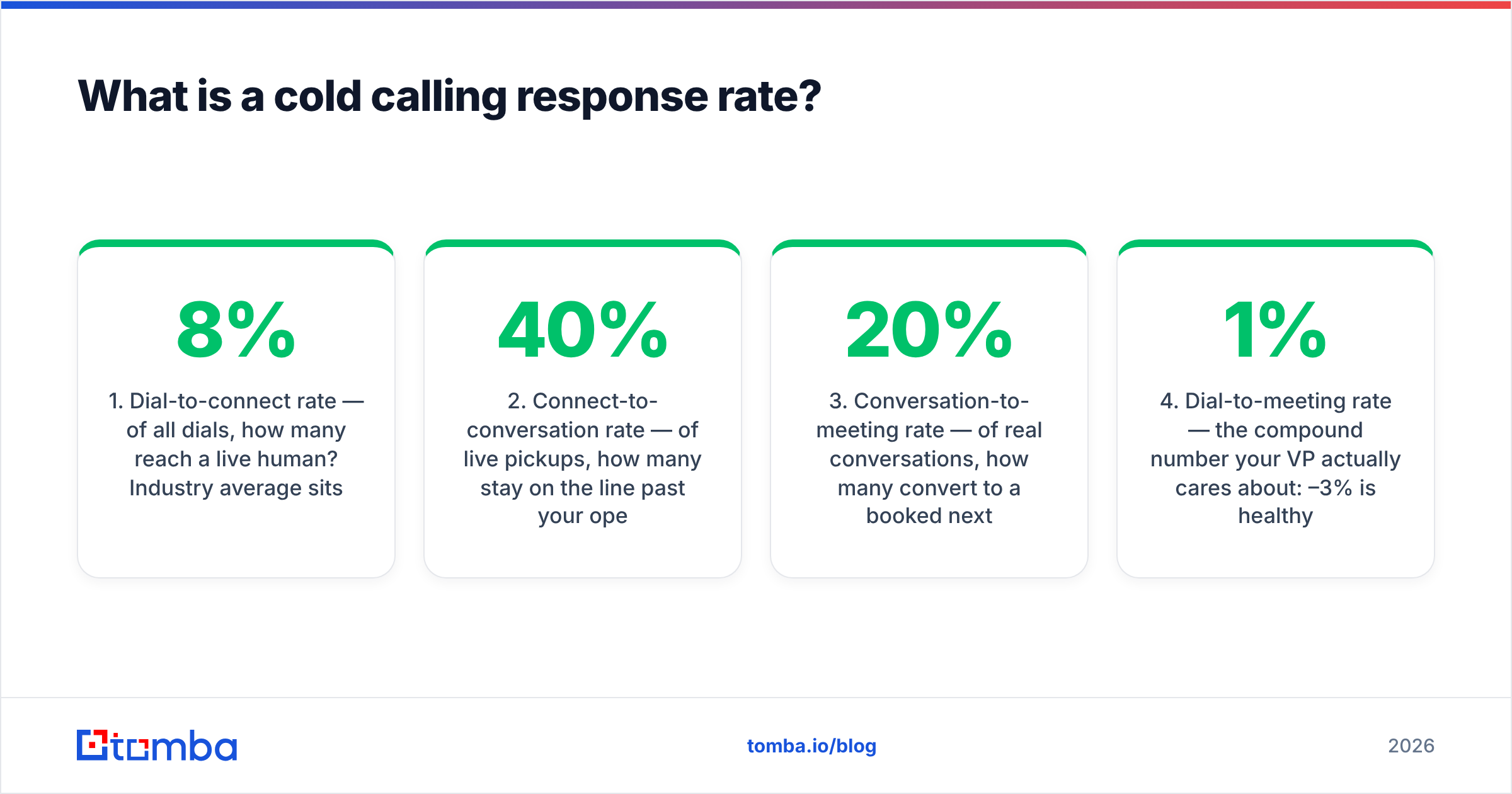
- Dial-to-connect rate — of all dials, how many reach a live human? Industry average sits around 8%–12% on cold B2B lists, and it's almost entirely a function of data quality and timing.
- Connect-to-conversation rate — of live pickups, how many stay on the line past your opener? A good opener holds 40%–60%.
- Conversation-to-meeting rate — of real conversations, how many convert to a booked next step? Strong reps land 20%–35%.
- Dial-to-meeting rate — the compound number your VP actually cares about: 1%–3% is healthy for cold outbound.
When someone tells you their cold calling response rate is "20%," ask which line above they mean. Usually it's connect-to-conversation, and the compound dial-to-meeting number is far lower.

What is a good cold calling response rate in 2026?#
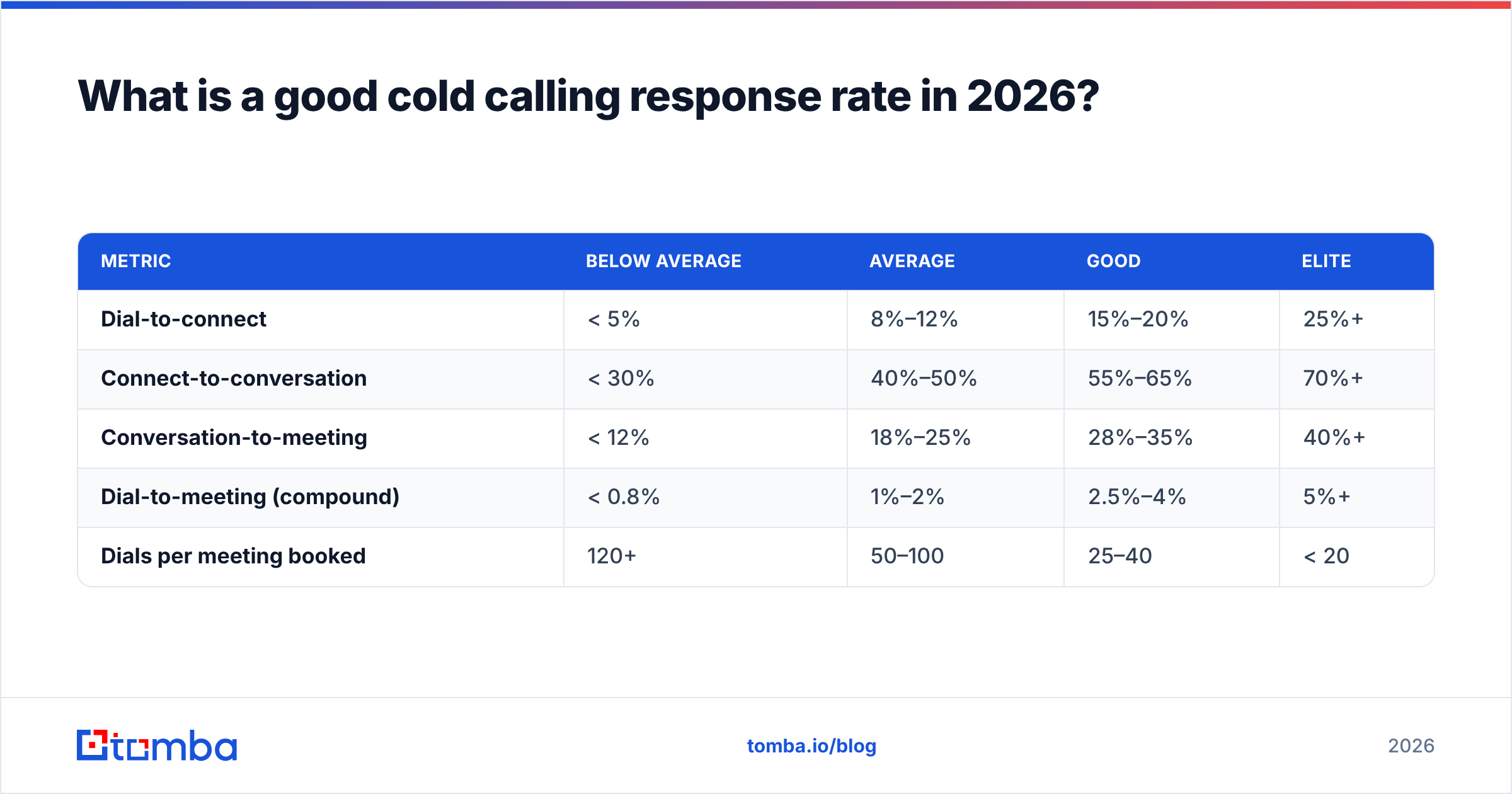
A good cold calling response rate depends on your industry, list quality, and how you count — but here are the benchmarks most B2B teams should anchor to. These reflect blended 2026 outbound data across SaaS, agencies, and professional services.
| Metric | Below average | Average | Good | Elite |
|---|---|---|---|---|
| Dial-to-connect | < 5% | 8%–12% | 15%–20% | 25%+ |
| Connect-to-conversation | < 30% | 40%–50% | 55%–65% | 70%+ |
| Conversation-to-meeting | < 12% | 18%–25% | 28%–35% | 40%+ |
| Dial-to-meeting (compound) | < 0.8% | 1%–2% | 2.5%–4% | 5%+ |
| Dials per meeting booked | 120+ | 50–100 | 25–40 | < 20 |
Notice the last row. If it takes you 120 dials to book one meeting and an elite rep needs under 20, the gap is almost never "talent." It's the inputs: bad numbers, wrong personas, and calling at dead hours. According to HubSpot's sales research, the difference between top and bottom quartile callers is dominated by list quality and cadence discipline, not charisma.
Why is my cold calling response rate so low?#
Low response rates almost always trace back to one of three root causes. Diagnose in this order — fixing them out of sequence wastes weeks.
- Bad or stale phone data. If 30% of your numbers are disconnected, outdated, or belong to the wrong person, your connect rate is capped no matter how good your pitch is. This is the most common and most fixable problem.
- Wrong timing and cadence. Calling once, at 1pm on a Friday, and giving up guarantees a low number. Connects cluster on Tuesday–Thursday mornings and late afternoons in the prospect's local time zone.
- A weak first 10 seconds. Even with a perfect list and perfect timing, a robotic "Did I catch you at a bad time?" opener triggers instant hang-ups. Your opener has one job: earn the next 30 seconds.
Here's the uncomfortable math. If your list is 70% accurate, your best possible connect rate is already knee-capped by 30% before you dial. You can't out-script bad data. That's why the highest-leverage move for most teams is enriching and validating contact records first — pulling correct mobile numbers with a phone finder and confirming they're live with a phone validator — then optimizing the human parts.
How do you calculate cold calling response rate?#
Use this simple formula, and pick the denominator on purpose:
- Connect rate = (Live connects ÷ Total dials) × 100
- Response / conversation rate = (Meaningful conversations ÷ Live connects) × 100
- Meeting conversion = (Meetings booked ÷ Meaningful conversations) × 100
- Compound (dial-to-meeting) = (Meetings booked ÷ Total dials) × 100
A worked example: 500 dials → 60 live connects (12% connect) → 30 real conversations (50% conversation) → 8 meetings (27% meeting conversion) → 1.6% dial-to-meeting. That 1.6% is your true north-star. If you only reported "50% response rate," you'd badly overstate performance and never find the leak.
Track all four every week per rep. The stage with the lowest number relative to the benchmark table above is where you invest. If your definition of response rate drifts week to week, you can't trend it — lock the formula first.
What actually improves cold calling response rate?#
Seven levers, ordered by impact-to-effort. Start at the top.
1. Fix your data before you dial#
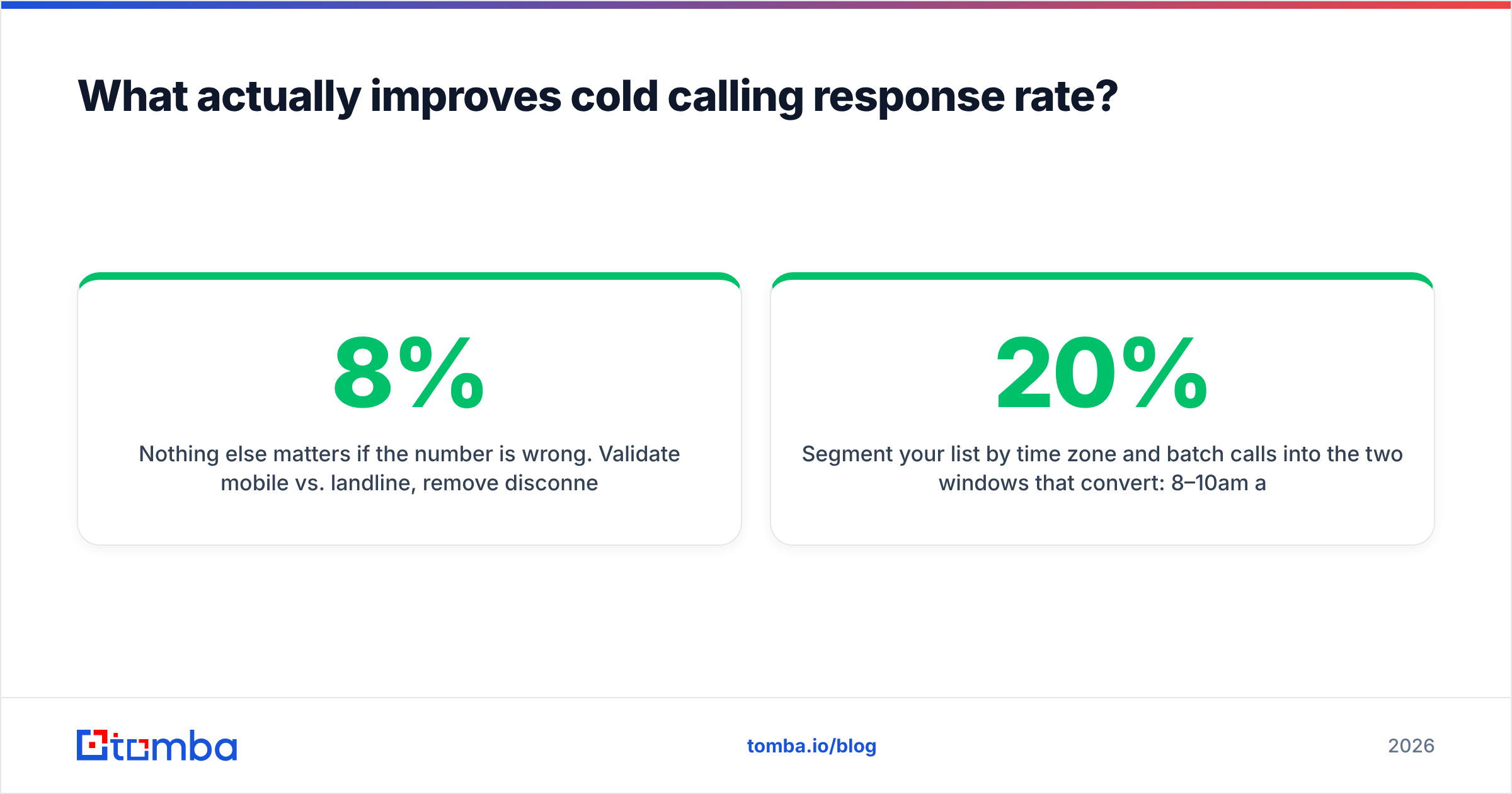
Nothing else matters if the number is wrong. Validate mobile vs. landline, remove disconnected lines, and append direct dials instead of gatekept mains. A clean list can lift connect rates from 8% to 18% overnight — that's a 2x improvement with zero change to your script. Pull accurate direct numbers from a maintained B2B database rather than scraped, months-old lists.
2. Call at the right time in the right time zone#
Segment your list by time zone and batch calls into the two windows that convert: 8–10am and 4–6pm local. Tuesday through Thursday outperform Monday and Friday. This alone can add 20%–30% more connects without a single extra dial.
3. Use local presence and warm the number#
Prospects answer local area codes far more than 1-800 or out-of-state numbers. Rotate local caller IDs and keep them off spam lists — a flagged number tanks your connect rate silently. Check your numbers periodically so you're not dialing from a burned line.
4. Rewrite your first 10 seconds#
Lead with a permission-based, pattern-interrupt opener that names a specific, relevant reason for the call. Drop "How are you today?" Try: "Hi [Name], I know I'm an interruption — can I take 20 seconds to say why I called, and you tell me if it's worth continuing?" Honesty plus brevity holds the line.
5. Multithread with email and LinkedIn#
A call after a relevant email or LinkedIn touch connects at a higher rate because the name isn't cold anymore. Sequence: touch, then call within 24 hours. Enrich each record with role, company, and a trigger event so every call has a reason to exist.
6. Standardize objection handling#
Most reps freeze on "I'm not interested" or "send me an email." Build a one-page objection matrix, role-play it weekly, and the conversation-to-meeting rate climbs without touching the top of the funnel.
7. Coach on recordings, not gut feel#
Review real call recordings against the funnel stages. If conversations are high but meetings are low, it's a closing-the-call problem, not a list problem. Coaching to the specific weak stage compounds fast.
Cold calling vs. cold email: which gets a better response rate?#
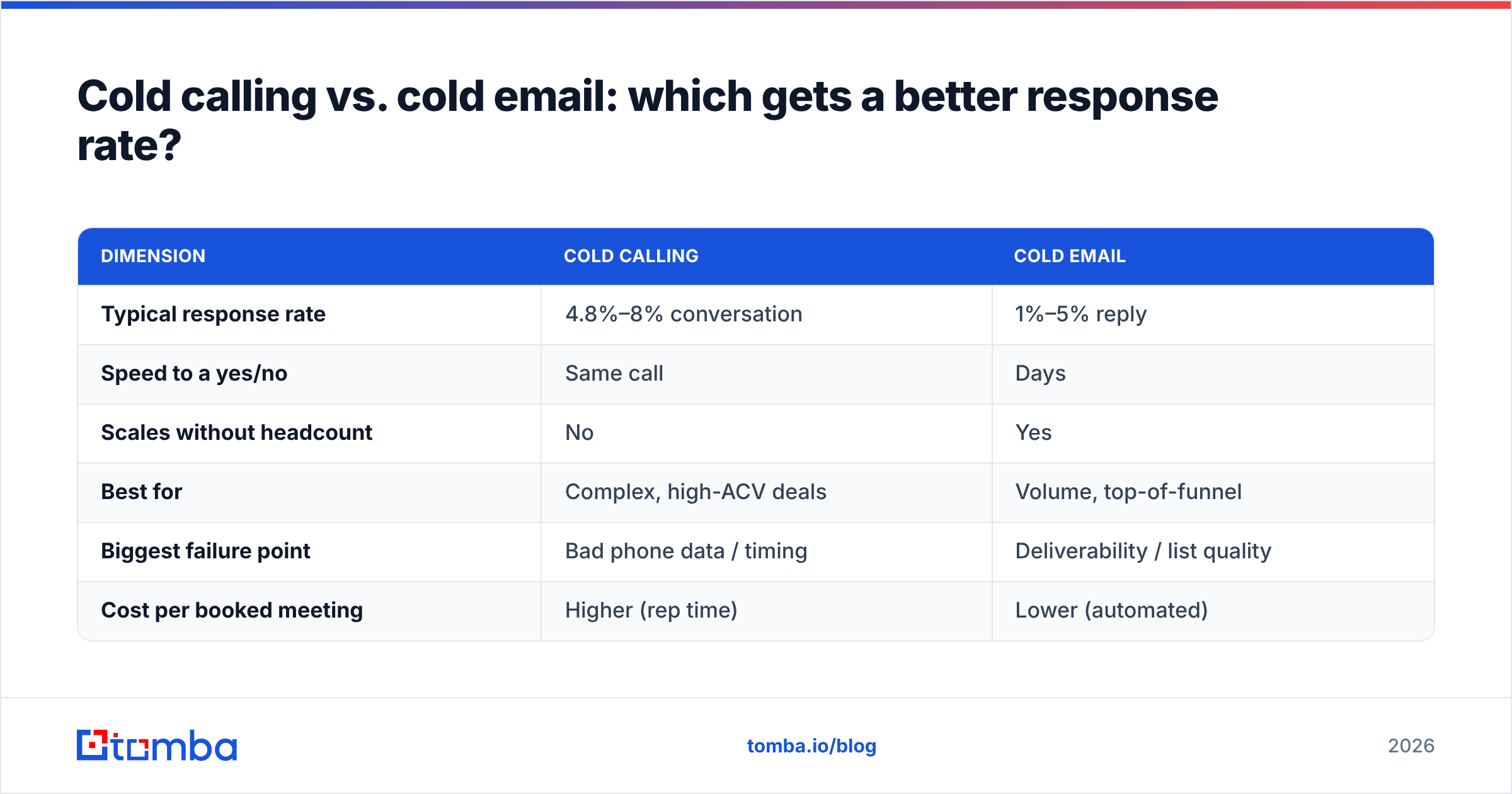
They measure different things, so don't compare the raw percentages — compare cost per meeting and speed to answer. Calls get a decision faster; email scales cheaper. The best teams run both and let each cover the other's blind spot.
| Dimension | Cold calling | Cold email |
|---|---|---|
| Typical response rate | 4.8%–8% conversation | 1%–5% reply |
| Speed to a yes/no | Same call | Days |
| Scales without headcount | No | Yes |
| Best for | Complex, high-ACV deals | Volume, top-of-funnel |
| Biggest failure point | Bad phone data / timing | Deliverability / list quality |
| Cost per booked meeting | Higher (rep time) | Lower (automated) |
The through-line for both channels is the same: accurate contact data. A cold email bounces on a bad address the way a cold call dies on a disconnected number. If you're running both plays, verify emails with an email verifier and validate phones from the same enriched record so every rep works from one clean source of truth. Independent reviews on G2 and buyer research from Salesforce both point to data hygiene as the top predictor of outbound efficiency.
How many dials should a rep make per day?#
Volume matters, but only after quality. A common healthy range is 50–80 quality dials per day per SDR when working an enriched, validated list — enough to hit statistical significance without burning out or turning the pitch robotic.
Chasing 200 low-quality dials a day is a trap: connect rates crater, morale drops, and numbers get flagged as spam, which poisons future connects. Fewer dials against better data almost always wins on dials-per-meeting. If you find yourself needing 120 dials to book one meeting, don't add dials — fix the inputs.
Common cold calling response rate mistakes to avoid#
- Reporting one blended number. It hides which stage is broken.
- Never refreshing the list. Phone data decays ~2.5% per month; a six-month-old list is ~15% dead on arrival.
- Ignoring time zones. Calling East Coast prospects at 4pm your Pacific time means you're hitting them at 7pm.
- Optimizing the script before the data. You can't out-talk a disconnected line.
- Not warming numbers. A spam-flagged caller ID silently halves your connects.
Closing: build response rate on accurate data first#
Your cold calling response rate is a chain, and it's only as strong as the phone number at the front of it. Before you rewrite a single opener, make sure every record is real: correct direct dials, live numbers, and enriched context that gives each call a reason to happen.
That's where Tomba fits. Use the Tomba Email Finder and its companion phone finder to build verified, enriched contact lists — accurate direct emails and phone numbers pulled from transparent data sources, then confirmed with the email verifier and phone validator before your reps ever dial. Start free with 25 searches a month, and see Tomba pricing when you're ready to scale — Starter is $49/mo. Fix the data, and the response rate follows.
Related guides#
Ready to find emails that actually work?
Join 150,000+ professionals who stopped guessing and started sending. Free credits on signup — no credit card required.
Get the Tomba newsletter
Practical outbound tactics and product updates — once every two weeks.
About the author