Cold Calling Success Rate in 2026: Benchmarks That Hold Up
What counts as a good cold calling success rate in 2026? Real connect, conversation, and meeting benchmarks — plus the levers that actually move them.
Cold Calling Success Rate in 2026: Benchmarks That Hold Up
TL;DR
- A "good" cold calling success rate depends on which number you mean: connect rate, conversation rate, or meeting-booked rate. Mixing them up is why teams argue about the same call and reach opposite conclusions.
- Realistic 2026 benchmarks: ~20-30% connect rate, ~15-20% of connects turn into a real conversation, and ~1-3% of dials convert to a booked meeting. Top reps beat this; most teams sit below it.
- The single biggest lever is who you dial and when, not the script. Bad data caps your ceiling before you open your mouth.
- Multiple dials matter: a large share of connects happen after the first attempt, so single-touch calling quietly wastes your list.
- Pairing accurate phone data with verified email follow-up is where the math stops fighting you.
Cold calling is not dead, but the lazy version of it is. If you measure the wrong thing, you will either quit a channel that works or keep pouring hours into one that doesn't. This guide breaks down what a cold calling success rate actually is, what "good" looks like in 2026, and the concrete levers that move it.
What is a cold calling success rate, really?#
A cold calling success rate is the percentage of dials that produce a defined outcome — and the outcome you pick changes the number completely. Sales teams throw around "success rate" as if it's one metric. It isn't. There are at least three stacked rates, and each measures a different failure point.
Think of it like a sales funnel wearing a phone headset. Every dial enters the top; only a fraction survives each stage. Here are the rates that matter:
- Connect rate — the percent of dials where a live human picks up. This is mostly a function of data quality and timing, not talent.
- Conversation rate — of the people who pick up, how many stay on for a real exchange instead of hanging up in five seconds. This is where your opener earns its keep.
- Meeting/conversion rate — of those conversations, how many end in a booked meeting, a qualified next step, or another agreed outcome.
- Dial-to-meeting rate — the compound number that leadership actually cares about: meetings booked divided by total dials.
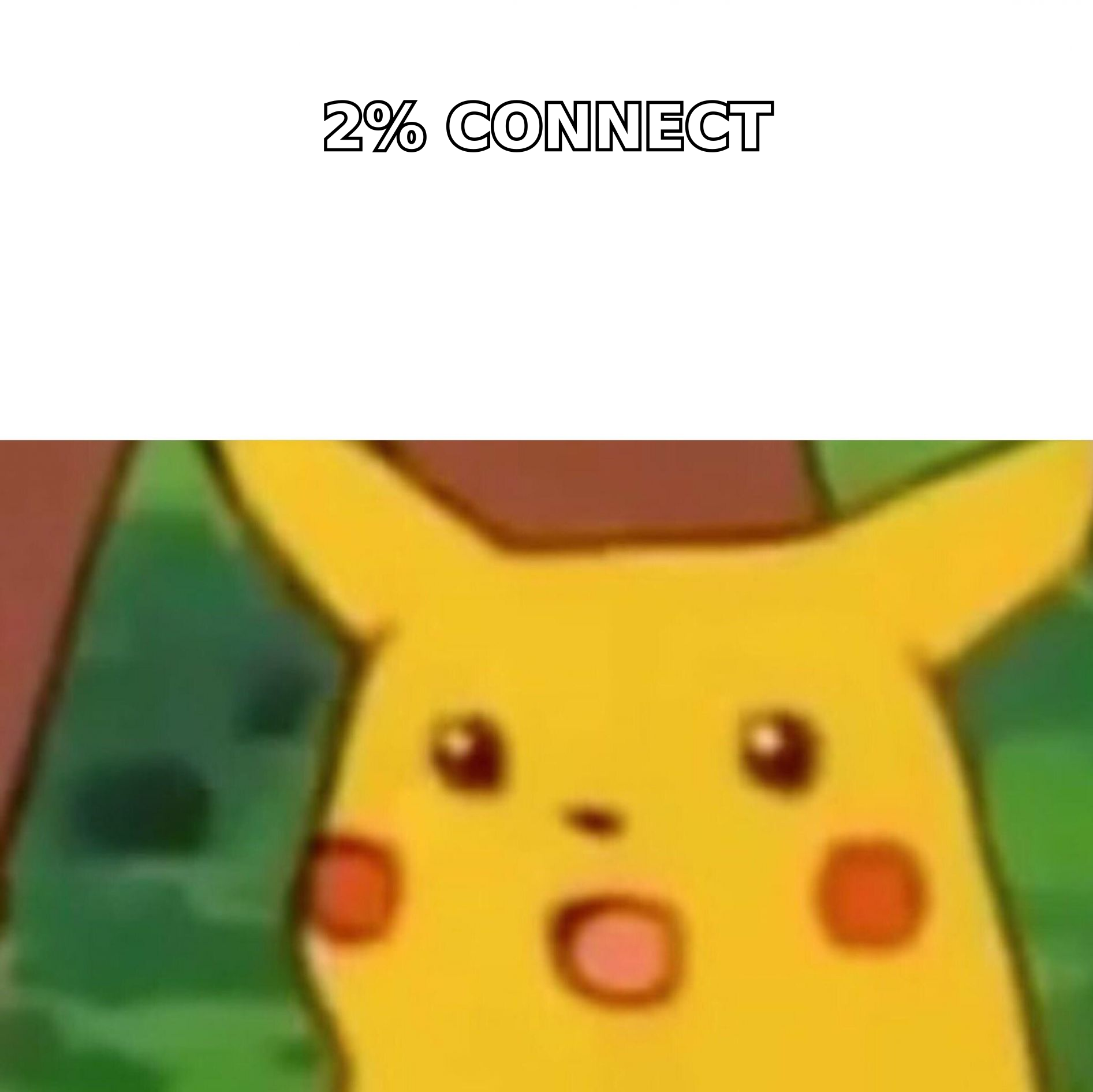
When someone says "our cold calling success rate is 2%," they almost always mean the last one — dial-to-meeting. That sounds brutal until you realize it's the product of three separate percentages multiplied together. Fix any one of them and the whole equation improves.
What is a good cold calling success rate in 2026?#
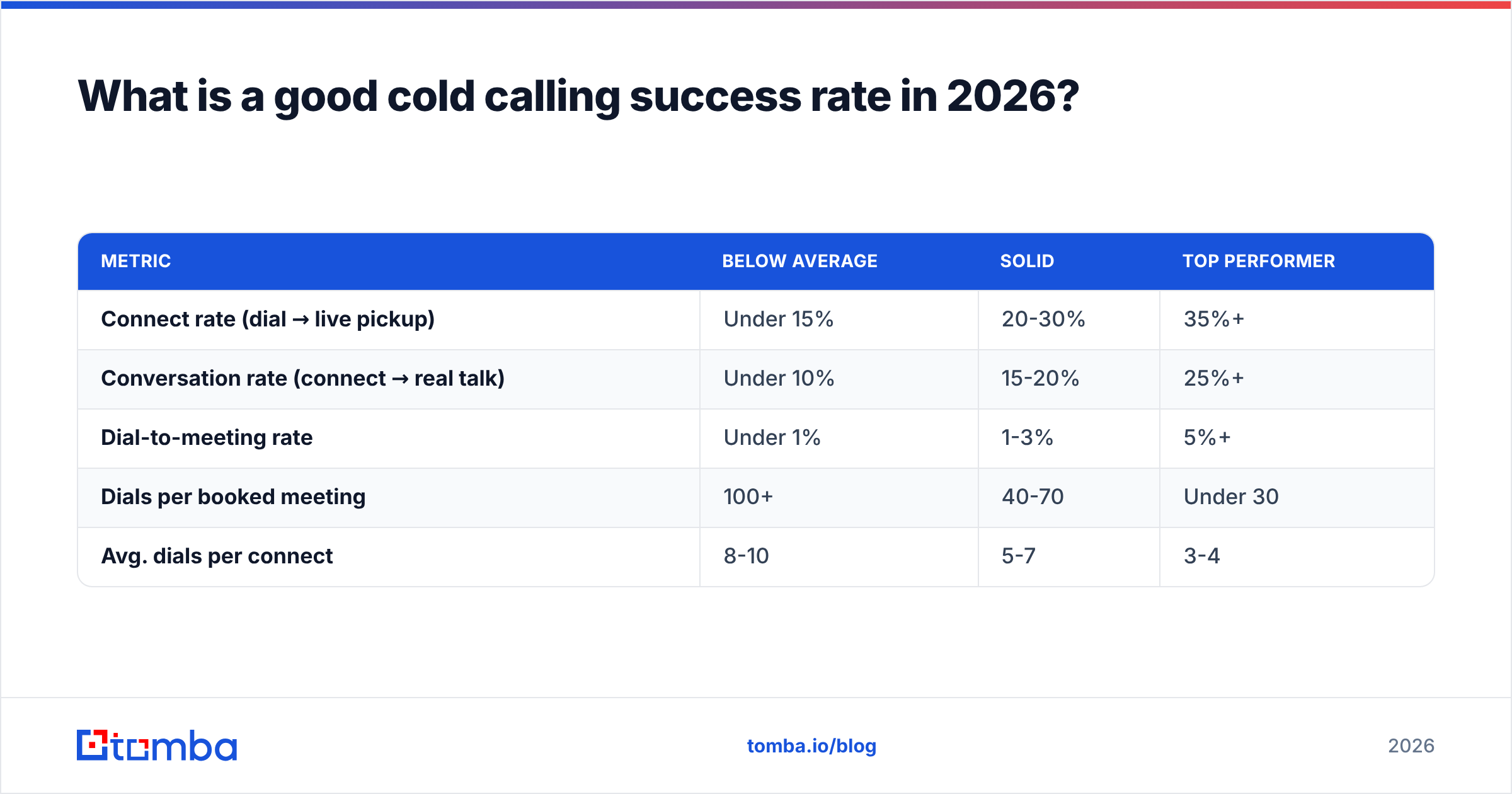
Aim for roughly a 20-30% connect rate, a 15-20% conversation rate off those connects, and a 1-3% dial-to-meeting rate — with the best reps pushing meeting rates toward 5%. These ranges are consistent with what vendors like HubSpot and industry analysts have reported across large call datasets, and they hold up in 2026 because the fundamentals of phone behavior haven't changed as fast as the tooling has.
Here's a benchmark table you can hold your own numbers against:
| Metric | Below average | Solid | Top performer |
|---|---|---|---|
| Connect rate (dial → live pickup) | Under 15% | 20-30% | 35%+ |
| Conversation rate (connect → real talk) | Under 10% | 15-20% | 25%+ |
| Dial-to-meeting rate | Under 1% | 1-3% | 5%+ |
| Dials per booked meeting | 100+ | 40-70 | Under 30 |
| Avg. dials per connect | 8-10 | 5-7 | 3-4 |
Two cautions before you benchmark yourself against this. First, these numbers swing hard by industry, seniority of target, and region — dialing a VP of Engineering at a 5,000-person enterprise is a different sport than dialing an owner-operator of a local business. Second, a high connect rate with a terrible conversion rate usually means a data problem disguised as a talent problem: you're reaching people, they're just the wrong people.
Why is your cold calling success rate lower than the benchmark?#
Most of the gap comes from three fixable causes: bad numbers, bad timing, and single-touch calling. Reps love to blame the script, but the script is usually the smallest lever.
- Wrong or stale phone numbers. If 30% of your list is disconnected, wrong-department, or reassigned, your connect rate is capped before you dial. This is the most common and least discussed cause of a low cold calling success rate.
- Calling at dead hours. Mid-morning and late afternoon consistently outperform lunch and first-thing. Calling a time zone you didn't check is a self-inflicted wound.
- Giving up after one dial. A large share of connects happen on the second through sixth attempt. Reps who dial once and move on are throwing away contacts who would have answered on Tuesday.
- Spray-and-pray targeting. A generic list of 5,000 "leads" converts worse than 500 accounts that actually match your ICP. Volume without fit just manufactures rejection.
- No pre-call research. Ten seconds of context — a recent funding round, a job change, a tech-stack signal — turns a cold call into a warm-ish one.
The uncomfortable truth: you can have a flawless opener and still post a 0.5% success rate if your list is garbage. Data comes first. That's why teams increasingly pair their dialer with a real B2B database and enrich contacts before a single call goes out, so reps spend their hours on numbers that ring the right desk.
How do you calculate cold calling success rate correctly?#
Divide the outcome you care about by total dials, and track all three funnel stages separately so you know which one is broken. The formulas are simple; the discipline is in not blending them.
- Connect rate = live connects ÷ total dials × 100
- Conversation rate = meaningful conversations ÷ live connects × 100
- Dial-to-meeting rate = meetings booked ÷ total dials × 100
- Dials per meeting = total dials ÷ meetings booked
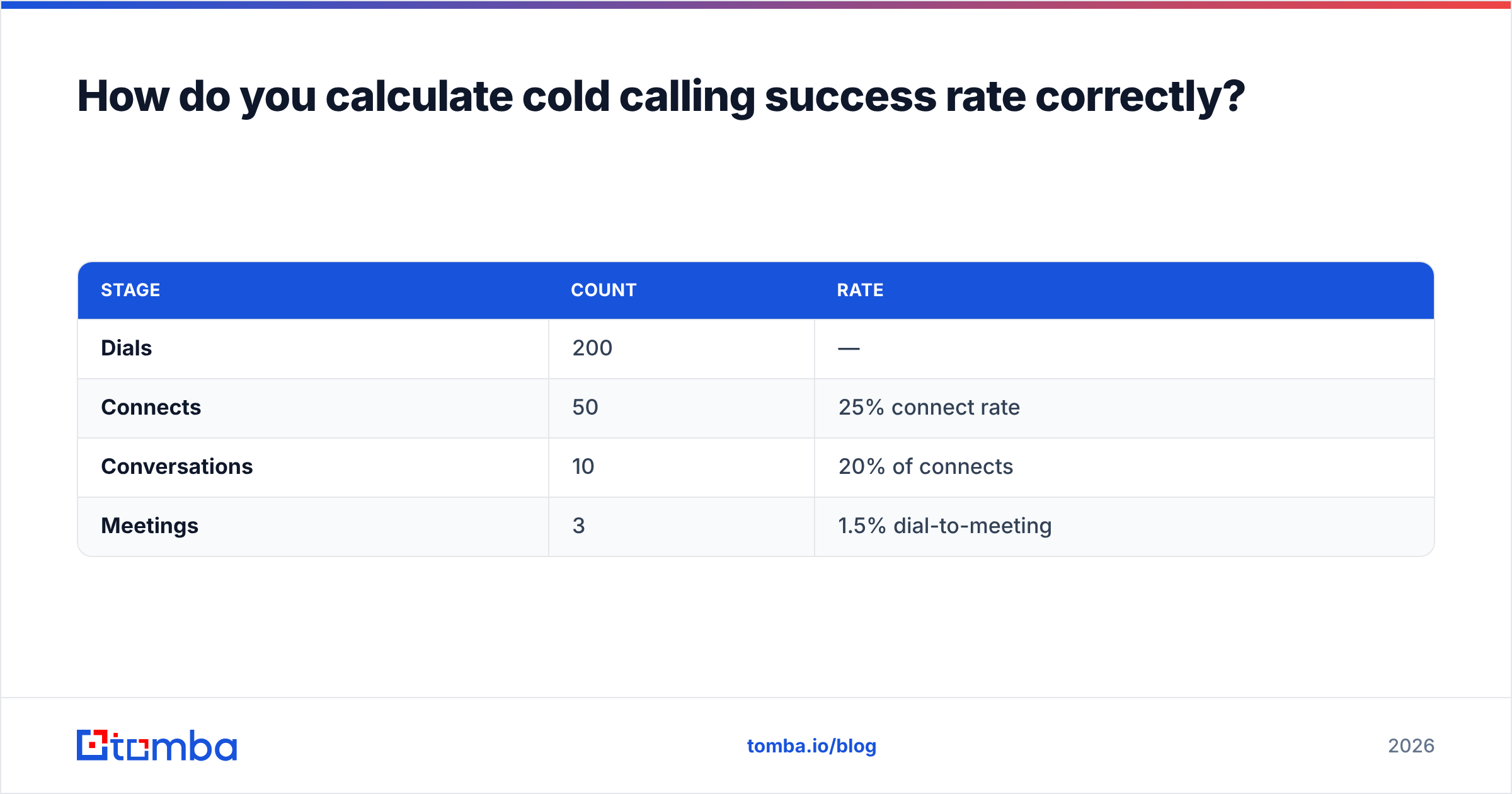
A worked example. Say a rep makes 200 dials in a week, connects with 50 people, has 10 genuine conversations, and books 3 meetings:
| Stage | Count | Rate |
|---|---|---|
| Dials | 200 | — |
| Connects | 50 | 25% connect rate |
| Conversations | 10 | 20% of connects |
| Meetings | 3 | 1.5% dial-to-meeting |
That rep is dead-on benchmark. Now suppose a second rep makes the same 200 dials, connects with 50, but only has 4 conversations and books 1 meeting. Same connect rate, half the conversation rate — the problem is clearly the opener or the targeting, not the data. Splitting the funnel tells you exactly where to coach. A single blended "0.5% vs 1.5%" number never would.
Which levers move a cold calling success rate the fastest?#
Rank your fixes by cost-to-impact: data quality and multi-touch cadence pay off fastest, script polish pays off slowest. Here's the priority order most teams should follow.
- Clean and verify your contact data. Remove disconnected numbers and confirm you're dialing the right person before you dial. This lifts connect rate directly and costs nothing in call time.
- Enforce a multi-dial cadence. Set a rule — for example, 6 attempts across 3 different days and 2 time windows — before a contact is retired. This alone can double connects on the same list.
- Call in the productive windows. Test your own data, but early morning and late afternoon in the prospect's local time beat the middle of the day for most B2B roles.
- Tighten the first 10 seconds. A permission-based opener ("Did I catch you at a bad time?") beats a monologue. This lifts conversation rate once connects are healthy.
- Layer email around the call. A verified email touch before and after the dial warms the number and gives a fallback channel. Calls plus verified emails consistently outperform either channel alone.
- Log and review outcomes weekly. What gets measured by stage gets fixed by stage.
Notice the pattern: the top three levers are about reaching the right person at the right time, not about being more clever on the phone. That's where the leverage lives.
How does data quality change the math?#
Cutting bad numbers from a list raises the connect rate mechanically, which multiplies through every downstream stage. This is the compounding effect most teams underestimate.
Imagine two reps working identical scripts and cadences. Rep A dials a raw list where 35% of numbers are wrong. Rep B dials a verified list with under 5% bad numbers. Even with the exact same skill, Rep B connects with far more real prospects per hour, has more conversations, and books more meetings — not because they're better, but because their denominator isn't polluted with dead ends.
This is why enrichment and verification sit upstream of everything. Before a campaign, teams use a phone finder to source direct-dial numbers, a phone validator to strip out invalid lines, and data enrichment to confirm the person still holds the role you're targeting. Independent review sites like G2 rate data-first outreach tools highly precisely because accuracy at the top of the funnel is the cheapest performance gain available. Skip it, and you're optimizing a script for numbers that were never going to answer.
Is cold calling still worth it compared to email?#
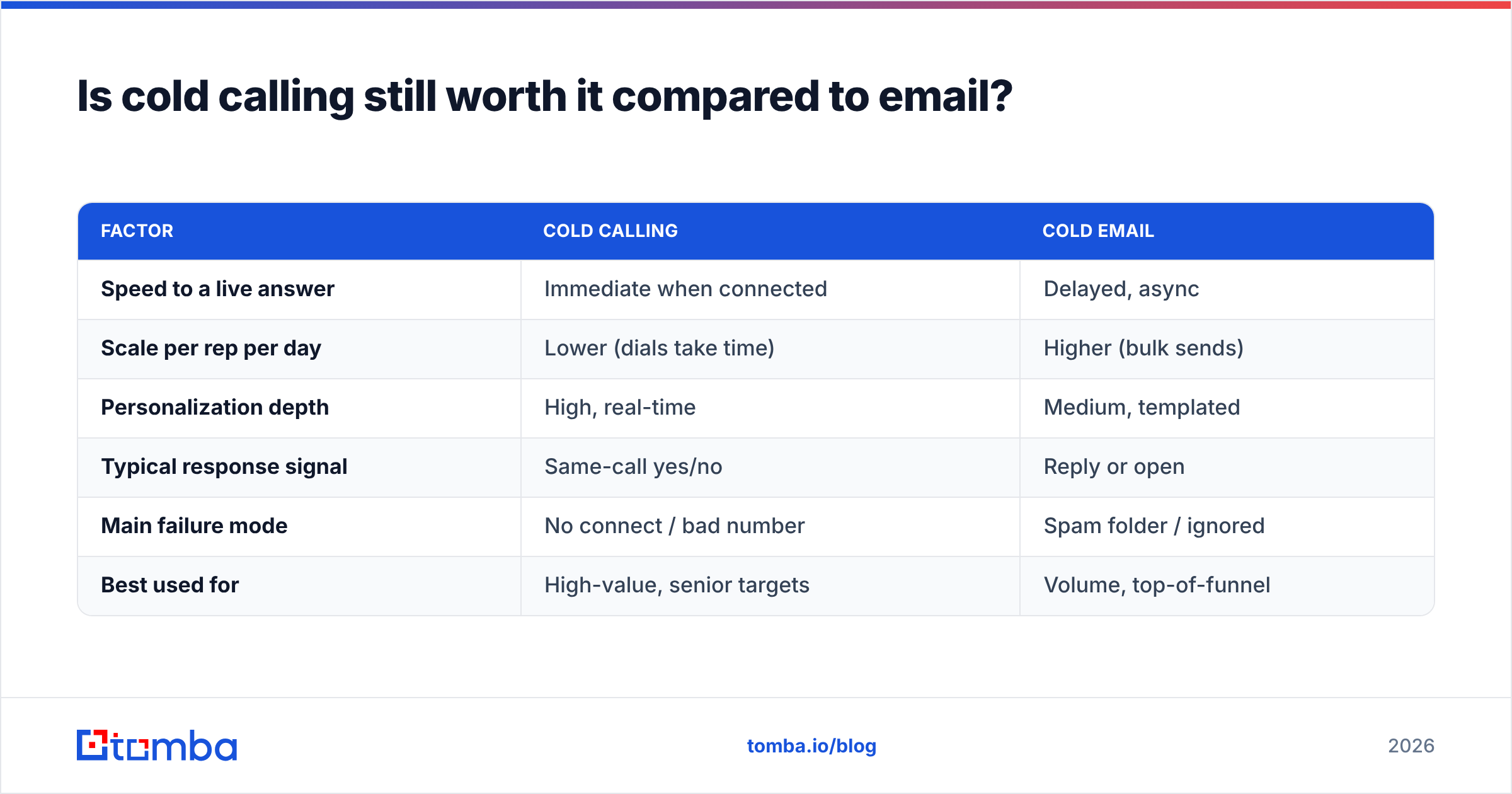
Yes — but the winning play in 2026 is combining calls with verified email, not choosing one. Cold calling and cold email fail in different ways, which is exactly why they cover for each other.
| Factor | Cold calling | Cold email |
|---|---|---|
| Speed to a live answer | Immediate when connected | Delayed, async |
| Scale per rep per day | Lower (dials take time) | Higher (bulk sends) |
| Personalization depth | High, real-time | Medium, templated |
| Typical response signal | Same-call yes/no | Reply or open |
| Main failure mode | No connect / bad number | Spam folder / ignored |
| Best used for | High-value, senior targets | Volume, top-of-funnel |
A rep who calls without email loses the prospects who never pick up. A rep who emails without calling loses the ones who never read email but will talk for two minutes. Sequencing them — email to warm, call to close the gap, email to follow up — is what pushes a mediocre cold calling success rate into respectable territory. If you want to model the email side, our guide on improving email deliverability pairs naturally with a calling cadence.
What should you track beyond the success rate?#
Track leading indicators that predict success rate, not just the outcome itself. By the time your dial-to-meeting rate drops, the cause is weeks old. Watch these instead:
- Talk time per connect — rising talk time usually predicts a rising conversation rate.
- Attempts before connect — if this creeps up, your data is aging or your timing slipped.
- Voicemail-to-callback ratio — tells you whether your voicemails are worth leaving.
- Bad-number percentage — the canary for data decay; when it climbs, re-enrich immediately.
- Meeting show rate — booking meetings that no-show flatters your success rate without helping revenue.
These metrics turn a lagging scoreboard into an early-warning system. When your bad-number percentage ticks up, you refresh the list before your connect rate craters — instead of discovering the damage a month later in a pipeline review.
The bottom line#
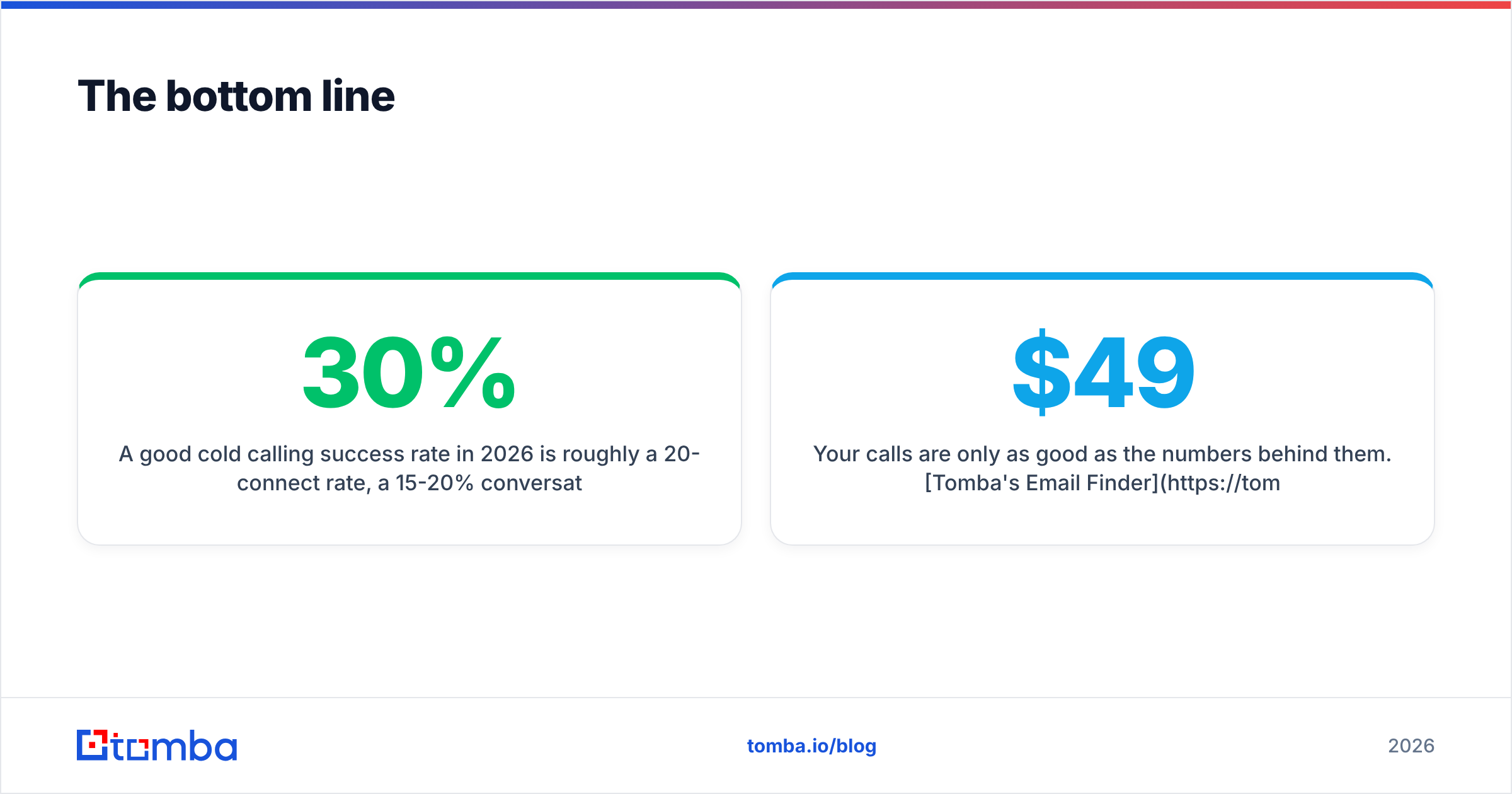
A good cold calling success rate in 2026 is roughly a 20-30% connect rate, a 15-20% conversation rate, and a 1-3% dial-to-meeting rate — but the number you should obsess over is the one you're weakest at. Split your funnel, fix data first, enforce a multi-touch cadence, and wrap verified email around every call. Do that and the math stops working against you.
Your calls are only as good as the numbers behind them. Tomba's Email Finder and its companion phone finder, verifier, and enrichment tools give you accurate, verified contact data so every dial lands on the right person at the right desk — with a verified email ready for the follow-up. Start on the free tier (25 searches/month) or scale up on the Starter plan at $49/mo; see full Tomba pricing to match a plan to your call volume.
Related guides#
Ready to find emails that actually work?
Join 150,000+ professionals who stopped guessing and started sending. Free credits on signup — no credit card required.
Get the Tomba newsletter
Practical outbound tactics and product updates — once every two weeks.
About the author