Cold Calling Web Design Sales: A 2026 Playbook That Works
Cold calling still books web design projects in 2026—if your list, script, and follow-up are dialed in. Here's the exact playbook, with scripts, targeting, and the tools that make dialing pay off.
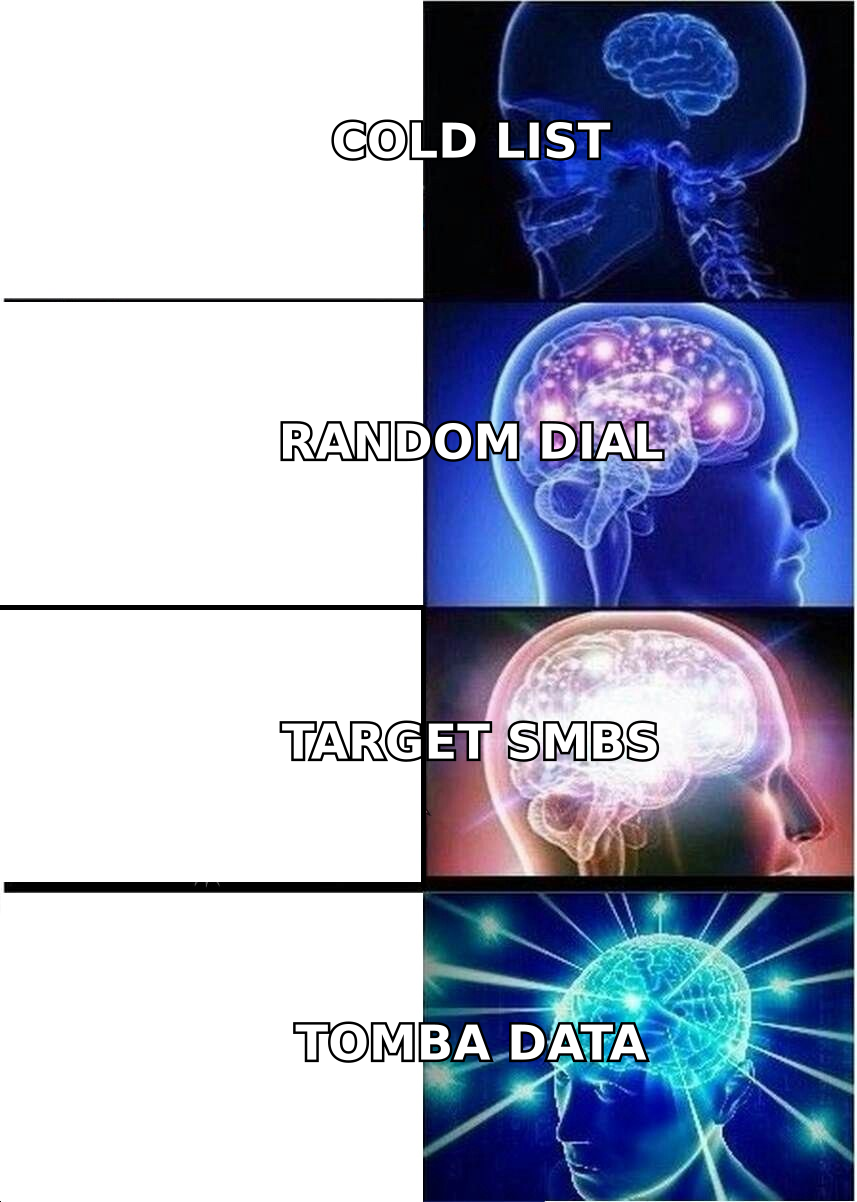
Cold calling to sell web design sounds like a relic. It isn't. It's just badly done by most freelancers and agencies who dial a random list, wing a script, and quit after two calls. Done with a targeted list and a tight pitch, the phone is still one of the fastest ways to book web design work in 2026.
TL;DR#
- Cold calling web design sales works when you call the right businesses (outdated, slow, or non-existent sites) with a specific, benefit-led opener—not a generic "we build websites" pitch.
- The list beats the script. Spend 60% of your prep time finding decision-makers and their direct numbers, not polishing lines.
- Book the audit, not the sale. Your only call goal is a 15-minute site review, which closes far better than trying to sell a $5k project cold.
- Follow-up multiplies results. Most deals close on call 3–5, not call 1. Multichannel (phone + email) beats phone alone.
- Tools pay for themselves. A verified direct-dial and decision-maker email turn a cold list into a warm pipeline.
Does cold calling still work for selling web design in 2026?#
Yes—if you change what you're selling on the call. You are not selling a website. You are selling a free, useful audit of a problem the prospect already feels: a site that loads slowly, looks dated, doesn't rank, or doesn't convert.
The math is simple. Local service businesses—dentists, law firms, HVAC companies, restaurants, contractors—still run on websites built five to ten years ago. Many were never mobile-optimized properly. According to HubSpot's sales research, the phone remains a primary channel for reaching decision-makers who ignore email entirely, and small-business owners in trades are exactly that audience.
The catch is volume and precision. Random dialing gets you hung up on. Targeted dialing—businesses you've already checked have a weak site—gets you a conversation because your opener is about them, not about you.
Who should you actually call?#
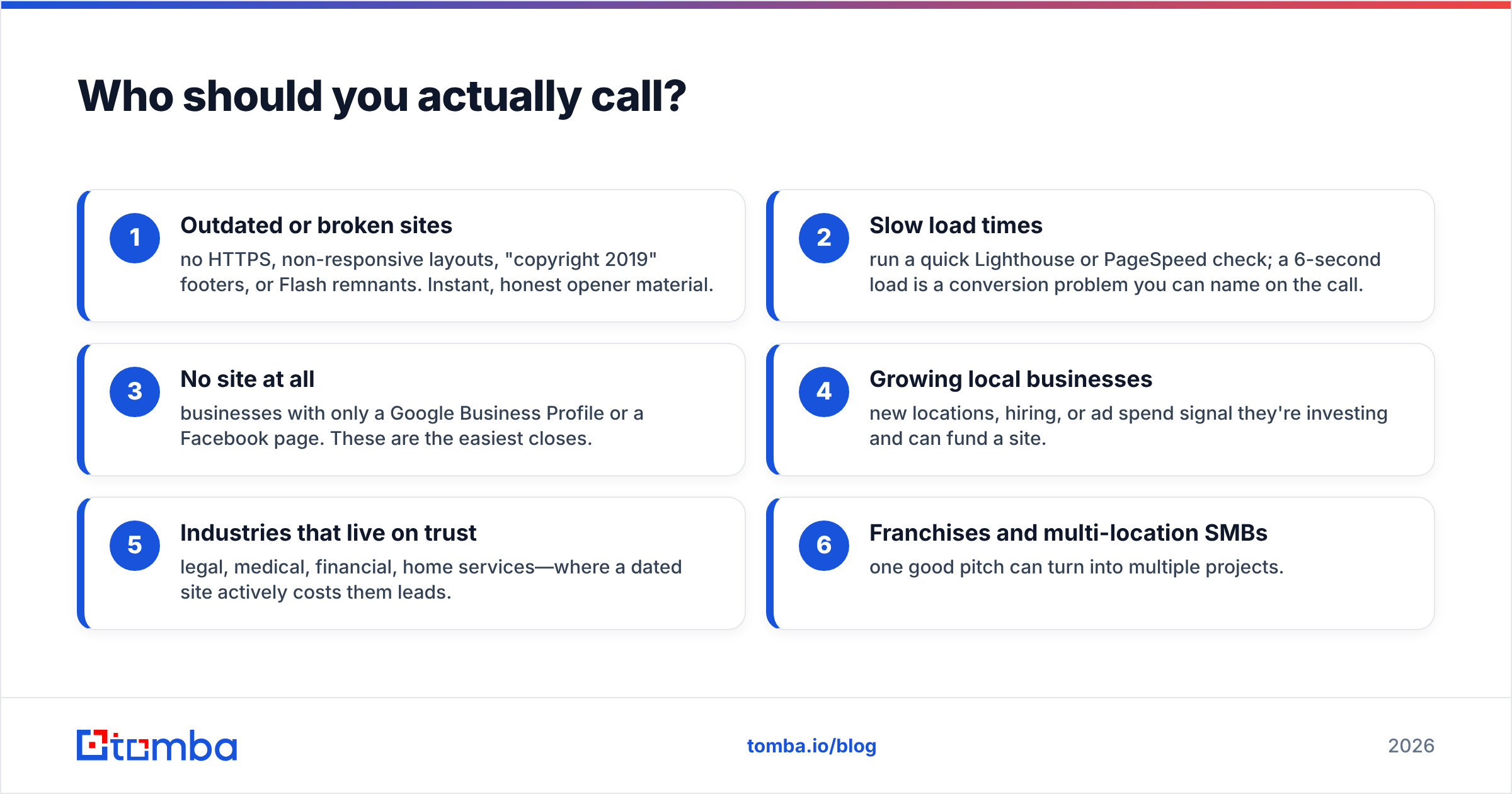
Your best cold-call web design prospect has three traits: a visible problem, budget, and a reachable decision-maker. Skip enterprises (procurement kills you) and skip pre-revenue startups (no budget). Aim for the middle.
Build your list around these signals:
- Outdated or broken sites — no HTTPS, non-responsive layouts, "copyright 2019" footers, or Flash remnants. Instant, honest opener material.
- Slow load times — run a quick Lighthouse or PageSpeed check; a 6-second load is a conversion problem you can name on the call.
- No site at all — businesses with only a Google Business Profile or a Facebook page. These are the easiest closes.
- Growing local businesses — new locations, hiring, or ad spend signal they're investing and can fund a site.
- Industries that live on trust — legal, medical, financial, home services—where a dated site actively costs them leads.
- Franchises and multi-location SMBs — one good pitch can turn into multiple projects.
Once you know who, you need names and numbers. Pulling the owner or marketing lead—plus a direct line instead of the front-desk gatekeeper—is where most callers lose. A phone finder and a domain search turn a company name into a decision-maker and a direct dial, so you're not stuck in reception loops.
What's the best cold calling script for web design sales?#
The best script is short, names the prospect's problem in the first ten seconds, and asks for a low-commitment next step. Here's a proven structure.
1. Pattern interrupt + permission (10 seconds)
"Hi [Name], this is [You] with [Agency]—I know I'm calling out of the blue. Can I steal 30 seconds and then you can tell me to buzz off?"
Asking permission disarms the reflex hang-up and earns you the next 30 seconds.
2. Specific, personalized reason (15 seconds)
"I was looking at [Business]'s site this morning and noticed it's not loading well on mobile—took about seven seconds on my phone. For a [industry] business, that's probably costing you calls from people searching on their phones."
Specificity is everything. "Your site loads slow" beats "we improve websites" by a mile.
3. The ask—book the audit, not the project
"I'm not trying to sell you anything today. I'd like to send over a quick two-minute video showing exactly what I'd fix and what it could mean for your bookings. What's the best email for that?"
You just moved the deal to a warm channel and captured their email. That's the win.
4. Handle the brush-off
- "We already have a guy." → "Totally—most people I call do. This is just a second opinion, free, no strings. Worst case you confirm your guy's doing great."
- "Not interested." → "Fair enough. Quick question before I go—are you getting enough leads from the site, or is that not really where your business comes from?" (This reopens 20% of calls.)
Keep the tone consultative. You're a specialist offering a diagnosis, not a salesperson reading lines.
How do you build a cold-call list that converts?#
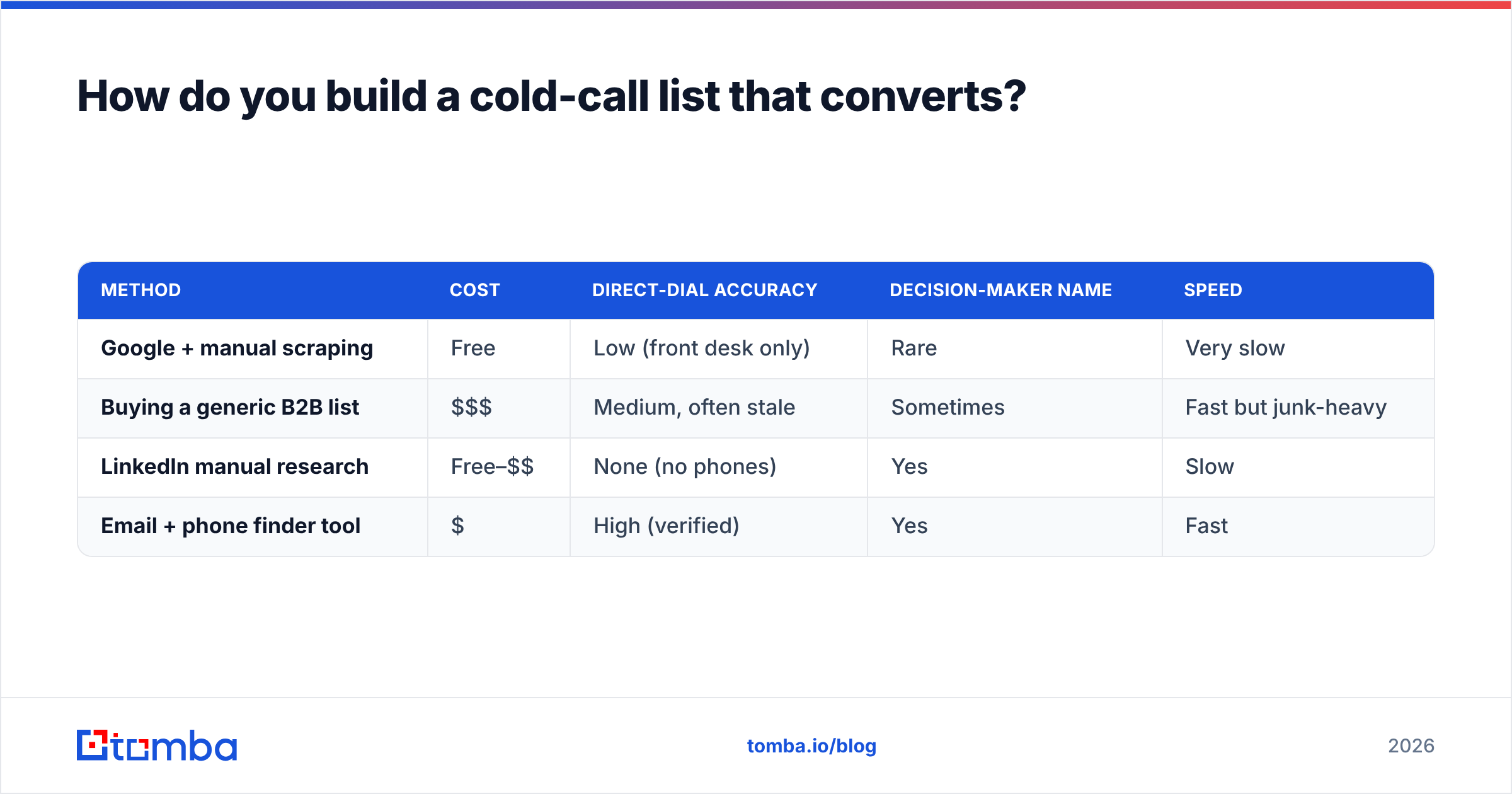
You need three data points per prospect: the business, the decision-maker, and a way to reach them. Here's a comparison of common ways to assemble that list and where each falls short.
| Method | Cost | Direct-dial accuracy | Decision-maker name | Speed |
|---|---|---|---|---|
| Google + manual scraping | Free | Low (front desk only) | Rare | Very slow |
| Buying a generic B2B list | $$$ | Medium, often stale | Sometimes | Fast but junk-heavy |
| LinkedIn manual research | Free–$$ | None (no phones) | Yes | Slow |
| Email + phone finder tool | $ | High (verified) | Yes | Fast |
Generic bought lists are the classic trap: cheap per record, expensive in wasted dials and burned reputation. Manual scraping is free but caps your volume at a handful of prospects an hour.
A better workflow: identify the businesses with weak sites, then enrich each one with a verified contact. Tools like Tomba pull the decision-maker's professional email and, where available, a direct number from the company domain—so you spend your hour dialing, not digging. Compare that to a purchased list where half the numbers ring a disconnected line.
Phone-only or multichannel? What actually books meetings#
Multichannel wins, and it isn't close. Phone alone forces you to catch someone in a two-minute window of availability. Pairing the call with email and, occasionally, a LinkedIn touch gives the prospect three chances to say yes on their schedule.
A simple, effective cadence over 10 business days:
- Day 1: Cold call. If no answer, leave a 15-second voicemail referencing their site.
- Day 1 (same hour): Send the promised audit email—even if you didn't reach them, reference the voicemail.
- Day 3: Second call, different time of day.
- Day 5: Value email—one specific tip they can use whether or not they hire you.
- Day 8: Third call.
- Day 10: Breakup email—"Should I close your file?" (surprisingly high reply rate).
This is where having the prospect's verified email matters as much as the phone. The call earns attention; the email finder makes sure your follow-up actually lands in the right inbox instead of a generic info@ address nobody checks. If you want to understand deliverability before you send at volume, brush up on email deliverability so your follow-ups don't get filtered.
What tools and metrics should you track?#
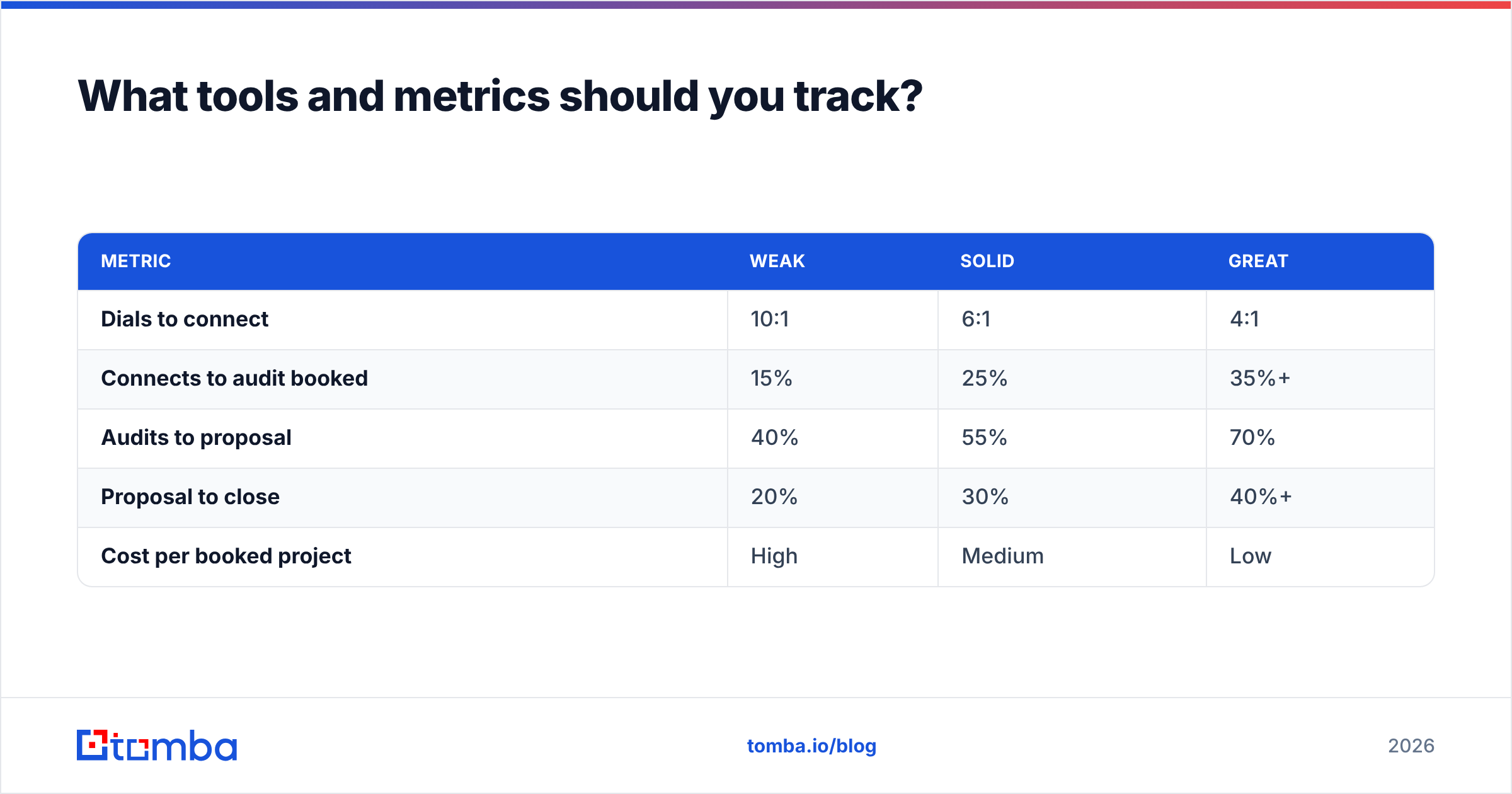
Treat cold calling like a pipeline, not a lottery. Track these numbers weekly so you know what to fix:
| Metric | Weak | Solid | Great |
|---|---|---|---|
| Dials to connect | 10:1 | 6:1 | 4:1 |
| Connects to audit booked | 15% | 25% | 35%+ |
| Audits to proposal | 40% | 55% | 70% |
| Proposal to close | 20% | 30% | 40%+ |
| Cost per booked project | High | Medium | Low |
If your dial-to-connect ratio is bad, your list is the problem—wrong numbers or wrong people. If connects are fine but audits aren't booking, your opener is the problem. This diagnostic split tells you exactly where to spend your next hour.
On the stack side, you need three layers:
- A contact-data source to build accurate lists (verified emails + phone numbers).
- A dialer or CRM to log calls, set follow-up reminders, and prevent leads from slipping. Popular options are reviewed on G2.
- A calendar link so booking an audit takes one click, not an email tennis match.
Keep it lean early. A spreadsheet, a phone, and a reliable enrichment tool will out-book a bloated tech stack run on a bad list. You can review Tomba pricing to see where a free tier of 25 searches per month fits a beginner testing the channel before scaling to the $49/mo Starter plan.
Is cold calling better than cold email or ads for web design?#
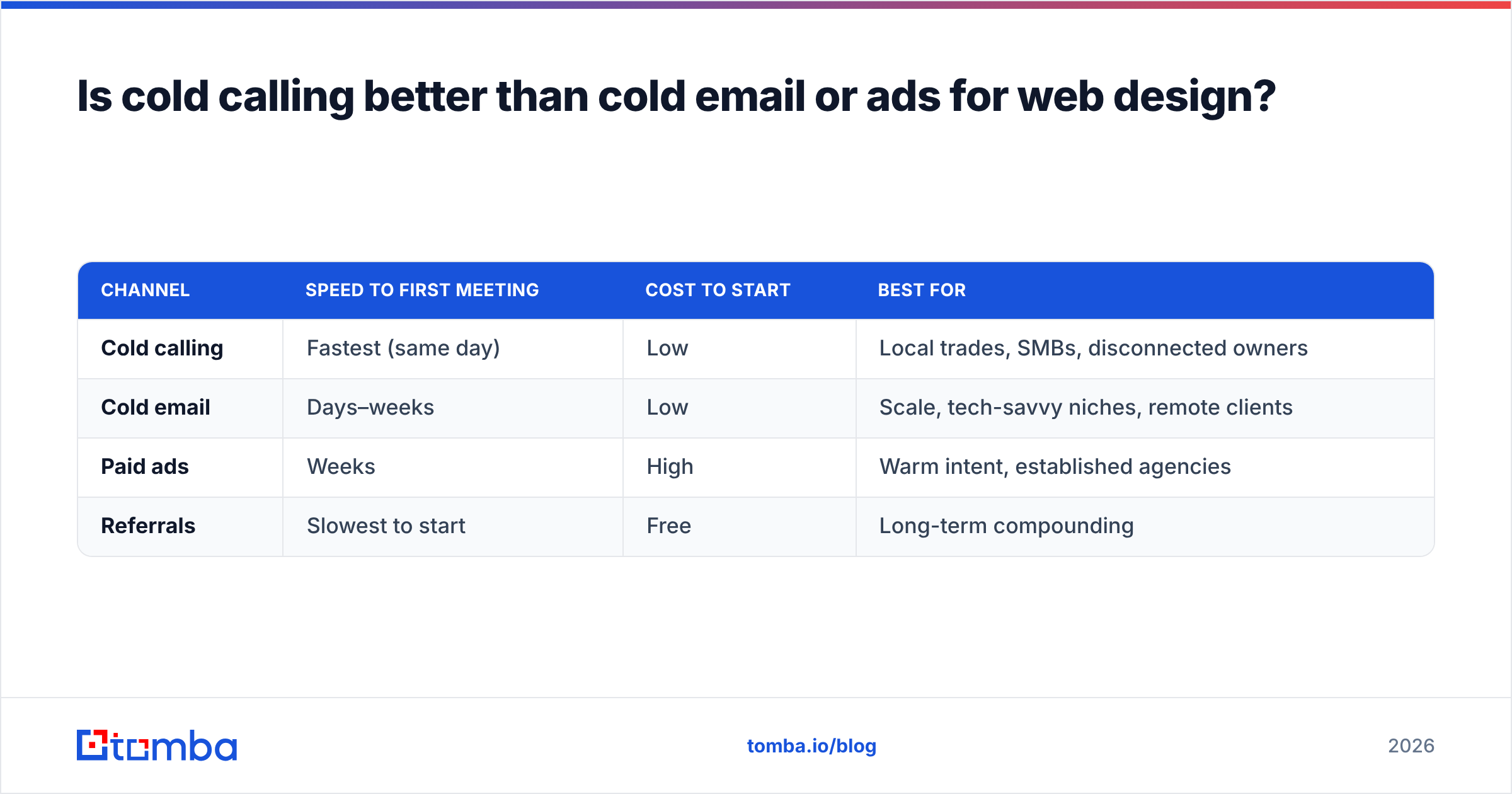
It depends on your stage and skin thickness, but each channel has a clear best-fit. Cold calling wins on speed-to-feedback and works best for local, phone-friendly industries. Cold email wins on scale and is easier to automate. Paid ads win on inbound intent but demand budget and patience.
| Channel | Speed to first meeting | Cost to start | Best for |
|---|---|---|---|
| Cold calling | Fastest (same day) | Low | Local trades, SMBs, disconnected owners |
| Cold email | Days–weeks | Low | Scale, tech-savvy niches, remote clients |
| Paid ads | Weeks | High | Warm intent, established agencies |
| Referrals | Slowest to start | Free | Long-term compounding |
The honest answer for most freelancers and small agencies: run cold calling and cold email together off the same enriched list. The call surfaces the interested prospects fast; the email nurtures the rest without more dial time. As Wikipedia's overview of cold calling notes, conversion has always depended on relevance and timing—modern data tools simply make both easier to hit.
Common mistakes that kill web design cold calls#
- Pitching the build, not the problem. Nobody buys "a website." They buy more calls, more bookings, more trust. Lead with their outcome.
- Calling the front desk. Without the owner's or marketer's direct line, you're negotiating with a gatekeeper trained to say no.
- No specific hook. "I noticed your site" is generic. "Your contact form is broken on mobile" gets a meeting.
- Quitting after one touch. The data is unambiguous: most closes happen on the third to fifth contact.
- Winging the list. A great script on a bad list produces silence. Fix the list first.
Closing thought: the phone still works when the data does#
Cold calling web design sales in 2026 isn't dead—it's just unforgiving of a lazy list. The callers who win are the ones who show up already knowing the prospect's site problem and holding a direct line to the person who can fix it. That's a data problem before it's a sales problem.
If you want to turn a list of businesses with weak websites into a dialable pipeline of decision-makers, start with the Tomba Email Finder. Find the owner or marketing lead behind any company domain, pair it with a verified email for your follow-up cadence, and spend your hours closing web projects instead of chasing disconnected numbers. Test it free, prove the channel, then scale the dialing that pays.
Related guides#
// get started
Find, verify and enrich your first contacts today
Start on the free plan with 25 searches a month, then scale when your team is ready.
Free plan · No credit card required · GDPR & CCPA
// about the author