Cold Email Case Study: How a 1.2% Reply Rate Hit 14%
A full teardown of a real cold email case study: the exact list, copy, and sequence changes that took reply rates from 1.2% to 14% in 90 days.
Most "cold email case study" posts show you a screenshot of a full inbox and skip the boring parts that actually caused the result. This one does the opposite. Below is a full teardown of a 90-day outbound rebuild for a mid-market B2B SaaS team — the data, the copy, the sequence, and the deliverability plumbing — with the exact numbers at each stage.
TL;DR
- A B2B SaaS team went from a 1.2% reply rate to 14% in 90 days without adding headcount or new tools.
- The single biggest lever was list quality, not clever copy — verified, tightly-targeted contacts beat volume every time.
- Copy shifted from "we do X" pitches to one-sentence relevance + one question, cutting length by ~60%.
- Deliverability fixes (domain warmup, SPF/DKIM, verified sends) rescued ~30% of emails that were silently landing in spam.
- Replicable takeaway: fix data → fix inbox placement → fix copy, in that order.
What was the starting point for this cold email case study?#
The subject was a 40-person B2B SaaS company selling workflow software to operations teams. Before the rebuild, their outbound looked like most struggling programs: high volume, low discipline.
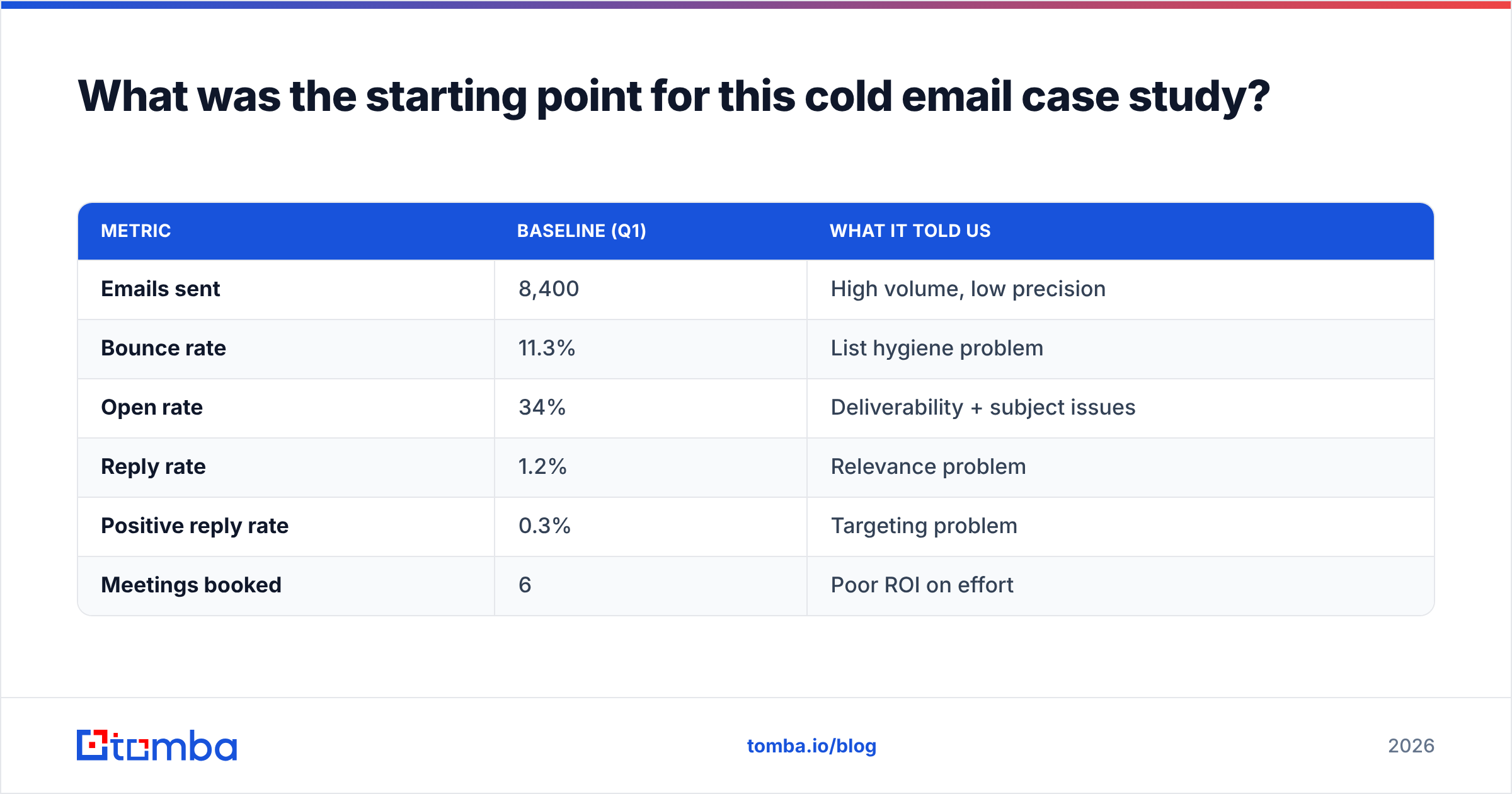
Here is the honest baseline from their first 90 days of the year.
| Metric | Baseline (Q1) | What it told us |
|---|---|---|
| Emails sent | 8,400 | High volume, low precision |
| Bounce rate | 11.3% | List hygiene problem |
| Open rate | 34% | Deliverability + subject issues |
| Reply rate | 1.2% | Relevance problem |
| Positive reply rate | 0.3% | Targeting problem |
| Meetings booked | 6 | Poor ROI on effort |
A 1.2% reply rate on 8,400 emails is 101 replies, and only about 25 of those were positive. For a two-person SDR team burning a full quarter, that is close to a rounding error. The instinct on the team was to "improve the copy." The data said the copy was the last thing to touch.
Why was the reply rate so low to begin with?#
The reply rate was low because of three compounding failures, ranked by how much damage each did: bad data, bad inbox placement, and bad relevance.
An 11.3% bounce rate is the tell. When more than one in ten sends bounces, mailbox providers read your domain as a low-trust sender, and the emails that don't bounce start quietly skipping the inbox. So the "34% open rate" was flattering — it was 34% of a shrinking pool of delivered mail. The real reach was far lower.
Think of it like a leaky bucket. You can pour more water in (send more emails) or you can make the water sweeter (better copy), but if the bucket has holes in the bottom (bad data and spam placement), none of it matters. We patched the holes first.

Here is how we diagnosed the three failures:
- Bad data — 11.3% hard bounces plus an unknown volume of catch-all addresses that "delivered" but never reached a human. Roughly a third of the list was junk.
- Bad inbox placement — a single sending domain, no warmup, and a missing DKIM record meant Google and Microsoft were filtering aggressively.
- Bad relevance — a 180-word template that opened with "We're a leading platform that helps companies…" — the exact phrasing every prospect deletes on reflex.
How did fixing the list move the numbers?#
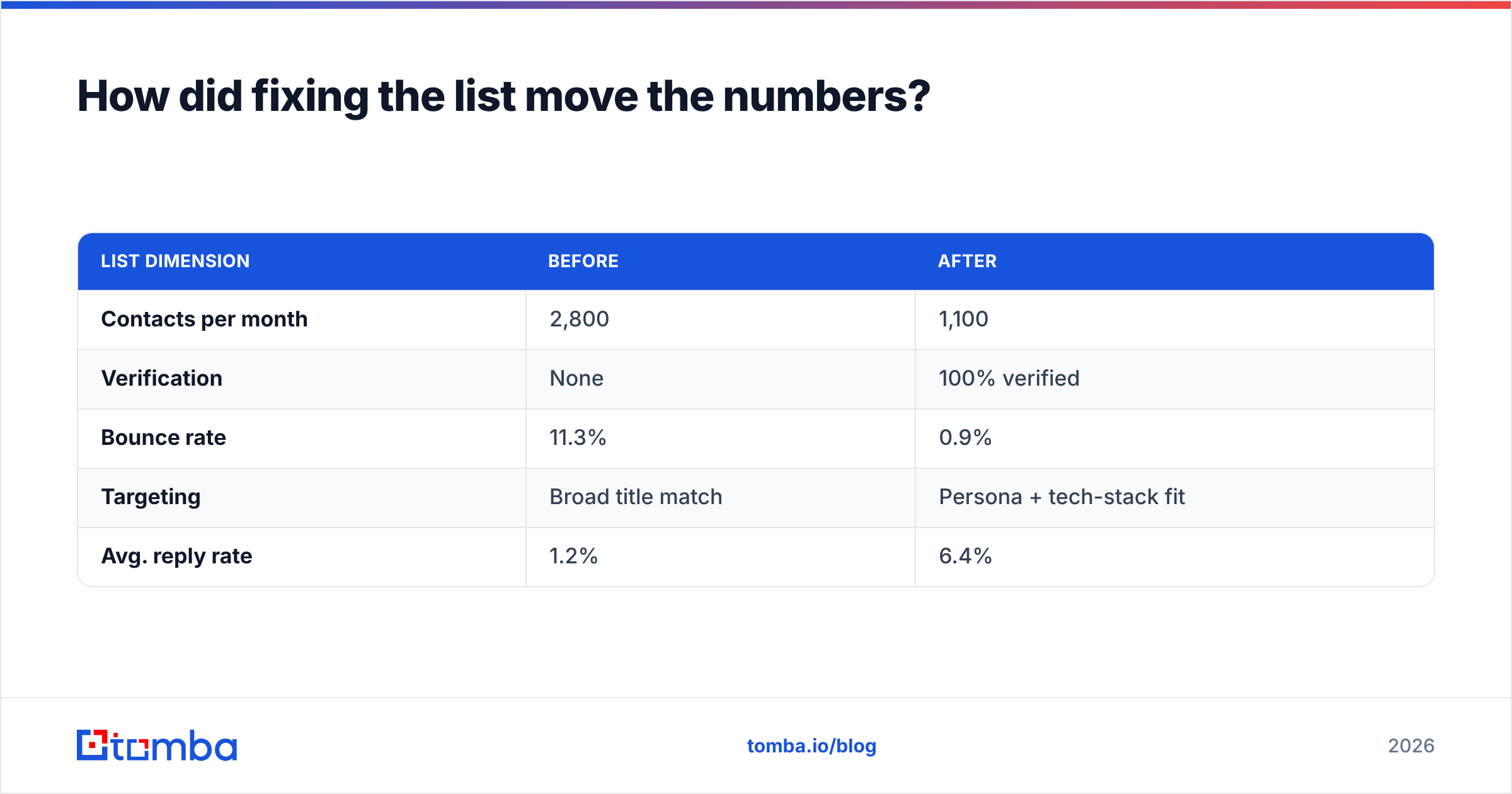
Fixing the list did more than any copy change — it cut bounces from 11.3% to 0.9% and roughly doubled the positive reply rate on its own.
The team was building lists by scraping and guessing email patterns. We replaced that with a verified workflow: pull contacts by role and company using a domain search, then run every address through an email verifier before it ever entered a sequence. Catch-all domains got flagged and routed through a catch-all verifier instead of being trusted blindly.
Just as important was narrowing the list. The old approach targeted anyone with "operations" in their title at any company over 50 employees. The new approach targeted a specific persona — ops leaders at 100–500 person companies using a named competitor tool. Smaller list, dramatically higher relevance.
| List dimension | Before | After |
|---|---|---|
| Contacts per month | 2,800 | 1,100 |
| Verification | None | 100% verified |
| Bounce rate | 11.3% | 0.9% |
| Targeting | Broad title match | Persona + tech-stack fit |
| Avg. reply rate | 1.2% | 6.4% |
Cutting the list by more than half and increasing results is the counterintuitive lesson every strong cold email case study repeats. Fewer, better contacts win. If you want to see the mechanics of building targeted lists at scale, the Tomba Email Finder and bulk email finder are the tools this team leaned on, and G2's sales intelligence category is a good neutral place to compare options.
What role did deliverability play?#
Deliverability was the hidden multiplier — after verifying the list, inbox placement fixes recovered roughly 30% of sends that had been landing in spam.
Verified contacts stop bounces, but they don't fix a low-trust domain. The team made four changes to their sending infrastructure, none of them glamorous:
- Authentication — added the missing DKIM record and corrected the SPF record so mailbox providers could confirm the sender identity.
- Warmup — moved off the primary corporate domain to a dedicated sending domain and warmed it up over three weeks before scaling volume.
- Volume pacing — capped sends at 40 per mailbox per day across several mailboxes instead of blasting from one.
- Ongoing monitoring — checked sender reputation weekly and pulled any thread that triggered spam complaints.
The impact showed up as a jump in replied rate even before copy changed, because more mail was actually being seen. For a deeper walk-through of the mechanics, Google's Postmaster Tools guidance is the authoritative reference, and it pairs well with Tomba's own primer on email deliverability.
How did the copy and sequence change?#
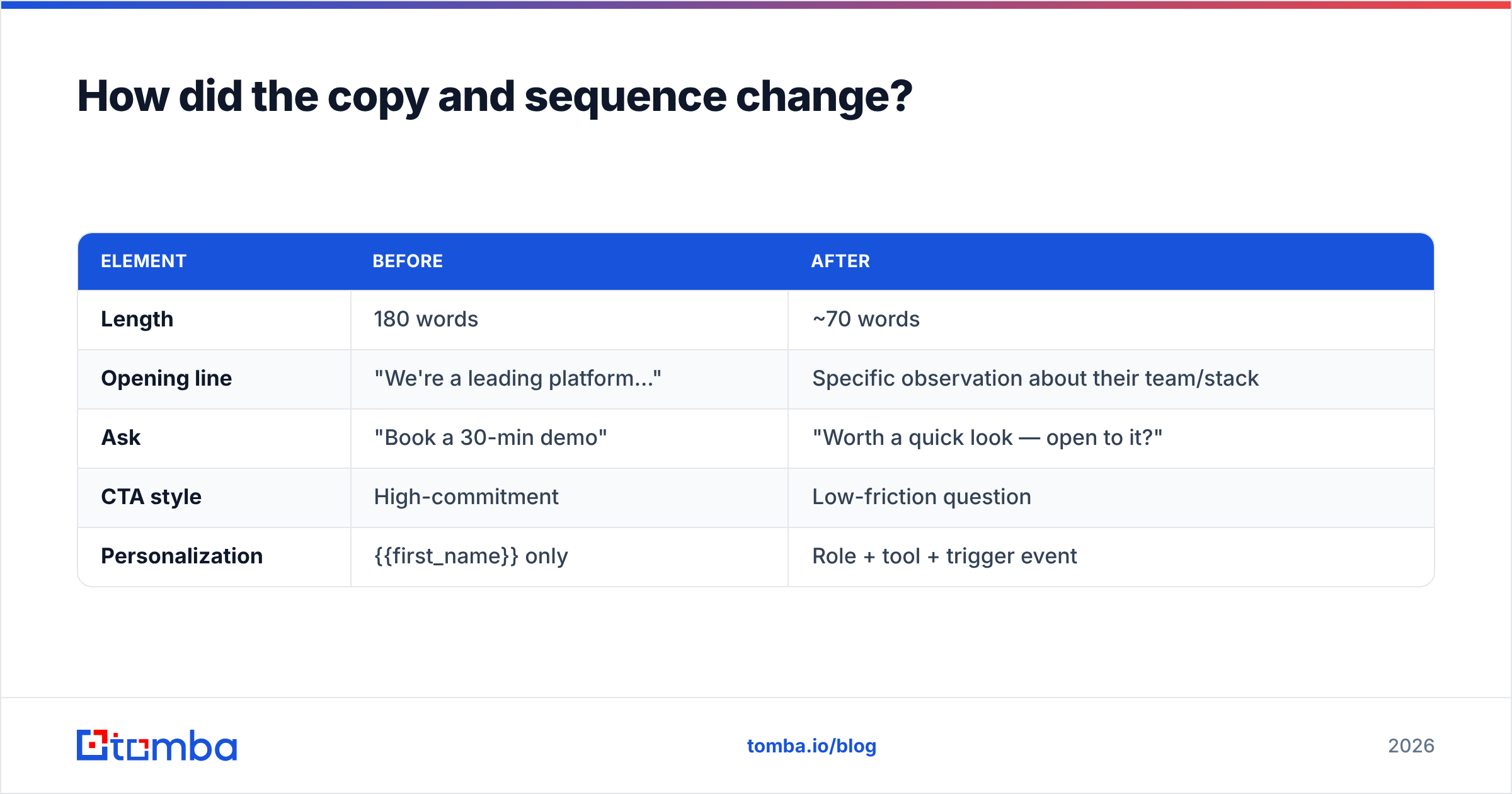
The copy got shorter, more specific, and more human — the winning email dropped from 180 words to about 70 and led with relevance instead of a pitch.
The old email led with the company. The new one led with the prospect. Here is the structural before-and-after:
| Element | Before | After |
|---|---|---|
| Length | 180 words | ~70 words |
| Opening line | "We're a leading platform…" | Specific observation about their team/stack |
| Ask | "Book a 30-min demo" | "Worth a quick look — open to it?" |
| CTA style | High-commitment | Low-friction question |
| Personalization | {{first_name}} only | Role + tool + trigger event |
The winning first email read roughly like this:
Hi {{first_name}} — noticed {{company}}'s ops team is still running {{competitor_tool}} across {{n}} sites. The teams we work with switch when reporting starts eating their week. Is that a live problem for you, or already solved?
No feature list. No "circling back." One relevant observation and one honest question. The sequence itself dropped from six emails to four, spaced over 14 days, with each follow-up adding a new angle rather than repeating the ask. That follow-up discipline matters — if you want the framework, this internal breakdown of response rate drivers covers the timing logic in more depth.
What were the final results after 90 days?#
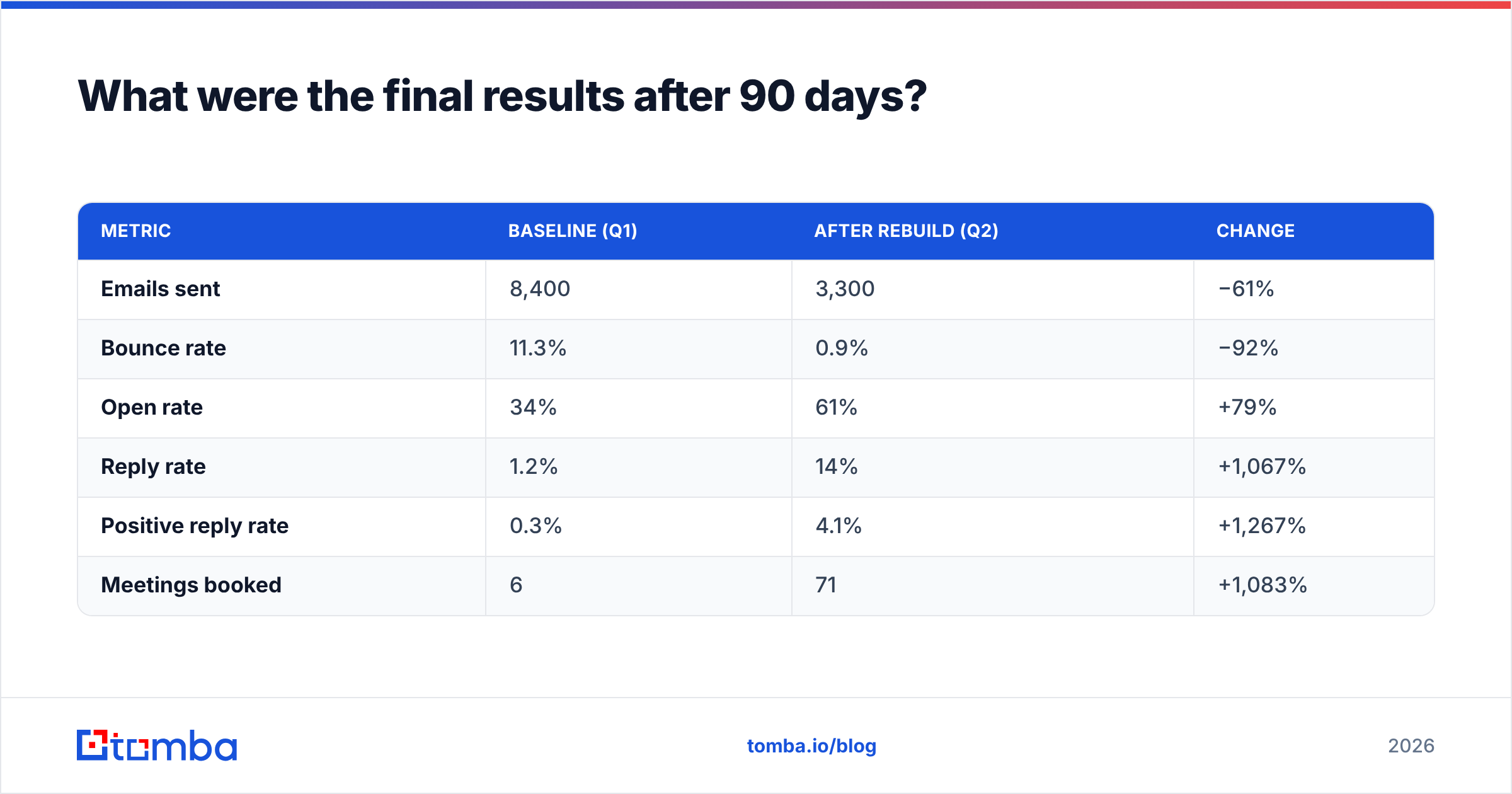
After 90 days the program went from 6 meetings to 71, driven by a 14% reply rate on less than half the send volume.
| Metric | Baseline (Q1) | After rebuild (Q2) | Change |
|---|---|---|---|
| Emails sent | 8,400 | 3,300 | −61% |
| Bounce rate | 11.3% | 0.9% | −92% |
| Open rate | 34% | 61% | +79% |
| Reply rate | 1.2% | 14% | +1,067% |
| Positive reply rate | 0.3% | 4.1% | +1,267% |
| Meetings booked | 6 | 71 | +1,083% |
The headline is not the 14% reply rate. It is that they achieved it while sending 61% fewer emails. Less work, better data, more meetings. That is the entire thesis of modern outbound compressed into one table.
What can you copy from this case study?#
You can copy the sequence of priorities, which is the part most teams get backwards. Do these in order:
- Verify and narrow the list first. No copy fixes a 30% junk rate. Start with a clean, tightly-targeted list and confirm every address before it enters a sequence.
- Fix deliverability before you scale. Authenticate the domain, warm it up, and pace your volume. A perfect email in the spam folder converts at zero.
- Cut copy length in half. Lead with a specific, true observation about the prospect. Ask one low-friction question. Delete every sentence about yourself.
- Shorten the sequence, vary the angle. Four thoughtful touches beat six repetitive ones.
- Measure positive replies, not opens. Opens are vanity in a post-Apple-Mail-Privacy world. Track replies that lead to conversations.
None of this requires a bigger budget. The team in this cold email case study used the same headcount and roughly the same spend — they just reallocated effort from volume to precision.
Where does Tomba fit in?#
If the biggest lever in this case study was list quality, that is exactly where a tool earns its cost. The whole rebuild started with verified, targeted contacts — pulled by role and company, checked for validity, and cleaned of catch-alls before a single email went out.
That is what the Tomba Email Finder is built for: find professional email addresses by domain, name, or company, verify them in the same workflow, and export clean lists straight into your sequencer. There is a free tier with 25 searches a month to test it on your own list, and paid plans start at $49/mo — you can see the full Tomba pricing before committing. Fix the data first, and the rest of your cold email case study writes itself.
Related guides#
Ready to find emails that actually work?
Join 150,000+ professionals who stopped guessing and started sending. Free credits on signup — no credit card required.
Get the Tomba newsletter
Practical outbound tactics and product updates — once every two weeks.
About the author