How to Write a Cold Email Company Introduction (2026 Guide)
A cold email company introduction lives or dies in the first two lines. Here's the framework, templates, and mistakes that quietly kill your reply rate.
Most cold email company introductions read like a press release nobody asked for. You lead with your founding year, your award shelf, your "industry-leading platform," and by line three the prospect has already archived you. The introduction is the hardest 90 words in outbound because it has to do the opposite of what instinct tells you: talk less about your company and more about the person reading it.
This guide breaks down how to introduce your company in a cold email without triggering the delete reflex — the structure, the templates, the metrics that matter, and the specific phrases that quietly tank your reply rate.
TL;DR#
- Lead with relevance, not your company name. The first line is about the prospect; your company earns its mention in line three or four.
- One value claim, one proof point, one ask. A company introduction that lists five differentiators converts worse than one that names a single outcome.
- Keep it under 120 words. Long intros signal "this is about me, not you." Short ones respect the reader's time.
- Personalization beats template polish. A rough email referencing a real trigger outperforms a beautiful generic one every time.
- Deliverability comes first. The best introduction never read is worth zero — verified addresses and a warmed domain decide whether your words are seen at all.
What is a cold email company introduction?#
A cold email company introduction is the opening message you send to a prospect who has never heard of you, with the goal of explaining who your company is and why it's relevant to them — in a way that earns a reply, a meeting, or at minimum a "tell me more."
Think of it like introducing yourself at a conference. Nobody wants the person who corners them and monologues about their startup's funding round. The people who get remembered ask a sharp question, connect to something the other person cares about, and only then explain what they do. Cold email works the same way. The company introduction is not a monologue — it's the opening line of a conversation you hope the other person continues.
Technically, the introduction spans the subject line, the first sentence, and the two-to-three sentences that frame your company against the prospect's world. Get those wrong and the rest of your carefully written email never gets read.
Why do most company introductions fail?#
Because they're written from the sender's point of view. The classic failure looks like this:
"Hi Sarah, I'm reaching out from Acme Solutions, a leading provider of cloud-based workflow automation trusted by over 2,000 companies worldwide. We were founded in 2018 and have won several awards for..."
Every word of that is true and none of it matters to Sarah. She doesn't know you, so your credentials are noise. Worse, "leading provider" and "trusted by 2,000 companies" are phrases every vendor uses, which makes you sound identical to the last twelve emails she deleted.

The second reason intros fail is timing and reach. A brilliant introduction sent to a stale, unverified address bounces — and bounces hurt your sender reputation, which then buries your next email in spam. According to HubSpot's sales research, personalization and relevance consistently outrank clever copy in reply-rate studies. The company that gets replies isn't the one with the slickest pitch; it's the one that reaches the right person, at a deliverable address, with a reason to care.
What does a high-converting company introduction look like?#
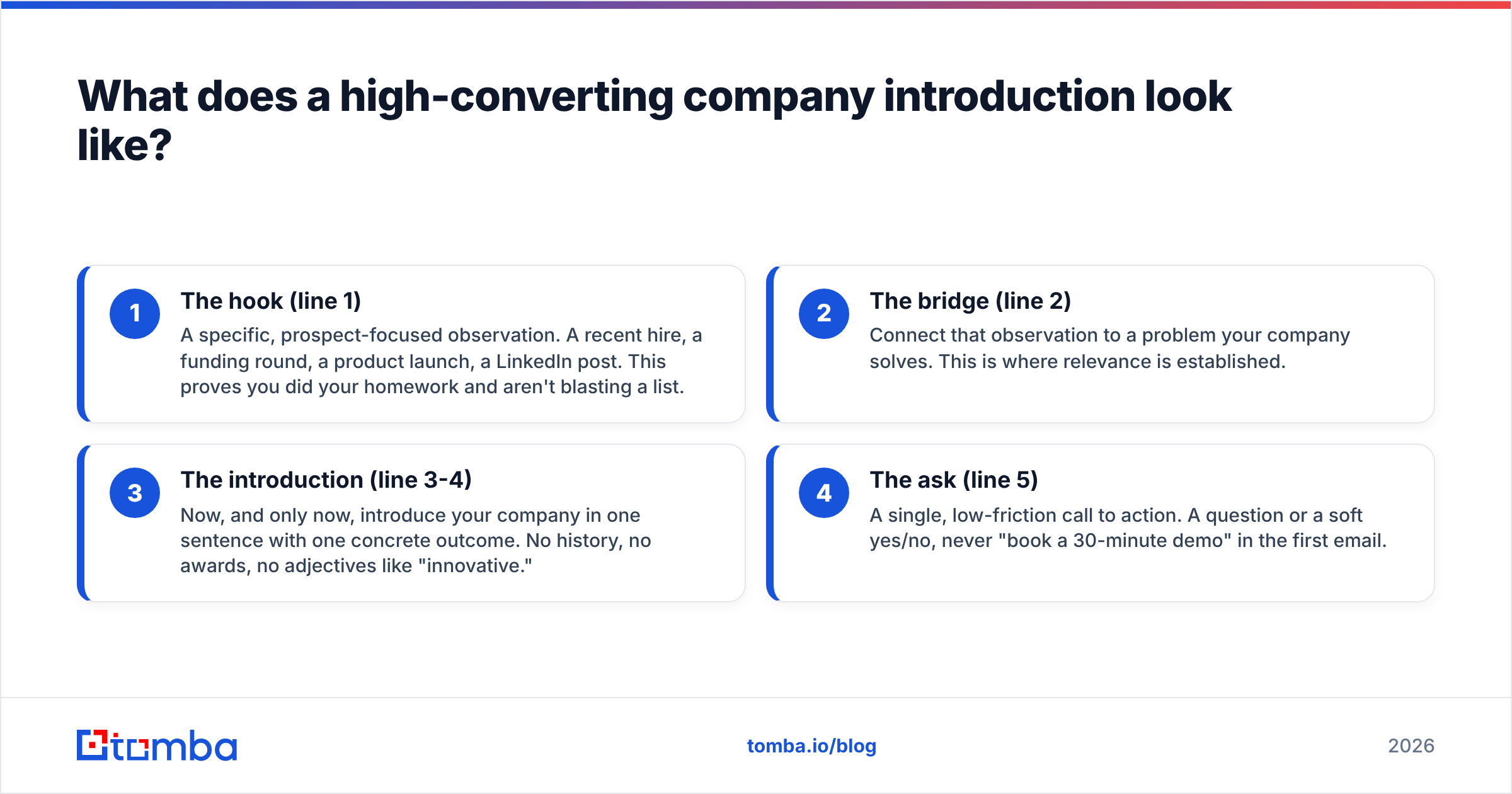
The strongest cold email introductions follow a repeatable four-part structure. Each part earns the right to the next line.
- The hook (line 1) — A specific, prospect-focused observation. A recent hire, a funding round, a product launch, a LinkedIn post. This proves you did your homework and aren't blasting a list.
- The bridge (line 2) — Connect that observation to a problem your company solves. This is where relevance is established.
- The introduction (line 3-4) — Now, and only now, introduce your company in one sentence with one concrete outcome. No history, no awards, no adjectives like "innovative."
- The ask (line 5) — A single, low-friction call to action. A question or a soft yes/no, never "book a 30-minute demo" in the first email.
Here's the same message rewritten with the framework:
"Hi Sarah — saw NimbleOps just opened two new fulfillment centers. Scaling ops usually means finance loses visibility into per-warehouse costs fast. We built Acme to give ops-heavy teams that cost breakdown automatically; DTC brands like yours cut month-end close from 9 days to 2. Worth a quick look, or is cost visibility already handled?"
Same company, same product. One version is about Acme. The other is about Sarah. Only one gets a reply.
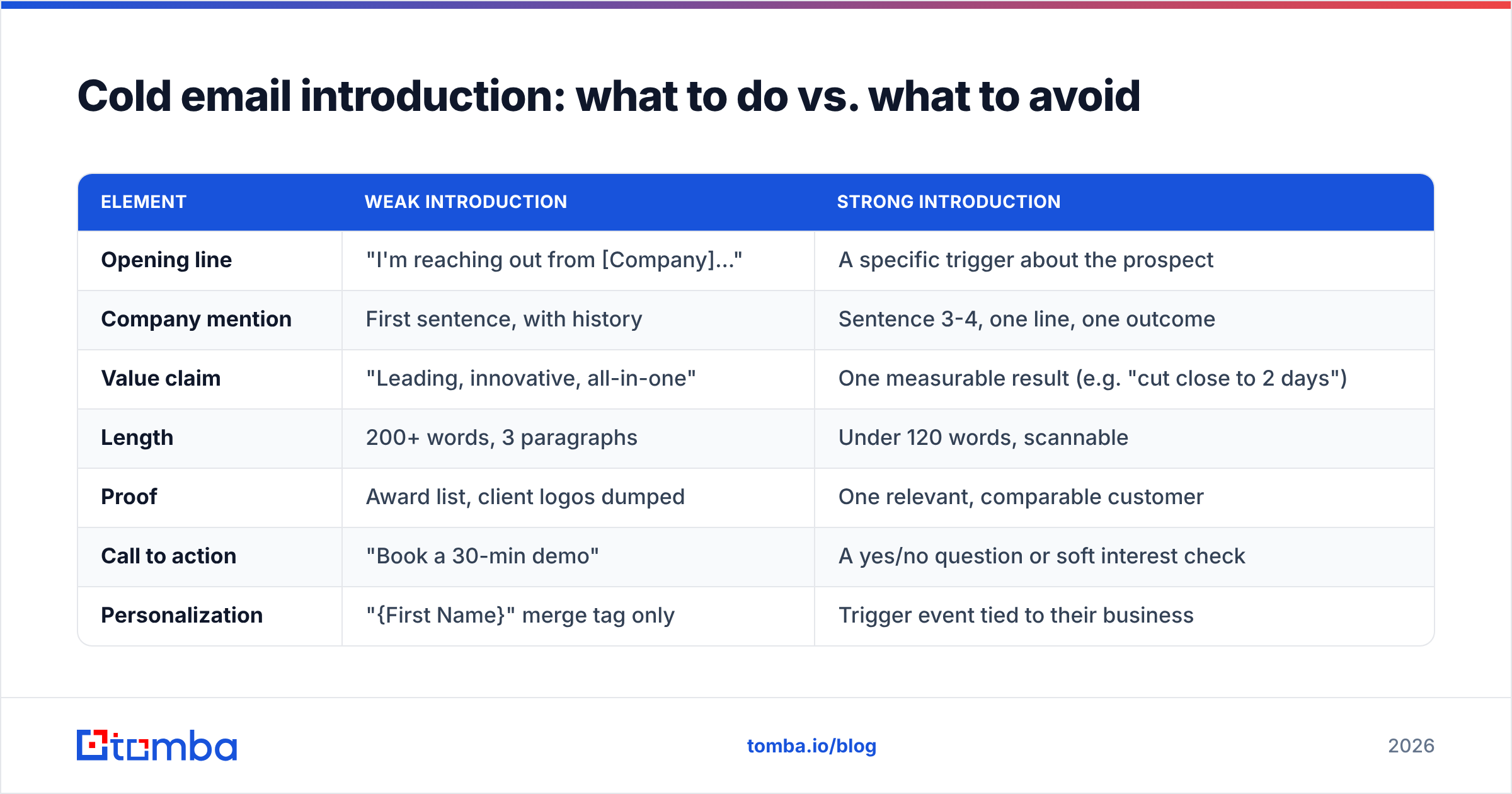
Cold email introduction: what to do vs. what to avoid#
| Element | Weak introduction | Strong introduction |
|---|---|---|
| Opening line | "I'm reaching out from [Company]…" | A specific trigger about the prospect |
| Company mention | First sentence, with history | Sentence 3-4, one line, one outcome |
| Value claim | "Leading, innovative, all-in-one" | One measurable result (e.g. "cut close to 2 days") |
| Length | 200+ words, 3 paragraphs | Under 120 words, scannable |
| Proof | Award list, client logos dumped | One relevant, comparable customer |
| Call to action | "Book a 30-min demo" | A yes/no question or soft interest check |
| Personalization | "{First Name}" merge tag only | Trigger event tied to their business |
Notice that every "strong" column choice reduces how much space your company occupies and increases how much space the prospect occupies. That's the whole game.
Which templates actually work in 2026?#
Three introduction angles consistently outperform the generic "let me tell you about us" open. Adapt them, don't copy them verbatim — recognizable templates get pattern-matched into the trash.
The trigger-event intro. You reference something that just happened at their company and position your introduction as timely rather than random. Best for prospects showing buying signals (hiring, funding, expansion).
The peer-proof intro. You introduce your company through the lens of a similar customer's result. "We help [comparable company] do [specific outcome]" works because social proof from a peer beats any self-description. This is where a strong B2B database helps — you can find genuinely comparable companies instead of name-dropping logos that don't resemble the prospect.
The problem-first intro. You open with a problem the prospect almost certainly has, then introduce your company as the team that solves exactly that. Best when you can't find a personal trigger but know the segment's pain deeply.
For ready-made starting points you can customize, Tomba's cold email templates and subject line generator give you tested skeletons — but the personalization is still on you.

How long should a company introduction be?#
Under 120 words, ideally closer to 75. Every additional sentence lowers the odds the whole thing gets read on a phone screen, where most first opens happen. Length signals intent: a short email says "I respect your time and I have one specific reason to write," while a long one says "settle in, this is about me."
A practical test: if you removed your company name, would the email still feel relevant to the reader? If yes, your framing is prospect-first. If the email collapses without your company name propping it up, you've written a brochure, not an introduction.
Keep paragraphs to one or two sentences. White space is a deliverability and readability asset — dense blocks of text read as "sales spam" to both humans and filters.
Does the introduction even matter if the email lands in spam?#
No — and this is the part most guides skip. The most persuasive company introduction ever written earns zero replies if it never reaches the inbox. Deliverability is upstream of copy.
Three things decide whether your introduction is seen:
- Address quality. Sending to invalid or catch-all addresses drives bounces. A bounce rate above ~2-3% signals to mailbox providers that you're a low-quality sender, and your email deliverability collapses. Verify before you send.
- Domain reputation. A cold domain with no warmup history gets throttled or spam-foldered regardless of content. Warm the domain and ramp volume gradually.
- Authentication. SPF, DKIM, and DMARC records tell providers you are who you claim to be. Missing records are an instant credibility hit.
This is why data hygiene sits at the foundation of any outbound program. Before you obsess over your opening line, make sure the addresses on your list are real. Tools like Tomba's email verifier exist precisely because a great introduction sent to a dead inbox is wasted effort. G2's reviews of outbound tooling (see the sales engagement category on G2) repeatedly show that teams blaming "bad copy" for low reply rates usually have a deliverability problem masquerading as a copy problem.
How do you find the right person to introduce your company to?#
Relevance starts before the first word. Introducing your company to the wrong contact — a junior employee, a role that doesn't own the budget, or a person who left the company months ago — guarantees a non-reply no matter how good the writing is.
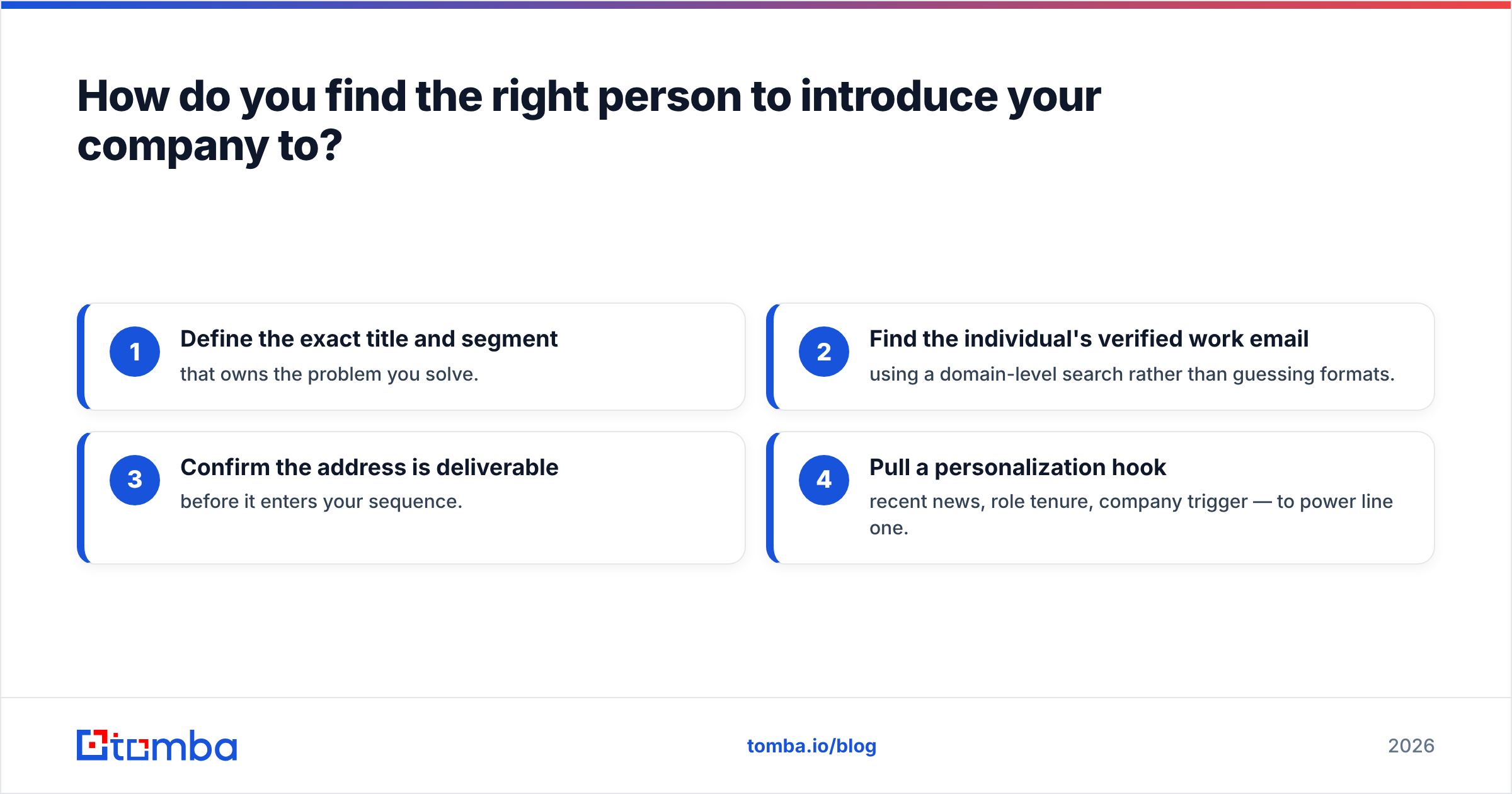
The workflow that actually scales:
- Define the exact title and segment that owns the problem you solve.
- Find the individual's verified work email using a domain-level search rather than guessing formats.
- Confirm the address is deliverable before it enters your sequence.
- Pull a personalization hook — recent news, role tenure, company trigger — to power line one.
Tomba's email finder and domain search handle steps two and three: you give it a name and company (or just a domain) and get back verified professional addresses, so your carefully written introduction reaches a real person who can actually say yes.
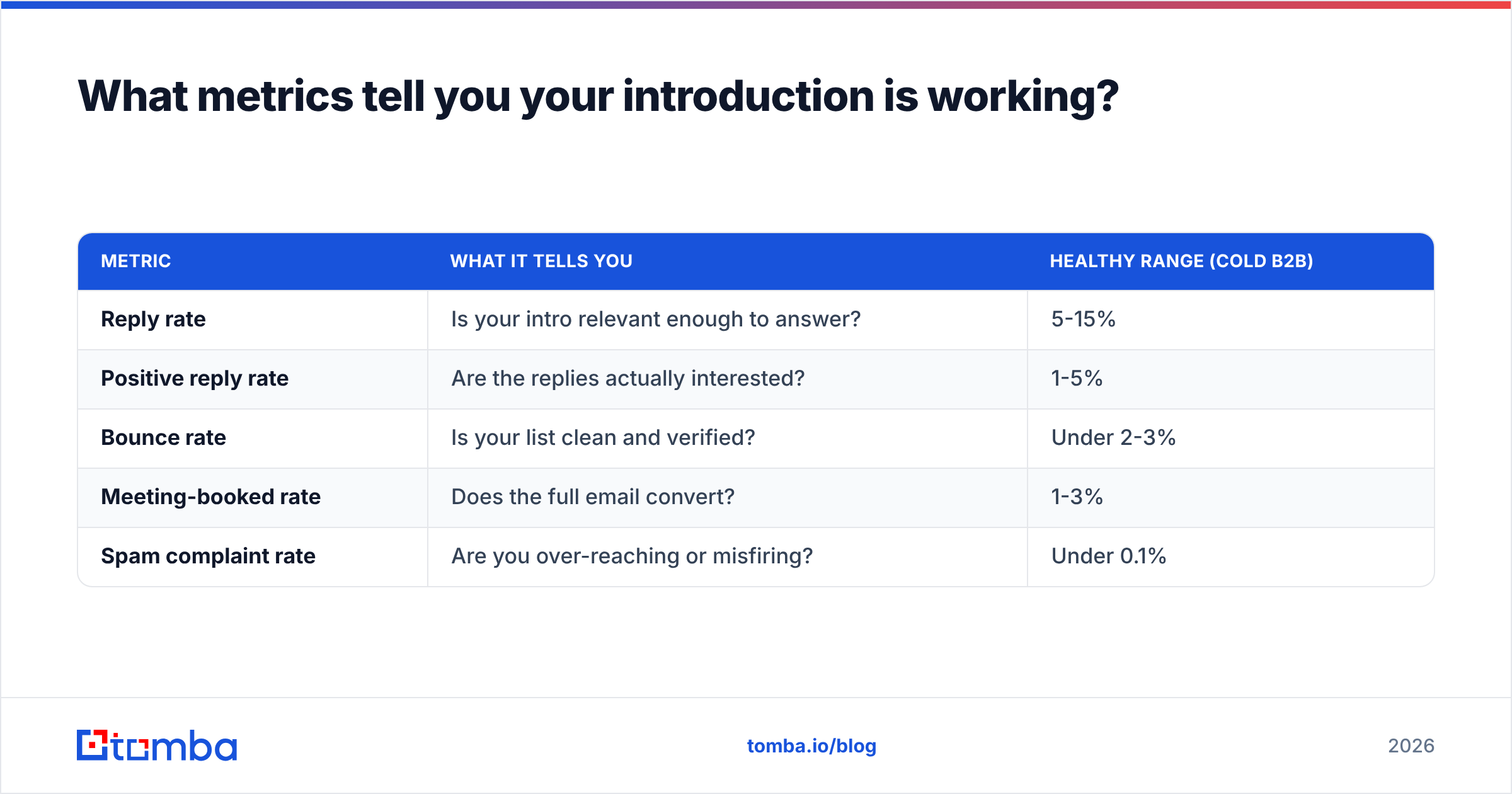
What metrics tell you your introduction is working?#
Judge the introduction by replies, not opens. Open rate has become unreliable since Apple Mail Privacy Protection inflates it, and opens don't pay your commission anyway. Watch these instead:
| Metric | What it tells you | Healthy range (cold B2B) |
|---|---|---|
| Reply rate | Is your intro relevant enough to answer? | 5-15% |
| Positive reply rate | Are the replies actually interested? | 1-5% |
| Bounce rate | Is your list clean and verified? | Under 2-3% |
| Meeting-booked rate | Does the full email convert? | 1-3% |
| Spam complaint rate | Are you over-reaching or misfiring? | Under 0.1% |
If your bounce rate is high, fix data before copy. If opens are fine but replies are near zero, your introduction is landing but failing to connect — rewrite it to be more prospect-first. Tracking response rate at the introduction stage tells you whether the top of your funnel is healthy long before anything reaches a demo.
Common mistakes that quietly kill your reply rate#
- The autobiography opener. "Founded in 2015, we are a leading…" Delete it. Nobody cares about your origin story in a cold email.
- Feature dumping. Listing five capabilities dilutes the one that matters to this prospect. Pick one outcome.
- Fake personalization. "I loved your recent post!" with no specifics is worse than no personalization — it reads as automated flattery.
- The premature demo ask. Asking for 30 minutes before you've earned 30 seconds of attention kills momentum.
- Ignoring mobile. If your introduction doesn't scan cleanly on a phone, most prospects never finish it.
- Skipping verification. Sending to unverified addresses to "save time" costs you far more in reputation damage than verification ever would.
Frequently asked questions#
How do I introduce my company without sounding salesy? Talk about the prospect's situation first and your company second. Replace adjectives ("innovative," "leading") with one specific, measurable outcome a comparable customer achieved. Salesy language is almost always self-focused language.
Should I mention my company name in the subject line? Usually no. A subject line that leads with your company name signals "advertisement." Lead with a benefit, a question, or a reference to the prospect instead.
How many follow-ups should a company introduction sequence have? Three to five touches spaced a few days apart is standard for cold B2B. Each follow-up should add a new angle or proof point, not just "bumping this to the top of your inbox."
Is AI-written company introduction copy a good idea? AI is excellent for first drafts and variations, but the personalization — the trigger event, the peer comparison — has to be real and specific. Use AI to scale structure, not to fake relevance.
The bottom line#
A cold email company introduction succeeds when it barely talks about your company. Lead with the prospect, bridge to their problem, introduce yourself in one line with one proof point, and ask for something small. Then make sure the mechanics underneath — verified addresses, a warm domain, the right contact — actually deliver those words to a human who can act on them.
That last part is where most outbound quietly fails. Before you rewrite your opening line for the tenth time, make sure it's reaching real people. Start with the Tomba Email Finder to source and verify the professional addresses behind your introductions — the free tier gives you 25 searches a month to test it, and Tomba pricing scales from $49/mo when you're ready to run volume. A great introduction deserves an inbox that actually receives it.
Related guides#
Ready to find emails that actually work?
Join 150,000+ professionals who stopped guessing and started sending. Free credits on signup — no credit card required.
Get the Tomba newsletter
Practical outbound tactics and product updates — once every two weeks.
About the author