Cold Email Follow Up Subject Line: 2026 Guide + Examples
Your follow-up subject line decides whether the second, third, and fourth email get opened at all. Here's what works in 2026, with tested examples and a copy-paste framework.
Most cold sequences die on the second email, not the first. You wrote a decent opener, got a few opens, and then every follow-up landed in a black hole. Nine times out of ten, the culprit is the subject line you slapped on the follow-up — usually "Re: quick question" or the dreaded "just checking in."
This guide breaks down what actually makes a cold email follow up subject line get opened in 2026, with concrete examples, a comparison of the main approaches, and a framework you can reuse across an entire sequence.
TL;DR#
- The follow-up subject line is a separate copywriting job — don't reuse the opener's line or default to "Re:" on autopilot.
- Shorter wins. Lines under ~5 words and 40 characters consistently out-open long ones on mobile, where most B2B email is triaged.
- Thread vs. fresh subject is a real decision. Continuing the thread keeps context; a new subject gets a fresh shot at attention. Use both across a sequence.
- Curiosity and relevance beat fake urgency. "Re: {{their initiative}}" outperforms "LAST CHANCE" with professional buyers.
- Deliverability comes first. The best subject line can't save an email that lands in spam — verified addresses and a warmed domain do more than clever wording.
Why does the follow-up subject line matter so much?#
Think of your sequence like knocking on a door. The first knock (your opener) is polite and expected. By the third knock, the person inside has already decided whether you're worth answering — and the only thing they see before deciding is the subject line and sender name in their inbox preview.
Follow-ups make up the bulk of replies in most cold campaigns. Industry data from vendors like HubSpot and Backlinko repeatedly shows that a large share of positive responses come from the second through fifth touch, not the first. If those follow-ups have weak subject lines, you're throwing away the majority of your pipeline before the recipient reads a single word of body copy.
The subject line is doing three jobs at once on a follow-up:
- Signal continuity — remind them there's an existing thread without forcing them to reopen it.
- Re-earn the open — the novelty of your first email is gone, so the line has to stand on its own.
- Stay out of spam — repetitive, salesy, or ALL-CAPS lines across a sequence are a fast track to the promotions tab.
What makes a good cold email follow up subject line?#
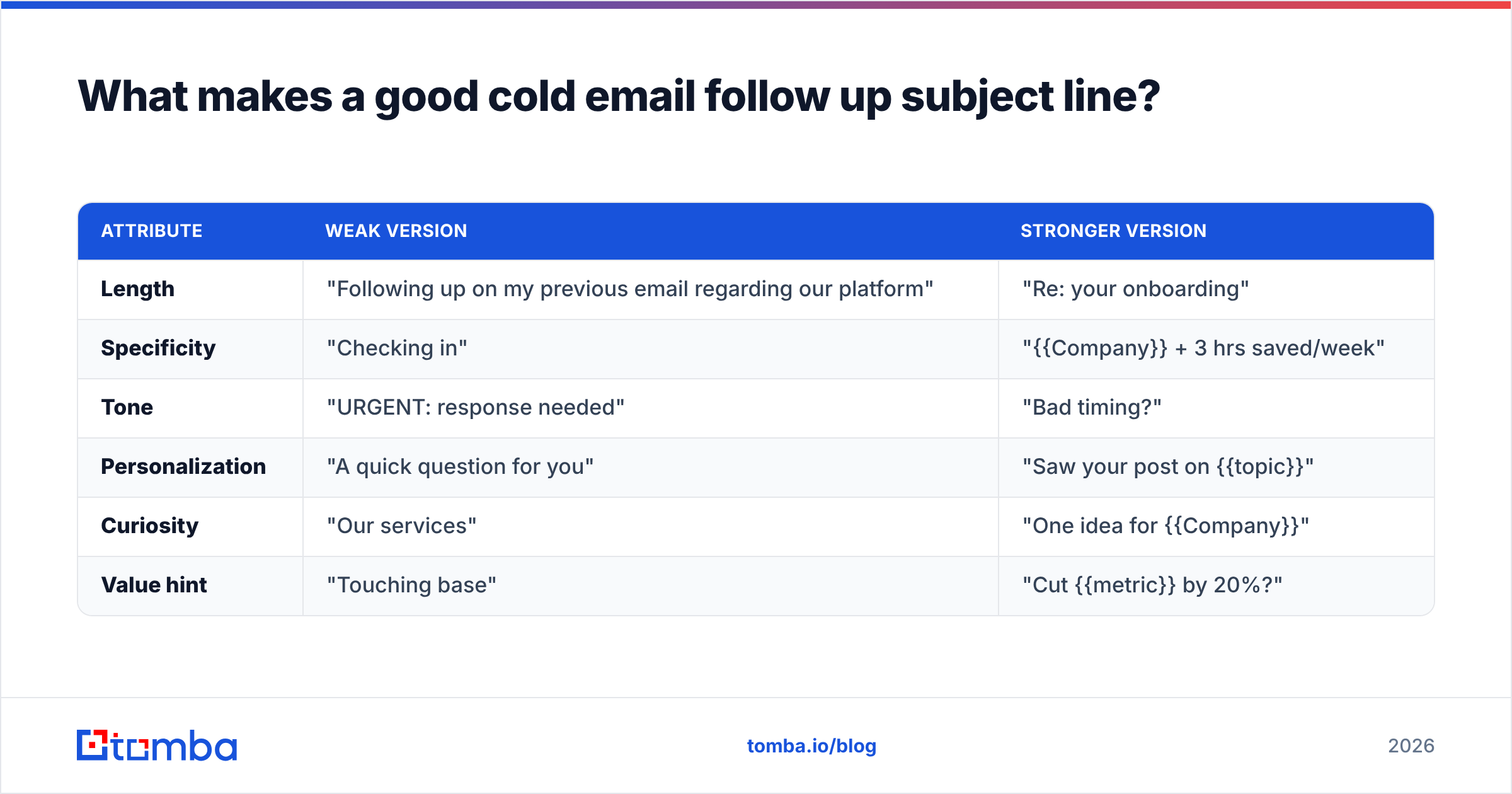
A strong follow-up subject line is short, specific, and low-pressure. It reads like something a colleague would send, not a campaign. Here are the attributes that matter most, with bad-vs-good examples.
| Attribute | Weak version | Stronger version |
|---|---|---|
| Length | "Following up on my previous email regarding our platform" | "Re: your onboarding" |
| Specificity | "Checking in" | "{{Company}} + 3 hrs saved/week" |
| Tone | "URGENT: response needed" | "Bad timing?" |
| Personalization | "A quick question for you" | "Saw your post on {{topic}}" |
| Curiosity | "Our services" | "One idea for {{Company}}" |
| Value hint | "Touching base" | "Cut {{metric}} by 20%?" |
Notice what the stronger column has in common: it's concrete, it references the recipient, and it never manufactures urgency. Professional buyers have seen every fake-deadline trick, and those lines now trigger the exact skepticism you're trying to avoid.
Length deserves special attention. Roughly 60–70% of B2B email is first triaged on a phone, where inbox previews cut subject lines at around 35–40 characters. If your key word sits at character 55, it's invisible. Front-load the meaningful word.
Should you continue the thread or start a fresh subject line?#
Both — and the choice should change across the sequence. This is the single most useful decision in follow-up copywriting, so treat it deliberately.
- Continue the thread ("Re: original subject"). Keeps the conversation visually grouped, preserves context, and feels like a natural nudge. Best for follow-ups 1 and 2, sent a few days apart. The risk: if the original subject was weak, "Re:" inherits that weakness.
- Start a fresh subject. Gives a new angle a clean shot at attention, useful when the first subject clearly flopped. Best for follow-ups 3 and 4, or when you're changing the value proposition. The risk: you lose thread continuity, so the body has to re-establish context fast.
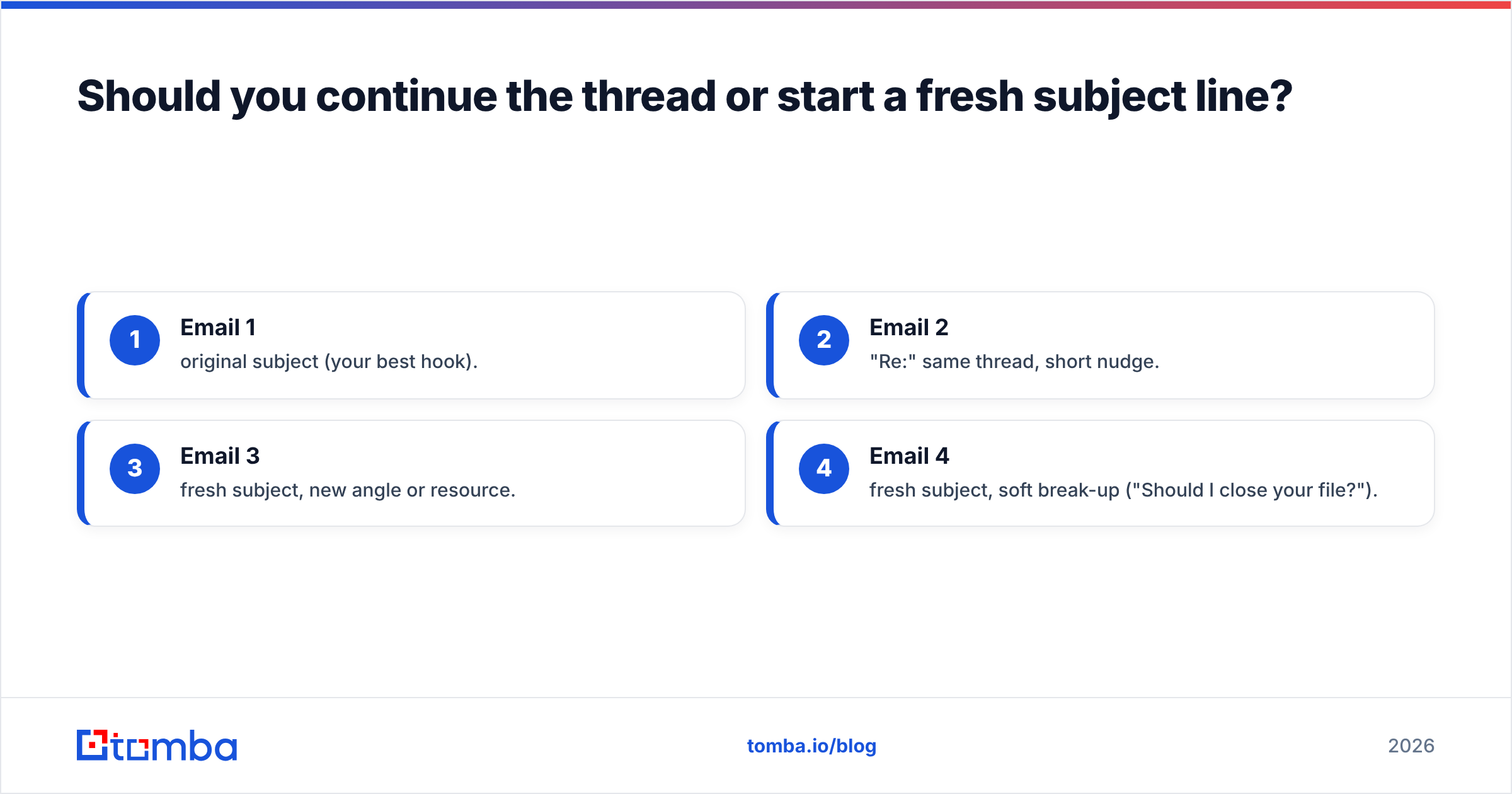
A practical pattern for a four-touch sequence:
- Email 1 — original subject (your best hook).
- Email 2 — "Re:" same thread, short nudge.
- Email 3 — fresh subject, new angle or resource.
- Email 4 — fresh subject, soft break-up ("Should I close your file?").
Testing both approaches is where an email verifier and clean list hygiene pay off — you can't trust A/B open-rate data if a chunk of your sends are bouncing off dead addresses and skewing the numbers.
What are the best cold email follow up subject line examples?#
Here's a categorized swipe file. Replace the {{brackets}} with real personalization — merge tags without real data behind them are worse than no personalization at all.
Thread continuation (short nudge)
- "Re: {{original subject}}"
- "quick follow-up"
- "bumping this up"
- "did this get buried?"
Curiosity / pattern interrupt
- "one idea for {{Company}}"
- "probably a no?"
- "wrong person?"
- "bad timing?"
Value-forward
- "{{Company}} + {{result}}"
- "cut {{metric}} by 20%?"
- "3 ways {{competitor}} does this"
Relevance / trigger-based
- "saw {{Company}}'s {{announcement}}"
- "congrats on {{funding/launch}}"
- "your post on {{topic}}"
Break-up (last touch)
- "should I close your file?"
- "closing the loop"
- "permission to stop?"
The "probably a no?" and "should I close your file?" lines consistently punch above their weight because they use a mild negativity bias — people reply to correct an assumption ("no, actually, send me the details"). Use them sparingly, once per sequence.
Which subject line mistakes kill follow-up open rates?#
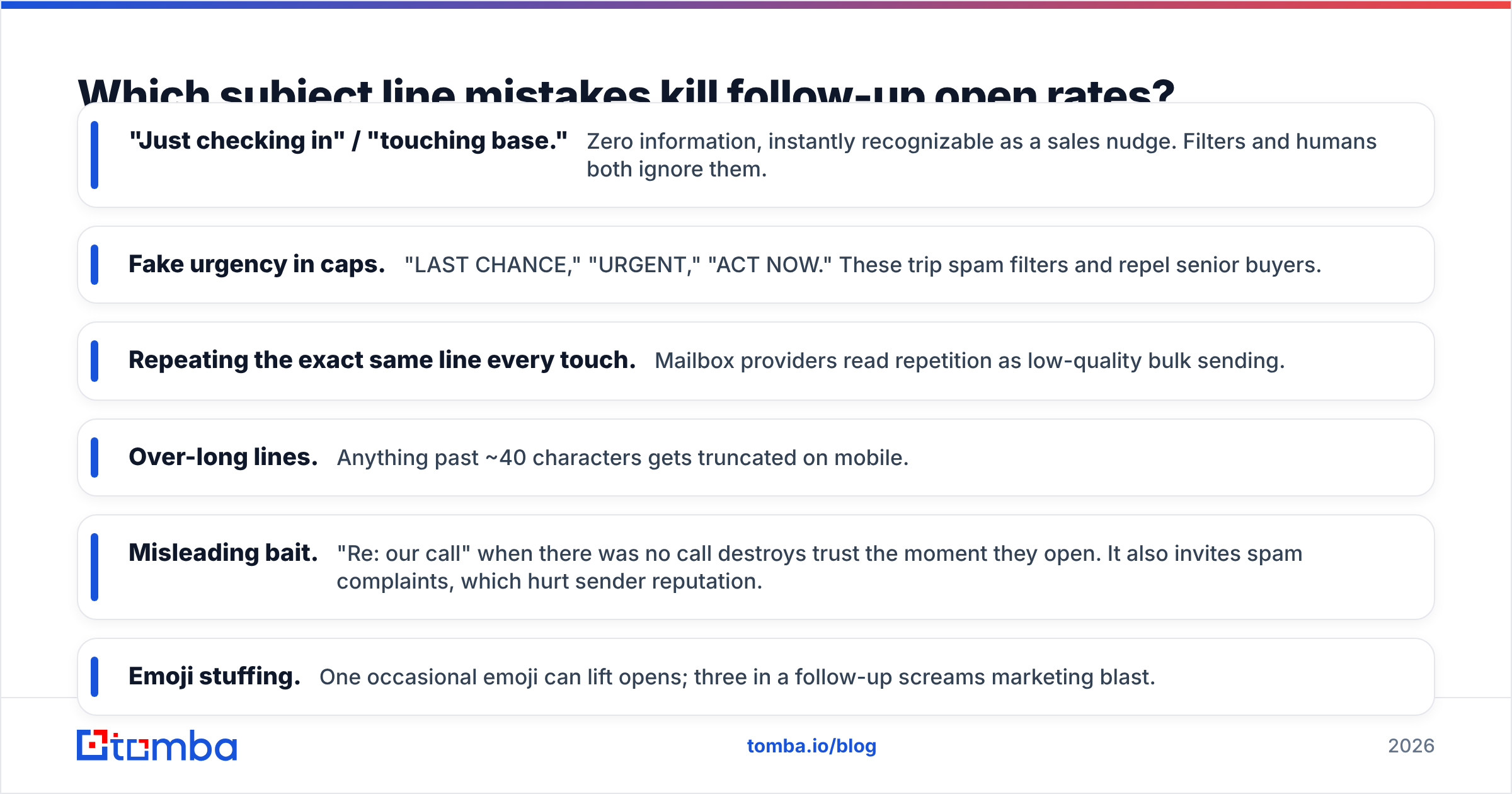
Avoid these — each one measurably drags down opens or deliverability:
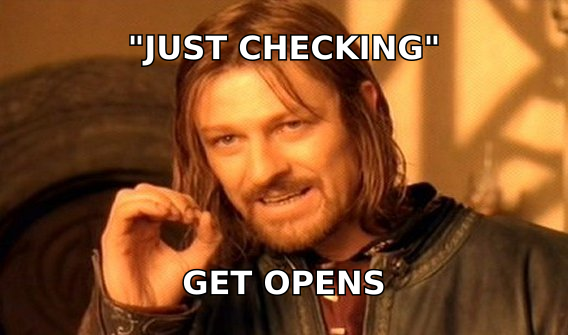
- "Just checking in" / "touching base." Zero information, instantly recognizable as a sales nudge. Filters and humans both ignore them.
- Fake urgency in caps. "LAST CHANCE," "URGENT," "ACT NOW." These trip spam filters and repel senior buyers.
- Repeating the exact same line every touch. Mailbox providers read repetition as low-quality bulk sending.
- Over-long lines. Anything past ~40 characters gets truncated on mobile.
- Misleading bait. "Re: our call" when there was no call destroys trust the moment they open. It also invites spam complaints, which hurt sender reputation.
- Emoji stuffing. One occasional emoji can lift opens; three in a follow-up screams marketing blast.
If your open rates are collapsing across an entire sequence regardless of wording, the problem probably isn't the subject line — it's email deliverability. Check your domain against a blacklist checker, confirm SPF/DKIM/DMARC are set, and make sure you're only sending to verified contacts. You can pull clean, verified addresses at the source with a dependable email finder instead of buying stale lists that guarantee bounces.
How should you A/B test follow-up subject lines?#
Test one variable at a time, and give each variant enough volume to mean something. A few rules that keep tests honest:
| Testing rule | Why it matters |
|---|---|
| One variable per test | Change length OR tone, not both, or you won't know what moved the needle. |
| Minimum ~200 sends per variant | Smaller samples produce noise you'll mistake for signal. |
| Clean list first | Bounces inflate "not opened" and corrupt your rate. |
| Segment by persona | A line that works for founders may flop with procurement. |
| Measure replies, not just opens | With privacy features like Apple MPP, open rates are directional at best; replies are truth. |
That last point matters more every year. Apple Mail Privacy Protection and similar features auto-load images, which inflates open tracking. Lean on reply rate and meetings booked as your real KPIs, and treat open rate as a soft directional signal. G2 and Capterra reviews of most sending tools now flag this openly — read them before trusting a vendor's dashboard numbers at face value.
For clean test data, deduplicate and verify your list before you split it. Tomba's bulk email finder and verification step remove the dead addresses that would otherwise pollute your denominator.
A copy-paste framework for a full follow-up sequence#
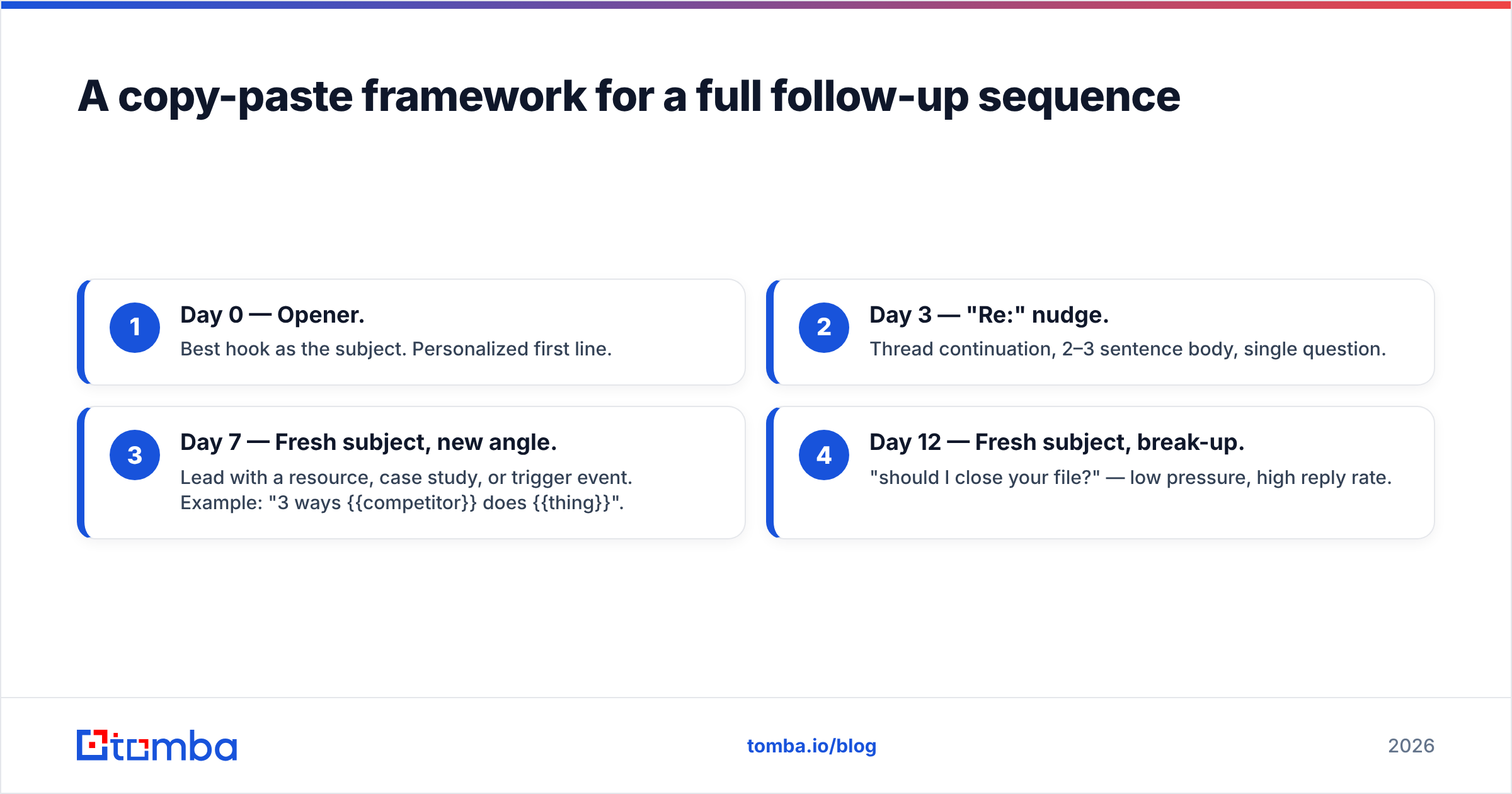
Put it together. Here's a four-touch structure with subject-line logic baked in:
- Day 0 — Opener. Best hook as the subject. Personalized first line.
- Day 3 — "Re:" nudge. Thread continuation, 2–3 sentence body, single question.
- Day 7 — Fresh subject, new angle. Lead with a resource, case study, or trigger event. Example: "3 ways {{competitor}} does {{thing}}".
- Day 12 — Fresh subject, break-up. "should I close your file?" — low pressure, high reply rate.
Keep the sender name and address identical across all four so the thread stays coherent and your domain reputation compounds instead of fragmenting. And keep bodies short: the subject line earns the open, but a wall of text loses the reply.
Frequently asked questions#
Do "Re:" subject lines actually work if there was no prior reply? Yes, when there genuinely was a prior email in the thread — it's honest continuation. Faking "Re:" on a first-ever contact is misleading and hurts trust and deliverability.
How long should a follow-up subject line be? Aim for under 40 characters and ideally 3–5 words. Mobile truncation is the main constraint.
How many follow-ups is too many? Four to six touches is standard for cold B2B. Beyond that, reply rates drop and complaint rates rise. Always include a clear break-up email.
Should the follow-up subject match the first email? For touches 1–2, continuing the thread is fine. For 3–4, switch to a fresh subject to get a new shot at attention.
Start with contacts worth emailing#
The cleverest cold email follow up subject line is wasted on a guessed or dead address — it bounces, dents your reputation, and never gets seen. Fix the input first. Use the Tomba Email Finder to source accurate, verified professional emails by name, company, or domain search, then run your sequence against a list that actually lands. Start free with 25 searches a month, and check Tomba pricing when you're ready to scale from testing subject lines to filling a pipeline.
Related guides#
Ready to find emails that actually work?
Join 150,000+ professionals who stopped guessing and started sending. Free credits on signup — no credit card required.
Get the Tomba newsletter
Practical outbound tactics and product updates — once every two weeks.
About the author