Cold Email for Business Partnership: Templates That Win Deals
A partnership cold email is not a sales pitch. Learn the structure, timing, and templates that get decision-makers to say yes to a first call.
Partnership outreach fails for a reason most people never diagnose: they write a sales email and slap the word "partnership" on it. A decision-maker can smell that in the first line. A real cold email for business partnership sells nothing — it offers a fair trade of value, proves you understand the other company, and asks for one small next step. Get those three things right and reply rates climb from the industry-average 1-5% into the double digits.
This guide breaks down what actually works in 2026, with templates you can adapt today.
TL;DR#
- A partnership email is a value swap, not a pitch. Lead with what you bring to them, not what you sell.
- Personalization beats volume. One researched email to the right VP outperforms 200 generic blasts.
- Structure wins: relevant hook → specific value → social proof → tiny ask (a 15-minute call, not a signed deal).
- Reach the decision-maker directly. Use a verified work email, not a generic info@ inbox that dies in a shared queue.
- Follow up 2-3 times. Most partnership replies come on the second or third touch, not the first.
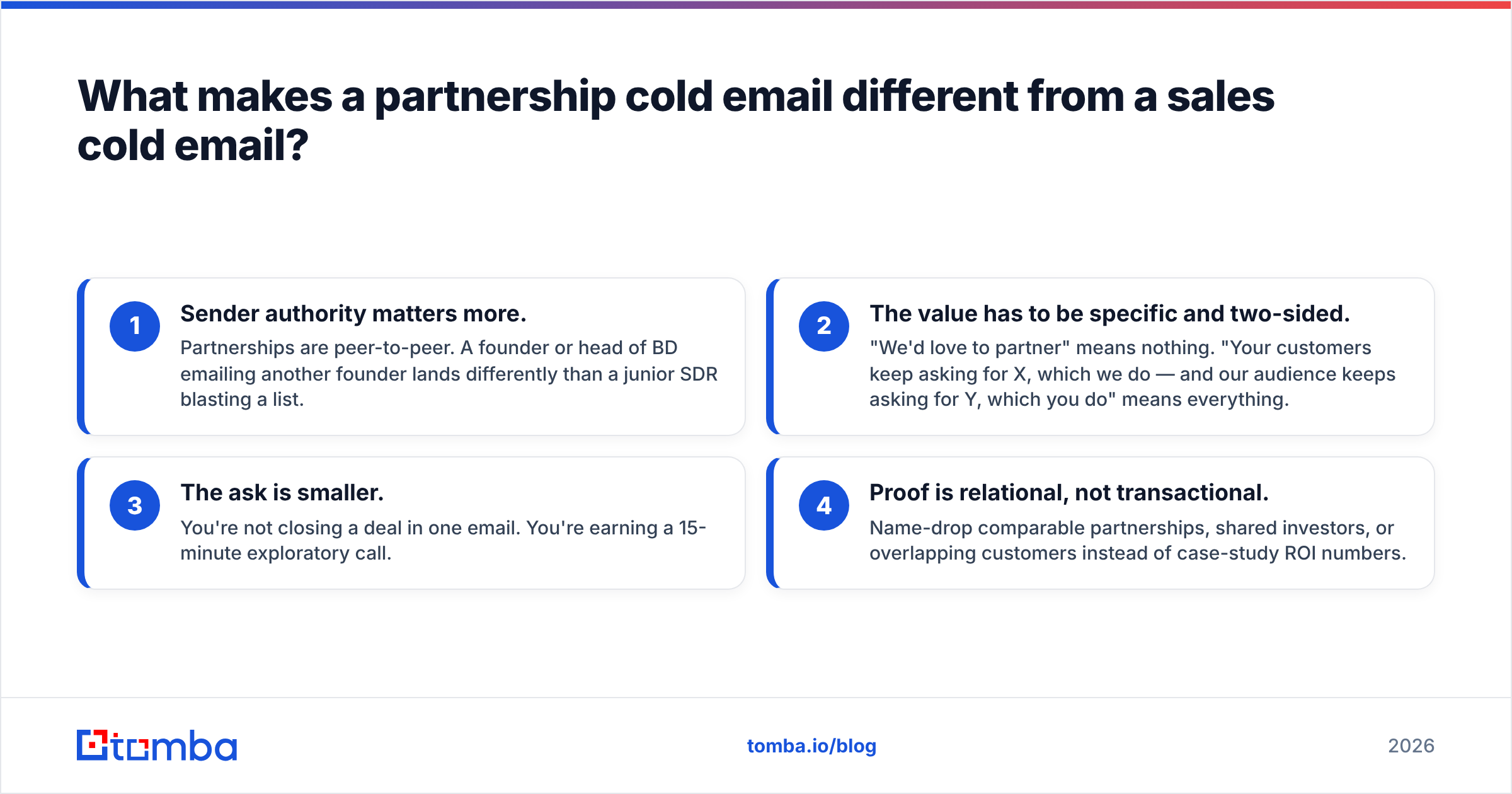
What makes a partnership cold email different from a sales cold email?#
The buyer's question changes. In a sales email, the reader asks "Do I need this product?" In a partnership email, they ask "Will working with this company make my company look good and perform better?"
Think of it like proposing a joint venture between two neighboring shops. You don't walk in and try to sell the owner your inventory — you point out that your customers and theirs overlap, and that a shared window display would bring both of you more foot traffic. The ask is collaboration, and the framing is mutual gain.
That shift changes every part of the email:
- Sender authority matters more. Partnerships are peer-to-peer. A founder or head of BD emailing another founder lands differently than a junior SDR blasting a list.
- The value has to be specific and two-sided. "We'd love to partner" means nothing. "Your customers keep asking for X, which we do — and our audience keeps asking for Y, which you do" means everything.
- The ask is smaller. You're not closing a deal in one email. You're earning a 15-minute exploratory call.
- Proof is relational, not transactional. Name-drop comparable partnerships, shared investors, or overlapping customers instead of case-study ROI numbers.

What are the core elements of a high-converting partnership email?#
Every partnership email that gets a reply hits the same beats in roughly the same order. Here's the anatomy.
- Subject line (specific, curiosity-driven): "Idea for [Their Company] + [Your Company]" or "Your [product] users + our [audience]". Avoid "Partnership opportunity" — it reads like spam.
- Opening line (about them): Reference a recent launch, a piece of content, a funding round, or a shared customer. This proves you did the work.
- The value swap (one clear sentence each way): What they gain, what you gain. Keep it balanced.
- Credibility (one line): A comparable partner, a metric, or a mutual connection.
- The ask (one small step): A short call, framed with two time options or a simple "worth exploring?"
- Signature (real human, real title): Full name, role, company, and a way to verify you're legitimate.
If you're refining subject lines specifically, a quick pass through a subject line generator can help you A/B a few angles before you commit.
What does a partnership cold email template look like?#
Here are three field-tested structures. Adapt the bracketed parts — never send them raw.
Template 1 — The audience overlap (best for co-marketing)
Subject: Your users + our audience
Hi [First Name],
I noticed [Their Company] just launched [specific feature]. We keep hearing from our [X-size] audience of [audience type] that they need exactly that.
On our side, we run [asset — newsletter, community, integration marketplace] with [reach metric], which your customers would likely find useful.
We did something similar with [Comparable Partner] and it drove [rough result]. Worth a 15-minute call to see if there's a fit?
[Name, Title, Company]
Template 2 — The integration proposal (best for product/tech partnerships)
Subject: Idea for [Their Product] + [Your Product]
Hi [First Name],
A handful of mutual customers — [Customer A], [Customer B] — have asked us to connect [Your Product] with [Their Product]. Right now they're exporting CSVs by hand.
We'd handle the build on our side. For you, it's a new integration listing and stickier customers at zero eng cost.
Open to a quick chat with your BD or product team?
[Name, Title, Company]
Template 3 — The referral/reseller angle (best for channel partnerships)
Subject: Sending you deals in [industry]
Hi [First Name],
We regularly get inbound from [customer type] who need [their offering] — outside our scope, so today we point them nowhere.
We'd rather send them to you. In return, our customers occasionally need [your offering], and we'd love a warm channel back.
15 minutes to map out how a referral loop could work?
[Name, Title, Company]

How do you find the right decision-maker's email?#
The best partnership email in the world is worthless if it lands in a generic info@ inbox that nobody reads. You need the direct address of the person who can actually say yes — usually a founder, Head of Partnerships, Head of BD, or VP of Marketing.
The reliable workflow:
- Identify the role, not just the company. Search the target company's team page or LinkedIn for the partnerships or BD lead.
- Find their work email. An email finder resolves a name plus company domain into a verified professional address in seconds. If you only have the domain and want to see every reachable contact, a domain search returns the company's email pattern and known addresses.
- Verify before you send. Bouncing on a partnership email is worse than bouncing on a sales email — it can burn your sender reputation and get flagged before a human ever sees your message. Run the address through an email verifier first.
Deliverability is not optional here. A single well-crafted message to a verified, monitored inbox beats a spray-and-pray blast every time — and it protects the domain you'll rely on for months of follow-up.
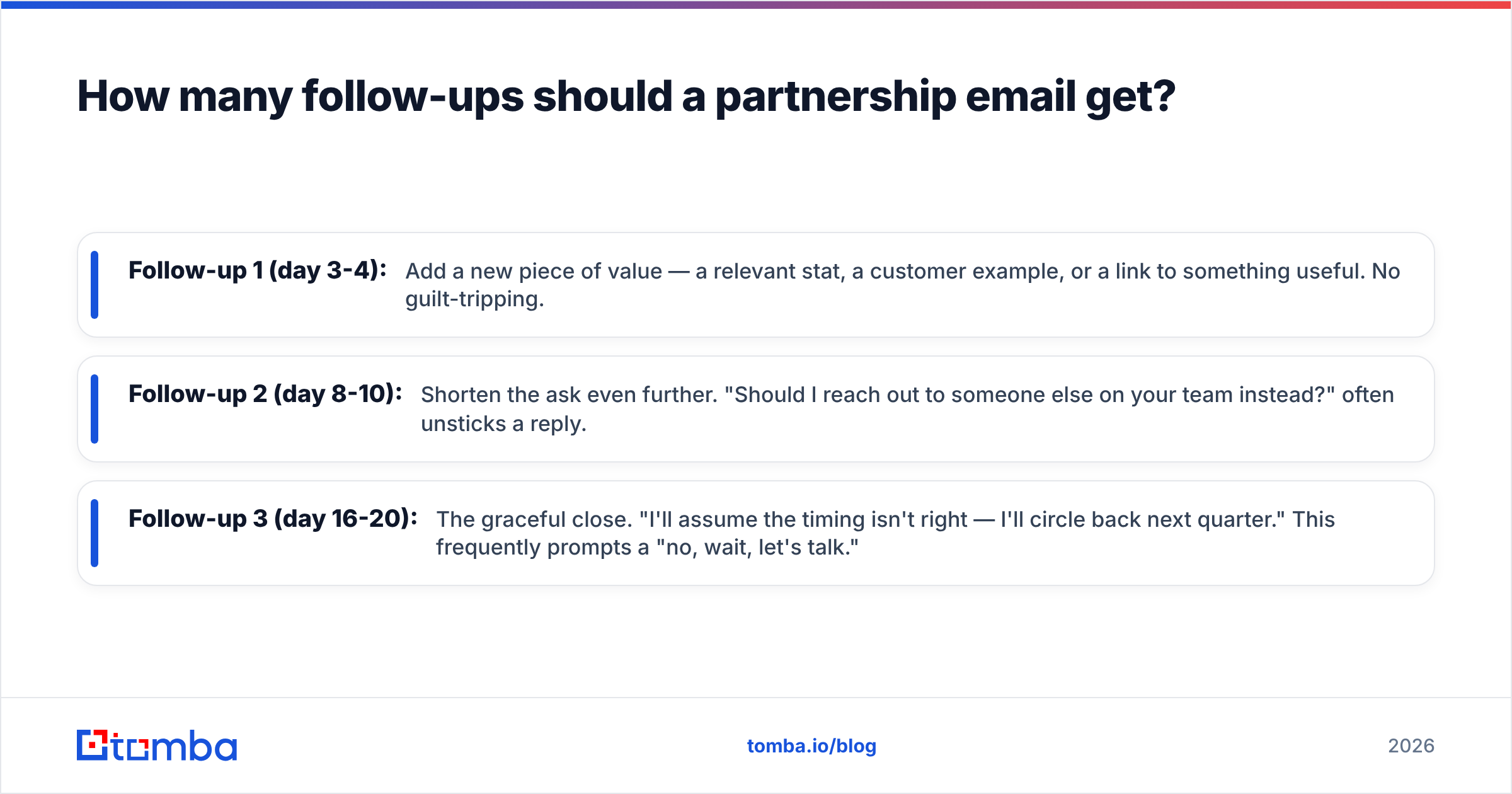
Which outreach approach wins: personalized partnerships vs. mass cold email?#
Here's the honest trade-off. Mass outreach is fast and cheap per email but converts terribly for partnerships, because partnerships are trust-first. Personalized outreach is slower per email but is the only thing that reliably books partnership calls.
| Factor | Mass cold email | Personalized partnership email |
|---|---|---|
| Emails per week | 500-2,000 | 20-50 |
| Research per contact | Near zero | 10-15 min |
| Typical reply rate | 1-3% | 8-20% |
| Meeting-book rate | Very low | Moderate to high |
| Sender reputation risk | High | Low |
| Best for | Volume lead gen | Strategic alliances |
| Cost driver | Sending volume | Human research time |
The data backs the personalized side. HubSpot's research on outreach consistently shows that personalized, relevant emails outperform generic sends by a wide margin, and buyer-trust reports from firms like Gartner point to peer credibility as the strongest driver of B2B relationship decisions. For a broader view of what buyers expect from vendors and partners in 2026, HubSpot's sales statistics are a useful reality check.
If you want to scale personalization without dropping quality, the move is to research a tight list, enrich it with verified contact data, and reuse a strong template skeleton — not to widen the net until relevance collapses.
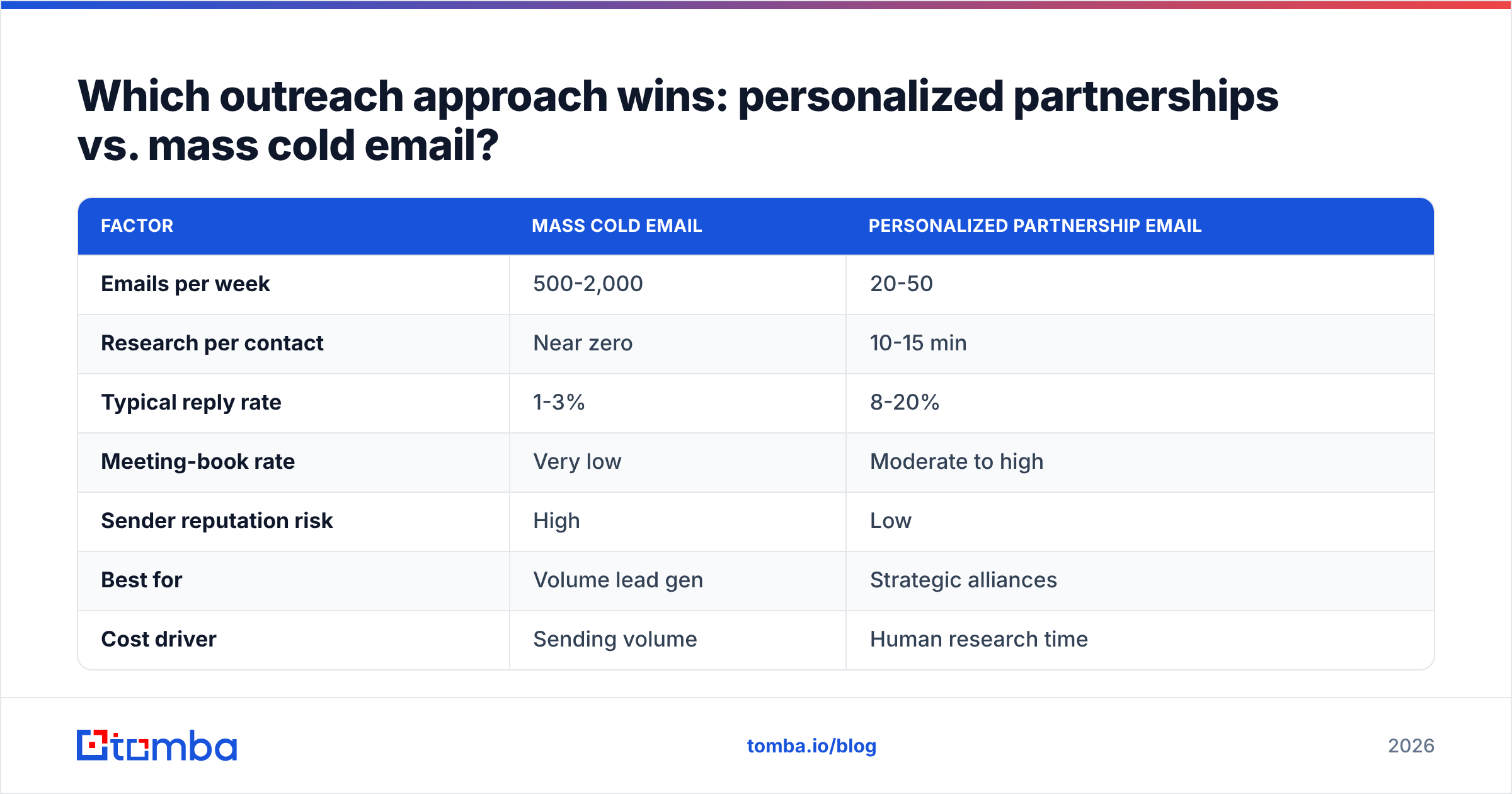
How many follow-ups should a partnership email get?#
Two to three. Not one, and not seven.
Partnership contacts are busy people for whom your email is not urgent. A single send has a high chance of getting buried, not rejected. The follow-up is where most positive replies actually happen — and each one should add a new angle, not just say "bumping this."
- Follow-up 1 (day 3-4): Add a new piece of value — a relevant stat, a customer example, or a link to something useful. No guilt-tripping.
- Follow-up 2 (day 8-10): Shorten the ask even further. "Should I reach out to someone else on your team instead?" often unsticks a reply.
- Follow-up 3 (day 16-20): The graceful close. "I'll assume the timing isn't right — I'll circle back next quarter." This frequently prompts a "no, wait, let's talk."
Track your response rate by template and by follow-up number so you learn which angles actually move the needle. If your first-touch reply rate is fine but nobody books, the ask is too big. If nobody replies at all, the value swap isn't landing.
What are the most common partnership cold email mistakes?#
Avoid these and you're ahead of most senders:
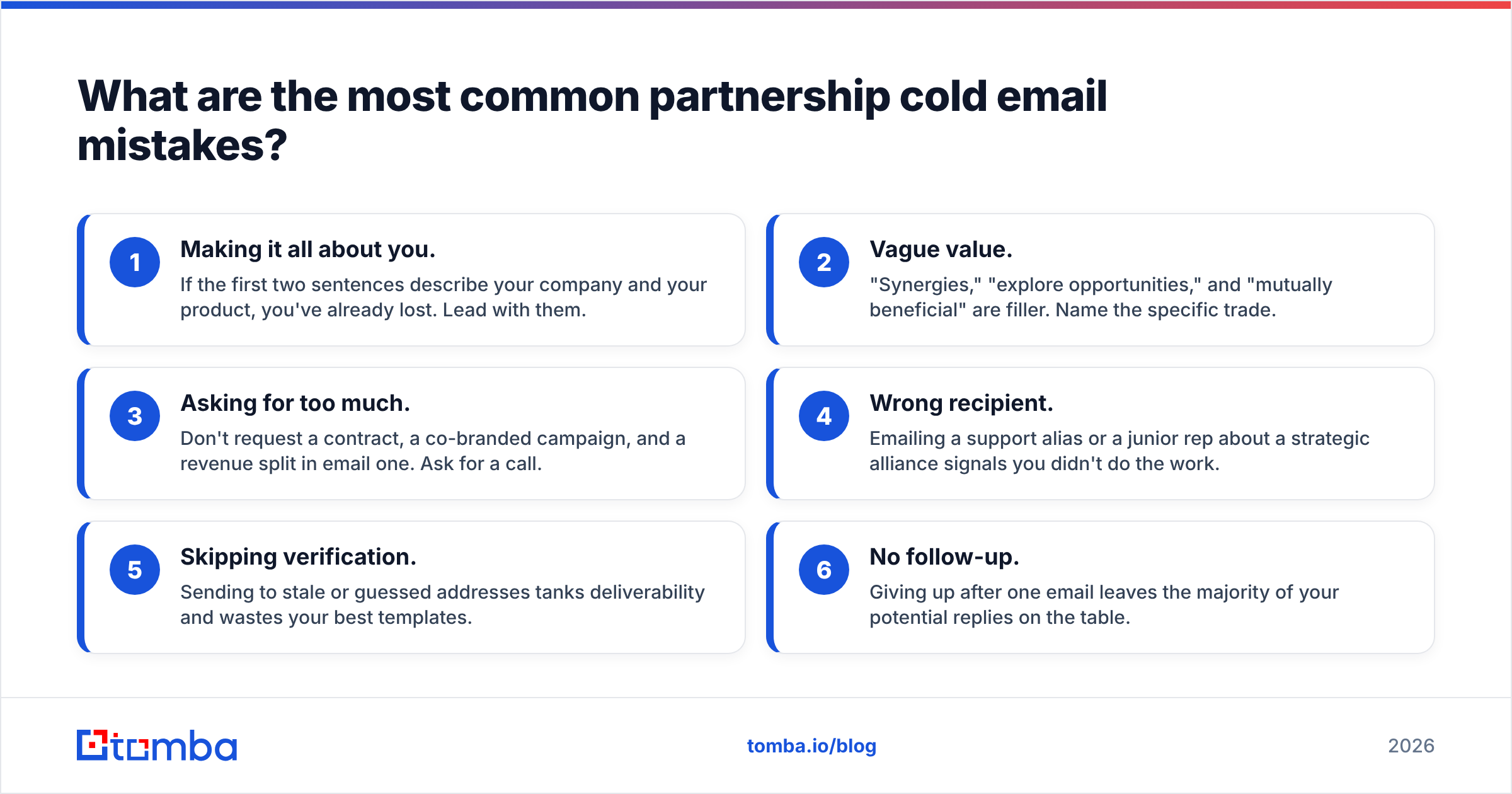
- Making it all about you. If the first two sentences describe your company and your product, you've already lost. Lead with them.
- Vague value. "Synergies," "explore opportunities," and "mutually beneficial" are filler. Name the specific trade.
- Asking for too much. Don't request a contract, a co-branded campaign, and a revenue split in email one. Ask for a call.
- Wrong recipient. Emailing a support alias or a junior rep about a strategic alliance signals you didn't do the work.
- Skipping verification. Sending to stale or guessed addresses tanks deliverability and wastes your best templates.
- No follow-up. Giving up after one email leaves the majority of your potential replies on the table.
A useful gut check: read your draft and ask, "Would a busy VP forward this to a colleague and say 'this looks worth 15 minutes'?" If not, tighten the value swap.
How do you scale partnership outreach without sounding robotic?#
The goal is repeatable personalization, not automation that reads like a mail merge. A practical stack:
- Build a focused target list — 30-50 companies whose audience genuinely overlaps with yours.
- Enrich each contact with a verified name, title, and work email so every send reaches a real decision-maker.
- Keep a template skeleton (like the three above) and swap in one genuinely researched detail per email — the launch, the mutual customer, the shared investor.
- Sequence the follow-ups with new value each time.
- Measure and prune. Kill templates that underperform; double down on the angle that books calls.
If you'd rather start from a proven structure, browse a library of cold email templates and adapt the partnership-specific ones to your value swap. You can also validate your tool choices against peer reviews on G2 before committing budget.
Start with the right contacts#
Great partnership emails begin long before you write a word — they begin with reaching the right person at a live, verified address. Use the Tomba Email Finder to turn a target company and a decision-maker's name into a verified professional email, then verify it before you hit send. The free tier gives you 25 searches a month to test the workflow, and paid plans start at $49/mo on the Starter tier when you're ready to scale a real partnership pipeline (see full Tomba pricing for details).
Write the value swap. Reach the decision-maker directly. Follow up with fresh value. That's the entire playbook — and it works because it treats the other company as a partner, not a prospect.
Related guides#
Ready to find emails that actually work?
Join 150,000+ professionals who stopped guessing and started sending. Free credits on signup — no credit card required.
Get the Tomba newsletter
Practical outbound tactics and product updates — once every two weeks.
About the author