How to Write a Cold Email for Partnership That Gets Replies
A practical 2026 guide to writing a cold email for partnership: research, structure, subject lines, templates, and follow-ups that turn strangers into strategic partners.
Partnership outreach fails for a boring reason: most people send a sales pitch and call it a partnership request. A cold email for partnership is a different animal. You are not asking someone to buy — you are asking them to co-create value, share an audience, or build something together. That changes the psychology, the structure, and the follow-up.
This guide breaks down exactly how to write partnership cold emails that get opened, read, and answered in 2026 — with templates you can adapt today.
TL;DR#
- A cold email for partnership must lead with mutual value, not a feature list — the recipient should see what they gain in the first two lines.
- Research beats volume: a personalized, well-targeted email to 30 right-fit partners outperforms 3,000 generic blasts.
- Structure it in five parts: relevance hook, credibility proof, specific partnership idea, low-friction ask, and a clear next step.
- Verify contact data before sending — bounced partnership emails silently kill deals and hurt your sender reputation.
- Follow up 3–4 times over two to three weeks; most partnership replies come after the first message.
What Is a Cold Email for Partnership?#
A cold email for partnership is an unsolicited message proposing a mutually beneficial business relationship to someone who does not know you yet. The "partnership" can take many forms — co-marketing, integrations, referral deals, content collaboration, reseller agreements, or joint events.
The key difference from a sales email: a sales email asks the recipient to spend money or time on your thing. A partnership email asks them to combine forces so both sides win. Get that framing wrong and your email reads like a pitch, which is exactly what busy founders and partnership leads delete on sight.
Think of it like proposing a duet rather than selling a concert ticket. You are not the star asking for applause — you are offering to make each other sound better.

Why Do Most Partnership Emails Get Ignored?#
Before templates, understand the failure modes. Partnership emails die for predictable reasons:
- No clear value for the recipient. The email talks about your product, your goals, your funding round — and never answers "why should I care?"
- The wrong person. You emailed a support alias or a junior marketer when the decision sits with a partnerships lead or founder.
- Vague ask. "Let's explore synergies" means nothing. Busy people need a concrete, small next step.
- Bad data. The email bounced, went to a catch-all nobody reads, or hit a stale address. Deliverability problems mask themselves as "low response rates."
- No follow-up. One email, no reply, giving up. Most partnership conversations start on email two or three.
The fix for the first three is copywriting. The fix for the fourth is clean data and verification. The fifth is a cadence. We will cover all three.
What Makes a Cold Email for Partnership Actually Convert?#
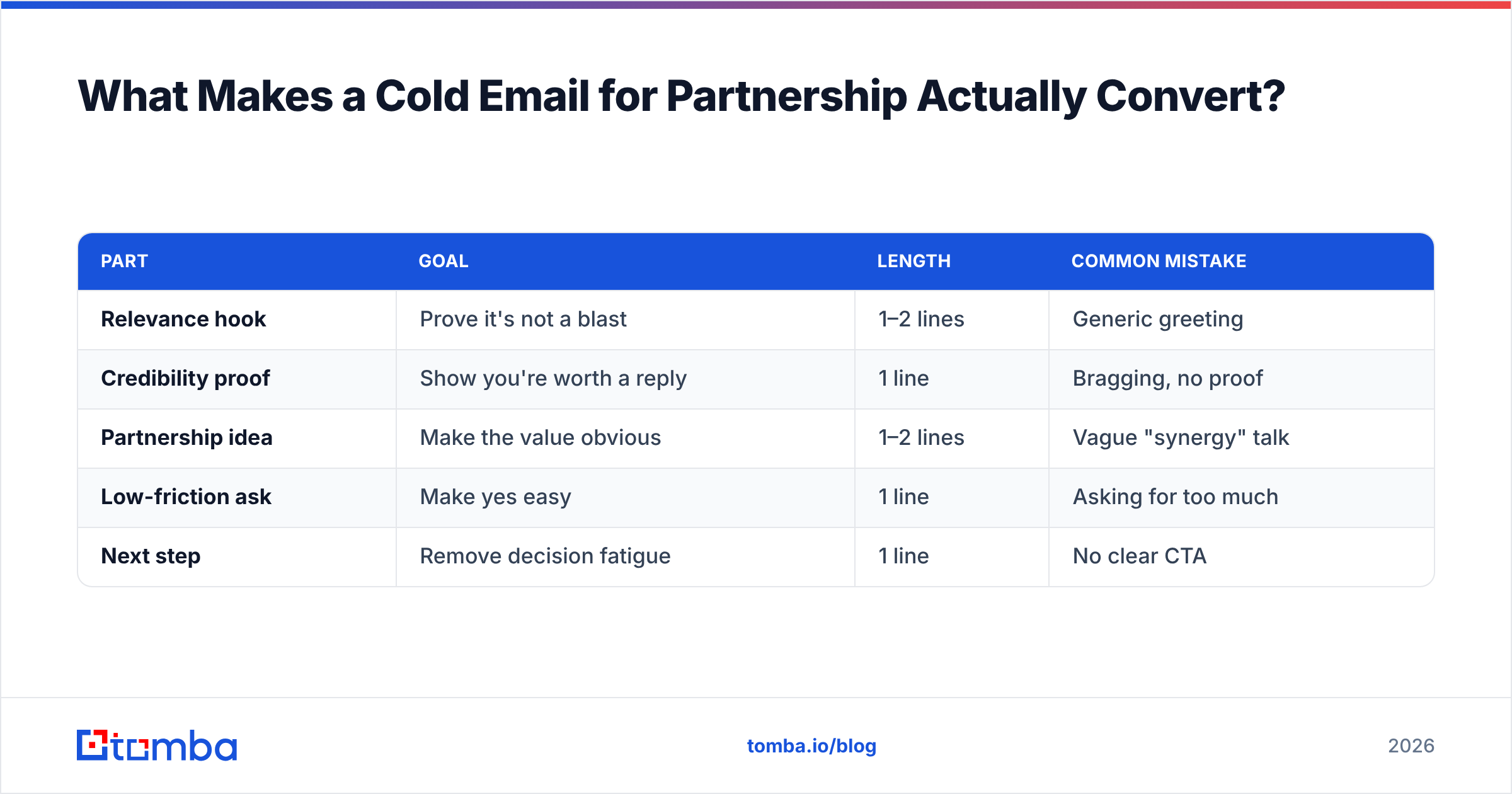
Every high-performing partnership email shares the same skeleton. Here are the five components, in order:
- Relevance hook (line 1–2): Prove you know them. Reference a specific product, a recent launch, a shared audience, or an overlap in customers. Generic openers ("I hope this email finds you well") signal a template.
- Credibility proof (line 3): One sentence that shows you are legitimate — a metric, a recognizable customer, a mutual connection, or audience size.
- The partnership idea (line 4–5): Name the specific collaboration and the value they get. Be concrete: "co-host a webinar to your and our combined 40k subscribers," not "explore a partnership."
- The low-friction ask (line 6): Ask for one small thing — a 15-minute call, a yes/no on interest, or a quick intro to the right person.
- The next step (closing): Remove decision friction. Offer two time slots or a single question they can answer in one word.
Keep the whole thing under 120 words. Partnership decision-makers skim. If your email needs scrolling, it needs cutting.
The 5-Part Partnership Email Framework#
| Part | Goal | Length | Common mistake |
|---|---|---|---|
| Relevance hook | Prove it's not a blast | 1–2 lines | Generic greeting |
| Credibility proof | Show you're worth a reply | 1 line | Bragging, no proof |
| Partnership idea | Make the value obvious | 1–2 lines | Vague "synergy" talk |
| Low-friction ask | Make yes easy | 1 line | Asking for too much |
| Next step | Remove decision fatigue | 1 line | No clear CTA |
How Do You Find and Verify Partnership Contacts?#
You can write the perfect email and still fail if it never reaches a human. Partnership outreach lives or dies on contact quality, so treat data as step zero.
Start by identifying the right role: partnerships manager, head of BD, growth lead, or — at smaller companies — the founder. Then find a reliable, direct email rather than a info@ or partnerships@ alias that gets buried.
A repeatable workflow looks like this:
- Find the company domain, then use a domain search to pull the email pattern and named contacts for that organization.
- Locate the specific decision-maker with an email finder by name and domain instead of guessing at
first.last@. - Verify every address with an email verifier before you send, so bounces don't tank your deliverability.
- Check catch-all domains with a catch-all verifier, since catch-all servers accept everything and hide invalid addresses.
- Enrich the record with role, seniority, and LinkedIn so your personalization has something to work with.
This matters more than people admit. A high bounce rate damages email deliverability across your whole domain — meaning even your good emails start landing in spam. Verification is not optional hygiene; it is a prerequisite for outreach that scales.

What Subject Lines Work for Partnership Outreach?#
Your subject line has one job: earn the open without sounding like a sale. For partnership emails, curiosity and specificity beat hype.
Patterns that consistently perform:
- The mutual-audience angle: "Idea for [Their Company] x [Your Company]"
- The specific-observation angle: "Noticed [specific thing] — quick partnership idea"
- The referral angle: "[Mutual contact] suggested I reach out"
- The direct angle: "Partnership: [their audience] + [your product]"
- The short-and-human angle: "quick question about [their initiative]"
Avoid ALL CAPS, exclamation points, and words like "free," "guaranteed," or "urgent" — they trip spam filters and cheapen a partnership request. If you want to pressure-test options before sending, run them through a subject line tester to catch spam triggers and length problems.
Keep subject lines under 50 characters so they don't truncate on mobile, where most first opens now happen.
Cold Email for Partnership: Templates You Can Steal#
Here are three templates for the most common partnership scenarios. Adapt the bracketed parts — never send them verbatim.
Template 1: Co-Marketing / Content Collaboration#
Subject: Idea for [Their Company] x [Your Company]
Hi [First name],
Your recent [guide/webinar/report] on [topic] was genuinely useful — we send similar buyers your way without realizing it.
We run [your product] for [audience], with [credibility metric, e.g. "12k newsletter subscribers in the same space"].
Would you be open to co-creating [specific asset — a joint webinar, a co-authored report] and cross-promoting it to both lists? Rough math puts our combined reach around [number].
Worth a quick 15-minute call next week? Tuesday or Thursday works on my end.
[Your name]
Template 2: Integration / Technical Partnership#
Subject: [Their Product] + [Your Product] integration?
Hi [First name],
A handful of our customers already use [their product] alongside ours and have asked for a native integration. That's usually a strong signal.
We're [your product], used by [recognizable customers or number]. An integration would reduce churn for the shared accounts and give both teams a co-selling story.
Are you the right person to scope this — or could you point me to whoever owns your API and partnerships?
Happy to send a one-page brief if useful.
[Your name]
Template 3: Referral / Reseller Partnership#
Subject: [Mutual contact] suggested I reach out
Hi [First name],
[Mutual contact] mentioned you work with [audience] who often need [problem your product solves] — which is exactly what we do.
We'd love to set up a simple referral arrangement: you send relevant clients our way, we pay [X]% and handle everything. No lift on your side.
Open to a short call to see if the fit makes sense?
[Your name]
For more reusable frames across scenarios, browse a library of cold email templates and swap in your own value proposition.
How Should You Follow Up on a Partnership Email?#
Most partnership deals close on the follow-up, not the first send. Silence rarely means "no" — it usually means "busy." A disciplined cadence separates people who land partnerships from people who send one email and complain outreach doesn't work.
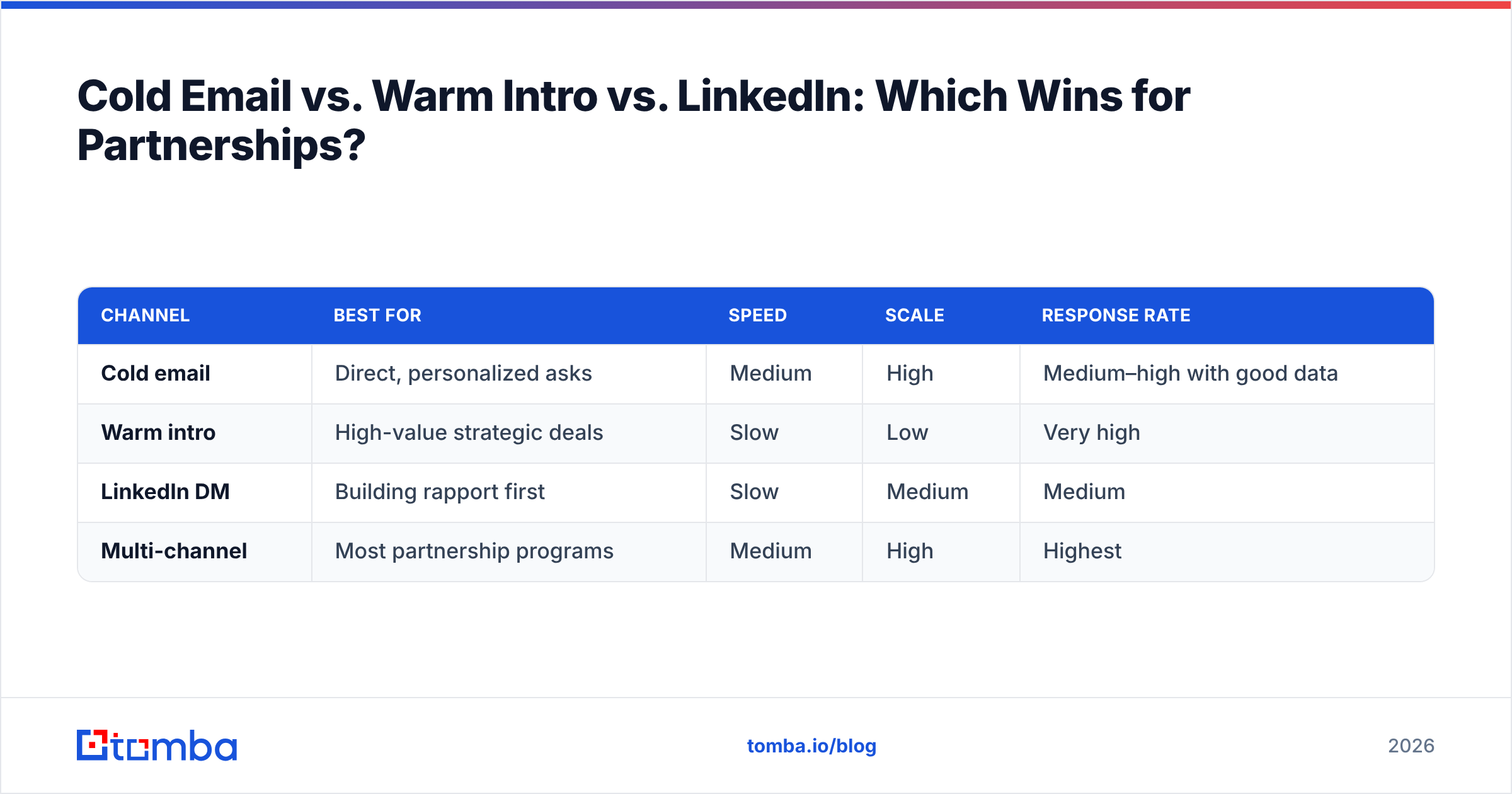
A proven follow-up sequence:
| Timing | Angle | |
|---|---|---|
| 1 — Initial | Day 0 | The core partnership pitch |
| 2 — Bump | Day 3 | Short reply-to-self: "Any thoughts on this?" |
| 3 — Value add | Day 7 | Share a relevant asset, case study, or idea |
| 4 — Break-up | Day 14 | "Should I close the loop?" — often triggers a reply |
Rules that keep follow-ups from becoming spam:
- Reply in the same thread so context stays intact.
- Add value each time — a new angle, a data point, a relevant example — rather than "just bumping this."
- Cap it at four. Beyond that you're annoying, and it hurts your response rate reputation.
- Track opens and replies so you know who to prioritize and who to drop.
Cold Email vs. Warm Intro vs. LinkedIn: Which Wins for Partnerships?#
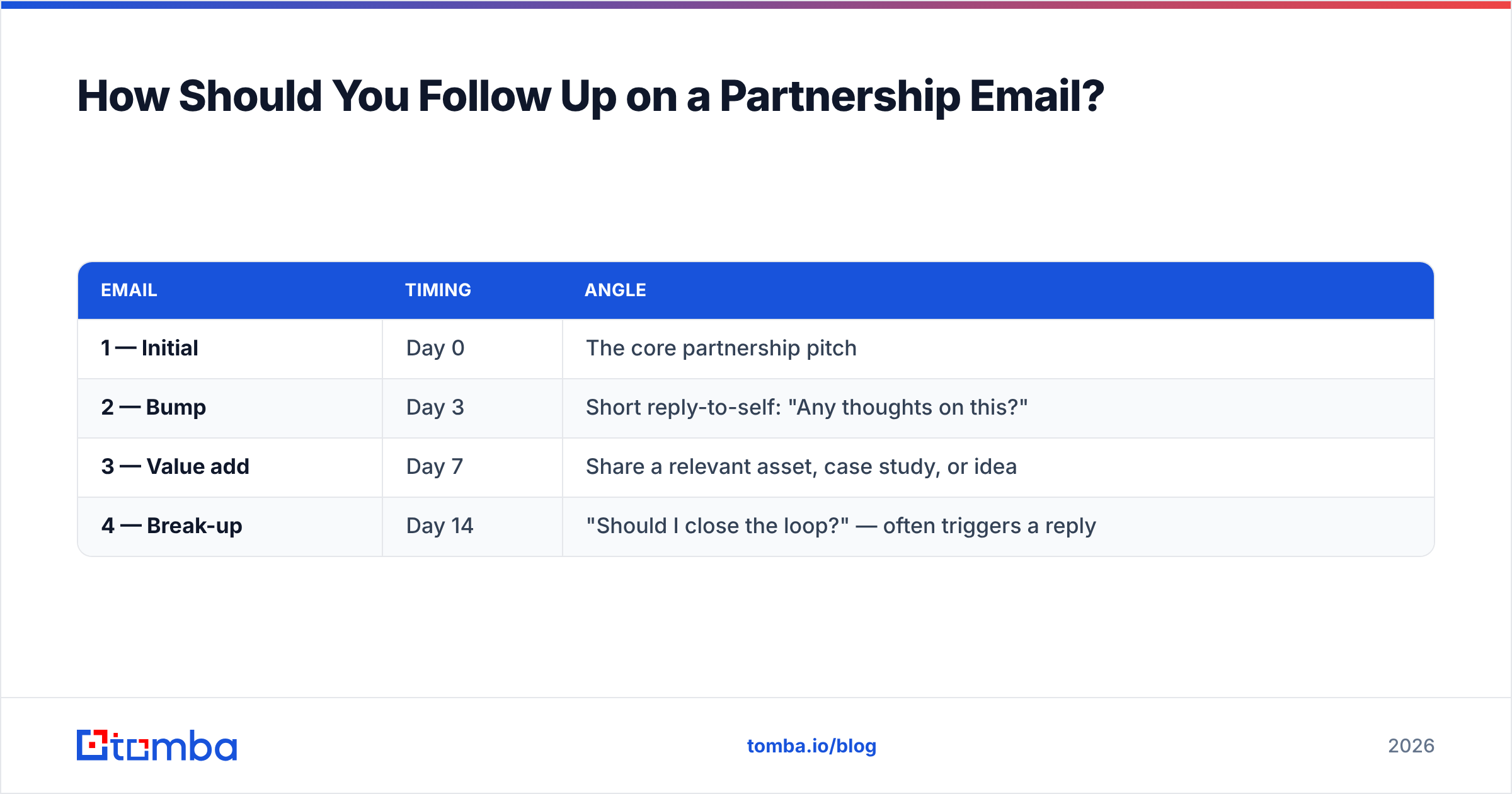
Cold email is not the only channel, and the smartest partnership programs blend all three. Here's an honest comparison:
| Channel | Best for | Speed | Scale | Response rate |
|---|---|---|---|---|
| Cold email | Direct, personalized asks | Medium | High | Medium–high with good data |
| Warm intro | High-value strategic deals | Slow | Low | Very high |
| LinkedIn DM | Building rapport first | Slow | Medium | Medium |
| Multi-channel | Most partnership programs | Medium | High | Highest |
Warm intros convert best but don't scale — you only have so many mutual connections. Cold email scales and, when personalized and verified, holds a strong response rate. LinkedIn works well as a soft touch before or after the email. The winning play is usually email first, LinkedIn as reinforcement: connect on LinkedIn a day after your email so your name shows up twice. To reach the right profiles, a LinkedIn finder helps you match LinkedIn contacts to verified work emails.
What Metrics Should You Track?#
Partnership outreach is measurable. Track these to improve over time:
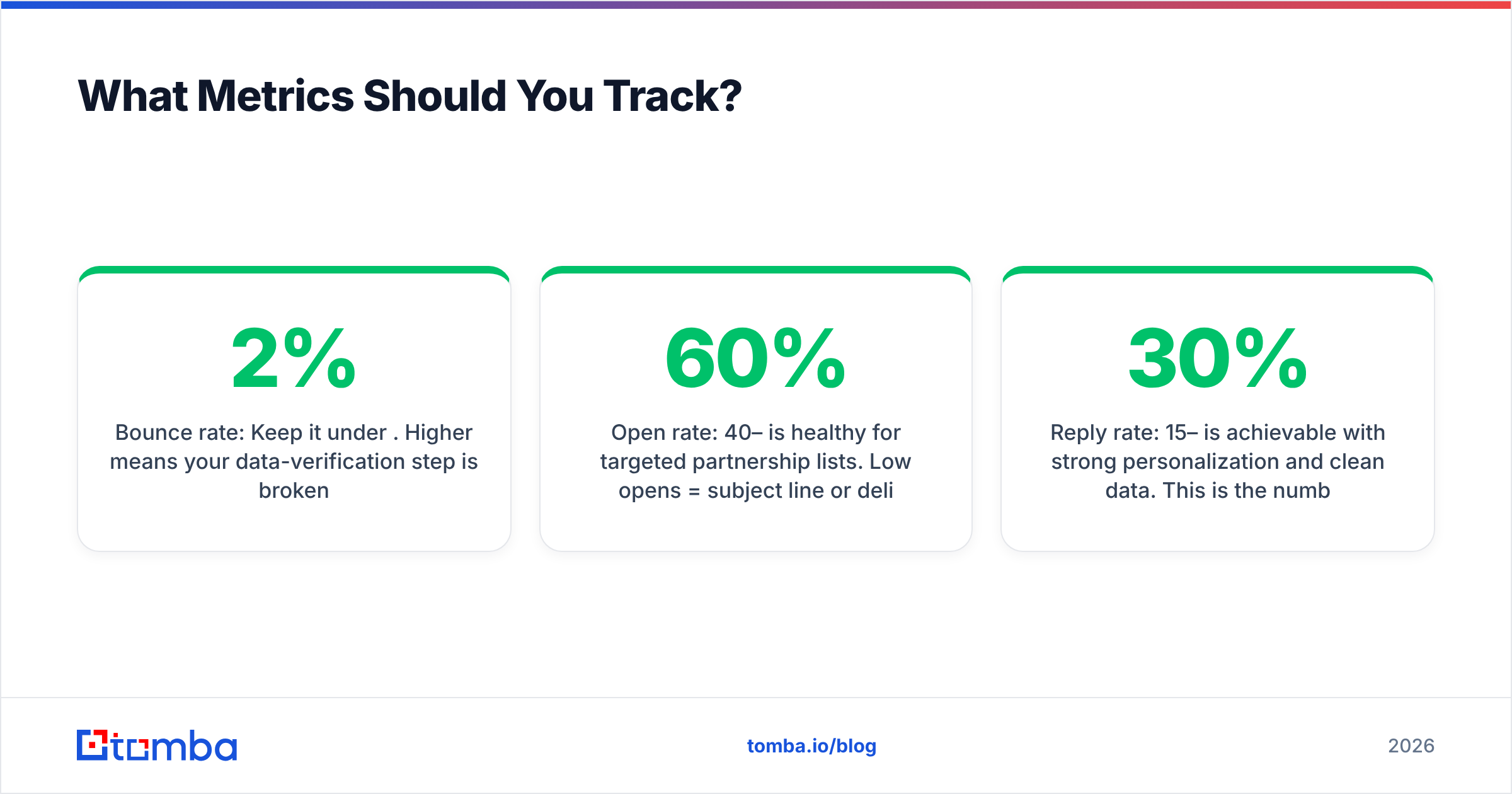
- Bounce rate: Keep it under 2%. Higher means your data-verification step is broken.
- Open rate: 40–60% is healthy for targeted partnership lists. Low opens = subject line or deliverability issue.
- Reply rate: 15–30% is achievable with strong personalization and clean data. This is the number that matters most.
- Positive reply rate: Of the replies, how many want to talk? This measures targeting and offer quality.
- Meetings booked: The real currency of partnership outreach.
If opens are fine but replies are low, your copy or offer is weak. If opens are low, fix your subject lines and deliverability first. Tools like a spam checker and an email reputation checker help you diagnose the deliverability side before you blame the copy.
Common Mistakes to Avoid#
- Pitching product instead of partnership. Reframe every sentence around mutual benefit.
- Emailing the wrong role. Verify you have the partnerships or BD decision-maker, not a generic inbox.
- Sending unverified lists. Bounces are silent deal-killers and reputation-killers.
- Writing a wall of text. Under 120 words, always.
- Giving up after one email. The money is in follow-ups two through four.
- Faking personalization. "I love your work" with no specifics is worse than no personalization — it reads as automated.
The Bottom Line#
A cold email for partnership succeeds when it feels like an opportunity, not an interruption. That means three things done well: research the right person, lead with what they gain, and back it up with clean, verified contact data so your message actually arrives. Nail those, add a disciplined follow-up cadence, and partnership outreach becomes one of the highest-ROI channels in your growth stack.
Start with the data layer, because everything else depends on it. Use the Tomba Email Finder to find and verify the exact partnership decision-makers you want to reach — by name, company, or domain — then send outreach you know will land in a real inbox. Check the Tomba pricing plans, including a free tier of 25 searches a month, and start building your partnership pipeline on data you can trust.
Related guides#
// get started
Find, verify and enrich your first contacts today
Start on the free plan with 25 searches a month, then scale when your team is ready.
Free plan · No credit card required · GDPR & CCPA
// about the author