Cold Email Opening Lines: 12 Examples That Get Replies
Most cold email opening lines get deleted before the second sentence. Here are 12 that survive, the four archetypes behind them, and the one-minute test to check yours.
TL;DR
- Your opening line has one job: buy the second sentence. It is not where you pitch, credential yourself, or explain who you are.
- "I hope this email finds you well," "My name is X and I work at Y," and "Quick question" are the three highest-volume, lowest-return openers in B2B. They signal template.
- Four archetypes carry almost everything that works: Trigger, Observation, Peer Proof, and Direct Ask. Pick one per email, never two.
- Personalization only pays when it's specific and recent. Generic flattery ("Loved your website!") tests worse than no personalization at all, because it costs the reader a beat and returns nothing.
- None of it matters if the address bounces. Opening-line optimization on a 22% bounce list is rearranging deck chairs.
Why do cold email opening lines matter more than the subject line?#
The subject line gets the open. The opening line gets the read. Those are different jobs, and most teams over-invest in the first.
Here's the mechanics. In Gmail, Outlook, and every mobile client, your first sentence is visible before the open — it renders as preview text right next to the subject. So your opening line is actually doing double duty: it's part of the open decision, then it's the entire read decision. A subject line that wins the open and an opener that fails the read produces the worst outcome available to you — a burned impression with a real buyer who now recognizes your sender name and ignores it.
The read decision happens in roughly the time it takes to scroll. The prospect isn't evaluating your argument. They're running one pattern match: is this about me, or is this about you? Every opener that begins with "I," "We," or "My name is" answers that question the wrong way in the first two words.
That's the whole theory. The rest is execution.
What are the four archetypes of cold email opening lines?#
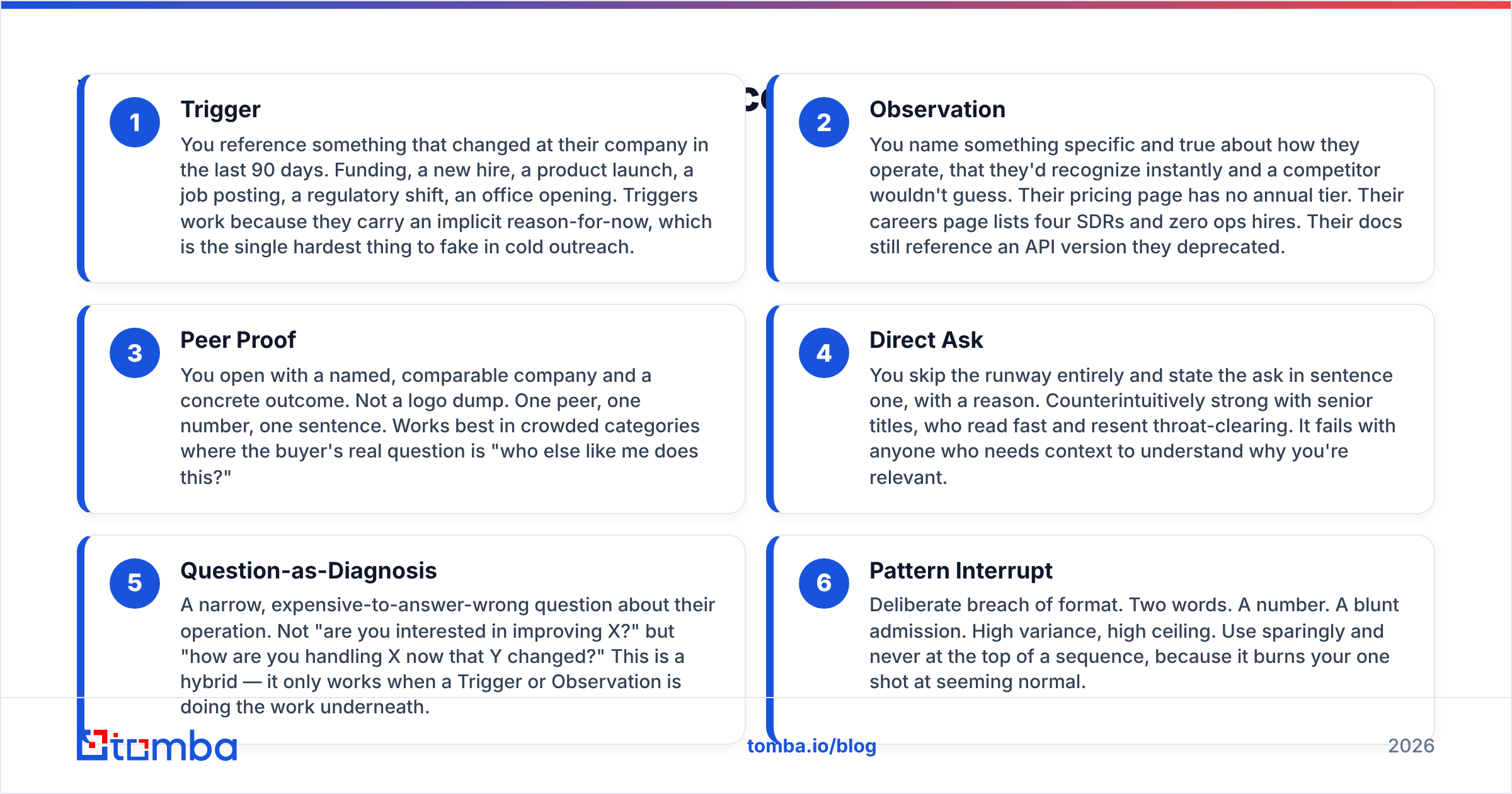
Almost every high-performing opener collapses into one of four shapes. Learn the shapes and you stop hunting for lines.
- Trigger — You reference something that changed at their company in the last 90 days. Funding, a new hire, a product launch, a job posting, a regulatory shift, an office opening. Triggers work because they carry an implicit reason-for-now, which is the single hardest thing to fake in cold outreach.
- Observation — You name something specific and true about how they operate, that they'd recognize instantly and a competitor wouldn't guess. Their pricing page has no annual tier. Their careers page lists four SDRs and zero ops hires. Their docs still reference an API version they deprecated.
- Peer Proof — You open with a named, comparable company and a concrete outcome. Not a logo dump. One peer, one number, one sentence. Works best in crowded categories where the buyer's real question is "who else like me does this?"
- Direct Ask — You skip the runway entirely and state the ask in sentence one, with a reason. Counterintuitively strong with senior titles, who read fast and resent throat-clearing. It fails with anyone who needs context to understand why you're relevant.
- Question-as-Diagnosis — A narrow, expensive-to-answer-wrong question about their operation. Not "are you interested in improving X?" but "how are you handling X now that Y changed?" This is a hybrid — it only works when a Trigger or Observation is doing the work underneath.
- Pattern Interrupt — Deliberate breach of format. Two words. A number. A blunt admission. High variance, high ceiling. Use sparingly and never at the top of a sequence, because it burns your one shot at seeming normal.
If you can't tell which archetype your opener belongs to, it doesn't belong to one. Rewrite it.
Which cold email opening lines actually get replies?#
Twelve openers, sorted by archetype. Steal the structure, not the words.
Trigger
- "You posted a Senior RevOps role three weeks ago — usually that means the reporting stack broke before the team did."
- "Saw the Series B closed in April. Most teams at that stage discover their data hygiene problem about two quarters later."
- "Your changelog shows you shipped SSO last month. That usually moves you upmarket faster than the pipeline can keep up."
Observation
- "Your pricing page has three tiers and no annual option — deliberate, or still on the roadmap?"
- "Noticed your careers page lists six AEs and no one in enablement. That ratio tends to show up in ramp time."
- "Your docs still reference v2 of the API. Your blog announced v3 in January. Guessing that's a support-ticket generator."
Peer Proof
- "Ramp's outbound team was running the same two-channel motion you are. They cut list-build time from six hours a week to forty minutes."
- "Three companies in your ICP switched off manual list building last quarter. Same reason each time: their reps were spending 30% of the week not selling."
Direct Ask
- "I want fifteen minutes to show you why your bounce rate is a hiring problem, not a tooling one."
- "Direct ask: are you the person who owns email deliverability, or should I be talking to someone in ops?"
Pattern Interrupt
- "This is a cold email. You'll know within one line whether it's worth the other four."
- "22%. That's the average bounce rate on a scraped list. I'm guessing yours is close."
Notice what's absent. No "I hope this finds you well." No "My name is." No "I'll be brief" (which is never brief). No "I know you're busy," which tells the reader you're about to waste their time anyway.
How do the archetypes compare on effort, risk, and scale?#
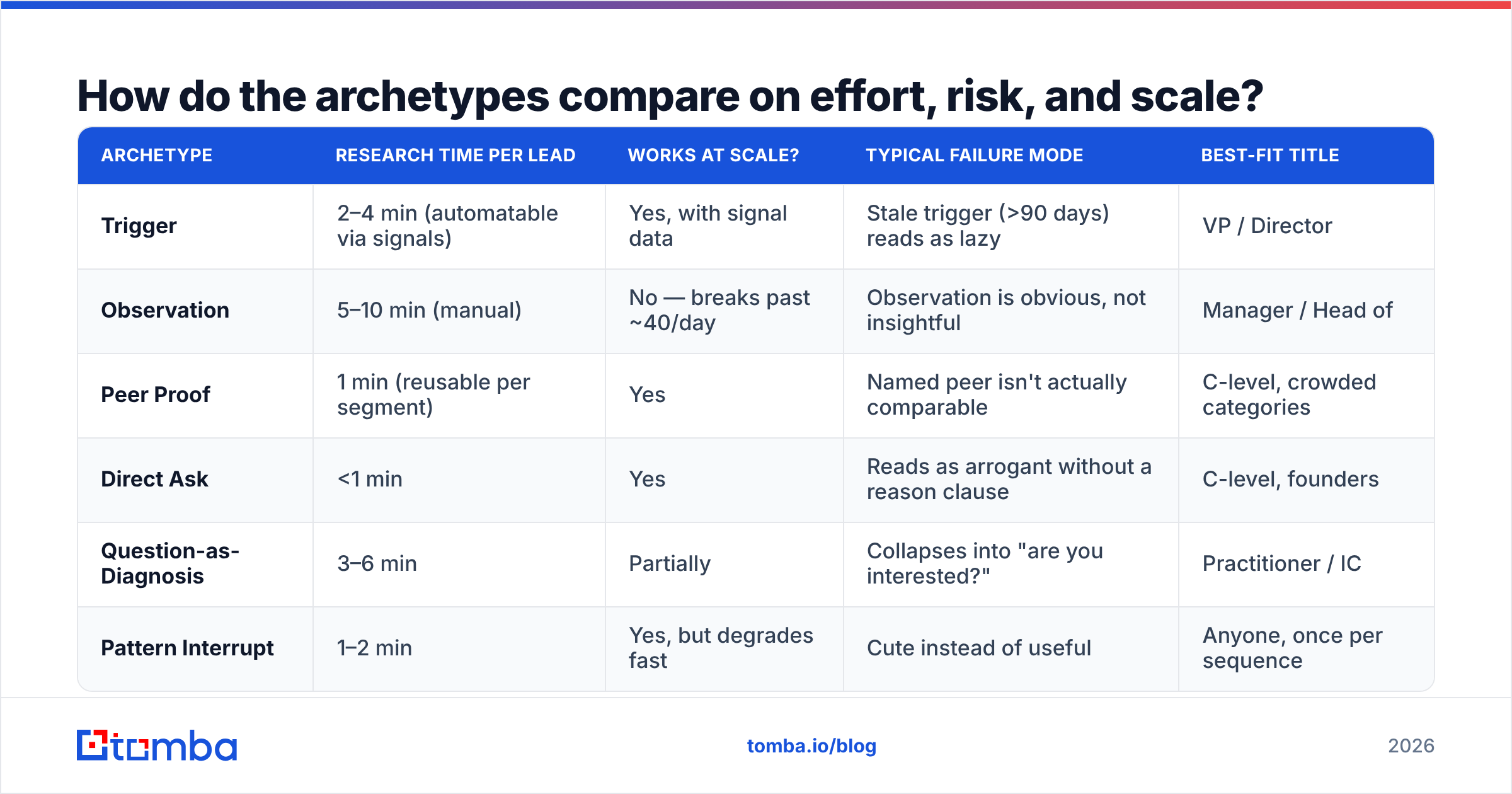
The honest tradeoff nobody puts in a template roundup: the openers that work best are the ones that scale worst. Here's the shape of it.
| Archetype | Research time per lead | Works at scale? | Typical failure mode | Best-fit title |
|---|---|---|---|---|
| Trigger | 2–4 min (automatable via signals) | Yes, with signal data | Stale trigger (>90 days) reads as lazy | VP / Director |
| Observation | 5–10 min (manual) | No — breaks past ~40/day | Observation is obvious, not insightful | Manager / Head of |
| Peer Proof | 1 min (reusable per segment) | Yes | Named peer isn't actually comparable | C-level, crowded categories |
| Direct Ask | <1 min | Yes | Reads as arrogant without a reason clause | C-level, founders |
| Question-as-Diagnosis | 3–6 min | Partially | Collapses into "are you interested?" | Practitioner / IC |
| Pattern Interrupt | 1–2 min | Yes, but degrades fast | Cute instead of useful | Anyone, once per sequence |
The practical read: build your first-touch emails on Trigger and Peer Proof, because those survive volume. Reserve Observation for the fifty accounts that actually matter. Use Direct Ask on follow-ups, where the reader already has context and further runway is insulting.
What are the worst cold email opening lines, and why do they fail?#
Three lines dominate B2B inboxes and all three fail for the same structural reason: they consume the reader's attention without transferring any information.
"I hope this email finds you well." It cannot be false, so it carries zero signal. Worse, it is the single most reliable template marker in existence. Filter your own inbox for it — the results will be 95% cold outreach. Your prospect has run that same filter in their head.
"My name is [Name] and I'm the [Title] at [Company]." All of this is in your signature and your From line. You are asking a stranger to read information they already have, before you've earned the right to ask them for anything.
"Quick question —" The question is never quick. It is almost always "do you want to buy my thing." Buyers learned this in 2019.
There's a fourth, subtler one: fake personalization. "Loved your recent post!" with no reference to what the post said. "Congrats on the growth!" with no number. This tests worse than no personalization in most sequences we've seen reported, and the reason is intuitive once stated — the reader gives you a beat of attention expecting substance, receives nothing, and now distrusts everything downstream. A generic opener is neutral. A hollow personalized opener is a broken promise on line one.
Research from HubSpot's sales blog and buyer-behavior work summarized by Gartner both land in the same place: B2B buyers are spending less time with sellers, not more. The tolerance for runway is gone.
How do you write a cold email opening line in under a minute?#
Four steps. Time-box it, because opener perfectionism is a stall tactic.
Step 1 — Find one true, specific fact. Not their industry. Not their headcount. One fact from the last 90 days: a hire, a launch, a post with an actual claim in it, a page on their site that reveals a decision. If you can't find one in 90 seconds, this account doesn't get an Observation opener — it gets Peer Proof and moves on.
Step 2 — State the fact, then the implication. The fact alone is trivia. The implication is why you're worth reading. "You hired three AEs in Q1" is trivia. "You hired three AEs in Q1 — which usually means someone is now manually building lists for three more people" is an opener.
Step 3 — Delete every "I" and "we" in sentence one. Mechanical rule, no exceptions. If the sentence can't survive it, the sentence is about you.
Step 4 — Read it as the recipient. Ask one question: would a competitor of mine be able to send this exact line to this exact person? If yes, it's not an opener, it's a template. Rewrite the implication until the answer is no.
Then stop. The opener is 15% of the email's job. Your ask, your proof, and your CTA carry the rest. If you want a sanity check on the line above it, run your subject through a subject line generator — but do it after the body is written, not before.
Does personalization still beat volume in 2026?#
It beats volume per email. It loses on total pipeline, which is why the debate never dies.
The resolution most good outbound teams have landed on is tiering:
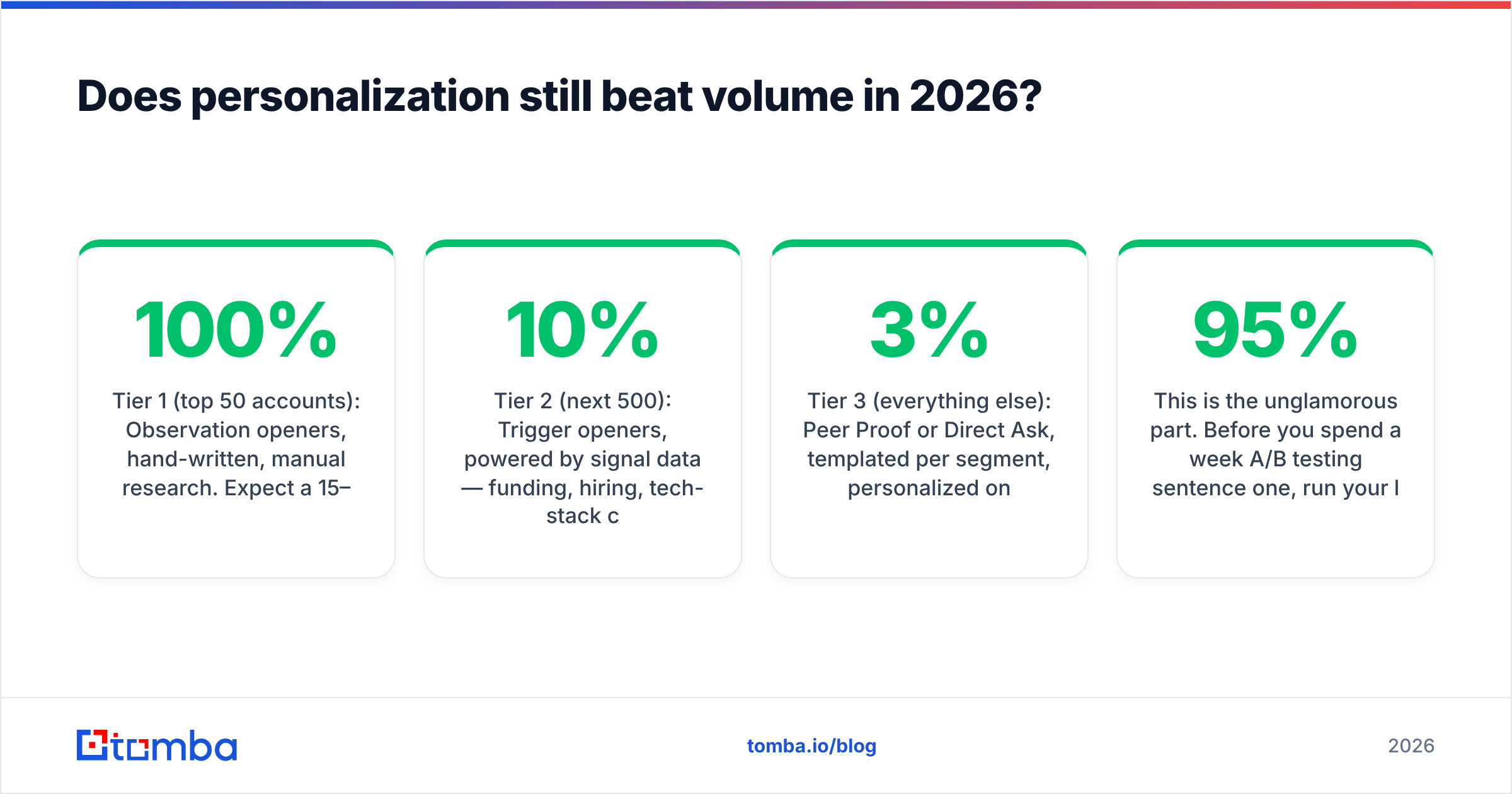
- Tier 1 (top 50 accounts): Observation openers, hand-written, 100% manual research. Expect a 15–30% reply rate. Expect it to take an hour per five emails.
- Tier 2 (next 500): Trigger openers, powered by signal data — funding, hiring, tech-stack changes. Semi-automated. Reply rates in the 5–10% band.
- Tier 3 (everything else): Peer Proof or Direct Ask, templated per segment, personalized only at the company + role level. Reply rates 1–3%, but the volume math works.
What kills all three tiers equally is bad data. A brilliant Observation opener sent to firstname.lastname@ on a domain that switched to f.lastname@ two years ago is a bounce, and enough bounces move you from the inbox to spam permanently — at which point your openers are being read by nobody.
This is the unglamorous part. Before you spend a week A/B testing sentence one, run your list through an email verifier and check what your actual deliverable percentage is. If it's under 95%, fix that first. Every point of bounce rate you shave is worth more than any opener you'll write this quarter, and the effect compounds — sender reputation is a stock, not a flow.
How should you test opening lines without burning your list?#
Test one variable. Openers are the easiest thing in cold email to test badly, because they sit at the top and everything downstream is confounded by them.
Do this:
- Hold subject line, body, and CTA constant. Vary only sentence one.
- Split at 200+ sends per variant minimum. Below that you're reading noise.
- Measure reply rate, not open rate. Open rate has been unreliable since Apple Mail Privacy Protection started pre-fetching images, and it never measured the thing you care about anyway.
- Segment by title. An opener that wins with founders often loses with directors, and the aggregate hides both effects.
- Run it for two weeks minimum. Day-of-week effects are larger than most opener effects.
Don't do this:
- Don't test six variants at once on a 400-lead list.
- Don't test openers and CTAs in the same experiment.
- Don't compare this month's test against last month's baseline. Your list changed. Your response rate baseline moves with list quality, not just copy quality.
And keep a kill list. Once "I hope this email finds you well" loses to a blank first line — and it will — never test it again. The Zeigarnik effect explains part of why open loops in sentence one outperform closed pleasantries: an unfinished thought holds attention in a way a completed courtesy cannot.
What should you do next?#
Rank the levers by leverage, then work down:
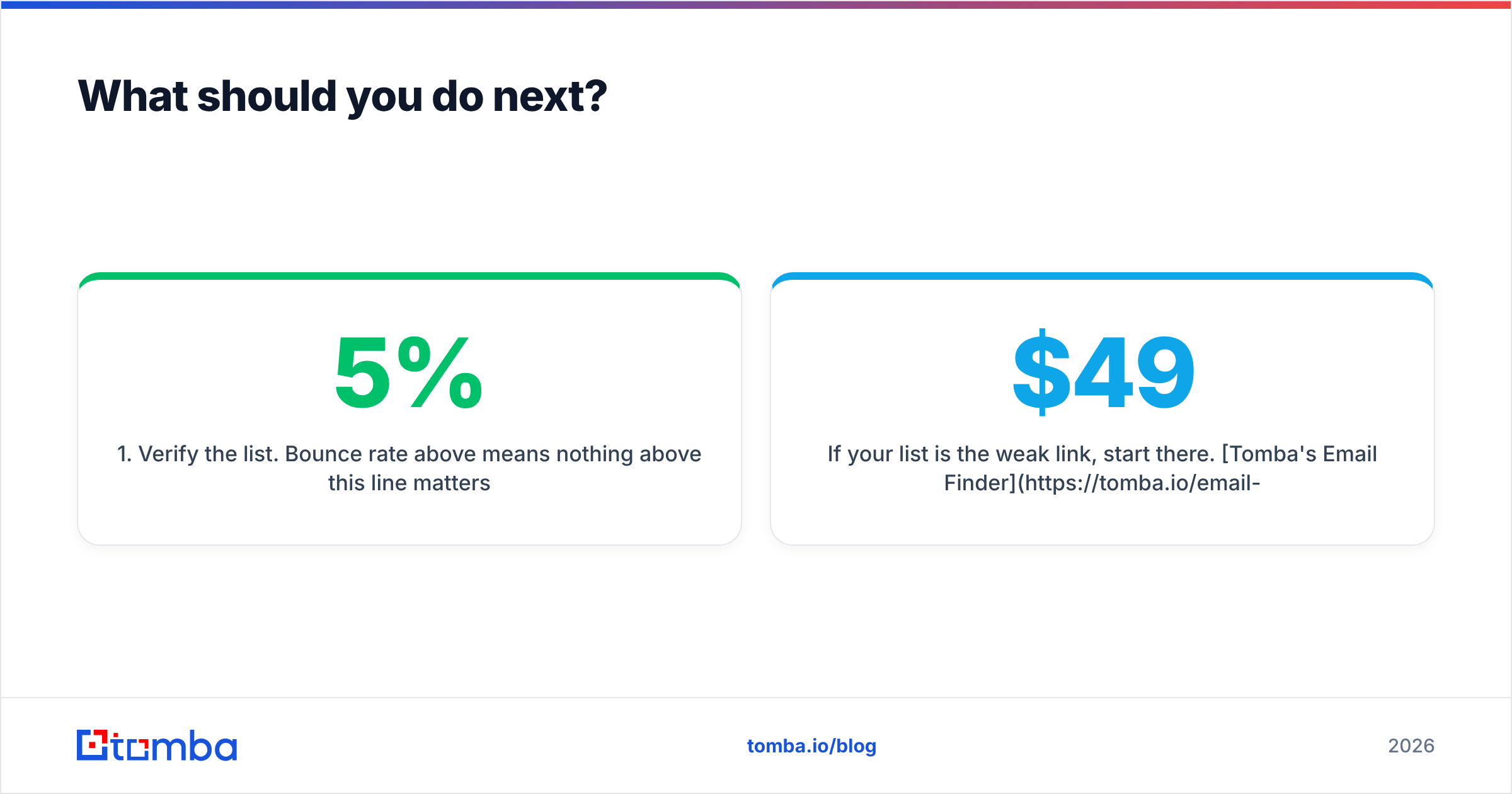
- Verify the list. Bounce rate above 5% means nothing above this line matters.
- Pick one archetype per tier. Not two. Not a hybrid.
- Write ten openers, kill eight. The two survivors are the ones a competitor couldn't send.
- Test one variable for two weeks. Reply rate only.
- Rewrite quarterly. Every opener that works publicly stops working within about six months, because it gets copied.
The unfair advantage in cold email was never the sentence. It's knowing that the person you're writing to exists, holds the role you think they hold, and can actually receive mail at the address on your list. Get that right and a mediocre opener still lands. Get it wrong and the best sentence you'll ever write bounces.
If your list is the weak link, start there. Tomba's Email Finder verifies each address at the moment it's found, so you're writing openers for people who will actually see them — free tier includes 25 searches a month, Starter is $49/mo, and Growth runs $99/mo if you're building lists at volume. Fix the deliverability floor first. Then go write a sentence worth reading.
Related guides#
Ready to find emails that actually work?
Join 150,000+ professionals who stopped guessing and started sending. Free credits on signup — no credit card required.
Get the Tomba newsletter
Practical outbound tactics and product updates — once every two weeks.
About the author