Cold Email Subject Line Networking: 27 Formulas That Work
Networking emails fail in the inbox preview, not the pitch. Here are the subject line patterns that actually get opened by strangers in 2026 — plus the ones that quietly kill your reply rate.
TL;DR
- A networking subject line has one job: prove you are a person, not a sequence. Anything that smells like a template gets archived before the body is read.
- Short beats clever. Subject lines of 3–7 words consistently outperform 9+ word lines in cold networking outreach, because mobile previews truncate at roughly 35–40 characters.
- The three highest-performing categories are shared context ("Both at SaaStr Thursday?"), specific compliment ("Your Q3 pricing teardown"), and direct low-ask ("15 min, no pitch").
- Personalization tokens like
{{first_name}}in the subject line now reduce opens with senior buyers — they read as automation. Personalize with facts, not variables. - None of it matters if the address bounces. A 6% bounce rate on a networking send will tank your domain reputation faster than any bad subject line ever could.
What makes a networking subject line different from a sales one?#
The reader's question is different, so the answer must be too.
A sales subject line answers "why should I care?" A networking subject line answers "who are you, and why are you in my inbox?" Those are not the same problem. Sales lines lean on value props, numbers, and pain. Networking lines lean on proximity — the sense that you and the recipient already share some small piece of world.
Think of it like walking up to someone at a conference. You do not open with "We help Series B fintechs reduce CAC by 34%." You open with "You gave the talk on churn cohorts, right?" The subject line is the equivalent of that first four seconds before they decide whether to keep listening or scan the room for someone else.
This is why so much standard cold email advice fails when you repurpose it for networking. The cold email playbook optimizes for a transaction. Networking optimizes for a relationship that might pay off in eighteen months, or never, or in a way you did not predict. The subject line has to signal "low stakes, real human" rather than "qualified opportunity."
What are the core subject line patterns for cold networking outreach?#
There are five structural families. Everything else is a remix.
- Shared context — you and the recipient occupy the same room, list, cohort, alumni network, Slack group, or conference. Examples:
Also at RevOps Summit?,Fellow Wharton '19,Saw you in the Pavilion Slack. This is the single strongest opener because it converts a cold contact into a warm-ish one at zero cost. - Specific compliment — you reference one concrete artifact they made. Not "loved your content." Examples:
Your churn cohort chart,That pricing teardown (page 4),Re: your take on PLG hiring. Specificity is the entire mechanism. Vague praise reads as flattery-as-a-service. - Direct low-ask — you name the ask and shrink it. Examples:
15 min, no pitch,One question about your RevOps stack,Quick favor — 2 minutes. Works best when the recipient is senior enough to have seen a thousand pitches and appreciates being spared the dance. - Curiosity gap (used sparingly) — you withhold exactly one piece of information. Examples:
A weird thing about your careers page,Something your competitor is doing. Powerful, and easy to abuse. If the body does not deliver the promised thing immediately, you have burned the contact permanently. - Mutual connection — the strongest of all, when it is real. Examples:
Priya said to email you,Referred by Marcus at Datadog. Reply rates on genuine referral subject lines routinely land two to four times higher than any other pattern. Never fake this.
Notice that four of the five require you to know something true about the person. That is the actual work. The subject line is just the receipt.
Which subject lines actually get opened, and which get archived?#
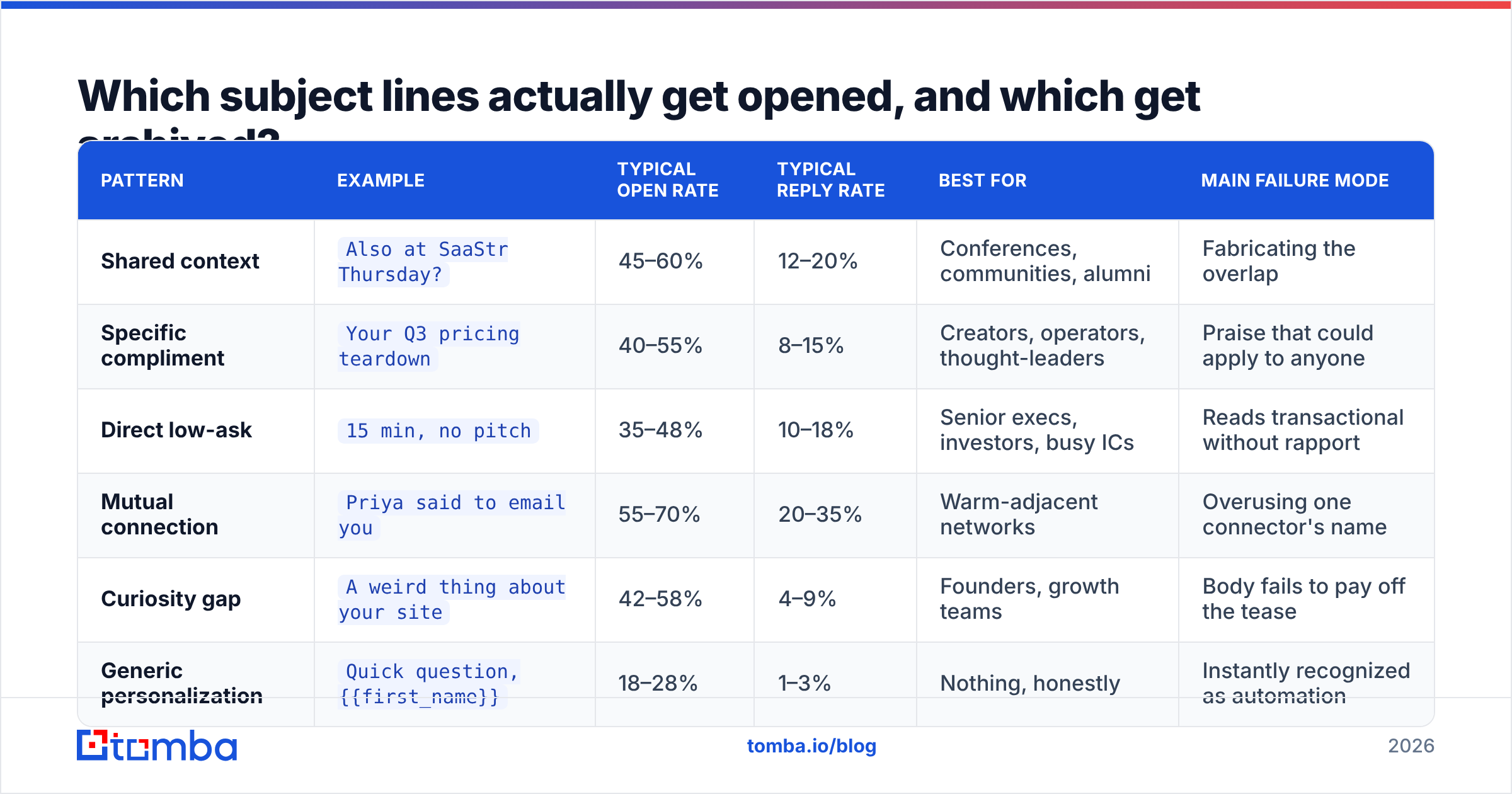
Here is a comparison of the five families against the metrics that matter for networking outreach specifically — where a reply is the only success condition, since there is nothing to click.
| Pattern | Example | Typical open rate | Typical reply rate | Best for | Main failure mode |
|---|---|---|---|---|---|
| Shared context | Also at SaaStr Thursday? |
45–60% | 12–20% | Conferences, communities, alumni | Fabricating the overlap |
| Specific compliment | Your Q3 pricing teardown |
40–55% | 8–15% | Creators, operators, thought-leaders | Praise that could apply to anyone |
| Direct low-ask | 15 min, no pitch |
35–48% | 10–18% | Senior execs, investors, busy ICs | Reads transactional without rapport |
| Mutual connection | Priya said to email you |
55–70% | 20–35% | Warm-adjacent networks | Overusing one connector's name |
| Curiosity gap | A weird thing about your site |
42–58% | 4–9% | Founders, growth teams | Body fails to pay off the tease |
| Generic personalization | Quick question, {{first_name}} |
18–28% | 1–3% | Nothing, honestly | Instantly recognized as automation |
Two things jump out of that table.
First, the curiosity gap has a high open rate and a low reply rate. That gap between opens and replies is the tell of a subject line writing checks the body cannot cash. High opens with low replies is not a win — it is a slow-motion sender reputation problem.
Second, generic personalization tokens are now actively harmful. Ten years ago Quick question, {{first_name}} was a growth hack. In 2026, buyers have received that exact string several thousand times. The mailmerge variable is the modern equivalent of a fax cover sheet: technically functional, unmistakably mechanical. HubSpot's sales research has tracked this decay across a decade of email benchmarks, and the direction has been one way the entire time.
How long should a networking subject line be?#
Between three and seven words. Under 40 characters if you can manage it.
The constraint is not aesthetic — it is physics. Gmail on an iPhone shows roughly 35–40 characters of subject line before truncating. Outlook mobile shows slightly more. If your key differentiating word lands at character 52, on mobile it does not exist. And the majority of first-touch opens on cold outreach happen on a phone, often in a triage session where the recipient is deleting rather than reading.
So the operative question is not "what is my subject line?" It is "what are my first 35 characters?"
Compare:
- ❌
Following up on my previous note about a potential partnership opportunity— the recipient seesFollowing up on my previous no...and learns nothing. - ✅
Both at SaaStr Thursday?— 24 characters. Fully visible. Answers "who are you" and "why now" simultaneously.
Sentence case, not Title Case. Title Case reads like a press release. Lowercase-leaning subject lines read like something a colleague typed on their phone, which is exactly the register you want.
And no emoji. On networking outreach to senior B2B contacts, emoji in the subject line correlates with the spam folder, not with personality.
Should you use questions, statements, or fragments?#
Fragments win, questions are close, statements lose.
A fragment — Your churn cohort chart — implies an ongoing conversation. It has the syntax of an internal forward, not a broadcast. That familiarity is doing quiet work before the reader consciously evaluates anything.
A question — Both at SaaStr Thursday? — creates a small open loop and invites a one-word answer. Excellent for shared-context plays.
A complete declarative statement — We help companies like yours reduce churn — is unmistakably marketing. Full sentences in a subject line signal that a marketer wrote it. Nobody emailing a peer writes a full sentence in the subject.
One more structural note: Re: and Fwd: prefixes on a first-touch email are a lie. They spike opens and destroy trust in the same second. Do not do it. The recipient checks their thread history, finds nothing, and now knows exactly what kind of sender you are.
What is the biggest mistake in cold email subject line networking?#
Optimizing the subject line while ignoring the list.
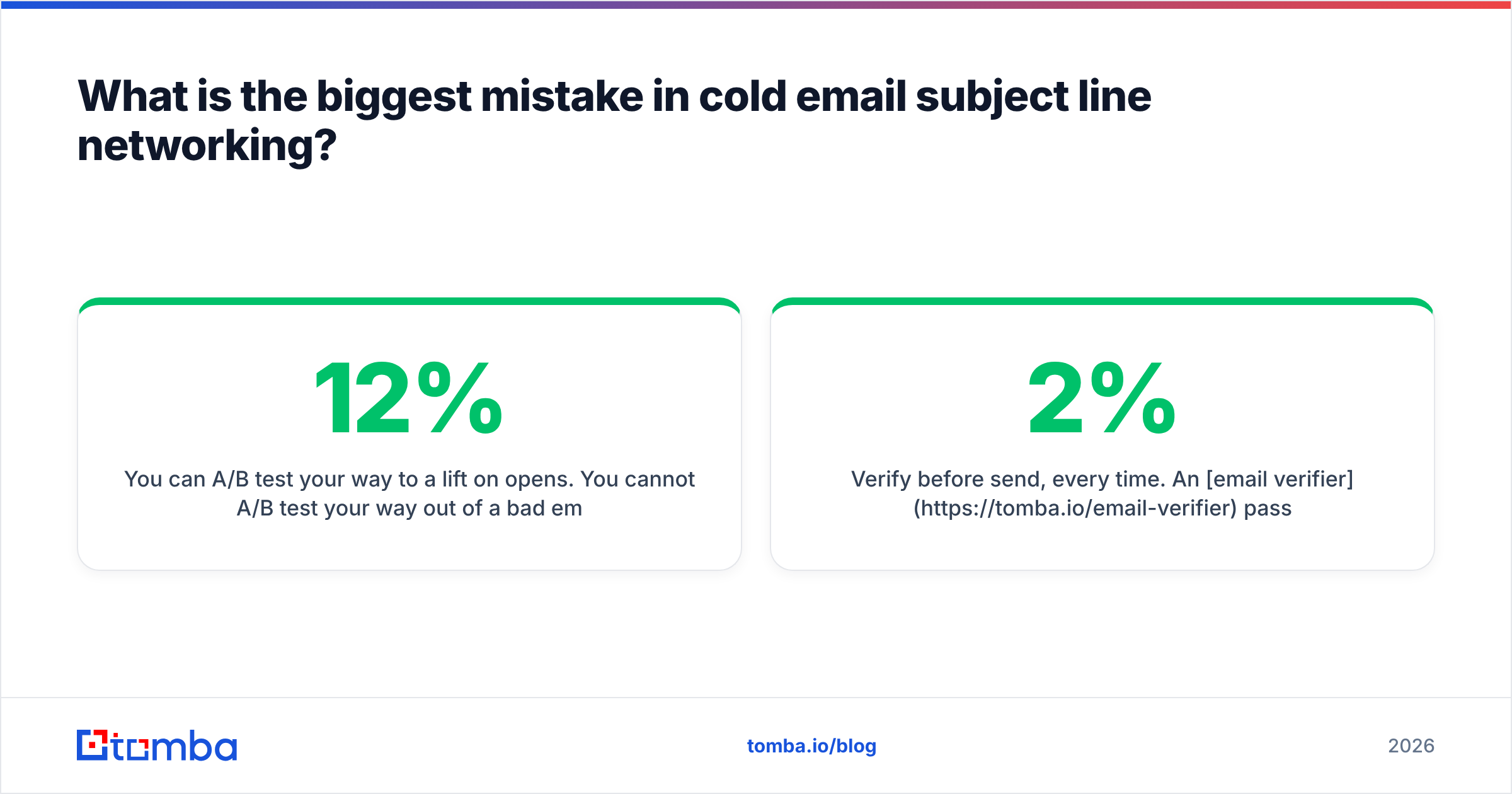
You can A/B test your way to a 12% lift on opens. You cannot A/B test your way out of a bad email address. If 6% of your networking sends bounce, mailbox providers start treating your domain as a list-buyer's domain, and your beautifully crafted Both at SaaStr Thursday? gets filed in Promotions for everyone — including the people whose addresses were fine.
This is the unglamorous half of subject line performance. Deliverability determines your ceiling; copy determines where you land under it.
The sequence that actually works:
- Source the address from a real signal — the company domain, a conference attendee list, a LinkedIn profile — rather than guessing at a pattern. A tool like Tomba's email finder resolves name plus domain into a verified address instead of blasting six permutations and hoping.
- Verify before send, every time. An email verifier pass drops your bounce rate below 2% for a fraction of a cent per contact. That is the cheapest deliverability insurance available.
- Segment by pattern family. Do not send the same subject line to conference contacts and referral contacts. They earned different openers.
- Cap your daily volume. Networking outreach at 500 sends a day is not networking. Fifty highly researched sends will out-reply five hundred sprayed ones, and your domain survives the quarter.
If you want to pressure-test wording before it ships, Tomba's free subject line tester scores length, spam-trigger words, and mobile truncation. The subject line generator is useful for breaking out of a rut, though you should always rewrite its output — anything generated by a model and sent unedited will eventually collide with someone else's identical output.
How do you personalize without sounding automated?#
Personalize with facts, not with fields.
A field is {{first_name}}, {{company}}, {{industry}}. Any tool can fill those, and every recipient knows it. A fact is something that required a human to look at something: a line from their podcast appearance, a change on their pricing page, the specific talk they gave, the open role they just posted.
The heuristic: if your subject line would still be true after swapping in a different recipient, it is not personalized.
Test it. Quick question about Acme's growth — swap Acme for anything, still works, not personalized. Your point about usage-based pricing at 22:14 — cannot be swapped, personalized.
This does not scale to thousands of contacts, and that is the point. Networking is a low-volume, high-research motion. The correct comparison is not "how many can I send" but "how many replies did I earn per hour of effort." At fifty researched sends a week with a 15% reply rate, you are having seven or eight real conversations. That is a functioning network. At two thousand templated sends with a 1.5% reply rate you get thirty replies, most of them "unsubscribe," and a scorched domain.
What about follow-up subject lines?#
Follow-ups should stay in-thread. Reply to your own email, keep the original subject, add nothing.
Changing the subject line on a follow-up creates a new thread, which means the recipient loses the context of the original — and you lose the visual signal that this is an ongoing conversation rather than a fresh cold hit. The exception is the final email in a sequence, where a genuine pattern interrupt earns its keep: Closing the loop, Should I stop emailing you?, Wrong person?.
That last one, Wrong person?, is unusually effective in networking contexts because it is often literally true and it gives the recipient a socially easy way to respond — forwarding you to the right contact costs them nine seconds and makes them feel helpful.
Two to three follow-ups is the ceiling for networking. Beyond that you are no longer networking; you are pestering, and the person you are pestering talks to other people in your industry.
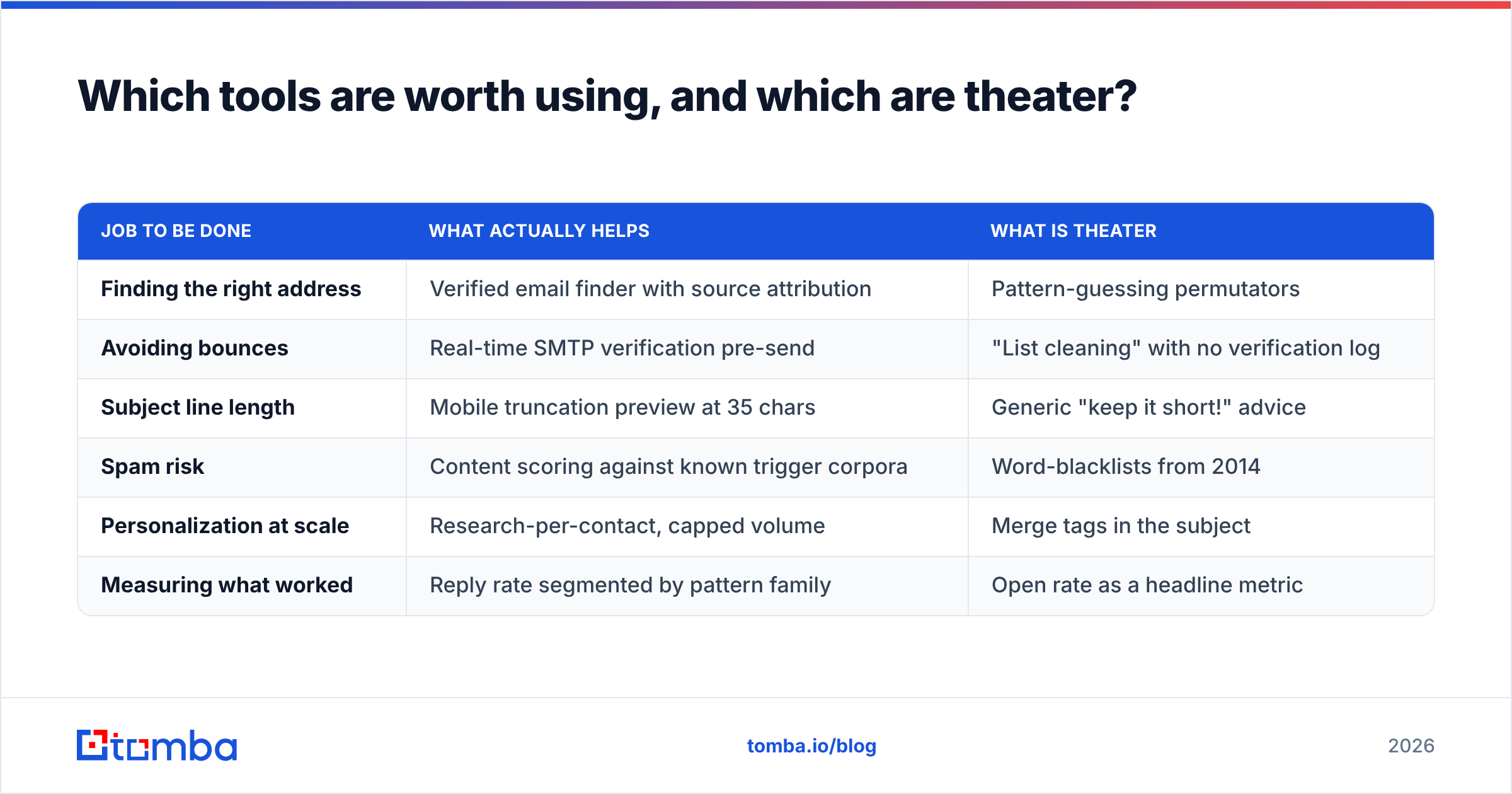
Which tools are worth using, and which are theater?#
Most subject-line tools are dressed-up character counters. The ones that matter address a real constraint.
| Job to be done | What actually helps | What is theater |
|---|---|---|
| Finding the right address | Verified email finder with source attribution | Pattern-guessing permutators |
| Avoiding bounces | Real-time SMTP verification pre-send | "List cleaning" with no verification log |
| Subject line length | Mobile truncation preview at 35 chars | Generic "keep it short!" advice |
| Spam risk | Content scoring against known trigger corpora | Word-blacklists from 2014 |
| Personalization at scale | Research-per-contact, capped volume | Merge tags in the subject |
| Measuring what worked | Reply rate segmented by pattern family | Open rate as a headline metric |
That last row deserves emphasis. Since Apple Mail Privacy Protection began pre-fetching images, open rate is a noisy, inflated, largely decorative metric. If you are still optimizing subject lines against open rate, you are optimizing against noise. Track replies. Track positive replies separately. The subject line's job is not to get opened — it is to get answered.
For a broader view of the tooling landscape, G2's category pages are a reasonable neutral starting point, though weight recent reviews far more heavily than aggregate scores.
A quick checklist before you hit send#
Run every networking subject line through this:
- Is it under 40 characters?
- Would it survive being read on a phone with the last 60% cut off?
- Does it contain a fact that could not apply to anyone else?
- Is it in sentence case, with no emoji and no
Re:prefix? - Does the body immediately pay off whatever the subject promised?
- Has the address been verified in the last 90 days?
- Is the ask small enough that "yes" costs the recipient under fifteen minutes?
Six yeses and a verified address is a good networking email. Seven yeses and it is a very good one.
Where to start#
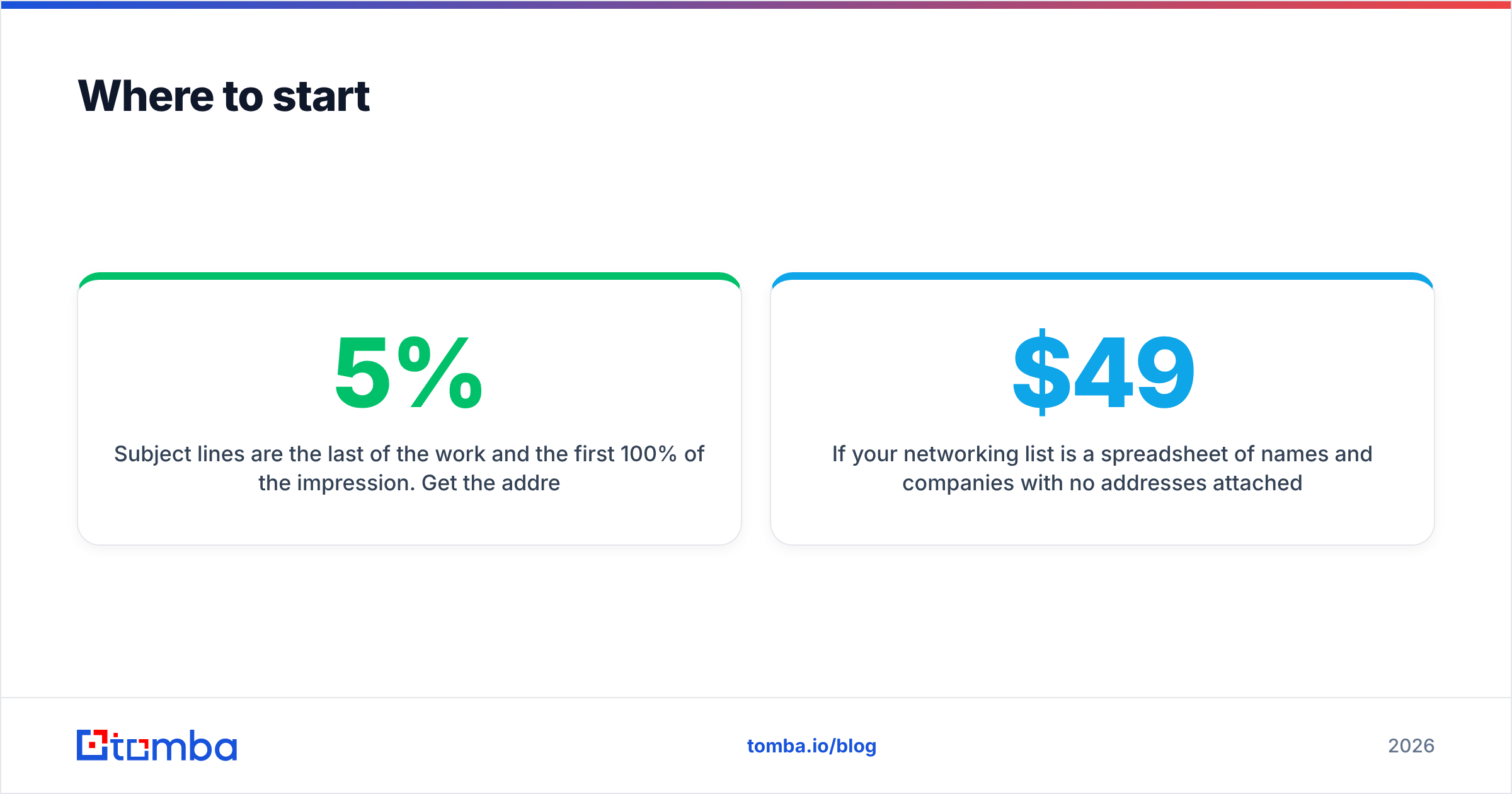
Subject lines are the last 5% of the work and the first 100% of the impression. Get the address right, get the fact right, then spend ten minutes on seven words.
If your networking list is a spreadsheet of names and companies with no addresses attached, start there — Tomba Email Finder resolves name plus domain into a verified professional address, with source attribution so you know where each one came from. The free tier covers 25 searches a month, which is enough to test the workflow on your next conference follow-up list; paid plans start at $49/month if you scale past that. Check current Tomba pricing for the full breakdown.
Find the person. Verify the address. Then write the seven words that prove you actually looked.
Related guides#
// get started
Find, verify and enrich your first contacts today
Start on the free plan with 25 searches a month, then scale when your team is ready.
Free plan · No credit card required · GDPR & CCPA
// about the author