Cold Email Subject Lines for CEOs: 27 Examples That Work
CEOs delete faster than anyone else in the org chart. Here are 27 cold email subject lines for CEOs that survive the preview pane, plus the four-word rule and the phrases that get you filed under noise.
TL;DR
- CEOs read subject lines on a phone, in a hallway, between meetings. You get roughly 35 characters and half a second.
- Short beats clever. Four to seven words outperforms everything else in cold outbound to founders and CEOs.
- Specificity is the whole game: a number, a company name, or a real event beats any curiosity gimmick.
- "Quick question," "Touching base," and anything with "Re:" that isn't actually a reply will get you filtered, not opened.
- A great subject line on a wrong or unverified address is worth zero. Deliverability and data quality come before copy.
Why are cold email subject lines for CEOs different?#
Because the reader is different, and the difference is structural rather than psychological.
A VP of Marketing gets maybe 60 emails a day and has a workflow for triaging them. A CEO of a 200-person company gets 200+, half of which are internal escalations, board material, and legal. She is not reading your email. She is scanning a list of senders and 30-ish visible characters, deciding which ones survive the swipe.
That changes the job of the subject line. For a mid-level buyer, the subject line's job is to earn a click. For a CEO, the subject line's job is to prove — before the email is opened — that a competent person on the other side did homework. If it doesn't do that in the preview pane, nothing inside the email matters.
Three consequences follow:
- Mobile truncation is the real constraint. iOS Mail shows about 35 characters of subject in the inbox list. Gmail on Android shows a bit more. Anything past that is invisible until opened, which means the payload has to land in the first four or five words.
- Gatekeeping is often algorithmic, not human. Most CEOs at companies under 500 people have no EA. Their filter is Gmail's Promotions tab and a mental pattern-match on "this is a template."
- Status asymmetry cuts both ways. Over-formality reads as fear. Over-familiarity reads as a script. The register you want is peer-to-peer: how a competitor's CEO would title an email.
Most guides to cold email treat the subject line as a copywriting exercise. For CEOs it's closer to an information design exercise — compress one useful fact into a phone-width string.

What subject line length actually works for CEOs?#
Four to seven words. Under 40 characters. That's not a style preference, it's a rendering constraint.
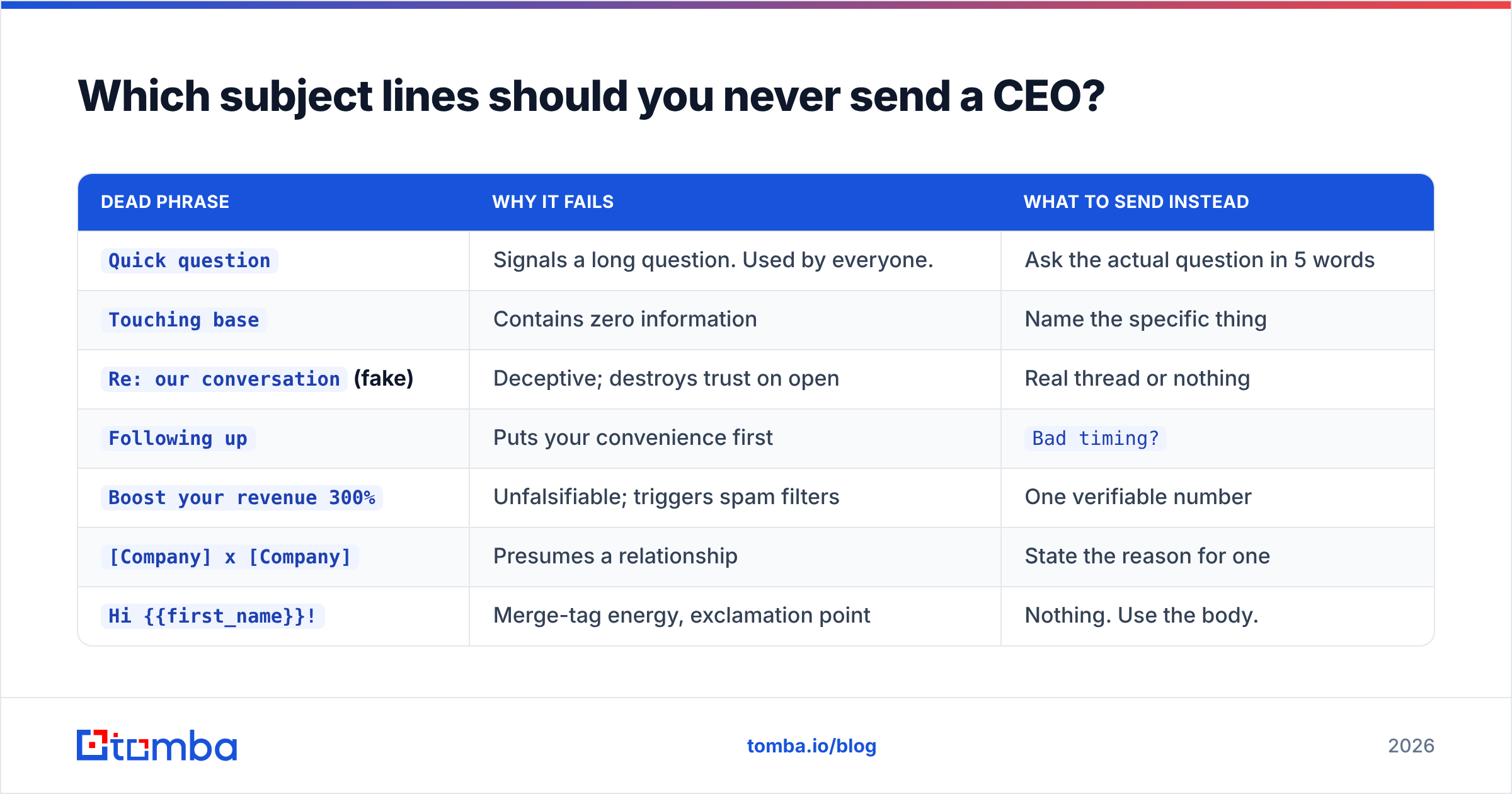
Here's how the common length bands behave in practice when you're emailing founders, CEOs, and C-suite operators cold:
| Length band | Chars | Renders fully on mobile? | Typical use | Realistic open range |
|---|---|---|---|---|
| 1–3 words | <25 | Yes | Ultra-terse, "Churn" or "Series B" | 35–55%, but high delete rate |
| 4–7 words | 25–40 | Yes | The sweet spot for cold CEO outbound | 40–60% |
| 8–12 words | 40–65 | Truncated on iOS | Warm intros, referrals, event follow-up | 25–40% |
| 13+ words | 65+ | Truncated everywhere | Newsletter and marketing blasts | 12–25% |
| Question format | any | n/a | Works only when the question is specific | Varies wildly |
One-word subject lines ("Churn.") get opened at a high rate and deleted at a high rate, because they read as bait. The bounce-back is a reputation hit you don't see in your dashboard. Four to seven words gives you enough room to name a company, a number, or an event — which is what earns the second look.
Also worth noting: sentence case beats Title Case beats ALL CAPS, in that order, every time. Title Case reads as marketing. A CEO writing to another CEO types in lowercase-ish sentence case, and your subject should match.
What are the best cold email subject lines for CEOs?#
Below are 27 lines grouped by the mechanism that makes them work. Steal the structure, not the words — a copied line stops working the moment three other reps in your category use it on the same person.
Trigger-event lines (highest performing category)
Your Series B and the SDR mathCongrats on the Acme acquisitionSaw the Denver office postingNew CFO — pipeline reporting?Your G2 reviews mention onboardingRe: your comment on the earnings call
Number-first lines
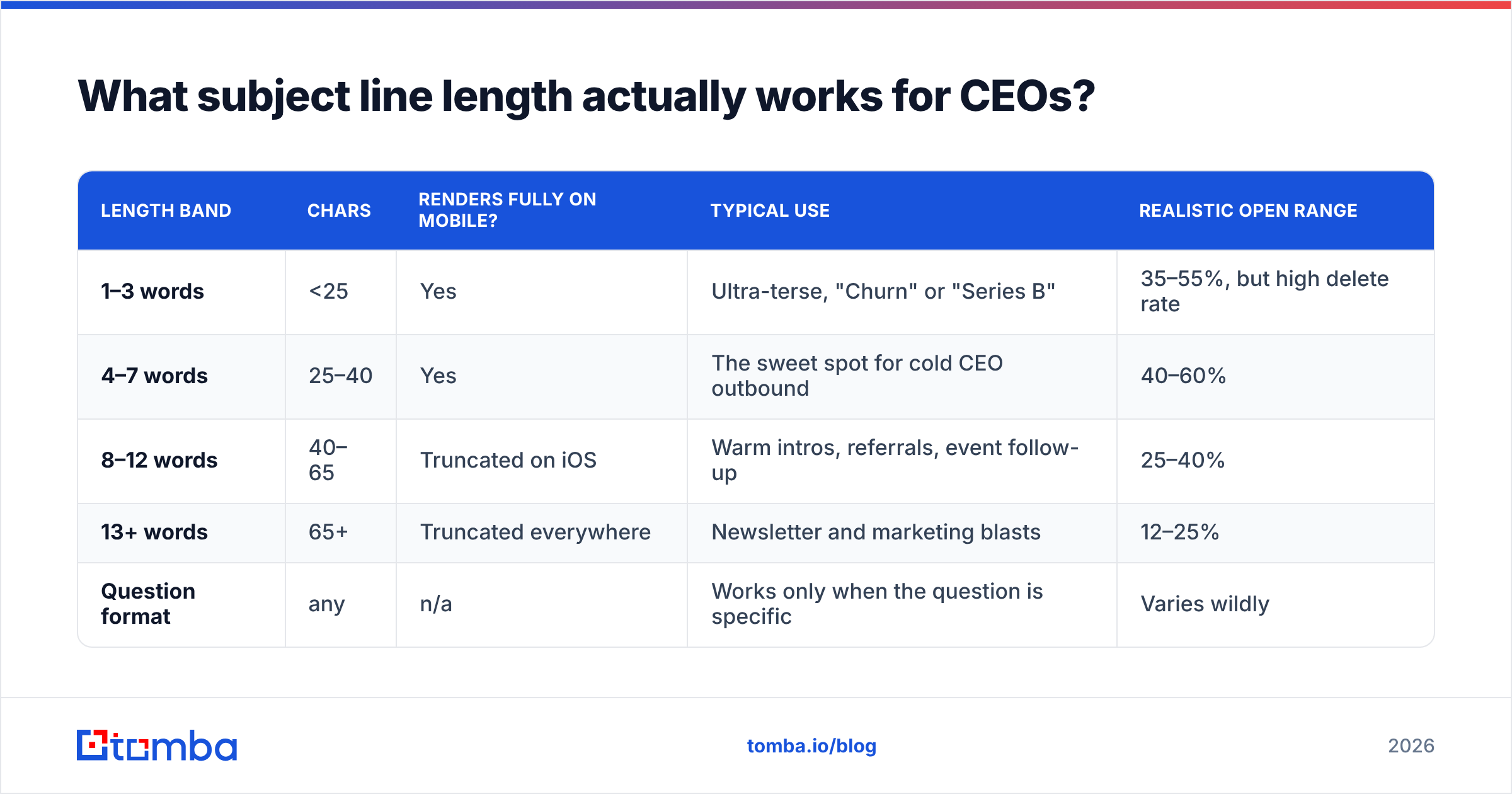
$1.2M in expansion you're not billing31% of your leads are unreachableCut 9 hours a week from RevOps4 competitors, 1 gapYour 14-day trial converts at 6%
Peer-reference lines
How Ramp's CRO handles thisTwo of your investors use usWhat Notion did at your stageSame problem, 3 portfolio cos
Problem-naming lines
The handoff between AE and CSWhy your reps skip the CRMChurn in month 4Duplicate contacts in SalesforceYour enterprise deals stall at legal
Direct-ask lines (use sparingly, they work)
Worth 12 minutes?Should I talk to Sarah instead?Bad timing?Wrong person?
Contrarian / pattern-interrupt lines
Don't buy this yetWe're probably too small for youIgnore this if Q3 is locked
Lines 22 through 24 deserve a note. Wrong person? and Should I talk to Sarah instead? get replies from CEOs at a rate that surprises people, because they're low-effort to answer and they let the CEO do the thing CEOs love: delegate. The catch is that they only work if the body of the email is genuinely short and genuinely relevant. Used as a trick on a bad-fit account, they generate a one-word "yes" and nothing else.
Which subject lines should you never send a CEO?#
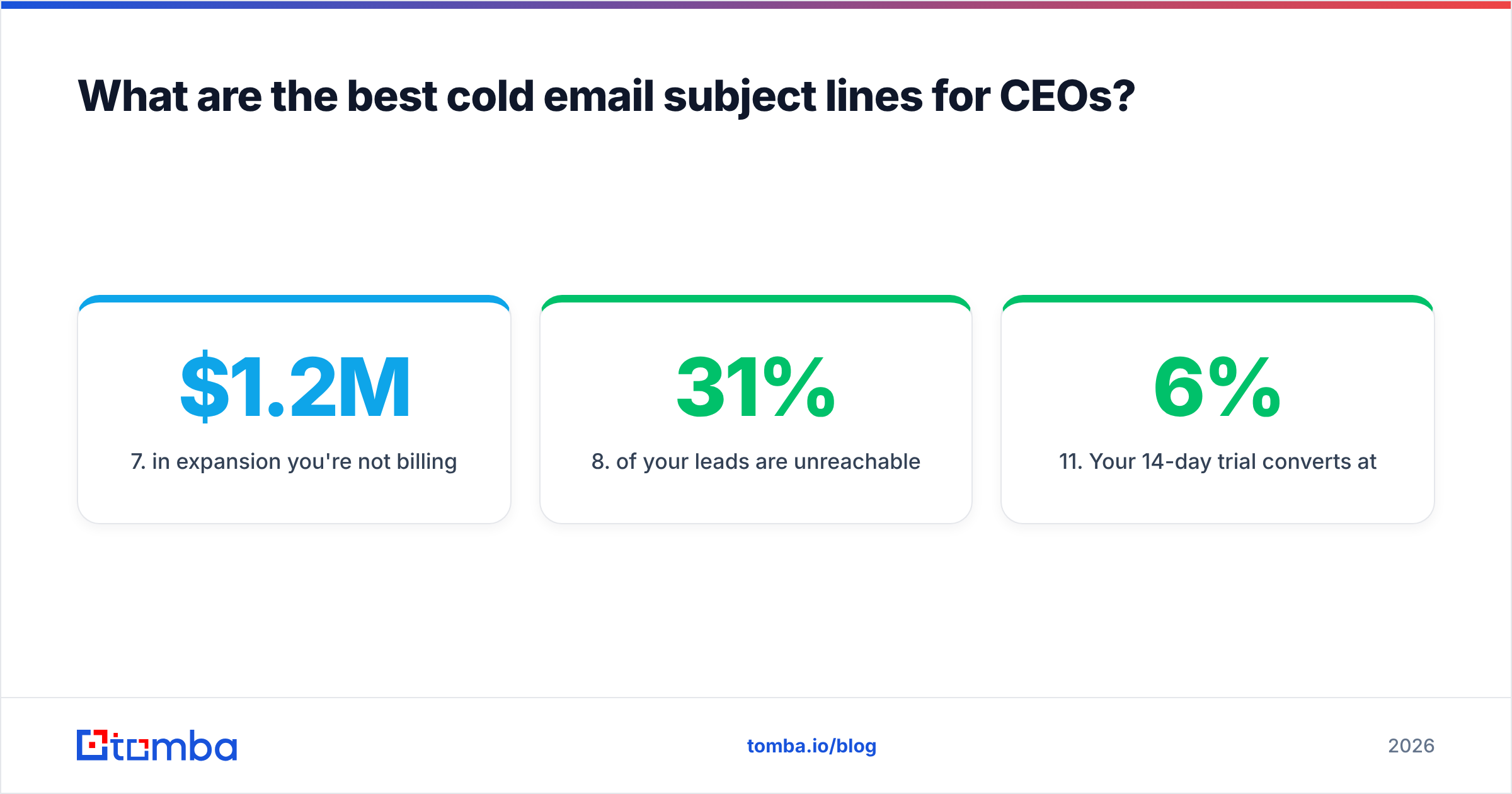
The dead phrases are dead for a simple reason: every CEO has seen them 400 times this quarter, from 400 SDRs, and pattern-matched them to "delete."
| Dead phrase | Why it fails | What to send instead |
|---|---|---|
Quick question |
Signals a long question. Used by everyone. | Ask the actual question in 5 words |
Touching base |
Contains zero information | Name the specific thing |
Re: our conversation (fake) |
Deceptive; destroys trust on open | Real thread or nothing |
Following up |
Puts your convenience first | Bad timing? |
Boost your revenue 300% |
Unfalsifiable; triggers spam filters | One verifiable number |
[Company] x [Company] |
Presumes a relationship | State the reason for one |
Hi {{first_name}}! |
Merge-tag energy, exclamation point | Nothing. Use the body. |
Partnership opportunity |
Means "I want to sell you something" | Say what you're selling |
The Re: fake-reply trick is worth singling out. It still lifts open rate. It also permanently marks you as someone who lies to get attention, which is an odd first impression to give a person you want to sign a contract. Several major deliverability guides now flag manufactured Re: and Fwd: prefixes as engagement-bait signals; providers are increasingly good at detecting them. The short-term open lift is a long-term sender reputation tax.
Similarly, emoji in subject lines to a CEO: no. It reads as e-commerce. The single exception is a well-known industry symbol that the recipient's own company uses in its branding, and even then it's a coin flip.
How do you personalize a CEO subject line without being creepy?#
There's a line between "you researched my company" and "you researched me," and CEOs feel it immediately.
Safe, effective personalization pulls from public business facts: funding rounds, job postings, product launches, earnings calls, conference talks, open-source repos, review-site feedback, pricing page changes. These say I studied your business.
Unsafe personalization pulls from personal signals: their kid's soccer team, their marathon time, a photo from their Instagram. These say I studied you, and the reaction is discomfort, not delight. "Saw you ran Boston" has never closed a deal.
Here's the practical hierarchy, ordered by how much lift each source gives per hour of research:
- Funding and M&A events — highest lift. New capital means new budget and new pressure. A round announced in the last 45 days is the single best trigger in B2B.
- Hiring signals — a posting for "Director of RevOps" tells you exactly which process is broken, and lets you write
Your RevOps postingas a subject. - Product and pricing changes — a new enterprise tier means new enterprise problems (procurement, SSO, security review).
- Public complaints — G2 and Capterra review text, community threads, support forums.
Your G2 reviews mention onboardingis uncomfortable but honest, and CEOs respect it more than flattery. - Leadership changes — a new CFO or CRO rewires purchasing authority for six months.
- Competitor moves — what a direct rival just shipped or announced is often more urgent to a CEO than what she shipped herself.
Research firms tracking B2B buying behavior, including Gartner's sales practice, have documented for years that buying groups reject vendors who demonstrate no understanding of context. The subject line is where that understanding is either proven or absent.
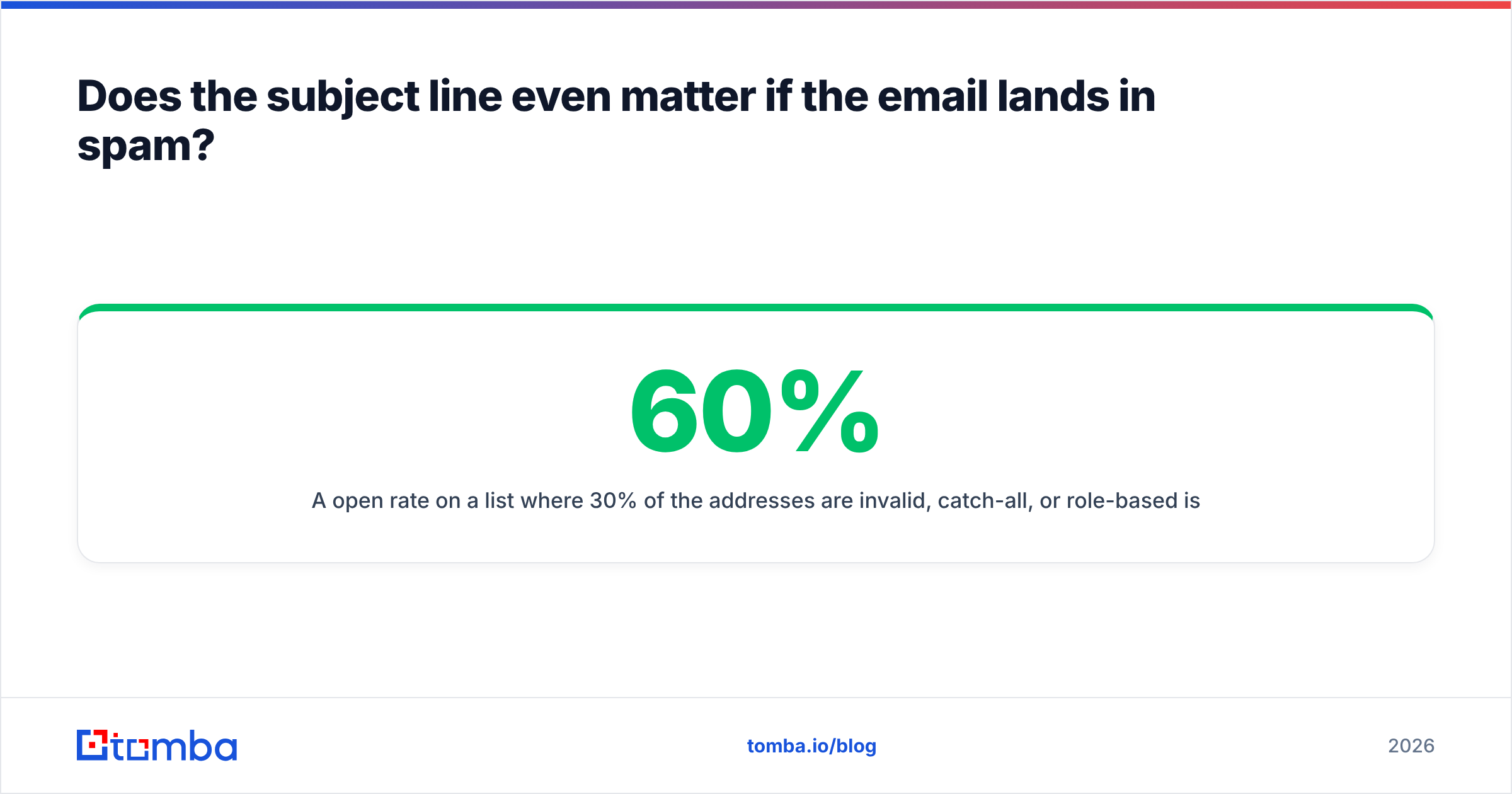
Does the subject line even matter if the email lands in spam?#
No. And this is where most subject-line advice quietly falls apart.
A 60% open rate on a list where 30% of the addresses are invalid, catch-all, or role-based is a worse business outcome than a 40% open rate on a clean list. Bounces above roughly 3% start degrading domain reputation. Once your domain is degraded, your beautiful four-word subject line lands in Promotions or Spam, where nobody reads subject lines at all.
So the order of operations for cold outbound to CEOs is:
- Get a correct address. CEO emails are the hardest tier to source — small companies use
firstname@, larger ones usefirst.last@, and executives often sit behind a different pattern than the rest of staff. An email finder that returns a confidence score, not just a guess, matters more here than anywhere else in the org chart. - Verify before sending. Run every executive address through an email verifier and quarantine anything that comes back risky or catch-all.
- Warm the domain. Send volume ramps slowly. New domains cannot open with 500 sends a day.
- Then write the subject line.
Reps do this backwards constantly — they spend an afternoon on 27 subject line variants and send them to a list they scraped in eleven minutes. Skipping step one and two makes steps three and four cosmetic.

How should you A/B test CEO subject lines?#
Carefully, because your sample size is small and your denominator lies.
Cold outbound to CEOs is a low-volume, high-value motion. If you're sending 80 emails a week to a target account list, you cannot run a statistically meaningful subject-line test in a quarter. What you can do:
- Test archetypes, not words. "Trigger event" vs. "number-first" across 200 sends tells you something.
Your Series Bvs.Your series Btells you nothing. - Measure reply rate, not open rate. Since Apple Mail Privacy Protection, open rates are inflated by pre-fetching and are functionally decorative. Reply rate is the only honest metric for this motion. A subject line that lifts opens and drops replies is a bad subject line.
- Hold the body constant. Most "subject line tests" are actually testing two different emails.
- Log the trigger, not just the copy. Which archetype of trigger event produced the reply matters more than the phrasing. Funding rounds may convert at three times the rate of hiring signals in your category, or the reverse.
If you want a fast sanity check on tone, length, and spam-word density before you send, run the line through a subject line tester — it won't tell you what will work, but it will catch what obviously won't. And when you're stuck staring at a blank field, a subject line generator is a reasonable way to produce 20 mediocre options that you then cut to one good one.
What does a complete CEO cold email look like?#
Subject lines don't live alone. Here's a full example that respects the constraints above:
Subject: 31% of your leads are unreachable
Ravi —
Pulled a sample of 400 contacts from your last three webinar landing pages. 31% of the addresses were invalid, catch-all, or role-based. At your ACV that's roughly $340K of pipeline your SDRs are working on and can't reach.
We fix the intake, not the outreach. Two of your board's portfolio companies run it.
Worth 12 minutes, or should I send this to whoever owns demand gen?
— Dana
Note the mechanics: the subject is a number the recipient hasn't seen, the body proves it in one sentence, the ask is small, and the last line gives the CEO a delegation exit. That exit is not a failure state. A forwarded email from the CEO to a VP is the warmest intro in B2B.
Note also what's absent: no "hope this finds you well," no company boilerplate, no calendar link, no PS with a case study PDF. HubSpot's own cold email research has consistently found that shorter emails to senior buyers outperform longer ones — and the effect is strongest at the top of the org chart, where reading time is scarcest.
The one-line summary#
Write the subject line as if you were the CEO's peer, forwarding her something she'd want to know. Four to seven words. One concrete fact. No gimmicks, no fake Re:, no exclamation points.
Then make sure the address is real.
Getting the address right is the unglamorous half of this. Executive email patterns diverge from company defaults more often than any other seniority tier, and a bounced send to a CEO costs you the account and a piece of your domain reputation at the same time. Tomba's Email Finder returns confidence-scored executive addresses by domain and name, with verification built into the same call — so the subject line you spent 20 minutes on actually reaches a person. The free tier covers 25 searches a month; paid plans start at $49/mo. Check Tomba pricing if you're sourcing at volume.
Related guides#
// get started
Find, verify and enrich your first contacts today
Start on the free plan with 25 searches a month, then scale when your team is ready.
Free plan · No credit card required · GDPR & CCPA
// about the author