Cold Emailing Law Firms Template Guide: 5 Proven Examples
Law firms are among the hardest B2B buyers to cold email — gatekept inboxes, ethics rules, and partners who bill in six-minute increments. Here are five templates that still get replies, plus what to fix before you send.
TL;DR
- Law firms reply to cold email, but only when you email the right role — practice group leads, marketing directors, and firm administrators outreply managing partners by a wide margin.
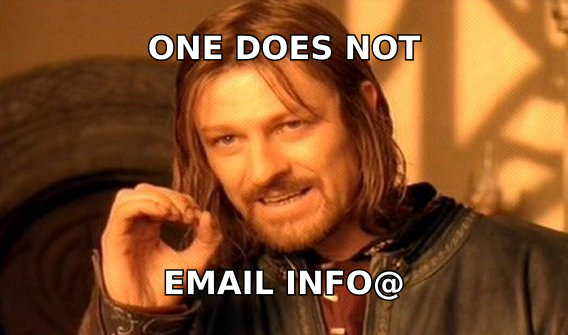
- Generic templates die at
info@catch-all addresses. Before you write a single line, verify the address and confirm the firm's email pattern. - The five templates below map to five distinct buyer situations: legal tech, staffing, marketing services, co-counsel referrals, and vendor renewals.
- Attorney advertising rules (ABA Model Rule 7.3 and its state analogs) restrict lawyers soliciting clients — they do not restrict you selling to a law firm. Know which side of the line you're on.
- Reply rate is downstream of list quality. A 40% bounce rate on a partner list will sink your domain faster than any subject line can save it.
Why is cold emailing law firms harder than other B2B verticals?#
Because you're selling to people whose entire professional training is built around skepticism, and whose time is billed in six-minute increments.
Think of a partner's inbox like the front desk of an emergency room. Everything that arrives gets triaged in under two seconds against one question: is this bleeding? Your email about "streamlining document workflows" is not bleeding. It gets sorted to the back of the queue and forgotten.
Three structural problems make legal harder than, say, selling to a SaaS RevOps team:
1. The decision-maker is rarely the email owner. Managing partners delegate vendor evaluation to firm administrators, COOs, or practice group leads. Emailing the name at the top of the website is the single most common mistake.
2. Catch-all domains are everywhere. A huge share of law firm domains — especially firms under 50 attorneys — route unknown addresses to a shared inbox instead of bouncing them. Your email "delivers," your metrics look fine, and nobody ever reads it. This is why a catch-all verifier matters more in legal than in almost any other vertical.
3. Formality is still the default. The lowercase, no-signature, "hey — quick one" style that works on a 28-year-old growth marketer reads as unserious to a 54-year-old litigation partner. You need warmth without informality, which is a narrower target than most cold email advice accounts for.
Who should you actually email at a law firm?#
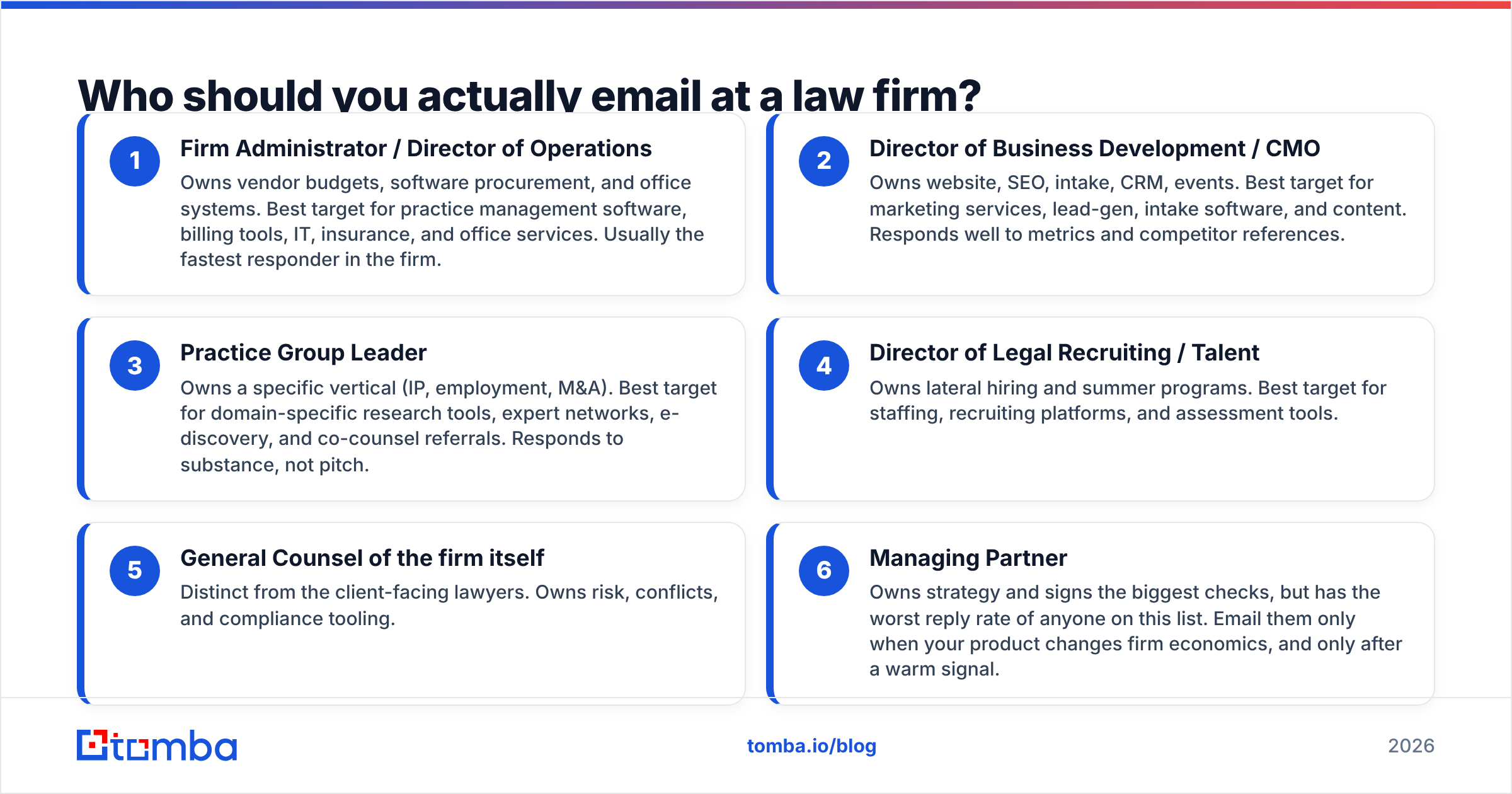
Match the role to what you sell. Here's the map that consistently produces the highest reply rates:
- Firm Administrator / Director of Operations — Owns vendor budgets, software procurement, and office systems. Best target for practice management software, billing tools, IT, insurance, and office services. Usually the fastest responder in the firm.
- Director of Business Development / CMO — Owns website, SEO, intake, CRM, events. Best target for marketing services, lead-gen, intake software, and content. Responds well to metrics and competitor references.
- Practice Group Leader — Owns a specific vertical (IP, employment, M&A). Best target for domain-specific research tools, expert networks, e-discovery, and co-counsel referrals. Responds to substance, not pitch.
- Director of Legal Recruiting / Talent — Owns lateral hiring and summer programs. Best target for staffing, recruiting platforms, and assessment tools.
- General Counsel of the firm itself — Distinct from the client-facing lawyers. Owns risk, conflicts, and compliance tooling.
- Managing Partner — Owns strategy and signs the biggest checks, but has the worst reply rate of anyone on this list. Email them only when your product changes firm economics, and only after a warm signal.
The practical implication: your list-building step is 70% of the work. Pull the firm's people page, identify the operations and BD layer, then use a domain search to resolve the firm's actual email pattern (first.last@, flast@, finitial+lastname@ — legal skews heavily toward first.last@ and flast@) before you generate a single address.
What are the best cold emailing law firms template structures?#
Five templates, five situations. Each one is short on purpose. The median engagement time on a cold email from an unknown sender is under nine seconds — your entire message has to survive a nine-second read.
Template 1 — Legal tech / practice management (to the Firm Administrator)#
Subject: Billing reconciliation at [Firm Name]
[First name] —
Firms in the 20–60 attorney range usually lose 3–6 billable hours per timekeeper each month to manual time reconstruction. At [Similar Firm], moving pre-bill review off spreadsheets recovered about 4 hours per attorney per month.
Worth a 12-minute call to see whether the same gap exists at [Firm Name]?
[Your name]
Why it works: it names a number the administrator already tracks, references a peer firm, and asks for a defined, small time commitment.
Template 2 — Marketing services (to the BD Director)#
Subject: [Firm Name] vs [Competitor Firm] on "[practice area] attorney [city]"
[First name] —
You're on page 2 for "[practice area] attorney [city]" — [Competitor Firm] holds positions 1 and 3. The gap looks like it comes down to their attorney bio schema and 40-odd practice-area pages you don't have.
I put the full breakdown in a one-page doc. Want it?
[Your name]
Why it works: competitive rivalry between firms is the strongest emotional lever in legal marketing. It also offers something before asking.
Template 3 — Co-counsel / referral (to a Practice Group Leader)#
Subject: [Specific case type] referral — [State]
[First name] —
We turn away 2–3 [case type] matters a quarter because we're not licensed in [State]. Your [practice group] page suggests you handle exactly this.
Open to a referral arrangement? Happy to send the next one your way and see how it goes.
[Your name]
Why it works: it leads with revenue, not with a pitch. Referral emails routinely see the highest reply rates in the entire legal vertical.
Template 4 — Recruiting / staffing (to Legal Talent)#
Subject: 2 laterals — [practice area], [City]
[First name] —
Two [practice area] associates (4th and 6th year, both from AmLaw 100 firms) are looking at [City] this quarter. Your [practice group] posting has been up since [month].
Want the anonymized profiles?
[Your name]
Template 5 — Renewal / displacement (to Operations)#
Subject: [Incumbent Vendor] renewal
[First name] —
I noticed [Firm Name] runs on [Incumbent Vendor]. Most firms renew in [month] without re-quoting.
If it's useful, I can send a side-by-side of what three comparable firms paid last cycle. No call needed.
[Your name]
Pair any of these with a tested subject line — the subject line generator is a reasonable starting point, but the pattern to imitate is what you see above: nouns, no adjectives, no "quick question."
How do these templates compare on effort, reply rate, and risk?#
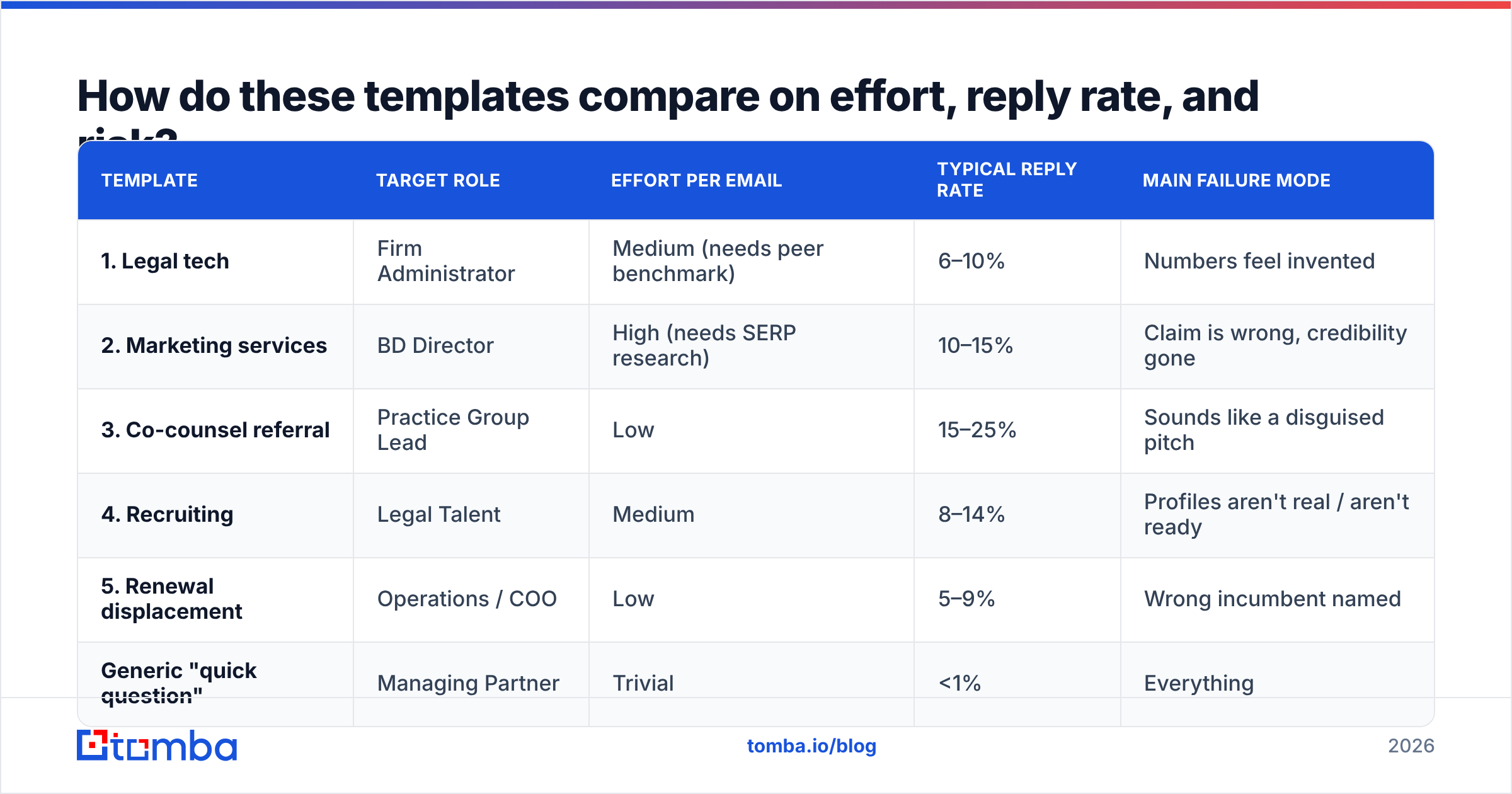
| Template | Target role | Effort per email | Typical reply rate | Main failure mode |
|---|---|---|---|---|
| 1. Legal tech | Firm Administrator | Medium (needs peer benchmark) | 6–10% | Numbers feel invented |
| 2. Marketing services | BD Director | High (needs SERP research) | 10–15% | Claim is wrong, credibility gone |
| 3. Co-counsel referral | Practice Group Lead | Low | 15–25% | Sounds like a disguised pitch |
| 4. Recruiting | Legal Talent | Medium | 8–14% | Profiles aren't real / aren't ready |
| 5. Renewal displacement | Operations / COO | Low | 5–9% | Wrong incumbent named |
| Generic "quick question" | Managing Partner | Trivial | <1% | Everything |
The pattern is obvious once you see it: reply rate tracks with how much research went into the first sentence, and inversely with how senior the recipient is. The co-counsel template beats the rest not because it's better written but because it opens with money moving toward the reader.
What ethics and compliance rules actually apply?#
This trips up more people than it should, so let's be precise about who the rules bind.
ABA Model Rule 7.3 governs solicitation of clients by lawyers. If you are a lawyer emailing a prospective client, live-person and targeted-solicitation restrictions apply, and most states layer on additional advertising rules — labeling requirements, retention obligations, and in some jurisdictions pre-filing with the bar. Read the actual text of Rule 7.3 plus your state's version before sending anything.
If you are a vendor selling to a law firm, Rule 7.3 does not apply to you. You're doing ordinary B2B outreach. What does apply is CAN-SPAM: accurate headers, a non-deceptive subject line, a physical postal address, a working unsubscribe honored within 10 business days. The FTC's CAN-SPAM compliance guide is short and worth reading once.
And if you're emailing into the EU or UK, GDPR/PECR legitimate-interest analysis applies regardless of what your US-based competitors are doing.
A practical rule of thumb: if your email would embarrass you when read aloud in a deposition, don't send it. Lawyers screenshot things.
How do you keep a law firm list from destroying your domain?#
You send to people who exist, at addresses that resolve, from a domain that has authenticated itself. That's the whole game.
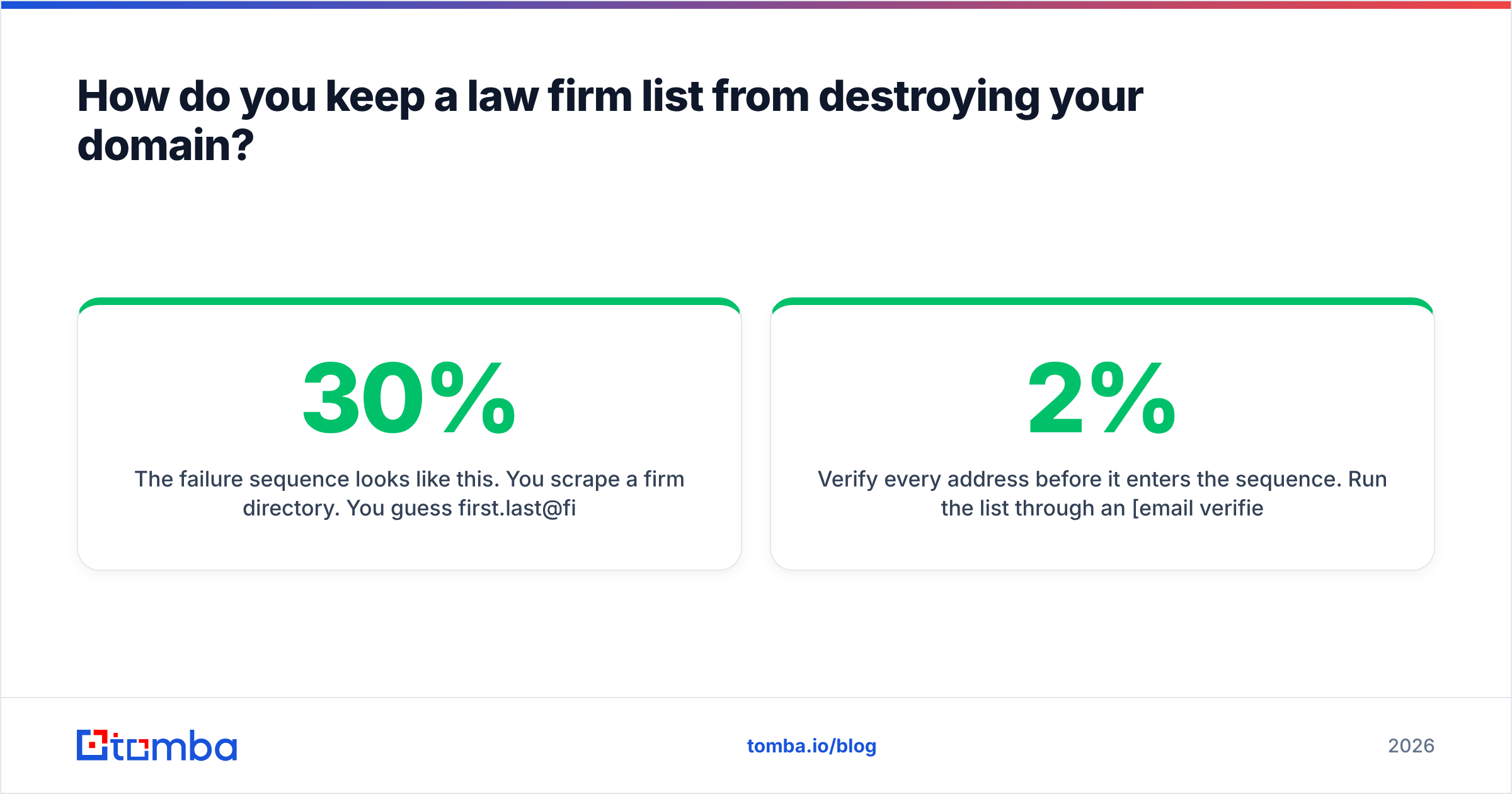
The failure sequence looks like this. You scrape a firm directory. You guess first.last@firmname.com for 400 attorneys. Roughly 30% of those attorneys left the firm in the past 18 months — legal has meaningful lateral churn. Your bounce rate lands north of 25%. Google and Microsoft both start throttling your domain within two sends. Now every email you write — including replies to warm leads — lands in spam, and you've spent eight weeks rebuilding sender reputation that took a year to earn.
The fix is unglamorous and mechanical:
- Verify every address before it enters the sequence. Run the list through an email verifier and drop anything that isn't a confirmed deliverable. Target under 2% bounce.
- Segment catch-all domains separately. Don't count them as "valid" and don't send volume into them. Test with a small batch first.
- Authenticate. SPF, DKIM, DMARC on the sending domain. Non-negotiable since the 2024 bulk-sender requirements.
- Warm the domain. New domains send 10–20/day for the first two weeks, ramping slowly. There is no shortcut and everyone who tries one learns this the expensive way.
- Cap volume per firm. Emailing six people at the same 30-attorney firm in the same week is how you get domain-blocked by their IT.
- Re-verify quarterly. Legal contact data decays faster than the B2B average.
Do you need a specialized legal database, or a general email finder?#
Both approaches work; they fail differently.
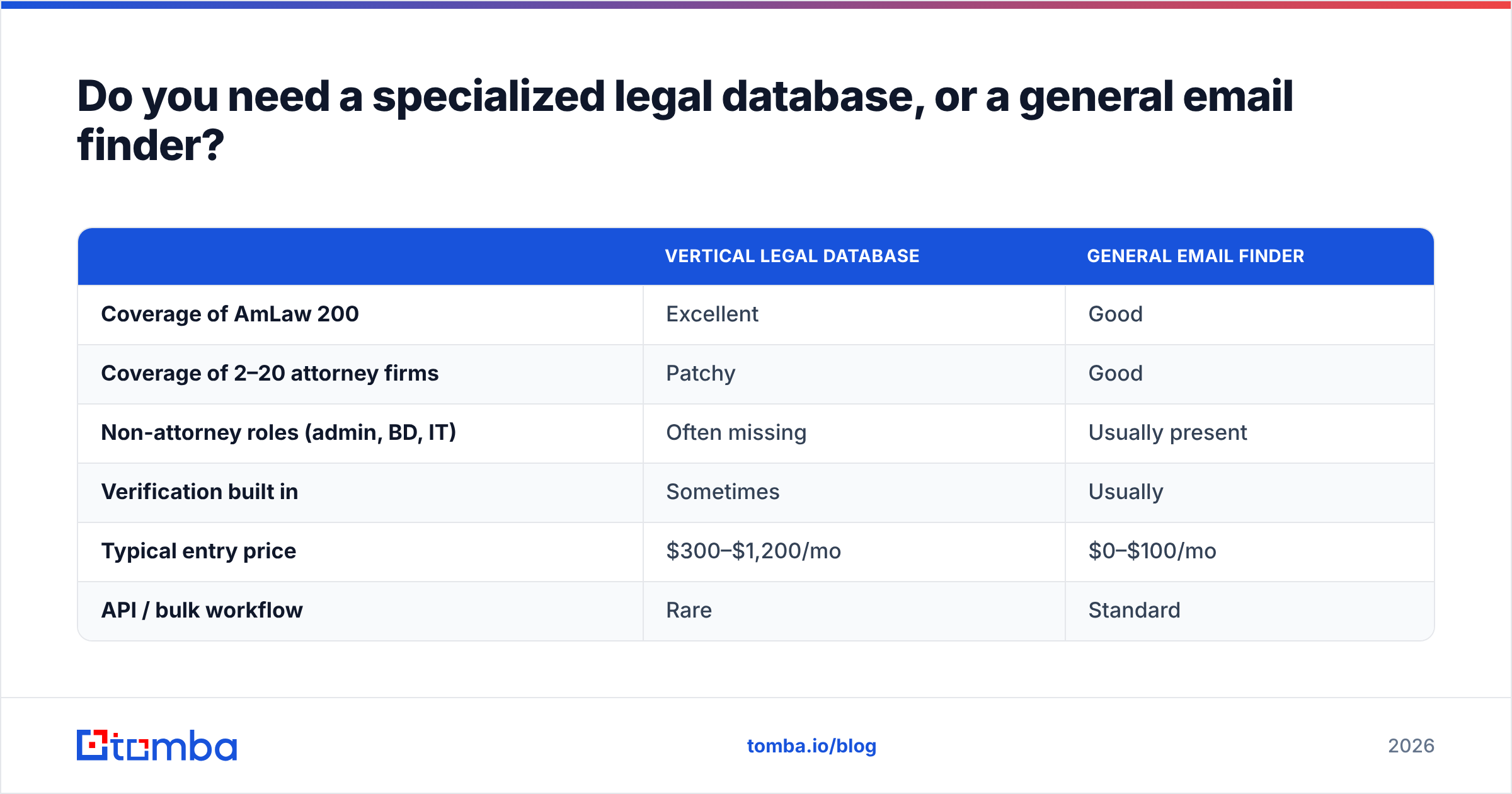
| Vertical legal database | General email finder | |
|---|---|---|
| Coverage of AmLaw 200 | Excellent | Good |
| Coverage of 2–20 attorney firms | Patchy | Good |
| Non-attorney roles (admin, BD, IT) | Often missing | Usually present |
| Verification built in | Sometimes | Usually |
| Typical entry price | $300–$1,200/mo | $0–$100/mo |
| API / bulk workflow | Rare | Standard |
Vertical databases are strong on big-firm attorney rosters and weak exactly where your best targets sit — the operations and BD layer, which isn't listed on a bar directory. General finders like Tomba, Hunter, or Findymail resolve the domain pattern and let you build any role you can name. BookYourData is a solid option if you'd rather buy a pre-built, verified legal list than build one, and it's a fair fit for teams without a research function.
If you're building rather than buying, the honest workflow is: pull the firm's people page → confirm the pattern via domain search → generate candidate addresses → verify → segment catch-alls → send. Tomba's Free tier gives you 25 searches a month to test whether a given firm's data even resolves, with Starter at $49/mo and Growth at $99/mo once you're running real volume.
What should you do in the next hour?#
Pick one practice area. Pull ten firms. Find the firm administrator and the BD director at each — not the managing partner. Resolve the email pattern, verify the twenty addresses, and send Template 1 or Template 2 with a real, checkable number in the first sentence.
Twenty well-researched emails to the right role will beat two thousand generic ones to info@, and they won't cost you your domain.
When you're ready to build the list, Tomba's Email Finder resolves law firm email patterns by domain and returns verified, deliverable addresses — including the operations and marketing roles the legal databases skip. Start on the free tier, verify before you send, and let the templates do the rest.
Related guides#
Ready to find emails that actually work?
Join 150,000+ professionals who stopped guessing and started sending. Free credits on signup — no credit card required.
Get the Tomba newsletter
Practical outbound tactics and product updates — once every two weeks.
About the author