Cold Outreach in 2026: A No-Fluff Guide That Gets Replies
Cold outreach still books meetings in 2026 — but only if your data, channels, and sequences are dialed in. Here's the honest playbook, with templates and a channel comparison.
Cold outreach is not dead — bad cold outreach is. The difference in 2026 comes down to three things: who you contact, how you reach them, and what you say. Get those right and cold email, LinkedIn, and phone still fill pipeline. Get them wrong and you burn your domain, your list, and your reputation.
This guide is the practical version. No motivational filler, no "just add value" hand-waving. You'll get a channel-by-channel breakdown, the data hygiene that keeps you out of spam, a sequence you can copy, and templates that get answered.
TL;DR#
- Cold outreach still works in 2026, but reply rates now hinge on data accuracy and relevance far more than volume.
- Multichannel beats single-channel — email + LinkedIn + phone in one coordinated sequence typically doubles connect rates versus email alone.
- Verified contact data is the highest-leverage input. A 20% bounce rate quietly destroys deliverability before your copy ever gets read.
- Short, specific, one-ask messages win. Personalization at the "I researched you" level beats mail-merge tokens.
- Measure replies and meetings, not opens. Apple Mail Privacy Protection made open rates a vanity metric.
What is cold outreach?#
Cold outreach is contacting a prospect who has no prior relationship with you or your company, with the goal of starting a business conversation. Think of it like knocking on doors in a neighborhood where nobody knows your name yet — the only thing that earns you a second sentence is being obviously relevant to the person answering.
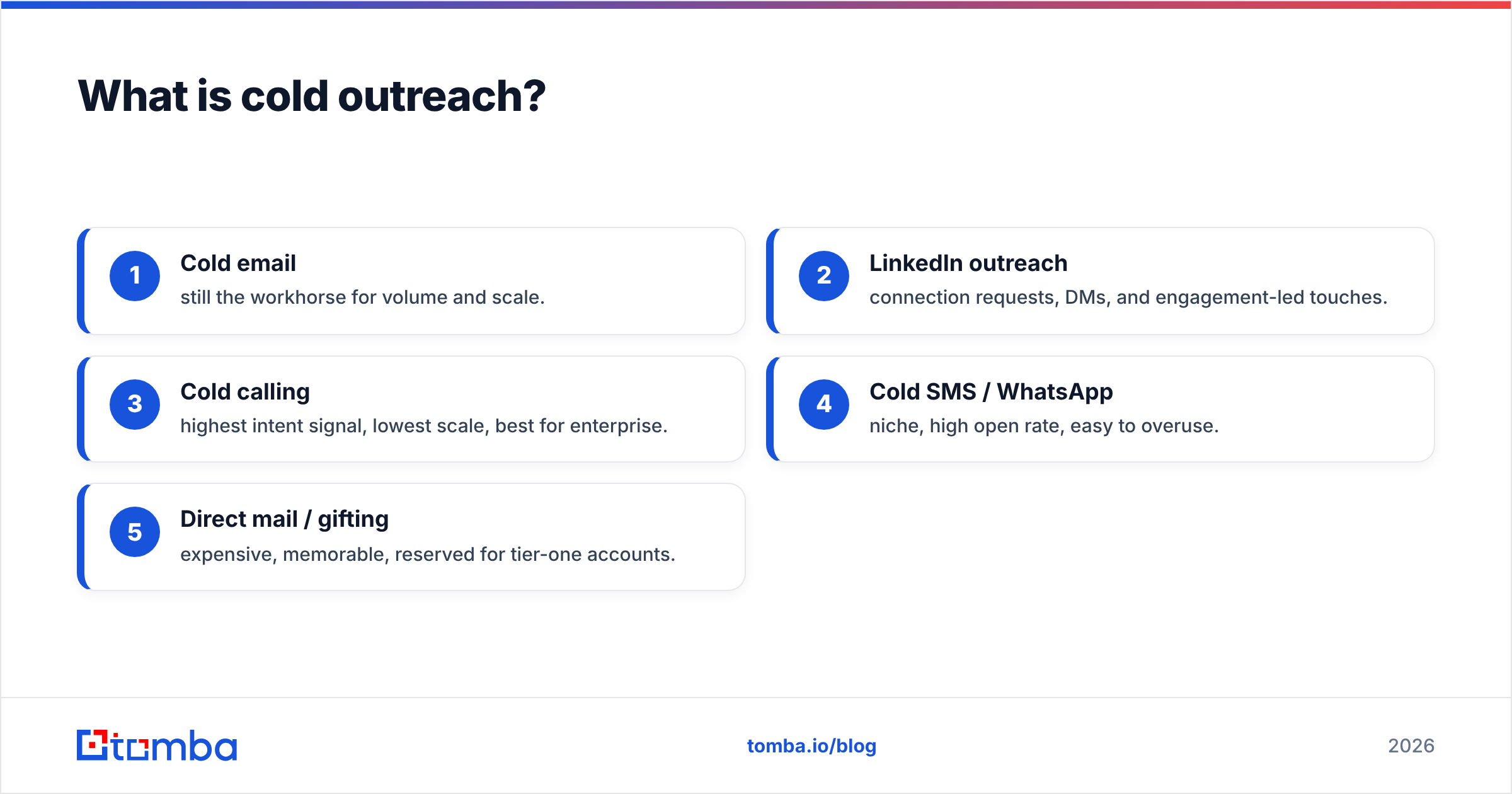
It spans several channels:
- Cold email — still the workhorse for volume and scale.
- LinkedIn outreach — connection requests, DMs, and engagement-led touches.
- Cold calling — highest intent signal, lowest scale, best for enterprise.
- Cold SMS / WhatsApp — niche, high open rate, easy to overuse.
- Direct mail / gifting — expensive, memorable, reserved for tier-one accounts.
The word "cold" is the important part. The prospect didn't ask to hear from you, so the burden is entirely on you to be worth their attention. That's why data quality and message relevance matter more than any single "growth hack."
Is cold outreach still legal and worth it in 2026?#
Yes — and yes, when done right. Cold outreach is legal in most B2B contexts as long as you follow the rules for the region you're contacting: CAN-SPAM in the US, GDPR and the ePrivacy Directive in the EU, CASL in Canada. The common thread is honest sender identity, a real physical address, a working opt-out, and a legitimate business reason to contact someone. For a plain-language primer on the regulations, the FTC's CAN-SPAM guidance is the canonical source.
Is it worth it? The economics still favor outbound when your data and targeting are tight. The problem is that inbox providers have gotten ruthless. Google and Yahoo's 2024 bulk sender requirements made authentication (SPF, DKIM, DMARC) and low spam complaint rates non-negotiable. Send sloppy, high-bounce campaigns and you don't just get ignored — you get filtered permanently.
That's the real shift. Cold outreach in 2026 rewards operators who treat their sending domain like an asset and punishes everyone else.
Which cold outreach channel should you use?#
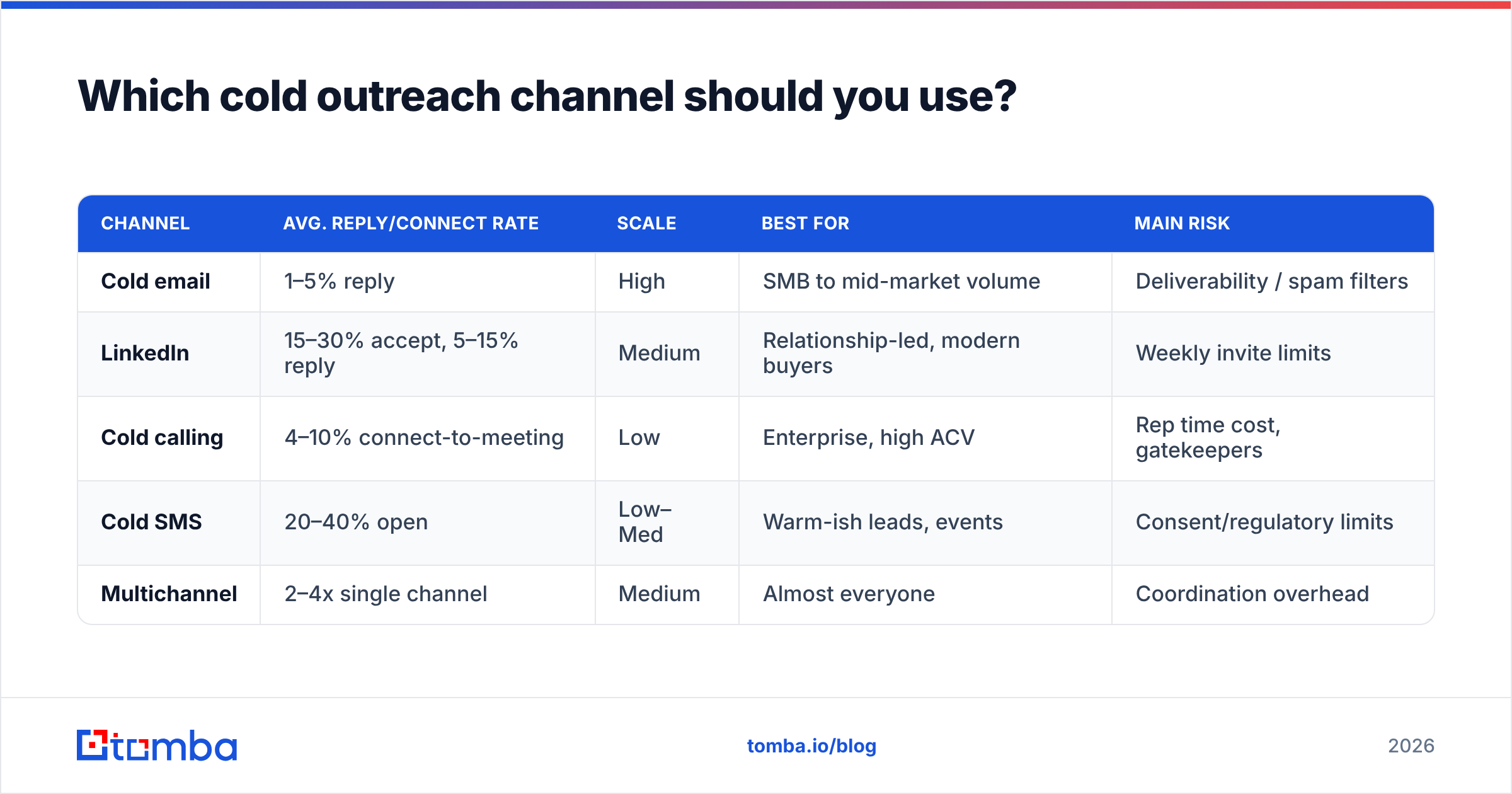
There's no single best channel — there's a best mix for your motion, deal size, and audience. Here's how the main channels stack up.
| Channel | Avg. reply/connect rate | Scale | Best for | Main risk |
|---|---|---|---|---|
| Cold email | 1–5% reply | High | SMB to mid-market volume | Deliverability / spam filters |
| 15–30% accept, 5–15% reply | Medium | Relationship-led, modern buyers | Weekly invite limits | |
| Cold calling | 4–10% connect-to-meeting | Low | Enterprise, high ACV | Rep time cost, gatekeepers |
| Cold SMS | 20–40% open | Low–Med | Warm-ish leads, events | Consent/regulatory limits |
| Multichannel | 2–4x single channel | Medium | Almost everyone | Coordination overhead |
A few honest takeaways from the table:
- Email scales but converts thin. A 1–5% reply rate means you need real volume and real data quality to make it pay.
- LinkedIn converts richer but caps hard. Invite limits (~100–200/week) mean it can't be your only engine.
- Calling is expensive per dial but unbeatable for intent. One live conversation beats fifty ignored emails for a six-figure deal.
- Multichannel is the actual answer. The teams winning at outbound sales strategy aren't picking one channel — they're sequencing three.
If you're contacting mobile-first buyers or field roles, pairing email with a verified B2B phone number lets you follow an ignored email with a call that actually connects instead of hitting a dead extension.
Why does contact data quality decide everything?#
Because your copy never gets a chance if your data is wrong. This is the part most guides skip, and it's the part that quietly kills campaigns.
Here's the chain reaction. You buy or scrape a list. Fifteen to twenty-five percent of those addresses are stale, wrong, or catch-all traps. You send anyway. Mailbox providers see a spike in bounces and unknown-user rejections, flag your domain as a low-quality sender, and start routing even your valid emails to spam. Now your reply rate on good contacts craters through no fault of your copy.
Verified data breaks that chain. Before a campaign, you want to:
- Find the right person — not a generic info@ address, but the actual decision-maker's professional email. A dedicated email finder resolves name + company into a deliverable address.
- Verify every address — run the list through an email verifier to strip invalids, and use a catch-all verifier for the domains that accept everything so you're not gambling on ghosts.
- Enrich for relevance — job title, seniority, company size, and tech stack turn a name into a targeting decision.
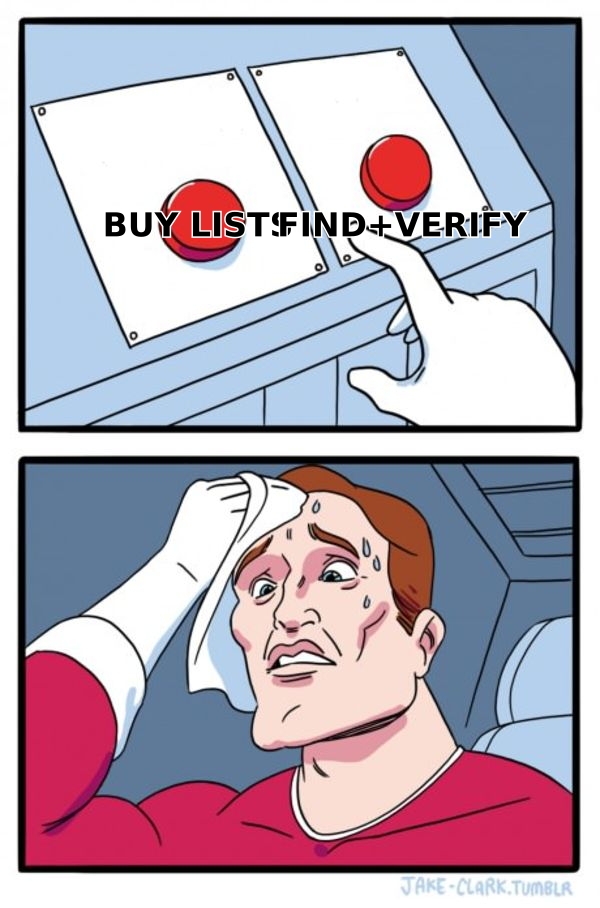
The math is brutal and simple. Sending to a 95%-verified list of 1,000 versus an unverified list of 1,000 isn't a 5% difference in outcomes — it's the difference between protected deliverability and a poisoned domain. Data hygiene is not a nice-to-have; it's the foundation the entire campaign sits on.
What does a high-converting cold outreach sequence look like?#
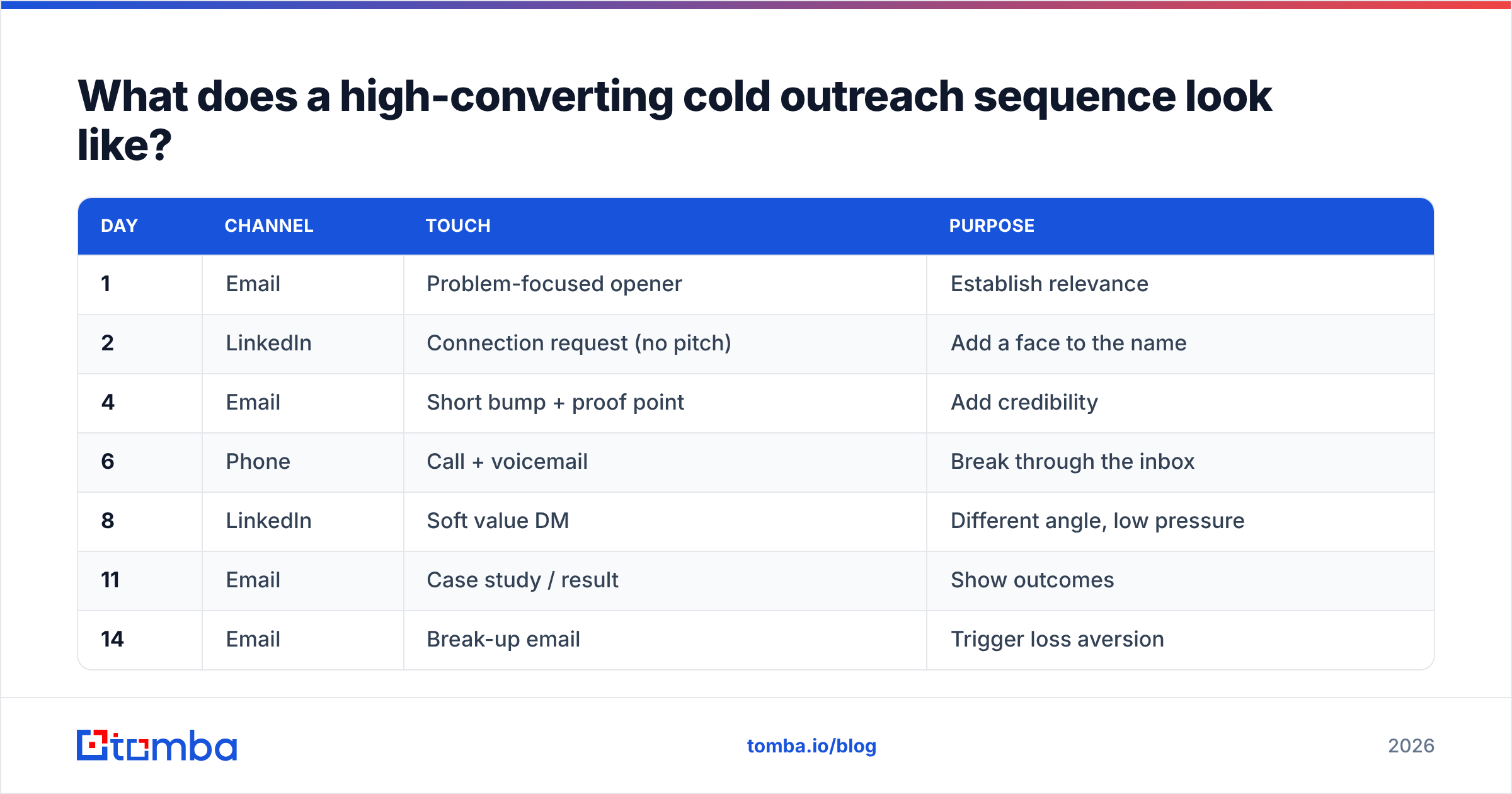
A sequence is a planned series of touches across channels and days, not a single email you resend. The goal is to be persistently relevant without being annoying. Here's a proven 14-day multichannel skeleton you can adapt.
| Day | Channel | Touch | Purpose |
|---|---|---|---|
| 1 | Problem-focused opener | Establish relevance | |
| 2 | Connection request (no pitch) | Add a face to the name | |
| 4 | Short bump + proof point | Add credibility | |
| 6 | Phone | Call + voicemail | Break through the inbox |
| 8 | Soft value DM | Different angle, low pressure | |
| 11 | Case study / result | Show outcomes | |
| 14 | Break-up email | Trigger loss aversion |
Rules that make the sequence work:
- One ask per message. Every touch should have a single, obvious next step — usually "worth a 15-minute call?"
- Vary the angle, not just the wording. Touch 1 is the problem, touch 4 is proof, touch 6 is human, touch 11 is outcomes. Don't just say "just bumping this."
- Space it out and respect limits. Daily blasts feel like harassment; a 2–3 day cadence feels like persistence.
- The break-up email pulls its weight. "I'll assume the timing's off and close your file" reliably wins a chunk of replies from people who kept meaning to respond.
For teams building this at scale, connecting your finder and verifier to the CRM through the HubSpot integration or Salesforce integration keeps enriched, verified contacts flowing into sequences automatically instead of via copy-paste.
What cold outreach templates actually get replies?#
Templates are starting points, not scripts. The winning formula in 2026 is short, specific, and centered on the prospect's world — not yours. Here are three you can adapt.
The problem-first opener (email, touch 1):
Subject: quick question about {{specific process}}
Hi {{first name}},
Noticed {{company}} is {{specific trigger — hiring SDRs, expanding to EU, launched X}}. Teams doing that usually hit {{specific problem}} around this stage.
We helped {{similar company}} cut that from {{before}} to {{after}}. Worth a quick look at whether the same applies to you?
{{signature}}
The LinkedIn soft touch (DM, touch 5):
Hi {{first name}} — saw your post on {{topic}}, the point about {{detail}} matched what we hear from other {{role}}s. Not pitching, just curious how you're handling {{related challenge}} right now?
The break-up (email, touch 7):
Subject: closing your file
Hi {{first name}}, I've reached out a few times and haven't heard back, which usually means it's not a priority right now — totally fair. I'll close things out on my end. If {{problem}} moves up the list, just reply here and I'll pick it back up.
What makes these work:
- The trigger line does the heavy lifting. "{{Company}} is hiring SDRs" proves you looked. Generic openers get deleted.
- Brevity signals respect. Under 90 words. Nobody reads a wall of text from a stranger.
- The ask is low-friction. "Worth a look?" beats "Do you have 30 minutes Tuesday at 2pm?"
If you want more starting points, Tomba's free cold email templates library and subject line generator are useful for testing variations quickly.
How do you keep cold emails out of spam?#
Protect the domain, warm it up, and keep complaints near zero. Deliverability is a technical discipline, and skipping it is why most "great copy" never gets read.
The non-negotiables:
- Authenticate. Set up SPF, DKIM, and DMARC before sending a single cold email. Providers now reject or spam-folder unauthenticated bulk mail outright.
- Use a separate sending domain. Never cold-email from your primary domain. A dedicated domain (e.g.,
try-yourcompany.com) contains the blast radius if reputation dips. - Warm up gradually. Ramp new domains over 3–4 weeks — start at 20–30 sends/day and increase slowly. Tomba's free email warmup calculator helps you plan the ramp.
- Cap volume per inbox. Keep it under ~50 cold sends per inbox per day. Scale by adding inboxes, not by cranking one to 500.
- Verify before every send. This is where accuracy and deliverability meet — a clean list keeps bounce rates under 2%, which is the threshold providers watch.
- Monitor complaints. Google's Postmaster Tools will show your spam complaint rate; keep it under 0.3% or expect throttling.
The connective tissue here is data. Every deliverability best practice assumes you're sending to real, verified people. That's why the verification step isn't a separate chore — it's the thing that makes warmup, authentication, and volume discipline actually pay off. A single ignored bad-data blast can undo weeks of careful domain warming.
How do you measure cold outreach success in 2026?#
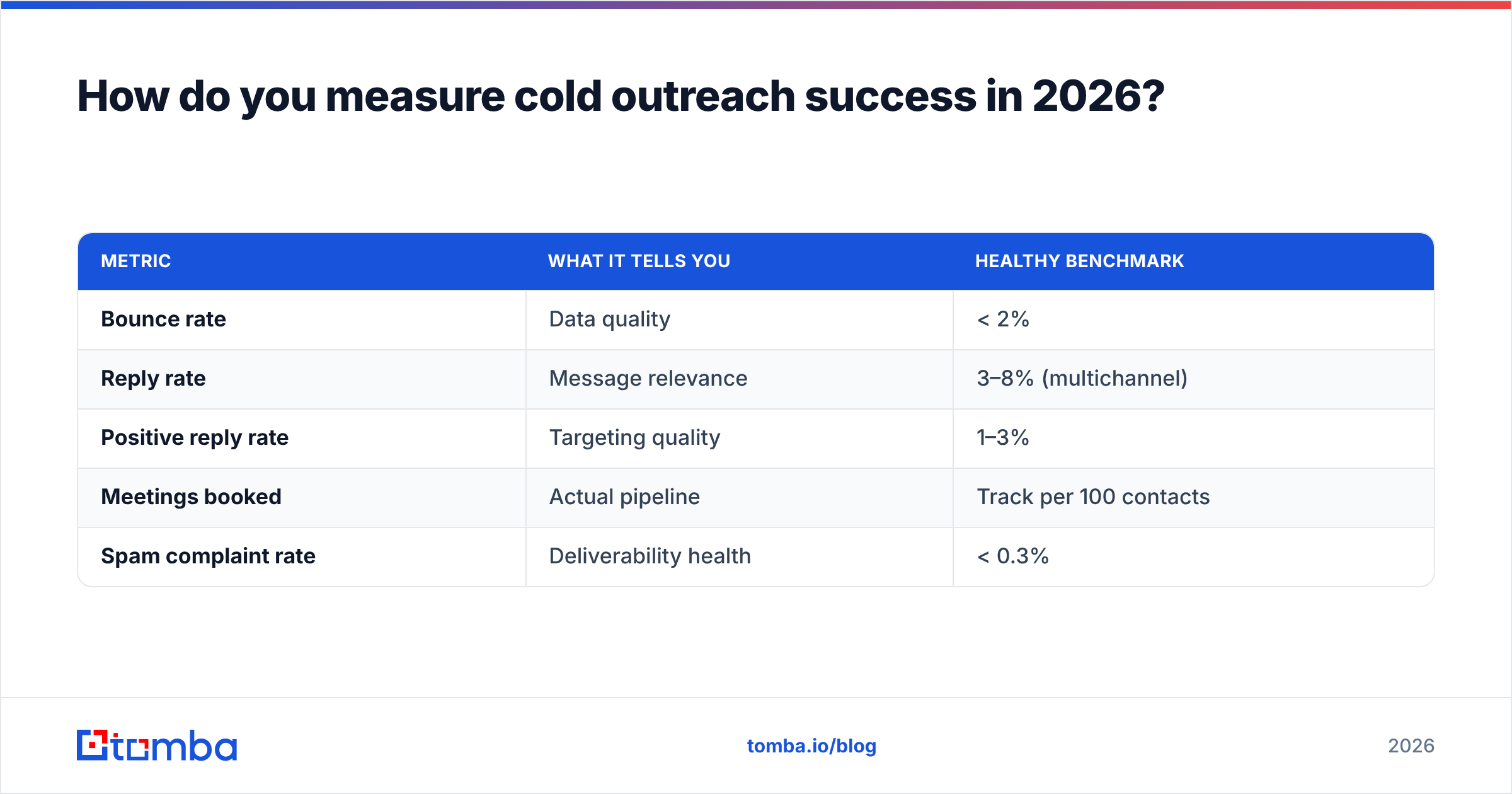
Track replies and meetings booked — not opens. Apple's Mail Privacy Protection and similar features inflate open rates with bot pre-fetches, so opens are effectively noise now. The metrics that matter:
| Metric | What it tells you | Healthy benchmark |
|---|---|---|
| Bounce rate | Data quality | < 2% |
| Reply rate | Message relevance | 3–8% (multichannel) |
| Positive reply rate | Targeting quality | 1–3% |
| Meetings booked | Actual pipeline | Track per 100 contacts |
| Spam complaint rate | Deliverability health | < 0.3% |
If your bounce rate is high, fix your data before touching your copy — you're optimizing the wrong variable. If replies are low but bounces are clean, the problem is targeting or message relevance. This diagnostic order saves teams weeks of rewriting subject lines when the real issue was a stale list. For deeper definitions of the terms here, Tomba's B2B glossary breaks down email deliverability and related concepts.
Cold outreach mistakes that quietly kill campaigns#
- Sending before verifying. The single most common and most expensive mistake.
- One channel only. Email-only outreach leaves the majority of your connects on the table.
- Personalization theater. "{{first name}}, I loved your work" fools no one. Reference something real or don't reference it at all.
- No follow-up. Most replies come from touch 3+. One-and-done outreach wastes the list you paid for.
- Pitching in the connection request. On LinkedIn, the invite is to connect — not to sell. Save the ask.
- Ignoring the unsubscribe. Beyond being illegal, it spikes complaints and torches your domain.
Start with the data, not the copy#
The best cold outreach in 2026 is boring in the best way: right person, verified address, relevant message, patient sequence, protected domain. There's no hack that beats getting those fundamentals right — and every one of them starts with knowing your contacts are real.
That's the foundation Tomba is built for. Use the Tomba Email Finder to turn names and companies into verified, deliverable addresses, run your list through the verifier before you send, and enrich contacts so your targeting is sharp. You get 25 free searches a month to test it, and paid plans start at $49/mo — see full Tomba pricing for volume tiers. Fix the data, and the rest of your outreach finally gets the chance it deserves.
Related guides#
Ready to find emails that actually work?
Join 150,000+ professionals who stopped guessing and started sending. Free credits on signup — no credit card required.
Get the Tomba newsletter
Practical outbound tactics and product updates — once every two weeks.
About the author