Coldlytics vs SalesIntel (2026): Which B2B Data Tool Wins?
Coldlytics sells done-for-you prospect lists; SalesIntel sells human-verified B2B data at scale. We break down price, accuracy, coverage, and workflow fit so you can pick the right one — or a leaner alternative.
Choosing between Coldlytics and SalesIntel comes down to one question: do you want someone to build your prospect lists for you, or do you want a self-serve database you can query on demand? They solve the same problem — getting accurate B2B contacts into your outbound engine — but they do it in almost opposite ways.
This comparison is written for sales, RevOps, and demand-gen teams who are done overpaying for stale data. We'll look at how each tool sources contacts, what it actually costs, where accuracy holds up, and when a leaner email-finder stack beats both.
TL;DR: Coldlytics vs SalesIntel at a glance#
- Coldlytics is a done-for-you prospecting service. You submit a research request, and human researchers hand-build a targeted list with verified emails. Great for niche ICPs, slow for high volume.
- SalesIntel is a self-serve B2B data platform known for "human-verified" contacts, technographics, and intent data. Strong US coverage, enterprise pricing, annual contracts.
- Accuracy: Both lean on human verification, so both beat pure-scrape databases on bounce rate — but neither is cheap, and both charge for coverage you may not use.
- Cost profile: Coldlytics is pay-per-list/credit; SalesIntel is a seat + credit annual commitment. Neither has a meaningful free tier.
- The lean alternative: If you mostly need accurate emails on demand, an API-first email finder like Tomba covers the same job at a fraction of the price with a real free tier.
What is Coldlytics and who is it for?#
Coldlytics is a managed prospecting service, not a database you log into and search. You define a target — say, "heads of marketing at 50–200 person SaaS companies in the UK" — and a team of researchers manually builds the list, sourcing and verifying each contact before delivery.
That human-in-the-loop model is the whole pitch. Because a person is looking at each record, Coldlytics handles fuzzy targeting (job-title nuance, company-signal filtering, "only companies hiring SDRs right now") that a rigid database filter struggles with. The tradeoff is speed and scale: lists take time to research, and you pay per contact researched.
It fits founders and small teams running high-touch outbound to a tightly defined niche, where 200 perfect contacts beat 20,000 mediocre ones. It's a poor fit if you need tens of thousands of records this week or want to pull data programmatically into your CRM.

What is SalesIntel and who is it for?#
SalesIntel is a self-serve B2B contact and company intelligence platform. You get a searchable database of contacts with emails and direct-dial phone numbers, plus technographics (what software a company uses), firmographics, and buyer-intent signals. Its marketing centers on "human-verified" data re-checked on a rolling cycle to fight decay.
SalesIntel targets mid-market and enterprise sales and marketing teams that want everything — contact data, intent, and enrichment — in one contract, with integrations into Salesforce and HubSpot. Coverage is strongest in North America; it thins out internationally compared to some global providers.
The catch is the commercial model. SalesIntel sells annual contracts with per-seat pricing and credit caps, and pricing is quote-only. That's fine for a funded team standardizing on one vendor, and heavy for a small team that just needs verified emails.
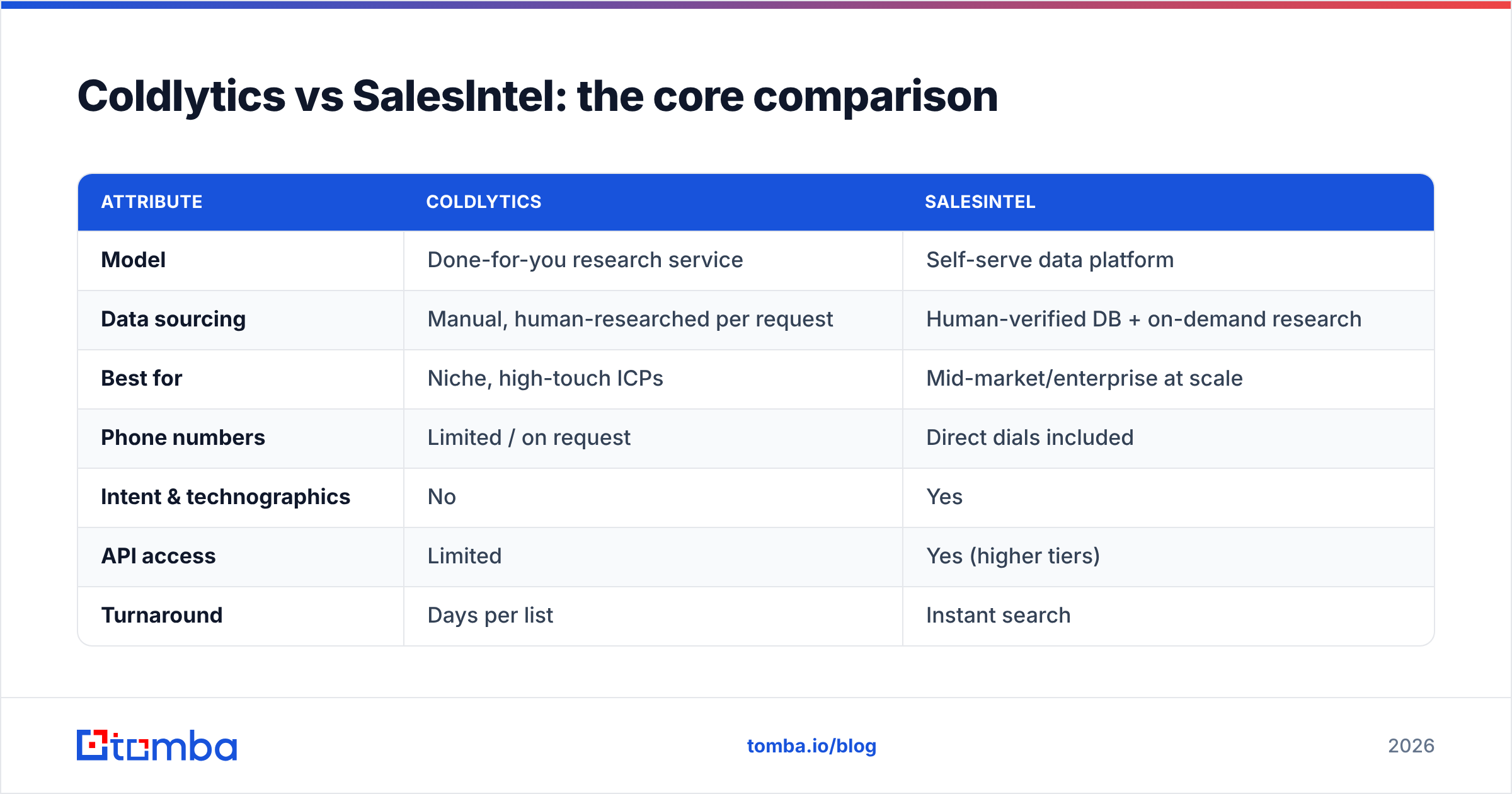
Coldlytics vs SalesIntel: the core comparison#
Here's the head-to-head on the attributes that actually change your buying decision.
| Attribute | Coldlytics | SalesIntel |
|---|---|---|
| Model | Done-for-you research service | Self-serve data platform |
| Data sourcing | Manual, human-researched per request | Human-verified DB + on-demand research |
| Best for | Niche, high-touch ICPs | Mid-market/enterprise at scale |
| Phone numbers | Limited / on request | Direct dials included |
| Intent & technographics | No | Yes |
| API access | Limited | Yes (higher tiers) |
| Turnaround | Days per list | Instant search |
| Free tier | No | No (demo only) |
| Pricing | Per-contact / credit | Annual contract, quote-based |
The pattern is clear: Coldlytics trades speed for precision on hard-to-reach niches, while SalesIntel trades flexibility for an all-in-one enterprise dataset. Neither is designed for the team that just wants clean emails, cheaply, without a sales call.
Is Coldlytics or SalesIntel more accurate?#
Both are more accurate than raw-scrape databases, and for the same reason: a human validates records. Coldlytics verifies each email as part of the research; SalesIntel re-verifies its database on a rotating schedule and offers on-demand research when a contact isn't already in-store.
But "human-verified" has a shelf life. B2B data decays roughly 2–3% per month as people change jobs — the widely cited figure from data-quality research at Gartner and others. A record verified in January is measurably worse by June. SalesIntel fights this with re-verification cycles; Coldlytics sidesteps it by researching fresh each time, which is why its lists are current but slow to produce.
Whichever you pick, verify at send time. Running any list through an email verifier before a campaign catches the decay that happened between purchase and launch — and protects your sender reputation from the bounces that tank deliverability.
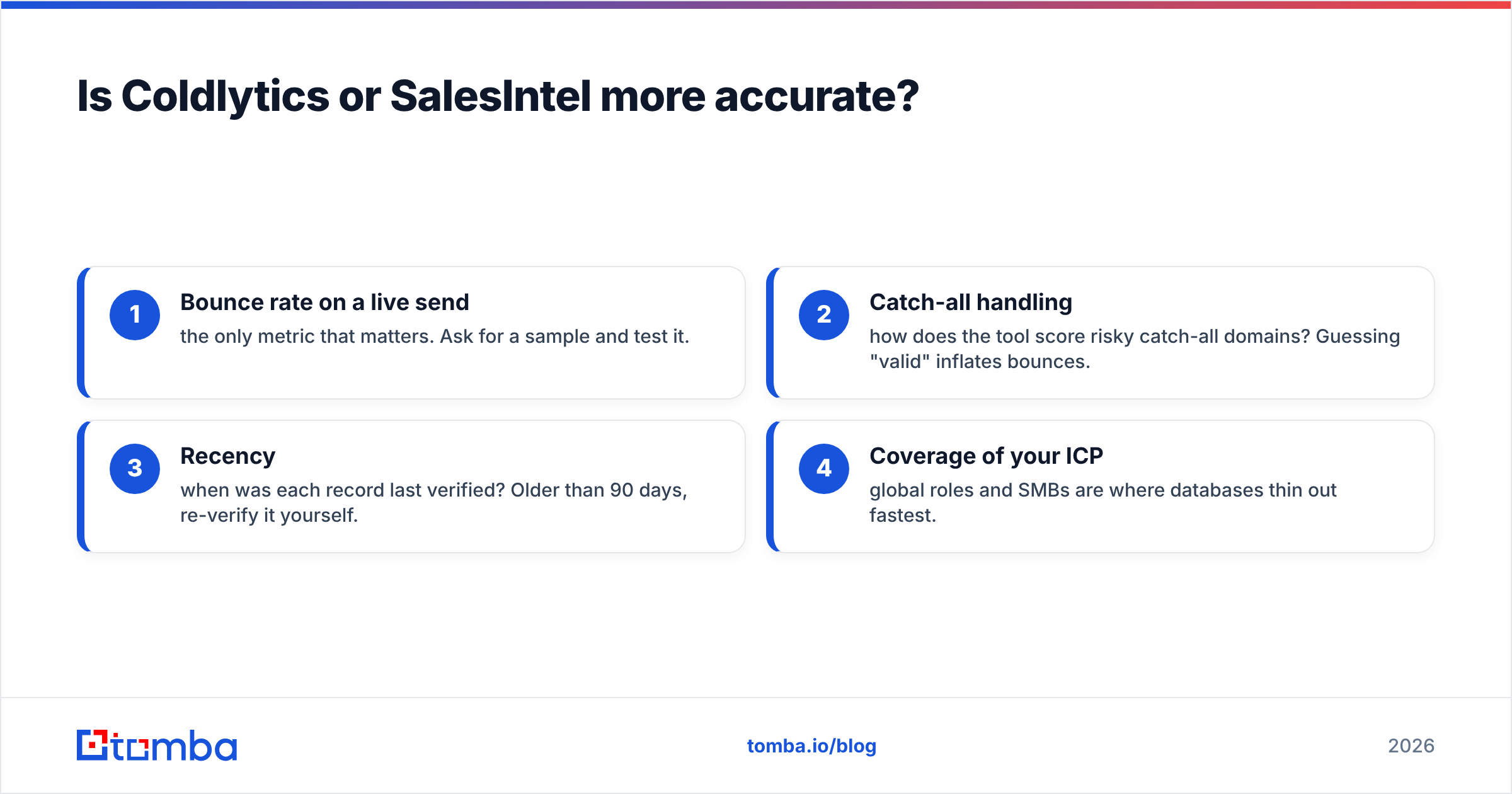
Three accuracy checks to run on any provider, including these two:
- Bounce rate on a live send — the only metric that matters. Ask for a sample and test it.
- Catch-all handling — how does the tool score risky catch-all domains? Guessing "valid" inflates bounces.
- Recency — when was each record last verified? Older than 90 days, re-verify it yourself.
- Coverage of your ICP — global roles and SMBs are where databases thin out fastest.
How much do Coldlytics and SalesIntel cost?#
Neither publishes simple public pricing, and both skew expensive for what most small teams need.
Coldlytics runs on a credit/subscription model priced against the number of prospects researched — you're paying for human research time, so per-contact costs are higher than a database lookup but the fit quality is higher too. SalesIntel is quote-based annual contracts with per-seat licensing and credit limits; expect a four-to-five-figure yearly commitment once you add intent and multiple seats.
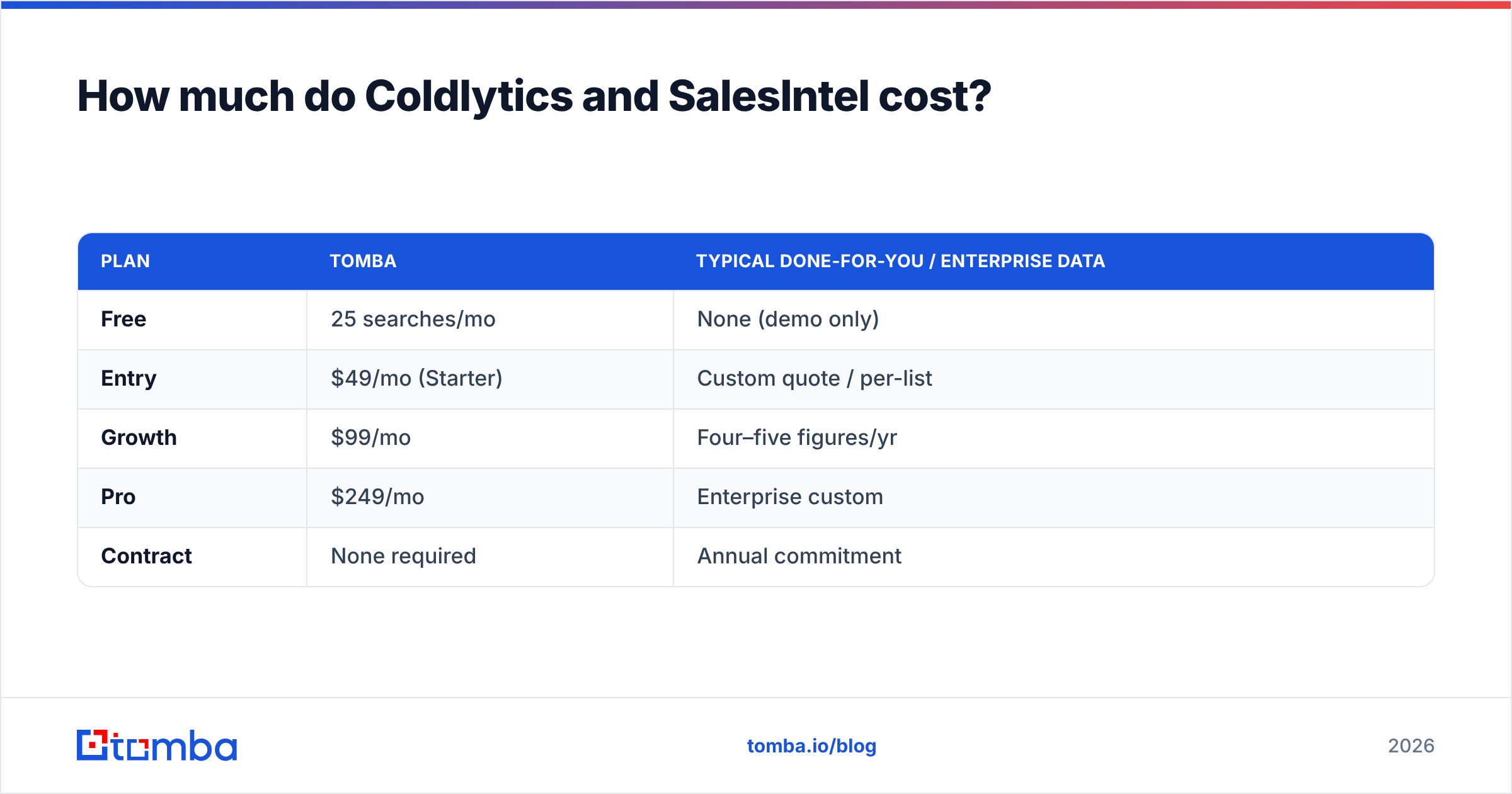
Compare that to a self-serve email finder with transparent, published tiers:
| Plan | Tomba | Typical done-for-you / enterprise data |
|---|---|---|
| Free | 25 searches/mo | None (demo only) |
| Entry | $49/mo (Starter) | Custom quote / per-list |
| Growth | $99/mo | Four–five figures/yr |
| Pro | $249/mo | Enterprise custom |
| Contract | None required | Annual commitment |
If you want the full breakdown of credits and limits, the Tomba pricing page lists every tier without a sales call — which is the point. You can start free, scale to $49/mo, and never sign an annual contract.
When should you skip both and use an email finder?#
Skip both when your real need is "accurate emails, on demand, in my workflow" rather than "a managed service" or "an enterprise data suite."
A large share of teams evaluating Coldlytics or SalesIntel don't actually need done-for-you research or intent data — they need to turn a list of companies or LinkedIn profiles into verified contacts and push them into a sequence. That's an email-finder job, and it's dramatically cheaper self-serve.
Here's where a tool like Tomba fits that gap:
- You already know your targets. Use domain search to pull every contact at a company, or the LinkedIn finder to convert profiles to verified emails.
- You need scale without a contract. Bulk email finder processes a CSV in one pass — no researcher queue, no annual commitment.
- You build your own tooling. The Tomba API drops find-and-verify directly into your CRM or product, which Coldlytics's service model can't match.
- You want to test before paying. The free tier lets you validate accuracy on your own ICP first.
You still get verification quality without the enterprise price tag. And when you do need company-wide coverage, data enrichment fills in the firmographic fields that would otherwise justify a SalesIntel seat.
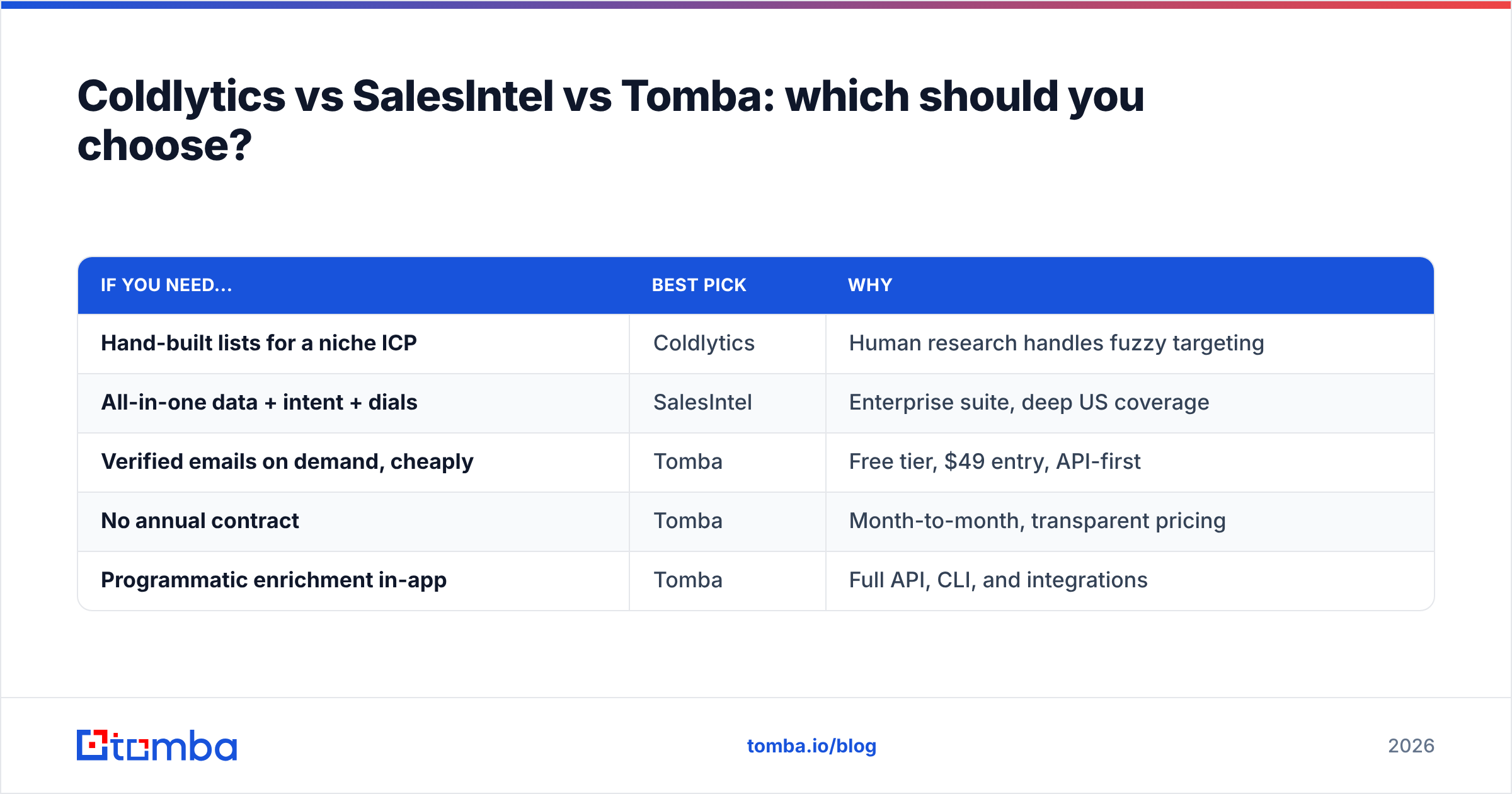
Coldlytics vs SalesIntel vs Tomba: which should you choose?#
Match the tool to the job, not the hype:
| If you need... | Best pick | Why |
|---|---|---|
| Hand-built lists for a niche ICP | Coldlytics | Human research handles fuzzy targeting |
| All-in-one data + intent + dials | SalesIntel | Enterprise suite, deep US coverage |
| Verified emails on demand, cheaply | Tomba | Free tier, $49 entry, API-first |
| No annual contract | Tomba | Month-to-month, transparent pricing |
| Programmatic enrichment in-app | Tomba | Full API, CLI, and integrations |
Choose Coldlytics if you run high-touch outbound to a hard-to-define audience and value precision over volume. Choose SalesIntel if you're a mid-market or enterprise team consolidating contact data, intent, and dials into one annual contract and have the budget for it. Choose an email finder like Tomba if your bottleneck is simply getting accurate emails into your campaigns without a sales call, a contract, or a researcher queue.
It's worth cross-shopping peers too — tools like BookYourData offer pay-as-you-go verified lists that sit between the done-for-you and self-serve models, and comparing a few options on your own ICP sample is the only way to know what actually bounces.
Frequently asked questions#
Is Coldlytics a database like SalesIntel? No. Coldlytics is a done-for-you research service where humans build lists per request. SalesIntel is a self-serve database you search yourself. That difference drives everything else — speed, price, and how you access the data.
Which has better data accuracy? Both use human verification, so both beat pure-scrape sources on bounce rate. Coldlytics researches fresh each time; SalesIntel re-verifies its database on a cycle. Either way, re-verify at send time — B2B data decays ~2–3% monthly.
Do either offer a free trial? Not a meaningful one. SalesIntel offers a demo, and Coldlytics quotes per project. If a free tier matters, a self-serve email finder gives you 25 free searches a month to test accuracy before you pay.
Can I get phone numbers from both? SalesIntel includes direct-dial phone numbers. Coldlytics provides them on request. If dials are central to your motion, a dedicated phone finder can supplement whichever email source you choose.
The bottom line#
Coldlytics and SalesIntel are both solid at what they do — Coldlytics for precision niche research, SalesIntel for enterprise-grade all-in-one data. But most teams comparing them are really trying to solve a simpler problem: accurate emails, fast, without a contract.
If that's you, start with the Tomba Email Finder. Find and verify professional emails by name, domain, or company, push them straight into your outbound tools via API, and test the whole thing on the free tier before you spend a dollar. Skip the researcher queue and the annual commitment — and put verified contacts into your pipeline today.
Related guides#
Ready to find emails that actually work?
Join 150,000+ professionals who stopped guessing and started sending. Free credits on signup — no credit card required.
Get the Tomba newsletter
Practical outbound tactics and product updates — once every two weeks.
About the author