CompanyData.com BoldData vs Kipplo: B2B Data Compared
CompanyData.com, BoldData, and Kipplo all sell B2B company records — but they price, cover, and refresh data very differently. Here's an honest side-by-side to pick the right one.
Choosing a B2B data provider is a bet on three things. How many records you get. How clean they are. And how much you pay before you see a single reply. This CompanyData.com BoldData vs Kipplo comparison breaks down where each tool wins and where each one hurts. All three sell company and contact data. But they aim at different buyers, and they price in very different ways. Read on to decide without wasting a quarter's budget on a list that bounces.
TL;DR — CompanyData.com vs BoldData vs Kipplo#
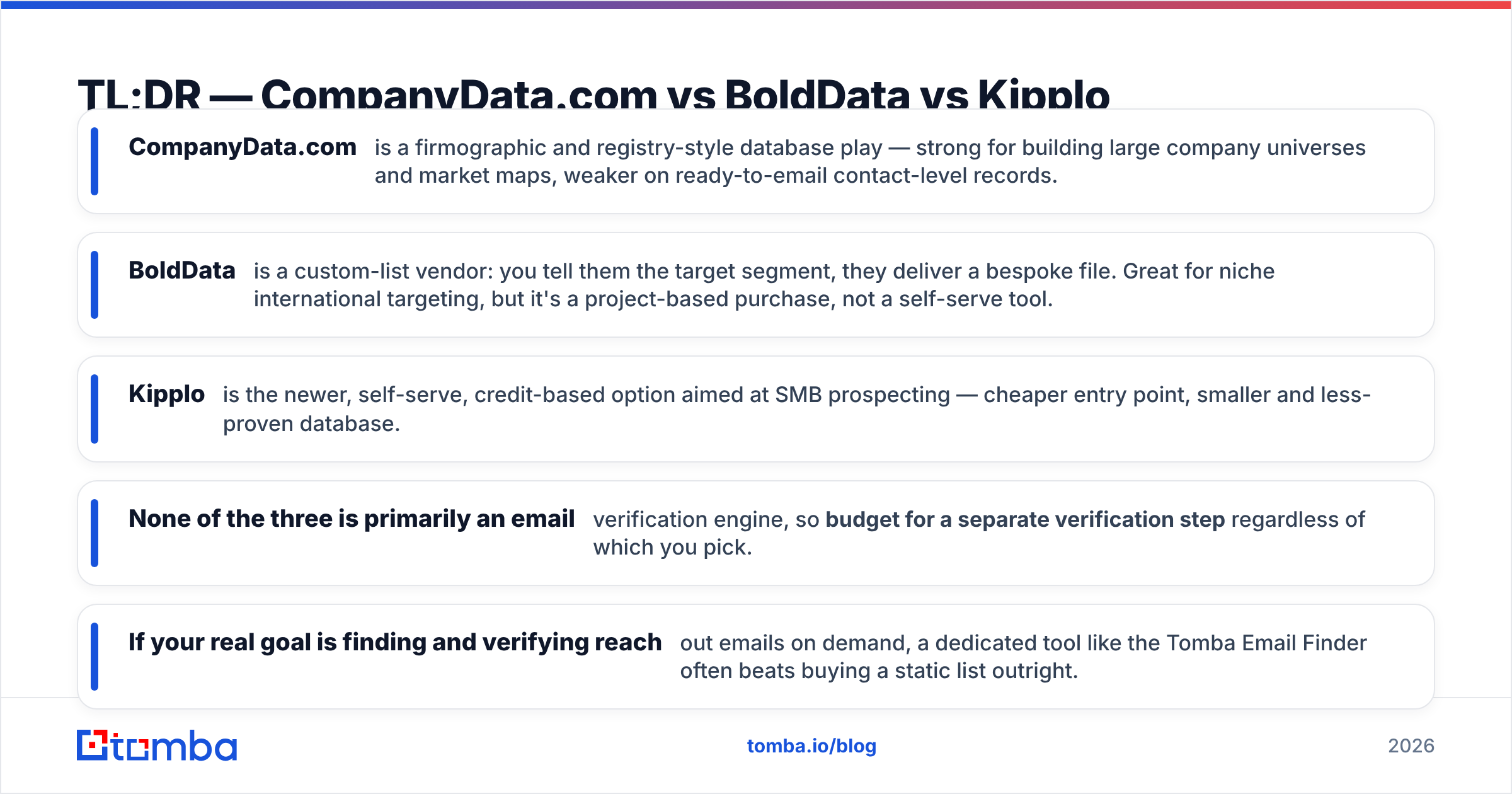
- CompanyData.com is a firmographic and registry-style database play — strong for building large company universes and market maps, weaker on ready-to-email contact-level records.
- BoldData is a custom-list vendor: you tell them the target segment, they deliver a bespoke file. Great for niche international targeting, but it's a project-based purchase, not a self-serve tool.
- Kipplo is the newer, self-serve, credit-based option aimed at SMB prospecting — cheaper entry point, smaller and less-proven database.
- None of the three is primarily an email-verification engine, so budget for a separate verification step regardless of which you pick.
- If your real goal is finding and verifying reach-out emails on demand, a dedicated tool like the Tomba Email Finder often beats buying a static list outright.

What do CompanyData.com, BoldData, and Kipplo actually sell?#
They're often lumped together as "B2B data," but they're three different products.
CompanyData.com sells access to a large database of company records. That means firmographics like industry codes, employee bands, revenue estimates, locations, and registration details. Think of it as a map of companies rather than a Rolodex of people. You use it to size a market, enrich accounts you already have, or build a total-addressable-market universe. Contact-level, person-specific email addresses are not its center of gravity.
BoldData works more like a data agency. You describe the audience — say, logistics decision-makers in the Benelux with 50–200 employees. Their team then assembles a custom list from their sources and hands you a file. It's a good fit when your targeting is unusual or heavily international, because a human is scoping the pull. The trade-off: it's a quote-and-deliver process, so turnaround and minimums matter. You're also buying a snapshot rather than a living, always-updating tool.
Kipplo is the self-serve challenger. You log in, filter, and pull contacts against a credit balance, much like the newer prospecting platforms. The appeal is speed and a low entry price. The caveat is that it's younger. The database depth and refresh cadence are less battle-tested than the incumbents, and independent reviews are thinner on the ground. Always cross-check current claims against the vendor's own site and third-party listings on G2 before committing.
The one thing all three share: they're data sources, not deliverability guarantees. A record being in a database doesn't mean the mailbox still exists.
How do their models and pricing compare?#
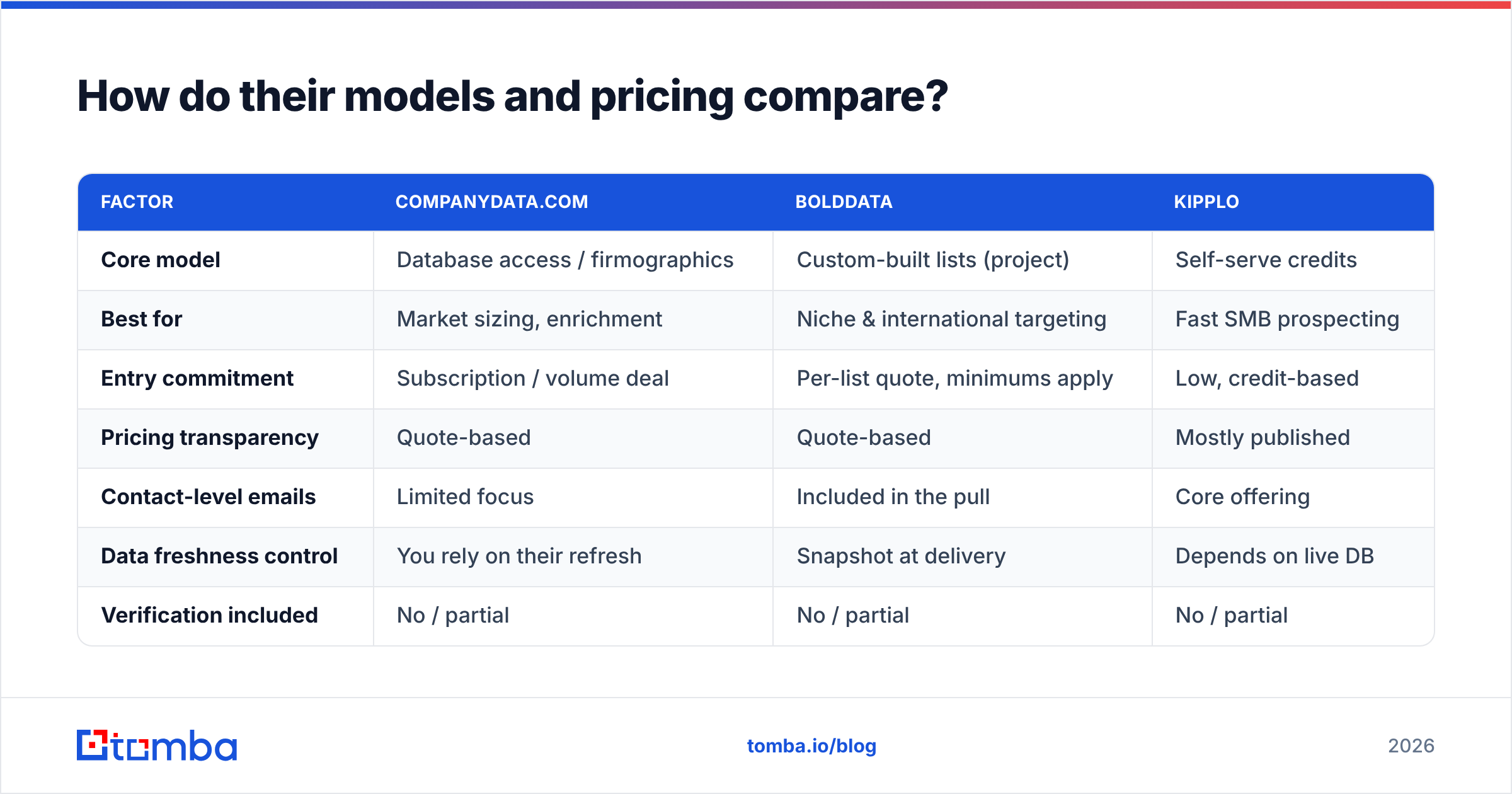
Pricing transparency is where these three diverge hardest. CompanyData.com and BoldData both lean toward "contact us for a quote," which usually means volume-based or project minimums. Kipplo leans self-serve with published-ish credit tiers. Because vendor pricing shifts, treat the figures below as model shape, not a live rate card — confirm on each provider's site.
| Factor | CompanyData.com | BoldData | Kipplo |
|---|---|---|---|
| Core model | Database access / firmographics | Custom-built lists (project) | Self-serve credits |
| Best for | Market sizing, enrichment | Niche & international targeting | Fast SMB prospecting |
| Entry commitment | Subscription / volume deal | Per-list quote, minimums apply | Low, credit-based |
| Pricing transparency | Quote-based | Quote-based | Mostly published |
| Contact-level emails | Limited focus | Included in the pull | Core offering |
| Data freshness control | You rely on their refresh | Snapshot at delivery | Depends on live DB |
| Verification included | No / partial | No / partial | No / partial |
The pattern to notice: the two established players optimize for breadth and bespoke scope but hide the price behind a sales motion, while Kipplo optimizes for speed and a low first bill but asks you to trust a newer dataset. There's no universally "cheapest" winner — the cheapest option is the one whose data you don't have to re-buy in six months.

Which one has the most accurate and fresh data?#
Accuracy is the whole game, and it's the hardest thing to verify before you buy. A few honest realities:
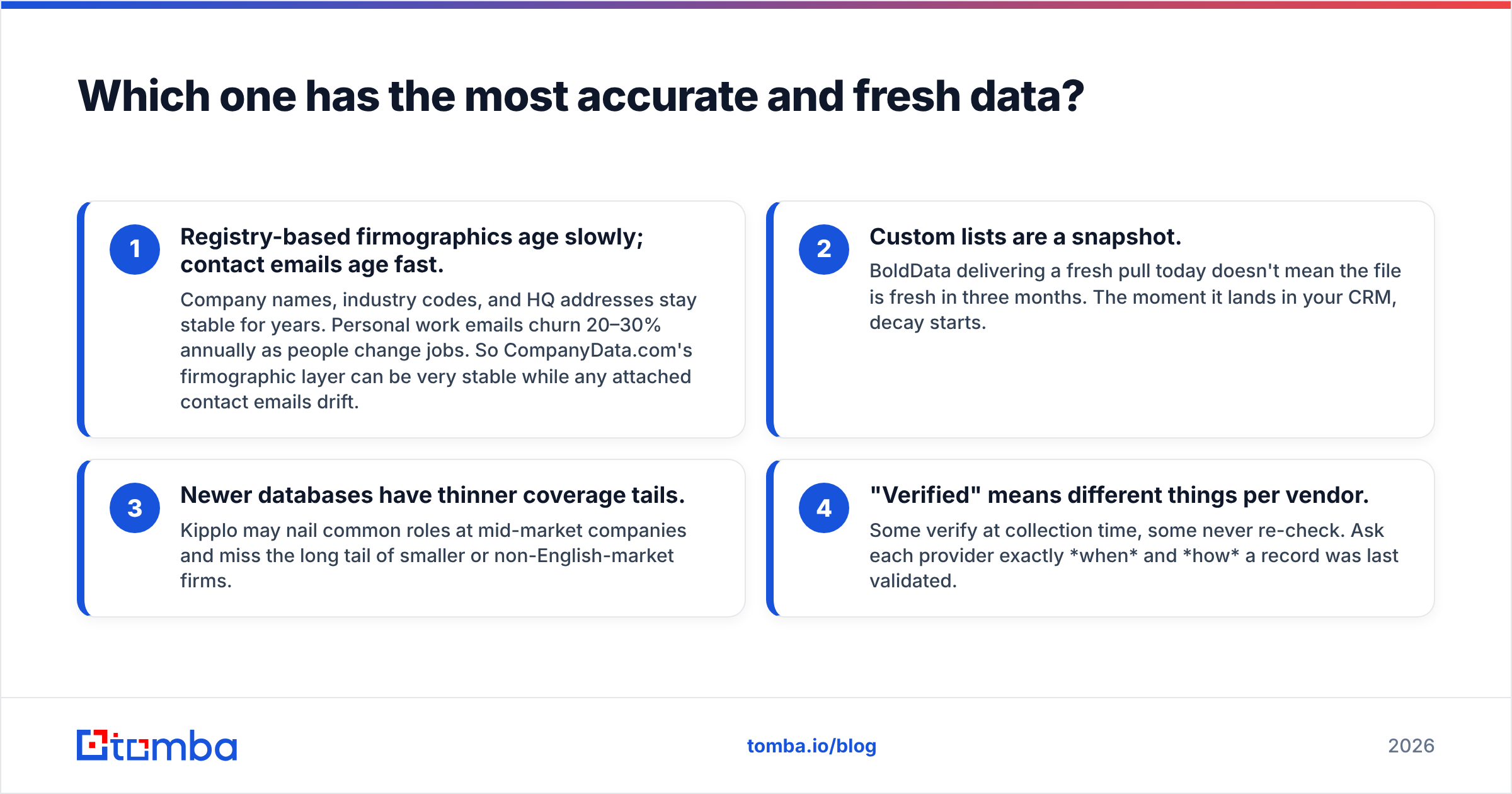
- Registry-based firmographics age slowly; contact emails age fast. Company names, industry codes, and HQ addresses stay stable for years. Personal work emails churn 20–30% annually as people change jobs. So CompanyData.com's firmographic layer can be very stable while any attached contact emails drift.
- Custom lists are a snapshot. BoldData delivering a fresh pull today doesn't mean the file is fresh in three months. The moment it lands in your CRM, decay starts.
- Newer databases have thinner coverage tails. Kipplo may nail common roles at mid-market companies and miss the long tail of smaller or non-English-market firms.
- "Verified" means different things per vendor. Some verify at collection time, some never re-check. Ask each provider exactly when and how a record was last validated.
This is why serious teams treat any purchased list as raw material, not finished goods. You run it through an email verifier before the first send to strip dead mailboxes, catch-alls, and role accounts. Skipping that step is how good lists quietly torch a sending domain's reputation. If you want to understand where the numbers behind a provider come from, it's worth reviewing published notes on data sources and refresh methodology rather than trusting a single "accuracy %" on a landing page.
Is a static list the right tool at all?#
Here's the pushback worth stating plainly: for a lot of teams, buying a bulk list from any of these three is the wrong shape of purchase.
A static list has three structural problems. It decays the day you receive it. It commits budget up front before you've validated product-market fit for that segment. And it tempts teams to blast the whole file, which is exactly the behavior that gets domains blocklisted.
The alternative is on-demand discovery: find and verify contacts for the specific accounts you're working this week, at the moment you need them. That keeps data fresh by definition and ties spend to activity. A B2B database you can query on demand — plus a finder that returns a verified address for a given name and domain — often produces better reply rates than a 100k-row CSV, because every record is current and every send is intentional.
That doesn't make CompanyData.com or BoldData useless. If you genuinely need to size a market or pull an unusual international segment in one shot, a database or a custom-list agency is the right instrument. Just don't confuse "I have 50,000 rows" with "I have 50,000 prospects."
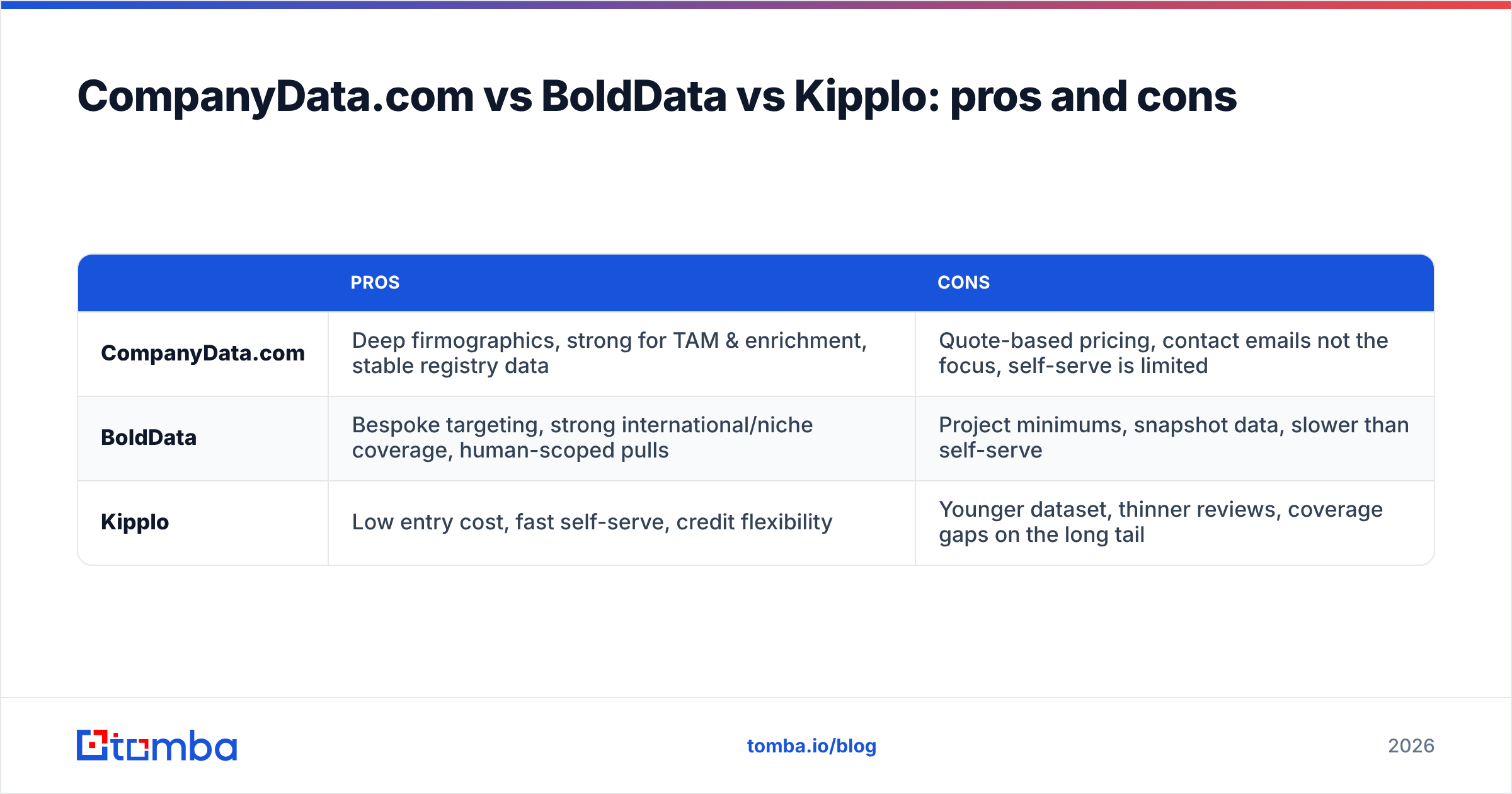
CompanyData.com BoldData vs Kipplo: Pros and Cons#
| Pros | Cons | |
|---|---|---|
| CompanyData.com | Deep firmographics, strong for TAM & enrichment, stable registry data | Quote-based pricing, contact emails not the focus, self-serve is limited |
| BoldData | Bespoke targeting, strong international/niche coverage, human-scoped pulls | Project minimums, snapshot data, slower than self-serve |
| Kipplo | Low entry cost, fast self-serve, credit flexibility | Younger dataset, thinner reviews, coverage gaps on the long tail |
A simple way to read this table: pick CompanyData.com when the unit of work is a company, BoldData when the unit of work is a hard-to-source segment, and Kipplo when the unit of work is speed on a budget. And in all three cases, add a verification and enrichment layer so the records you actually send to are clean. Running purchased rows through data enrichment also fills the gaps — missing titles, phone numbers, or social profiles — that a single provider rarely covers completely.
How should you choose between them?#
Work through these questions in order:
- What's your unit of work — companies or people? Companies and market maps → CompanyData.com. People you can email → Kipplo or a finder.
- Is your target segment weird or international? If mainstream filters won't capture it, BoldData's human-scoped custom pull earns its premium.
- How fast do you need it, and how predictable is your budget? Self-serve credits (Kipplo, or a query-based finder) beat quote cycles when you need data today.
- Can you tolerate a snapshot, or do you need living data? Static file → any of the three. Always-current → on-demand tooling.
- Do you have a verification step? If not, add one before you spend a cent on outreach. This is non-negotiable.
For most outbound and prospecting teams, the honest answer is a hybrid: use a database or custom list to define the universe, then use an on-demand finder to pull and verify the exact contacts you're working, when you're working them.
The verdict#
There's no single winner — there's a best fit per job. CompanyData.com is the pick for firmographic depth and account enrichment. BoldData is the pick for bespoke, international, hard-to-find segments. Kipplo is the pick for low-cost, self-serve speed if you're comfortable with a newer dataset. All three should be paired with independent verification. None of them is a deliverability guarantee, and all of them start decaying the moment the file lands.
If your actual problem is "I need current, verified email addresses for the people I'm reaching out to this week," a static list is the long way around. Start with the Tomba Email Finder to pull and validate contacts on demand, keep the data fresh by querying it when you need it, and layer in enrichment only where a record is thin. You'll spend less up front, protect your sending reputation, and skip the six-month "why is my purchased list bouncing" surprise entirely. Check current Tomba pricing — the free tier lets you test coverage on your own target accounts before you commit a budget to anyone.
Related guides#
Ready to find emails that actually work?
Join 150,000+ professionals who stopped guessing and started sending. Free credits on signup — no credit card required.
Get the Tomba newsletter
Practical outbound tactics and product updates — once every two weeks.
About the author