CompanyData.com vs BoldData vs LeadGenius: 2026 Comparison
CompanyData.com, BoldData, and LeadGenius all sell B2B data, but they buy very differently. Here's an honest, side-by-side breakdown of coverage, pricing, and workflow so you pick the right one.
Buying B2B data used to mean one thing: a rep, a quote, and a spreadsheet emailed three days later. Three vendors that still shape that market — CompanyData.com, BoldData, and LeadGenius — each answer the "how do I actually get the list" question in a completely different way. This guide breaks down where each one wins, where it drags, and when a self-serve tool beats all three.
TL;DR: Which one should you pick?#
- CompanyData.com is a firmographic and company-registry play — strong for global company records and compliance-grade filtering, weaker on ready-to-email contact-level data.
- BoldData is a custom-list broker: you tell them the target, they build and deliver a one-time file. Great for tightly-defined campaigns, less great if you need continuous, refreshed data.
- LeadGenius is a managed, human-plus-AI research service aimed at enterprise GTM teams — high accuracy, high touch, high price, long onboarding.
- If you want data today, self-serve, and pay-as-you-scale, a live tool like Tomba's email finder or B2B database usually beats a quote-and-wait vendor for speed and cost.
- Rule of thumb: compliance-heavy firmographics → CompanyData.com; one-off niche list → BoldData; enterprise custom research at scale → LeadGenius; fast, ongoing prospecting → self-serve.
What are CompanyData.com, BoldData, and LeadGenius?#
All three sell "B2B data," but they are not the same product category.
CompanyData.com focuses on company-level intelligence: firmographics, registry-sourced entity records, industry codes, revenue bands, and location data across millions of businesses. It's the kind of source you use to size a market, enrich a CRM with company attributes, or filter an addressable universe before you ever touch a person.
BoldData (bolddata.nl) is a data brokerage. You describe an audience — say, "manufacturing companies in Germany with 50–200 employees and a purchasing director" — and their team assembles a custom file from their databases and delivers it as a one-time download. It's a service wrapped around data, not a live platform you log into.
LeadGenius (leadgenius.com) sits at the top of the market: a managed service where trained researchers plus automation build and verify custom datasets and buying-signal lists for large GTM and RevOps teams. Think "outsourced data research department" rather than "download a CSV."
Here's the core distinction in one line: CompanyData.com sells records, BoldData sells a list, and LeadGenius sells a service.

How do they compare side by side?#
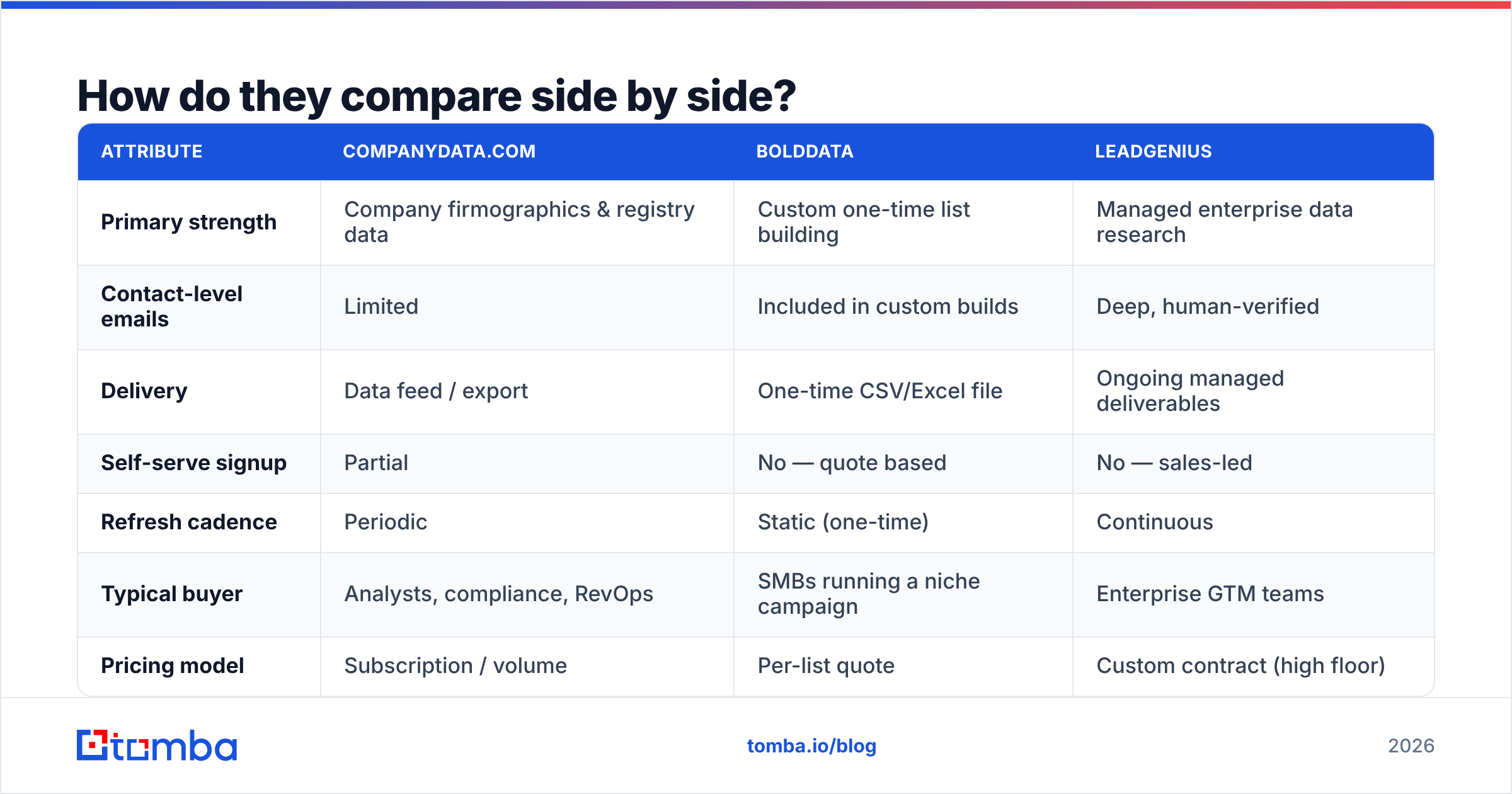
The differences that actually affect your workflow are delivery model, contact-level depth, refresh cadence, and how you pay. Here's the honest breakdown.
| Attribute | CompanyData.com | BoldData | LeadGenius |
|---|---|---|---|
| Primary strength | Company firmographics & registry data | Custom one-time list building | Managed enterprise data research |
| Contact-level emails | Limited | Included in custom builds | Deep, human-verified |
| Delivery | Data feed / export | One-time CSV/Excel file | Ongoing managed deliverables |
| Self-serve signup | Partial | No — quote based | No — sales-led |
| Refresh cadence | Periodic | Static (one-time) | Continuous |
| Typical buyer | Analysts, compliance, RevOps | SMBs running a niche campaign | Enterprise GTM teams |
| Pricing model | Subscription / volume | Per-list quote | Custom contract (high floor) |
| Time to first data | Days | Days | Weeks (onboarding) |
The pattern is clear: as you move from CompanyData.com to BoldData to LeadGenius, you gain accuracy and hand-holding but lose speed and pay a lot more per record.
Which has the best data coverage and accuracy?#
It depends on what you mean by coverage.
For sheer company breadth, CompanyData.com is strong. Registry-sourced records mean broad international coverage and consistent firmographic fields — useful when you need to know that a company exists, its size, and its sector, but you don't yet need a named human.
For contact accuracy on a specific target, LeadGenius wins. Because humans verify records against a defined brief, the emails and titles you get back are usually clean. That accuracy is the whole reason the price is what it is.
BoldData lands in the middle: coverage depends entirely on the segment you request. For a well-trodden segment (e.g., dentists in the Netherlands) the file can be excellent; for an obscure or fast-changing niche, freshness varies because the file is a snapshot the day it's delivered.
The catch that applies to all three: static data decays. B2B contact data goes stale at roughly 20–30% per year as people change jobs (a figure widely cited across data vendors and validated by sources like Gartner research on data quality). A one-time list is accurate the day you buy it and a little less accurate every day after. That's the structural argument for a live lookup tool: you verify emails at the moment of send, not at the moment of purchase.
How does pricing compare?#
None of the three publish simple, transparent price cards — and that's the honest headline.
- CompanyData.com typically prices by subscription tier or data volume. Predictable if you're an ongoing consumer, but you're often committing before you've stress-tested the data.
- BoldData quotes per list. You describe the audience, they price the file. Fine for a single campaign; it doesn't amortize if you need fresh data every month, because every refresh is a new purchase.
- LeadGenius is a custom enterprise contract. Expect a meaningful annual floor and a procurement cycle. It's built for teams where a data researcher's salary is the alternative — not for a founder testing a channel.
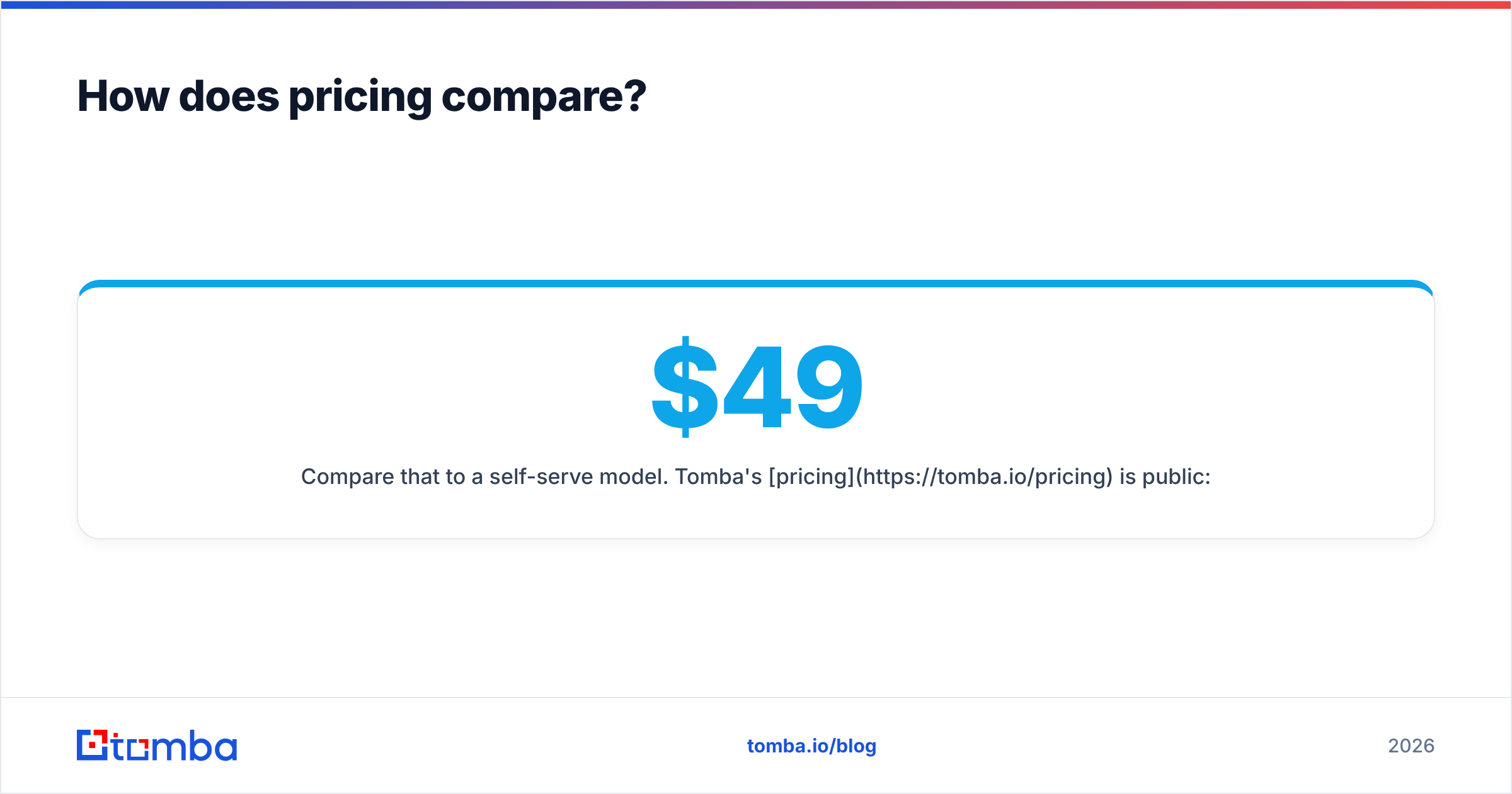
Compare that to a self-serve model. Tomba's pricing is public: a Free tier with 25 searches/month, Starter at $49/mo, Growth at $99/mo, and Pro at $249/mo. You can start today, see real results, and scale credits as pipeline justifies it — no quote call, no annual lock-in. For teams that want volume, a bulk email finder run handles thousands of lookups without a brokered file.

When should you choose each one?#
Match the tool to the job instead of chasing a single "winner."
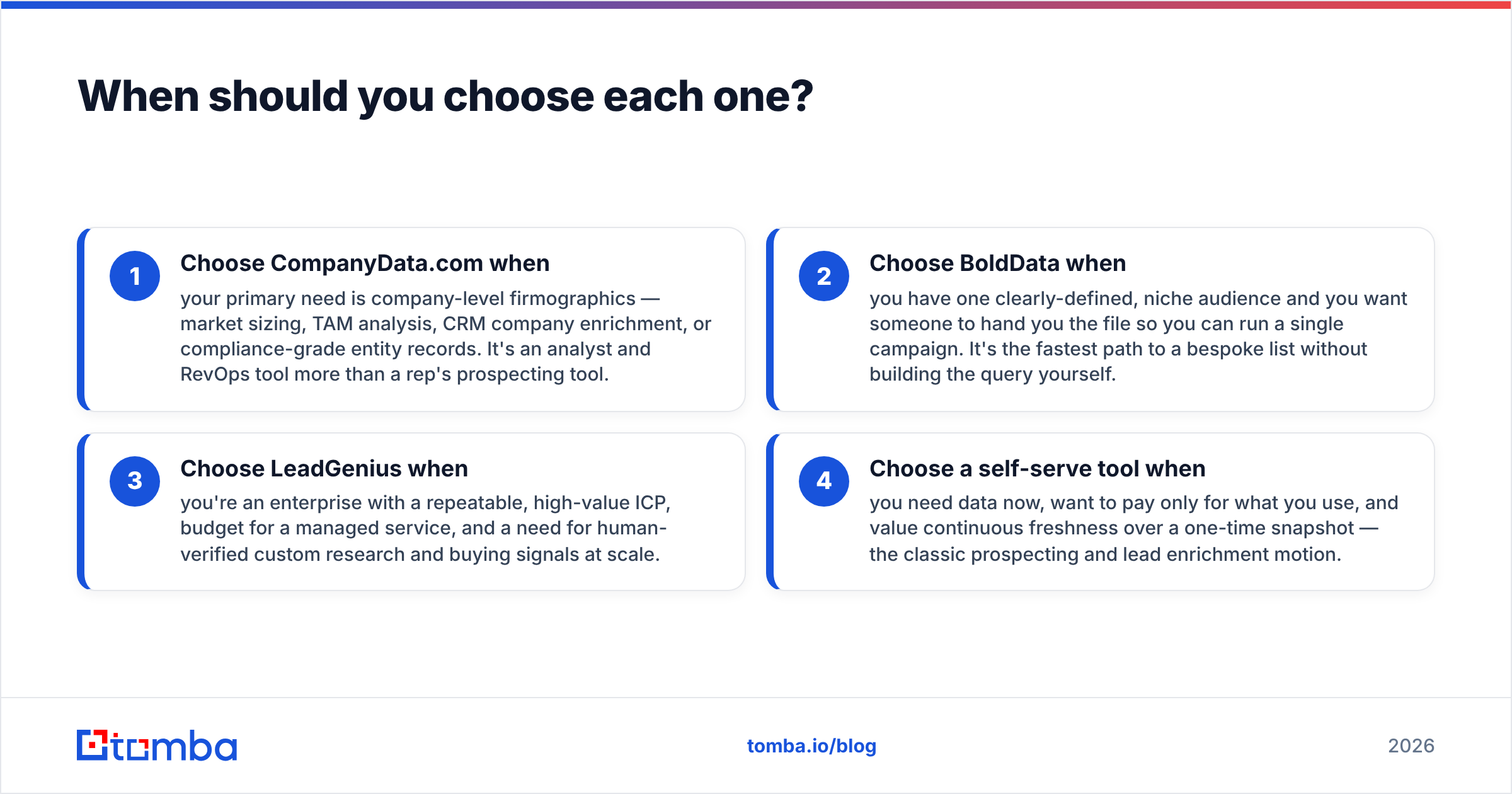
- Choose CompanyData.com when your primary need is company-level firmographics — market sizing, TAM analysis, CRM company enrichment, or compliance-grade entity records. It's an analyst and RevOps tool more than a rep's prospecting tool.
- Choose BoldData when you have one clearly-defined, niche audience and you want someone to hand you the file so you can run a single campaign. It's the fastest path to a bespoke list without building the query yourself.
- Choose LeadGenius when you're an enterprise with a repeatable, high-value ICP, budget for a managed service, and a need for human-verified custom research and buying signals at scale.
- Choose a self-serve tool when you need data now, want to pay only for what you use, and value continuous freshness over a one-time snapshot — the classic prospecting and lead enrichment motion.
Most teams actually blend these. A common stack: firmographic sizing from a company-data source, then live contact discovery and verification from a self-serve finder feeding the CRM. You don't have to pick one religion.
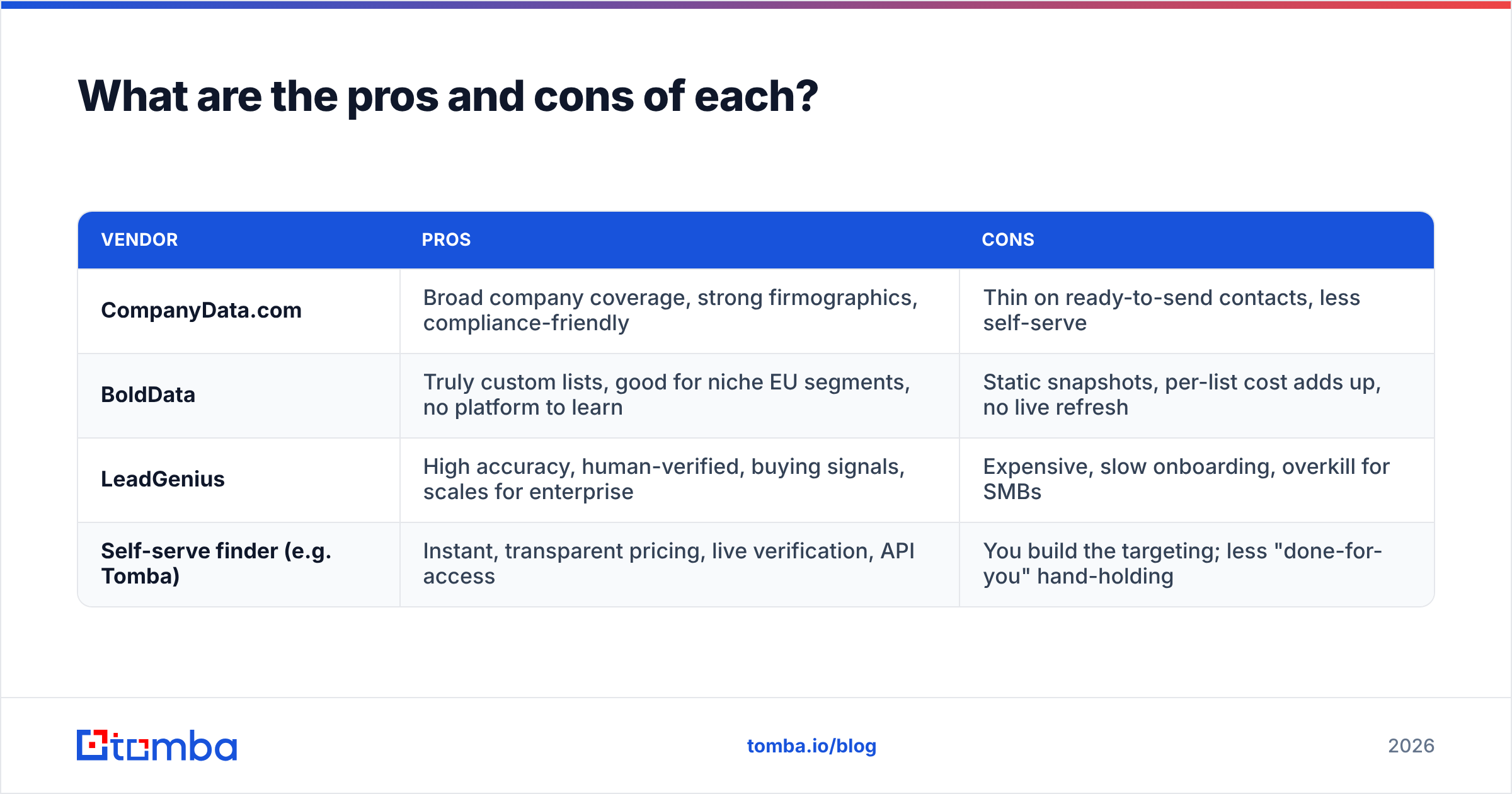
What are the pros and cons of each?#
A quick, honest ledger.
| Vendor | Pros | Cons |
|---|---|---|
| CompanyData.com | Broad company coverage, strong firmographics, compliance-friendly | Thin on ready-to-send contacts, less self-serve |
| BoldData | Truly custom lists, good for niche EU segments, no platform to learn | Static snapshots, per-list cost adds up, no live refresh |
| LeadGenius | High accuracy, human-verified, buying signals, scales for enterprise | Expensive, slow onboarding, overkill for SMBs |
| Self-serve finder (e.g. Tomba) | Instant, transparent pricing, live verification, API access | You build the targeting; less "done-for-you" hand-holding |
The trade-off axis is consistent: done-for-you vs. do-it-now. Brokered and managed services remove work but add cost and latency. Self-serve tools add a little setup but give you speed, control, and per-unit economics you can actually forecast.
What about integrations and workflow?#
This is where the delivery model bites hardest.
BoldData's one-time file lands in your inbox as a CSV — you import it, dedupe it, and it starts aging immediately. LeadGenius delivers into your systems as part of the managed engagement, which is smoother but gated behind that contract. CompanyData.com typically exposes feeds or exports suited to analysts.
A self-serve platform is built to live inside your existing stack. With Tomba, you can pull contacts straight into a CRM through native integrations like HubSpot and Salesforce, script lookups against the email finder API, or enrich rows directly in a spreadsheet. The data isn't a file you received — it's a query you can re-run whenever a record looks stale. For a hands-on comparison of self-serve data platforms, G2's B2B data category is a reasonable neutral starting point.
That difference — a query you own versus a file you were handed — is the whole game for teams that prospect continuously.
The verdict: which wins the companydatacom bolddata vs leadgenius matchup?#
There's no single winner, because they serve different buyers — but for most sales and marketing teams doing ongoing outbound, none of the three is the fastest or cheapest path.
- Need compliance-grade company records? CompanyData.com.
- Need a one-off niche list built for you? BoldData.
- Need enterprise-scale managed research and have the budget? LeadGenius.
- Need fresh contacts today, priced transparently, that plug into your CRM? A self-serve finder wins on speed and cost.
The mistake is treating "buy a B2B list" as one decision. Firmographic intelligence, bespoke campaign lists, and managed enterprise research are three different products with three different price tags and three different wait times.
If your real problem is "I need verified, current contact emails to run outbound this week," the brokered-list and managed-service models are slower and pricier than they need to be. Start with Tomba's Email Finder — find professional emails by name, company, or domain, verify them live, and only pay for what you use. Spin up a free account with 25 searches, test the accuracy against your own ICP, and scale to a paid plan only once the pipeline earns it. That's the honest fast lane none of these three offer out of the box.
Related guides#
Ready to find emails that actually work?
Join 150,000+ professionals who stopped guessing and started sending. Free credits on signup — no credit card required.
Get the Tomba newsletter
Practical outbound tactics and product updates — once every two weeks.
About the author