CompanyData.com, BoldData vs ListKit: 2026 B2B Data Comparison
CompanyData.com, BoldData, and ListKit all sell B2B data, but they win at very different jobs. Here's an honest, side-by-side breakdown of accuracy, pricing, coverage, and which one fits your outbound motion.
Buying a B2B list feels simple until the bounces start rolling in. This CompanyData.com, BoldData vs ListKit comparison cuts through the sales pitch. All three promise clean records and fast delivery. But each one is built for a different buyer. Pick the wrong one and you overpay for firmographics you never use. Or you burn your sender reputation on a stale export.
This is a neutral, side-by-side look at all three. It also shows where a self-serve tool fits when a static list is the wrong shape for your problem.
TL;DR — Which Should You Buy?#
- CompanyData.com is strongest for company-level datasets at scale. Think market sizing, TAM analysis, and enrichment feeds — not ready-to-send SDR contacts.
- BoldData is a custom, human-curated list vendor. You name the target segment, and they hand-build the file. It is great for niche international B2B, but slower and pricier per record.
- ListKit is the SDR-first play. It sells verified emails and phone numbers for cold email and cold calling, priced on credits.
- None of the three is a live lookup tool — they sell snapshots. Data decays about 2-3% per month, so freshness at send time matters more than file size.
- Is your real job "find and verify the right email the day I send"? Then a self-serve email finder plus an email verifier usually beats a bulk list.

What Are CompanyData.com, BoldData, and ListKit?#
All three are "B2B data providers," but that label hides three business models.
- CompanyData.com — A firmographic database vendor. Its core asset is company records: industry codes, revenue bands, employee counts, tech signals, and locations. Contacts exist too. But the core is company-level intelligence. You plug it into a CRM, a scoring model, or a data enrichment pipeline.
- BoldData — A Netherlands-based custom list builder. You brief them on a segment, like "HVAC installers in Germany with 10-50 staff." They then compile and deliver a tailored file, often with human research on top. It skews international and niche.
- ListKit — A US-centric, SDR-facing platform. It sells verified emails and phone numbers in credit packs. These are tuned for people running cold email and cold calling today.
The practical difference: CompanyData.com answers "who are the companies," BoldData answers "build me this exact list," and ListKit answers "give me contacts I can email this week."
How Do CompanyData.com, BoldData vs ListKit Compare?#
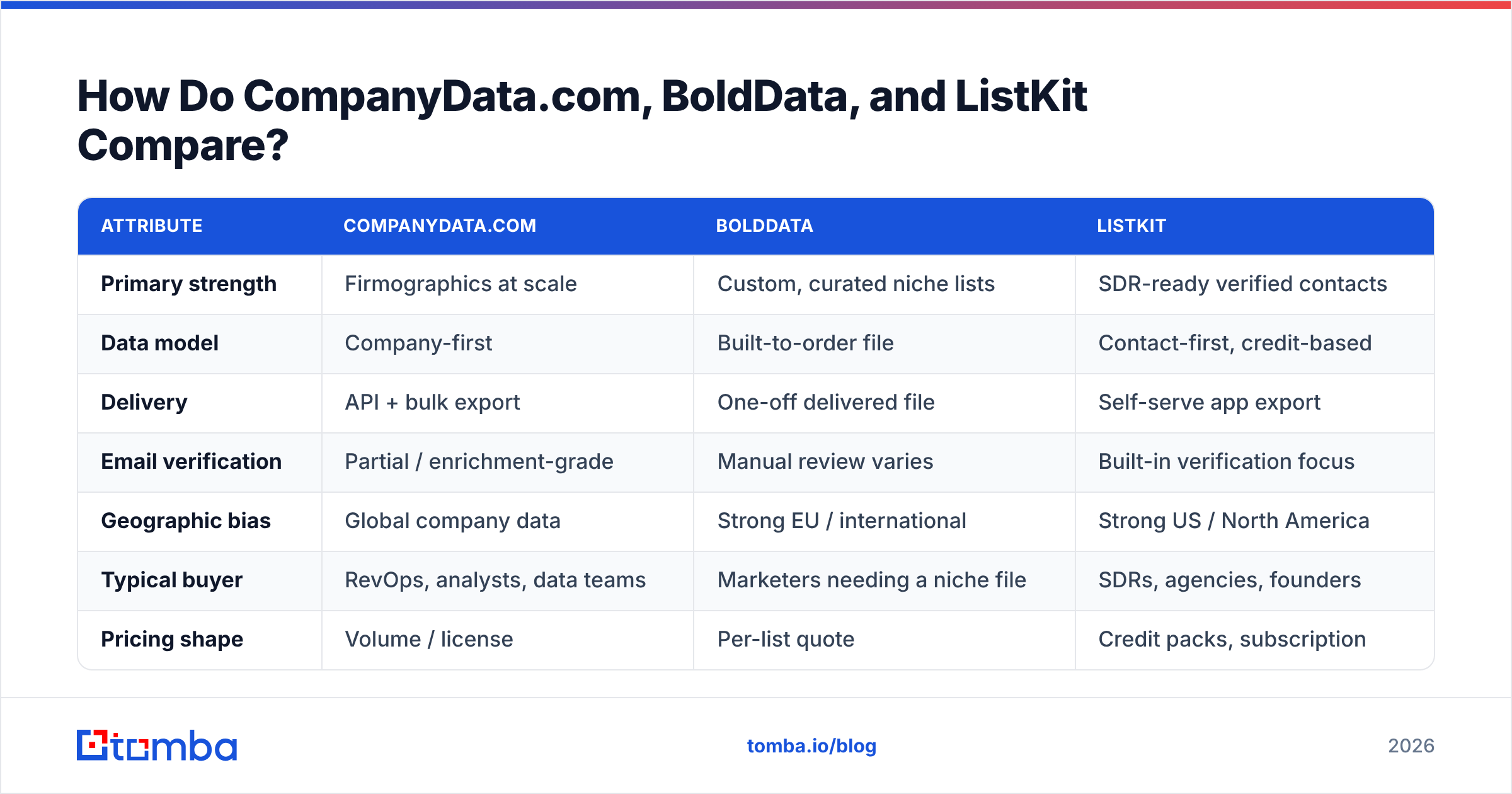
Here is the honest side-by-side. Treat exact prices as a rough guide. All three quote by volume, geography, and contract, and published numbers change often.
| Attribute | CompanyData.com | BoldData | ListKit |
|---|---|---|---|
| Primary strength | Firmographics at scale | Custom, curated niche lists | SDR-ready verified contacts |
| Data model | Company-first | Built-to-order file | Contact-first, credit-based |
| Delivery | API + bulk export | One-off delivered file | Self-serve app export |
| Email verification | Partial / enrichment-grade | Manual review varies | Built-in verification focus |
| Geographic bias | Global company data | Strong EU / international | Strong US / North America |
| Typical buyer | RevOps, analysts, data teams | Marketers needing a niche file | SDRs, agencies, founders |
| Pricing shape | Volume / license | Per-list quote | Credit packs, subscription |
| Best for | TAM, scoring, enrichment | Hard-to-source segments | Cold outreach at speed |
Notice that no row header says "live accuracy at send time." Every static list shares that gap. It is the single biggest driver of bounce rates.
Which Has the Most Accurate Data?#
Accuracy depends on what you are measuring. For company firmographics — industry, size, location — CompanyData.com is the safest bet. That data is its native asset. For hard-to-find niche contacts in Europe, BoldData's human curation often surfaces records the big databases miss. For US B2B email and phone, ListKit's verification-first pipeline tends to produce the lowest bounce rate of the three on ready-to-send lists.
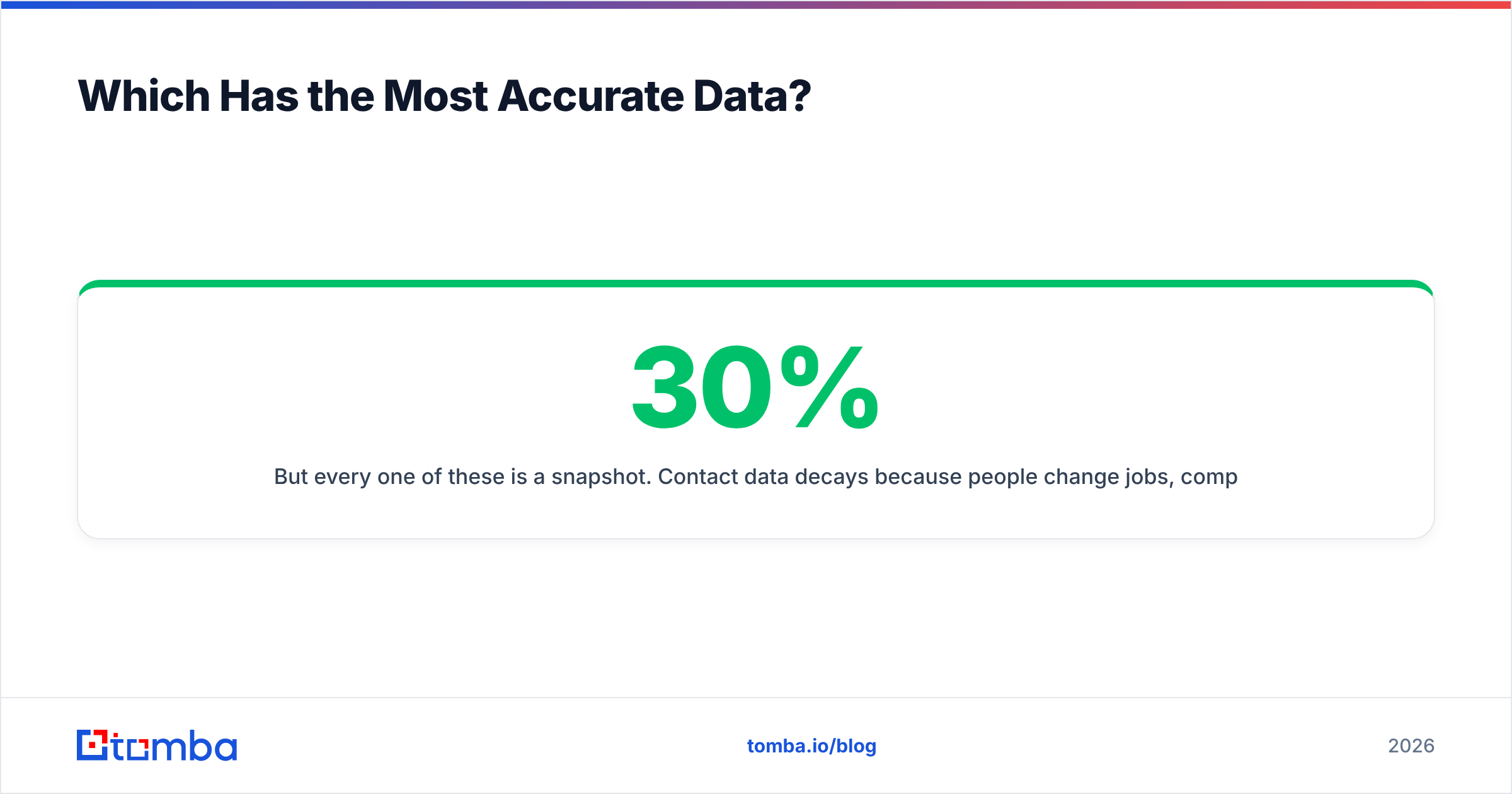
But every one of these is a snapshot. Contact data decays fast. People change jobs, companies rebrand, and inboxes get shut off. Studies from vendors like G2 and enrichment providers put B2B data decay at roughly 25-30% per year. A list that was 95% valid in January can drop below 80% by summer.
So the smart workflow is not "trust the file." It is "verify at send." Run any purchased list through a dedicated email verification pass before your first campaign. This catches the records that went stale between export and outreach. It also protects your domain reputation.

How Does Pricing Compare Across the Three?#
Pricing philosophy differs as much as the data.
- CompanyData.com licenses data by volume and use case. It is cheap per record at large scale. But it is not built for a founder who wants 500 contacts this afternoon.
- BoldData quotes per project. A human helps compile the list, so the cost per record is the highest of the three. That is fair. You are paying for curation you cannot self-serve.
- ListKit uses credit packs and subscriptions. That makes small and mid volumes fast and easy to predict. It is the most "swipe a card and start" of the three.
If you want a mental model: CompanyData.com is buying a dataset, BoldData is hiring a research service, and ListKit is filling a bucket of contact credits.
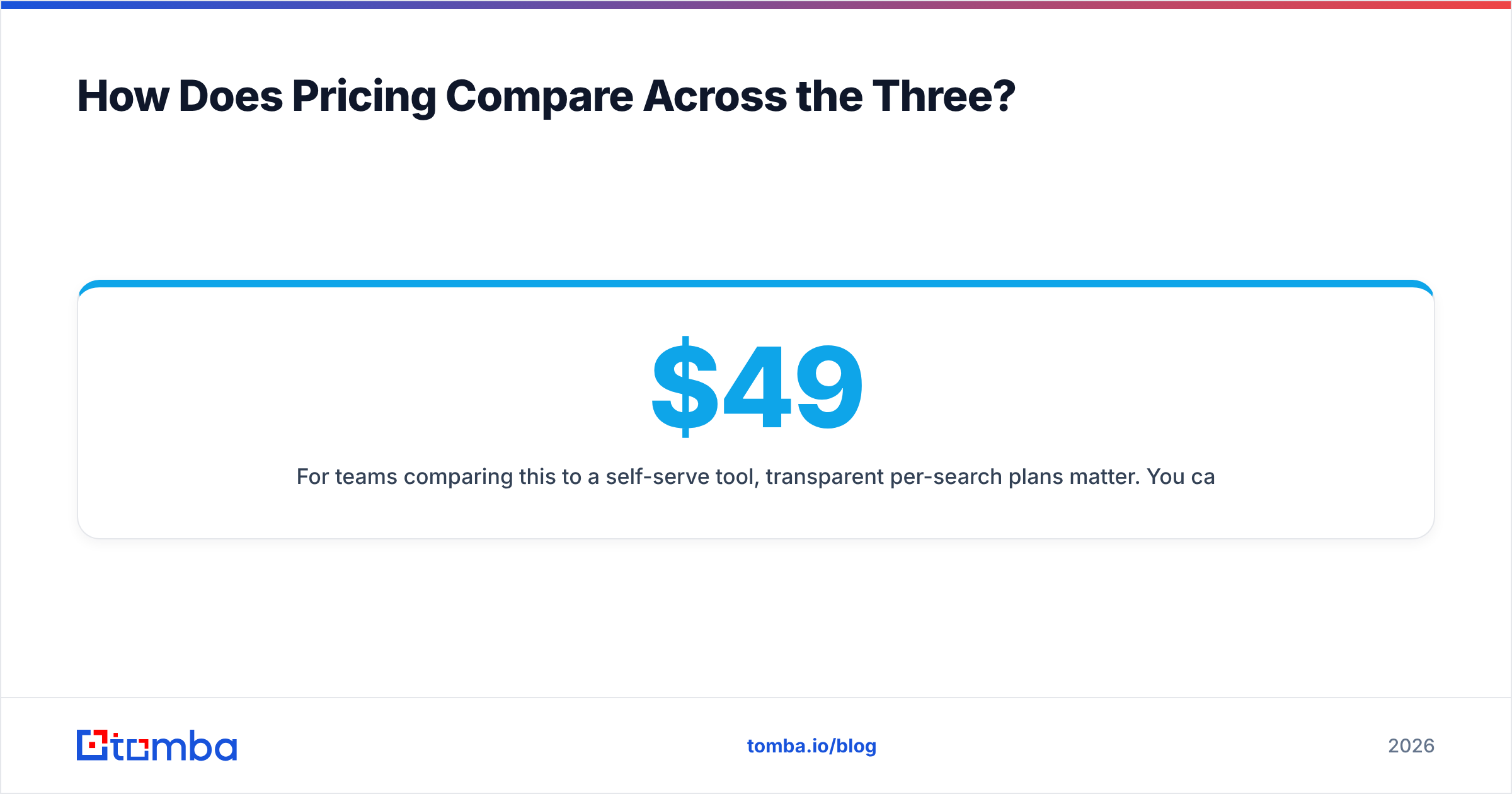
For teams weighing a self-serve tool, clear per-search plans matter. The Tomba pricing page shows a usage-based model. There is a Free tier with 25 searches a month, Starter at $49/mo, Growth at $99/mo, and Pro at $249/mo. So you are not locked into a five-figure annual license just to test one segment.
When Should You Buy a List vs. Find Contacts Yourself?#
Buy a static list when the segment is stable, large, and you need it once. Market sizing, a broad ABM tier, or a mailing you will run and archive are all good fits. CompanyData.com and BoldData shine here.
Buy credits or self-serve when the target changes weekly, is small, or must be fresh. SDR prospecting and account-specific outreach fit here. So does the "I found this company on LinkedIn an hour ago" moment. In each case, a snapshot is already out of date. ListKit leans this way, and so do dedicated lookup tools.
A few concrete signals you should skip the bulk file:
- You send in small, targeted batches. A 200-contact campaign to a hand-picked account list does not need a 50,000-row database.
- You already have the companies, just not the people. A domain search returns the verified emails behind a company you already care about — no list purchase required.
- You need to enrich records you own. If you have a CRM full of half-empty rows, data enrichment fills the gaps without buying an overlapping list.
- Reputation is on the line. Fresh, verified-at-send data keeps your bounce rate low and your domain out of the spam folder.
What About Data Freshness and Deliverability?#
This is where the "which vendor" question quietly becomes a "which workflow" question. A perfectly sourced list is worthless if 15% of it bounces on day one. Mailbox providers read high bounce rates as a spam signal. Then they start routing your good emails to junk.
Three habits protect you regardless of which provider you choose:
- Verify every list at import, not just at purchase. Bulk-check the file the day you load it. Use a bulk email finder and verifier instead of trusting the seller's month-old validation.
- Warm up the segment gradually. Do not blast a fresh 20,000-record file from a cold domain.
- Re-verify recurring lists on a cadence. Anything you mail more than once should be re-checked quarterly to strip the records that have decayed.
CompanyData.com, BoldData, and ListKit can all supply the raw material. The freshness step is on you.
Which One Is Right for Your Team?#
Match the tool to the job, not the marketing:
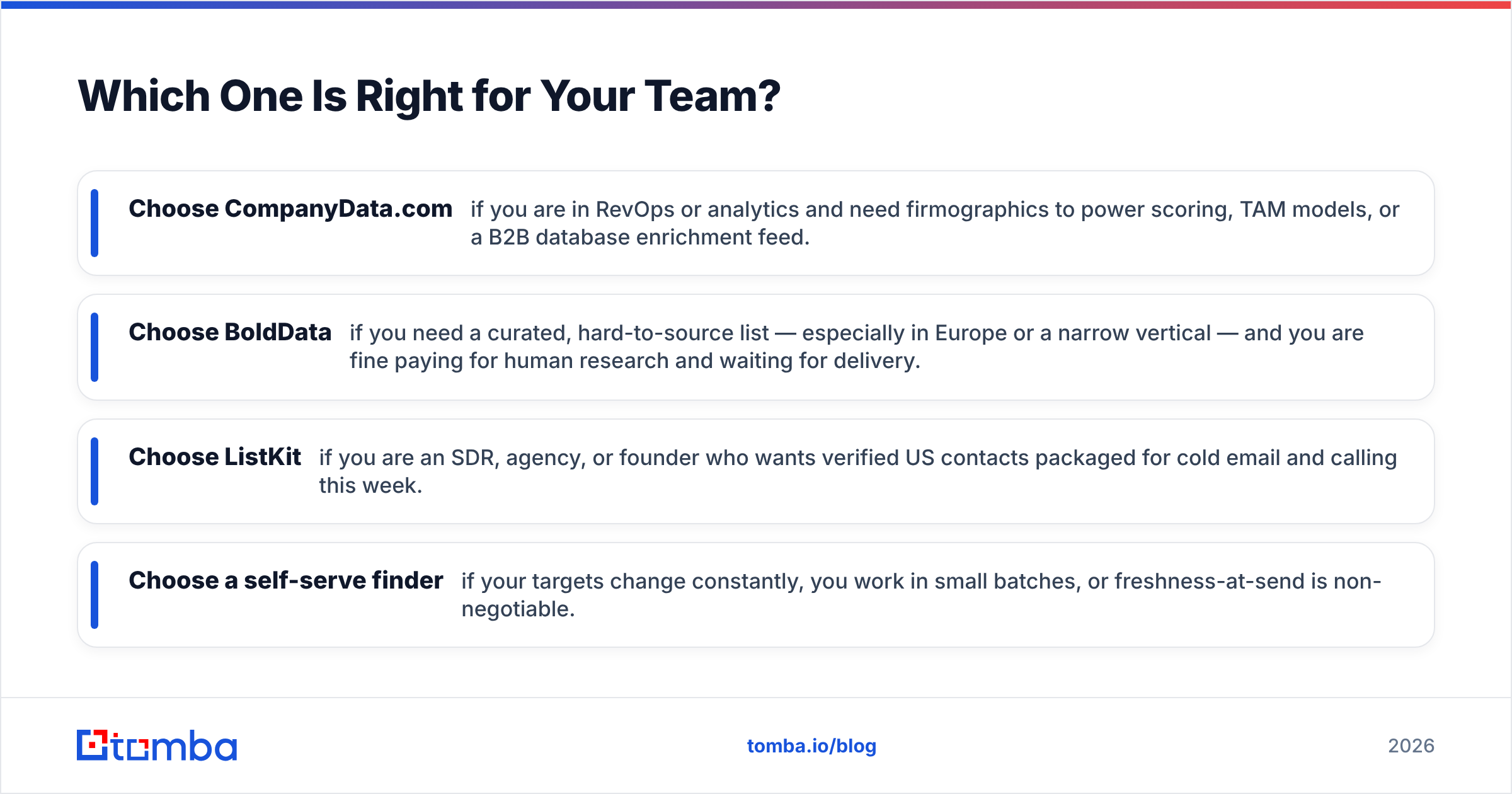
- Choose CompanyData.com if you are in RevOps or analytics and need firmographics to power scoring, TAM models, or a B2B database enrichment feed.
- Choose BoldData if you need a curated, hard-to-source list — especially in Europe or a narrow vertical — and you are fine paying for human research and waiting for delivery.
- Choose ListKit if you are an SDR, agency, or founder who wants verified US contacts packaged for cold email and calling this week.
- Choose a self-serve finder if your targets change constantly, you work in small batches, or freshness-at-send is non-negotiable.
You can also mix them. Many teams use a firmographic source to pick accounts. Then they use a lookup tool to pull and verify the exact contacts when they are ready to reach out. That is the best of both, without over-buying either.
For deeper vendor evaluation, cross-check any provider's reviews on an independent source like Capterra and read each vendor's own docs — CompanyData.com, BoldData, and ListKit — before signing an annual contract.
The Bottom Line#
In this CompanyData.com, BoldData vs ListKit breakdown, one truth stands out: they are not really competing for the same buyer. One sells firmographics. One sells curation. One sells SDR-ready contacts. The real question is less "which is best" and more "which job am I hiring it for." You should also ask whether a static snapshot is even the right shape for your problem.
Does your outreach depend on hitting the right inbox on the day you send, not the day a file was exported? Then skip the bulk-list gamble and pull verified contacts on demand. The Tomba Email Finder returns professional emails by name, domain, or company, with verification built in. Your first campaign lands in inboxes instead of spam traps. Start free with 25 searches a month, and scale up only when the results prove themselves.
Related guides#
Ready to find emails that actually work?
Join 150,000+ professionals who stopped guessing and started sending. Free credits on signup — no credit card required.
Get the Tomba newsletter
Practical outbound tactics and product updates — once every two weeks.
About the author