CompanyData.com (Bolddata) vs ZoomInfo: 2026 B2B Data Comparison
CompanyData.com (Bolddata) sells raw company lists; ZoomInfo sells a full GTM platform. Here's how they compare on data, pricing, and fit—plus a leaner way to source verified contacts.
Comparing CompanyData.com (Bolddata) vs ZoomInfo? Both sell B2B data, but in opposite ways. Here's the plain-English breakdown.
TL;DR
- CompanyData.com (Bolddata) sells one-time, downloadable company and contact lists. You filter by industry, geography, or firmographics. You buy a file and own it forever. No seats, no platform.
- ZoomInfo is a full go-to-market platform. You get a live contact database, intent data, workflow automation, and CRM enrichment. It's an annual, seat-based subscription that usually starts in the five figures.
- Buy Bolddata when you need a bounded, exportable list for one campaign and hate subscriptions. Buy ZoomInfo when you want fresh data wired into your CRM and sales sequences.
- Both charge for coverage you may not use. If you just need verified emails on demand, a pay-as-you-go finder like Tomba fills the gap for far less.
- Data decays 2–3% every month, whatever the vendor. Verifying at send time matters more than the size of the database you licensed.
What are CompanyData.com (Bolddata) and ZoomInfo?#
The short version: these two tools solve the same problem—getting B2B contact data—in almost opposite ways.
CompanyData.com, which runs the Bolddata brand, is a list vendor. You pick a segment—say, "SaaS companies in Germany, 50–200 employees." You see a count. You pay once. Then you download a CSV or Excel file of company records, plus decision-maker contacts where available. Think of it like a printed map. It's accurate the day it's made. It's yours to keep. But it never updates itself. You can browse their filters and datasets on bolddata.com.
ZoomInfo is a subscription intelligence platform. Instead of a static file, you get a searchable live database and browser extensions. You also get intent signals—who's researching your category right now—and native pushes into Salesforce, HubSpot, and outreach tools. It's less a map and more a GPS that reroutes as traffic changes. You can see the platform scope at zoominfo.com.
That difference—file you own versus platform you rent—drives every other trade-off below.

How do CompanyData.com (Bolddata) vs ZoomInfo compare head-to-head?#
Here's the practical breakdown, across the attributes that actually change a buying decision.
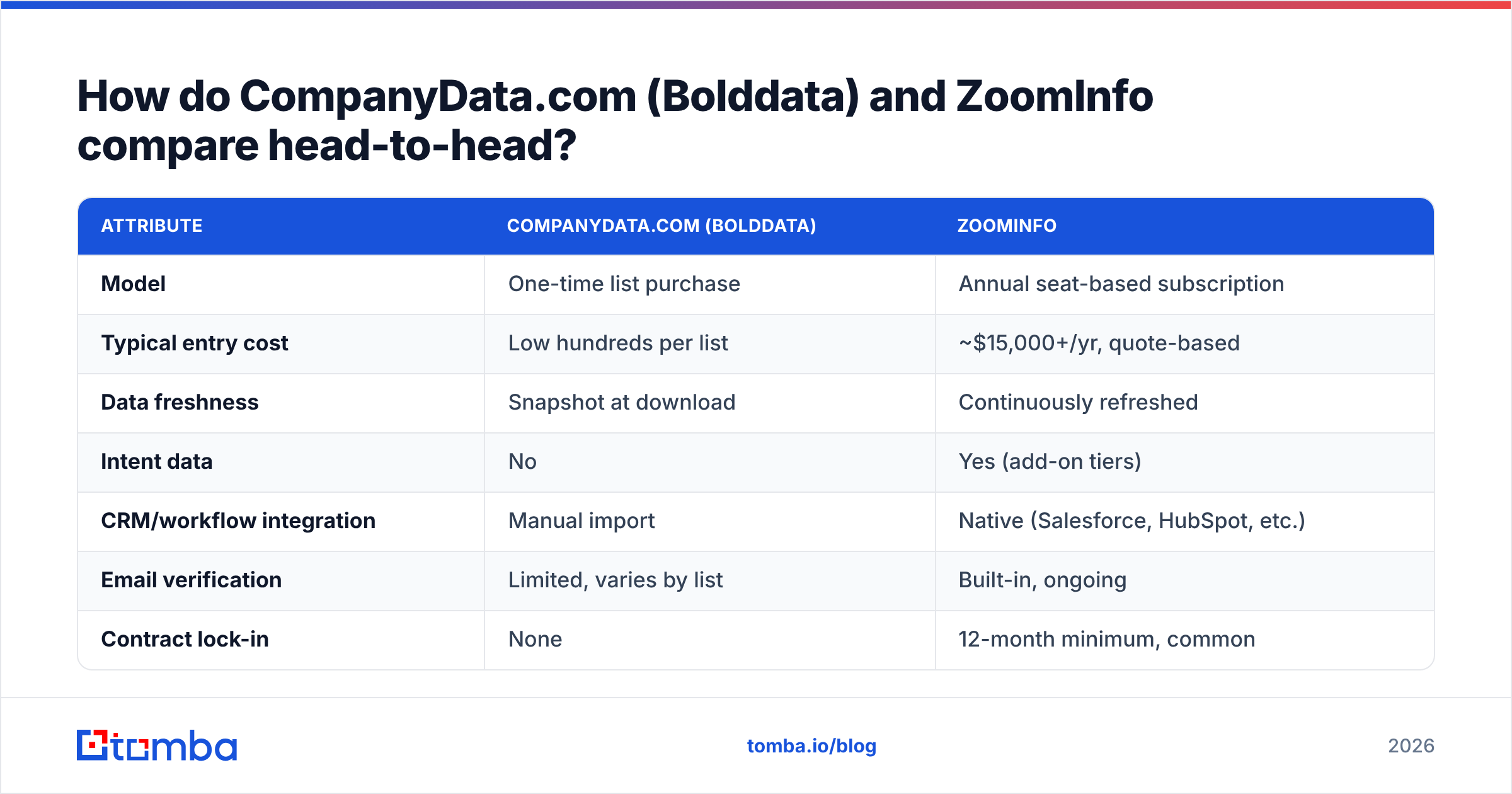
| Attribute | CompanyData.com (Bolddata) | ZoomInfo |
|---|---|---|
| Model | One-time list purchase | Annual seat-based subscription |
| Typical entry cost | Low hundreds per list | ~$15,000+/yr, quote-based |
| Data freshness | Snapshot at download | Continuously refreshed |
| Intent data | No | Yes (add-on tiers) |
| CRM/workflow integration | Manual import | Native (Salesforce, HubSpot, etc.) |
| Email verification | Limited, varies by list | Built-in, ongoing |
| Contract lock-in | None | 12-month minimum, common |
| Best for | Bounded one-off campaigns | Always-on outbound teams |
| Data ownership | You keep the file | Access ends when subscription ends |
Two rows do most of the work. First, cost structure: Bolddata is capex you control; ZoomInfo is opex you renew. Second, freshness: a downloaded list starts decaying at once. ZoomInfo re-verifies in the background—which is why it costs 50–100x more per year.
Neither is "better" in the abstract. A founder testing a niche market with 400 accounts doesn't need a $15k platform. A 20-rep SDR team burning 10,000 contacts a month can't run on stale CSVs.
Is ZoomInfo worth the price over a list vendor?#
Only if you use the parts you're paying for. ZoomInfo's premium is justified by three things a list vendor can't match:
- Live re-verification. People change jobs every ~24 months on average. ZoomInfo re-checks records nonstop. So a contact you pull today is more likely to be valid than a line in a six-week-old file.
- Intent and scoops. You learn an account is researching "email deliverability tools" this week, so you can time your outreach. A static list has no such signal.
- Workflow depth. Native enrichment auto-fills firmographics and contact fields on new CRM leads. Nobody touches a spreadsheet.
The catch is well documented in buyer reviews on G2. Expect opaque quote-based pricing, hard annual contracts, and overage fees when you pass your export credits. Run outbound just one quarter a year, and you pay for eight idle months.

That's the honest tension. ZoomInfo is a genuinely strong platform. But it's a heavy commitment when your recurring need is narrower than "everything a GTM suite does."
When should you choose CompanyData.com (Bolddata) instead?#
Choose Bolddata when your requirement is bounded and exportable. Concrete cases:
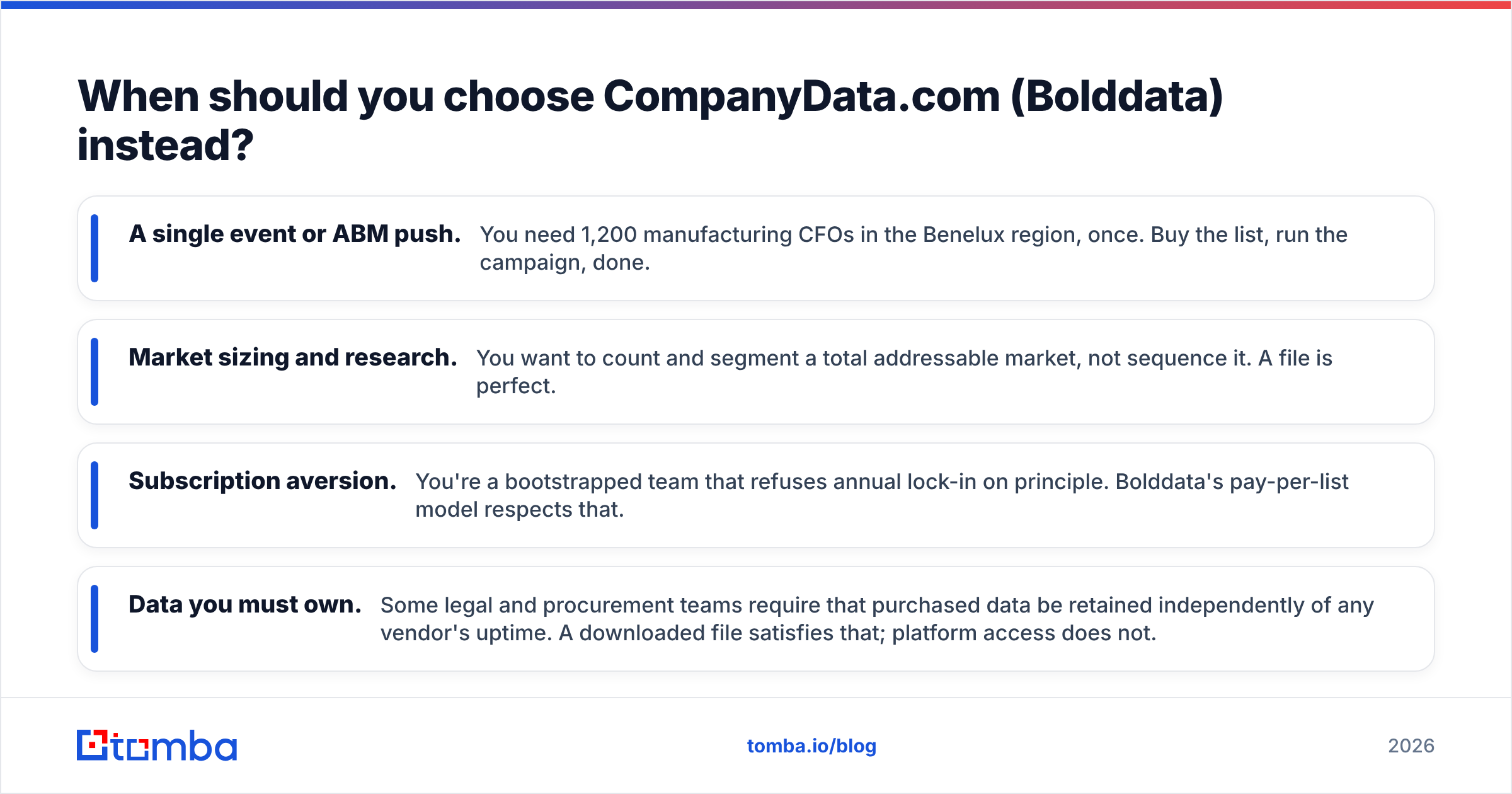
- A single event or ABM push. You need 1,200 manufacturing CFOs in the Benelux region, once. Buy the list, run the campaign, done.
- Market sizing and research. You want to count and segment a total addressable market, not sequence it. A file is perfect.
- Subscription aversion. You're a bootstrapped team that refuses annual lock-in on principle. Bolddata's pay-per-list model respects that.
- Data you must own. Some legal and procurement teams require data that outlives any vendor's uptime. A downloaded file meets that need; platform access does not.
As a Tomba client and respected peer in B2B data, Bolddata does the list-vendor job cleanly. You get transparent counts before you pay, and no seat math. Its weakness is the flip side of that strength. The moment you download, accuracy starts to slip—and there's no built-in way to re-verify the emails before you send.
That last point burns a lot of buyers. It's also where a focused tool changes the math.
What's the cheaper alternative to both for finding verified emails?#
Strip the question down to "I need correct, deliverable emails for specific people." Then you don't need a $15k platform or a bulk list you'll never fully use. You need an email finder with verification, priced by usage.
That's the gap Tomba fills. Instead of licensing a database or buying a snapshot, you look up the exact contacts you need. You verify them right when you need them:
- Email Finder — find a professional email from a name plus a company domain.
- Domain search — pull every discoverable contact at a target company, with role and department context.
- Email verifier — SMTP-check any address before it hits your sequence, even ones inside a Bolddata file. It protects your sender reputation.
- Bulk email finder — upload names and domains, get verified emails back. It's the middle ground between one-off lookups and a full platform.
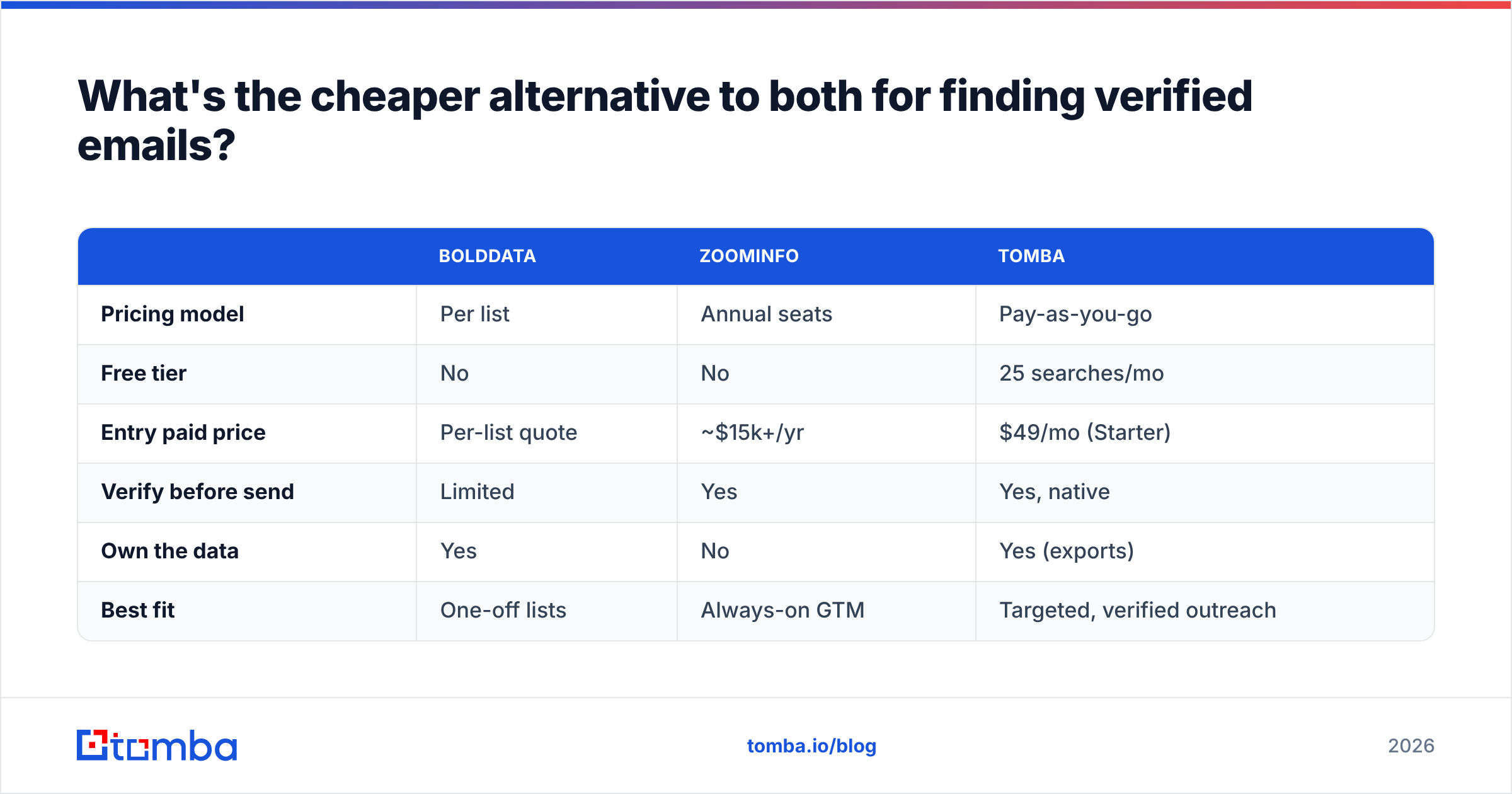
Here's how the three approaches compare on the metric most teams care about: cost to reach a fixed number of verified people.
| Bolddata | ZoomInfo | Tomba | |
|---|---|---|---|
| Pricing model | Per list | Annual seats | Pay-as-you-go |
| Free tier | No | No | 25 searches/mo |
| Entry paid price | Per-list quote | ~$15k+/yr | $49/mo (Starter) |
| Verify before send | Limited | Yes | Yes, native |
| Own the data | Yes | No | Yes (exports) |
| Best fit | One-off lists | Always-on GTM | Targeted, verified outreach |
Full Tomba pricing runs Free (25 searches/mo), Starter at $49/mo, Growth at $99/mo, and Pro at $249/mo. There's no annual lock-in and no quote gymnastics. If you know who you want to reach but don't want to rent a whole intelligence suite, that's a very different cost curve.
How accurate is the data, and why does verification matter more than database size?#
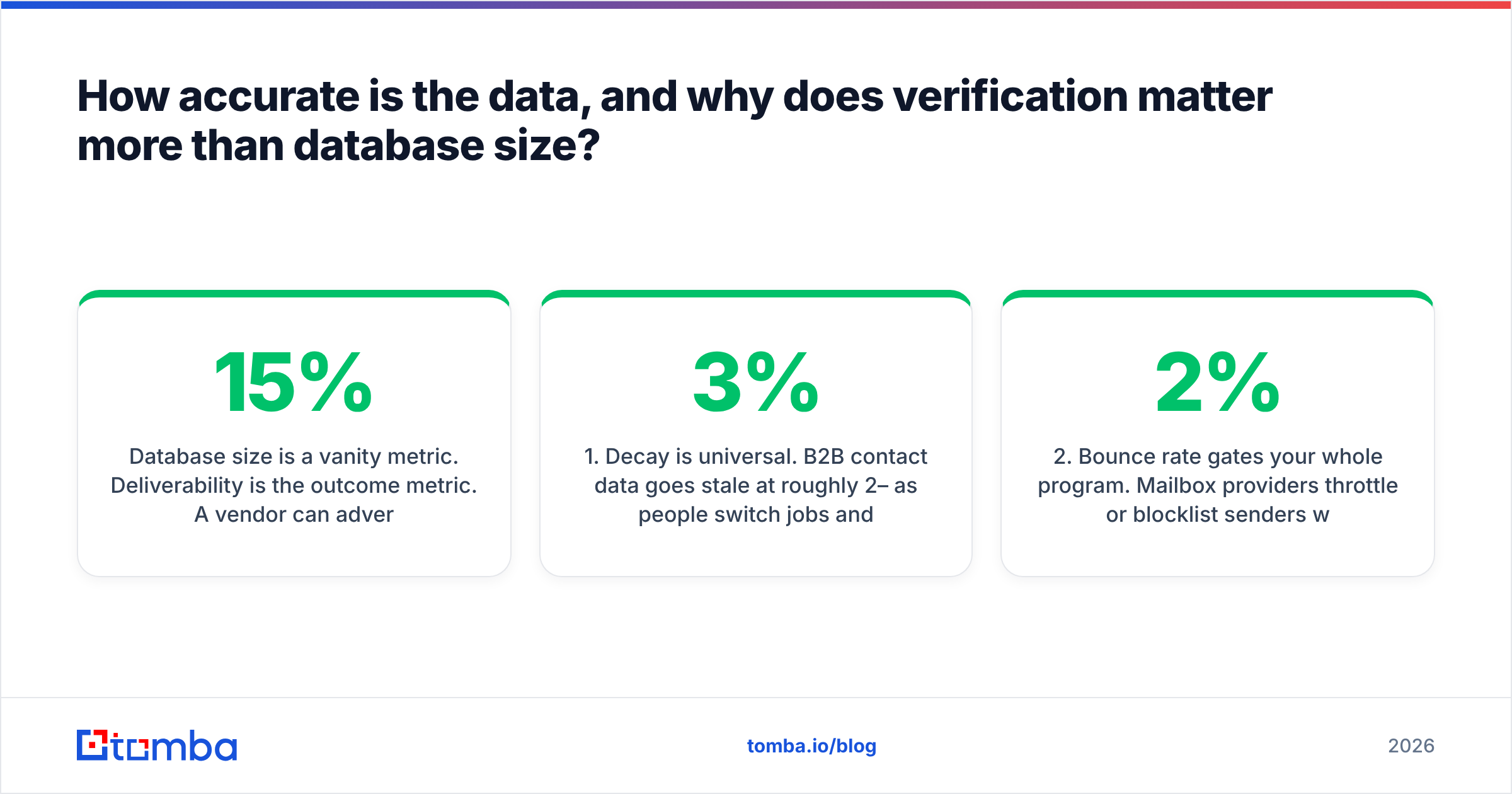
Database size is a vanity metric. Deliverability is the outcome metric. A vendor can advertise 100 million contacts. But if 15% of the emails bounce, you waste those sends—and you hurt your domain's email deliverability for every good address too.
The math that actually matters:
- Decay is universal. B2B data goes stale at roughly 2–3% per month as people switch jobs and companies restructure. No provider is immune—not ZoomInfo's live database, and especially not a fixed Bolddata file.
- Bounce rate gates your whole program. Mailbox providers throttle or block senders whose bounce rate creeps above ~2%. One dirty list can sink your inbox placement for weeks.
- Verification is cheap insurance. Running addresses through an email verifier before sending costs a fraction of a cent each. It prevents a reputation hit that no amount of database volume can buy back.
So verify at send time, whatever vendor you buy from. Bought a Bolddata list? Verify it before you load it. Exporting from ZoomInfo? Spot-check anyway—continuous refresh reduces decay but never kills it. Finding emails one target at a time? Use a tool that verifies inline, so a bad address never enters your sequence.
Which one should you pick?#
Match the tool to the shape of your need, not to the size of its logo:
- Pick CompanyData.com (Bolddata) if you want a one-time, ownable list for a set campaign or market study, and you refuse subscriptions. Just verify the file before you send.
- Pick ZoomInfo if you run always-on outbound at scale and need intent signals and native CRM enrichment. You should also use it daily to justify the five-figure annual cost.
- Pick Tomba if you need verified emails for specific people, on demand. You skip renting a database or over-buying a list—and you keep what you export.
Many teams combine approaches. Source accounts from a list or platform, then use an email finder to fill and verify the contacts that matter. The tools aren't mutually exclusive—but your budget usually is.
The bottom line#
In the end, CompanyData.com (Bolddata) vs ZoomInfo comes down to a file you own versus a platform you rent. Bolddata wins on ownership, price transparency, and zero lock-in. ZoomInfo wins on freshness, intent, and workflow depth. Both make you pay for coverage you may never fully use.
If you really just need correct, deliverable emails for your target list—found and verified on demand—start with the Tomba Email Finder. The free tier gives you 25 searches a month, so you can test accuracy against your own targets before you spend a cent. Every result is verified, so it protects your domain instead of risking it. Prove the data quality first; scale the spend second.
Related guides#
Ready to find emails that actually work?
Join 150,000+ professionals who stopped guessing and started sending. Free credits on signup — no credit card required.
Get the Tomba newsletter
Practical outbound tactics and product updates — once every two weeks.
About the author