ContactOut vs Harmonic (2026): Which B2B Data Tool Wins?
ContactOut finds verified contacts; Harmonic tracks startup signals. See where each wins on data, pricing, and workflow — plus a cheaper hybrid.
Picking between ContactOut and Harmonic feels like a fair fight until you actually look at what each tool does. One hands you a person's verified email and phone. The other tells you which startup just raised a Series A and is about to start hiring. They overlap in the sales-intelligence conversation, but they solve different problems — and buying the wrong one wastes budget you won't get back.
This comparison breaks down where each tool wins, what you actually pay, and when neither is the right call.
TL;DR — ContactOut vs Harmonic at a glance#
- ContactOut is a contact-data tool: LinkedIn-focused email and phone lookup for recruiters and outbound sellers who need to reach a specific person now.
- Harmonic is a company-intelligence platform: it tracks startup growth signals — funding, headcount, web traffic — for VCs, and sales teams chasing fast-growing accounts.
- They are not direct substitutes. ContactOut answers "how do I email this person?"; Harmonic answers "which companies should I even be targeting?"
- Pricing is opaque on both — ContactOut gates real volume behind sales calls, and Harmonic is enterprise-priced from day one.
- If your core need is finding accurate emails at a transparent price, a dedicated email finder like Tomba covers that job for a fraction of either platform's cost.
What is ContactOut and who is it for?#
ContactOut is a contact-enrichment tool built around LinkedIn. You install its Chrome extension, browse a profile, and it surfaces personal and work emails plus phone numbers. It also ships a search portal and an email finder API for pulling contacts programmatically.
Its heaviest users are recruiters. ContactOut leans hard on personal email coverage — the Gmail and Outlook addresses candidates actually read — which matters when you're poaching passive talent who never check their work inbox. Sales teams use it too, but the product's DNA is recruiting.
Strengths worth naming honestly:
- Personal email depth — its consumer-email database is one of the largest in the category.
- LinkedIn-native workflow — the extension meets recruiters where they already work.
- Bulk and API access — you can move beyond one-off lookups once you're on a paid tier.
The catch is transparency. Free access is capped tightly, and the plans that unlock real volume push you into a sales conversation instead of a public price. You can read ContactOut's own product pages but you won't get a full price sheet without talking to them.

What is Harmonic and who is it for?#
Harmonic is a startup-intelligence database. Instead of "give me this person's email," Harmonic answers "show me every seed-stage fintech in Europe that grew headcount 40% last quarter." It ingests funding rounds, hiring velocity, web traffic, GitHub activity, and founder signals, then lets you build dynamic lists that update as companies move.
Its primary buyer is venture capital — associates sourcing deals before a company is on anyone's radar. But a growing slice of users are GTM teams at startups selling to startups, who want to catch accounts at the exact moment they get budget and start scaling.
Where Harmonic is strong:
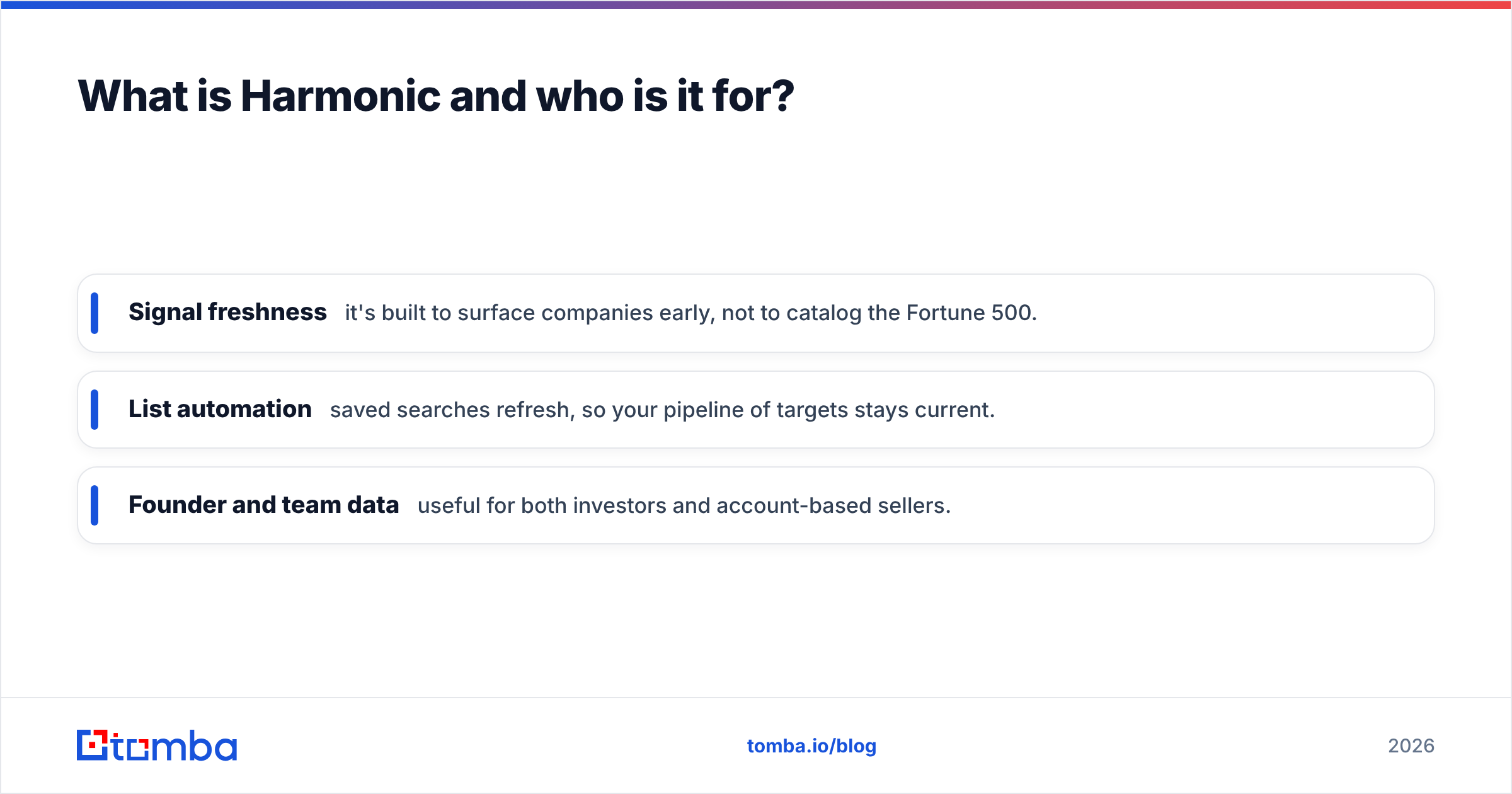
- Signal freshness — it's built to surface companies early, not to catalog the Fortune 500.
- List automation — saved searches refresh, so your pipeline of targets stays current.
- Founder and team data — useful for both investors and account-based sellers.
What it is not: a tool for reliably getting a named person's verified email. Harmonic tells you which company and who runs it. Turning that into a deliverable email address is a separate step — often a separate tool. For a primer on the vocabulary here, Tomba's B2B glossary is a decent reference.
ContactOut vs Harmonic: the core difference#
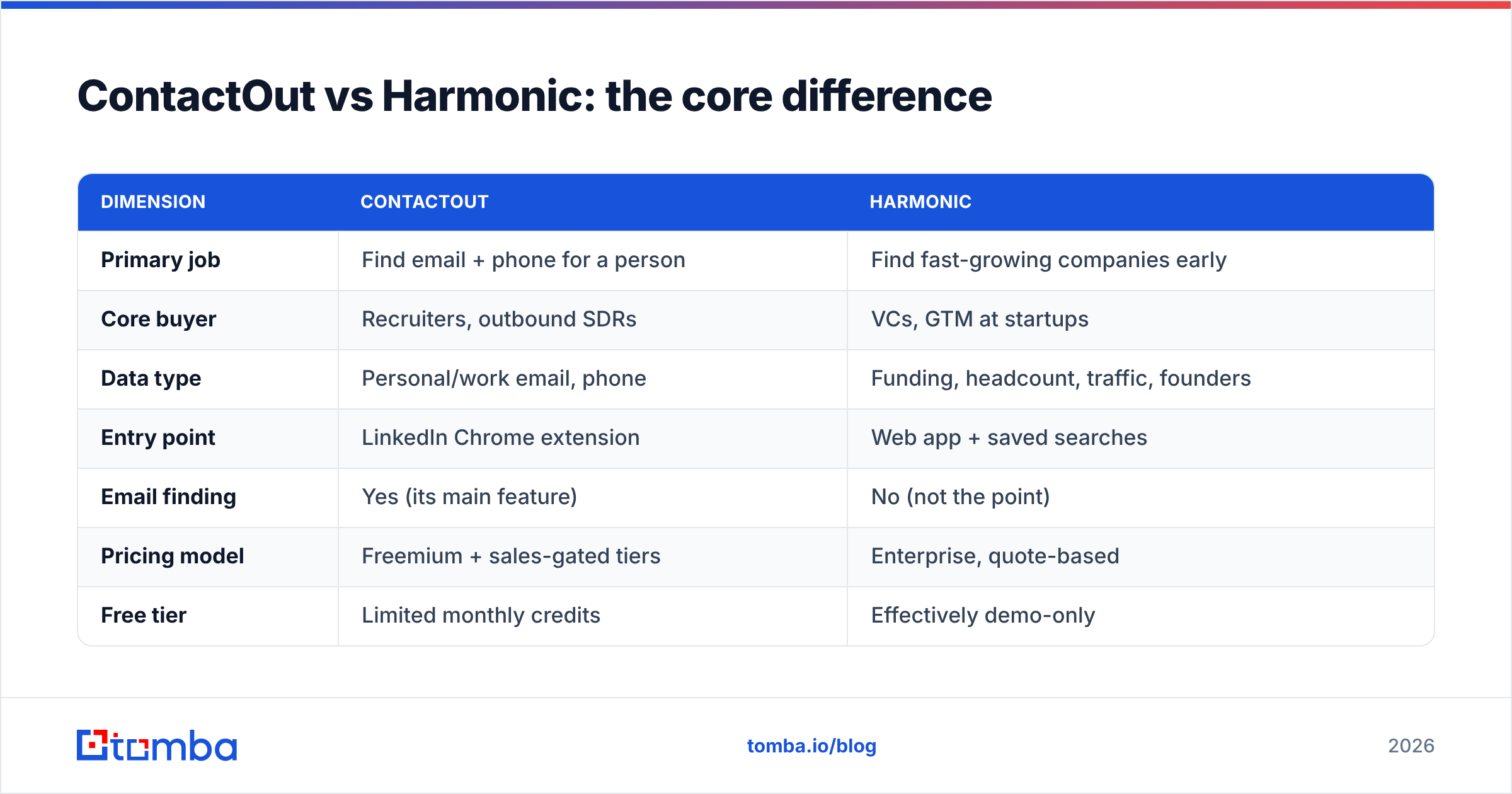
Here's the cleanest way to hold it in your head. ContactOut is a contact database. Harmonic is a company signal database. One gets you to a person; the other gets you to an opportunity.
| Dimension | ContactOut | Harmonic |
|---|---|---|
| Primary job | Find email + phone for a person | Find fast-growing companies early |
| Core buyer | Recruiters, outbound SDRs | VCs, GTM at startups |
| Data type | Personal/work email, phone | Funding, headcount, traffic, founders |
| Entry point | LinkedIn Chrome extension | Web app + saved searches |
| Email finding | Yes (its main feature) | No (not the point) |
| Pricing model | Freemium + sales-gated tiers | Enterprise, quote-based |
| Free tier | Limited monthly credits | Effectively demo-only |
| Best for | Reaching a known person | Deciding who to reach |
Notice the "email finding" row. This is where most buyers get confused. If your bottleneck is deliverable contact data, Harmonic doesn't solve it — you'd still bolt on an email verifier or a finder afterward. And if your bottleneck is knowing which accounts deserve your time, ContactOut doesn't solve that either.
Which one has better data accuracy?#
Different data, so "accuracy" means two different things.
For ContactOut, accuracy means: does the email bounce? Contact-finder accuracy is dominated by database freshness and how the tool verifies before it hands you an address. ContactOut performs well on personal emails but, like every provider, degrades on work emails at companies with strict catch-all setups — where a server accepts everything and confirms nothing. If you route unknown domains through a catch-all verifier, you avoid burning your sender reputation on addresses that only look valid.
For Harmonic, accuracy means: is the signal right? Did that company actually raise, actually grow, actually ship? Harmonic's data is strong on funded, venture-tracked companies and thinner on bootstrapped or offline businesses that don't generate the digital exhaust its models watch for. If you sell into non-tech verticals, that blind spot is real.
The honest takeaway: neither tool is "more accurate" in the abstract. ContactOut is accurate at contacts, Harmonic at company signals, and each is weakest exactly where the other is designed to be strong.
ContactOut vs Harmonic: pricing compared#
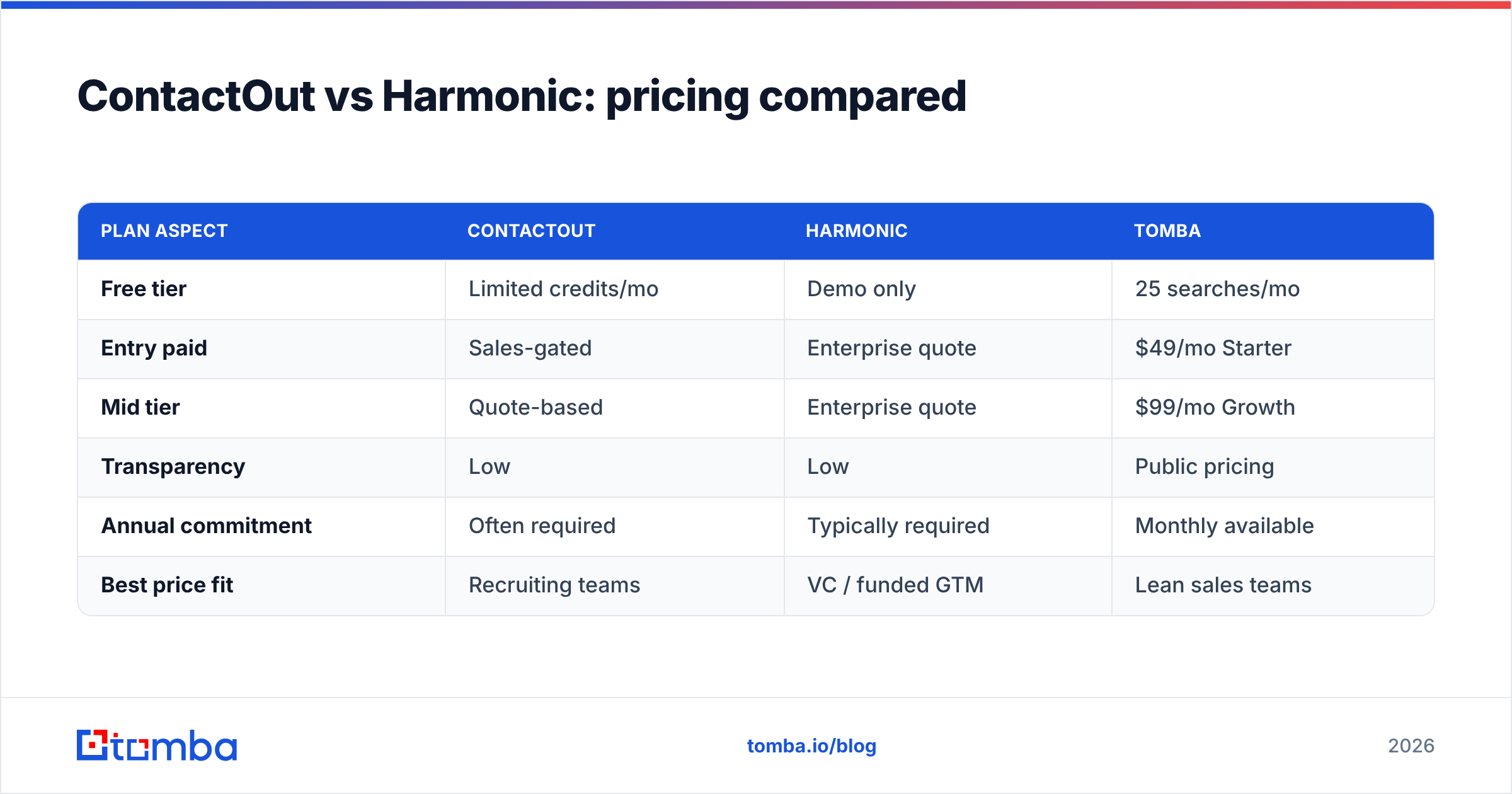
This is where both tools frustrate hands-on buyers. Neither publishes clean, self-serve pricing at the volume a real team needs.
| Plan aspect | ContactOut | Harmonic | Tomba |
|---|---|---|---|
| Free tier | Limited credits/mo | Demo only | 25 searches/mo |
| Entry paid | Sales-gated | Enterprise quote | $49/mo Starter |
| Mid tier | Quote-based | Enterprise quote | $99/mo Growth |
| Transparency | Low | Low | Public pricing |
| Annual commitment | Often required | Typically required | Monthly available |
| Best price fit | Recruiting teams | VC / funded GTM | Lean sales teams |
ContactOut's model works if you're a staffing agency running high recruiter volume and can justify a seat-based contract. Harmonic's enterprise pricing makes sense for a fund or a well-funded startup treating sourcing as a core function.
But if you're a small sales team that mostly needs verified emails without a sales call, both are overkill on price and process. Transparent Tomba pricing starts at a free tier of 25 searches, then $49/mo — you can see the number before you commit, which is the whole point.

When should you choose ContactOut?#
Pick ContactOut when the job is reaching known individuals and personal-email coverage is your bottleneck. It's the stronger choice if:
- You recruit. Passive candidates ignore work email; ContactOut's consumer-email depth is its edge.
- You live inside LinkedIn. The extension fits a profile-by-profile workflow.
- You need phone numbers too. Recruiters and closers often need to call, not just email.
- Volume justifies a contract. At high monthly lookups, seat pricing can pencil out.
Skip it if you want transparent pricing, only need business emails, or you're a two-person team that can't absorb an annual commitment.
When should you choose Harmonic?#
Pick Harmonic when your problem is targeting, not reaching. It fits when:
- You're a VC or scout sourcing deals before companies trend.
- You sell to startups and want to strike right after a funding round.
- You run account-based motions and need dynamic lists that refresh on real signals.
- Budget isn't the constraint — you can absorb enterprise pricing for early access to data.
Skip it if you sell into traditional, non-venture industries, if you need verified contact emails as the output, or if you can't justify enterprise spend. Harmonic tells you who to chase; you still need a way to actually contact them.
Do you actually need a hybrid — or a simpler tool?#
Here's the uncomfortable question. Many teams eyeing ContactOut vs Harmonic are trying to solve one concrete problem: turn a company or a person into a deliverable email. Neither platform is the cheapest, cleanest path to that.
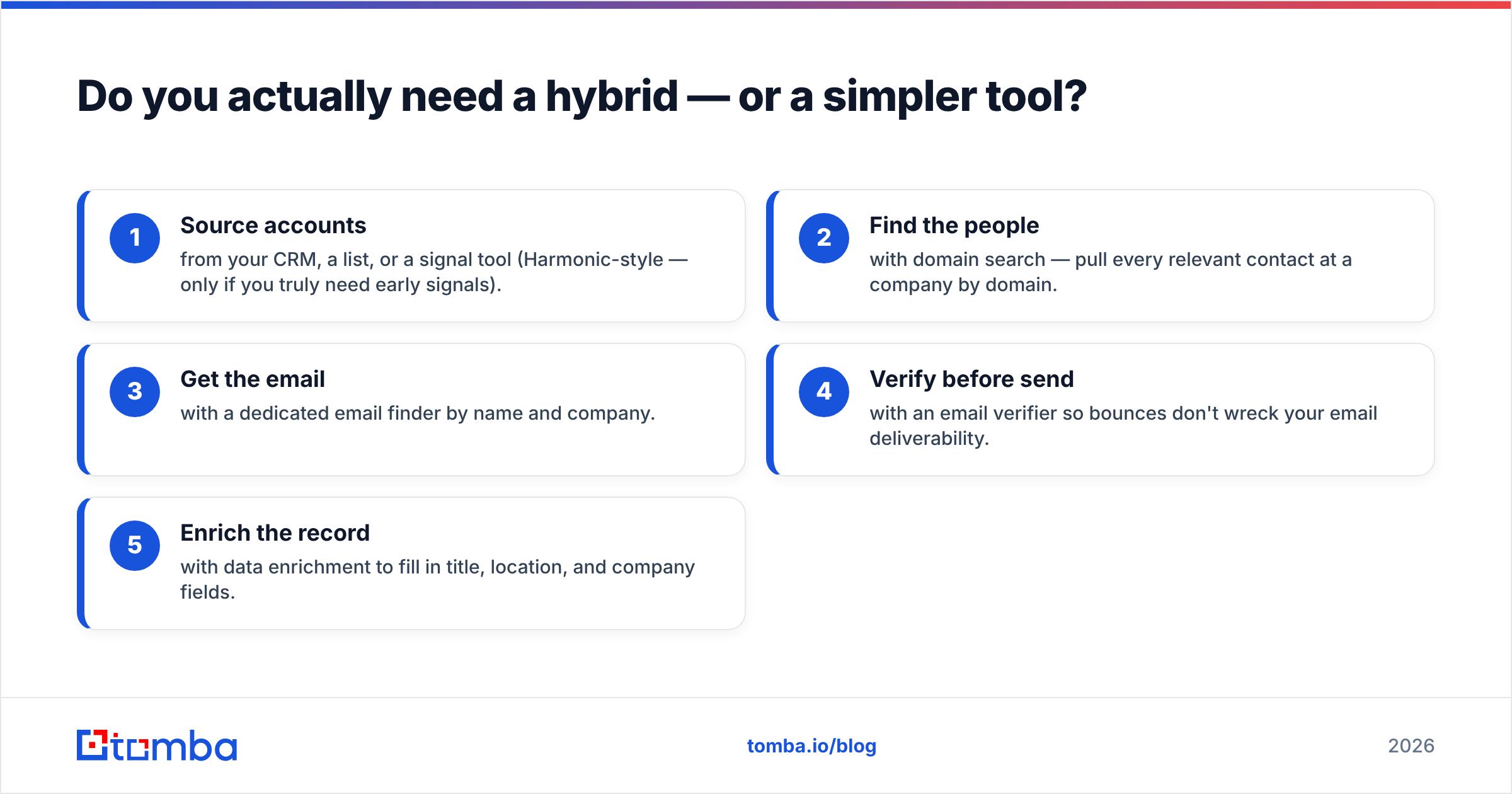
A leaner stack often looks like this:
- Source accounts from your CRM, a list, or a signal tool (Harmonic-style — only if you truly need early signals).
- Find the people with domain search — pull every relevant contact at a company by domain.
- Get the email with a dedicated email finder by name and company.
- Verify before send with an email verifier so bounces don't wreck your email deliverability.
- Enrich the record with data enrichment to fill in title, location, and company fields.
That workflow costs a fraction of an enterprise contract and gives you the one output both platforms make you work for: an email you can safely send to. Independent reviews on G2 show the pattern clearly — buyers increasingly split "signal" tools from "contact" tools rather than overpaying for one platform that half-does both.
ContactOut vs Harmonic: the verdict#
There's no universal winner, because they're not really competing for the same job.
- Choose ContactOut if you're a recruiter or high-volume outbound team that needs personal emails and phones, and you can live with sales-gated pricing.
- Choose Harmonic if you're an investor or a startup-selling GTM team that needs early growth signals and has enterprise budget.
- Choose neither if your real need is transparent, accurate email finding — that's a solved problem that doesn't require either platform's price tag.
Be honest about your actual bottleneck. Most teams overspend on a broad platform when a focused tool would clear the blocker faster and cheaper.
Get verified B2B emails without the enterprise contract#
If what you really need is accurate contact data at a price you can see up front, start with the Tomba Email Finder. Search by name, company, or domain, verify before you send, and skip the sales call entirely. The free tier gives you 25 searches a month to test accuracy on your own list — then scale to a $49/mo plan only when the results earn it. Reach the right people without paying platform prices for data you can get direct.
Related guides#
Ready to find emails that actually work?
Join 150,000+ professionals who stopped guessing and started sending. Free credits on signup — no credit card required.
Get the Tomba newsletter
Practical outbound tactics and product updates — once every two weeks.
About the author