ContactOut vs PrivCo (2026): Which Data Tool Wins?
ContactOut sells contacts. PrivCo sells private-company financials. Here's an honest breakdown of what each one actually does, what it costs, and which one your team should buy in 2026.
TL;DR
- ContactOut and PrivCo are not really competitors. ContactOut is a contact-data tool (emails, phone numbers, LinkedIn-sourced profiles). PrivCo is a private-company financial intelligence database (revenue, funding, ownership, growth signals).
- Buy ContactOut if your bottleneck is reaching people. Buy PrivCo if your bottleneck is qualifying companies before you reach anyone.
- PrivCo is the pricier of the two — private-company financials are expensive data to license and maintain, and it's priced like research software, not like a prospecting seat.
- Most outbound teams that buy PrivCo still need a contact source on top of it. That's where a dedicated email finder at $49/mo does the same job as a $99+ seat.
- The honest 2026 stack for most B2B teams: a firmographic/financial layer for targeting, plus a cheap, high-accuracy contact layer for execution. Not one tool pretending to be both.
Why are people comparing ContactOut vs PrivCo at all?#
Because both get filed under "B2B data" in procurement, and that category label hides a huge functional gap.
Think of it like buying a map versus buying a car. PrivCo tells you which neighborhoods are worth driving to — which private companies are growing, who just raised, who's doing $40M in revenue with no PE sponsor. ContactOut is the car: it gets you to a specific person's inbox. Nobody sane asks "should I buy a map or a car?" — but that's exactly the question that shows up when both line items land on the same budget review.
So the useful comparison isn't "which is better." It's which layer of your go-to-market is actually broken, and which of these two fixes it.
What is ContactOut?#
ContactOut is a contact-data platform best known for its Chrome extension. You sit on a LinkedIn profile, click the extension, and it surfaces personal and work email addresses plus phone numbers. It also ships a web search app, bulk export, and an API.
What ContactOut is genuinely good at:
- LinkedIn-adjacent workflows. If your reps live in LinkedIn Sales Navigator all day, the extension fits their hands without retraining anyone.
- Personal email coverage. ContactOut leans harder into personal/consumer emails than most B2B tools — which is why recruiters love it and why some compliance teams flinch at it.
- Phone numbers. Mobile coverage is a real part of the pitch, not an afterthought.
- Recruiting use cases. A large slice of ContactOut's customer base is talent acquisition, not sales. That shapes the data and the UI.
What it is not: a research tool. ContactOut will not tell you whether a company is worth pursuing. It assumes you already decided.

What is PrivCo?#
PrivCo is a private-company financial database. Public companies file 10-Ks; private companies file nothing, and PrivCo's whole business is reconstructing what they would have filed. Revenue estimates, employee counts over time, funding history, ownership structure, M&A activity, growth rates.
Who actually buys PrivCo:
- Investment banking and PE/VC associates building target lists and pre-diligence screens.
- Corporate development teams hunting acquisition targets in fragmented markets.
- Enterprise sales teams with high ACVs who need to know if a private prospect can actually write a $200K check.
- Market researchers and consultants sizing segments where public comps don't exist.
PrivCo's pitch is depth on the ~90% of the economy that never files with the SEC. Its weakness, from a sales-execution standpoint, is that it hands you a company and stops. You still have to figure out who to email and what their address is.
ContactOut vs PrivCo: how do they actually compare?#
Here is the head-to-head on the dimensions that matter when you're choosing.
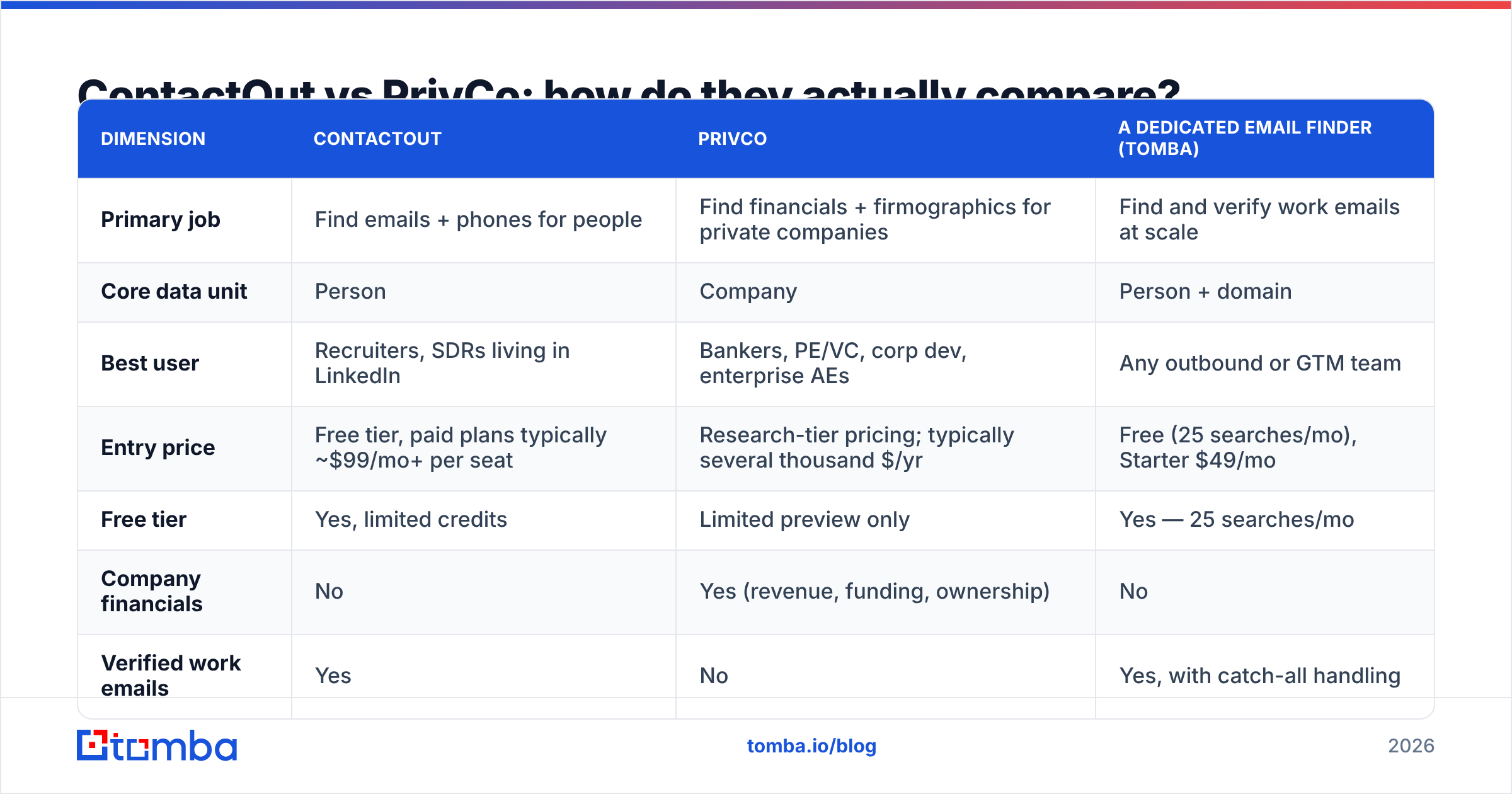
| Dimension | ContactOut | PrivCo | A dedicated email finder (Tomba) |
|---|---|---|---|
| Primary job | Find emails + phones for people | Find financials + firmographics for private companies | Find and verify work emails at scale |
| Core data unit | Person | Company | Person + domain |
| Best user | Recruiters, SDRs living in LinkedIn | Bankers, PE/VC, corp dev, enterprise AEs | Any outbound or GTM team |
| Entry price | Free tier, paid plans typically ~$99/mo+ per seat | Research-tier pricing; typically several thousand $/yr | Free (25 searches/mo), Starter $49/mo |
| Free tier | Yes, limited credits | Limited preview only | Yes — 25 searches/mo |
| Company financials | No | Yes (revenue, funding, ownership) | No |
| Verified work emails | Yes | No | Yes, with catch-all handling |
| Phone numbers | Yes (mobile focus) | Company-level only | Yes, via phone finder |
| Bulk / CSV enrichment | Yes | Limited export | Yes |
| API access | Yes | Enterprise tier | Yes, on all paid plans |
| Chrome extension | Yes (LinkedIn-native) | No | Yes |
| Compliance posture | Personal emails raise GDPR questions | Research data, low PII risk | B2B work emails only |
Read that table once and the conclusion writes itself: they overlap on almost nothing. The only true overlap is "company name and domain," which every tool in the category has.
Which one should you buy for outbound sales?#
Neither, alone. And this is the part vendors won't say out loud.
If you run outbound, your funnel has two distinct failure modes:
- Targeting failure — you're emailing companies that were never going to buy. Wrong size, wrong stage, no budget. PrivCo fixes this.
- Execution failure — you have the right accounts but your emails bounce, your contacts are stale, or you can't find the VP of Ops at all. ContactOut (or an email finder) fixes this.
Most teams diagnose the wrong one. They buy a research platform to fix a bounce-rate problem, or they buy more contact credits to fix a targeting problem. Then they blame the tool.
Run the diagnostic honestly:
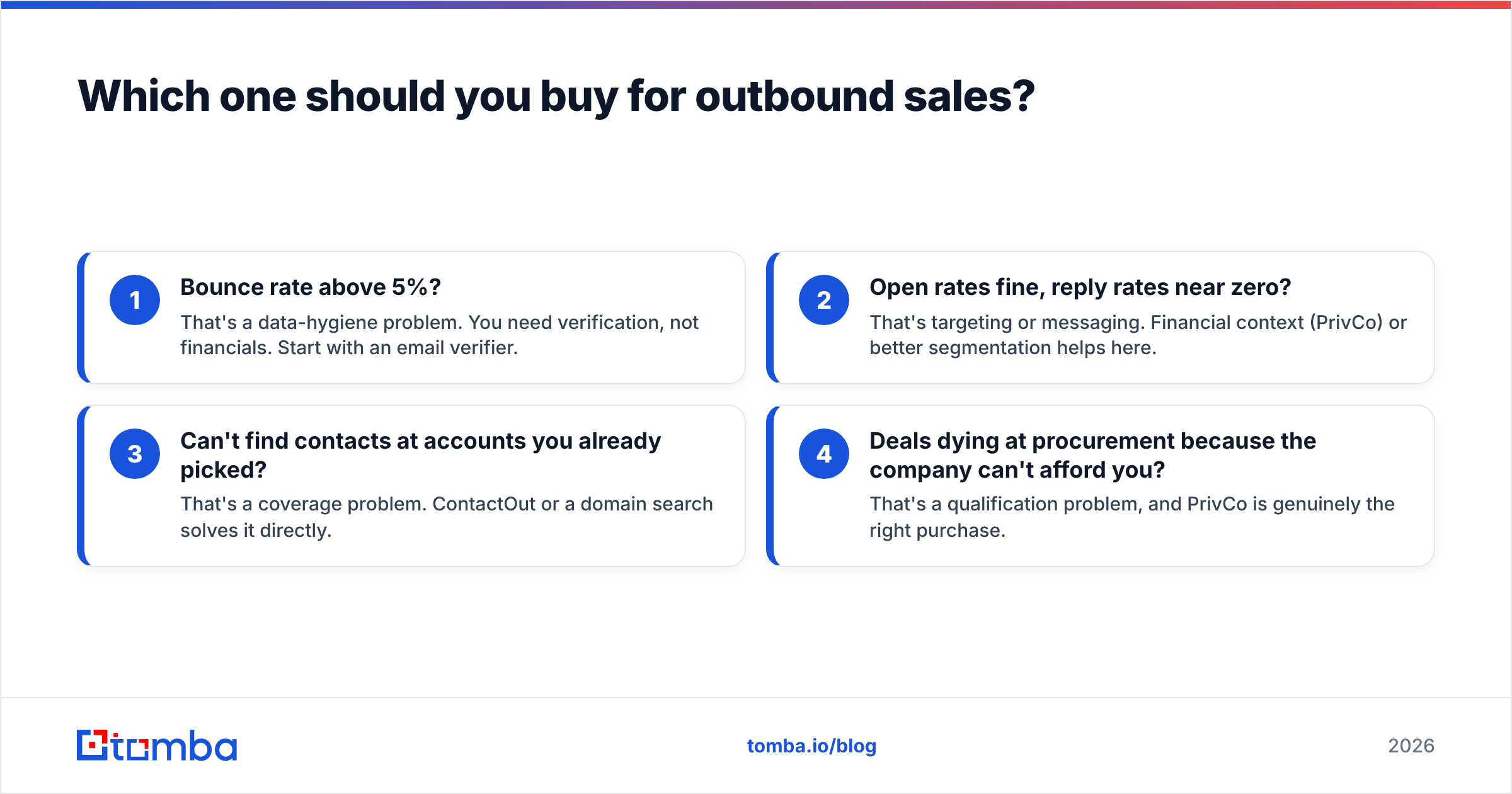
- Bounce rate above 5%? That's a data-hygiene problem. You need verification, not financials. Start with an email verifier.
- Open rates fine, reply rates near zero? That's targeting or messaging. Financial context (PrivCo) or better segmentation helps here.
- Can't find contacts at accounts you already picked? That's a coverage problem. ContactOut or a domain search solves it directly.
- Deals dying at procurement because the company can't afford you? That's a qualification problem, and PrivCo is genuinely the right purchase.

Is PrivCo worth the price?#
For the right buyer, yes — and it's important to be fair here. Private-company financial data is genuinely hard to produce. It requires state filings, court records, credit data, hiring signals, and modeled estimates stitched together. That's expensive, and PrivCo charges accordingly.
But the price only makes sense if your deal sizes justify it. A rough test: if your average contract value is under $25K, the marginal value of knowing a prospect's exact revenue band rarely covers a research-tier subscription. You can approximate the same signal from employee count, funding announcements, and job postings — all of which are cheap or free.
If your ACV is $100K+, or you're doing M&A sourcing, the math flips hard. One avoided dead-end diligence process pays for the year.
For a broader look at how research platforms are priced and reviewed by actual buyers, G2's business intelligence category is a reasonable neutral reference — filter to private-company data and read the mid-market reviews, not the enterprise ones.
Is ContactOut worth it compared to cheaper email finders?#
This is the more common real-world decision, because ContactOut competes with a crowded field.
ContactOut's differentiators are the LinkedIn-native extension and personal-email coverage. Both are real. But you pay for them, and you pay per seat. If your team is running programmatic outbound — bulk lists, CSV enrichment, API calls into your CRM — the per-seat browser-extension model stops being an advantage and starts being a tax.
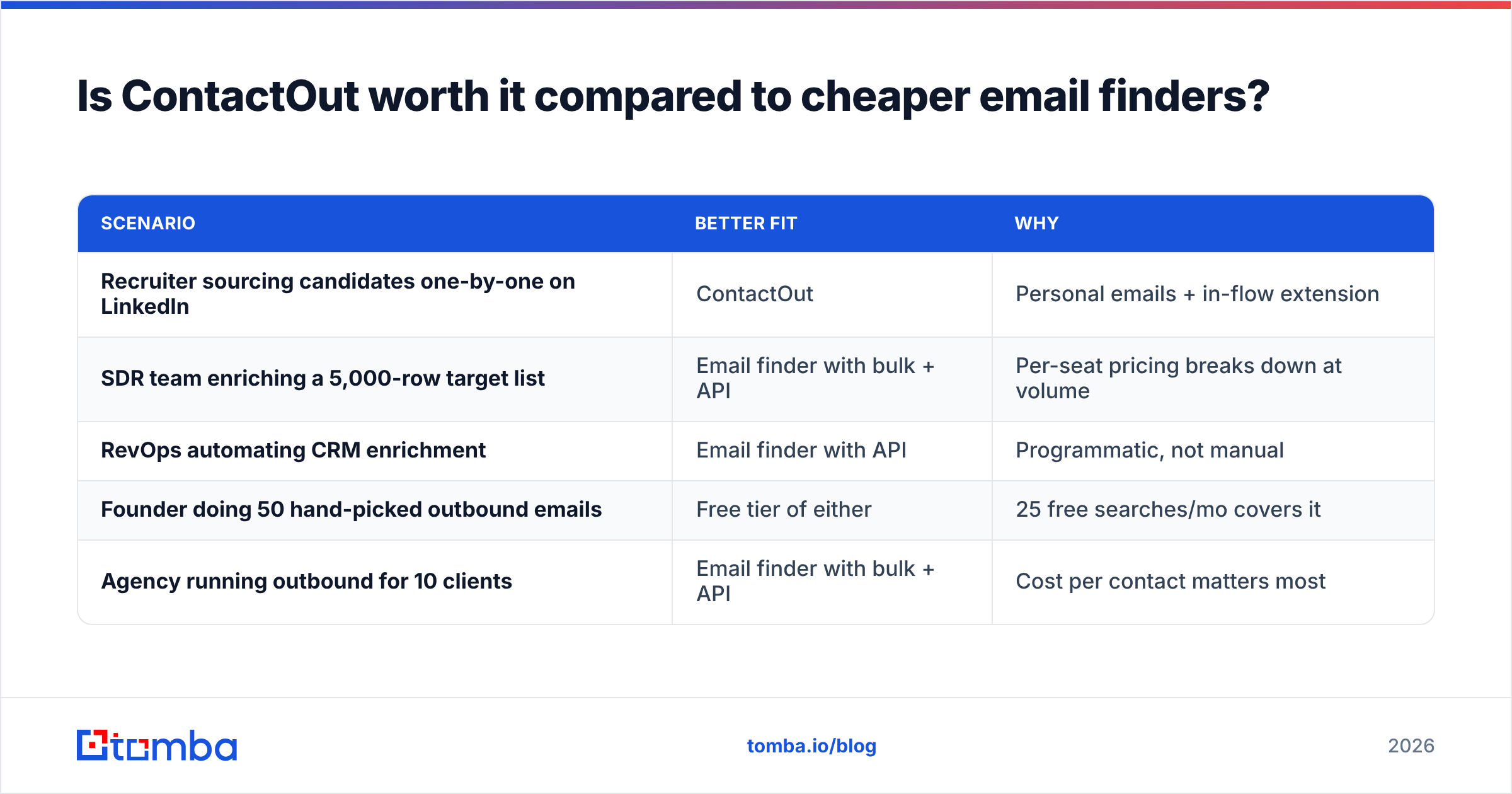
| Scenario | Better fit | Why |
|---|---|---|
| Recruiter sourcing candidates one-by-one on LinkedIn | ContactOut | Personal emails + in-flow extension |
| SDR team enriching a 5,000-row target list | Email finder with bulk + API | Per-seat pricing breaks down at volume |
| RevOps automating CRM enrichment | Email finder with API | Programmatic, not manual |
| Founder doing 50 hand-picked outbound emails | Free tier of either | 25 free searches/mo covers it |
| Agency running outbound for 10 clients | Email finder with bulk + API | Cost per contact matters most |
The honest framing: ContactOut is a fine tool with a specific shape. If your workflow is that shape, buy it. If your workflow is "enrich a list, verify it, push it to the sequencer," you're overpaying for a browser extension you'll barely open. A bulk email finder plus an API does that job at a lower unit cost.
Also worth noting: if you're evaluating ContactOut against the wider market, look at the ContactOut alternative landscape before committing to an annual seat contract. And if company-level firmographics matter more to you than deep financials, a curated B2B database or a partner like BookYourData can cover targeting at a fraction of research-platform pricing — BookYourData in particular is a solid pick when you want verified, filterable lists without a six-figure data contract.
What about data accuracy and compliance?#
Two things people underweight until they get burned.
Accuracy. Contact data decays roughly 25–30% per year — people change jobs, companies get acquired, domains migrate. Any vendor quoting a 95%+ accuracy figure is quoting a lab number. What matters is whether the tool verifies at request time or serves you a cached record from 14 months ago. Ask that question directly in the demo. Ask about catch-all domains specifically, because that's where most "verified" databases quietly fail — a catch-all verifier exists precisely because a plain SMTP ping returns "valid" for every address on those domains.
Compliance. ContactOut's personal-email coverage is a feature for recruiters and a liability for European B2B outbound. Under GDPR, a personal Gmail address has a much weaker legitimate-interest argument than a work address at the company you're contacting. If you're prospecting into the EU, work-email-only sourcing is the safer posture. The ICO's guidance on direct marketing is the primary source worth reading — not a vendor's compliance blog post.
PrivCo, for what it's worth, has the cleanest compliance story of the three: it's company data, not personal data.
What's the practical stack for 2026?#
Stop looking for one tool. Build two layers.
Layer 1 — Targeting (who's worth contacting):
- Firmographics + intent: employee count, funding, tech stack, hiring signals. Cheap, often free.
- Financials (optional, high-ACV only): PrivCo or similar, if deal size justifies it.
- List sourcing: a filterable B2B database for the long tail.
Layer 2 — Execution (reaching them):
- Email discovery: find the person's work address by name + domain.
- Verification: kill bounces before they hit your sender reputation.
- Enrichment: fill in title, seniority, LinkedIn, phone.
- Delivery: your sequencer, warmed and authenticated.
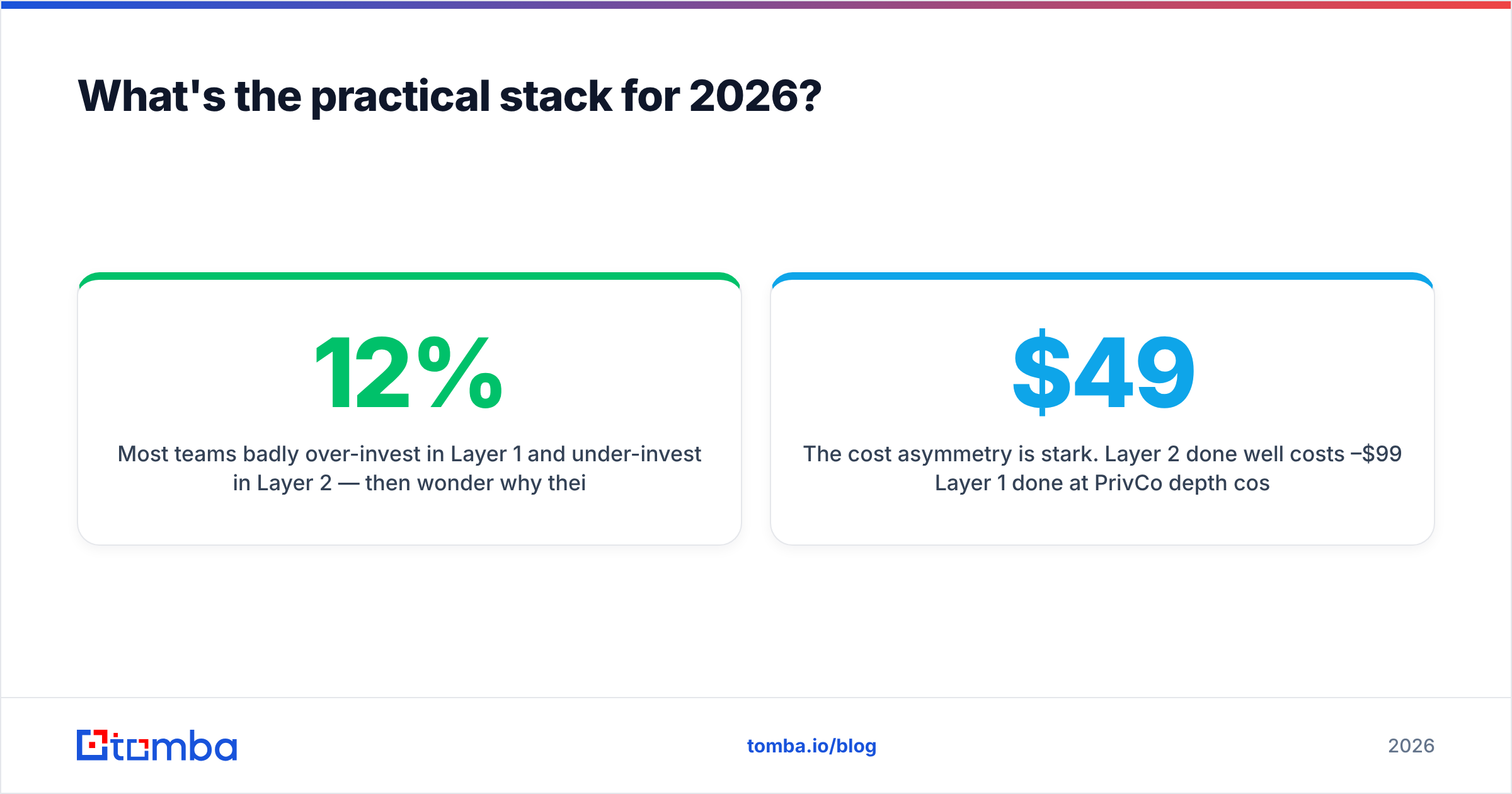
Most teams badly over-invest in Layer 1 and under-invest in Layer 2 — then wonder why their email deliverability is in the tank. A pristine target list that bounces at 12% is worth less than a mediocre list that lands.
The cost asymmetry is stark. Layer 2 done well costs $49–$99/mo. Layer 1 done at PrivCo depth costs multiples of that. Fix the cheap layer first, measure, then decide whether you actually need the expensive one.
The verdict: ContactOut or PrivCo?#
- Choose PrivCo if you're in finance, corp dev, or enterprise sales with six-figure ACVs, and your real question is "is this private company worth my time?" Nothing on this list replaces it.
- Choose ContactOut if you're a recruiter or a LinkedIn-native SDR who needs personal emails and mobiles in-flow, and per-seat pricing fits your headcount.
- Choose neither if what you actually need is high-volume, verified work email discovery with an API and bulk workflows. That's a different product category, and it costs a lot less than both.
The mistake isn't picking the wrong one. It's picking either one to solve a problem it was never built for, then concluding "B2B data tools don't work."
Ready to fix the execution layer first?#
Before you sign a research-platform contract, find out whether your problem was ever targeting in the first place. Run your existing target accounts through the Tomba Email Finder — enter a name and a domain, get a verified work email back, and see how much of your funnel gap was just bad contact data.
The free tier gives you 25 searches a month, no card. Starter is $49/mo when you outgrow it, with bulk, API, and catch-all verification included. Check Tomba pricing to see where your volume lands. If the bounces disappear and the replies still don't come, then go buy the financial data — you'll know exactly what you're paying to fix.
Related guides#
Ready to find emails that actually work?
Join 150,000+ professionals who stopped guessing and started sending. Free credits on signup — no credit card required.
Get the Tomba newsletter
Practical outbound tactics and product updates — once every two weeks.
About the author