Conversion Blitz vs Exellius: Which Lead Tool Wins in 2026?
One is a 15-tool all-in-one suite sold on lifetime deals. The other is a targeted B2B lead-data platform. We break down pricing, data accuracy, deliverability risk, and which one belongs in your outbound stack in 2026.
TL;DR
- Conversion Blitz is a bundle: 15+ small lead-generation and marketing tools (email finder, chatbot, review widget, scraper, newsletter sender) sold under one subscription, often via lifetime-deal marketplaces. Breadth is the pitch.
- Exellius positions itself as a targeted B2B lead-data and prospecting platform — fewer tools, more focus on sourcing and enriching contacts for outbound teams.
- The real decision is not "which has more features." It's who owns the data quality, because a bundled email finder and a dedicated data engine are not the same product.
- If your bottleneck is finding and verifying decision-maker emails at scale, neither suite is a substitute for a purpose-built email finder with a verification layer in front of your sender.
- Budget reality: a $59 lifetime deal that produces a 22% bounce rate costs far more than a $49/mo tool that produces a 2% one. Deliverability is the hidden line item.
If you're comparing Conversion Blitz vs Exellius, you're almost certainly trying to answer one question: can one of these replace the three or four tools I'm currently paying for? This post answers that honestly — including the cases where the answer is no.
What is Conversion Blitz?#
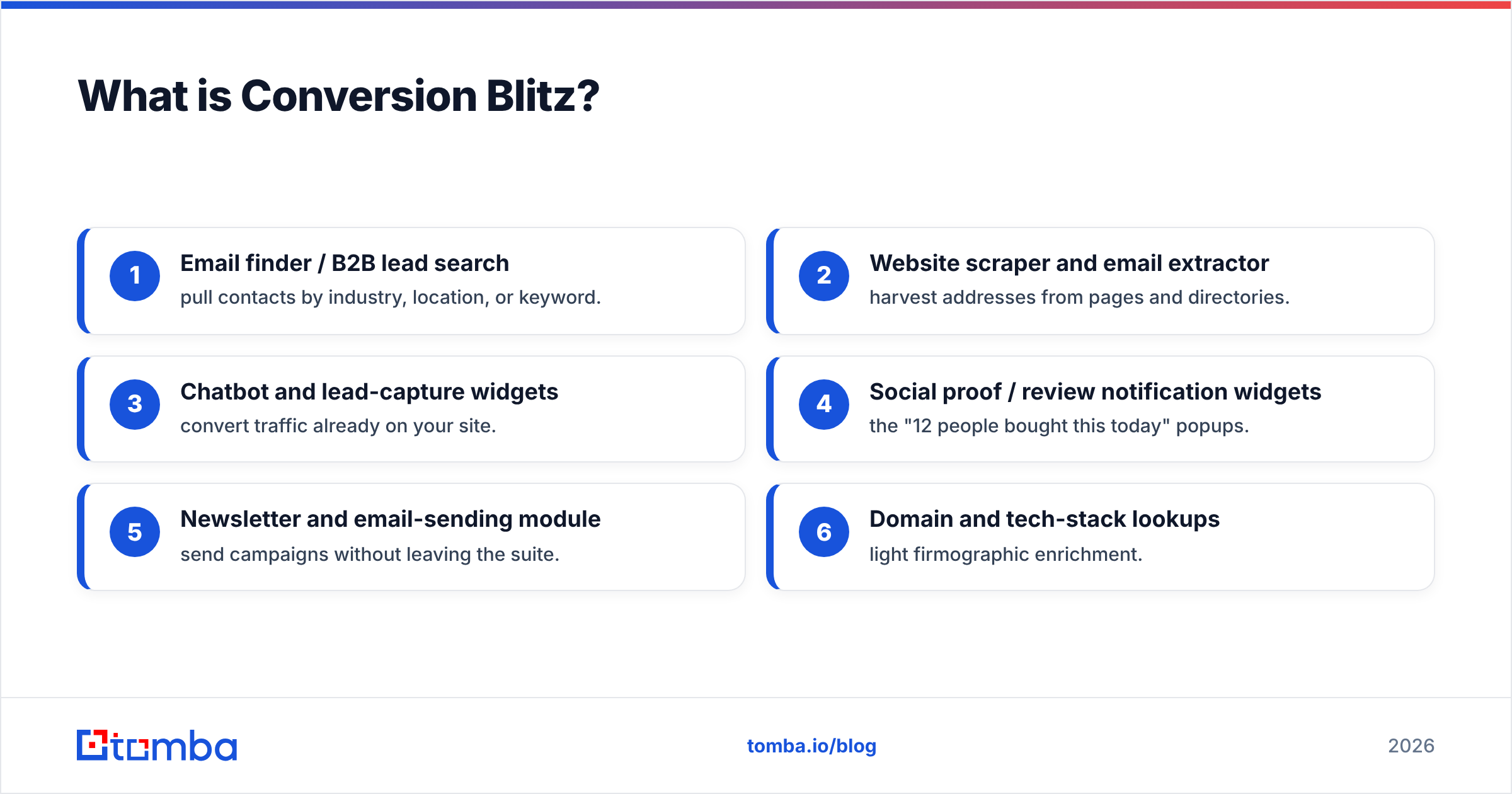
Conversion Blitz (conversionblitz.com) is an all-in-one lead generation and marketing suite. Instead of doing one thing deeply, it packages a long list of small utilities behind a single login. The typical lineup includes:
- Email finder / B2B lead search — pull contacts by industry, location, or keyword.
- Website scraper and email extractor — harvest addresses from pages and directories.
- Chatbot and lead-capture widgets — convert traffic already on your site.
- Social proof / review notification widgets — the "12 people bought this today" popups.
- Newsletter and email-sending module — send campaigns without leaving the suite.
- Domain and tech-stack lookups — light firmographic enrichment.
The commercial model is what defines it. Conversion Blitz is heavily distributed through lifetime-deal and bundle channels, which means the entry price is often a one-time payment rather than a monthly one. That is genuinely attractive to solo founders, agencies with thin margins, and anyone testing outbound for the first time.
The trade-off is depth. When one vendor maintains 15 tools, each tool gets roughly 1/15th of the engineering attention. The email finder inside a marketing suite is rarely competing with vendors whose entire company is an email finder.
What is Exellius?#
Exellius (exellius.com) takes the opposite posture: a narrower B2B lead generation and data platform aimed at outbound teams who want targeted contact lists rather than a grab-bag of widgets. The pitch is sourcing quality — building lists that match an ICP, enriching them, and handing them to your sequencer.
That focus matters. A platform whose only job is data has a clear incentive: if the emails bounce, the product has failed. A suite that also sells you chatbots and popup widgets can survive a mediocre email finder because the finder was never the headline.
Where Exellius tends to be weaker is everything around the data. You'll still need a sending tool, a warmup tool, and usually a separate verification pass before you push anything into a sequencer. It is a component, not a stack.

Conversion Blitz vs Exellius: how do they actually compare?#
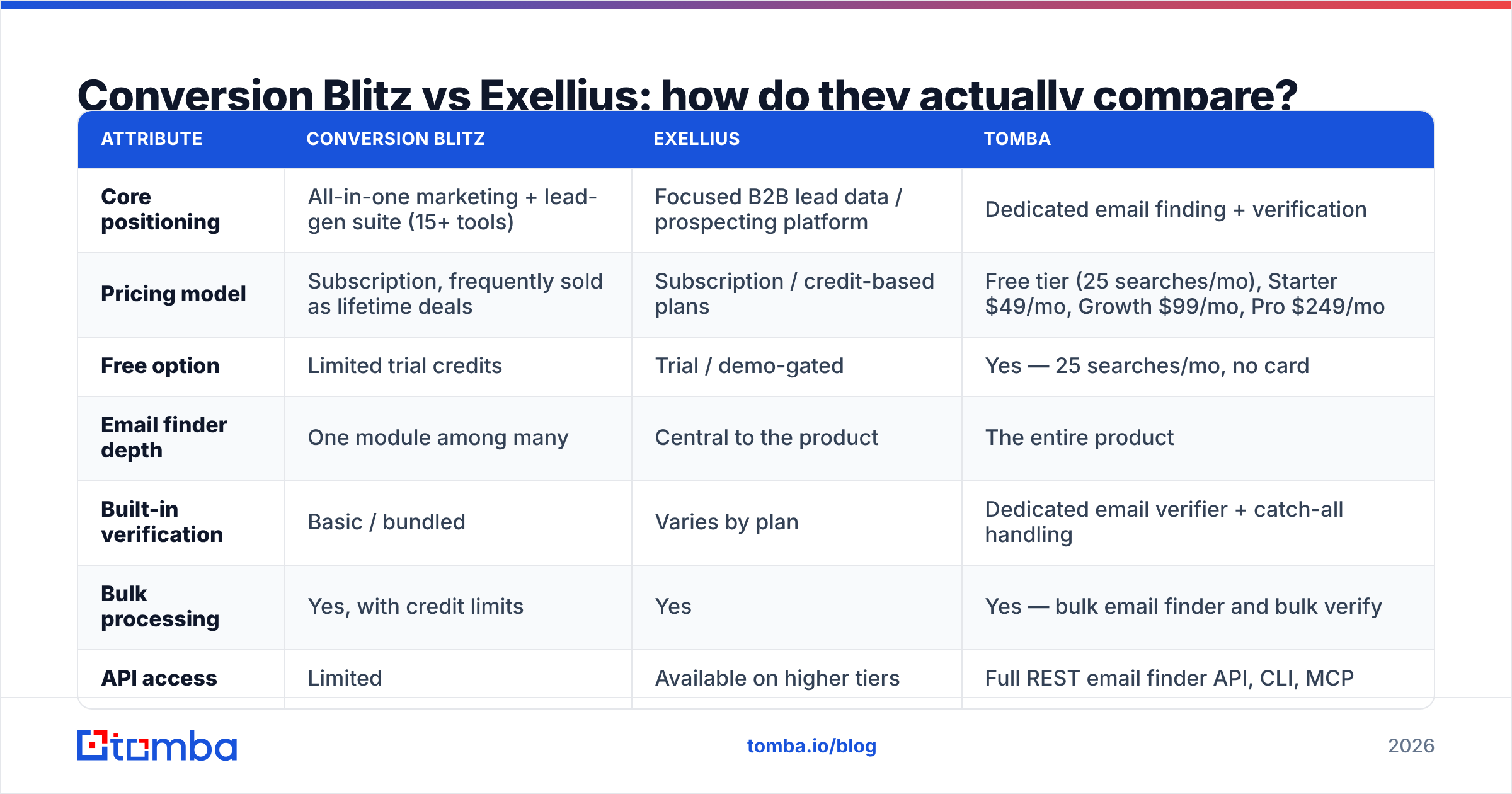
Here is the honest side-by-side. Pricing on both platforms shifts with promotions and lifetime-deal cycles, so treat the pricing row as shape of the model, not a quote — always confirm on the vendor's own page before you buy.
| Attribute | Conversion Blitz | Exellius | Tomba |
|---|---|---|---|
| Core positioning | All-in-one marketing + lead-gen suite (15+ tools) | Focused B2B lead data / prospecting platform | Dedicated email finding + verification |
| Pricing model | Subscription, frequently sold as lifetime deals | Subscription / credit-based plans | Free tier (25 searches/mo), Starter $49/mo, Growth $99/mo, Pro $249/mo |
| Free option | Limited trial credits | Trial / demo-gated | Yes — 25 searches/mo, no card |
| Email finder depth | One module among many | Central to the product | The entire product |
| Built-in verification | Basic / bundled | Varies by plan | Dedicated email verifier + catch-all handling |
| Bulk processing | Yes, with credit limits | Yes | Yes — bulk email finder and bulk verify |
| API access | Limited | Available on higher tiers | Full REST email finder API, CLI, MCP |
| Sending / sequencing | Included (newsletter module) | Not the focus | Not included — integrates with your sender |
| Best for | Solo founders wanting one login for everything | Teams who want targeted lists without a suite | Teams who need accurate emails feeding an existing stack |
The table exposes the actual fault line. Conversion Blitz sells breadth. Exellius sells targeting. Neither sells accuracy as the headline promise. That's the gap you have to fill yourself.
Which one has better data accuracy?#
This is the section that decides your ROI, so be skeptical of everyone here — including us.
Neither Conversion Blitz nor Exellius publishes independently audited accuracy benchmarks with methodology you can reproduce. That's normal in this category; most vendors quote an internal number. What you can do is run the same test both platforms would fail or pass honestly:
- Build a 200-contact control list from a segment you already know — customers, past leads, people whose emails you can confirm.
- Run the same list through each tool and record hit rate (how many it found) and validity rate (how many survive an independent verification pass).
- Send a small, warmed batch and measure the actual hard-bounce rate — the only number that matters to your domain.
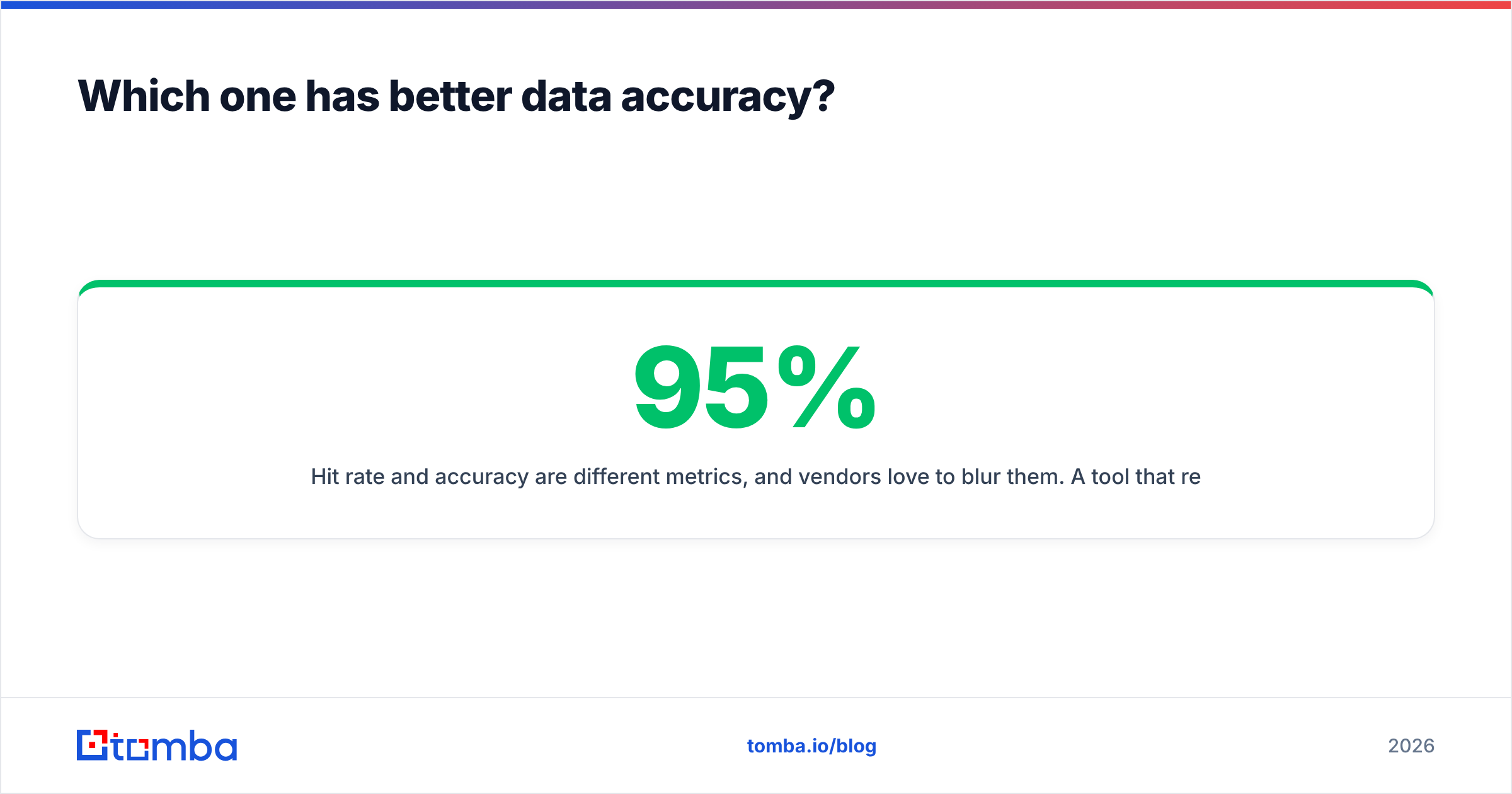
Hit rate and accuracy are different metrics, and vendors love to blur them. A tool that returns an email for 95% of your list but is right 70% of the time is worse than a tool that returns 65% and is right 98% of the time. The first one gets your domain flagged.

Two structural facts to weigh:
- Scraper-sourced emails decay fast. Tools that lean on page scraping and pattern-guessing (a common approach in bundled suites) tend to surface generic inboxes — info@, contact@, sales@ — which inflate hit rate and tank reply rate. Check what percentage of returned addresses are role accounts before you celebrate.
- Catch-all domains break naive verifiers. A huge share of B2B domains accept everything at the SMTP layer, so a basic "verified" flag means nothing. If a tool can't distinguish a real catch-all mailbox from a black hole, you're gambling. That's the entire reason a catch-all verifier exists as a separate product category.

Is an all-in-one suite worth it, or should you unbundle?#
The all-in-one pitch is seductive: one bill, one login, no integration work. Here's when it genuinely wins and when it quietly costs you.
Bundling wins when:
- Volume is low. If you're sending 200 emails a month, a 15% bounce rate is annoying, not fatal. A cheap suite is fine.
- You need many small things poorly rather than one thing well. Chat widget, popup, newsletter — if none of them are your revenue engine, "good enough" is genuinely good enough.
- Cash is the binding constraint. A one-time lifetime payment beats a recurring bill when runway is the problem.
Unbundling wins when:
- Outbound is a core channel. The moment cold email is how you make money, data quality becomes the whole ballgame.
- You have a sender you care about. Domain reputation is not recoverable on a whim. Google and Microsoft's 2024 bulk-sender requirements pushed the acceptable spam-complaint threshold to 0.3%, and bounce tolerance has tightened alongside it. A dirty list is now an existential risk, not a nuisance — email deliverability is the constraint your list quality feeds into.
- You already have a sequencer. If Instantly, Smartlead, or HubSpot already sends your mail, the "sending module" in a suite is dead weight you're paying for.
The honest framing: Conversion Blitz vs Exellius is a false binary for most teams. The winning stack is usually targeted data source + dedicated verification + your existing sender, not one vendor pretending to be all three.
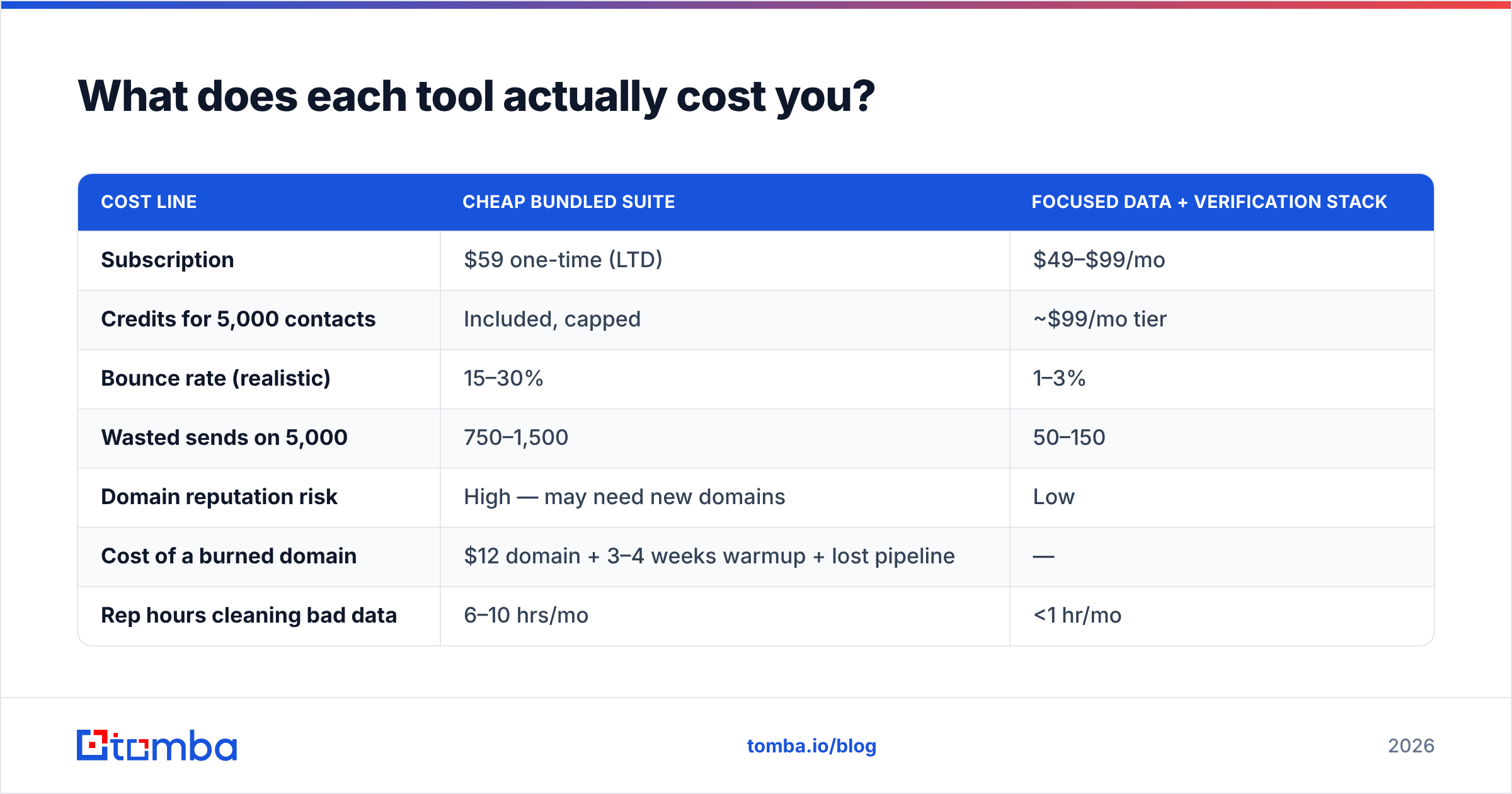
What does each tool actually cost you?#
Sticker price is the smallest number in this calculation. Model the real cost:
| Cost line | Cheap bundled suite | Focused data + verification stack |
|---|---|---|
| Subscription | $59 one-time (LTD) | $49–$99/mo |
| Credits for 5,000 contacts | Included, capped | ~$99/mo tier |
| Bounce rate (realistic) | 15–30% | 1–3% |
| Wasted sends on 5,000 | 750–1,500 | 50–150 |
| Domain reputation risk | High — may need new domains | Low |
| Cost of a burned domain | $12 domain + 3–4 weeks warmup + lost pipeline | — |
| Rep hours cleaning bad data | 6–10 hrs/mo | <1 hr/mo |
Run your own version of that table with your numbers. In almost every scenario where outbound volume clears a few thousand sends a month, the "expensive" focused stack is cheaper — because burned domains and dead pipeline are the largest line items and they never show up on the invoice.
If you want a sanity check on either vendor's claims, read the unfiltered reviews on G2 or Capterra and filter for the one-star and three-star reviews specifically. Five-star reviews tell you what the marketing says; three-star reviews tell you what the product does.
Which should you choose in 2026?#
Pick by constraint, not by feature count.
- Choose Conversion Blitz if: you're a solo operator or small agency, you want one subscription covering website widgets, a chatbot, a light scraper, and basic prospecting, and your outbound volume is modest. The lifetime-deal pricing genuinely changes the math when cash matters more than precision.
- Choose Exellius if: you want targeted B2B lists built around an ICP without buying a marketing suite you'll never open, and you already have a sending and sequencing tool you're happy with.
- Choose neither as your data layer if: cold email is your primary revenue channel. In that case, buy a dedicated finder and verifier, and keep your suite (if you want one) for the widgets.
- Layer verification on top regardless. Whichever you pick, do not send unverified addresses. Run the export through a verifier before it touches your sequencer. This single step protects the asset — your domain — that everything else depends on.
A practical hybrid many teams land on: use a suite or lead platform for discovery and firmographic filtering, then push every export through a dedicated finder and verifier to fill gaps and kill the junk before send. You get the targeting without inheriting the bounce rate.
How do you migrate without breaking your pipeline?#
If you're switching between these tools — or layering a verification step in front of one — do it in this order:
- Export your current list with source attribution so you can measure which tool produced which contacts.
- Deduplicate first. Overlapping sources inflate your credit burn. A quick remove duplicates pass before verification saves real money.
- Verify everything, including "already verified" contacts. Vendor verification flags are not portable trust.
- Segment by confidence. Send to valid-and-deliverable first. Park catch-all and risky addresses in a separate low-volume test batch.
- Measure bounce rate by source. After two weeks you'll have a defensible answer to "Conversion Blitz vs Exellius" for your market, which beats anyone's blog post — including this one.
The bottom line#
Conversion Blitz and Exellius solve different problems. Conversion Blitz gives you a wide, cheap toolbox where no single tool is best-in-class. Exellius gives you focused lead data without the surrounding suite. Both are reasonable purchases for the right team, and neither is a scam.
But if your bounce rate is your bottleneck, the answer to this comparison isn't in this comparison. It's in the verification layer neither product treats as its headline.
Start with the data, not the toolbox. Tomba's Email Finder does one job and does it deeply: find the professional email behind a name and domain, then confirm it's real before you send. The free tier gives you 25 searches a month with no card, Starter is $49/mo, and Growth is $99/mo when you scale — see full Tomba pricing. Run your current list through it, compare the bounce rates, and let the numbers decide which side of this comparison you actually belong on.
Related guides#
Ready to find emails that actually work?
Join 150,000+ professionals who stopped guessing and started sending. Free credits on signup — no credit card required.
Get the Tomba newsletter
Practical outbound tactics and product updates — once every two weeks.
About the author