9 Best Convin Alternatives in 2026: Compared and Ranked
Convin does call QA and agent coaching well, but it is not the right fit for every revenue team. Here are nine Convin alternatives compared on pricing, coaching depth, integrations, and who each one actually suits.
TL;DR — what you actually need to know#
- Convin is a contact-center-first platform. It is strongest at call QA, agent scoring, and coaching at scale — weaker as a pure sales conversation-intelligence layer for a 20-rep SaaS AE team.
- The best Convin alternative depends on your motion. Outbound SaaS sales → Gong or Clari Copilot. Contact center / BPO → Observe.AI or CallMiner. Budget-conscious SMB → Avoma, Jiminny, or Fireflies.
- Pricing is almost never public in this category. Expect $80–$150 per seat/month for sales conversation intelligence, and quote-only pricing for contact-center suites.
- No conversation AI fixes a bad list. If reps are dialling wrong numbers and emailing dead inboxes, better call analytics just gives you prettier data about a broken top of funnel.
- Run a real pilot. Two weeks, 200+ recorded calls, one scorecard. Vendors that can't set that up in a week won't get faster after you sign.
What is Convin and who is it actually built for?#
Convin is an AI-powered conversation intelligence and quality-management platform. It records and transcribes calls, auto-scores them against custom QA scorecards, flags compliance breaches, and pushes coaching tasks to agents and supervisors. It also ships an agent-assist layer that surfaces real-time cues during live calls.
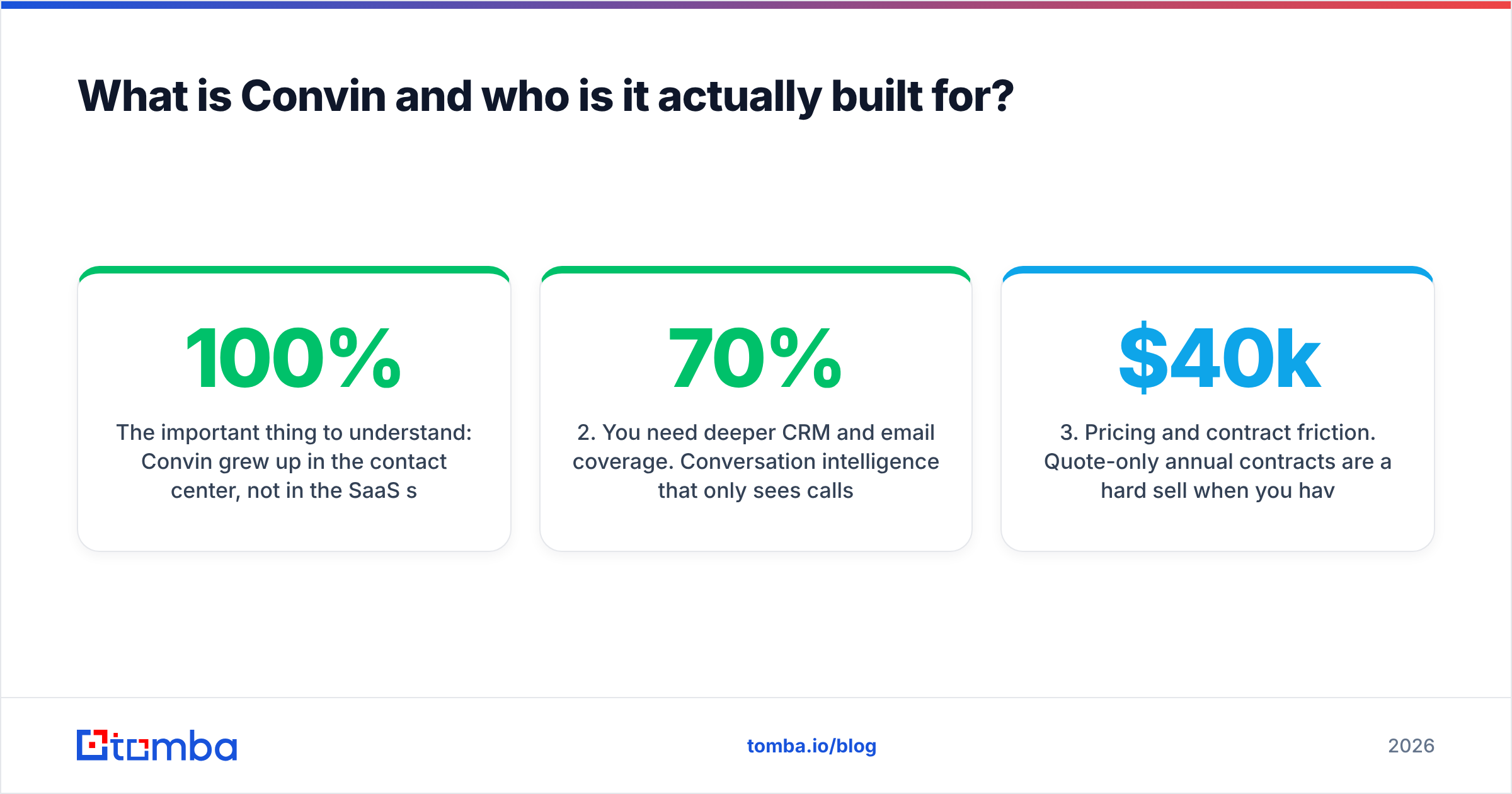
The important thing to understand: Convin grew up in the contact center, not in the SaaS sales floor. Its centre of gravity is 100% call auditing, agent scorecards, and supervisor workflows — the things a 300-seat BPO or an inside-sales team running high-volume dials cares about. That's why its feature list leans on QA automation, violation detection, and agent leaderboards rather than deal risk, pipeline forecasting, or multi-thread tracking.
That focus is exactly why teams start looking for Convin alternatives. The three most common triggers:
- You're a sales org, not a support org. You want deal intelligence — who's on the call, is the champion going dark, did anyone mention the competitor — not agent adherence scores.
- You need deeper CRM and email coverage. Conversation intelligence that only sees calls misses the 70% of a deal that happens over email, Slack, and LinkedIn.
- Pricing and contract friction. Quote-only annual contracts are a hard sell when you have 12 reps and a $40k tooling budget.

What should you compare Convin alternatives on?#
Before you look at a single demo, pin down the five criteria that actually decide the outcome. Most buyers get seduced by transcript accuracy demos and then discover the integration they needed doesn't exist.
- Primary motion — Is this a sales tool (deal risk, forecasting, MEDDIC tracking) or a service/QA tool (agent scoring, compliance, adherence)? Almost every disappointment in this category traces back to buying the wrong one.
- Coverage of channels — Calls only, or calls + email + meetings + chat? A tool that reads only 30% of your buyer interactions gives you 30% of the picture.
- Coaching workflow — Can a manager build a scorecard, assign a clip, and track improvement in under five minutes? If coaching takes 20 minutes per rep, nobody does it.
- Integration depth — Not "we have a Salesforce integration," but which objects, which direction, and how often. Ask for the field mapping doc during evaluation.
- Total cost including data — Conversation intelligence is a downstream tool. If you're also paying for dialers, contact data, and enrichment, the per-rep stack cost matters more than any single line item.
Which Convin alternatives are worth evaluating in 2026?#
Here's the honest shortlist. Pricing below reflects publicly available information at time of writing — nearly every vendor in this category negotiates, and the enterprise tiers are quote-only.
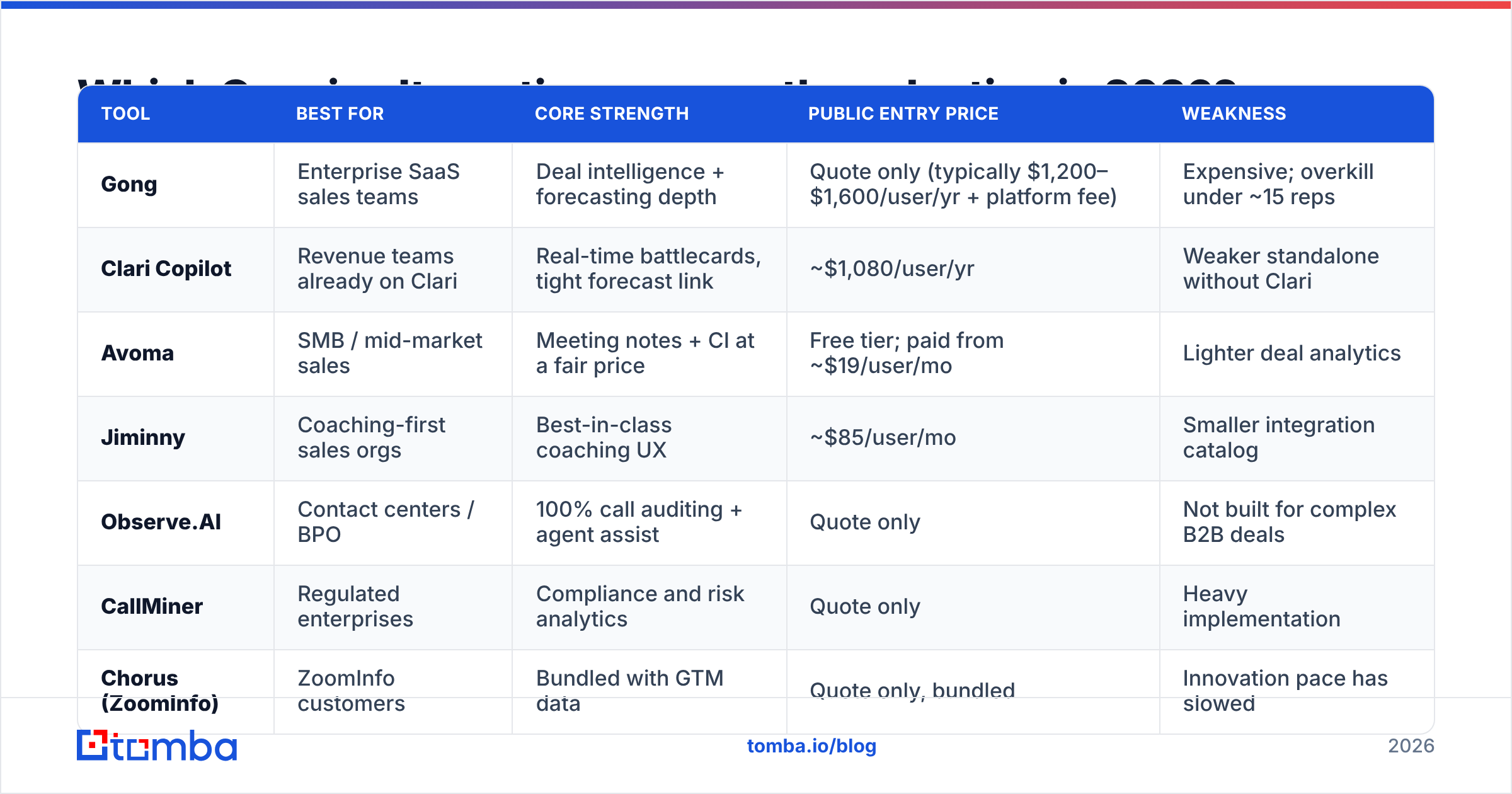
| Tool | Best for | Core strength | Public entry price | Weakness |
|---|---|---|---|---|
| Gong | Enterprise SaaS sales teams | Deal intelligence + forecasting depth | Quote only (typically $1,200–$1,600/user/yr + platform fee) | Expensive; overkill under ~15 reps |
| Clari Copilot | Revenue teams already on Clari | Real-time battlecards, tight forecast link | ~$1,080/user/yr | Weaker standalone without Clari |
| Avoma | SMB / mid-market sales | Meeting notes + CI at a fair price | Free tier; paid from ~$19/user/mo | Lighter deal analytics |
| Jiminny | Coaching-first sales orgs | Best-in-class coaching UX | ~$85/user/mo | Smaller integration catalog |
| Observe.AI | Contact centers / BPO | 100% call auditing + agent assist | Quote only | Not built for complex B2B deals |
| CallMiner | Regulated enterprises | Compliance and risk analytics | Quote only | Heavy implementation |
| Chorus (ZoomInfo) | ZoomInfo customers | Bundled with GTM data | Quote only, bundled | Innovation pace has slowed |
| Balto | Live agent guidance | Real-time prompting during calls | Quote only | Narrow scope — guidance only |
| Fireflies.ai | Lean teams / startups | Cheapest usable transcription + notes | Free tier; paid from ~$10/user/mo | Not a true revenue intelligence tool |
Gong — the default enterprise answer#
Gong is the category's 800-pound gorilla, and if your problem is "I can't see what's happening in my pipeline," it's still the safest answer. It reads calls, emails, and calendar activity, scores deal risk, and its forecasting module is genuinely useful rather than decorative.
The catch is price and gravity. Gong charges a platform fee on top of per-seat licensing, typically lands north of $30k/year for a mid-sized team, and expects annual commitment. Under about 15 reps, you're buying a jet to cross a river.
Pick Gong if: you're 25+ quota-carrying reps, deals take 60+ days, and multi-threading matters.
Clari Copilot — conversation intelligence wired to the forecast#
Formerly Wingman, Clari Copilot's differentiator is that conversation data feeds directly into Clari's forecasting engine. Real-time battlecards fire during live calls when a competitor gets mentioned. Pricing is more transparent than Gong's and materially cheaper.
Pick Clari Copilot if: you already run Clari for forecasting, or you want live in-call guidance without contact-center baggage.
Avoma — the value play for mid-market#
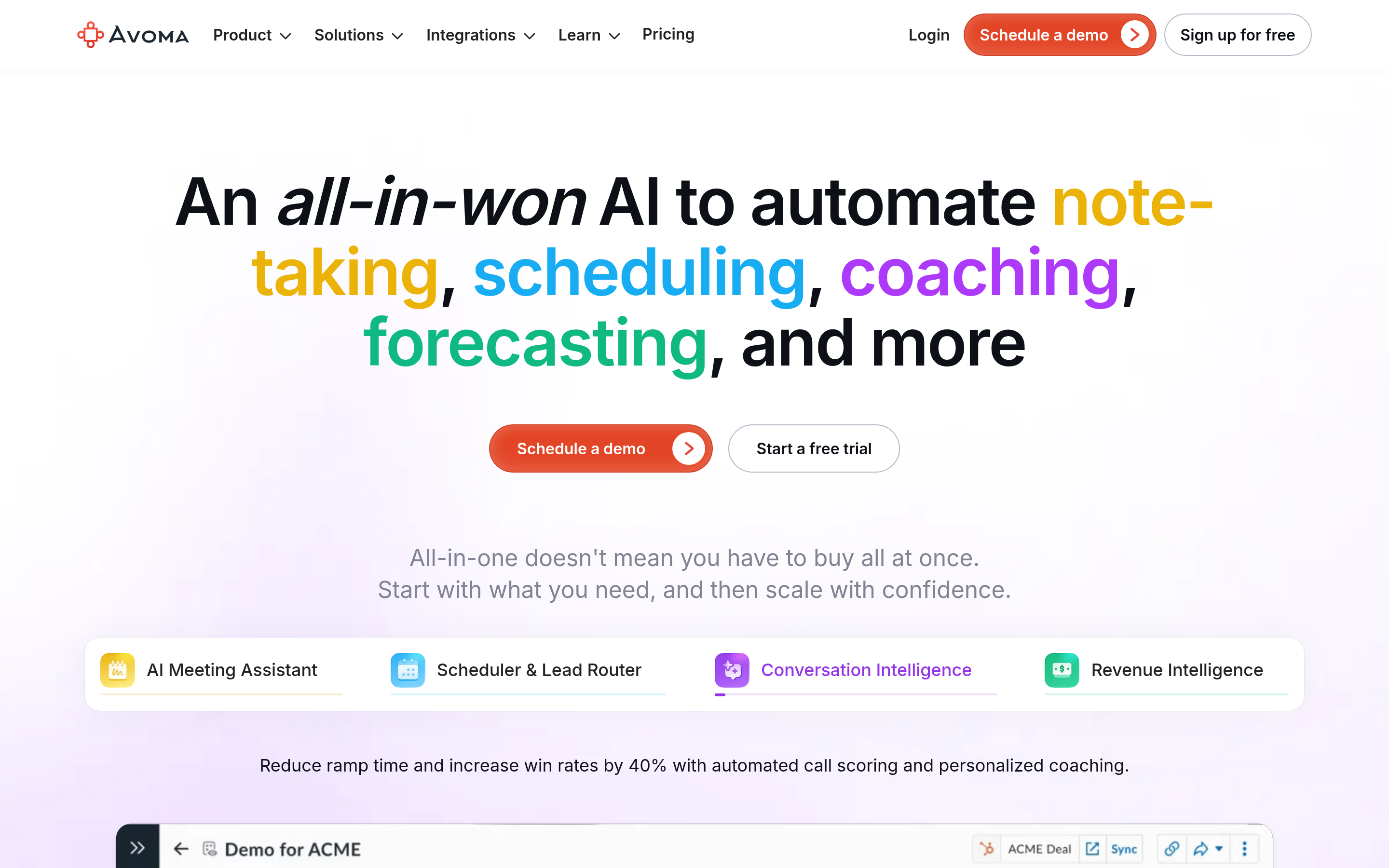
Avoma bundles AI meeting assistant, transcription, conversation intelligence, and revenue intelligence into tiered plans that start low and scale. There's a genuine free tier. It's not going to give you Gong's depth of deal analytics, but for a team of 10–40 the price-to-value ratio is the best in this table.
Pick Avoma if: you want 80% of the value at 25% of the price and can live without enterprise-grade forecasting.
Jiminny — if coaching is the actual problem#
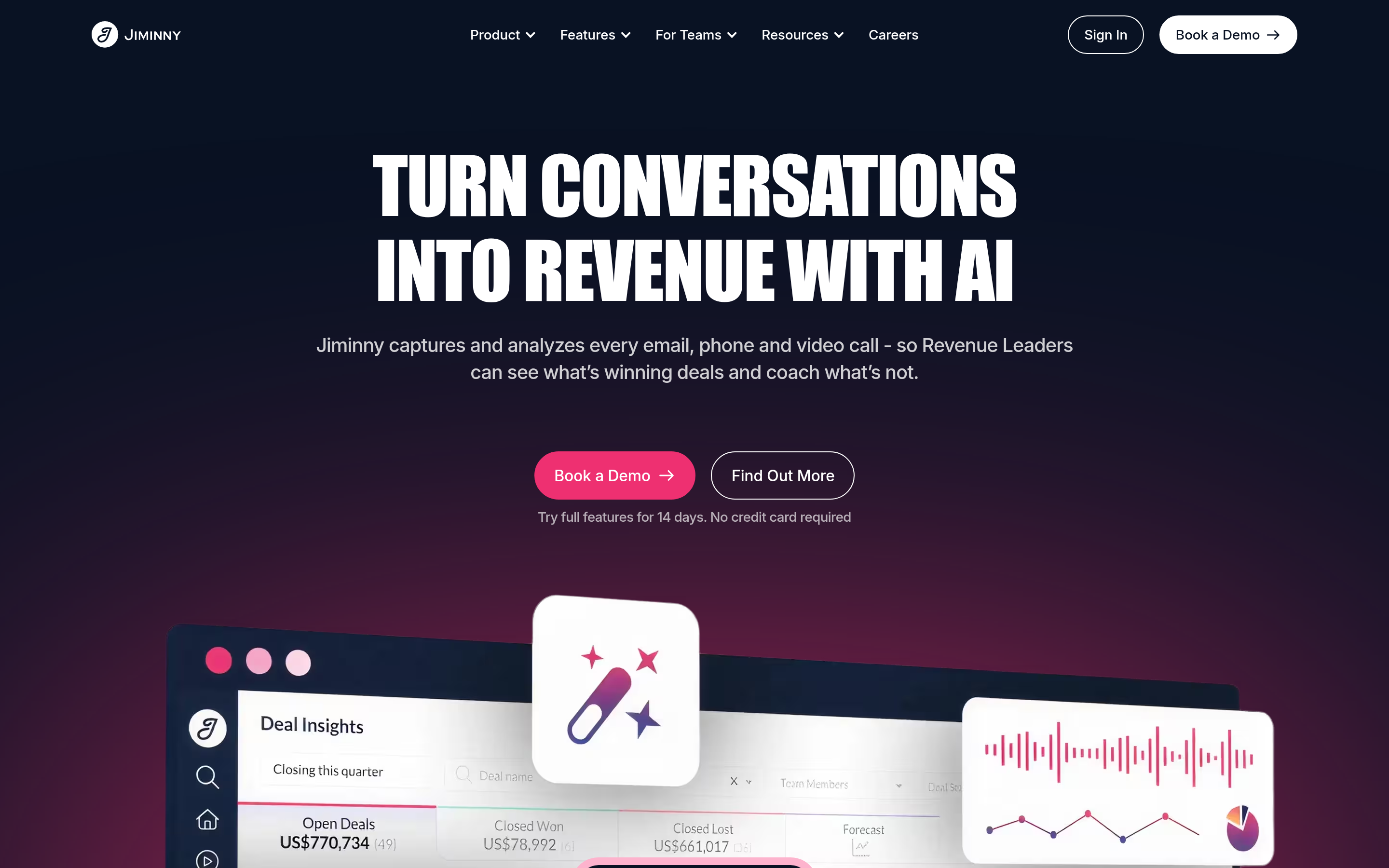
Jiminny is unapologetically a coaching platform. Clip sharing, scorecards, comment threads on specific timestamps, ramp tracking for new hires. Managers actually use it, which is more than you can say for most CI tools that get bought and abandoned.
Pick Jiminny if: your churn problem is rep ramp time, not pipeline visibility.
Observe.AI and CallMiner — the true Convin replacements#
If you liked Convin's category but not Convin's execution, these are your peers. Observe.AI does 100% call auditing, automated QA, and real-time agent assist for contact centers. CallMiner goes deeper on compliance, risk, and regulated-industry analytics — it's the choice when a missed disclosure costs you a fine, not a deal.
Both are quote-only and both involve real implementation work. Budget 4–8 weeks to value, not 4 days.
Fireflies.ai — the "we just need transcripts" answer#
Fireflies transcribes, summarises, and searches meetings across Zoom, Meet, and Teams for roughly the price of a coffee per user per month. It is not a revenue intelligence platform and doesn't pretend to be. But a lot of teams shopping for Convin alternatives discover, after an honest look at their process, that what they actually needed was searchable call notes.
Pick Fireflies if: your real requirement is "stop taking notes manually" and everything else was aspirational.
Is Convin better than Gong or Observe.AI?#
Wrong question. They're not competing for the same job.
- Convin vs Observe.AI is a real fight. Both target contact centers, both do automated QA and agent assist. Observe.AI has more enterprise logos and a longer track record; Convin often wins on price and speed of deployment. Check current G2 category grids for how the peer scores are trending in your segment.
- Convin vs Gong is not a fair fight in either direction. Gong is a sales-revenue platform. Convin is a QA-and-coaching platform. Ask a Gong rep to auto-score 100% of your inbound support calls against a 30-item compliance scorecard and watch the demo get awkward. Ask Convin to tell you which of your six-figure deals is going dark and you'll get the same face.
The honest verdict: if you bought Convin expecting Gong, that's a scoping error, not a product failure. Fix the scope first, then shortlist.
What does conversation intelligence not fix?#
Here's the part vendors won't put on the comparison page. Conversation intelligence is a downstream tool. It analyses conversations that already happened. It cannot make a conversation happen.
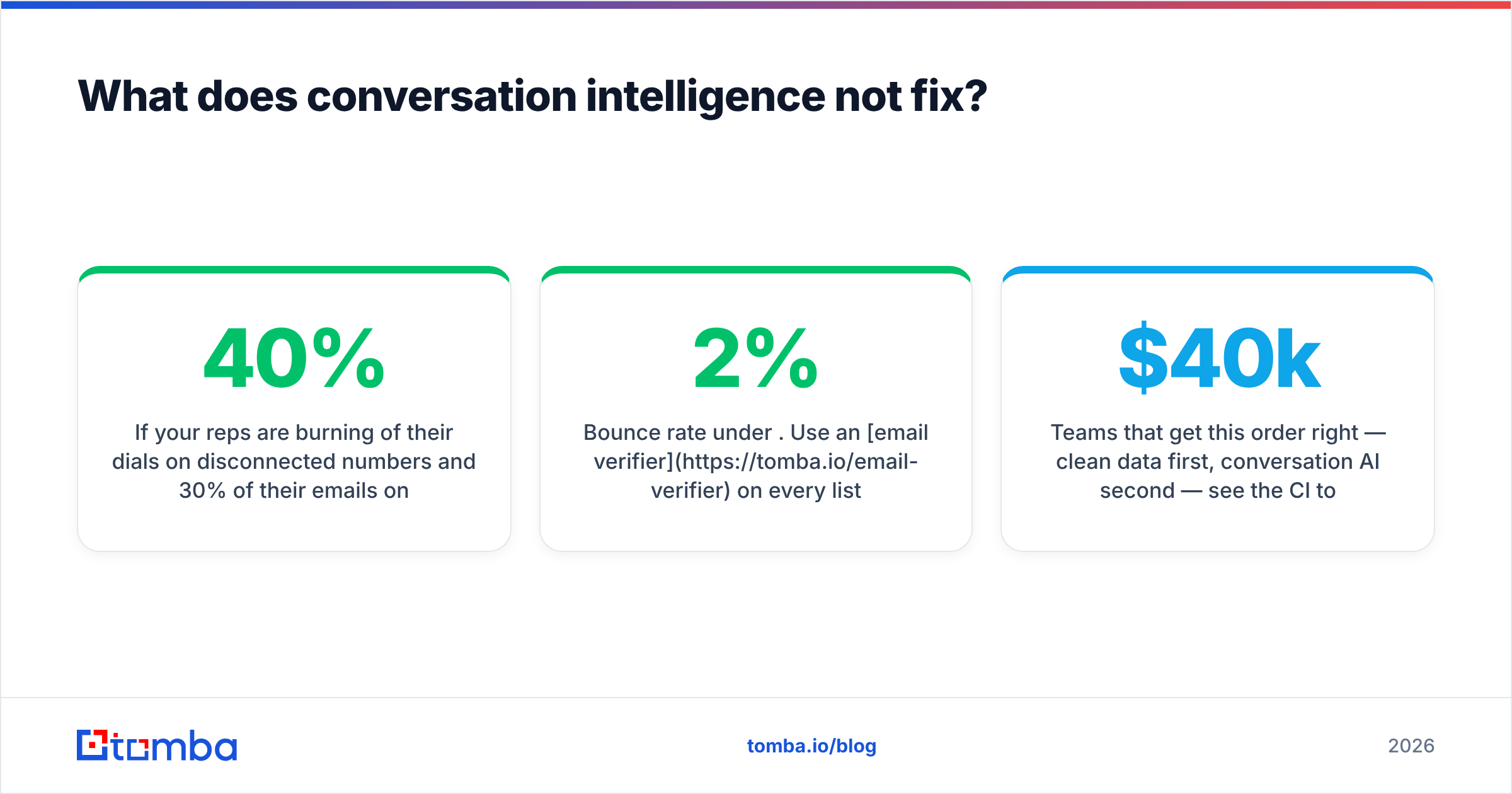
If your reps are burning 40% of their dials on disconnected numbers and 30% of their emails on addresses that bounce, better analytics on the surviving 30% tells you almost nothing useful. You'll get a beautiful dashboard confirming that reps who talk to real buyers close more deals.
The fix is upstream, and it's unglamorous:
- Verified contact data at the top of the funnel. A bulk email finder run before the sequence goes out beats any post-hoc analytics.
- Bounce rate under 2%. Use an email verifier on every list before it touches your sending domain — deliverability damage is expensive and slow to reverse.
- Direct dials that actually connect. A phone finder that returns mobile numbers rather than switchboards changes connect rates more than any real-time battlecard.
- Enriched records so the AI has context. Data enrichment gives your conversation intelligence tool the firmographics it needs to segment calls meaningfully.
Teams that get this order right — clean data first, conversation AI second — see the CI tool pay for itself. Teams that do it backwards spend $40k finding out their list was the problem.
How should you run the evaluation?#
A two-week pilot beats a two-hour demo every time. Structure it like this:
- Week 0 — define one scorecard. Not eight. One. Five to seven criteria, weighted, agreed by the sales manager who'll actually use it.
- Week 1 — pipe in 200+ real calls. Not cherry-picked wins. A representative mix including no-shows, price objections, and the calls nobody wants reviewed.
- Week 1 — check transcript accuracy on your accents and jargon. Every vendor demos flawless American English. Test it on your actual reps, your actual product names, and any non-native speakers on the team.
- Week 2 — have a manager coach three reps using only the tool. If it takes more than 10 minutes per rep, adoption will die within a quarter.
- Week 2 — pull the integration audit. Confirm which CRM fields get written, how often, and what happens on conflict.
Score each vendor out of 10 on those five, and the decision usually makes itself. Ignore the AI-feature checklist entirely — everyone has the same features on the box now, and the difference is in whether managers open the tool on a Tuesday.
Which Convin alternative should you choose?#
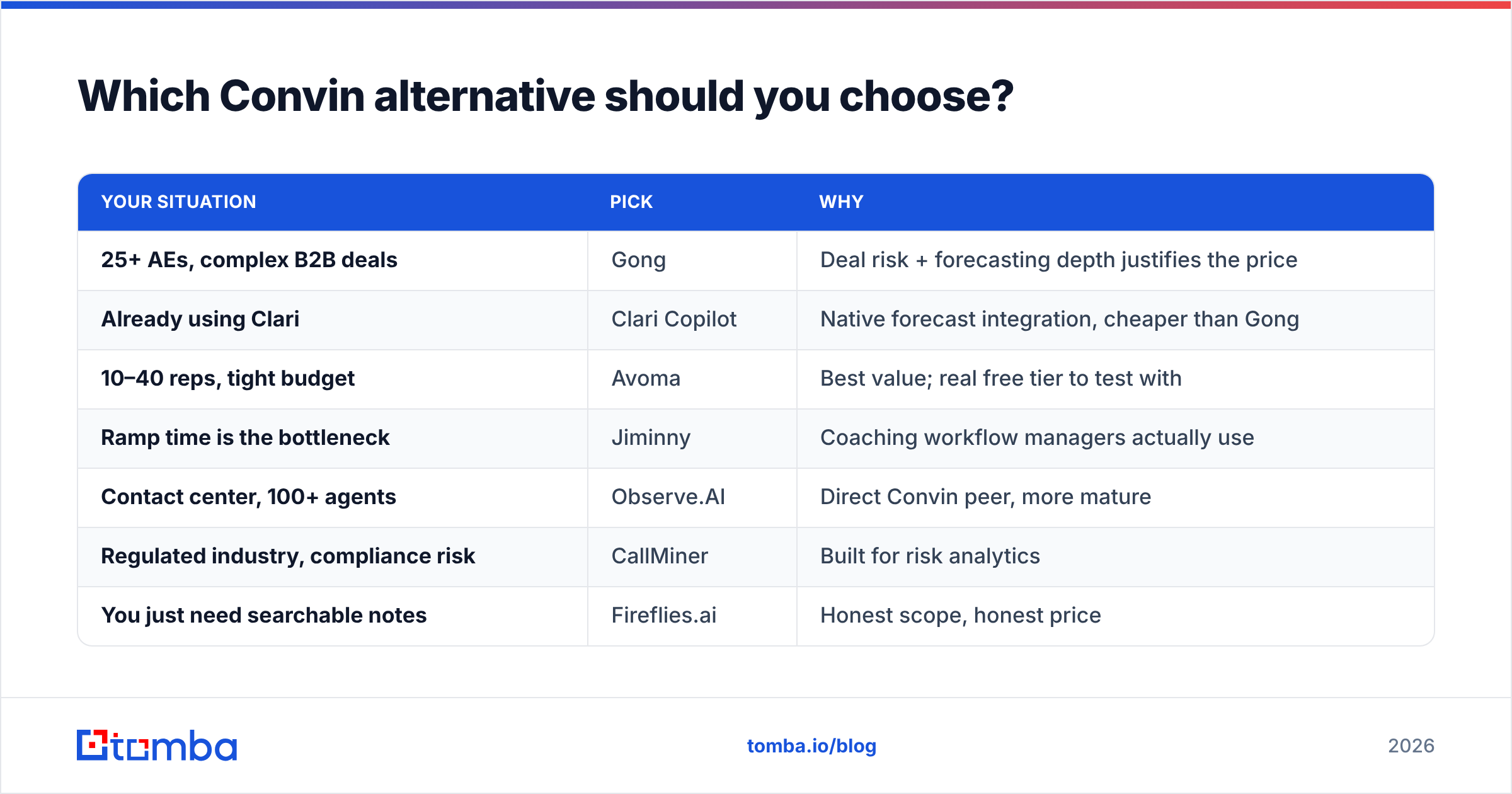
Short version, by profile:
| Your situation | Pick | Why |
|---|---|---|
| 25+ AEs, complex B2B deals | Gong | Deal risk + forecasting depth justifies the price |
| Already using Clari | Clari Copilot | Native forecast integration, cheaper than Gong |
| 10–40 reps, tight budget | Avoma | Best value; real free tier to test with |
| Ramp time is the bottleneck | Jiminny | Coaching workflow managers actually use |
| Contact center, 100+ agents | Observe.AI | Direct Convin peer, more mature |
| Regulated industry, compliance risk | CallMiner | Built for risk analytics |
| You just need searchable notes | Fireflies.ai | Honest scope, honest price |
And one more, which nobody puts on these lists: fix the funnel before you buy the analytics. If your connect rate is under 5% and your bounce rate is over 3%, spending $40k on conversation intelligence is buying a microscope for a problem you need a shovel to solve.
Fix the top of the funnel first#
Conversation intelligence tells you what happened on the calls you got. It doesn't get you more calls with the right people.
Tomba Email Finder does the upstream job: find verified professional email addresses by domain, name, or company, so your reps are reaching decision-makers instead of shouting into dead inboxes. The free tier gives you 25 searches a month to test accuracy on your own target accounts before you commit — and Tomba pricing starts at $49/month for Starter when you're ready to scale.
Get the list right first. Then let your conversation AI earn its keep.
Related guides#
Ready to find emails that actually work?
Join 150,000+ professionals who stopped guessing and started sending. Free credits on signup — no credit card required.
Get the Tomba newsletter
Practical outbound tactics and product updates — once every two weeks.
About the author