Coresignal vs GetProspect (2026): Which B2B Data Tool Wins
Coresignal sells raw B2B datasets by the million. GetProspect finds emails one LinkedIn profile at a time. They barely compete — and that is exactly why teams pick the wrong one. Here is the honest breakdown.
TL;DR
- Coresignal is a data supplier, not a prospecting tool. It sells firmographic, employee, and job-posting records through APIs and bulk datasets — you build the workflow yourself.
- GetProspect is a prospecting tool, not a data supplier. It pulls emails from LinkedIn profiles and search pages via a Chrome extension, then stores them in simple lists.
- Price gap is enormous. GetProspect starts around $49/mo with a free tier; Coresignal's self-serve API plans typically start in the four-figure range per month, and bulk datasets are quoted.
- Neither is an email-first accuracy play. Coresignal's contact coverage is thinner than its company coverage; GetProspect's per-email accuracy varies a lot outside tech.
- Most SMB and mid-market teams need a third option: a dedicated email finder with an API, verification, and per-search pricing that scales down as well as up.
What are Coresignal and GetProspect, actually?#
They get compared because both show up when you search "B2B data." That's where the similarity ends.
Coresignal is a data-as-a-service company. It maintains large public-web datasets — company profiles, employee profiles, job postings, funding, technographics — and delivers them as raw records. You consume them through an API or you take a full dataset drop into S3/GCS and load it into your warehouse. There is no UI for "find me the VP of Sales at Acme and email her." Coresignal's buyer is a data engineer, a RevOps lead building an ICP scoring model, or a product team enriching their own app.
GetProspect is an email finder built around LinkedIn. You install the Chrome extension, run a Sales Navigator or regular LinkedIn search, and it extracts names, titles, companies, and matched email addresses into a list you can export or push to a CRM. It also has a small web-app database and bulk-upload email lookup. Its buyer is an SDR, a founder doing their own outbound, or a small agency.
So the real question isn't "which is better." It's which layer of the stack do you actually need — raw records at volume, or contactable emails right now.
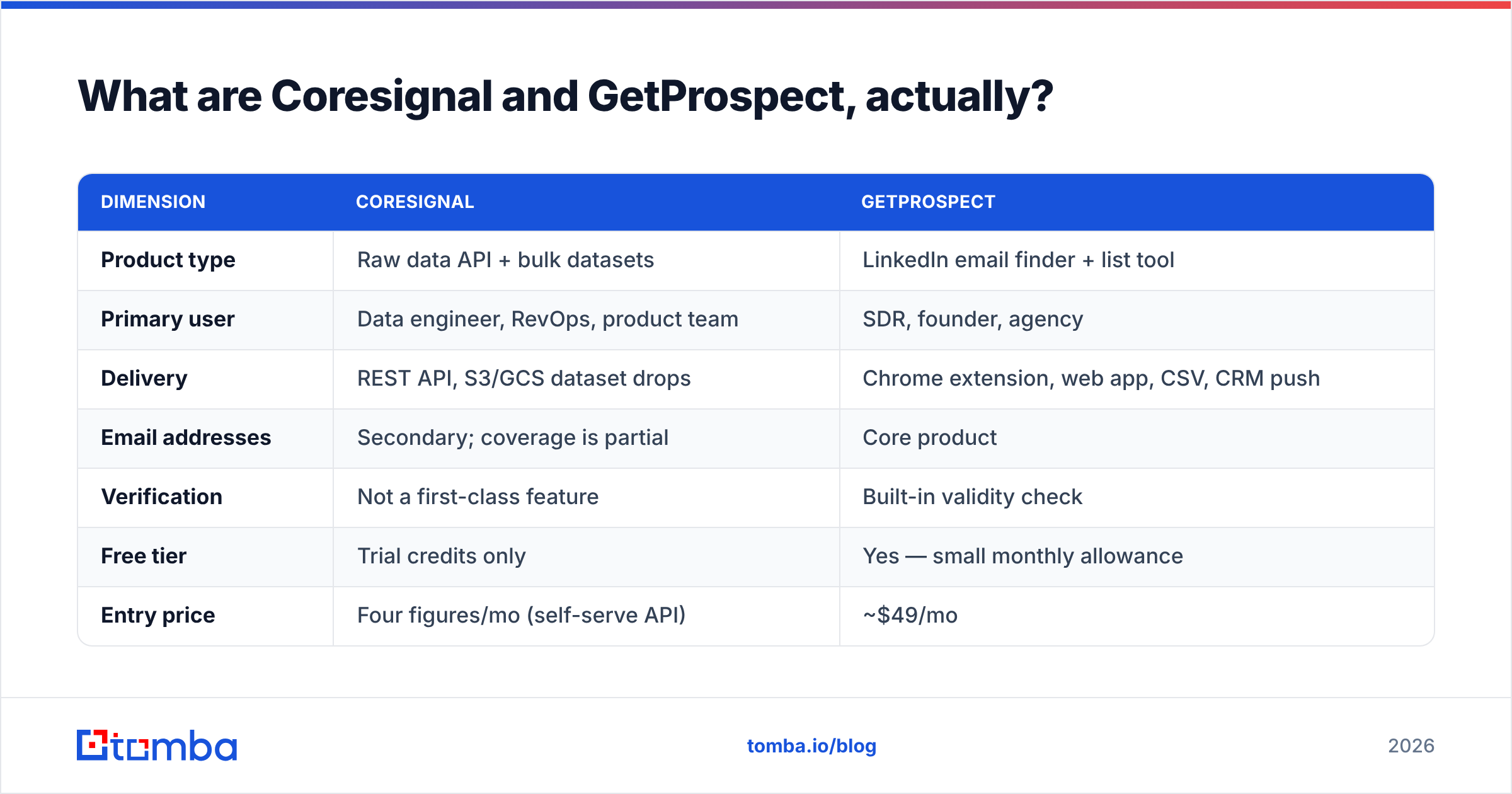
| Dimension | Coresignal | GetProspect |
|---|---|---|
| Product type | Raw data API + bulk datasets | LinkedIn email finder + list tool |
| Primary user | Data engineer, RevOps, product team | SDR, founder, agency |
| Delivery | REST API, S3/GCS dataset drops | Chrome extension, web app, CSV, CRM push |
| Email addresses | Secondary; coverage is partial | Core product |
| Verification | Not a first-class feature | Built-in validity check |
| Free tier | Trial credits only | Yes — small monthly allowance |
| Entry price | Four figures/mo (self-serve API) | ~$49/mo |
| Setup effort | Days to weeks (engineering) | Minutes |
| Good at | Scale, breadth, historical records | Speed, simplicity, LinkedIn workflows |
Which one has better data coverage?#
Coresignal wins on breadth of records; GetProspect wins on usable emails per hour of work. Those are different metrics and you should be clear about which one you're buying.
Coresignal's public-web coverage runs into the hundreds of millions of employee profiles and tens of millions of company records, with job postings refreshed continuously. That's genuinely hard to replicate. If you want to answer "which US SaaS companies posted a Head of RevOps role in the last 30 days," Coresignal is built for exactly that question and GetProspect simply cannot answer it.
But raw profile coverage is not contact coverage. A record can have a name, title, company, tenure, and skills — and no verified work email. In practice, teams that buy Coresignal end up bolting an email-finding and verification layer on top, because the dataset gives them the who but not the how to reach them. That's a second vendor, a second bill, and a second accuracy problem.
GetProspect inverts this. It finds a person because you already looked at them on LinkedIn, then attempts an email match. Coverage is therefore capped by what you can surface in LinkedIn search, and email hit rates are strongest in tech, marketing, and startup-adjacent roles where public patterns are well documented. Manufacturing, healthcare, regional European mid-market, and government tend to be thinner — as they are for most extension-based tools.


The honest read: neither tool is optimizing for email accuracy as its headline metric. Coresignal optimizes for record volume and freshness. GetProspect optimizes for workflow speed. If bounce rate is the number your boss looks at, you need a tool whose entire reason for existing is that number — which is why plugging an email verifier into either stack is standard practice, not an upsell.
How do Coresignal and GetProspect pricing compare?#
This is where the two products stop being comparable at all.
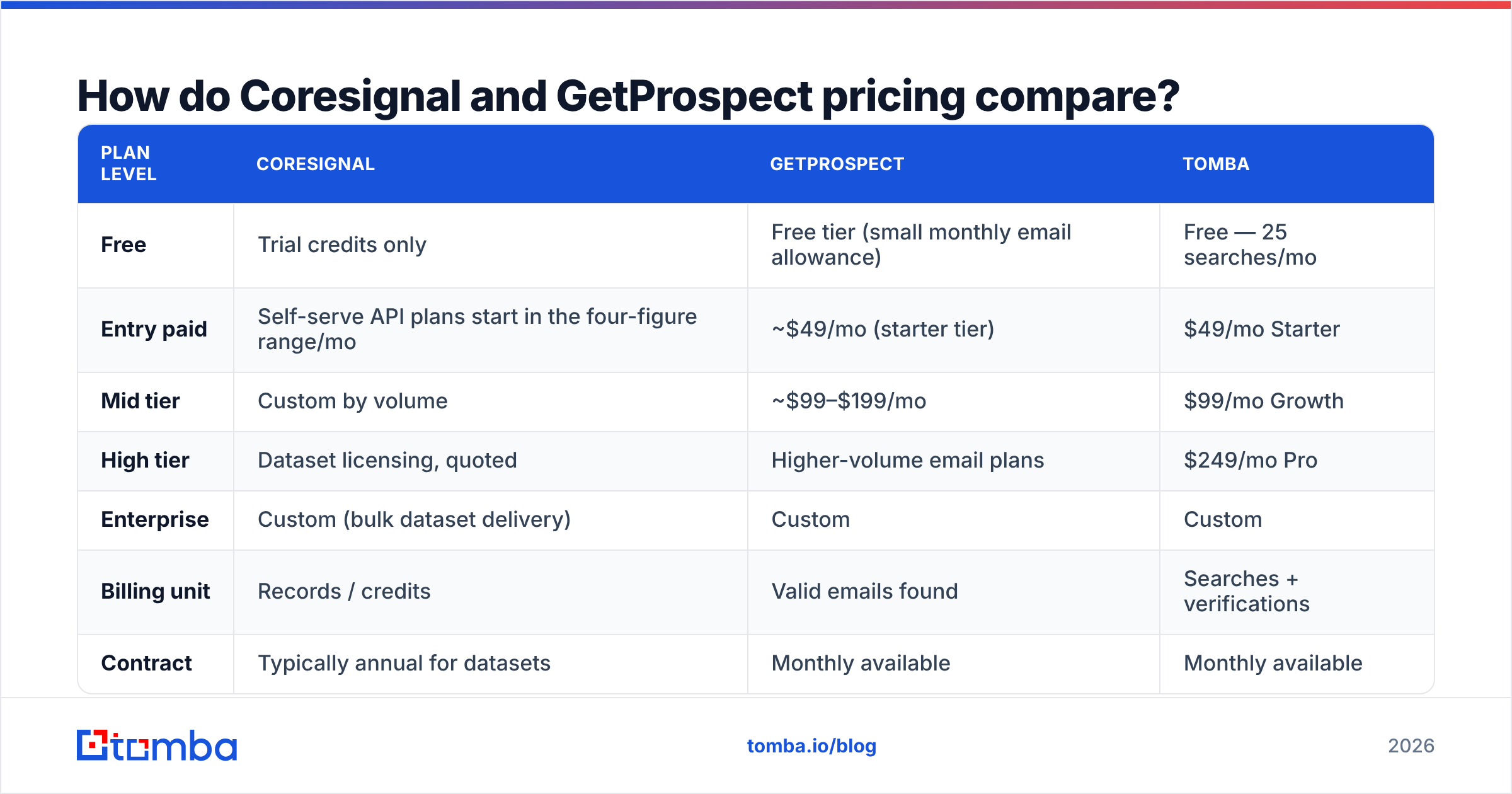
| Plan level | Coresignal | GetProspect | Tomba |
|---|---|---|---|
| Free | Trial credits only | Free tier (small monthly email allowance) | Free — 25 searches/mo |
| Entry paid | Self-serve API plans start in the four-figure range/mo | ~$49/mo (starter tier) | $49/mo Starter |
| Mid tier | Custom by volume | ~$99–$199/mo | $99/mo Growth |
| High tier | Dataset licensing, quoted | Higher-volume email plans | $249/mo Pro |
| Enterprise | Custom (bulk dataset delivery) | Custom | Custom |
| Billing unit | Records / credits | Valid emails found | Searches + verifications |
| Contract | Typically annual for datasets | Monthly available | Monthly available |
Vendor pricing changes; check each provider's page before you budget. The shape of the gap, though, has been stable for years.
Read that table again. Coresignal's floor is roughly where GetProspect's ceiling sits. That is not a criticism of Coresignal — you are buying a different asset. But it means the phrase "Coresignal vs GetProspect" is misleading for 90% of the teams who type it. If you have a $500/month tooling budget, Coresignal was never in the running. If you're building an ICP model over 10 million companies, GetProspect was never in the running.
The genuinely awkward middle is the team that needs API-grade access at SMB pricing — programmatic email finding and enrichment, wired into a CRM or a product, without a five-figure annual commitment. Neither of these two serves that band well. Compare it against Tomba pricing, where the same $49/mo entry point buys you API access rather than just a UI seat.
Is Coresignal or GetProspect better for outbound prospecting?#
GetProspect, easily — if your motion is LinkedIn-first and low-volume.
The workflow is fast: search on LinkedIn, click the extension, get a list, export, load into your sequencer. For a solo founder or a two-person SDR team running 200–500 contacts a month, that's a clean loop and $49 is a rounding error.
The cracks show up at three points:
- Verification depth. A "valid" flag from an extension is not the same as an SMTP-level check plus catch-all handling. Domains that accept everything will happily accept a wrong address, and you find out from your bounce report a week later. Run anything questionable through a catch-all verifier before it hits a sequence.
- Volume ceilings. Extension-based extraction is throttled by LinkedIn itself. If you need 5,000 verified contacts this month, you are going to hit limits, warnings, or both.
- No programmatic layer worth the name. When outbound becomes a system rather than a task, you want to call an API from a workflow, not click a browser button.
Coresignal, meanwhile, is a poor prospecting tool and doesn't pretend otherwise. Handing an SDR a JSON dataset is not a workflow. What Coresignal is excellent at is defining who to prospect — building the target account list from hiring signals, headcount growth, and tech adoption, which you then hand to a contact-finding layer.

That two-layer pattern — signals from a data provider, contacts from an email finder — is how most competent GTM teams actually operate. The mistake is expecting one vendor to do both well.
Which should you pick for enrichment and RevOps?#
Pick by where the data has to land.
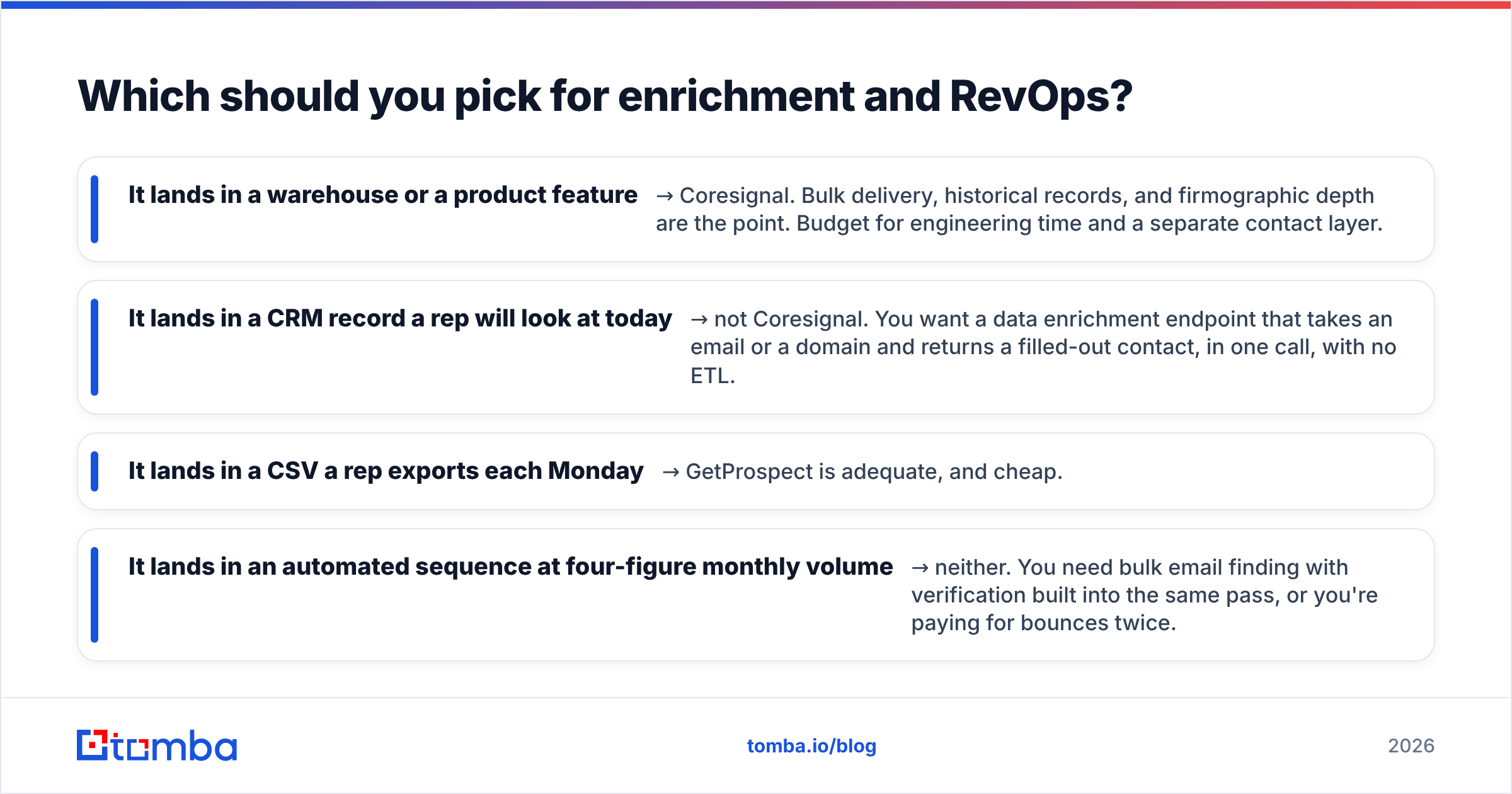
- It lands in a warehouse or a product feature → Coresignal. Bulk delivery, historical records, and firmographic depth are the point. Budget for engineering time and a separate contact layer.
- It lands in a CRM record a rep will look at today → not Coresignal. You want a data enrichment endpoint that takes an email or a domain and returns a filled-out contact, in one call, with no ETL.
- It lands in a CSV a rep exports each Monday → GetProspect is adequate, and cheap.
- It lands in an automated sequence at four-figure monthly volume → neither. You need bulk email finding with verification built into the same pass, or you're paying for bounces twice.
A useful stress test: ask each vendor how it behaves on a catch-all domain. Coresignal will tell you it isn't a verification product. GetProspect will give you a probabilistic flag. A verification-first tool will tell you why it's uncertain and let you decide the risk threshold. Only one of those answers protects your sender reputation.

What are the strongest alternatives to both?#
If you landed on "Coresignal vs GetProspect" and neither fits, you're in good company. The comparison is common precisely because both products sit at the edges of the market.
If you need signals and datasets at scale: Coresignal's closest peers are the other data-as-a-service providers — the ones selling records rather than seats. Check third-party reviews on G2 before committing, because dataset freshness claims are hard to audit from a demo.
If you need contactable, verified emails with an API: the category to shop is email finders, not data warehouses. The evaluation criteria are narrow and testable:
- Verified hit rate on your ICP, not on their demo list. Upload 100 of your own known-good contacts and measure.
- Catch-all handling — does it guess, or does it tell you it's uncertain?
- API from the entry tier, not gated behind enterprise sales.
- Per-search pricing that scales down, so a slow month doesn't cost the same as a peak month.
- Native integrations — HubSpot, Salesforce, Sheets, Zapier — so the data lands where reps work.
- Source transparency — you should be able to see where an address came from and how confident the system is.
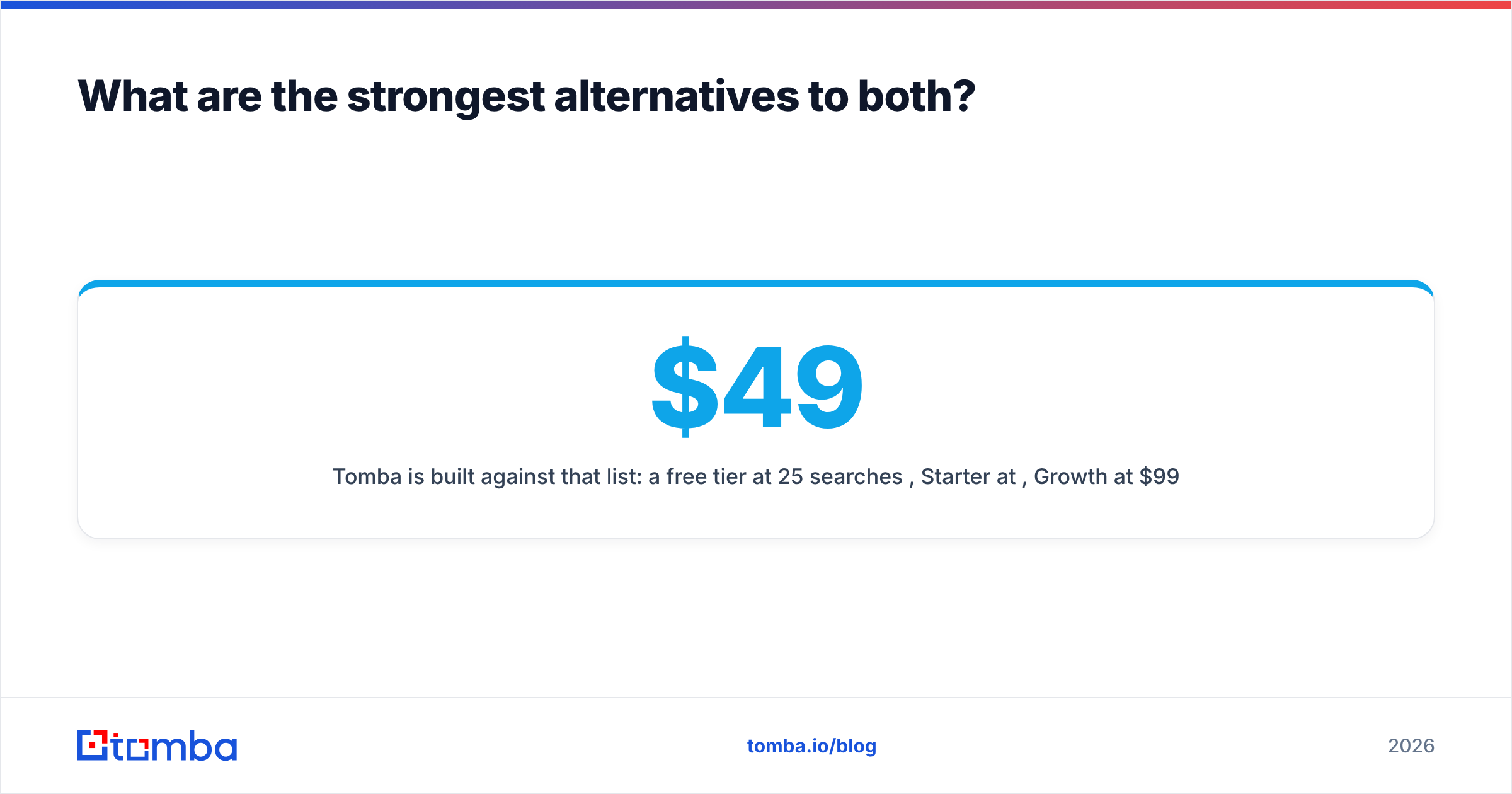
Tomba is built against that list: a free tier at 25 searches/mo, Starter at $49/mo, Growth at $99/mo, Pro at $249/mo, with the Tomba API available from the paid tiers rather than reserved for enterprise contracts. Domain search, catch-all verification, and phone lookup sit alongside the finder, so the "who" and the "how to reach them" come from the same system.
If you're a peer-comparison shopper: it's worth noting that database-first vendors like BookYourData solve a different slice again — pre-built, pay-as-you-go contact lists with no subscription. That model beats both Coresignal and GetProspect when you want a one-off list and nothing else. Different job, legitimately good at it.
Coresignal vs GetProspect: the verdict#
| Your situation | Best pick |
|---|---|
| Building an ICP model or product feature over millions of companies | Coresignal |
| Solo founder, LinkedIn-led, <500 contacts/mo | GetProspect |
| SDR team needing verified emails at volume, with an API | Dedicated email finder (Tomba) |
| Warehouse-first RevOps with existing enrichment budget | Coresignal + a verification layer |
| One-off list purchase, no subscription | Pay-as-you-go database vendor |
| Bounce rate is your KPI | Verification-first tooling, whatever else you run |
The framing that actually helps: Coresignal is infrastructure, GetProspect is a tool, and most teams need a system. Infrastructure without a contact layer is an expensive spreadsheet. A tool without an API is a bottleneck the day you scale. A system is the finder, the verifier, the enrichment call, and the integrations working as one pass — which is the gap both of these products leave open.
Be honest about your volume, your budget, and who is going to maintain the thing. If the answer to "who maintains it" is "nobody, we're four people," Coresignal is the wrong shape regardless of how good the data is. If the answer to "what happens at 5,000 contacts a month" is "we click faster," GetProspect is the wrong shape regardless of how cheap it is.
Ready to test the middle path?#
Before you sign an annual data contract or resign yourself to browser-extension throughput, run a real bake-off. Take 100 contacts from your actual ICP — not a demo list — and put them through the Tomba Email Finder. Measure the verified hit rate, the catch-all handling, and how long it takes to get the results into your CRM. The free tier gives you 25 searches to start, Starter is $49/mo with full API access, and there is no annual commitment to unwind if it doesn't beat what you're using today.
Data you can't email is trivia. Start with the emails.
Related guides#
Ready to find emails that actually work?
Join 150,000+ professionals who stopped guessing and started sending. Free credits on signup — no credit card required.
Get the Tomba newsletter
Practical outbound tactics and product updates — once every two weeks.
About the author