The CPQ Process Explained: From Configure to Closed-Won in 2026
Most quotes don't stall because of price. They stall because the CPQ process is held together by spreadsheets, approvals nobody owns, and a contact record that's six months stale. Here's the fix.
TL;DR
- The CPQ process (Configure, Price, Quote) is the chain of steps between "the buyer wants a proposal" and "the buyer has a signable document with the right SKUs, the right discount, and the right approvals attached."
- Most teams don't have a pricing problem. They have a handoff problem: reps rebuild quotes in spreadsheets, approvals sit in Slack, and legal finds out on Friday.
- A working CPQ process has 7 stages. Skipping stage 2 (rules) or stage 5 (approval logic) is what turns a 2-hour quote into a 9-day quote.
- CPQ software is not a CRM and not a billing system. Buying one before you've written down your pricing rules just automates the mess faster.
- Garbage contact data breaks CPQ before pricing ever does — a quote sent to a bounced address is a quote that never existed. Clean, verified contacts at the top of the funnel are a CPQ prerequisite, not a nice-to-have.
What is the CPQ process, exactly?#
CPQ stands for Configure, Price, Quote. It's the operational sequence that converts a qualified opportunity into a priced, approved, legally sound proposal a buyer can sign.
Think of it like ordering a custom car. Configure is picking the trim, engine, and options — and being blocked from picking two options that physically can't coexist. Price is the dealer applying list price, your trade-in, the seasonal rebate, and the finance rate. Quote is the printed sheet you sign. Nobody calls that "CPQ" at a dealership, but that's what it is: constrained choices, layered pricing, one document.
In B2B, the same three steps get messy because:
- Products have dependencies (Module B requires Platform A, seat tiers change per-seat cost)
- Pricing has layers (list, volume tier, regional, partner, contractual, one-off discount)
- Approvals have thresholds (>20% discount needs a director; non-standard terms need legal)
- The output has to be legally accurate, not just persuasive
Without a defined CPQ process, each rep invents their own. That's how two customers in the same segment end up paying 40% different prices for the same bundle — and how you discover it in a renewal call.
What are the 7 stages of the CPQ process?#
Here's the sequence in practice. Each stage has an owner and a fail mode.
- Trigger and data capture — An opportunity hits the "proposal" stage in your CRM. The rep pulls in company size, entity name, billing contact, and buying committee. Fail mode: the legal entity name is wrong, or the quote goes to a contact who left the company.
- Configure — Select products, quantities, terms, and add-ons under guided rules. Invalid combinations should be impossible to select, not merely discouraged. Fail mode: a rep quotes a bundle that engineering can't provision.
- Price — Apply the price book: list price → volume tier → contract or partner rate → promo. Deterministic, not improvised. Fail mode: a rep manually types a number they "know is right."
- Discount and margin check — Requested discount is checked against a floor. Margin is calculated before the quote goes out, not after the deal is booked. Fail mode: deals close below floor and nobody notices until the quarter closes.
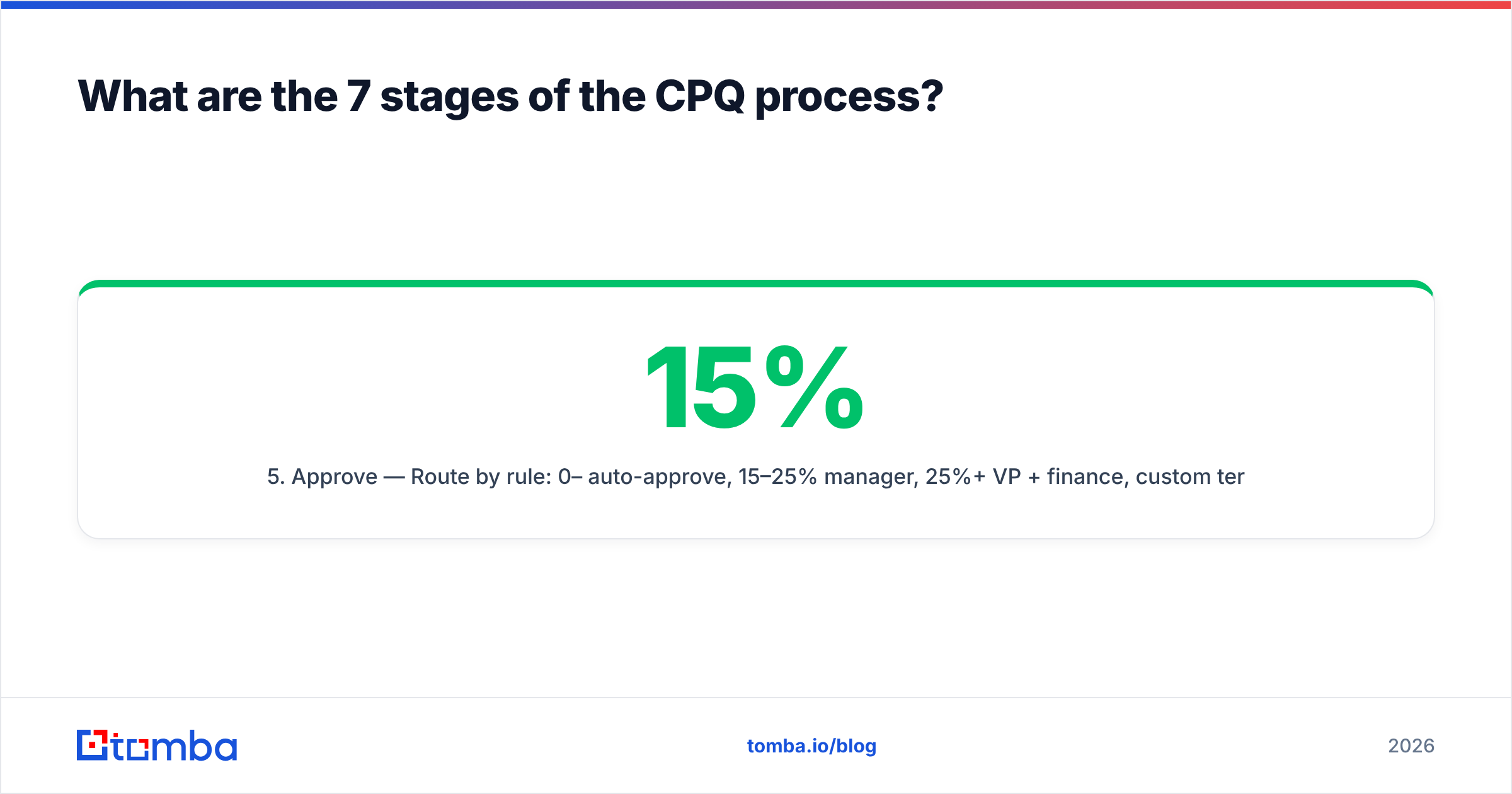
- Approve — Route by rule: 0–15% auto-approve, 15–25% manager, 25%+ VP + finance, custom terms + legal. Time-boxed with escalation. Fail mode: approval sits in a DM for four days.
- Generate the quote document — Branded, versioned, with terms attached, delivered as a link (so you can see when it's opened), not a PDF buried in a thread. Fail mode: v3 of the quote is emailed while v2 is the one being signed.
- Deliver, track, and close — Send, track engagement, handle redlines, push to e-signature, then sync the signed line items to billing and revenue recognition. Fail mode: what was quoted and what gets billed differ, and finance eats the reconciliation.
Stages 1 and 7 are where CPQ touches the rest of your GTM stack. Stages 2–6 are where CPQ software earns its money.
Why do quotes take days instead of hours?#
Run the audit before you buy anything. Time-stamp every quote in your last 30 closed opportunities and measure the gap between "opp moved to proposal" and "quote delivered." Then bucket the delay.
In most mid-market teams the delay is not in the pricing engine. It's here:
- Waiting on internal approval. The single biggest bucket. Usually because thresholds aren't documented, so reps escalate to whoever answers first.
- Rebuilding the same quote. A rep copies last quarter's spreadsheet, forgets to update the price book, and someone catches it downstream.
- Chasing product truth. "Does the Enterprise tier include SSO?" gets asked in Slack instead of being enforced by config rules.
- Wrong or stale contact data. The quote is perfect and goes to a procurement lead who left in March. You lose a week discovering that.
That last one is underrated. Gartner has been saying for years that B2B buying groups are getting larger, which means more contacts to verify, not fewer. If your quote lands in a dead inbox, none of the pricing sophistication upstream matters. Running your buying-committee contacts through an email verifier before the quote goes out is a 30-second step that prevents a 7-day stall.
What's the difference between CPQ, CRM, and billing?#
They get conflated constantly, and buying the wrong one is expensive. Here's the honest split.
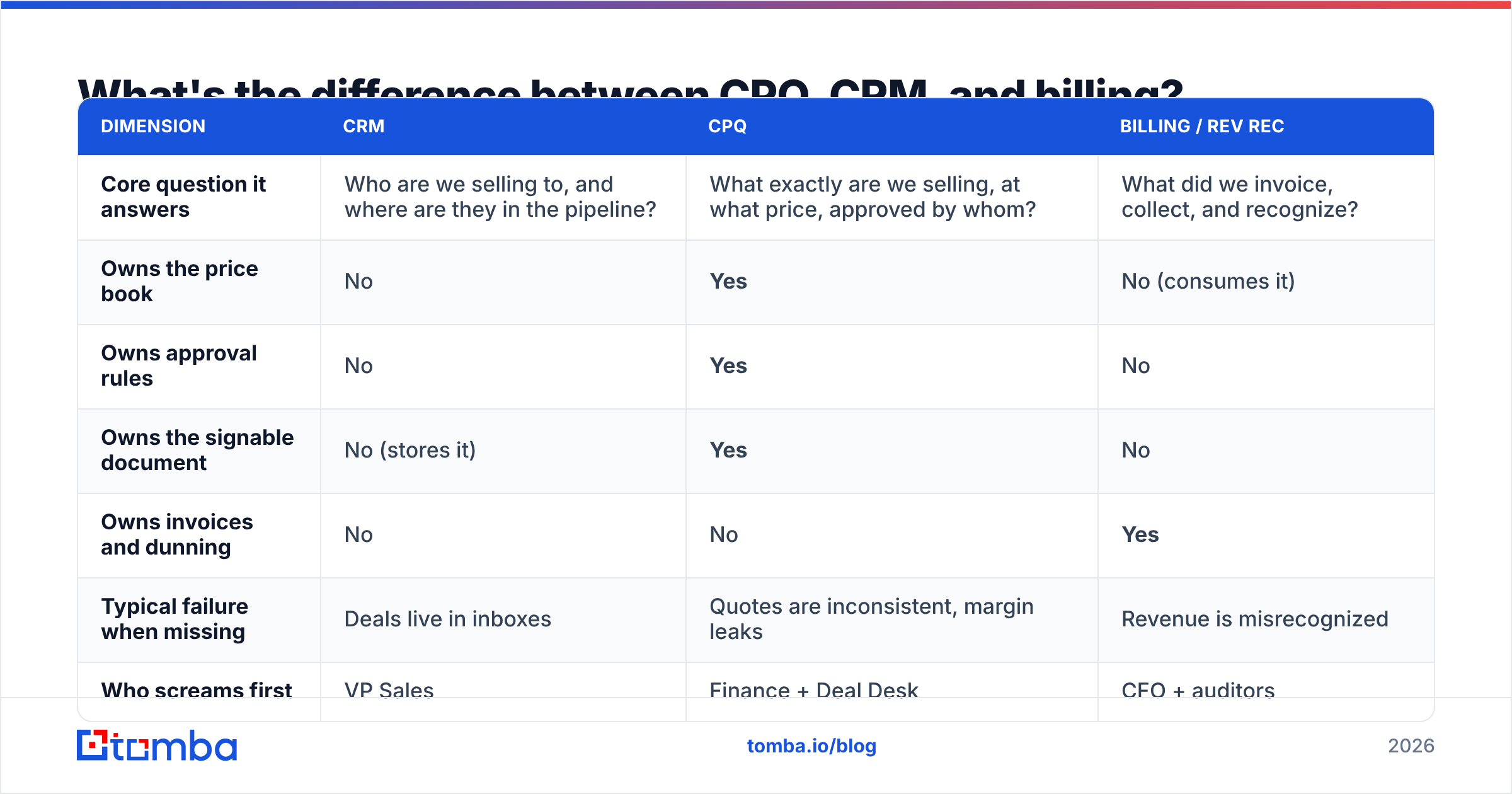
| Dimension | CRM | CPQ | Billing / Rev Rec |
|---|---|---|---|
| Core question it answers | Who are we selling to, and where are they in the pipeline? | What exactly are we selling, at what price, approved by whom? | What did we invoice, collect, and recognize? |
| Owns the price book | No | Yes | No (consumes it) |
| Owns approval rules | No | Yes | No |
| Owns the signable document | No (stores it) | Yes | No |
| Owns invoices and dunning | No | No | Yes |
| Typical failure when missing | Deals live in inboxes | Quotes are inconsistent, margin leaks | Revenue is misrecognized |
| Who screams first | VP Sales | Finance + Deal Desk | CFO + auditors |
The rule of thumb: CRM knows the deal, CPQ defines the deal, billing collects the deal. If your "CPQ" is a Google Sheet and your approval rule is "ask Dave," you have a CRM and a habit — not a CPQ process.
When is CPQ software worth it (and when is it overkill)?#
Not every company needs a CPQ platform. The threshold is complexity, not headcount.
You probably don't need CPQ software yet if:
- You sell 1–3 SKUs with a published price and a single discount tier
- Fewer than ~20 quotes a month
- One approver, and they're in the room
A quote template plus a documented discount policy will beat a six-month CPQ implementation.
You almost certainly need it if:
- Bundles, usage tiers, or term-based pricing (annual vs. multi-year) exist
- Discount approvals cross more than one function
- You've discovered two customers on wildly different prices for the same config
- Quote-to-cash reconciliation is a manual monthly chore
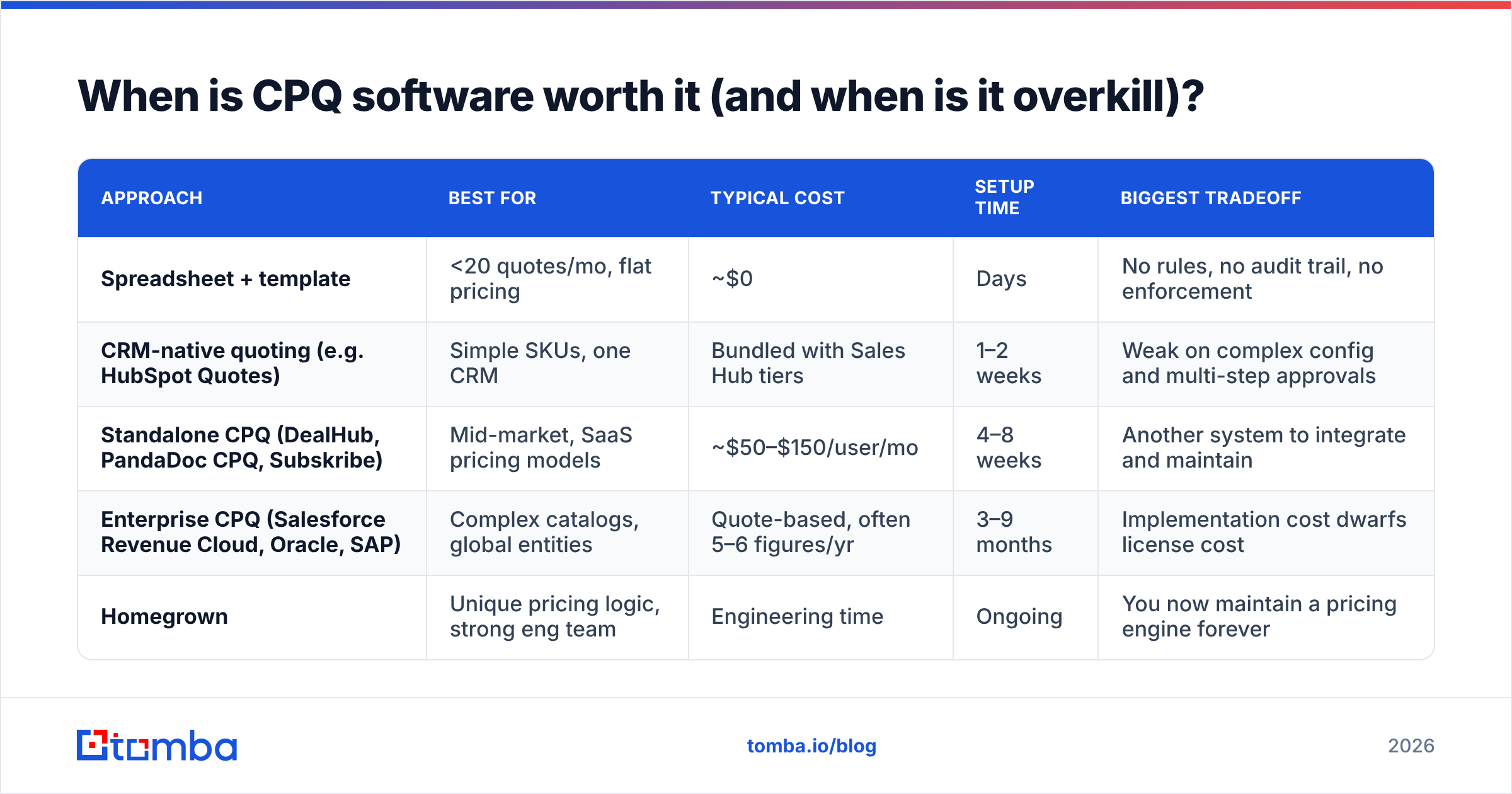
Here's the market landscape at a glance. Prices move — treat these as directional and verify on the vendor's own page.
| Approach | Best for | Typical cost | Setup time | Biggest tradeoff |
|---|---|---|---|---|
| Spreadsheet + template | <20 quotes/mo, flat pricing | ~$0 | Days | No rules, no audit trail, no enforcement |
| CRM-native quoting (e.g. HubSpot Quotes) | Simple SKUs, one CRM | Bundled with Sales Hub tiers | 1–2 weeks | Weak on complex config and multi-step approvals |
| Standalone CPQ (DealHub, PandaDoc CPQ, Subskribe) | Mid-market, SaaS pricing models | ~$50–$150/user/mo | 4–8 weeks | Another system to integrate and maintain |
| Enterprise CPQ (Salesforce Revenue Cloud, Oracle, SAP) | Complex catalogs, global entities | Quote-based, often 5–6 figures/yr | 3–9 months | Implementation cost dwarfs license cost |
| Homegrown | Unique pricing logic, strong eng team | Engineering time | Ongoing | You now maintain a pricing engine forever |
Two sanity checks before you sign anything. First, browse the CPQ category on G2 and read the 3-star reviews specifically — that's where implementation reality lives. Second, ask every vendor to configure your three ugliest historical deals during the demo. Not their demo catalog. Yours.
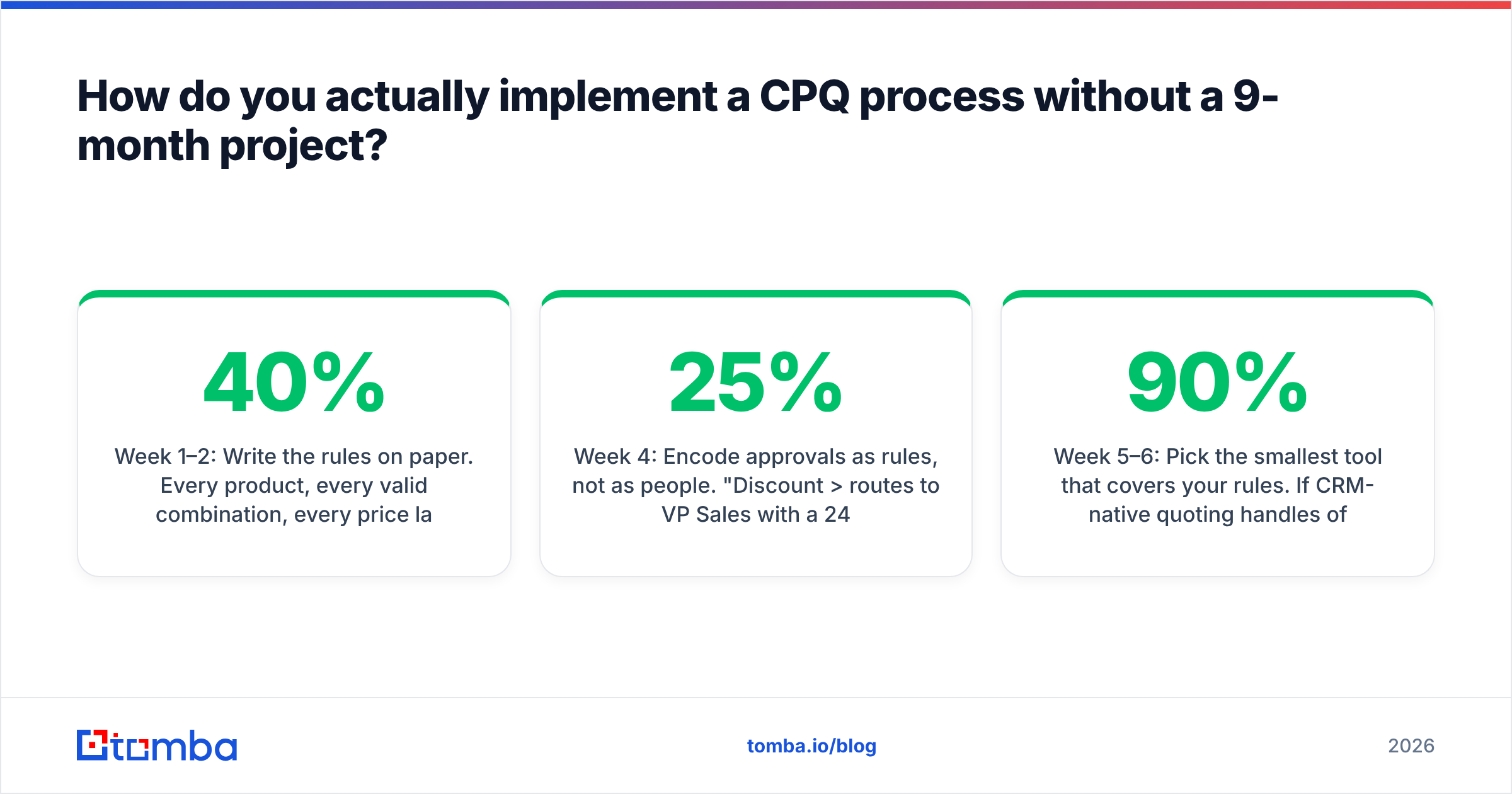
How do you actually implement a CPQ process without a 9-month project?#
The failure pattern is buying the tool first and discovering your pricing rules were never written down. Reverse the order.
Week 1–2: Write the rules on paper. Every product, every valid combination, every price layer, every discount threshold, every approver. If you cannot write it in a doc, no software can encode it. This step alone fixes 30–40% of quote delays.
Week 3: Clean the inputs. A pricing engine fed by a rotten CRM produces confident nonsense. Dedupe accounts, standardize legal entity names, and re-verify the contacts on open opportunities. Contact enrichment at this stage is cheap; a quote sent to the wrong entity is not.
Week 4: Encode approvals as rules, not as people. "Discount >25% routes to VP Sales with a 24-hour SLA, auto-escalates to CRO after that." Named thresholds, not named heroes.
Week 5–6: Pick the smallest tool that covers your rules. If CRM-native quoting handles 90% of your quotes, use it and handle the remaining 10% manually. Do not buy enterprise CPQ for an edge case.
Week 7+: Instrument it. Track quote cycle time, approval cycle time, discount distribution, and quote-to-close rate. If you can't see the distribution of discounts by rep, you can't manage margin — you're just hoping.
What metrics tell you the CPQ process is working?#
Four numbers. Track them monthly, and be suspicious of any one of them improving in isolation.
- Quote cycle time — Opp-to-proposal → quote delivered. Target: under 24 hours for standard configs, under 72 for custom. If it's a week, you have an approval problem, not a pricing problem.
- Approval cycle time — Submitted → approved. This should be measured separately, because it's usually the majority of quote cycle time and it's the easiest to fix with rules.
- Discount distribution — Not the average. The distribution. An average of 12% hides a rep who lives at 35%.
- Quote accuracy rate — Percentage of quotes that reach signature without a correction cycle. Below 85% means your config rules aren't enforcing anything.
Then one more, which sits at the seam between CPQ and the rest of your revenue operations stack: quote-to-billing variance. If what you quoted and what finance invoiced differ by more than a rounding error, your stage-7 sync is broken and you'll find out during an audit.
How does contact data quality break the CPQ process?#
This is the part most CPQ content skips, because CPQ vendors don't sell contact data.
The CPQ process assumes it knows who the quote goes to. In practice:
- The economic buyer changes mid-cycle in a meaningful share of enterprise deals
- Procurement and legal contacts are often not in the CRM at all until stage 6
- Job changes silently rot your contact records — B2B data decays at roughly 20–30% per year across the industry
- The billing contact is almost never the same person as the champion
Each of those is a stall. You built a perfect quote and mailed it to a ghost.
The fix is boring and it works: verify before you send, and enrich the buying committee before you configure. When a new stakeholder appears in a call, find their real address the same day rather than guessing firstname.lastname@. A domain search on the account gives you the company's actual email pattern and the people attached to it, so the quote reaches procurement on the first try instead of the third.
If you sync accounts through Salesforce or another CRM, do the verification step on write, not on send — enrich the record when it's created and you never have to think about it at quote time. Tomba's Salesforce integration handles that write-time enrichment path.
What's the smallest change with the biggest payoff?#
If you only do one thing this quarter: document your discount thresholds and encode them as automatic routing rules with an SLA. Approval latency is, in most teams, the single largest slice of quote cycle time, and it costs nothing but a decision to fix.
If you do two things: add a verification gate before any quote is sent. One dead email address turns a fast quote into a slow one, and no CPQ platform on the market will tell you the address is dead.
The CPQ process is not really about pricing software. It's about removing the ambiguity that makes humans stop and ask each other questions. Rules replace questions. Verified data replaces guesses. Everything else is document formatting.
Getting the quote right means getting the recipient right. Before your next proposal goes out, run the buying committee through Tomba's Email Finder to confirm you're sending to a real, current, deliverable address — procurement, legal, and the champion included. The free tier covers 25 searches a month, Starter is $49/mo, and the Growth plan at $99/mo fits most quoting teams. A quote that lands beats a quote that's perfect and lost.
Related guides#
Ready to find emails that actually work?
Join 150,000+ professionals who stopped guessing and started sending. Free credits on signup — no credit card required.
Get the Tomba newsletter
Practical outbound tactics and product updates — once every two weeks.
About the author