9 Best Cresta Alternatives for AI Sales Teams in 2026
Cresta delivers real-time agent assist that few tools match, but the enterprise contract, seat minimums, and rollout timeline don't fit every revenue team. Here are nine Cresta alternatives compared on pricing, coaching depth, and data quality.
TL;DR#
- Cresta is a contact-center AI platform, not a prospecting tool. Its core value is real-time agent assist, live coaching, and conversation intelligence for high-volume phone teams.
- The main reasons people search for Cresta alternatives: enterprise-only pricing with no public tiers, seat minimums, long implementation cycles, and a feature set that overshoots small outbound teams.
- Best swaps by use case: Gong or Chorus for revenue intelligence, Balto or Abstrakt for real-time call guidance, Observe.AI or Convin for QA automation, Dialpad Ai for an all-in-one phone stack.
- Most teams solve the wrong problem. Before you buy a $60k/year conversation AI, check whether your reps are talking to the right people at all — bad contact data caps every downstream metric.
- Cheapest honest starting point: pair a lightweight coaching tool with a solid data layer. Tomba starts at $49/mo and fixes the input side; conversation AI only fixes the output side.
What is Cresta and who is it actually for?#
Cresta is an AI platform for contact centers. It listens to live calls and chats, surfaces suggested responses to the agent in real time, flags compliance risks, auto-scores QA, and rolls performance data up to supervisors. The pitch is straightforward: instead of coaching after the call is lost, coach during it.
That works. Cresta's real-time assist is one of the few implementations that behaves like a genuine copilot rather than a transcription tool with a dashboard bolted on. You can read the product positioning directly on Cresta's site.
The friction is who it's built for. Cresta is designed for organizations running hundreds of agents on repeatable, high-volume conversations — support, collections, insurance renewals, inside sales at scale. Its buyer is a VP of Contact Center Operations with a procurement process, a security review, and a budget line that already exists.
If you're a 12-rep outbound team trying to lift connect rates, that's a mismatch. You'll pay enterprise pricing for orchestration you don't need, and you'll spend six weeks in onboarding to solve a problem that might not be your bottleneck.
Why do teams look for Cresta alternatives?#
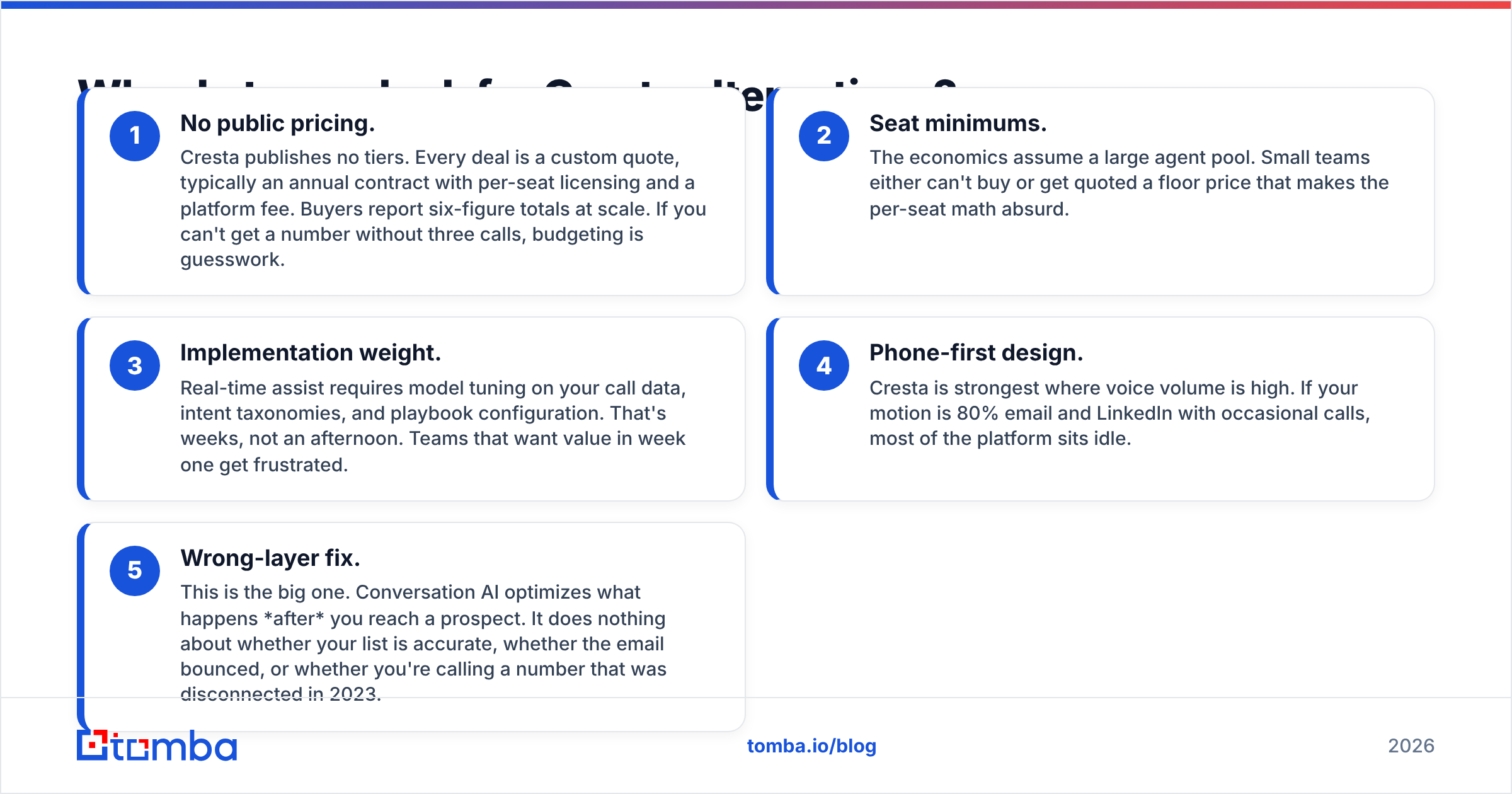
Five patterns come up repeatedly in G2 reviews and buyer conversations. You can browse the raw sentiment yourself on G2's conversation intelligence category.
- No public pricing. Cresta publishes no tiers. Every deal is a custom quote, typically an annual contract with per-seat licensing and a platform fee. Buyers report six-figure totals at scale. If you can't get a number without three calls, budgeting is guesswork.
- Seat minimums. The economics assume a large agent pool. Small teams either can't buy or get quoted a floor price that makes the per-seat math absurd.
- Implementation weight. Real-time assist requires model tuning on your call data, intent taxonomies, and playbook configuration. That's weeks, not an afternoon. Teams that want value in week one get frustrated.
- Phone-first design. Cresta is strongest where voice volume is high. If your motion is 80% email and LinkedIn with occasional calls, most of the platform sits idle.
- Wrong-layer fix. This is the big one. Conversation AI optimizes what happens after you reach a prospect. It does nothing about whether your list is accurate, whether the email bounced, or whether you're calling a number that was disconnected in 2023.
What should you compare Cresta alternatives on?#
Don't evaluate on feature checklists — every vendor has all the boxes ticked. Evaluate on these five dimensions instead:
- Real-time vs. post-call. Real-time assist (Cresta, Balto, Abstrakt) whispers to the rep mid-call. Post-call intelligence (Gong, Chorus) analyzes the recording afterward. These are different products solving different problems. Buying the wrong category is the most common expensive mistake.
- Pricing transparency. Public per-seat pricing means you can model cost before you talk to anyone. Custom-quote-only vendors cost more, on average, and take longer to buy.
- Time to first value. Ask directly: how many days from contract to a rep seeing a useful suggestion? Anything over 30 days needs a very good reason.
- Data dependency. Every one of these tools assumes the conversation already happened. None of them create pipeline. Ask what percentage of your dials connect and what percentage of your emails land before you optimize the conversation itself.
- Stack fit. Does it write clean data back to your CRM, or does it become a fifth tab your reps never open?
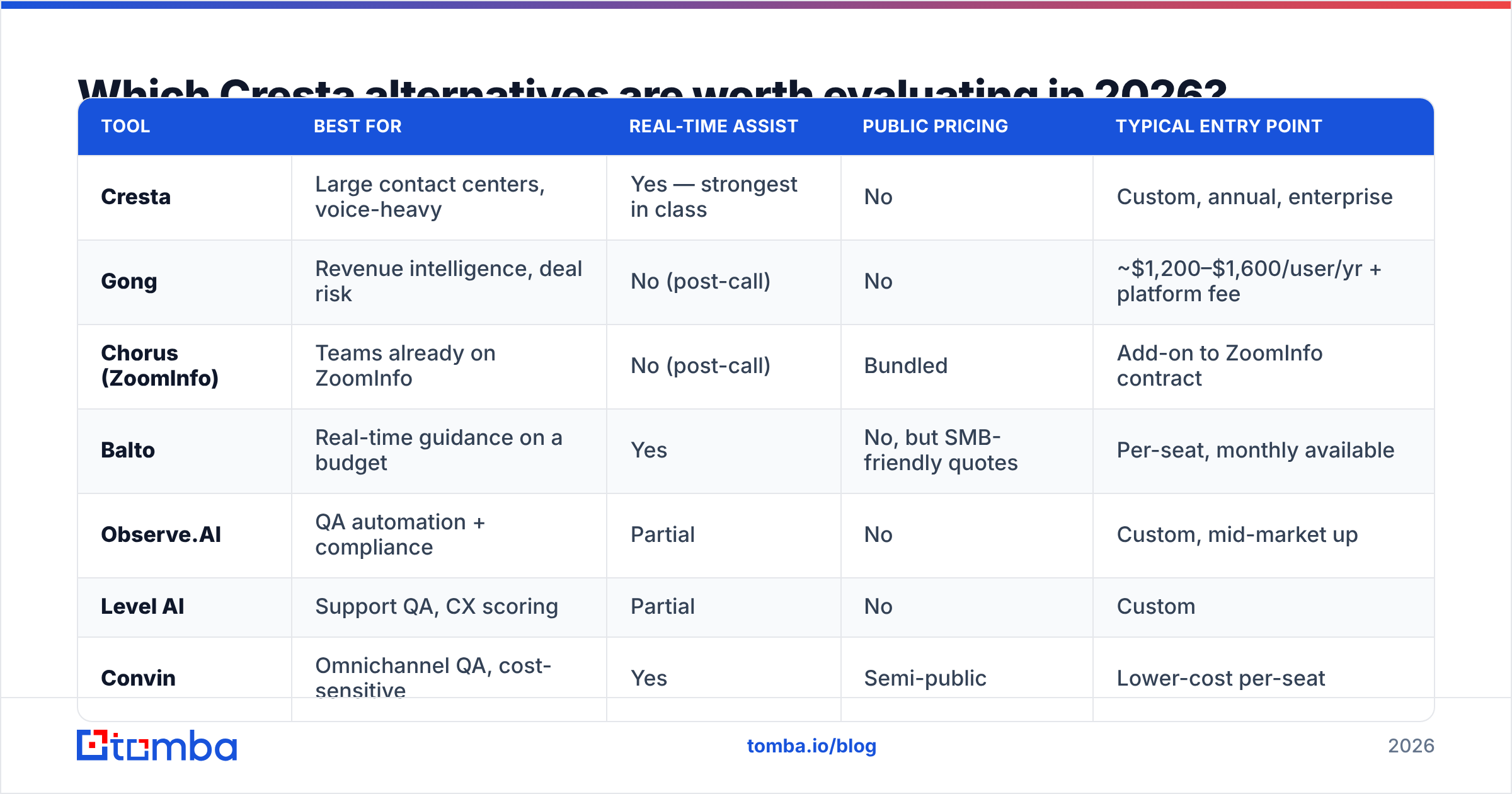
Which Cresta alternatives are worth evaluating in 2026?#
| Tool | Best for | Real-time assist | Public pricing | Typical entry point |
|---|---|---|---|---|
| Cresta | Large contact centers, voice-heavy | Yes — strongest in class | No | Custom, annual, enterprise |
| Gong | Revenue intelligence, deal risk | No (post-call) | No | ~$1,200–$1,600/user/yr + platform fee |
| Chorus (ZoomInfo) | Teams already on ZoomInfo | No (post-call) | Bundled | Add-on to ZoomInfo contract |
| Balto | Real-time guidance on a budget | Yes | No, but SMB-friendly quotes | Per-seat, monthly available |
| Observe.AI | QA automation + compliance | Partial | No | Custom, mid-market up |
| Level AI | Support QA, CX scoring | Partial | No | Custom |
| Convin | Omnichannel QA, cost-sensitive | Yes | Semi-public | Lower-cost per-seat |
| Dialpad Ai | Phone system + AI in one | Yes | Yes — from ~$27/user/mo | Self-serve |
| Abstrakt | SMB real-time call scripting | Yes | Semi-public | Per-seat, low commitment |
| Tomba | Fixing the data layer feeding all of the above | N/A | Yes — Free / $49 / $99 / $249 | Self-serve, free tier |
A note on the last row: Tomba is not a conversation intelligence tool and doesn't pretend to be. It's in the table because it's the layer most Cresta evaluations skip. More on that below.
Gong — the default post-call answer#
Gong is what most revenue teams actually mean when they say "we need conversation AI." It records, transcribes, and analyzes calls, then attaches insight to deals: which topics correlate with wins, which deals went quiet, which rep skipped discovery. Gong's own product pages are clear about the deal-intelligence framing.
Choose Gong over Cresta if your motion is complex B2B sales with long cycles and you care about pipeline forecasting more than agent throughput. Don't if you need in-the-moment help — Gong won't save a call that's going sideways right now.
Pricing is not public and typically lands around $1,200–$1,600 per user per year plus a platform fee, with annual commitment. That's real money for a 20-rep team.
Balto — real-time assist without the enterprise weight#
Balto is the closest functional substitute for Cresta's core loop: it listens live and shows the rep the right thing to say. It's lighter to deploy, friendlier to mid-market budgets, and less opinionated about your call taxonomy.
You give up some model sophistication. Cresta's suggestions are trained more deeply on your specific outcomes; Balto leans on configured playbooks. For most teams under 100 agents, that trade is worth it.
Observe.AI and Level AI — QA automation first#
Both attack the same problem: your QA team manually scores 2% of calls and calls it quality management. These platforms score 100% of calls automatically against your rubric, surface coaching moments, and flag compliance breaches.
If your pain is "we can't see what's happening on our calls," start here rather than with real-time assist. It's a cheaper, faster win, and it tells you whether real-time guidance would even help.
Dialpad Ai — the all-in-one shortcut#
Dialpad bundles the phone system, transcription, live coaching, and AI summaries into one product with published per-user pricing. It's the only option in this list you can buy with a credit card in ten minutes.
The AI is not as deep as Cresta's. But if you're also shopping for a phone system, buying one product instead of two is a legitimate strategy — and the total cost is a fraction of an enterprise conversation-AI contract.
Convin and Abstrakt — the value plays#
Both target teams priced out of the enterprise tier. Convin does omnichannel QA with real-time nudges; Abstrakt does real-time call scripting for SMB sales and support teams. Neither will win a feature bake-off against Cresta. Both will be live in days and cost a fraction as much.
Is conversation AI even the right purchase?#
Here's the uncomfortable question no vendor in this category will ask you: what's your connect rate?
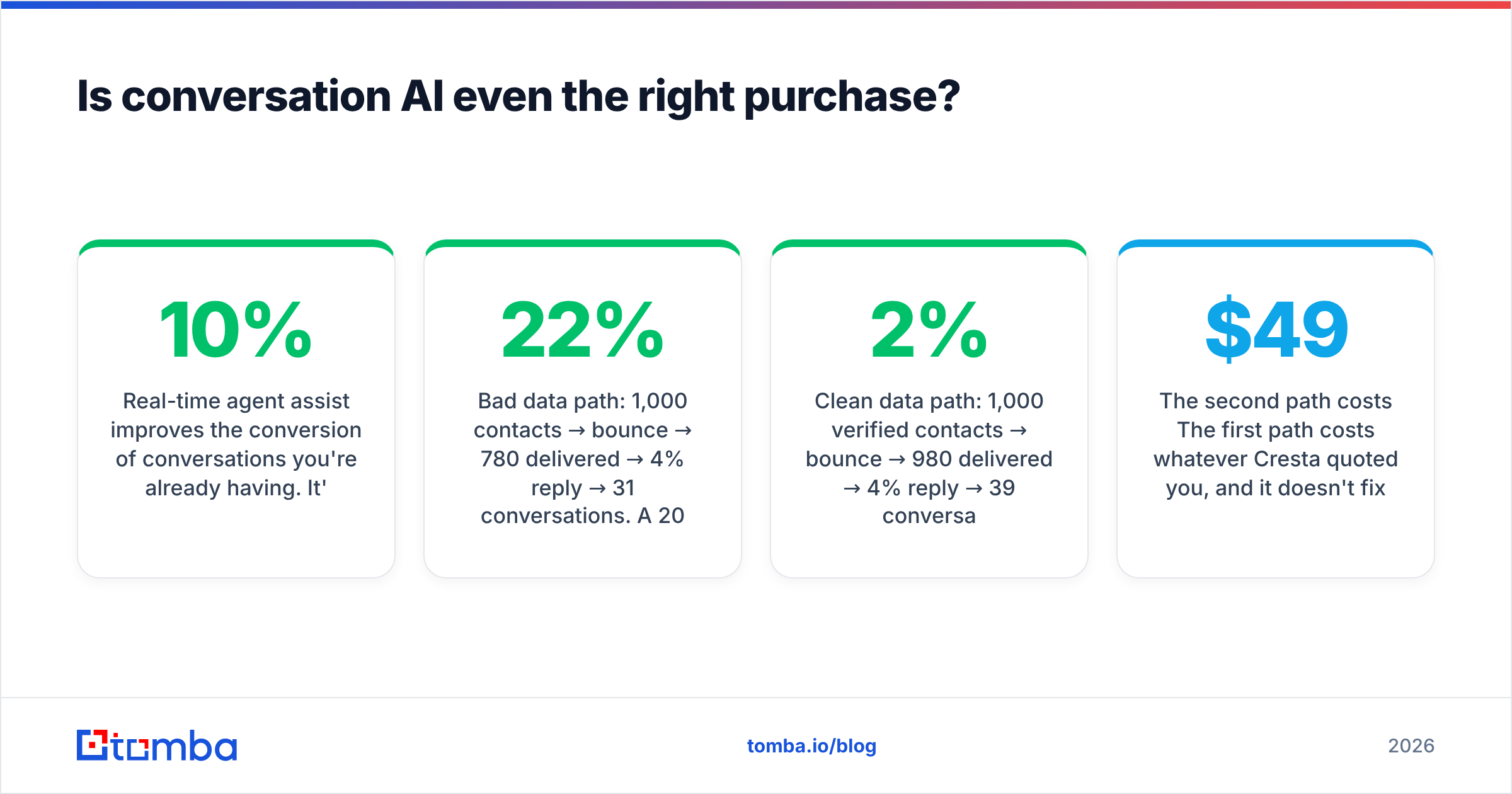
Real-time agent assist improves the conversion of conversations you're already having. It's a multiplier on a number. If that number is small because your list is stale, your emails bounce, or half your phone records are dead, a multiplier doesn't help much. You're optimizing the last 10% of a funnel that's leaking at the top.
Run the arithmetic on your own numbers:
- Bad data path: 1,000 contacts → 22% bounce → 780 delivered → 4% reply → 31 conversations. A 20% coaching lift on those conversations gets you ~6 extra outcomes.
- Clean data path: 1,000 verified contacts → 2% bounce → 980 delivered → 4% reply → 39 conversations. Same coaching lift, more raw material, and your sender reputation survives the quarter.
The second path costs $49/month. The first path costs whatever Cresta quoted you, and it doesn't fix the leak.
What does the data layer actually look like?#
If you decide the input side is your real bottleneck — and for most teams under 50 reps, it is — here's the shape of that stack:
- Find the contacts. Use an email finder to resolve names and domains into verified work emails instead of guessing patterns. Pattern-guessing produces the bounces that wreck deliverability.
- Verify before you send. An email verifier catches dead mailboxes, role accounts, and traps before your sequencer does. This is the single highest-ROI step in outbound and it costs cents per record.
- Get the phone numbers right. If you're evaluating call-coaching software, you're making calls. A phone finder and validator keep your dialer from burning half its cycles on disconnected lines — which is what actually depresses agent productivity metrics.
- Enrich what you already have. Data enrichment fills in job titles, company size, and tech stack on records you already own, so segmentation and routing stop being guesswork.
- Automate it. The Tomba API drops all of the above into your existing CRM or sequencer workflow, so nobody is exporting CSVs at 11pm.
None of this competes with Cresta. It runs underneath Cresta — or underneath whichever alternative you pick.
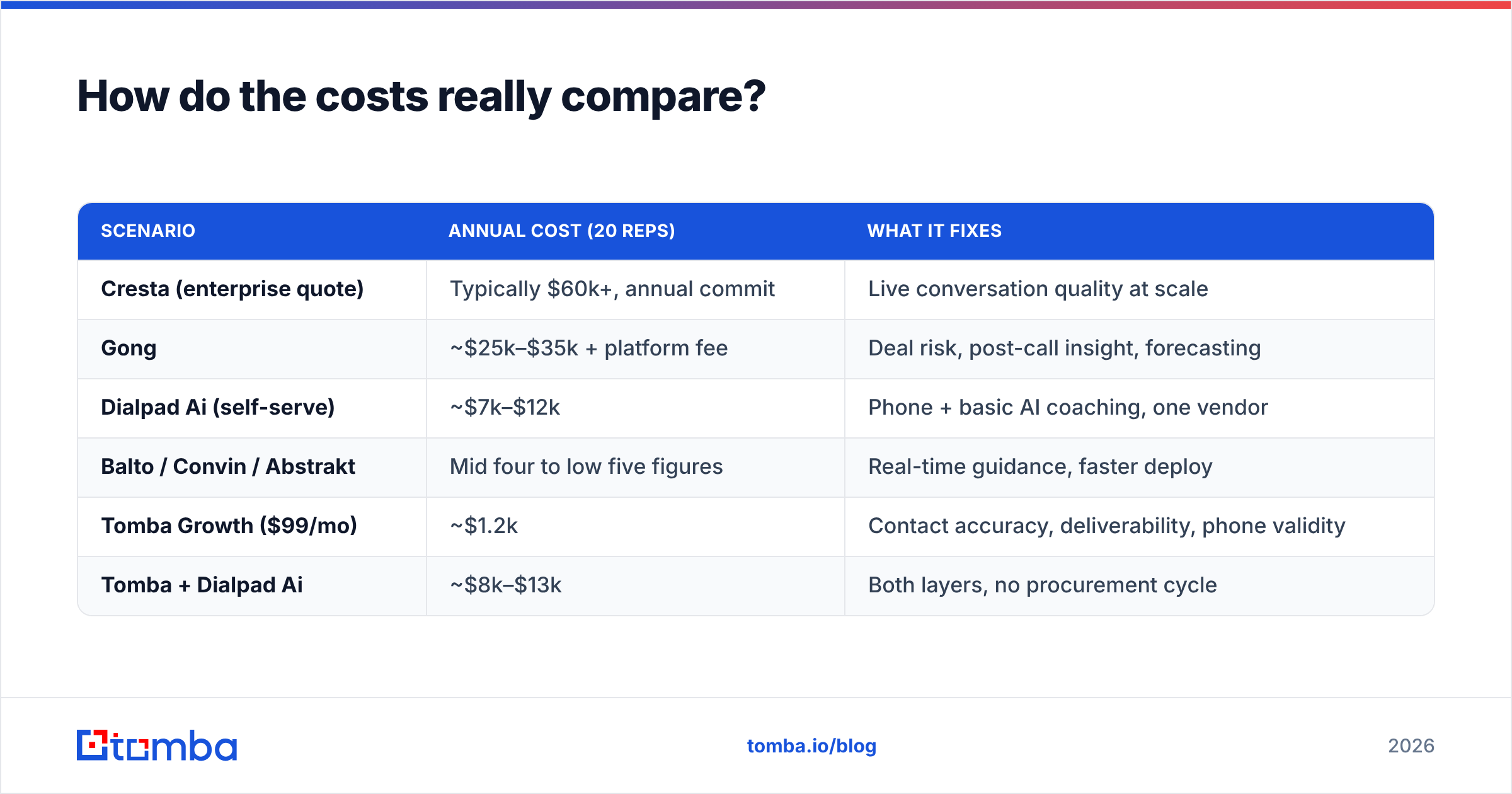
How do the costs really compare?#
| Scenario | Annual cost (20 reps) | What it fixes |
|---|---|---|
| Cresta (enterprise quote) | Typically $60k+, annual commit | Live conversation quality at scale |
| Gong | ~$25k–$35k + platform fee | Deal risk, post-call insight, forecasting |
| Dialpad Ai (self-serve) | ~$7k–$12k | Phone + basic AI coaching, one vendor |
| Balto / Convin / Abstrakt | Mid four to low five figures | Real-time guidance, faster deploy |
| Tomba Growth ($99/mo) | ~$1.2k | Contact accuracy, deliverability, phone validity |
| Tomba + Dialpad Ai | ~$8k–$13k | Both layers, no procurement cycle |
Those Cresta, Gong, and Balto figures are directional — none of the three publish rate cards, and quotes vary hard by volume and term. Treat them as a starting hypothesis to test in your own negotiation, not a price list. Tomba's numbers are exact because Tomba pricing is public: Free (25 searches/mo), Starter $49/mo, Growth $99/mo, Pro $249/mo, Enterprise custom.
The pattern that matters: the bottom row buys you both layers for less than the top row buys you one.
Which Cresta alternative should you pick?#
- You run 200+ agents on repeatable voice workflows and have budget. Stay with Cresta or shortlist Observe.AI. The platform depth is real and you'll use it.
- You run complex B2B sales and want deal intelligence. Gong. Not a Cresta competitor so much as a different product for a different question.
- You want real-time help without a procurement cycle. Balto, Abstrakt, or Convin. Faster, cheaper, 80% of the outcome.
- You need a phone system anyway. Dialpad Ai. One vendor, published pricing, credit card checkout.
- Your connect rates and bounce rates are ugly. Fix that first. No amount of conversation AI rescues a conversation that never starts.
Start where the leverage actually is#
Every tool on this list assumes the hard part is already done — that your rep is on a live call with a qualified person whose contact details were correct. That assumption is doing enormous work, and for most teams it's false.
Before you sign an annual conversation-AI contract, spend a month making your data layer honest. Run your existing list through verification, resolve the missing emails, validate the phone numbers, and re-measure your connect and reply rates. If those numbers jump, you just bought yourself a bigger denominator for every coaching dollar you spend afterward.
Start with the Tomba Email Finder. The free tier gives you 25 searches a month to test accuracy against your own list — no sales call, no quote, no six-week onboarding. If the results hold up, Starter is $49/mo and the API drops into whatever stack you land on. Fix the input, then go shopping for the copilot.
Related guides#
Ready to find emails that actually work?
Join 150,000+ professionals who stopped guessing and started sending. Free credits on signup — no credit card required.
Get the Tomba newsletter
Practical outbound tactics and product updates — once every two weeks.
About the author